
| Category | Value (images) |
|---|---|
| Bud | 5 |
| Newly open | 9 |
| Mature | 12 |
Illustrative values, not sourced observations. Invented example for the stated comparison; not a biological threshold, ecological estimate or observed dataset.
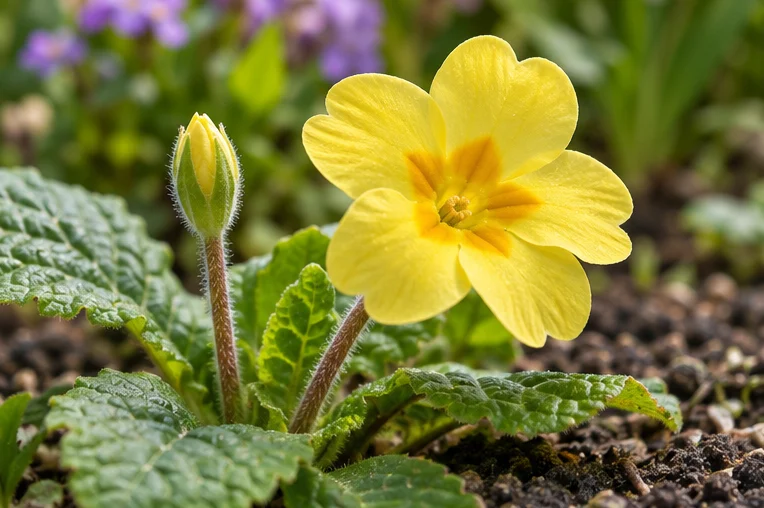
A primrose at the edge of a path can offer a compact lesson in how a flower gets its shape. A bud, a blossom that has just opened and a fully displayed flower may all be visible within one small patch. They make an appealing sequence in photographs. But when somebody asks which of two mature floral forms has the wider opening, a photograph of a bud is not a small, convenient version of the answer. It shows a different developmental condition. The comparison won't become a mature one by putting more images into the folder, or by enlarging an early view to the size of a later view.
The problem is especially vivid in the common primrose, Primula vulgaris. The two familiar forms are called pin and thrum. In a typical open pin flower, the stigma at the end of a long style is near the mouth of the corolla tube, while the anthers sit lower down. In a typical open thrum flower, the anthers are near that mouth and the stigma is lower. These are different flower forms borne on different plants, not successive steps through which one flower normally passes. A young flower from a pin plant is not a thrum waiting to become a pin. Its stage and its eventual form are distinct facts.
Looking at a primrose from above, a person may first notice pale petals and a brighter center. The arrangement inside the opening takes a different sort of attention. Anthers are structures bearing pollen, and the stigma is the receptive surface at the end of the style. The corolla tube is the tubular part formed by the petals below their expanded display. These are not three views of the same feature. A picture can record the outline of the petals clearly and still tell the reader very little about the lower positions of the reproductive structures. This is why useful images depend on a question: an image may be usable for one trait and unsuitable for another.
The developmental question is not simply “When is it open?” It can instead be “When does this particular difference become visible?” For one feature an early difference may be detectable before a photograph taken from above would show it. Another feature may be best compared once the flower is fully displayed. Even when both features ultimately distinguish the mature forms, there is no reason to presume that all their differences become measurable at the same instant. The observation made at one stage should keep its stage label when it is used as evidence about development.
What the original work distinguishes
In their study of late flower development in common primrose, Margaret A. Webster and Philip M. Gilmartin examined pin and thrum flowers across development. They described distinct temporal patterns for differentiation in different floral features. Their analyses distinguished how differences in style length arose from the changes implicated in anther elevation, and they reported a wider mouth of the corolla tube in the thrum flowers in their matched comparison. The paper is useful not because it supplies a universal field photograph key, but because it explicitly compares features and stages rather than treating all forms as fully differentiated at the first observation.
It is important to keep the strength of that result with its design. The study used specified plant material and examined internal structures and cell morphology; it was not an exercise in assigning unlabeled phone photos by center color. A wider opening observed in the matched material is not an automatic identification rule from any single view of any garden primrose. An emerging flower seen at an oblique angle can look narrow even if its mature counterpart would have a broad mouth. Likewise an unobstructed opening can still lack the resolution needed to identify what appears at its center. The paper should make us more exacting about geometry and stage, not more confident in a shortcut.
A separate primary paper, Robert Ornduff's study of pollen flow in a British population, addresses a different level of evidence. Its published abstract describes observations on pollen removal and the composition of pollen loads on stigmas. Two collection approaches gave somewhat different results. The abstract reports that movement between forms was less than expected under a random-flow comparison in the population studied. It does not follow that one can predict that result from the shape of a flower in a photograph. The pollen-flow paper helps explain why not to make that leap. Organ arrangement suggests questions about possible contact; detecting the pollen that actually arrived takes separate evidence.
Someone could accurately label an image “partly open common primrose with visible central structures” without documenting a visit, pollen delivery, fertilization, or the reproductive state of the individual flower. These claims are not a staircase every gorgeous picture automatically climbs. If later work contributes one of those records, tie it to the relevant flower or population and give it its own evidence label. The developmental paper and the pollen-flow paper are complementary precisely because their questions and observations are different. They are not two opportunities to make a picture support more than it contains.
Toy usable images by stage
Illustrative values, not sourced observations. These counts are invented for an image-review example. They are not rates of development, biological thresholds, measures of morph frequency, or outcomes reported by either paper.
| Stage | Usable images |
|---|---|
| Bud | 5 |
| Newly open | 9 |
| Mature | 12 |
There are 26 usable images in this toy folder. Twelve are in the mature category and 14 are not. If every row in the folder were fed into a mature-morphology analysis, more than half of the resulting observations would be drawn from outside the stated stage. The addition would make the file longer but the question less clear. The correct mature count of candidate images is still twelve, before accounting for repeated photographs of the same flowers. A study of the opening sequence could use all three groups in a different way.
The table does not say how many images were attempted. That matters if somebody asks whether buds were harder to photograph. Suppose five usable bud images were selected from six attempts, while twelve usable mature images came from forty attempts. The mature count would be higher even though the fraction usable would be lower. Neither denominator is given in the chart. Similarly, the nine newly open images could depict nine plants or many frames from one subject. The chart keeps its small honest job: showing the count that passed a defined image check in three stage groups.
The word “usable” also needs a companion phrase. A frame might pass a check for whether petals have separated and fail a check for measuring the width of the tube mouth. A crisp side view could show the profile but leave the mouth foreshortened. If the table was built for stage illustration, don't treat it as an inventory of quantitative images. If it was built for a specific measurement, say what scale and view that measurement required. The number of good files cannot define the task on its own.
Distinguish an observed opening from a time since opening
A field observer might operationally name three visual states. In a bud the floral display has not spread open. Newly open could mean the opening has appeared but the lobes are still visibly unfolding relative to the local series. Mature might mean the blossom is fully expanded for the comparison in hand, without obvious damage or senescent distortion. These are practical recording categories, not mandatory botanical stages. They should be spelled out with example images and an ambiguous category if there are gray cases.
Time since first opening is a different variable. A blossom first found open on Tuesday morning may have opened any time since the prior look. If the last view was Sunday afternoon, it is wrong to stamp it as one hour old because it looks fresh. The best time record is usually an interval between the last known closed state and the first known open state. A narrower interval supports a narrower statement. An image taken once can establish that a blossom was open when seen without answering when it began.
A calendar date alone is weaker. Two flowers taken on the same afternoon can be at different stages; two flowers first open on different dates can still provide a useful matched stage comparison. If the aim is to understand when flowering starts across a patch, calendar and stage records may both matter. If the aim is to compare the mouth of the corolla tube after expansion, matching by calendar date alone is likely to obscure the comparison. The observer should record both where possible, rather than choosing one on the secretary's assumption that dates and stages are interchangeable.
Likewise, plant age is not the same as flower age. The metaphor “a young primrose” is useful in the headline but needs translation in a record. A mature plant can bear both an opening bud and a fully expanded flower on the same date. An image label such as “young plant” cannot be substituted for “first flower not fully expanded.” Give the plant and individual flower different identifiers and let each carry its own history. Otherwise a difference among flowers can be incorrectly treated as a difference among whole plants.
Sometimes the most honest stage is “uncertain between newly open and fully expanded.” It may not be clear whether lobes have spread further in the hours since a previous photograph or whether they are in a form that naturally holds them at that angle. Gray cases need not be thrown away. Keep them out of the comparison governed by a strict mature criterion and make them available for a separate look at classification uncertainty. The cost of a visibly incomplete answer is usually smaller than the cost of falsely confident labels concealed inside a pooled average.
What the camera did, and what the flower did
A rim seen from directly in front presents a different apparent width than the same rim at a steep angle. A photograph can therefore suggest narrowing even when the opening did not change. Imagine the camera pointed down vertically in a first image of a flower facing upward, then moved to the side in a repeat. Put the two prints together and the second outline may look much narrower. The discrepancy is a record of the relative camera and subject orientation. It cannot show the opening closed unless the shape remains narrower in comparable views or other evidence rules out the projection change.
Scale has a similar limitation. A ruler visible beside the leaves does not necessarily scale the little opening several centimeters closer to the lens. A ruler tilted away from the camera will not represent the same image scale as a comparable reference near the mouth and in the same plane. Where a consistent reference cannot be obtained without disturbing the flower, a qualitative description is more defensible. “The opening was visible and central detail was resolved” may be genuinely useful. A converted width in millimeters calculated using an unrelated ruler is not an improvement simply because it has decimals.
The visible petal spread is also not the mouth of the corolla tube. In a view from above the petal lobes furnish the larger outline; the opening lies at the center. The two outlines can change by different amounts across stages. An editor who writes “the flower was wider” should identify which outline the observers measured. If a photographer records the petals before and after expansion, that evidence can stand on its own as a change in visible display. It does not supply a missing measurement of the opening.
A dark patch in the center need not be an empty cavity. Shadow, reflection, blur or an out-of-focus surface may hide details. The observation “no anthers visible at the mouth” is not equivalent to “anthers absent.” To support the latter anatomical conclusion would require a view and a method that can establish where the structures actually are. The useful everyday distinction is between not in the frame, in the frame but obscured, and clear enough to inspect. Using one blank for all three loses evidence that might be important later.
Lighting can affect stage classification as well. A soft side light may reveal the edge of a folded lobe, while overhead glare erases it. In this case an apparent change in the number of visible folds could come from the image rather than the flower. Keep the original view alongside any crop, and mark substantial edits. Color correction and sharpening can make a record more legible, but neither can restore detail the lens never captured. A comparison that can be interpreted only after aggressive adjustments has weaker visual evidence than one where the relevant feature survives quite ordinary display.
With time series, the safest visual question is often smaller than the original ambition. It can be possible to establish that the display expanded between two dates without measuring precisely by how much, or to show that the opening became visible without seeing the lowest structures. This isn't an inferior substitute if the question is about expansion or visibility. It is the exact result the sequence makes available. An especially good photo caption says where the evidence ends: “Here the edge of the mouth is visible; the lower tube is not shown.”
Stage can manufacture a difference
Imagine a toy comparison in which each form has a mouth width of two arbitrary units while opening and four when fully expanded. The two forms are the same at each stage. Now give the first group three opening views and one mature view; give the second one opening view and three mature views. The pooled averages are two and a half and three and a half, respectively. The gap in the average was manufactured by the stage mix. Enlarging the folder by collecting the same unequal mix would make a more orderly-looking version of the same problem.
The converse is possible. Suppose a difference is present at the mature stage but not visible in early images. If most of the usable images in both forms were early, the pooled result could make the mature difference look small. The error is not always an exaggeration, or always in favor of one form. Pooling changes the question from a mature comparison to an average over the photographed stages. The result has a description, but not the one in the section heading. A reader cannot reconstruct a mature difference from the pooled mean unless the stage information was saved.
Look first at overlap in the actual record. If the collection has excellent mature pin images but no suitably viewed mature thrum images, no calculation fills that missing cell. A separate stage plot for pins might still be valuable. A descriptive note on the known thrum views might still belong in an appendix. The headline comparing mature forms should wait for a matched view set or explicitly state that the record is insufficient. This is better than making early thrum images carry a role they cannot perform.
Even balanced stage counts can be misleading if the images come from an unbalanced set of plants. Equal counts of flowers across forms could include twelve flowers from one plant on one side and one from each of twelve plants on the other. Answers about those flower images are still possible, but answers about differences across plants must account for the grouping. Closely repeated photos of one flower are another level down. They can make the sequence clearer, not add independent individuals to it. State the number of flowers and plants separately where the counting unit matters.
A stage-by-form table that preserves blanks is a useful protection. Set out which features are observable, how many distinct flowers support any summary, and whether the identity of each plant was recorded without using the outcome under test. A bud not independently linked to a later observed plant cannot become a verified pin simply because its outline looks pin-like. Leaving the form uncertain preserves the distinction between a hypothesis and an entry in the comparison. The uncertainty may itself reveal where a better observational record would be useful.
Same frame, different questions
A mature comparison asks what characterizes two forms in a specified display state. A developmental comparison asks how a trait changes as a flower develops or how that sequence differs across forms. They may use overlapping records, but their structure differs. The first benefits from comparable, well-resolved endpoints. The second requires useful information between endpoints. Someone who finds that two groups differ at maturity has not yet shown when divergence occurred. Someone who sees no difference in a first bud image has not shown that no difference was present in a feature hidden from view.
A sequence of dated views of the same flower answers a different question than a series assembled from different individuals. The first can show change within that observed flower. The second can represent the spread of forms in a group at several stages. Both can be informative, and the primary developmental paper used observations far richer than a glance into a garden. But a slideshow of different flowers should not be narrated as if one individual blossomed continuously through all the frames. If the assembled sequence is designed as an illustration, label it as such and identify it separately from any tracked flower.
Consider a field notebook with one beautiful view for each state, all photographed on the same date. That notebook can establish that the states co-occurred in the photographed patch. It may make an excellent introduction to flower development. It cannot tell us whether one plant typically took longer to open or whether one form always led another over the season. Those are timing questions that require records of when transitions happened and whose transitions they were. Adding an arrow through the images improves readability but does not add time observations.
There is also a tradeoff between preserving a trait across views and using it to assign the stage. Imagine that the comparison concerns petal spread. If the mature category is defined by having the broadest display in the patch, the definition has already selected for the trait under comparison. A more defensible stage rule might rely on the visible completion of unfolding in a tracked sequence and other independent cues, with ambiguity saved. The resulting rule should be evaluated for whether different forms can actually qualify under the same logic, rather than rewarding whichever most closely resembles the example photograph.
At the level of a single plant, the best early-to-late connection may come from an unobtrusive record of position and dates, not from identifying the morph from the earliest view. For a noninvasive observation you can use a sketch with landmarks and your own image identifiers. If neighboring buds are too close to distinguish after they open, acknowledge the loss of continuity. Nothing requires a visitor to manipulate a wild plant to make a tidy file. At a site where observations must be casual, a set of carefully described stills may be the appropriate record.
A good repeated view also preserves unsuccessful observations. A date when a flower was visible but the center could not be checked should remain a date in the notebook. Otherwise the remaining usable pictures suggest that observations ran perfectly and no ambiguous stage existed. If fogged lenses, poor light, or inaccessible viewpoints disproportionately affect one stage, the curated series may not represent the flowering progression by frequency. That is not a reason to stop curating; it is a reason to state what the display represents.
How a floral geometry observation relates to pollination
Pin and thrum present structures in different positions. From the developmental observations it is reasonable to ask whether an arriving insect could contact the structures at different heights within the opening. Answers require more than the stylized straight entrance often drawn in botanical diagrams. A visitor can approach from above, lean sideways, land on a lobe without entering, depart quickly, or be only partly visible. A photograph of the tube mouth does not record which movement occurred. A photograph of a visitor at the mouth may not reveal what it touched lower down.
Observed contact still leaves an important question open. If a visitor touches an anther or a stigma, the observer has evidence of contact, not necessarily evidence of what pollen moved, in which direction it moved, or whether its arrival contributed to seed production. That distinction is why Ornduff's population measurements are not interchangeable with drawings of floral organs. His abstract describes both pollen removal and pollen on stigmas, quantities that need not track each other exactly. Those observed relationships in one population should not be treated as an automatic property of all open primroses.
A mature flower is also not a guarantee of a recorded visit. Absence of a visit in a short watch describes those particular minutes of observation, not the flower's whole history. If a flower is shown in a representative mature view while no visitor is in the picture, there is no reason to caption it “unvisited.” If the record includes a timed watch, give the timing and distinguish visible approaches, landings, and identifiable contact. This keeps the relevant evidence even when it is too limited to support a broad account of behavior.
There are circumstances in which the two papers can sensibly appear next to each other in an article. The developmental study motivates separating stage from floral form. The pollen-flow study shows that interpretations about transfer can be confronted with independent measurements. Between them is a bridge made of questions, not an unbroken chain of proof. One could ask when certain structures are exposed, which visitors encounter the openings at those times, and whether pollen types deposited during visits meet predictions. Unanswered questions are not placeholders to fill with somebody's impression of a dramatic close-up.
In a field display designed for the public, show this gap. A clear image of a mature pin and one of a mature thrum might help a viewer recognize which parts a diagram names. Another card could describe how a population study separates pollen observed on stigmas from anatomical possibilities. The caption should not portray a perfectly arranged interior as a completed visit or a guaranteed transfer. Even photographs from one tracked population would need a link showing which flower, incident, or later sample belonged to which record before a specific causal account could be justified.
A practical check for an image collection
Start by writing the smallest claim that would actually be useful. If the collection is meant to teach recognition of fully displayed common primrose blossoms, say that. If it is meant to measure an opening width difference between morphs, describe the scale, the view, and what will count as usable before selecting winners. If it is meant to show the journey from closed to open, write whether the sequence depicts one tracked flower or a montage from several. A folder full of well-curated images can support more than one claim, but only when the links and exclusions needed for each are preserved.
Next choose a stable name for each subject. A simple hierarchy can keep the place, plant, flower, and image in distinct fields. That prevents a file called “primrose three final” from carrying the identity burden of an entire series. If the exact identity of an individual changes during review, note the evidence for the correction. Do not silently rename a folder to fit a favored comparison. When photographs came from separate places, a location code rather than an exact public coordinate is often sufficient for the analysis while avoiding unnecessary disclosure of the site.
Record state separately from quality. A stage can be confidently known from a direct observation even though a particular image is blurred. Conversely, a sharp image can show an intermediate flower whose classification is uncertain. Keep those states independent: confirmed stage with poor image, clear image with ambiguous stage, clear image with confirmed stage, and so on. If later reviewers disagree, preserve the original state and document how the difference was handled. Do not let the prettier view determine which record becomes the truth by default.
For each claimed structure, a one-line visibility note does useful work. “Petal display fully in view; tube mouth partly shadowed; no side view” states more than a generic image-quality score. It tells someone why the image might support a comparison of display diameter but not position of the stigma. It also lets reviewers ask whether one form lost more images for a specific reason. A single combined quality number hides that pattern and can encourage a false assumption that exclusions were equally likely across forms.
A quick consistency check can be done before any mean is calculated. Count unique plants and flowers; look at the stage distribution within each proposed comparison group; check that all images came from the intended view. If the decision depends on three borderline frames, repeat the descriptive summary with and without them and say whether its direction changes. This does not fix a weak observation series. It does reveal whether the headline depends on an uncertain distinction. A complete absence of any comparable frame in one group is still a reason to bound or defer a morph comparison, not a reason to substitute another stage.
A small record may not support quantitative comparisons at all. It can still teach a precise lesson. A diptych from one flower that shows unfolding between dated visits is powerful evidence about change in that flower. A pair from separate plants at comparable display stages can help orient viewers to structures if those structures are visible. A careful description of what was obscured can motivate a series of observations in which future images are obtained from a permitted, unobtrusive vantage. Reports become more useful when they ask each piece of evidence to do a job it can do.
What a better caption gives the next observer
Consider the caption “young version of a mature pin flower.” It might be fine if the earlier frame is linked to the same plant and the mature identity is documented later. Without that link it is ambiguous. Does the first photograph depict a flower whose morph was known, a look-alike selected later, or simply an example of an early state? Replace uncertainty hidden in grammar with a description. “Closed bud from plant P3, recorded before the tracked blossom opened; mature morph identified on a later date” tells the reader why the images belong together. If continuity was uncertain, the wording should say so.
At the other end of a sequence, “mature thrum showing a wide flower” is not specific enough for a quantitative article. A better description might identify full expansion under the series criterion and say whether the view shows the opening or the full outline. If the scale is absent, do not imply that an absolute width was extracted. If a width appears in the article, give the relevant units and the basis for the conversion. A disciplined caption prevents an illustration from accumulating false authority as it gets reused.
Alt text has a slightly different purpose. It should convey the features needed for accessibility without adding a diagnosis that the picture cannot support. An editorial image may show a closed bud and an open blossom in diffuse light; those are useful things to describe. If the picture was composed to illustrate an idea rather than made from a tracked observation, say so in the adjacent caption. Details such as the actual species, stage-by-form identity and scale belong in the evidentiary note only when they are independently established.
A printed page can help readers compare like with like by putting mature counterparts alongside one another and moving developmental transitions into a separate row. Align comparable images using a shared reference where it is justified, not an artistic rescale that makes apparent differences disappear. If photo sizes were intentionally harmonized for readability, say they are not a size comparison. A layout can otherwise erase the very evidence the text tells people to notice or manufacture a discrepancy that belonged only to cropping.
Finally distinguish “match not attempted” from “match failed.” If one form was never observed at maturity the article has a missing comparison. If mature photographs were made but no comparable view survived review, the effort and the availability problem are both worth recording. If matched frames exist and the trait does not appear different at the method's resolution, that is instead an observation with a known limit. These are separate outcomes. Saying only “no difference was found” puts them in the same bucket and invites a reader to overstate what happened.
When the choice of a reference image changes the conclusion
Imagine a volunteer review in which every record is judged against the first mature flower photographed that spring. It has an unusually flat display and is brightly lit. Pictures of fully expanded flowers with lobes angled upward repeatedly come back marked “still opening.” The reference makes judging faster, but it has smuggled a particular shape and view into the maturity criterion. Use several anchored examples where the stage is independently supported, and include ambiguous examples that demonstrate where judgment should stop. A reference should show observers how to apply a definition, not invite matching one specimen's silhouette.
A second reviewer can check a set independently before the earlier labels are revealed. If disagreements cluster around lighting, that suggests the review should better separate image visibility from stage. If they cluster around the boundary between halfway spread and fully expanded, it may mean the stage label is too fine for the photographs. The answer is not necessarily an elaborate score. It could be a smaller claim that all reviewers can connect to visible evidence, coupled with a clear record of which views could not be judged.
The same reference problem appears when comparing published diagrams with field images. A diagram often makes hidden parts visible with a view that a casual photograph does not provide. This is useful for naming structures and checking relative locations in the represented specimen. It is not a promise that the same parts will be distinguishable in any photograph from above, and it should not be used as a tracing template over poorly resolved images. The comparison between diagram and photograph should start by identifying what each represents and what each leaves out.
Do not make a young blossom answer for a mature one
Developmental stages are not obstacles to data cleaning. They are part of what there is to learn about the plant. The bud is the right subject for a question about its visible form; newly opening flowers can show how exposure begins; a well-observed mature flower is appropriate for a stated mature trait comparison. Seeing transitions in more detail can make the mature contrast more understandable. Pooling the transitions into that contrast without regard to stage does the opposite.
In the toy collection a dozen mature images are candidates for a mature comparison, not twenty-six. Even those twelve need a suitable view, adequate identification, and a clear account of how many flowers and plants appear. The other fourteen remain valuable for illustrating or investigating earlier states. Nothing should be lost simply because a frame cannot support one particular analysis. File completeness and completeness for a given question are useful precisely because they can differ.
The primrose's different forms offer one final reminder: stage-matched geometry, the activity of a visitor, and pollen found on a stigma are each worth documenting carefully. None has to be exaggerated to be interesting. Match mature flowers when maturity is the claim, preserve dates and stage uncertainty when timing is the claim, and use the measurements appropriate to transfer when transfer is the claim. A young blossom makes a good witness to its own part of the story, not to a later part it has yet to reveal.