
| Category | Value (records) |
|---|---|
| Confirmed linked | 7 |
| Lookalike unreviewed | 14 |
| Ambiguous link | 3 |
Illustrative values, not sourced observations. Examples describe evidence linkage, not species prevalence.
The message arrives after a garden walk: an expert has named the bee in a photograph. The picture has a clear side view, and the reviewer explains why the visible features support their decision. In another folder there are several blurrier pictures from the same garden. Their subjects share the same broad color pattern. It is tempting to fill the empty species cells with the newly confirmed name. But the expert did not identify the folder, the garden or the color pattern in the abstract. They identified an animal depicted in particular evidence. The other records still need evidence of their own.
This is a question of scope, not a reason to distrust experts. A careful determination is useful because it has an object and a basis. The strongest reviewer cannot evaluate views they have not been given, and a photograph connected to one occurrence does not become evidence for another just because the two rows are next to each other. Put a name on the narrowest set of records the evidence genuinely supports. Use similarities to guide review, not to promote the unreviewed subjects automatically.
The garden and notebook examples here are fictional. All observation guidance concerns passive viewing and existing photographs; it is not an invitation to handle insects, take specimens or look for a sensitive species at a precise location. Formal collections and expert taxonomic workflows appear only as context for understanding provenance. A broad credible label is better than a narrow name borrowed from the wrong animal. Leaving a record unresolved is often the most useful and defensible thing the reviewer can do.
Find the subject of the determination
Start with the simplest question: which insect did the reviewer mean? One photograph might show a bee clearly in the foreground and a partly obscured insect on a neighboring flower. Even if both look broadly similar, a review can concern only the subject the evidence and comment designate. Mark the subject in a private copy or describe its position in the frame; retain the original evidence as appropriate. If a reviewer says “the one on the left” and the images may be flipped or shown in different order, resolve the reference before recording a determination. A clear species name attached to an unclear subject is an incomplete record.
Next locate the occurrence. Here, a local occurrence entry records an observed animal or encounter under a stated field rule. Two subjects can belong to the same sampling event, such as one timed flower watch, without belonging to the same occurrence. Two photographs can also depict the same occurrence. Do not use “photograph” and “occurrence” as interchangeable terms in your database. A photo is evidence, an occurrence is what the evidence is about, and a determination is an interpretation applied to an identified subject. Those distinctions survive when a single spreadsheet eventually turns into several related files.
The local rule for counting encounters is project-specific. One timed watch might score one encounter for an insect continuously visible through multiple contacts. Another might record visits to individual flowers instead. A species determination tied to a photograph should follow continuous credible evidence of the particular subject, not simply the counting convention. Suppose one insect is visible in a known sequence of related frames. The review may reasonably apply to that same documented subject even if only one frame reveals the decisive trait. A later picture of a similar insect after the visual link is lost is a different case.
Some projects attach determinations to a curated physical voucher. In that setting a reviewer may be able to go back to the actual referenced object. A photo-bearing observation has its own evidence and can be reexamined, but do not call it a preserved specimen or imply that a physical voucher exists if it does not. If your project uses a term such as photographic voucher, define it so the audience can tell which material is available and how it is linked. A literature image used for comparison is a reference, not a voucher for the animal in your garden.
Separate event, file and subject before sharing records
GBIF's sampling-event guidance describes the use of event identifiers to connect related observations and information about effort or protocol. The important point for a small photo notebook is relational: a watch can have several observations associated with it. That shared event key says the observations came from an effort under the same heading. It does not say they depict the same organism or that one determination applies to every member of the group. Use the event key to organize evidence, then use a subject-level link to attach an identification.
A robust notebook can carry four concepts even without any specialized software. Record the watch or sampling event; record each field subject or occurrence with a stable identifier; record the media items and the parts of each item relevant to a subject; and record each determination with its evidence, scope and date. Some projects may need fewer physical tables or more relationships. The design test is what happens when the second person wants to change one label. A sound system lets them revise the determination on one subject without modifying that watch's other records or losing the link to the original image.
Times and names should not do the work of permanent identifiers. Two cameras can record subjects in the same second. A file can be renamed, and copies sometimes inherit a new creation timestamp. Species names may be revised. Positions in a sort order can change every time someone adds a record. Use stable codes for the actual observations and files, and store original capture and upload information where appropriate. If a label is embedded in a filename for convenience, do not let a rejected identification become an unchangeable part of the evidence key.
Multiple evidence items need not give multiple votes. If the reviewer inspected a single subject across five frames, those frames may collectively show enough for a decision. They do not constitute five independently identified individuals. Conversely, the same file can contain useful evidence for two separately identified insects. Record which part of the file is associated with each and avoid counting two subjects as one because there is only one image. A clear subject link lets the evidence support more or less than a file count without making the analyst guess.
Use what the image genuinely shows
The USGS bee identification resource describes keys and expert review as parts of a difficult task. A correct name may depend on features not visible in an attractive field photograph. Illumination and angle can change the appearance of an otherwise useful view. An exposed stripe can be conspicuous while a feature needed to separate two candidates is hidden. A reviewer should be able to leave a record at a broader level, or leave it unresolved entirely, without being treated as failing to complete a form.
Primary research, Quantifying effectiveness and best practices for bumblebee identification from photographs, evaluated when particular sets of images supported identification and how that identification compared with the associated specimens in its study. The results show both usefulness and limits: evidence visible in a photograph matters, and some photographic observations remain difficult. It would be a mistake to use that study as an accuracy guarantee for every bee or camera, or to infer that a successful identification in one photograph establishes the identity of similar subjects in neighboring pictures.
An image rendered at larger size does not supply anatomy from outside its field of view. Review the original where possible, and note whether a crop merely makes recorded details easier to see. Do not ask a generative image system to complete a partly hidden insect and then treat the generated areas as identifying evidence. An illustrative outline can help teach terms, but it remains clearly separate from the actual record. The same is true of a lookalike result from an automated image search: offer it as a candidate under the normal review rules, not as a substitute for a visible feature.
Some uncertainties are about evidence links rather than taxonomy. An expert may confidently identify the subject within an image while the project cannot establish which field entry the image belongs to. Both statements can be true. In that case the image-level determination can be recorded without naming either disputed occurrence. The question “what does this photo depict?” is distinct from “which field record documents this photo's subject?” A reviewer resolving one should not be assumed to have resolved the other. Give each a separate status and allow the link to remain ambiguous through export.
Toy reviewed record links
The chart and table show an invented batch of twenty-four record-level statuses, not results from any study or database. In this toy register, “Confirmed linked” means a determination is connected to an individual subject with a well-established record link. “Lookalike unreviewed” identifies a separate group flagged for possible review, with no accepted determination propagated from the confirmed records. “Ambiguous link” means the evidence cannot yet be tied confidently to the intended record. The categories are mutually exclusive for this fictional summary.
| Evidence-link status | Records |
|---|---|
| Confirmed linked | 7 |
| Lookalike unreviewed | 14 |
| Ambiguous link | 3 |
These bars sum to twenty-four records. They do not establish how many different insects or species were actually present. The fourteen flagged records contribute fourteen candidates for further review, not fourteen additional confirmations of whatever happened to be named among the seven linked cases. The three ambiguous records cannot be moved into the first bar just because their timestamps are nearby. A ratio such as seven out of twenty-four could describe the bookkeeping status in this toy batch; it is not the prevalence, abundance or identification accuracy of any taxon.
In a real notebook you might track multiple dimensions instead of forcing each record into one bar. An ambiguous link and an unresolved taxonomic determination are not equivalent. A confidently linked record may have a broad accepted label that could be improved. A visually strong photograph might have an unresolved field match. The simplified chart is useful only when the meanings behind the categories travel with it. It should never make a confidence judgment about a biological identification merely by counting a successful join.
Trace a burst of images before extending a determination
Imagine a passive watcher follows one insect along the visible face of a flower head. The first frame shows its back and the second its side. A short video segment links the motion and the setting between them. If the record shows continuity, a reviewer can identify the subject using the second frame and the first can be annotated as another view of that same subject. Explain that the first image does not carry all the diagnostic evidence alone. A person who sees it detached from the sequence should not be expected to recover the same confidence.
Now imagine a third frame taken after the volunteer loses the insect behind flower heads and moves to a new spot. It is possible that the same insect returned, but the observation does not establish that. The third image needs review as a separate subject or remains unresolved if the evidence is insufficient. Consecutive camera file numbers merely show the order in which pictures were stored. A short gap can contain an unobserved departure and arrival, especially at a busy patch. The right consequence of losing the link is narrower scope for the original determination, not an assumption of continuity because the later animal looks familiar.
Two similar insects can also cross in a continuous recording. Maintaining an uninterrupted view of the scene is not identical to maintaining identity of one subject. If they overlap and emerge on different sides, you may not be able to tell which one was reviewed earlier. Make a note about identity ambiguity and preserve the frames that can unambiguously be linked. This is an ordinary limit of observation, not proof the records are useless. They can still support a broader description of activity or separate determinations where features happen to be visible. They just cannot support the particular claim that one name follows one animal across the overlap.
When two volunteers share work, compare the independent notes without assuming they followed the same subject. One observation might say bee on upper bloom and another might note a darker bee on the neighboring head at nearly the same time. If there is no direct linkage, do not resolve their names by comparing broad patterns alone. A synchronized time, exact field context and sufficiently distinctive visible continuity can be informative together. A single suggestive detail should remain a tentative lead. The most useful audit statement may be that two observations came from the same watch but their subjects could not be shown to match.
Distinguish reference similarity from confirmation
A small teaching collection can collect several properly credited images that illustrate features under good views. A beginner can use the reference to notice differences in posture, visible structures or the shape of a pattern. The reference does not certify the garden photograph. Similarity is a sensible reason to offer a candidate name, not a criterion for entering an accepted determination. Keep candidate and accepted labels in different fields. If the only visible resemblance is a common pattern, it may help narrow which reference material to consult without narrowing the final record.
Consider what an expert actually says about a lookalike. A comment might state that it could be the same group but that there is no adequate view of a particular region. Reflect that in the note instead of abbreviating the comment to the candidate name. A more distant photograph of a common insect may be less identifiable than a clear photograph of a locally uncommon one. A regional species list can provide context, but it is neither positive identification of a common candidate nor automatic exclusion of an unusual record. Evidence and context are two parts of consideration, not interchangeable forms of proof.
You can build a queue of plausible matches without biasing the final review. Group similar files for efficient viewing, but give each subject an independent link and a way to remain unresolved. In an appropriate review exercise you might hide the previously confirmed name until the reviewer records the features visible in the new file. This can reveal whether the candidate is a visual hypothesis or just a consequence of how the folder was labeled. If reviewing independent images in a batch, ask the reviewer to list the individual subjects to which a determination applies. “All reviewed” should not become a default for unmentioned examples.
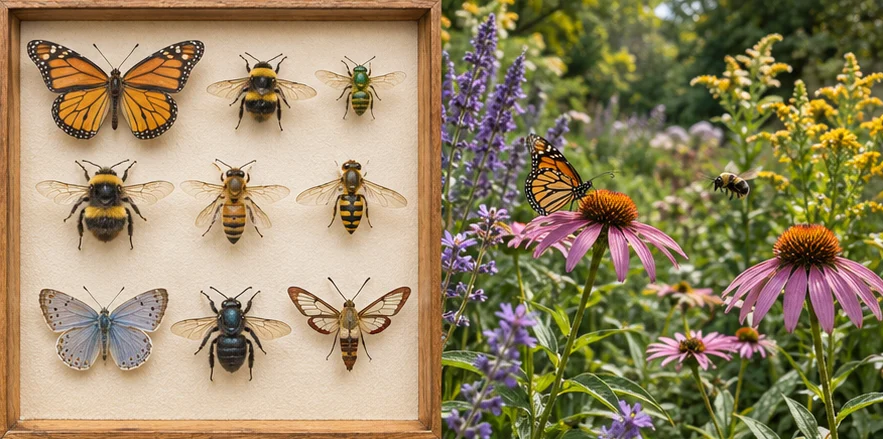
A public display can show reference examples, documented observations and unresolved lookalikes side by side. Use clearly different captions. A reference image might show the expected structure in an ideal view, while the observed image shows only a portion of a subject and is labeled at a broader level. Showing both teaches why identification is difficult. If using generated art for the reference scene, mark it as illustration and never present it as identifying documentation. A confident visual style should not be mistaken for authentic biological detail.
Borrow the right lesson from photo validation studies
The published comparison of bumble bee photographs and associated specimens asked a narrower question than whether a photo can always provide an answer. Its design made the evidence link important: an image assessment could be compared to an assessment involving the associated specimen for the subject. The study distinguishes whether images allowed a name from whether the compared determinations agreed. A garden program can borrow that distinction without collecting insects. It can log the proportion of files in which a reviewer could respond at a given rank and separately note any tested agreement. These are process measures, not estimates of a species' frequency.
Do not take an overall reported success rate from one study and apply it to a different mix of species or photographs. Image clarity, which body areas are visible and the available geographic identification guidance are all relevant to whether the comparison makes sense. A nursery archive made mostly of old distant photos is not the same material as a planned photographic study. An increase in quality in one series can lead to more accepted names without more biological diversity being present. Conversely a trustworthy reference can expose uncertainties rather than increase the number of narrowly assigned labels.
When a project uses a comparison exercise to improve its own judgment, ask evaluators to score evidence scope as well as names. For one practice image, can they all agree which subject is being discussed? For another, can they say whether multiple local files represent the same individual or merely came from the same watch? Several people agreeing on a name does not help if they are discussing different animals in the photo. Reliability in the link and reliability in the determination should be tested separately. The details can remain simple and still prevent a misleading certainty score.
It also helps to keep a record of changes that improve terminology rather than change identity. A later reference might revise the accepted name of a group or split categories previously presented together. A project should review which observations can support the new distinction. An older, correctly assigned broad label cannot always be converted to a newly available narrower one without new evidence. Preserve the original category and record the reference version used where changes matter. A method that updates vocabulary responsibly will not manufacture diagnostic observations after the fact.
Preserve ambiguous links as their own result
Suppose a clear image is received with two candidate field identifiers because a note on the camera card was smudged. Each field record refers to a different flower and both were made close in time. An expert can review the photograph's subject while the steward investigates which record it belongs to. Do not assign the name to both records and plan to delete one if somebody notices. That would inflate evidence immediately and make it hard to trace the uncertainty later. Keep the image assessment available for authorized use with the field link marked unclear.
Sometimes the linkage can be resolved from existing context: another file in the same recognizable sequence, a distinct flower layout visible in the original or a contemporaneous note. Record what changed and why the connection became credible. If the evidence never suffices, leave the records as they were and keep the fact of expert review only at its supported scope. Do not infer the observation time, site or source from the most convenient database candidate. The event metadata is part of what makes an accepted occurrence scientifically useful and deserves the same care as the taxonomic label.
When editing a spreadsheet, avoid implementing ambiguity as a blank indistinguishable from missing effort. Use reason codes such as not submitted for review, too little visible detail, conflicting determinations or uncertain field link. For a photo containing two candidate subjects, distinguish “review scope unclear” from “features inconclusive.” Someone can often fix the first by asking which individual the reviewer meant. Improving optics or asking a second specialist addresses a different problem. Decision codes can tell future staff what kind of next step would be justified, without pressuring them to manufacture a solution for every open record.
Do not treat editing time as the observation date. A true new record identified from newly connected evidence may improve the inventory of observations, but the subject was seen when the underlying occurrence actually happened. If a linkage change affects a table for a previous month, note it as a correction to evidence assignment. The species should not appear in the current month's biological activity solely because that is when the work was done. A report can have a revision date and the underlying field dates at the same time.
Check a combined export for silent name propagation
Test the result when a data system groups by time, site or sampling event. A faulty merge may copy one accepted name onto all records joined to the watch. A summary grouped by a rough color tag might similarly display a first accepted label as if it applied to every example of that appearance. Inspect the exact column used to link identity. An event ID helps find related evidence but is not the unique key for an image-level determination. In a reliable export, a single determination attaches only to the specified subject or documented set of linked frames.
Create a practice batch with several intentionally similar entries. Put one accepted name on one subject, leave another as a candidate and set a third to ambiguous linkage. Export the watch summary and verify that the first name appears in exactly the records intended to carry it. Then add a second image of the confirmed subject and make sure an occurrence count does not rise. Add a photo containing two labeled subject regions and make sure display annotations remain distinct. Testing these situations using fictional records is easier and less risky than debugging a sensitive wildlife archive by trial and error.
Respect how missing values are handled by reports. A chart of named species may intentionally include only confirmed names, while a chart of eligible encounter records should keep broader labels and unreviewed cases according to the protocol. Label the denominator in both. A smaller named subset is not evidence that other insects were absent. Where opportunities for review vary by season or observer, do not interpret changes in naming completeness as species turnover without checking its relationship to review effort. The exact shape of what a report excludes is as important as the title of what it shows.
Keep any public output appropriately general about sensitive locations. A contributor's private image may include a precise embedded location or distinctive property detail. A review workflow can use authorized evidence without giving the same detail to every future reader. Follow the program's sharing rules, and record that public media or location precision was limited where appropriate. The Darwin Core Quick Reference Guide gives standard context for occurrence, identification and other data concepts. Map your records to those meanings only where they actually fit. Protecting information should not require conflating the visible scope of a record with what was collected.
Work through a correction that changes what the map says
Imagine a fictional program that covers two broad districts. An expert confidently assigns a name to one clear photograph. By mistake, a spreadsheet imports that name into several records from both districts because all were filed under the same color tag. On the display, the species now seems to be widely documented. The correction begins by tracing which visible subject the reviewer identified and which field occurrence the source can actually support. The problem is not that the species could not occur in both districts. The problem is that the imported labels do not constitute evidence that it did.
The affected rows may need different responses. Some have photographs that were never reviewed, so they can revert to their last independently supported labels and enter a review queue. One could have an equivalent determination made previously on its own evidence, which remains valid if the audit can verify it. Another might have no photograph at all but still count as an eligible broad encounter under the sample rules. Do not discard every affected observation as false. Instead separate what happened in the field from the name acquired through the faulty linkage and explain which fields needed correction.
The resulting map can change without signifying a shift in the insect population. A correction notice can state that a determination was confirmed for a single documented subject, while some other labels were removed because the recorded evidence did not support propagating it. Keep the field dates and the date the correction was made. Where external users already relied on the older map, preserve enough provenance for them to identify which reports or summaries were affected. Do not imply retrospective absences where the honest conclusion is that a species-level record is not currently supported.
A versioned export also lets two legitimate uses coexist. The observation program can still count the qualifying broad records as evidence of effort and flower activity, while a species-specific table counts only accepted independent determinations. The two views use the same underlying history without having to agree on the number of labeled records. Make sure the old labels are retained as superseded history rather than mixed into the current table used to calculate species summaries. A map symbol should reflect the current supported assignment, not simply whichever name is most complete.
Preserve the difference between a labeled group and its members
A photograph may be the example that anchors a broad visual category for training. A volunteer team could use that category operationally to tally easily recognized broad patterns without claiming the group contains just one species. Give it a neutral descriptive name rather than the species name assigned to its best example. The training image supports the description of the category, but each subsequent category assignment remains an observation at that category's resolution. When the training protocol improves, preserve the rules of the earlier category so that apparent shifts do not silently arise from reclassifying the scale itself.
This matters even if a review covers several subjects independently. A training tile might illustrate three accepted identifications in good views. That shows what could be distinguished in those cases. It does not mean all new subjects can be identified with the same number of views or the same confidence. A training group should see ambiguous examples as well as neat examples. Otherwise people learn that any observation must culminate in a name, and their refusal to label a hidden structure looks like error rather than good judgment. Include a successful broad determination as a model outcome, not only perfect species labels.
For people comparing the composition of several watches, there is another subtle danger: names are easier to assign when the subject presents an unobstructed view. Suppose a chart shows only species-level accepted records. It can underrepresent categories whose members are harder to photograph or distinguish. This is not necessarily a reason to remove reliable names from a report. It is a reason to show unresolved and broad records alongside them, define which subset was reviewed, and avoid drawing simple abundance conclusions from differences in identification completeness. Data quality differences can be reported as such without discrediting the original watch.
Ask the reviewer exactly what kind of answer is needed
A short submission form can give the reviewer options: name of the marked subject, confidence or supported taxonomic level, which evidence was consulted and what could not be determined. It can also ask whether they actually made a determination or only suggested candidates. The form's design should not force a choice between a narrow species name and declining the entire record. If the view establishes a broader group but no species, store the improvement it supports. If the link to a field record is uncertain, allow the reviewer to comment on image content without impersonating the person who can resolve the linkage.
Sometimes a renewed question is cheaper than an elaborate cleanup. If the reply says that “the first two look good,” clarify whether that refers to two image files, two distinct subjects or two views of the same subject. If the intended figure changes when images are sorted, refer to stable identifiers. Preserve the response context with any final decision so a later steward does not reduce a nuanced answer to an unexplained approved tag. A respectful narrow follow-up can prevent days of later corrections, especially when several contributors have different interpretations of what the reviewed group represented.
After acceptance, record any limitations that affect public presentation. A photograph could be authorized for internal identification but not for broad reuse, or its published crop could omit the part the reviewer evaluated. Describe evidence at a suitable level without releasing unapproved details. If the authentic source cannot accompany an editorial image, the image should not be presented as though it independently verifies the record. A documented decision need not show everything to every audience, but its caption should not imply that the audience is seeing the evidence when it is seeing a substitute.
Check that a new resource is actually new evidence
If another copy of the same shot arrives from a different folder, it may be easier to read but not an independent occurrence. If a higher-quality original makes a feature visible that a compressed copy did not preserve, it can genuinely improve the determination for that subject. Record it as an improvement in the evidence available for an existing occurrence. A second independently documented subject would require its own link and review. These distinctions make it possible to celebrate progress in an archive without turning file management into ecology. In the field report, reserve new sightings for cases where the underlying observation record actually supports them.
Explain the narrow scope without making the expert sound evasive
A useful editor's note may say: “The reviewer identified the subject marked in frame A from its visible features. Other insects from the same watch remain at a broader level pending independent review.” This communicates an actual result rather than offering a vague statement that the area was verified. Put the note near the record or image it refers to. If the label relies on multiple views, state that and keep the links. Someone seeing a detached crop may otherwise assume the expert reached the same conclusion from a partial display alone.
When uncertain evidence is sent to an authorized reviewer, give them the context that helps answer the request: original images, scope of each candidate subject and basic time and place information at an appropriate level. Ask what rank the evidence supports rather than insisting on a species name. Clarify whether the desired decision concerns the subject in one photo or a series whose continuity was independently documented. A narrower question can benefit from a strong answer even if the larger notebook is still a mixture of accepted and unresolved records.
Keep early descriptions when a current label changes. A field note about a small bee on a particular flower can be accurate even if a species label added afterward had to be withdrawn. A photo that confirms the broad identity but not the original candidate still improves the record. Adjust the accepted identification with the reason and date, not the whole occurrence history. A useful audit trail shows how certainty narrowed or widened while preserving the core observation it was based on.
The reader should be able to repeat the central distinction from the final caption. A name was assigned to a particular subject on the evidence reviewed. The examples next to it were not thereby identified. One strong determination can help guide the next comparison, but it only travels where the documented evidence connects it. Keeping that boundary explicit is how a carefully identified photograph improves a garden record instead of quietly changing every lookalike around it.
A handoff test can use a fictional record with two species candidates and a clearly scoped review of only one insect. Ask the next steward to export the record without adding an occurrence, then ask them to explain which evidence would be needed to review the other insect. If the answer requires a new subject link rather than simply filling another name cell, the system is preserving the intended distinction. A review process succeeds when it produces a reproducible boundary around what the decision covered, not when it makes every nearby row look complete.
Sources and illustration note
- USGS: Identifying Bee Specimens, official identification and expert review resources.
- GBIF: Best Practices in Publishing Sampling-event data, official event and related-record guidance.
- Quantifying effectiveness and best practices for bumblebee identification from photographs, primary study of photo-based identification and associated specimens.
- Darwin Core Quick Reference Guide, maintained reference for event, occurrence and identification concepts.
All counts and examples are invented. If generated, the reference image and garden photo composition is editorial art, not a specimen series, evidence of occurrence or an authentic determination.