| Category | Value (notes) |
|---|---|
| Sheltering | 11 |
| Active feeding | 7 |
| Movement unclear | 6 |
Illustrative values, not sourced observations. Distinct notes, no comparison with continuous procedural counts.
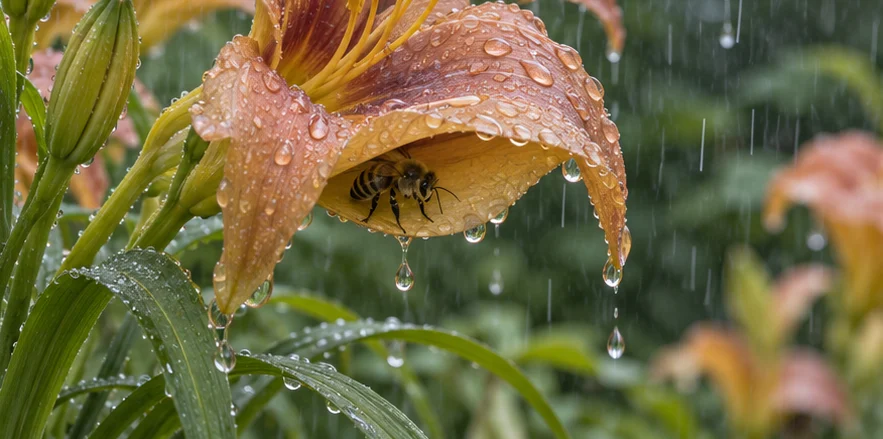
Rain has just eased at the edge of a garden path. The daisies are moving less in the wind, and a bee is visible beneath a bent petal. It stays in roughly the same position while an observer writes the time, checks a second flower, and looks back. Then it crawls around the rim. A moment later, another bee is visibly working the exposed center of a blossom nearby. These observations are worth recording. They do not all deserve the same tick on a form labeled “new foraging visit.”
The first bee was detected, but its arrival was not necessarily observed. Its covered position is consistent with sheltering, but the observer has not established why it was there. Crawling around the rim shows movement, but not a new entry from outside the flower. The second animal supplies better evidence of an active interaction with the exposed floral structures, though its exact food and the success of any pollen transfer may still be unknown. If the form keeps these facts separate, the observer can describe a changing scene instead of converting it into one ambiguous total.
A garden log can make room for stillness, movement, contact, and uncertainty without turning every watch into a formal study. The most useful habit is to tell the reader what was visibly happening, which part was inferred, and whether the record began before or after the animal entered view. This article shows how to do that around a passing shower with ordinary noninvasive observation. It does not ask anyone to move petals, collect bees, or remain outdoors during unsafe weather.
Count presence, behavior, and arrival on different lines
Presence answers a question about an animal's position at a particular time. Was there a bee beneath the petal when the observer looked? Was a bee already on the flower when the watch started? Presence can be recorded even if the animal never moves. It is useful in its own right if the project is asking which structures hold visible insects under changing conditions. It need not imply food collection, a newly initiated visit, or a distinct individual in a later snapshot.
Behavior answers a different question: what did the bee visibly do? It might remain stationary, reposition its legs, groom, crawl along a margin, probe an opening, or work a visible part of the flower. The list should be adapted to what the observer can distinguish. A covered head may leave mouthpart action unassessable. An observer can confidently record a still abdomen with no view of the head. “No movement seen” is then restricted to what was visible, and cannot be upgraded to “not feeding” merely because part of the body appeared quiet.
An arrival is a transition under a specified rule. It might be the observation of an insect entering the focal blossom from outside its boundary, or of an insect arriving on a selected plant from outside a patch. Choose one scale. A bee crawling between adjacent flowers can enter a new flower without making a new arrival in the patch. A bee that briefly flies away then lands again can make a new observed arrival under an entry rule, though it is not necessarily a new individual. These distinctions are easy to preserve when the unit is named before the watch.
“Foraging visit” is narrower than either position or arrival alone in this exercise. To score a new foraging visit, specify both a qualifying entry and a subsequent behavior compatible with collecting a resource that can actually be observed. If the protocol instead counts all landings or all insects on a target flower, describe the result using those terms. Do not impose this article's stricter foraging label on an existing program that defines its count differently. The aim is to prevent the field note from promising a behavior or sequence it did not measure, not to outlaw broader kinds of surveys.
A project can keep an episode identifier to connect changing actions within one observed stay. For example, one visible bee is present under a petal at the start, moves to the rim, makes several apparent probes, and then flies beyond the frame. The same episode contains several actions and may include active feeding evidence, but there is no documented arrival into the flower. The last visible departure could be scored independently. If a similar bee later returns and cannot be identified as that one, the record can mark a new entry without asserting a second individual.
These distinctions also matter when no bee appears. A completed watch with no detected arrivals is not equivalent to a watch canceled when raindrops made the lens unusable. An image with no animal visible beneath a clearly exposed rim is different from an image that does not show the underside. A chart that forces both conditions into “zero” erases information about coverage. Save completed, interrupted, and not attempted watches in different states. It is possible to have no qualifying foraging events and several useful observations in the same session.
Shelter is a good hypothesis, not a mind-reading exercise
A position beneath a petal suggests a cover function in the same ordinary way that someone standing in a doorway during rain suggests sheltering. But people can stand in doorways to talk, and a bee can occupy a protected position for reasons a clip does not resolve. It could have been there already, be resting, be working at a concealed structure, or be reacting to something else. Write “sheltering posture” or “stationary beneath petal, consistent with shelter” when the evidence is positional. Reserve stronger causal language for a design or sequence that supports it.
Look for observable features that make the label useful. Was the animal under the curve of a petal or simply on its shaded side? Did it remain in the same covered position across two time checks or only appear for one frame? Was the flower facing away from the observer so that protection was inferred from a partial shape? A crude sketch or side photograph can help clarify the relationship between cover and body position. As always, what was beneath the petal at the moment of observation does not necessarily reveal where the insect had been when rain began.
Show restraint around words such as sleeping, stuck, cold, or exhausted. Stillness in a short observation is not evidence for a particular physiological state. A confident story about an insect unable to fly is different from a duration of observed inactivity and a later departure. The latter can be logged accurately without diagnosing the animal. When another bee on the same flower behaves differently, do not try to fit both into one explanation unless the evidence warrants it. Individuals and occasions can differ even in very small spaces.
There are documented examples of bees using flowers in ways that go beyond feeding. A field report of overnight resting by male Emphorini bees describes bees in flowers of Ipomoea carnea. A primary study of Oncocyclus irises in Lebanon documented floral shelter use, including observations during changeable daytime conditions, alongside other forms of visitation. These examples substantiate that the broader phenomenon is real. They do not identify the bee in a random garden photograph or determine its reason for using a particular petal.
Weather can affect behavior, but local mechanisms and taxon-specific responses need evidence. A controlled study of simulated rainfall and buff-tailed bumblebees compared behaviors in a particular laboratory setting and found shifts in the share of workers engaging in different activities. Some workers still foraged in rainy treatments. Treat it as evidence from a defined species and experiment, not a rule that all bees stop foraging once it rains. A bee working a flower in changing conditions is not automatically an observation error because it violates an overly broad expectation.
The USDA Forest Service's native-plant pollinator garden guide provides useful background about floral visitors and garden habitats. It is context, not a behavior key for a bee in cover. A garden can offer food, places to stay, and features that help or hinder an observer's view. A thumbnail showing an animal near a flower cannot tell which of those functions was involved. Keep the surrounding habitat notes and the evidence for a specific behavior under distinct headings in the log.
Draw the boundary where it can actually be seen
For a structured watch, select the focal area before looking for action. It might be one marked flower, a clearly recognizable stem, or a patch with a written boundary. If the project compares movement between flowers, individual floral units might matter. If it asks how many visible arrivals occur on a selected patch, the patch boundary matters. Several blossoms on one stem can sit within one wider field of view. A short sketch helps when wet foliage makes edges difficult to distinguish in a recording.
Decide what happens when a bee goes behind a petal and emerges beside it. Vanishing behind a landmark is not necessarily departure. When you can follow the same movement continuously, keep it in the same episode unless your boundary definition specifically treats that move as a transition. If you lose the insect and later notice another shape, record the gap rather than inventing continuity or a new arrival. “Reappeared after obstruction, identity unresolved” can preserve both the visual event and the reason it was not counted as a documented entry.
A long movement can be surprisingly difficult to ascribe to the correct flower. In an image, one blossom may overlap a second and make an animal seem to cross from one to the other when it only moved on the nearer bloom. Wind can also move the flowers themselves. Use recognizable landmarks rather than position on the screen alone. If tracking fails, retain the coarser observation: movement within or near the patch, relation to floral boundary unclear. That is better than increasing the event count simply because the clip contains activity.
Some observers prefer to define a new episode after a specified time gap. A rule of that kind is an operational convenience, not proof that the next sighting comes from a different insect. Avoid presenting the cutoff as a universal feature of bee behavior. If a timing criterion is used, state whether it requires a visible departure or whether a gap from lost view is enough. The two choices solve different problems. One favors confidently observed boundaries, and the other creates reproducible records even when continuous tracking is impractical.
If several bees are present at the same time, use location or temporary labels only as long as they remain distinguishable. One could be under the lowest fold while another sits near the center. Once they cross behind the same petal, the labels may no longer follow individuals. That uncertainty can affect counts of distinct animals while leaving a simultaneous minimum count intact. Reporting “at least two visible at once” is a different assertion from assigning every later observation across the scene to bee one or bee two.
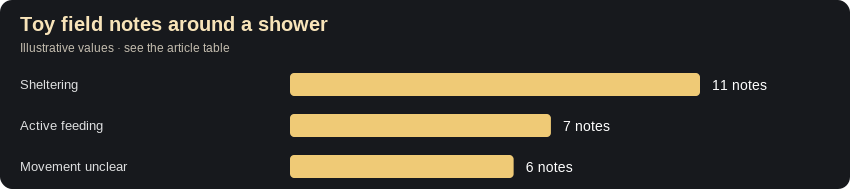
Chart: Toy field notes around a shower
The chart and matching table are illustrative only. These are invented classifications of twenty-four distinct field notes, not sourced observations, continuous behavior samples, or the number of individual bees. Each hypothetical note is assigned one principal category under the exercise's rubric.
| Principal note category | Notes |
|---|---|
| Sheltering | 11 |
| Active feeding | 7 |
| Movement unclear | 6 |
Here “Sheltering” is shorthand for a visibly covered, relatively stationary posture consistent with sheltering, not demonstrated motivation. “Active feeding” is shorthand for clearly observed behavior consistent with collecting a resource, not a direct measure of what was ingested or what pollen was delivered. “Movement unclear” holds notes showing some change in position or posture without enough evidence to place it in the other classes or establish a transition. A real log can add other categories and finer confidence fields. The legend should not force the observer to call all covered positions proof of refuge.
The three bars total twenty-four. The eleven sheltering notes are not eleven bees, eleven new arrivals, or eleven shelter episodes. One insect may have contributed multiple notes, and a single note could have been made after a long period of already stable presence. The seven feeding notes cannot be converted to seven new foraging visits without observing the relevant arrivals. The six unclear notes do not represent six uneventful scans. There was an observation to classify, but the method or evidence did not settle its meaning.
One reason for the distinction is the duration of behaviors. A relatively stationary bee can prompt notes repeatedly while it remains easy to see; a brief active visit may produce one note or none. Even scheduled snapshot notes are not the same as a count of episodes starting during a period. They can describe the proportion of sampled moments at which a state was seen, provided the schedule and coverage support that purpose. This particular toy example does not provide such a sampling schedule. It is a chart of how individual written notes could be sorted, no more.
A reader could compute that seven of twenty-four notes, around 29.2 percent, were in the active feeding category. That is a precise arithmetic statement about the invented note collection. It does not estimate the fraction of time bees spent feeding or compare feeding in rainy and dry conditions. No before, during, or after totals were supplied. Maybe the group happened to write far more notes after the sky cleared. The small bar chart cannot account for how that opportunity to record changed. A caption that says “notes” protects a correct count from an expansive interpretation.
Keep formal counts distinct from wet-weather notes
The UK Pollinator Monitoring Scheme's Flower-Insect Timed Count instructions are a useful example of an operational field definition. The scheme uses a specified watch, target flower patch, and suitable weather, and its guidance covers insects already sitting on target flowers as well as those that land. The scheme's official quick guide sets out those details concisely. Initial presence can therefore be a legitimate component of a formal count when the protocol explicitly says so. That does not make it a newly observed arrival or a confirmed feeding event.
A dry-weather standardized count and a set of optional rain notes answer different questions. The timing, target patch, coverage, and weather eligibility are part of the formal count's definition. Notes made around a shower can help an observer document interesting behaviors without presenting them as if they satisfied that protocol. If you contribute to a monitoring scheme, follow its instructions rather than merging the activity categories in this article with its tally. Use a distinct header, template, or dataset tag for exploratory observations outside its criteria.
This separation prevents an avoidable baseline error. Suppose one week includes only conditions suitable for the formal watch and the next week contributes a mixture of formal watches and wet-weather notes. A combined chart of “visits” could fall merely because part of the second week was measured under another procedure. It could also rise because the same stationary insect generated several notes, while the formal count used other rules. The apparent trend would not tell which. Running two explicit records may look less tidy, but your data will preserve the meaning of each entry.
It also helps when a watch is interrupted. A dry interval might become wet halfway through, or sudden gusts may make adequate observation impossible. Do not silently extend its end until the total number of visible minutes suits a standard, or resume later without marking the delay. Follow the program's own guidance for what qualifies. In a local teaching exercise, record the planned duration and usable portions separately, and state whether you included the session in any time-based summary. An exploratory recording can be worthwhile even if it is ineligible for a particular formal count.
If readers need a demonstration of the difference, show two distinct sentences about the same fictional patch. “A bee was present on the target flower at the start of a qualifying watch” describes an initial observation that may count under a stated survey. “No new feeding arrival by that animal was directly observed” describes the limit of evidence about its behavior. There is no contradiction. A well-written methods note tells an audience what was counted in each column, rather than implying that all definitions of a visit should agree.
Build a timeline without making rain do all the explaining
Record the earliest and latest usable observations around a shower with actual time labels. An observer may arrive while the rain is already tapering and know nothing about its beginning. If so, the record is about the tail of the event. A droplet visible on a petal can persist after precipitation ends, so it is not by itself a clock for active rain. “Petals visibly wet, no rain seen during this interval” is a useful description. “After rain” is appropriate when there is direct or clearly identified contextual evidence of the prior conditions.
Wind and cover can change at the same time as weather. A flower can tilt, making the underside visible for the first time precisely when the wind weakens or switches direction. This can create a new detection that is unrelated to a new arrival. Name the sightline as well as the weather. A photograph from a new angle might be good evidence that covered occupancy existed at that moment. It does not prove the animal crawled there because the camera could not see it a minute earlier. Keep the discovery time and the known entry time distinct.
Light can change rapidly as clouds move. A sheltered animal may be hard to distinguish under dark foliage, and intermittent sun can make its outline visible without any change in body position. If an apparent increase in activity is based on more visible animals, consider whether that improved view plausibly influenced the tally. A stationary reference mark in or near the frame can help establish whether blur, motion, and illumination changed appreciably. The observer need not quantify every optical feature; flagging a temporary loss of visibility may be enough to prevent a false transition label.
Rain coincides with changes in temperature, sun, and wind, and with the passage of time itself. Flowers may open differently as the afternoon progresses, people may move away from the path, and observer attention may shift from wide to close views. A difference before and after a shower is real as a description of the sessions if recorded carefully. It is not by itself evidence for a single cause. Clarify whether the project is a natural-history description, a repeated observational comparison, or an intervention with its own design. Each can support a different strength of statement.
A small matched study might revisit the same plant types during several eligible windows, with defined wet and dry observations taken under comparable sides of the path and similar time ranges. Even then wetness is not randomly assigned, and some important conditions may still differ. The resulting notes can build a plausible descriptive association, not eliminate every alternative. If the project observes one dramatic shower beside one attractive plant, report that single scene vividly and accurately. Do not require it to stand in for all gardens or species for the record to have value.
Remember that the study may naturally stop before conditions are unsafe for observers while the animals continue being active. A blank in the log at the height of a storm is no evidence that the patch was empty. Safety and access constraints belong in the coverage account. Use vantage points that do not disturb the animals and do not put people on slippery terrain or in dangerous weather. In a teaching setting, a previously recorded sequence can demonstrate lost view and reappearance without anyone waiting outdoors for suitable rain.
Make a behavior record that can be reviewed
A worksheet can begin with date, time, watch identifier, patch or flower identifier, observer position, and usable observation duration. Then add a small set of event fields: bee present at start, confirmed entry, continued presence, possible probing, visible movement, and exit or loss of view. Include a confidence note and a media identifier if a clip was captured. These fields are independent unless a chosen summary requires each note to take one primary category. The raw record should hold multiple supported facts even when a simple display can show only one label.
If an app requires one label per observation, define priority before classification. For example, a note on a visible feeding-compatible action could receive the active label while retaining the petal position in a free-text field. A sheltered posture might be recorded when that is the principal observed condition and there is no sufficient evidence of active feeding in that view. If a note describes distinct periods, splitting it into multiple time-marked segments can be appropriate. Just do not mix segment counts and whole-note counts in the same figure. The implications of the software layout should be visible in the method.
Different types of observation need not be scored at the same temporal scale. A ten-second clip may show one clear probing motion, while a check every minute may establish continued visibility at three instants. Claiming continuous shelter for the full span between first and last sighting requires more evidence than those snapshots alone. State the interval as “first and last observed covered posture” if there were gaps. If the animal could have left and returned during those gaps, continuous presence is unknown. Frame time, scan time, and inferred episode duration are different variables.
A good reviewer asks what evidence excludes an alternative. If the note says “new arrival,” do the preceding frames show the bee coming from outside the chosen boundary? If it says “feeding,” rather than merely “on flower,” is there a visible action to support that category? If it says “remained stationary,” was the body continuously visible or only at a series of checks? The question need not be adversarial. A short, reasoned challenge to a few records can reveal whether the definitions match the footage and whether the analysis survives reasonable disagreements.
Ask observers to classify a small shared set before a larger watch. Include a clear landing, a concealed animal with only part of the body visible, a case that reappears after occlusion, and a clip where the flower moves while the bee does not visibly relocate relative to it. Compare the judgments separately for position, action, and transition. A one-word category can conceal perfect agreement that the insect was beneath the petal alongside strong disagreement about whether it was feeding there. Separate scores point to a specific improvement in the rubric.
Imaging helps only if it supports the required view. Wider frames provide landmarks and can show the boundary crossing, while a closer frame can reveal mouthparts or grooming. Filming close and then zooming back may miss the entry or departure. Preserve the original sequence and record where a crop came from. Enlarging a blur does not restore missing evidence; generated or interpolated detail cannot establish what happened. An editorial image of a bee sheltered under a rain-beaded petal can illustrate the topic, but it is not the data for the field case.
Choose the analysis unit on purpose
For a set of notes, the note is the unit classified in the chart. For a set of continuous tracks, the episode might be the unit. For a patch comparison, the watch might be the unit over which an event rate is summarized. Those quantities answer three different questions. Counting more notes in one watch may change the note distribution while leaving the number of observed arrivals exactly the same. Pooling them requires a defined relationship, not just a common word like observation.
Imagine one conspicuous bee remains under a petal through eleven scheduled checks. If every usable check was independent of the observer's interest in the bee, the record may tell you something about how often a covered posture was observed at those check times. It still offers one observed run for that episode, assuming continuity was established. Conversely, eleven different confirmed arrivals would be eleven events under an entry rule, even if the same insect could make some of them. A raw “eleven” cannot settle those possibilities without identifiers and timing.
If the aim is to estimate time spent in visible behaviors, a regular scan schedule or a continuous recording may be a more appropriate start than a notebook filled when something interesting happened. Before collecting, decide what counts as state at each scan, how missing views are handled, and which population or set of watches the result describes. A long episode naturally appears in more scheduled snapshots than a brief one. That is acceptable for certain questions about how common a state is at sampled moments. It is a problem only if snapshot frequency is reported as the rate at which episodes began.
Similarly, a rate of new feeding visits per minute needs a valid numerator and denominator. A period with known arrival and feeding criteria can supply the numerator; usable time and coverage determine the denominator. Add a flower-availability denominator only if it was measured and helps answer the intended question. It is better to report a simple count for a complete, clearly described watch than a more impressive rate built from guessed exposure. Unassessable intervals should not be assumed to contribute either feeding events or quiet minutes.
Measurements taken from the same patch near one shower often share conditions. They need not be independent samples merely because they were separated by a minute or come from separate pictures. If you want to discuss whether a pattern repeats, repeat the watch on meaningful additional units, like comparable patches or days, and show those distinctions. A report of three monitored showers and their individual patterns tells more about repeatability than an unmarked total of three hundred frames. If only one episode was observed, say so and make the account a well-grounded natural-history note.
An example sequence that keeps its limits
Suppose a practice video begins with a bee under a petal and the flower already wet. In the first portion, the bee remains in the same visible position. In the middle it passes behind the rim for a short time, reappears nearby, and then seems to touch the flower center repeatedly with part of its head. At the end it leaves the view. The group has one confirmed initial presence, an observed covered posture, an unresolved passage, a possible feeding-compatible behavior whose visibility they can review, and a countable departure only if the boundary crossing was clear. They do not have a documented entry merely because they saw an ending.
In the second practice sequence, an observer sees a visitor come from outside the selected flower, sees it land in the same field of view, and keeps the head in view during repeated movement consistent with probing. Under a rule combining a visible entry and a sufficiently clear feeding action, this can qualify as a new feeding visit. It need not prove the specific resource. If reliable contact with a particular organ was visible, record that in another field. The treatment of the first sequence should not change just to make the examples produce the same label.
Here is a possible written record for the first case: “One bee visible beneath near petal at start of recording, observed in cover through initial segment. Brief loss of sightline behind rim. Visitor reappeared near the center; continuity plausible but not established. Later movement at floral structures visible, resource not measured. No witnessed entry into focal flower.” That note is concise but not vague. It gives the next observer enough information to decide whether their entry count, an occupancy record, or a description of possible behavior should include it.
When comparing field logs with videos, discrepancies often indicate different scopes rather than immediate mistakes. An observer may remember a bee appearing suddenly, while the footage shows only its first appearance in the recorded field. A wide camera may have caught an earlier approach but missed behavior inside the flower. Use timestamps and landmarks to reconcile what each source supports, and retain the disagreement if it cannot be resolved. Do not promote an uncertain field impression simply because a different source says there was definitely some bee in the patch.
Report the scene so the next watcher can build on it
A short summary can report how many watches were attempted, when the usable segments occurred, how the focal units were defined, and which observation classes were scored. If the results are only a collection of opportunistic notes, say that clearly. Show the counts of shelter-compatible positions, feeding-compatible observations, and uncertain movements as notes rather than animals. Keep any formal dry-weather tally separate and label omissions for interruptions or restricted viewpoints. Good description invites another observer to repeat a real method rather than copy the boundary-breaking shortcuts in a spreadsheet.
Include one sensible next step based on the limitation. If too many arrivals were lost because of the framing, back the view up and pair the wider footage with selected close-ups. If too many head movements were hidden, find a complementary angle that does not disturb the bee or change the flower. If rain and time of day were inseparable in the study, cover more dates and include comparable dry windows. An uncertain note becomes useful when it says what kind of evidence might resolve it. It is not an invitation to discard all observations that did not fit an attractive heading.
There is one useful distinction when a second person later visits the same patch: you can share the focal location without asking them to reproduce your interpretation. Provide the original notes, or give them a fresh copy of the criteria and ask them to annotate what is visible first. Their observations may show that the underside is often hidden from the approved position, or that the movement you called a probe is easier to confirm from another view. That does not invalidate the initial description. It tells you what another person can check and which details need stronger documentation. Repeatability at the level of the description is a good milestone even before you attempt a comparison across weather conditions.
Treat exceptional observations according to the collection method rather than their attractiveness. A photograph taken between watches may be the clearest account of a covered bee that you have. Tag it as an incidental record with its actual time and location rather than inserting it into a timed numerator. Likewise, if the most active visitor appeared just before the formal start, retain the natural-history note without moving the clock backward. This preserves the contrast between what careful preparation was able to sample and what chance allowed you to see. Both can matter to an observer deciding whether to study the behavior again.
A final garden note might say that bees were seen in covered positions around one shower and that feeding-compatible actions were also recorded in the nearby patch. It might add that entry was not visible for some animals. That is a stronger account than a tally claiming every bee present was a new forager. The petal marks a useful place to look, the rain marks an observation context, and the next motion marks a change to describe. Keep those facts together without asking them all to do the same job.