| Category | Value (contacts) |
|---|---|
| Fly | 4 |
| Bee | 7 |
| Moth | 2 |
| Unclear | 3 |
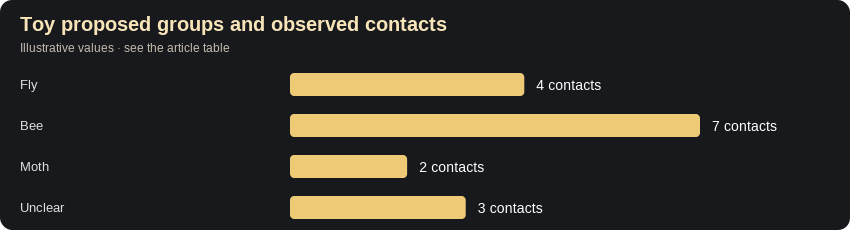
Illustrative values, not sourced observations. Illustrative contacts cannot establish which cue attracted a visitor.
A cream-colored flower near a garden path gives off a sweet smell at dusk. Someone calls it a moth flower. The phrase could be a promising idea about when to watch. It is a poor description of what has already been seen. At that point the observer has recorded something about color, something about time and something about human perception. No visitor has yet been documented.
Now imagine returning with a notebook. In one session an insect that appears to be a bee lands on the rim. In another a fly enters the center. After sunset a moth pauses and contacts a different flower of the same plant. Those observations sharpen the question rather than settle it. Each insect may respond to a different combination of cues, or the encounters may partly reflect which animals were already active in the area. Even the most aromatic flower does not explain the motives of an animal merely by smelling strong to us.
A good field inquiry keeps three statements apart: what a person detected, what an animal did and what caused that action. There is a fourth question if the inquiry concerns pollination, because a visit is not automatically successful pollen transfer. The most interesting part of the sweet smell is what it persuades us to look for next, not how quickly it lets us write a species name.
A nose describes an encounter, not a chemical inventory
“Sweet” is a reasonable entry in a field notebook. It records how a scent seemed to a particular observer at a particular place and time. It does not specify which volatile compounds were present, how much the flower emitted, or how any other animal perceived them. A second person may use different words for the same experience. A third may notice little at all. Preserve those descriptions as observer records rather than putting them on a single measuring scale that the method cannot support.
Do not assume a noticeable odor came from the nearest blossom. Another plant, a ripe fruit, damp material or a nearby object can contribute to the air moving past the observer. A plant can also have different smelling parts. In a casual garden observation, label a scent as detected near a flower if its source was not established. Better provenance allows a later reader to separate a particularly attractive photograph from what was actually perceived.
A person may describe intensity as faint, moderate or strong if the site uses those terms consistently, but the terms remain judgments. Standing closer, approaching from a different direction or having recently smelled something else can change how noticeable the same air is. Field notes gain value from a record of context: how near the observer could get without disturbance, what time it was and whether wind was noticeable. Those details do not replace chemical measurements. They make the human observation easier to interpret.
A flower can release a changing mix over its lifetime or through the day. If it smells stronger after sunset on one visit, the source may have changed, or conditions may have made the same emissions easier to notice. Keep both possibilities open without adding a mechanism by intuition. A repeat observation at a comparable stage and location is a better reason to describe a pattern than a powerful memory of a single evening.
The absence of a human-detected scent is not evidence that the flower has no odor-relevant signals. Animals differ in sensory capacities and behavior; a compound that barely registers to us may be detectable to a visitor. Likewise, something overwhelmingly sweet to a person need not be the strongest component for an insect. The useful comparison is between field observations made under stated conditions and hypotheses about the animals, not between human scent adjectives and a single presumed floral code.
A syndrome is a suggestion to test
The USDA Forest Service pollination brochure considers a range of traits together, including shape, color, scent and nectar features, in a familiar table of pollination syndromes. These recurring trait combinations can make useful predictions. A pale blossom, an evening emission pattern and a suitable structure might motivate an observer to look for nocturnal visitors. A prediction is not a census of that flower's visitors, and the table is not an identification key for an individual encounter.
A garden has many more routes to a flower than a tidy table implies. Available visitors can differ among sites and dates; animal schedules need not coincide exactly with a plant's flowering display. One animal might take a reward without transferring the plant's pollen effectively, while a less frequent visitor makes the more relevant contact. A flower may have multiple visitor groups, and an expected group may be present but rarely detected by the protocol. The label should not be stronger than the observations.
A trait can be useful for generating multiple candidate explanations instead of one. An evening scent could be associated with attraction at dusk, but daytime visitors may have learned where flowers are even when humans detect little odor. A cream-colored surface might be visually conspicuous under some light and not others. A broad landing area might allow several different visitors to approach in different ways. List alternatives before the watch so a surprising animal is treated as a result rather than a distraction.
The USDA Forest Service guide to attracting pollinators using native plants situates plant choices within varied garden conditions and pollinator groups. Use it for natural-history context, not as evidence that any particular insect visited this article's imagined garden. Where the goal is habitat, a diversity of appropriately selected plants serves a different purpose from a study isolating one cue. Do not mistake the success of a garden planting for evidence about one causal mechanism.
A practical phrasing rule helps keep these sources useful. “The combination of traits suggested watching for moths around dusk” describes a hypothesis and action. “The fragrance proved it was pollinated by moths” describes an unsupported result. A report can present an informed prediction with confidence. It should show where evidence begins rather than disguising a guess as a cautious sentence.
Decide what counts before the first watch
Suppose the outcome is flower contacts during short observation periods. Define contact so that a hovering insect and a landed insect do not both score by accident. One possible rule for an illustrative exercise is visible physical contact with the flower, followed by a departure or movement to a separate blossom before another encounter can count. Other questions could require contact with a named structure. Pick the rule that serves the objective and keep it consistent across sessions.
A broad category such as bee, fly or moth should also have a defined evidence threshold. A quick silhouette might not be enough. Keep an unclear category instead of assigning the blurred shape to the animal you expected at that hour. If identification can be improved later from a photograph, record the original uncertainty and the basis of revision. Do not make the contact disappear merely because the species is unknown.
A single animal can visit several blooms. If the outcome is contact events, that animal can legitimately generate several records. If the outcome is unique individuals, the same observations may be insufficient. Because field observers often cannot identify one individual upon its return, there is no honest default way to infer a population size from a contact chart. State whether the unit is an event, a blossom, a visit to the entire plant or a distinct individual identified under a method that supports that claim.
Record the flowers available during the watch. Ten contacts across a dozen open blossoms and ten contacts at one flower do not tell the same story about activity per blossom. Likewise, a broad display may make a patch more likely to receive encounters even without stronger scent from any particular flower. The appropriate exposure measure depends on the question. Time watched, number of visible available flowers and amount of habitat observed are reasonably kept separate before deciding how to combine them.
Visibility is not uniform. It may be easier to see the upper faces of large blossoms than the undersides of smaller ones. An insect that comes in from behind can touch a flower without any useful view of what it contacted. When the evidence is limited, label it. An observation like “approach seen; contact uncertain” can sit in the notes without being counted under a rule requiring clear physical contact. Zero observed contacts should be reserved for a sufficiently defined watch, not a view that never supported the observation.
Read the toy chart as event records
The companion chart called “Toy proposed groups and observed contacts” shows sixteen wholly fictional contacts. The word observed refers to a made-up scenario used to demonstrate recording. No researcher, handbook or actual observer supplied these values. The labels are broad working groups, not species names. The table repeats the same counts.
| Toy visitor group | Illustrative contacts |
|---|---|
| Fly | 4 |
| Bee | 7 |
| Moth | 2 |
| Unclear | 3 |
Four plus seven plus two plus three equals sixteen. Thirteen contact events received one of three proposed broad labels, while three stayed unclear. That count has no interpretation as an identification rate in a real survey. It belongs to the example. Seven is the largest individual label count here. It does not imply seven distinct bees, a greater population of bees, stronger preference by bees, or better pollination by bees.
In particular, the two moth contacts neither confirm nor refute a hypothesis that a scent helps attract some moths. No comparison in the chart controls or measures the scent. The numbers also lack watch effort by group or time, variation among plants and evidence about visitors available nearby. They cannot establish which cue was responsible for any contact or whether contact mattered to floral reproduction. The ambiguity is central to the example, not an issue the caption should hide.
If a reader asks for a percentage, answer the unit first. Seven out of sixteen is roughly forty-four percent of the toy contact events assigned to the bee label. That is a description of the constructed event list, not an estimated share of pollination. Excluding unclear events changes the denominator to thirteen and makes the number look larger without recording anything new. Either denominator needs a stated purpose. A percentage with a precise decimal is no better than a count if it represents the wrong question.
A more informative field chart might show groups separately by time window and plot effort beside them. It could distinguish verified contact with reproductive structures from contact with an outer surface where that difference is observable. A figure that combines such events should tell readers exactly which rule was used. A pie chart or an attractive stack of bars cannot make the underlying behaviors interchangeable. Choose the arrangement that preserves the important distinctions.
Schedule independent watches without promising independence everywhere
An evening hypothesis is best served by looking beyond the one fragrant evening that generated it. Plan visits across relevant times and more than one date, and try to keep the duration and field of view similar when comparisons depend on them. Separate flowers or plants can improve coverage when they are genuinely distinct in the study. Five checks of the same plant on one evening do not provide five gardens' worth of evidence.
For a simple natural-history project, pair a late-afternoon watch with one near dusk and repeat the pair on additional days when access is safe and allowed. Vary order among nearby patches if visiting several of them, so one site is not always observed first. Record conditions that affect detection and insect activity. This is not a universal schedule. It is an example of connecting a prediction about time to a watch that could contradict it.
An independent observer can help separate seeing from expecting. One person might note human-detected scent using a chosen procedure, while another watches floral contacts without being told which category the first assigned. Complete concealment may be impossible because observers can smell or see a flower themselves. Say what information was actually withheld rather than calling a conspicuous field comparison blind. The purpose is to reduce opportunities for expectations to govern ambiguous classifications.
Resetting a clock is not all that makes a repeat informative. Repeated contacts with one plant may share the same nearby insects, weather and plant condition. Watches in the same patch can also be related. Summarize the levels at which work was repeated: contact events within watches, watches within days or patches, and any wider units represented. A large event count is useful for describing what happened in the watch; it does not automatically make a comparison among plants precise.
If the same observer always handles the day sessions and a different person always handles the night sessions, differences in classification might be associated with time even when visitors are not. Consider overlapping observers or checking a shared set of records, where practical. Preserve disagreements on difficult cases instead of smoothing them away. A follow-up watch is most valuable when it can catch a mistake in the original idea, not merely provide a second signature under it.
Time and weather change who is available and what you can see
Dusk brings more than a different scent impression. Light declines, insects with different periods of activity become available to encounter the flower, and wind or temperature may change. An increase in moth contacts after sunset can be consistent with a scent hypothesis while also reflecting those other changes. Observing a timing pattern is worthwhile. It does not isolate the odor cue by itself.
Temperature or wind can affect both emission and movement of odor in the air. They can also affect how a person notices a smell and how animals move. A breeze does not produce a uniform cloud that visits every flower equally. A careful notebook can record whether conditions seemed still, gusty or sheltered. Without direct measurements it should not describe a precise plume or assert that a particular insect flew up its center.
Visibility can create its own artificial schedule. Bees may be easier to identify in broad daylight than small insects at dusk. If three night contacts remain unclear, comparing only confidently named night visitors with confidently named day visitors can disguise different uncertainty rates. Retain those records and report the observation conditions. Some watch windows may be useful for overall visible contacts but not for classifying contacts by taxon.
Do not add bright lights or chase a visitor to solve a low-light identification problem. Those actions can change the behavior that the watch intended to describe, in addition to disturbing the site. Work within safe, authorized access and say if a period could not be observed reliably. Some hypotheses may reasonably wait for a better method. A limited watch is preferable to a confident account produced under conditions of one's own making.
Dates matter for plants too. An open flower at the beginning of its display may not compare well with a senescing flower on a later watch. Some tissues may no longer present the same reward or shape; nearby competitors may have begun flowering. Note the stage and context rather than treating the plant's name as proof that everything stayed constant. That helps future readers distinguish a stated repeat from a new setting with the same label.
An attraction experiment asks another question
Observation can establish the times, places and behaviors that give rise to an explanation. Testing whether scent made a difference usually calls for an independent comparison capable of separating odor from other cues. A scented and unscented flower that also differ in color, shape and reward cannot isolate scent merely because the observer is particularly interested in it. The direction of a difference may be well recorded even while its cause remains unresolved.
In an appropriate research setting, the design might compare flowers or presentations that differ in a defined scent condition while keeping relevant visual and reward cues comparable. The exact protocol depends on the species, materials, permits and welfare considerations. This article does not propose modifying a public garden or applying unfamiliar substances to flowers. The lesson is methodological: identify which contrast would support the causal claim you want, and say why the available observation does or does not provide it.
One primary example is Klahre and colleagues' study of pollinator choice and floral scent in petunias. The researchers used genetically defined comparisons and behavioral tests in a specific plant and hawkmoth system to study scent alongside color. Their evidence is informative because the contrasts were designed around the cue question. It does not make a sweet smell a universal predictor, and it does not establish what brought any animal in the fictional garden to a flower.
A useful counterfactual is straightforward to express and difficult to observe casually: would otherwise comparable visitors have approached the same way if the scent cue alone had been different? A watch on one scented plant at dusk has no such comparison. A good observational result can still motivate it. In reporting, say “contact occurred while a scent was noticeable to the observer,” rather than compressing co-occurrence into “contact occurred because the flower smelled sweet.”
An experiment must define the behavioral endpoint too. An odor might change first orientation without changing contact rates. It might influence landing in a situation where a shape cue guides the final movement. An animal might approach repeatedly but spend no time near the relevant floral structures. Replacing one vague endpoint with another does not answer the question. The causes of detection, approach, contact and successful transfer need not be identical.
Behavior after arrival also matters
Flowers may be approached for reasons other than feeding, and a feeding visitor can interact without moving pollen between appropriate structures. A photograph of an insect on a petal documents a scene. It may show more detail if body placement and contact are visible. It does not establish where the insect had previously been, where it went next, or whether compatible pollen was deposited. Keep a scene-level statement separate from a reproductive conclusion.
The Forest Service brochure distinguishes pollination as pollen transfer to a stigma from the behaviors that can bring a visitor to a flower. This difference matters even if a project's focus is only broad natural history. You can call a visibly unidentified insect a visitor, or say it appeared to contact a particular part. To infer effective transfer you need evidence designed to address it. Frequency of contacts is one piece of the story, not the last step.
Pollen on a body can support a more limited inference than readers often make. It can indicate that pollen adhered, but casual observation may not reveal which plant it came from or whether it later reached an appropriate stigma. Likewise, seed formation can have several contributing factors depending on the plant and study system. Those measures can matter greatly in the right design. A photograph and several contact counts should not masquerade as that design.
Think of the toy rankings in this light. The bee label leads in contacts with seven. Even if those seven were valid observations rather than invented, the largest contact count would not necessarily identify the group transferring the most pollen. A less frequent group might interact differently, carry compatible material, or act under conditions better suited to the plant. Which possibility applies would require direct evidence. Don't convert a bar chart of frequency into a bar chart of reproductive contribution by changing its caption.
Behavioral descriptions can preserve future options for analysis. “Entered through the opening and visibly brushed the central structure” records different information than “landed on an outer petal.” The right terms should reflect what the observer can identify. If the anatomy is uncertain, say “contact near the center; exact structure not determined.” That note is more useful than assigning a precise anatomical part based only on a distant view.
Let the field sheet separate expectation from result
Prepare separate areas for the flower description, prediction, watch context and behavior. Fill the prediction before inspecting the resulting event list. For example, one entry might note a pale flower with a noticeable evening smell and propose watching for nocturnal moth contacts. The watch entries later say what happened independently. A reader can then reconstruct which part the observer inferred before data and which part they learned while watching.
For each observation, record a site or patch identifier, date, time window and the number or area of visible blossoms when that matters. Explain how the plants were chosen. If only fragrant plants were selected, the resulting visits cannot tell whether nonscented plants nearby had more or less activity. A convenience set can still document what the observer saw. The limitation belongs in the interpretation rather than hidden behind a tidy graph.
Describe scent separately from visitor behavior and retain qualifiers. “Sweet smell noticeable while standing beside the plant, source not verified” can coexist with “one fly-sized insect visibly contacted the outer rim, group unresolved.” The two statements do not need to imply a causal relationship. Record if either observation came from a different observer, viewpoint or time. Even on one shared sheet, not all lines are made under equal conditions.
For each confirmed contact, record the clearest group supported by the view and optionally retain evidence such as an image or descriptive features, where appropriate. Use a name no narrower than the evidence. An approach that could not be seen through to contact should not be removed from the field notes; just use the rule consistently about whether it enters the contact total. A table of confirmed contacts and a separate list of uncertain approaches can prevent a false choice between discarding observations and counting them incorrectly.
Include a way to mark a watch interrupted or unusable. A sudden shower might cause someone to stop after a minute. The corresponding zero is not comparable to a full fifteen-minute watch simply because both were scheduled for fifteen. Record actual rather than planned effort; note major obstructions or changes in visibility. An interrupted record can still tell readers why one comparison would be unfair.
Write a result that could disappoint the prediction
Suppose the observer expected moths on every dusk visit and saw a single possible one. If the watches were conducted well enough to detect clear contacts in their field of view, that limited record is worth reporting. It does not establish that moths never visit. It might suggest more dates, a different observation window or a narrower hypothesis. Editing away the discrepancy to protect the original story defeats the point of making a prediction.
Suppose instead that moth contacts were consistently observed after sunset. This directly supports a claim about timing within the monitored sessions, assuming the records support the classification and comparison. It still does not determine whether the moths used scent, color, location memory or another cue. The observation advances one link of the chain without settling the whole chain. State the gain. A series of capable watches is more informative than a first smell even without a controlled cue experiment.
Occasionally a field question changes as records accumulate. An observer may realize that the most frequent insects are difficult to classify in one light condition, or that one flower species blooms away from the others. It is reasonable to refine the protocol for later observations. Keep track of the change and avoid combining unlike phases as though all were recorded with the same detection method. Report exploratory conclusions as exploratory, especially if they were selected by looking at the same outcomes.
A good result sentence for a hypothetical observed pattern would mention the scope, behavior and uncertainty: “In the two observed evening sessions, two identified moth contacts occurred; three contacts were not assigned to a group. We did not test attraction by scent.” The actual example here supplies no sessions or observations at all, so its caption should say invented. The exercise of composing both captions makes the distinction between a story and a record easier to see.
Common ways a neat explanation goes wrong
The first is averaging over the wrong exposure. If one type of flower was watched twice as long or was far more numerous in the observed patch, its larger contact total may not represent greater contact under comparable conditions. A denominator of flower-minutes can be helpful when it suits the question, but only after deciding how to count available flowers and whether time and blooms have comparable meaning across watches. Normalization is a design choice, not an automatic repair.
The second is mistaking flower choice for long-distance attraction. An insect already feeding close by may move to the next visible flower without having entered the garden in response to its scent. An observer who begins watching only when an animal is near the flower does not see what happened beforehand. If the research question is how an animal located a patch from a distance, the relevant observation and comparison must include that part of its behavior. Contacts alone cannot fill in the route.
The third is treating nearby flowers as irrelevant. A nectar source with several kinds of blossoms can receive animal activity due to the whole display or position in a regular route. A later visitor might cross from one neighboring plant to another. Recording that context does not force you to declare that the nearby plants caused the contact. It gives a meaningful alternative to the assumption that the watched bloom did everything on its own.
The fourth is overstating consistency between human impressions. If one person calls the scent sweet and another calls it faintly fruity, those are not independent chemical assays proving a stable blend. They are descriptive impressions. Use them to locate a repeatable observation context or to formulate a question about chemistry. If a team wants comparable qualitative reports, agree a descriptive framework, then retain original observations and disagreements. Agreement improves communication without turning the group into an instrument.
The fifth is producing a marketing claim about a garden based on a handful of photographs. A photograph showing a particular visitor at a flower can make a fine observation record, but cannot tell which plants would support that visitor across seasons or whether a venue reliably attracts it. Habitat recommendations need relevant local evidence and context. Treat an attractive snapshot as a reason to learn more, not proof that the entire garden performs as advertised.
Keep illustrations from becoming invented evidence
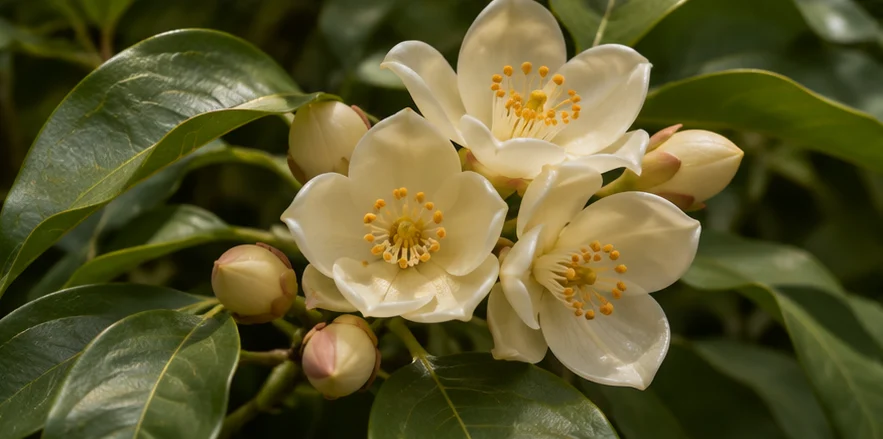
The opening scene and companion image work as teaching illustrations. Neither documents a particular plant at an identified site. The chart likewise represents an imaginary record of contacts. Put that statement near the material it qualifies so it remains visible if the chart travels as an image or a copied table. A source list does not supply provenance for values it never contained.
If the article is read aloud, someone should still hear the analytical limit. “Sixteen fictional contacts, not sixteen insects and not a test of scent” is more important than describing the color of the bars. A direct sentence can carry that meaning without cluttering the surrounding caption. This is especially important for charts whose broad labels invite familiar stereotypes about sweet flowers and insect groups.
Give the reader a next step proportional to the evidence. If the only record is a sweet smell, plan careful watches. If effect on attraction is important, ask what controlled comparison and endpoint would test it. If reproductive contribution matters, gather independent evidence suitable for pollen transfer or plant outcomes under an appropriate study design. No step has to replace the one before it. Each builds a different part of the explanation.
Return to dusk beside the path. We have a cue people can describe, a few plausible predictions, and a decision to see what arrives without rewriting ambiguous records to fit our expectations. That is already good field practice. The flower's scent need not become an identification tag to be worth attention. It can be a reason to set a watch, take a better note, and remain interested when the actual visitor is not the one we imagined.
A final review using two different questions
Read the first draft as if you were planning a return to the same flowers. Can you tell which period was watched, from where, and for how long? Could you identify the observation unit or recover which type of contact counted? If not, the field description has probably lost details required for a useful repeat. A claim about frequency cannot be made reproducible by adding stronger adjectives about the scent. Supply the missing parts of the method or narrow the claim.
Then read the draft as if you were testing an explanation. Underline any words that imply why something happened. “After” expresses an order; “because” assigns a cause. “Attracted” can mean that an animal was seen arriving in casual writing, yet it often suggests a causal claim in a scientific caption. Replace it with the specific behavior unless the cue comparison supports the stronger interpretation. The point is not to ban a useful word, but to prevent it from concealing an inference.
Now do the same for the name. If the article's notes say “moth-like silhouette,” a summary figure labeling the event as a species is not a stylistic shortening. It is an evidential change that needs its own basis. The reverse matters too: an adequately documented contact can be described specifically without claiming why it occurred. Separate confidence in identity from confidence in mechanism. A writer can be strongly supported on the first and know little about the second.
A review can end by making the simplest verified statement visible. In a real garden that might be “an insect visibly touched the flower at dusk,” with exactly the warranted identification and context. In this article it is a statement about a toy exercise and the logic that exercise demonstrates. A sensory description can be accurate and interesting all by itself. Its real scientific promise comes from making a testable suggestion without telling the observer in advance what they must find.
Compare opportunities as well as counts
Imagine that a group adds a second plant to the protocol after learning that its foliage partly screens the blossoms. A lower number of documented contacts there could mean fewer contacts, more missed contacts, or both. Before comparing the plots, document the viewing area and which surfaces were hidden. If a fair comparison would require disturbing the second plant, choose a narrower question that can be addressed from the permitted view. Transparent differences in opportunity are easier to interpret than impressive totals with no record of detection.
The same idea applies to the nearby animal community. A late watch may detect few bees at this flower even if bees sometimes use it at sunset. Without some context for activity elsewhere, it is harder to separate a flower-specific result from a sitewide lull. Independent observations of neighboring activity can help interpret that distinction; they do not automatically show a lack of attraction or explain why any individual chose its route. Use the context to narrow possibilities rather than as an automatic correction factor.
Finally, distinguish testing a candidate against an alternative from looking only for the expected candidate. An observer who logs moths but treats every other visitor as background cannot later claim moths were the only visitors. An inclusive protocol leaves room for contrasting discoveries and makes the outcome meaningful whether or not the original scent prediction survives. A useful natural-history study can end with a more interesting question than the one that sent the observer to the garden.