| Category | Value (events) |
|---|---|
| Front-leg sweep | 7 |
| Transfer movement | 5 |
| View lost | 4 |
Illustrative values, not sourced observations. Invented example for the stated comparison; not a biological threshold, ecological estimate or observed dataset.
Watch a bee long enough after it leaves a flower and the familiar picture of a pollen-covered visitor becomes a small motion study. A foreleg comes across the head. The legs briefly meet or pass one another. One leg disappears behind the body. By the time the bee turns sideways again, a colored mass on a hind leg catches the light. Seeing these events in that order can teach us how to watch grooming. It does not let us follow every grain from a flower to the mass, much less tell us where any of those grains eventually went.
The most conspicuous pollen on a bee is not necessarily the pollen best placed to reach a stigma. The dense load a honey bee carries on a hind leg is associated with collection and transport. A much less conspicuous scattering of grains on another body surface can have a different fate if that surface later contacts a flower. Researchers can ask where pollen sticks, what removes it, what remains after grooming, and which regions touch stigmas. Each question needs a measurement. No single yellow patch can answer them all.
A useful field note therefore reads more like a timeline than a statement of purpose. It names the leg and region when they can be identified. It records when the bee changes position and a later movement is hidden. It distinguishes the appearance of a load from direct evidence that material moved there during the recorded bout. The goal is not to make observation less vivid. It is to recover the rapid choreography without assigning outcomes the observer could not see.
First watch the motion, then name what it could have moved
The bee's front legs are nearest the head when it faces forward. A clear front-leg sweep can be described as a short passage of one foreleg across a particular head surface. That sentence can be true even if individual grains cannot be seen. Depending on the view, the observer may be able to record side, direction, and whether the leg actually appears to touch the surface. An appendage appearing in front of the eye in a projection is weaker evidence of contact than a trace that follows the leg and shows its relation to the head.
Sometimes the same appearance has several possible meanings. If the bee turns, a stationary background feature can appear to sweep across its face. An antenna flick and a leg motion can overlap in a low-resolution clip. A bright smear can be a slender appendage reflecting light rather than a cloud of pollen. Make the description less specific if the appendage cannot be traced. “Movement at the head, side uncertain” preserves what the scene supports. Coding it as a front-leg sweep simply because that is common in an explanatory diagram creates a misleading certainty.
Next distinguish a movement involving two legs from direct observation of grain transfer. When adjacent legs meet after a sweep, the movement can reasonably be described as a transfer-like maneuver under a declared observational rule. It does not establish how much pollen moved, or that pollen moved at all, without additional evidence. The same issue applies to a leg moving toward a hind-leg load. Motion can be consistent with packing while leaving the load unchanged at the resolution of the recording. Describe the two levels separately: leg movement visible, material movement inferred or unresolved.
When a surface visibly changes, retain its identity across the comparison. A patch might seem smaller simply because the bee turned its abdomen away. A load can catch sunlight at one angle and disappear against the body at another. If the images show comparable views before and after a clearly observed action, a change in appearance is worth reporting, with limits. Do not turn two unequal positions into a calibrated before-and-after measure of grain number. An animal is not a static sample merely because a frame can freeze it.
The word pack has its own ambiguity. It can refer to the observable mass arriving in a frame, a set of leg movements consistent with consolidation of pollen, or an inferred transfer into the load. Put the event next to the object in the note. For instance, an observer might write that the hind-leg mass was visible before the sweep, while a later leg-to-leg movement occurred outside view. That tells a reader something useful about both the load and the footage. It does not accidentally imply that the entire mass was formed between the two frames.
What the honey bee mechanics study measured
Guillermo Amador and colleagues' 2017 paper studied the mechanics of pollen capture and grooming in honey bees. They described how hairs near the eye can hold grains away from the underlying surface in a position amenable to removal by the forelegs. Their analysis also linked spacing of hairs on the foreleg to how it holds material removed during a swipe. The work distinguished the physical contribution of hairs from that of pollenkitt, the sticky coating on the pollen studied. Georgia Tech hosts a copy of the primary paper.
That research does not require us to believe that one casual swipe always removes the same amount. A geometric account of removal helps explain why the approach of the leg and the nature of the material matter. It does not imply a numerical conversion from scrapes counted to grains added to a load in a garden watch. The initial position of the grains and the area brought into contact with the foreleg can vary. The next movement can carry material somewhere else, and an observer may lose sight of it. Give a filmed sweep credit for what it shows while keeping quantitative findings tied to the study.
The relationship between adhesion and removal is particularly instructive. Material can stick effectively on first contact while remaining accessible to a moving leg, depending on how it is held by the hairs. Good capture is not proof that material will stay in place for the rest of the flight, and effective removal from the head is not proof that everything ends in a particular hind-leg load. The mechanical study focused on parts of this process that could be assessed under its conditions. Those pieces clarify the story; they do not complete all the missing transfers in an outdoor film.
The paper's finding about pollenkitt also has a clear boundary. Their comparison supports an important adhesive role for the pollen material they studied. It is not a rule assigning the same stickiness or accumulation pattern to everything that looks dusty on an insect. A bright material detected on a garden bee could be pollen, mixed debris, or material from more than one previous visit. Even when identity as pollen is clear, exact origin and surface properties are often not recoverable from color. Qualify a visual identification when the image leaves room for doubt.
Think of this paper as evidence about a local event. A foreleg moves across a surface, catches some material, and may later take part in another movement. With a sufficiently resolved method the local change can be investigated. Stigma delivery happens elsewhere and usually later. It is a different task with different evidence. Reliable knowledge of material removal can improve ecological hypotheses, but the honey bee mechanics study should not be made to stand in for a trace from an individual grain to a receptive surface.
In the safe-site study, persistence and contact had different maps
The term grooming safe site can sound like a guarantee that pollen remains protected until the next flower. A better reading is comparative: a region where material was relatively difficult for the bee to remove under the described conditions. This is a useful biological idea, but there are two further questions. Does the flower deposit pollen at that spot? Does a recipient stigma often come into contact with it? A region that is hard for the bee to groom but seldom touched by a stigma may be less useful for transfer than the appealing name suggests.
Ze-Yu Tong and Shuang-Quan Huang compared body sites in bumblebees, using retained fluorescent material to evaluate grooming accessibility. In separate parts of the study they considered how pollen from four Pedicularis species was placed on bees and which sites were contacted by stigmas. The publisher's article and abstract report that the hardest-to-groom sites included parts of the body midline. The largest shares of the measured pollen did not generally occupy the safest regions, and the sites most contacted by stigmas were not those safest sites. This is exactly why pollen persistence and recipient contact need distinct observations.
The authors interpreted the observed distributions as compatible with benefits for both sides of the interaction, not with a simple story in which plants must put all useful pollen where bees cannot reach it. That is a natural-history result about the systems they studied. It does not license assigning fixed function to a body site in any bee. Floral geometry can influence where the bee makes contact, and a different kind of visitor or flower can change which parts of the body become relevant. A safe site is defined relative to the observed behavior and the particular criterion used.
The study's marker assay and its pollen observations should not be renamed as the same measurement. Tracer retention helps compare which areas are difficult to clear under the studied conditions. Pollen placement records where plant-derived material was found after relevant visits. Stigma contact observations describe geometry of another step. This layered evidence is stronger than attempting to infer every map from one. It also shows why an unsupported claim that a dusted spot is a “pollination patch” oversimplifies the result.
The two queued studies used different bees and different questions. The honey bee mechanics work tells us about capture and removal at a small scale. The bumblebee work describes relative accessibility and flower/body relationships in another set of systems. A sentence joining the studies can say that geometry matters to pollen fate at more than one scale. It should not import a bumblebee body-site result into a quantitative claim about every honey bee sweep. The common lesson is how to separate outcomes, not a universal map of grazing legs or waiting stigmas.
Toy grooming behavior observations
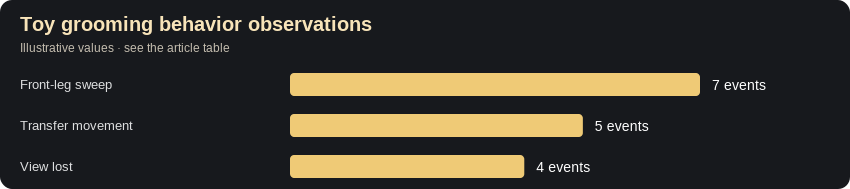
This figure uses invented counts, not observations from the studies and not suggested rates of grooming. The unit is predefined event windows. For this example each event receives one primary code. If the relevant leg-to-leg movement is visible, the record is classified under transfer movement, even if a front-leg sweep is also visible. If a sweep is seen and the window is sufficiently visible to establish no intervening transfer movement matching the definition, use front-leg sweep. If interruption prevents that distinction, use view lost. Hidden is a report about the evidence, not a type of grooming.
| Observable event code | Events |
|---|---|
| Front-leg sweep | 7 |
| Transfer movement | 5 |
| View lost | 4 |
The rows sum to sixteen windows. Twelve could be assigned a visible primary code and four could not. The five transfer records are five visible movements under the chosen coding rule, not five measured transfers of pollen mass. The seven sweep records do not represent the total number of sweeps: a sweep could occur in a record classified by its later transfer-like movement. Nor does any category indicate whether pollen was deposited on a stigma afterward. The plot is a demonstration of preserving observable outcomes and visibility limits, not a pollination result.
The word event can otherwise be read several ways. One person might count each leg stroke, another might count a whole grooming bout, and another might count each file in a photo library. With fourteen strokes on a single bee, those interpretations produce very different meanings. The toy table defines events as windows, so a short series of quick repeated strokes can all belong to one window. A genuine stroke-frequency study would store each qualifying stroke, report observation duration, and manage interruptions differently. Choose the unit to suit the question rather than because it fits a chart aesthetic.
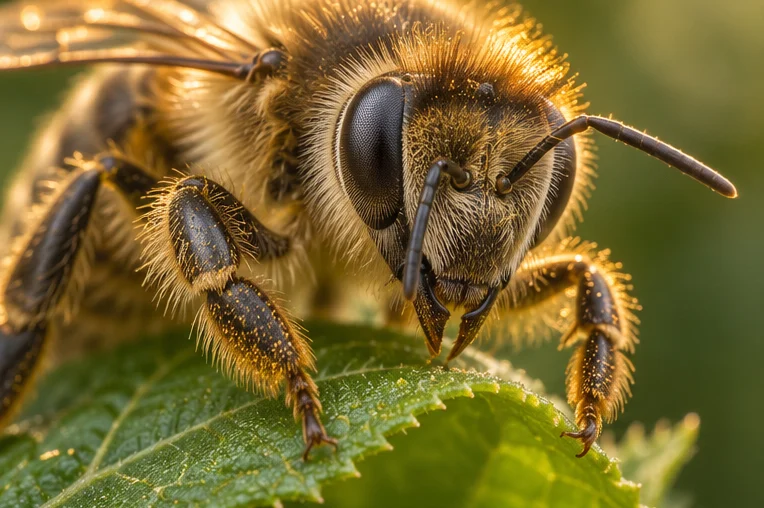
The editorial illustration shows details of a bee's face and forelegs. It is not a field finding or a measured trace of pollen. Working with recognizable anatomy ought to make the motion easier to understand. It should not imply that every brush produced a visible transfer or that the figure can be used to identify a grain's source. Separate labels on the art and on the data table keep the reader from giving a useful illustration a documentary status it was never meant to have.
Follow one bout without writing the missing frames
Imagine an existing clip of a bee perched where a leaf meets a stem. It begins mid-bout. The front of the bee is briefly sharp and the opposite side of the head cannot be seen. The observer can tell that a visible foreleg sweeps across the near side, and can record the time of the first whole sweep in the file. That is not the first sweep of the bout. If the camera had been running earlier, it might have captured an entirely different beginning. Mark the event as already in progress instead of starting its clock at the first frame and calling the value its total duration.
Next the leg contacts or closely approaches another leg. From this angle the two ends briefly overlap, but no grains can be tracked. An observer could describe a visible transfer movement according to the event rule above, as long as the leg identities and movement are supported. If the overlap might be purely a matter of perspective, use a more limited movement description. In neither case should the label mean that one can measure how much pollen passed or know which material the legs were manipulating.
A moment later the bee rotates and a dense load is visible on the far hind leg. The final image shows that something was there when the camera regained the view; it does not establish whether it was already there during the front-leg sweep. If the bee's near hind leg was previously visible and bare, that still does not prove the far leg was bare. Distinguish sides using the bee's body as a reference, and avoid calling an image-left to image-right change a transfer between sides. Camera movement and body motion can both change apparent handedness.
Finally the bee leaves the frame. The record can contain a documented head action, a possible transfer-like movement, and a later clearly visible load. It does not record the bee entering another flower. A graceful edit could follow the departing insect with stock footage of a bee touching a stigma. Such a cut is legitimate as a labeled explanation of possible events. It is not documentation that either the same bee or the same pollen reached that flower. A good natural history video identifies the difference between a continuous record and an illustrative sequence.
The case also shows why visibility should be coded for separate endpoints. A clearly shown foreleg is enough to place a sweep in its correct location. A blurred hind leg may invalidate a claim about packing in the same clip. An obscured head might make it impossible to classify the first movement while a later visible contact between legs remains defensible. Assigning a single quality tag to the whole video can conceal such differences. Keep the detailed time and visibility notes so a future reviewer can ask the particular question that the footage might answer.
Keep an observation clock and a biological clock
A recorded time begins when a camera or observer gets access to the scene. The biological action begins when the bee starts a maneuver. Sometimes those clocks line up. Other times the bee started before the camera found it, or the movement continues after departure. When the record does not show a beginning or end, a duration may be bounded but unknown. For example, one can report a sweep clearly visible for several frames without claiming the full episode took exactly that long.
Slow playback can reveal details of frames already recorded. It cannot reveal what occurred between frames the device never captured. A modern player may fill the gaps with interpolated images to create smoother motion. Those made-up frames can clarify how a presentation flows but should not be used as evidence of a contact or a second leg. Retain original timing and frame identifiers where possible. An annotated copy is useful if a later reader can still examine the evidence that preceded the annotation.
For a behavior comparison, decide whether pauses split a bout. If a bee stops moving the front legs for a short while and then resumes, one coder might count a second bout and another might retain the first. Neither threshold is natural simply because it was easy to apply after watching the clips. Record the working rule before summarizing frequency. If a study intends to compare rates across cameras with different frame sampling, a rule that relies on single-frame pauses might not travel well. Test it on several overlapping examples rather than manufacturing precision where equipment differs.
Weather and light can also affect who appears observable. A sunny angle may highlight hairs and make faint material visible; the opposite angle may make the same bee look clean. Longer perched bouts are easier for a person to notice than short maneuvers on a moving animal. If an archive consists mostly of clear selected clips, it can illustrate grooming actions beautifully without supporting a population rate. To compare frequency, define an observation window, keep track of lost or interrupted stretches, and preserve what selection was made. The hardest motions to record may be systematically different from the clearest.
Another concern is turning event counts into counts of animals. Several records from a conspicuous visitor circling the same small space may all belong to one individual. It is often appropriate to describe repeated observed events without knowing whether they came from the same bee. Report them at the event scale. A claim about differences among individuals or learning across visits needs stronger evidence about identity continuity. Lack of that evidence does not invalidate a movement description; it limits only what kind of summary it can support.
Bring the recipient into the story before claiming delivery
A pollen grain's route can be described as a sequence of possibilities: pickup from a floral structure, temporary residence on an animal, persistence or removal during grooming, and transfer to an appropriate recipient surface. The stages are not interchangeable. A bee can begin with substantial loose pollen and remove much of it while gathering material. Another bee may carry a modest visible amount but still contact the right floral surface. A load at departure is not a direct measure of which grains remain available across those scenarios.
Even the appearance of a grain touching a recipient needs careful wording. A part of the bee associated with pollen might brush something that turned out to be a petal edge rather than the stigma. A confidently identified stigma contact can indicate transfer opportunity. It does not establish that pollen of the relevant kind actually moved or was compatible. Some research measures recipient deposits directly under an appropriate design; casual footage ordinarily cannot. Say when the record supports contact geometry and when it supports deposition, rather than expecting the reader to infer a later endpoint from a general word such as pollinated.
The specimen data used to identify a grain is also a distinct evidentiary step. Similar shades of yellow cannot identify pollen to the source flower. A bee's immediately preceding observed visit may be one of several encounters it had before the record started. Carryover can make the neat story of one color originating from one flower surprisingly difficult to verify. When a gardener asks what a bright load “came from,” a description of the plant last seen being visited may be useful. Label it that way instead of assigning all material in the load to that observed plant.
The bee's collection objective and the plant's pollen transport opportunity can both matter without being enemies in every case. Tong and Huang's study gives a specific example in which much of the pollen was not at the hardest-to-groom sites and stigma contact focused on other regions. That invites questions about overlap in benefit, not a conclusion that body sites outside a particular map are never useful. It is perfectly reasonable to be interested in the bee's load as a sign of resource collection while not calling it a count of successful pollen deliveries.
When comparing flowers, be explicit about whether the same kind of bee and posture are relevant. A region that commonly brushes a stigma in one flower-visitor combination might not contact the reproductive structures in another. A bee visiting deeply or from an unusual angle may encounter different surfaces even on the same kind of flower. A geometric description with a qualified diagram can make this contrast legible. It cannot eliminate the need to know what happened in the particular observations from which an estimate is drawn.
Keep a sequence log others can read
A minimal annotation can start with encounter identifier, source footage, visible body side, time reference, movement category, and confidence note. Save the observed action in ordinary language before attaching a summary category. For example, “the near foreleg crosses from above the eye toward the mouth region, contact appears continuous until the leg vanishes behind the head” carries more evidence than a single box marked cleaned. If a later viewer has additional expertise or a sharper file, the phrasing gives them something specific to assess.
Distinguish what is visible in the original from what was added for interpretation. An arrow in a drawing can point to the likely direction of movement. Unless the actual movement was continuously recorded, the arrow does not itself label a measured path. A zoomed crop can clarify where to look but may eliminate evidence about body orientation or the side that was hidden. Saving an unmarked full frame beside the close view helps readers compare the two. Color and contrast adjustments should not be allowed to create the evidence used to judge a change in pollen presence.
Then test the annotation scheme against uncertain examples. Ask two people to independently view a short series containing clearly visible front-leg sweeps, ambiguous leg overlaps, and losses of view. Agreement on an easy example is useful, but the difficult transitions matter more for determining whether the categories are shared. If one reviewer scored transfer every time legs overlapped and the other required a visible directed sequence, revise the field definition. Do not resolve the gap only by choosing whichever observer produces the larger number of completed events.
If the evidence is genuinely ambiguous, keep the initial statements and the reconciled result where appropriate. A disagreement can expose a decision the original vocabulary could not handle, such as whether a hind-leg movement began before the visible part of the encounter. A revised rule can improve future notes. It should not convert the earlier ambiguous view into a fully resolved one by changing its label. Deliberately retaining uncertainty often strengthens a collection by telling future reviewers what a better viewpoint might have clarified.
One useful convention assigns ordinary negative statements only when the area and time were adequately visible. A note that “no transfer movement was observed” can mean little if the legs left the frame just when such a movement would have happened. A note that the interaction of interest was in view throughout and did not contain a matching movement supports a stronger classification. Documenting visibility separately from the score protects both kinds of records. It also lets a viewer retain a real foreleg sweep even if a subsequent question about hind-leg movement must remain unanswered.
Three patterns that would look alike in a still picture
Take three fictional scenes that all end with roughly similar hind-leg loads. In the first, a clip shows a sweep near the head and a clear leg-to-leg movement before departure. The initial load is also visible and does not change obviously. This supplies good evidence of movement order but poor evidence of how much material moved. If the story is about grooming behavior it is a useful clip. If the story is about the size of a load increasing, the resemblance of the beginning and ending frames should give the reviewer pause.
In the second scene, a bee comes to rest with a conspicuous load already on one hind leg. The camera holds position and records no clear front-leg movement before the bee leaves. That is an observation of a load present, not a negative test of whether the bee groomed earlier. In a gallery it may be the best picture for explaining where the load sits. Its value does not make it evidence of the sequence that formed it. The photograph belongs in a description of a visible transport state, not an account of how it arose.
In the third scene, a sequence of probed flowers and brief leg motions occurs partly behind leaves. For a while the bee seems to have no visible load. When it turns, a distinctly colored mass appears on the previously hidden hind leg. It is plausible that it was present all along. The more impressive final shot does not make the temporal story more certain. A transparent chronicle might read: “load visible on the far side after the turn; earlier state on that side unknown.” Readers can be invited to notice the turn rather than to guess what it conceals.
These fictional scenes teach a point about combining observations. The final state can be alike while the accessible paths are different. Conversely, clearly similar movements can end with different-looking loads because the bees started with different quantities, carried material on different sides, or presented different angles. The result is not a reason to reject field images. It is a reason to describe the stage and direction of inference before drawing cause from visual sequence.
Distinguish changes in the bee from changes in the recording
In a passive watch, the recording environment can introduce shifts without touching the insect. A focus adjustment can make isolated bright specks appear or disappear. A breeze may tilt the flower on which the insect was perched, changing which surfaces can be seen. A slight move of the observational viewpoint can make leg outlines overlap. These conditions are useful metadata, especially when the claim is about a change in a small region. Treat the focus shift as a possible explanation for a difference in appearance rather than automatically recording a disappearance of pollen.
Set a minimum evidence bar for a specific claim. For a front-leg sweep, identifying the leg and following the visible stroke may be enough. For a grain movement, more detail is required. For stigma delivery the location and movement of pollen near the recipient become crucial. An archive that uses one undifferentiated quality threshold could unnecessarily discard clear behavior or, worse, use a plausible behavior label to authorize precise pollen claims. In practice, write what each label permits rather than letting the words feed automatically into a broad statement of pollination.
Make room for different reasonable grouping choices. If the question is whether leg transfers tend to come after sweeps in the same bout, full observation windows matter. If the question is describing the characteristic pose of a moving foreleg, some interrupted windows may still be useful. The data do not have to be uniformly retained or discarded for every purpose. Preserve the files and metadata, then state the eligibility rule separately for each question. That is less confusing than a single flag labeled valid, which can travel into another analysis after its original meaning is forgotten.
Ordinary observer behavior can change the scene too. A comparison of naturally occurring movements does not need to disturb a visitor to bring it into focus. The appropriate sources for this article are existing research and unobtrusive observation under applicable access rules. Avoid manipulating flowers, confining bees, or putting material on them for a better demonstration. When a naturally recorded bout does not offer a good angle, demonstrate the uncertain step through a clearly labeled drawing or refer to a primary study. Leave the field record intact as evidence of what was actually seen.
Make the final account as short as the claim allows
Movement order is worth showing even if no individual grain can be tracked from one frame to the next.
A good set of captions might start with “foreleg crosses the visible side of the head,” continue with “two legs meet; any moving grains are unresolved,” and end with “packed load visible during the turn.” Another caption might say that a different study measures where stigmas touch the body. The captions can be vivid without straining to prove that the same pollen took every step. In many situations, that separation makes the story clearer to a newcomer because the record is no longer trying to explain unobserved processes in a single sentence.
Read a draft once looking for verbs that imply more than the evidence supports. “Brushed,” “touched,” “carried” and “deposited” should not be selected merely to avoid repetition. One describes a movement, another a contact, another a state, and the last a transfer to a recipient. If the recording stops at contact, save the potential transfer as a possibility and tie stronger claims to the studies that measured them. A reader can then understand why a full hind-leg load catches the eye while another surface may matter more to a later flower.
The same rule helps when a longer text includes words like “clean” and “clear.” A clearer image of the eye is an improvement in visibility. A clean-looking eye is a visual impression. Fewer grains in the relevant region before and after a documented sweep is a stronger statement requiring comparable views. A reader should not have to infer which of these an author meant from the placement of an adjective. In a field log, write the location and kind of evidence rather than treating the entire face as a single clean or dirty surface. That retains the distinction the laboratory work was able to examine in more detail.
For an education display, caption the foreleg and the hind-leg load as separate features rather than putting both labels on a single arrow. The anatomical picture can teach visitors where to look even if the recorded movie never resolves the intermediate movement. A second panel can show the position of a flower's recipient surface on its own terms. That format makes a gap in the documentation explicit while keeping the larger ecological story understandable. It also invites someone to pay attention to the small, fast movements, not only the saturated color that is easiest to recognize in a photograph.
The feature worth remembering is the order of what becomes observable. A given bee can sweep first, make another leg movement next, and finally present a loaded hind leg to the camera. The mechanics of capture and removal tell us why those movements deserve attention. Body-region studies tell us why later contact cannot be read from that load. When the view ends, the motion may continue. Recording that boundary gives us a much better story than calling every yellow patch evidence of delivery.