| Category | Value (records) |
|---|---|
| Upper body | 6 |
| Leg | 9 |
| Unclear region | 4 |
Illustrative values, not sourced observations. Invented example for the stated comparison; not a biological threshold, ecological estimate or observed dataset.
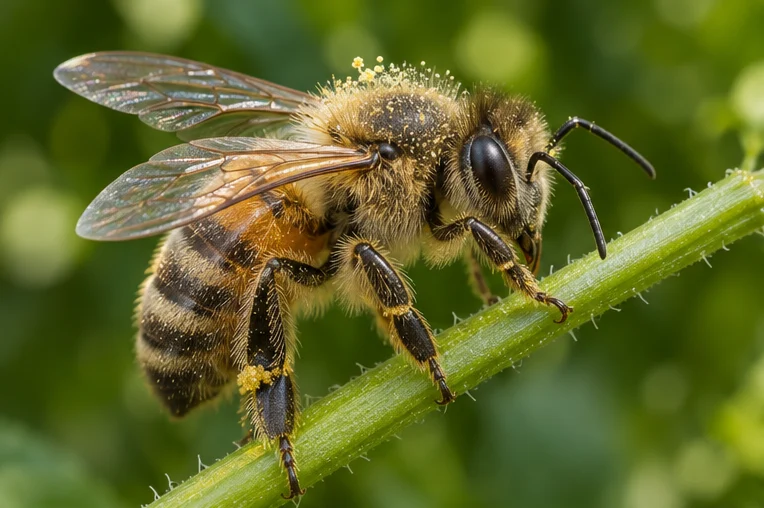
A bee leaves a flower with a pale streak between its wings and a thicker yellow patch on one hind leg. The streak tells you where something is visible in that view. The patch tells you something else about a different part of the bee. If both get entered as “pollen present,” you lose the difference that made the photograph interesting. If the back is called a safe site and the leg described as a packed load without enough detail to identify either, you gain certainty that the image did not supply. Keep the visible location, the possible identity of the material, and what happened to it as separate records.
The difference matters because a bee is not an inert surface. Material can adhere to its hairs, change position during grooming, go into a specialized carrying structure, or become available to a flower during contact. Each of those is a different event. A single image of a dusting is useful without showing where it came from, whether it can be groomed away, or whether any of it reaches a stigma. The strongest account starts from the geometry of the scene and then says what additional evidence would be needed to tell the next part of the story.
Toy visible pollen locations
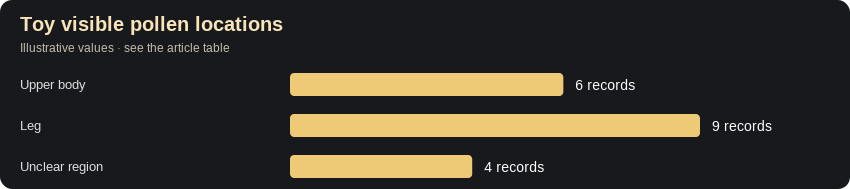
The chart and table show the same invented counts in records. These are fictional examples of observations assigned to one primary visible region under a teaching rule, not source observations, biological thresholds or an ecological estimate. The title uses pollen as a shorthand for the subject, not a claim that a photo alone identifies a substance. In a real photo log, describe an unconfirmed deposit as visible material or apparent dusting rather than certifying its identity.
| Main visible location | Records |
|---|---|
| Upper body | 6 |
| Leg | 9 |
| Unclear region | 4 |
There are nineteen illustrated records. The nine leg records do not show more grains or more mass than the six upper-body records. They do not establish that more bees carried pollen on legs, either, since records are not necessarily distinct individuals. Under the toy rule a record with a clearly coded main location has one label; a record that could not be placed goes in unclear region. A real project interested in both locations would often use independent flags and report when both applied. It could also count recordings in which each region was assessable. Those are additional data, not things that can be reconstructed from these three bars.
The unclear group has a valid observation in this example: a possible material patch was recorded, but its location could not be assigned at the desired resolution. It is not a count of bees with no material. Nor do the upper and leg categories certify everything on each insect. A side view may resolve a far edge of the back and one near leg while hiding the underside and the other legs. Use the view-supported location, not a hidden-body inference. An unresolved location can be the right outcome even when the photographer is confident the mark is real.
Tie the zone label to visible landmarks
An upper body label is broad. A more useful note might place a mark on the upper central thorax between visible wing bases, on the side of the thorax, or on the upper abdomen. These are not automatically equivalent patches. Some images can resolve the boundary between segments and others cannot. If the view is too oblique to say which region contains the patch, record the broad location or use an uncertainty field. Do not make the anatomical category more precise than the view because more precise names sound more credible.
A leg label can also be too broad for the intended comparison. A mark near the outer edge of a hind leg is not the same as material on a folded foreleg. Identify the leg, side and portion only when those distinctions are visible. It may be appropriate to say “near-side leg, segment unresolved” rather than guess hind leg from the color or size of the patch. Specialized carrying structures differ among bees, and an ordinary image may not show the diagnostic area. Referring to a leg patch as a pollen basket requires evidence of the relevant structure and its location, not simply a yellow color.
Perspective is the first test of a location claim. A leg held across the abdomen can appear to be part of the abdomen's outline. A folded wing can shade a patch or reflect light into the apparent back. A bright mark seen against the stem may belong to the stem rather than to the insect. If a sequence shows a feature moving with one body part as the bee changes position, that can help locate it. If only a still is available, retain the angle and degree of uncertainty. Do not force a definite location from a photograph that lacks the relevant depth cues.
An outline or arrow on a copy can make a zone easier to review. Keep the original photo and avoid cutting away landmarks such as wing bases or the point where a leg attaches. An arrow should identify a region rather than imply how the material arrived. State whether the region was at the visible centerline, simply near it in projection, or not possible to locate more closely. A clearly localized mark can remain unidentified. Conversely, a plausible material identification may not tell which underlying part is in view. Code the two judgments independently.
Separate deposit appearance, identity, and quantity
A visible dusting can have several explanations. It may represent pollen, other material, a highlight, or a feature of the body's own surface. Good light and a series of angles can show that a patch is associated with the body, though they may not determine what it contains. In some cases texture is clear enough to describe as granular; in others the patch is merely pale. Words such as apparent and unresolved are useful when attached to a specific limit. Do not assume a color common in flowers identifies a grain or identifies the plant it came from.
An apparent area is not a mass. A thin layer spread over a broad patch can look larger than a compact packet of more material. The same deposit can occupy more image pixels at one angle and fewer at another. Magnified previews can create an impression of individual grains that the instrument did not resolve. If a project has only photographs, describe area or extent only under a defined and calibrated method, or keep the description qualitative. Counting photos with material on a leg cannot tell how much material all observed bees carried there.
Distinguish loose material and a packed-looking load only as far as the image supports the appearance. A clearly defined compact feature may justify a note about its form. It does not tell when it accumulated. An image at departure from a flower can show the load near that moment, without establishing initiation at that flower. If the goal is to describe apparent change, compare the same side and region before and after under sufficiently compatible conditions. A darker area before arrival may have been impossible to judge. First visible and newly acquired are different entries.
The source is another evidential question. A bee might have visited several flowers before it appeared in view. Material could be on one part as it arrives, then be transferred to another part during or after the current encounter. A flower color that resembles the material gives a hypothesis worth checking but not a chemical or taxonomic identification. Avoid claiming a plant supplied all the material on a bee merely because both are in the same photograph. Give each known plant and visitor identity its own field and preserve the uncertainty about connecting them.
Read the safe-site study against the tested endpoint
Tong and Huang's primary study of safe sites of pollen placement compared body regions for how readily bumblebees groomed away a fluorescent proxy. The researchers also examined pollen placement and contacts with stigmas in four species of Pedicularis. That combination of measurements lets the paper ask a more specific question than “where does a bee look dusty?” It separately considers retention during the tested grooming observations, where pollen was found, and which parts of the bee the flowers contacted. A proxy's retention is not automatically an exact match for every pollen type, and the paper's measured sites are narrower than the whole upper body of an animal.
In the reported comparisons, some positions along upper and lower body regions were harder to groom than others, but most pollen did not fall within the hardest-to-groom classes in those four tested flowers. Nor were the sites most frequently contacted by the stigmas the safe sites in the reported comparisons. Those findings matter because they prevent an easy story in which every plant deposits all its pollen on unreachable patches. A difficult-to-groom site and a site that meets a receiving flower are different criteria. The study uses both to examine an ecological hypothesis; a still photo uses neither directly.
A related original study by Koch, Lunau and Wester examined ungroomed spots in the European honey bee and buff-tailed bumblebee and studied how floral structures could contact particular places. The researchers' approach provides stronger evidence for those cases than a one-frame deposit could. Differences between the tested flowers, species and methods are reasons to keep each result attached to its source. A photograph from a general garden watch is not a test of the label safe site. That term describes relative persistence under a defined grooming comparison, not a permanent property of everything visible on a bee's back.
One source can use the word safe to refer to known difficulty of removal, another to a combination of retention and access by a flower. Check the measured quantity before carrying the term across studies. If a project simply records whether material lies on an upper body zone, there is no need to code sites as safe at all. The potential relevance can be discussed separately from the observation. This makes it possible to appreciate the finding that position matters without claiming the research measured your particular image.
Read grooming research as a measurement of movement, not a label for every photo
Amador and colleagues' primary study of honey bee hairs and pollen grooming examined aspects of pollen capture and removal, including the spacing of hairs and the contribution of the sticky material known as pollenkitt. It addressed the quantitative mechanics of particular interactions in honey bees. The paper supports the idea that body surface and movement affect pollen retention and removal. It does not provide a universal conversion from how bright a patch appears to how easily it will be groomed, and it does not justify transferring a result about a specific leg or surface to every kind of bee.
The easiest confusion is to treat a snapshot as a rate. A photo can show a mark during one pause. It cannot by itself estimate how long the material has been there or how fast grooming might remove it. A short sequence could document a leg sweeping past a region. If the view does not resolve contact or change in the deposit, it is not a direct measure of removal. If it does resolve a visible change during contact, keep the sequence as evidence about that event while leaving identity and quantity to measurements that can support them.
An apparent loss can have many causes. The bee can rotate, the illumination can shift, or the surface can pass out of focus. Material could also fall, be moved toward another place on the animal, or become obscured by overlapping hairs. Record what changed in the same visible region and where continuity was lost. Even if the patch is genuinely no longer visible, the photograph does not necessarily show the destination of what was there. A statement such as “not visible after the sweep in this view” is more precise than “all pollen was removed.”
Similarly a visible patch that persists through a pause has not been shown impossible to groom. The observer may not have seen a qualifying grooming movement at all. The relevant movement could happen later or be hidden on the far side. A valid estimate of retention requires defined observation opportunities and enough evidence to compare the same location before and after the relevant action. A brief consistent image can still be useful as a lower-level observation of apparent persistence during the visible interval. Name that interval and stop at its edge.
Give deposit and pollen transfer different verbs
Pollen on an insect and pollen delivered to a recipient flower are not equivalent observations. A grain may be retained without ever touching a suitable stigma, or it may be carried in a position with limited availability to particular flowers. A documented contact at a plausible body zone can support a hypothesis of transfer without showing whether any grain moved. Establishing deposition requires evidence about the receiving structure and material in the studied event. Fertilization and later reproductive outcome are further questions, not consequences to assume from a photograph of contact.
The effect of placement depends on the fit between flower and visitor. A region may be hard to reach with legs but also rarely contact a given flower's receiving surface. Another could encounter that surface frequently despite being easier to groom. Those are distinct advantages and constraints. Tong and Huang's comparisons show why it is valuable to ask about both rather than assume that every persistent patch is a favored destination for plants. The study conditions matter. A broad photograph of the body does not contain a map of every possible floral contact.
A primary study comparing carried and body-surface pollen examined differences between pollen in provisioning structures and pollen elsewhere on individual bee bodies. That distinction helps a field observer keep the coating and transport questions separate. A visibly bulky load says little about how much material is available for transfer on the surfaces a flower actually contacts. Avoid the opposite absolute claim too: a leg is not automatically irrelevant to all floral interactions. Match the statement to the species, region, contact and outcome the evidence covers.
A useful caption can name more than one layer without merging them. For example: “A light patch was visible on the upper thorax near the wing bases. Contact with a flower was observed earlier in the same sequence, but transfer to or from that patch was not resolved.” This wording preserves the notable position and sequence. It does not tell the reader how much pollen the insect removed, when it deposited pollen, or whether the flower was pollinated. A carefully bounded statement is often more useful for a biologist than an enthusiastic guess.
Make exposure and body position visible in the denominator
Some parts of a bee are easier to see routinely. A side view may make a near leg conspicuous while the upper centerline under the wings remains hidden. A view from above can document the dorsal area well and obscure both legs in shadows. Comparing visible deposits from such records without accounting for opportunity can turn a viewing preference into an apparent body-zone pattern. For each zone, note whether it could be assessed independently of whether a mark was found. That way a valid visual nondetection can be distinguished from a region never in view.
In a real observation log, decide whether the unit is a frame, a sequence or a visit. Several close photographs taken in one visit can all show the same patch. Counting them as independent occurrences makes a well-photographed bee look common in the sample. The toy chart refers only to records. A fuller study might choose one qualifying view per encounter for a particular zone or use several views to complete that encounter's coding. Neither approach identifies distinct animals by default. If the same-looking bee returns later, do not infer its identity from appearance alone.
Keep planned watches apart from opportunistic clips. A naturally striking leg load may be easier to notice and more likely to prompt a photograph. That makes the resulting image useful as a specific example and a poor basis for estimating how frequently comparable leg loads occur. If estimating frequency is appropriate, design a record of observation opportunities before selecting subjects or visible features for attention. Record the unusable sequence count as well as the usable count. Any rate should name whether it describes all attempts, completed views or qualifying views of a particular region.
A comparison can include an example like this: twenty ordinary sequences were obtained, fifteen show the near leg in usable detail, and only eight show the upper thorax well enough to assess a small deposit. Those denominators are already different before the mark counts appear. The subset with both regions assessable can address a matched visibility question, but there may be few such records and they may favor a particular posture. Report the scope of the subset. Do not treat missing zone assessments as zero deposits or assume that all differences reflect where material accumulated.
Keep uncertainty about the photos distinct from uncertainty about nature
A label such as “unresolved” should have a reason. Motion blur compromises location differently from overlapping anatomy. A pale feature backlit strongly may be visible but hard to identify. A crop might remove the reference points needed to place it; the original may still be available. Identify the specific reason so a future reviewer can tell which part of the comparison might be improved and which biology simply was not measured. An honest record of photo limitations does not claim that the underlying behavior was itself unusual.
Pictures can be excellent and still miss a key event. A sharp view after grooming cannot show what the patch looked like before, unless another compatible view exists. A sequence of one side can miss an action on the other. Use the actual timing and viewpoint when discussing changes. A mark that seems to vanish in one frame may be visible in a later comparable pose, which suggests a recording issue. If there is no later qualifying view, leave the change unresolved rather than fill the missing segment with the most plausible motion.
Try a worked review before deciding how to code the archive
Take a fictional image from slightly above and behind. The near wing is visible and the base of the far wing is partly hidden. A faint bright region lies between them. The reviewer can say upper body near the wing bases. If the midline is not resolved, they should not assign the exact location tested in a published safe-site comparison. A mark appended to an annotated crop can help a second reviewer find the same location. Keep a view note so a later reader does not mistake a broad region for a precisely measured anatomical patch.
Consider a second fictional sequence with a visible near leg at departure and a compact yellow mark associated with it. On arrival that leg was folded and concealed. The observer can code leg as the location in the exit view. The evidence does not show that the mark appeared during this visit or that the whole patch is pollen. A separate label such as compact-looking is possible if the form is resolved. Compare what is known now with what was knowable before; the difference in camera view is not an estimate of the change in the deposit.
A third record has a bright area where a foreleg overlaps the thorax, and motion makes the attachment points unclear. If the observer can identify a mark but cannot distinguish its location, the example belongs in unclear region. Counting it as an upper-body deposit just because that is where a safe site is expected would use the hypothesis to assign the evidence. If a later compatible frame reveals which part moved with the feature, the reviewed outcome can change. Retain why it changed. An independent reviewer should be able to reproduce the original interpretation and the reason for its revision.
Now consider an image that shows a view of both a near leg and the dorsal body, with convincing visible marks on both. A one-label chart needs a rule for choosing its main label or an additional mixed category. A detailed archive can save both findings and derive any exclusive summary later. That avoids destroying useful information to fit a requested figure. The numbers in the toy chart describe a particular coding scheme, not an ideal to impose on all field records. Choose a display that lets readers understand whether two bars could count the same event.
Compare contact geometry without borrowing a later outcome
If footage includes a clearly visible floral structure, link it to the area of the insect it appeared to touch. Do not assume the closest structure in a photograph is the one that made contact. A skilled botanical identification can clarify which structures deliver and receive pollen. The visible action still needs its own evidence. When foliage hides the exact touch point, describe the approach and the plausible contact area instead of choosing a point by the map of an idealized flower. A motion sequence or a clearly timed view may support one type of contact while leaving other parts unresolved.
A useful comparison can ask whether similar postures repeatedly place the same visible body zone under a flower feature. That result is about alignment under the conditions observed. It does not reveal whether the same patch will contact a different flower later. As flowers and visitors vary, the geometry may change. A carefully documented account can show where consistency was observed and which additional comparisons would be needed. Do not use persistence of a mark across one interval as evidence of delivery across another.
When reading an original study that directly examined deposition, preserve its unit of outcome. A transferred particle in a proxy test can inform contact geometry, but is not automatically a viable pollen grain. A count at a recipient may reflect only the specified visit or treatment if the study could distinguish that contribution. If no such evidence is available for the field photo, keep the paper as explanatory context, not as a measurement of that photo. A reader may value a strong research result without needing it to describe every similar-looking scene.
Keep the observation nonintrusive
Observe from an ordinary permitted place. Do not catch, restrain, swab or dust a bee, or add material to a flower to test where it appears. Do not block or pursue visitors to obtain a hidden view. In a natural-history project the lack of access to the far side is an acceptable limit. Existing controlled research can help explain what a stronger comparison can establish without becoming an invitation to repeat it. If photos available without disturbance do not resolve the location, choose a broader category or leave it unclear.
Keep enough context for a second person to check the original sequence. Record time, setting, basic identifiers, viewpoint, zones that were assessable, material appearance, and any observed movements or contacts. A planned coding exercise can use existing photos or fictional scenarios to test whether observers agree on definitions. Ask which landmark supports each location and which stage of an event was actually visible. If they cannot answer, a more precise anatomical term is not better. Narrow the claim and preserve how the measurement was made.
Make an image-to-record audit before translating the findings into prose
Save a stable event identifier and the original frame sequence, if one exists. Assign a separate identifier to annotated or cropped copies. A table can then point to the original segment that supports a claim, while an arrow or enlarged view helps a reader find it. Do not allow annotations to replace the underlying source. An editor may brighten the image for accessibility yet make an ordinary highlight look like a granular patch. If a material judgment depends on a heavily processed copy, check whether the same feature can be distinguished in the original.
Record visibility by zone, not just overall clarity. A frame with excellent focus on the flower may show the bee's outline without enough detail to assess the hairs. A clear view of one leg does not show the corresponding area on the other side. A note that calls the whole event clear because one body area was visible creates an overly broad denominator. A small matrix with each region marked observable, not observable or uncertain can make these limitations explicit. Use the region labels consistently after deciding which distinctions the available images routinely support.
Have two reviewers label a small set of existing records without seeing the proposed ecological explanation. Ask them first to locate the observed patch, then to describe its appearance, and only then to consider whether the record supports a more specific interpretation. The order matters: a reviewer expecting an ungroomed midline patch may locate an ambiguous bright area nearer that line than a reviewer given no hypothesis. Honest disagreement can reveal the need for a broader category. Document an updated rule, rather than overwrite old entries so the original ambiguity vanishes from the archive.
A useful test record might show a clean-looking upper thorax in a well-resolved view and no view of the legs. The correct result is no apparent material recorded on the inspected upper area under that view, and an unknown leg status. Another record might show a conspicuous leg patch and an obscured back. These are not opposite outcomes in a complete cross-body comparison. They are different evidence opportunities. Where a chart shows an exclusive location code for a record, keep the visibility states available underneath so someone can inspect how the tally was built.
Distinguish a change in apparent distribution from a change in the animal
Suppose the first ten records were shot while bees climbed upward, mainly exposing the sides and legs. The next ten were recorded after the observer moved to a position from which the back was usually visible. The later batch may contain more upper-body material records even if the underlying distribution did not change. Compare what was visible before interpreting the shift. If comparable body-zone views exist, consider a separately labeled matched subset. If not, report the difference in evidence rather than infer a change in grooming or collection. Do not use the old chart as a benchmark for a new observation method without checking its scope.
The same issue arises when comparing bee groups. Different size, shape, posture or flight patterns can affect how much of an insect is visible. A broadly similar view may show a large visitor in enough detail to resolve a faint patch but show only the outline of a smaller one. Comparing their recorded marks without noting that limitation could confuse detectability with ecology. Preserve each group's count of qualifying observations and avoid drawing a conclusion from the apparent sample size alone. The photo is a real observation; treating it as an equal opportunity to see every relevant part is a separate assumption.
It may be possible to state a useful result with no comparison of biological frequencies at all. For instance, a teaching collection can demonstrate that an upper-body patch, a visible leg load and an ambiguous overlap are three distinct kinds of record. The outcome is improved interpretation, not a claim about how common each site is in any population. If a quantitative project later takes up the question, it can use those examples to define its coding agreement tests. A photo log does not need to claim broad ecological prevalence to be scientifically literate.
State what would change the interpretation
A whole series may document an area of apparent persistence without providing a valid comparison of grooming reach. If the bee never made a movement the project could identify as relevant grooming, the material was visible over the observed interval and that is all. If the bee made such a movement but both the patch and leg were obscured at the important moment, the observation addresses behavior and not the change in material. If the same patch remained visible and unchanged through continuous adequate views, that could support an apparent persistence observation during that event. None is a lifetime property of the patch or proof that the animal could not remove it later.
Consider the alternative that apparent remnant material is from a new contact. In an uninterrupted sequence, note natural contacts and changes rather than compare only the first and last frame. If a bee contacted another flower between the views, persistence and replacement may be hard to distinguish. If no additional contact was visible, the evidence may favor one explanation, but still does not identify individual grains. These limits can be written plainly. They help another person understand why a careful record left a reasonable biological question open.
In a follow-up using the same archive, make comparisons where body regions can be linked in the same individual and near-equivalent poses. If that subset is very small, show it as examples rather than treat it as a robust estimate across all visits.
A project that shows several kinds of evidence may mark each transition on its own timeline. The material was first visible at one frame, a grooming action was visible later and a flower contact occurred after that. Time order can make a proposed explanation plausible, but it cannot show the direction of material movement when key details were hidden. If the event concerns a different plant at the later contact, record that plant identification separately. A single name for the first flower does not provide the source of material or the identity of the subsequent recipient. This preserves the difference between an orderly sequence and a measured transfer.
It can also be useful to keep negative observations tied to the specific area inspected. The absence of a visible patch in one sharp view does not show that the area was clean at the resolution of individual pollen grains. State the smallest type of feature that the available image can credibly distinguish without making up an exact resolution. A comparison of compact patches may be possible where a comparison of fine dusting is not. This limitation is specific enough to guide a future watch and does not demand that the observer disturb an insect for a better view.
Check the direction of the claim one last time
A careful two-sentence note might read: “Loose-looking pale material was visible on the upper body in the departure view, and a compact-looking feature was visible on one leg. Material identity, change during this visit, grooming persistence and deposition were not determined.” If only the leg is known, say just that. If transfer is documented in a separate original study, describe what was measured there and do not attach it to the pictured animal. A compelling image and a good study can complement one another without being treated as observations of the same event.
For the illustrative chart, give readers the 6, 9 and 4 counts as records classified by visible scope. That sentence should travel with the figure if it appears by itself. Avoid short labels such as efficient pollination beside a categorical picture; they name outcomes not in the tally. The defensible conclusion retains the exact place where something was seen and refuses to supply the missing journey. A good field record can tell us about the back or a leg without telling us all that the bee did afterward. Preserving the narrower result is how an observation becomes useful evidence.