
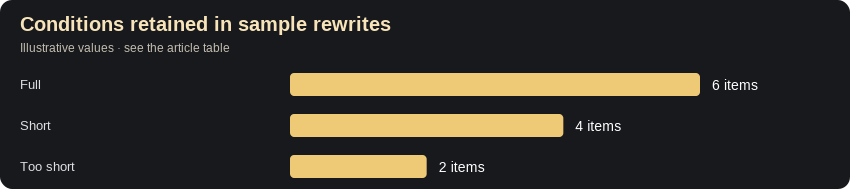
| Category | Value (items) |
|---|---|
| Full | 6 |
| Short | 4 |
| Too short | 2 |
Constructed checklist scenario for this brief, not measurements, ratings, or results from cited sources. Each displayed count represents checked items in the named example.
The newsletter arrives on Friday. Its headline says to sow the new observation strip this weekend. By Saturday morning the beds are still waterlogged, the volunteers have brought an unapproved mix, and half the group thinks the instructions apply to the trail verge as well as the garden. The editor did not intend any of those things. They were ruled out in the original notes. They disappeared when the long recommendation was reduced to one decisive sentence.
Plain language is supposed to help people act on an instruction, not simply help them reach the end of it faster. If a short version changes who should act, where, when, or under what conditions, it is a different recommendation. That can be a perfectly legitimate decision when a project genuinely changes its rules. It is not a harmless side effect of copy editing.
This guide offers a way to shorten instructions while preserving their scope. It follows a hypothetical garden through three versions of one notice, then works through editing decisions that arise in cards, newsletters, translations, and instructions shared between organizations. The garden rules below belong to a fictional exercise. They are not planting advice for a particular species, region, or month.
Separate wording from the decision it describes
Take a piece of garden guidance that sounds wordy. The tempting first question is “What can I delete?” A more productive one is “Which details could change what someone does?” A short planting notice can contain at least four kinds of material: the requested action, the conditions for taking it, an alternative if those conditions are not met, and reasons for the recommendation. They do not all need equal space. But it helps to separate them before deciding what belongs in an opening sentence, a follow-up line, a heading, or a linked explanation.
Start with the action at the level people can actually use. “Populate the habitat strip” could refer to planting seeds, moving pots, scattering material, or scheduling someone else to do it. “Sow the marked strip with the approved mix” gets closer. Then identify the unit of the action. Is it the marked strip from end to end, only the compartments in one color, or any bed that is available? Someone who can answer that question in the office because they have seen the site plan cannot assume a weekend volunteer can do the same from a forwarded notice.
Conditions are different from descriptive details. “The strip lies behind the cedar screen” helps locate it; “sow only the marked strip” limits what the instruction authorizes. “The crew often works on Saturday” is a habit; “sow during the scheduled work session” limits when to act. “The mix bag is brown” describes an object; “use only the approved mix” rules out substitutes. To tell which kind of detail you are reading, construct two cases that differ in that fact. If it flips a yes to a wait or a no, it probably needs to survive the edit in some usable form.
Reasons can make a statement persuasive, memorable, and easier to apply in an unusual case. They can also crowd out the actual rule if the deck is short. A good revision may move a paragraph about why the garden tracks planting locations to a “Why we mark the strip” explanation below the instructions. It should not delete “only the marked strip.” The project can explain that qualifier elsewhere at more length, but the immediate decision still needs the qualifier at the point where a person chooses which ground to disturb.
The federal plain language guide series leads to official Digital.gov guidance on writing, designing, and testing for intended readers. The CDC Clear Communication Index provides an official framework for evaluating public communication. Its public-health context is different from the garden example, but the attention to what readers understand is useful here. Neither source publishes the fictional rules in this article, validates the chart, or establishes that garden notices should have six conditions. The six are a local editing demonstration.
Work through the six garden conditions
Imagine a coordinator sends the following meaning to an editor. During the garden's designated autumn sowing window, volunteer participants may sow one marked observation strip in the community garden. Wait until the ground is no longer waterlogged, and use the packet containing the locally approved seed mix. The instruction applies to approved volunteer sessions. If the site coordinator has paused work, do not sow until the coordinator lifts the pause, even if the other requirements are met. This fictional notice is meant to allocate volunteers and make observations comparable, not to tell anyone how to grow a real plant.
For this exercise, reviewers wrote six checks. The scope is the marked strip. The season is the designated autumn window. The ground must not be waterlogged. The material is the approved mix. The occasion is an approved volunteer session. The coordinator's pause is an exception that overrides the affirmative statement. These are separate checks even if a real team schedules all eligible sessions in autumn. The overlap in one year's practice does not make the meanings interchangeable. A future autumn visit outside a session would still differ from a scheduled session, and a session offered outside the window would not itself extend the window.
The original notice can preserve all six without a long abstract introduction: “Sow only the marked strip. Use the approved seed mix at an approved volunteer session during the autumn sowing window, and wait until the soil is no longer waterlogged. If the coordinator has paused work, wait until the pause is lifted.” That is the exercise's Full version. It is not especially long, yet it names both the normal case and the override. In distribution to real readers it would also need dependable ways to identify the current window and approved sessions; the exercise assumes those terms have known referents.
The first shortened notice says, “During the autumn sowing window, sow the marked strip with the approved mix. Wait until the soil is no longer waterlogged.” It retains four checks: location, season, soil condition, and material. It does not require an approved session. It does not mention the pause. A volunteer with the right seed and a dry strip might use this version when work has been paused for an unrelated reason. The editor has not simply removed two details; the short version authorizes a case the full version prohibits.
The Too short version says, “Sow the marked strip in autumn.” It preserves the location and a seasonal constraint but loses the soil, mix, session, and pause conditions. For this toy exercise “in autumn” refers to the already designated autumn window known to its recipients. In a real notice that phrase can easily overstate the time range. If the approved window is narrower than the ordinary meaning of autumn, the version would not pass the timing check either. The count of two is therefore tied to this fictional reader context, not a claim that those four words preserve a precise date range in actual use.
All three notices name the action. We deliberately do not count the action as one of the six conditions. The difference matters for reading the chart: the bar can fall even though every version still tells someone to sow. An editor assessing only whether the draft contains an understandable verb would miss most of the scope change. Score separately whether the instruction has a clearly stated action, whether the correct limits survived, and whether a reader knows what to do when a limit is not satisfied.
Read the chart as a preservation test
The companion bar chart, “Conditions retained in sample rewrites,” counts the checks retained in each fictional version. Full retains six, Short retains four, and Too short retains two. The unit is items out of the same six. Short removes the session requirement and the pause override, while Too short removes two more conditions, soil and material. These are constructed counts from text that can be read here. They are not measurements from the CDC, the federal plain-language guide, volunteers, or any real garden.
A lower bar is not a better readability score. A higher bar is not proof that a reader understood the notice. The tally treats each retained condition equally to make the arithmetic transparent, even though an explicit stop order might be far more consequential than the location reminder. Another editing exercise could weigh conditions by consequence, but would need to say how those weights were assigned. For a field notice, it is often more useful to identify a single removed condition by name than to report the total alone. The chart is a quick view of preservation, not a substitute for judgment.
Notice that “Full” does not mean “the best possible writing.” It means the reference text contains the complete six-condition meaning used in this example. A revised notice could be shorter than Full and retain all six. For instance: “At an approved autumn sowing session, use the approved mix on the marked strip only if the soil isn't waterlogged. If the coordinator pauses work, wait for clearance.” This version keeps the official window if, in the project, an approved autumn sowing session is defined to occur within that window. Where no such definition exists, write “during the autumn sowing window” explicitly to avoid depending on an inference.
One way to record this audit is to note not just whether the words remain but how an actual case would turn out. Test an approved participant who arrives early on a day that is not an approved work session. Test a group that has permission to use the garden but not to disturb the unmarked verge. Test dry soil while a pause remains in force. An edit passes a condition only if it still guides the reader to the same intended action in both the ordinary and exception cases. A retained keyword inside a paragraph can be too vague to accomplish that. “Pause” in a sentence encouraging people to take breaks does not communicate a coordinator's stop order.
In a real project, allow for unresolved conditions rather than forcing all evidence into a binary check. A phrase might name a threshold that the editor cannot interpret, a site label that a new volunteer cannot find, or a schedule whose current version is unavailable. Mark those conditions as unclear pending verification. A manager deciding what to release needs to know why a condition failed: deleted, ambiguous, in conflict with another line, not discoverable, or dependent on information nobody has checked. The chart uses clear examples so it can be read without that extra uncertainty.
Know when a qualifier is a gate, and when it is only advice
Conditions do not all operate in the same way. “Only if the soil is not waterlogged” makes a gate. It is not a friendly reminder people can ignore after waiting a week. “Prefer the east side of the bench if both sides are free” is a preference with a fallback. “Ask the coordinator if you cannot tell which strip is marked” is a recovery path. An editor who substitutes “consider” for “wait” has changed the strength of the instruction. A soft, approachable tone is compatible with a clear limit.
Likewise, avoid making an ordinary preference sound like a prohibition. “Morning is often easier for volunteers” does not mean afternoon work is forbidden. Copy that says “Only sow in the morning” has added a rule with no support. You can write a helpful preference and keep it in its proper category: “Most groups choose the morning session. Afternoon sessions also count if they appear on the approved schedule.” That wording gives an example without creating an artificial deadline.
Exceptions have priority. If conditions are grouped with “and,” readers should be able to see that each normally has to hold. If there is a stop rule, place it next to the permission rather than in a distant discussion of logistics. “If work is paused, do not sow” is shorter and clearer than a long phrase that makes the restriction look like an optional consideration. The intended condition to resume work should be equally clear. “Wait until conditions improve” is not a substitute for “wait until the coordinator lifts the pause” when both drought and a non-weather shutdown are possible.
Logical shortcuts can fail in rewriting. Replace “do not sow if the strip is unmarked or work is paused” with “sow if the strip is marked or work isn't paused,” and you have changed which cases are allowed. In the first instruction either problem stops the work. Its equivalent positive formulation needs both a marked strip and no pause. The word choices are not theoretical when instructions are read quickly. It is easier to use one short sentence per decision than to hide an altered logical relationship in a polished sentence with several negatives.
The intended reader also matters but should not become an invisible condition. A phrase like “approved session” may be a shared shorthand among established volunteers. In an invitation forwarded to neighbors, there may be no way to identify what the term means. Explain the type of schedule or named organizer, and provide a current route to confirm eligibility when that is needed. If the guidance is only an internal instruction, label it accordingly. Do not let an internal group assume a public rendering carries knowledge that has never been published.
Put the key limit where the action appears
The most important qualifier belongs near the words that invite the action. A big heading that says “Sow this weekend” and a lower paragraph that says “Do not sow if the coordinator has paused work” can be worse than a neutral heading if readers only see the preview. They have already been given a command. A clearer heading could be “Sow only during approved sessions” or “Check the sowing window and site status before you plant.” Choose the wording that prevents the wrong assumption in the first place, then explain the normal process.
In a longer article, a short first paragraph can give the action and the dispositive stop conditions. A list can supply routine prerequisites or details needed to identify approved material. Use a separate heading for what to do if the action cannot proceed. This distributes information without separating a promise from the limit that controls it. A person who reads the first section can tell whether to keep going; someone who needs the recovery path can find it without scanning a general explanation of the project.
A brief social post or card is more limited, so change the job of that surface. If eight words are available, the card might appropriately say “Check whether your garden strip is ready.” It can lead to the full decision aid. It should not claim “Plant today” unless the necessary conditions can travel with the instruction and the publisher can support that claim at publication time. Good compression sometimes means replacing an instruction with an invitation to check, not hiding the instruction's assumptions in the link behind it.
An infographic or screenshot does not automatically make a qualifier visible to every reader. A phone preview may crop the bottom lines. A shared excerpt may omit the picture entirely. Some people encounter the material through a spoken rendering or a news feed that keeps only text. Essential limits should remain readable in the formats people use to make decisions. Don't solve a space problem by putting the crucial negative condition in tiny print. Test the same action across the article, card, attachment, and spoken or translated versions where they exist.
An ordinary edit can preserve scope while improving the headline. “Important restrictions and prohibitions on volunteer sowing activities” says little to someone trying to decide what to do. “Before sowing: check the strip, session, and pause” offers a usable plan. The following sentence can name the ground condition, window, and approved material. A headline can support the next step without doing all the work. The choice is not between an exhaustive title and a dangerously broad one.
Treat a missing observation differently from a failed condition
Readers do not always know whether a condition holds. The example group can tell that a coordinator had posted a pause yesterday, but nobody knows whether the post was replaced this morning. A volunteer sees a bag by the shed and cannot tell if it belongs to the current approved lot. Someone walks the path after a shower and sees standing water in a neighboring strip but cannot safely examine the target from the path. A notice that covers only known yes and known no cases does not yet answer what to do when verification fails.
Write an explicit uncertainty branch where a guess would have consequences. In the fictional garden, the coordinator might decide to defer work whenever pause status is unknown. The editor can then say, “If you can't confirm the pause has been lifted, wait.” This is not automatically the right decision for every project. Sometimes a small delay has a much bigger consequence than acting under uncertainty, and an authority may provide a different rule. The editorial job is to identify the need for a decision, record the approved policy, and phrase it plainly rather than inventing a fallback.
Likewise, distinguish an unsatisfied condition from current evidence about it. A person reading “the soil is wet” may be receiving a field observation, not an instruction to stop. A person reading “wait until the soil is no longer waterlogged” is receiving a rule. The exact relationship between the two depends on how the project explains waterlogged conditions. Ordinary wetness and the project stop criterion should not be treated as synonyms just for brevity. If the project has a physical test or an approved marker, use the actual wording and avoid adding invented safety thresholds.
A foreign or remote editor can ask useful practical questions. Who can verify an approved session? Which document is considered the current schedule? Does the person holding the old notice have a way to know it no longer applies? If the answers are unclear, polishing the imperatives will not solve the information gap. A short “Check the current volunteer schedule at the garden entrance before you sow” can help only if the entrance list actually contains the needed information and is accessible when people arrive. Confirm the route rather than leaving a decorative link to a general site.
Do not add real-world technical facts that the source did not supply. If a garden specifies an autumn window, do not infer that any variety should be sown before a named frost date, or that a given regional calendar applies. An editor is improving the description of the local procedure, not publishing an independent agronomy ruling. In agricultural, conservation, and other applied guidance, names of places, time windows, permissions, and thresholds often serve a different purpose from background information. Treat them as details to verify, not knobs to adjust for a smoother sentence.
Use a transition sentence instead of hiding the reason
Some exclusions sound arbitrary when every explanation is stripped out. A reader may wonder why the unmarked verge is off limits when it seems identical to the marked bed. If the reason is verified and can be stated publicly, place a compact explanation right after the rule: “Sow only the marked strip. The other ground is not part of the observation plan.” This gives a reader a reason to respect the boundary even when the exact two sentences are not on the sign. It does not invite them to decide that another strip seems scientifically close enough.
A useful explanation preserves the intended relation between rule and reason. If the boundary is partly a permission issue, avoid implying that it is purely a data-quality choice, because a volunteer may think they can waive it when comparison does not matter. If the pause protects equipment during survey work, don't say the pause lasts until soil dries unless the coordinator actually set that condition. Simplification can invent reasons as well as remove conditions. When the reason cannot be shared or is not documented, it is better to state the authority and action correctly than to supply a pleasing story.
In a public article, some readers are learning concepts and others are following instructions. One layer can tell volunteers exactly how to decide, while the next explains why the organizers designed the procedure that way. A paragraph about comparability belongs close enough to inform understanding without delaying the gate in urgent use. A discussion of other possible methods can go later under “Other sites may use different rules.” Distinct sections prevent readers from mistaking a comparison of approaches for a choice available within the present project.
This separation is also useful when the project broadens. An example from one bed may help explain why a status note exists. It should stay labeled as an example when the same guidance is reused at several sites. Replace “our south strip” with an accurate site-specific reference in each local edition, not a generic “the garden” if more than one area is in scope. Where a shared manual describes a decision pattern, have local pages provide the actual approved window and the current authority for pauses. Reader-friendly guidance can be modular without being vague.
Test cases that disagree with the headline
Begin a review with a case that should proceed. The person is at an approved session in the autumn window, the strip is marked, the soil meets the garden's condition, the right mix is present, and no pause applies. The Full notice makes it possible to take the intended action. Next, change one feature at a time. The strip is not the marked one. A session happens outside the window. The soil is still waterlogged. The packet has not been approved. The person is outside a session. The coordinator has left the pause in force. In every case, the action should change. If the edited notice gives a misleading yes for any case, it no longer says what the reference notice says.
Use a few combined cases too. Wet soil and an active pause may give the same immediate result, but different routes to resume. Drying does not lift the pause; lifting the pause does not make waterlogged ground acceptable. If a sentence says “wait until the issue is resolved,” it should make clear which issue must be resolved when there are several. A sequence of separate checks can make this easier to see than an elaborate definition of readiness. Test current state and future state, not just an isolated snapshot.
Then ask a colleague who was not involved in the writing to use the notice. Do not teach them the missing condition before giving the example. Ask what they would do and what in the notice led them there. Compare how they respond to “Saturday morning, right seed, normal strip, no listed session” before and after your edit. If they ask where to look for the schedule, the wording may preserve a conceptual condition while failing to supply the operational information needed to verify it. That is a valuable result, not evidence that the colleague read badly.
When the instructions are brief enough to fit on a card, perform the test on the card alone and on the full path it opens. Can a person recognize they should first check whether the work is approved? Does the clicked page put the current conditions immediately in view? Can a photo or shared screenshot still mislead by cutting off a second line? Take the trouble to distinguish an informational card that points to guidance from an instruction that tells someone to act immediately. They can both be useful, but the burden of carrying conditions is different.
Test in translations using the same decision scenarios rather than a word for word comparison. A translation may distribute the conditions into a heading and list instead of one sentence. That can be correct. A word chosen to soften the tone can turn “only” into “usually,” or a seasonal label can acquire different local meaning. Ask a reviewer to identify the allowed behavior in each case, especially where a stop condition overrides other evidence. The shape of the sentence can change as long as the behavior, authority, and limits remain recognizable.
Keep feedback specific. “The lead is unclear” gives a writer little information. “In the one-line email subject, a participant thinks the general autumn season is sufficient even on a cancelled workday” gives an exact misunderstanding and a surface where it occurs. “The sign mentions approved material, but at the shed none of the bags can be connected to that name” reveals a problem beyond editing. Team members can then decide whether to revise the notice, improve labels, or both. A successful edit is one where readers can understand and use the correct distinctions in the environment where the instructions matter.
Preserve meaning when organizational ownership changes
Instructions may begin on a coordinator's worksheet and end on a community partner's site. The partner may own the layout, but not the meaning of a project's eligibility rules. Give the receiving editor a plain explanation of which facts are fixed, which details can be made local, and who verifies current dates or changes. A shared draft can distinguish source facts, recommended language, and notices that are waiting for approval. This prevents a well-meaning copy editor from extending the project season because a different event calendar looks easier to read.
Separate editorial and substantive approval. The author can shorten “the soil must be free of extended waterlogging” to an approved project term if the procedures say how volunteers recognize it. The author should not replace it with a numerical threshold remembered from another guide. If an approval is pending, mark the clause clearly and avoid publishing a seemingly complete instruction with an unresolved number. Use an accurate placeholder only in a private draft, or choose public wording that honestly directs the reader to a named authority after verifying the route.
The same discipline helps when a condition is intentionally changed. Say the garden decided that supervised sessions scheduled outside the old window now qualify for a different trial. Revise the action and conditions at the source, update the guide and derivative materials, and check whether older copies are still circulating. Do not treat the new wording as a synonym for the old wording. A revision note can say what changed, for whom, and since when. If historical results still used the old rule, keep that distinction available to readers comparing records across seasons.
An audit can remain lightweight. Write down the reference recommendation, the short version, and the cases that must resolve the same way. Record an explanation for any legitimate change in behavior. If a notice moves from an official garden page to a partner newsletter, establish whether the newsletter is making an instruction itself or inviting people to consult the current official guidance. Check for name changes, date rollover, and ambiguous “we.” The same pronoun can point to volunteers, members of the public, the partner, or a garden worker depending on where the notice is placed.
Use a small decision card without overloading it
A field card can start with the choice most likely to prevent a mistake: check that work is open. It can then give the bounded action and visible prerequisites. In the fictional garden, an iteration might read: “Work paused? Don't sow. At an approved session during the autumn window, sow only the marked strip with the approved mix. Wait if the soil is still waterlogged.” Add one genuine route for confirming current status if it cannot otherwise be known. This card puts the override first, without requiring an explanation of the entire observation project.
If the space is shorter still, split the job between two surfaces with honest names. A tiny sign might say “Sowing instructions and current work status,” followed by a way to reach them. A linked page then carries the action and the thresholds. A label such as “Ready to sow” would be inaccurate if readiness varies with each session. If the only full instructions sit behind a path requiring a device, connection, or unfamiliar account, think about the people who need them without those resources. The editorial problems of reach and verification are not solved merely by making a short label fit.
On a newsletter, leave the policy summary in text even when the visual includes the same message. A photo can provide recognizability, but text in the actual message helps when images are omitted or cropped. A short subject may focus on the upcoming work rather than authorize it. “Autumn strip: check the next session” supports the choice without trying to encode the whole rule. The first paragraph can supply details in the order people need them. If an edition is forwarded weeks later, a reference to “this weekend” may be misleading; specify or link the intended date, depending on what the edition promises.
A spoken version needs particular care with grouped conditions and pauses. A sentence with five clauses that looks reasonable on paper may be hard to hold in memory. Say “First, check that work isn't paused.” Then state the time, place, and material. Separate the reason and repeat the central action only if useful, rather than relying on speed to keep the segment short. Someone hearing a brief site announcement may not have the opportunity to reread a subordinate clause. Test the spoken version as an instruction, not merely as a faithful reading of a printed paragraph.
Decide what not to claim about the edited notice
The chart at the start can tell a project that two short versions discarded specific conditions. It cannot tell which version readers like, how long they took to follow it, or whether participants behaved as intended. Those would require different observations. A task test with two volunteers can expose a misunderstood date, but it does not estimate the proportion of all readers who would make the same mistake. A larger test that uses unrelated tasks may be less useful for this particular notice than a careful small check of the correct cases. Report both what was learned and what is still unknown.
Likewise, do not confuse compliance with project impact. A field instruction may be well written and easy to follow, but adherence can depend on access, equipment, site changes, supervisor availability, and effort. A short message cannot make an unavailable approved packet appear. It can make the correct next action clear when that packet is missing. Editorial quality is worth evaluating on its own terms. A worksheet should say “material unavailable; contact coordinator,” if that is the verified route, rather than promising that supplies will be available every time.
The last review is the simplest. Read the action out loud, then ask who can take it, when and where, under what circumstances, and what happens when an overriding condition applies. Compare the answers with the approved meaning. Delete words that make those answers slower to find. Move background that deserves a more suitable place. Keep every condition that would change a real person's decision. The shorter notice should make the original recommendation easier to use, not quietly replace it with a different one.
Sources and further reading
- Federal plain language guidelines and guide series. This address redirects to the official Digital.gov plain language guides, which include writing, design, and testing for audience understanding.
- Centers for Disease Control and Prevention: Clear Communication Index. A public communication development and evaluation resource; the garden example and six-condition tally are not derived from the CDC index.