
| Category | Value (records) |
|---|---|
| Plain code | 18 |
| Descriptive code | 17 |
Illustrative only. Invented values, not taken from a source dataset or an official target. Use volunteer litter sorting cards with balanced wording and neutral allocation codes; separate effect of labels and handling from the stated intervention.
At a volunteer sorting table, one card says “B17.” The other says “Improved sorting guide.” Both lead to a set of trays, and both volunteers are asked to record the outcome. When the second group completes more tasks correctly, a coordinator credits the guide. But the cards have already told the groups different stories about the work they were about to do. The title may have encouraged one group to expect help. It may also have told the person distributing the cards which group to coach. A comparison of the two packages can be useful. It cannot isolate the guide from those extra differences.
An allocation code is supposed to let the study connect an assignment with an outcome. It is not the place to introduce another instruction. Give volunteers the safety, accessibility and task information they actually need, using the same language and material in both groups unless a difference is part of the question. Identify assignments with neutral codes where appropriate. If the effect of an informative heading is itself the intervention, say so and compare it deliberately. The key is to decide which differences belong to the study and which differences arrived with the stationery.
The example here concerns an optional practice task with clean, prepared samples representing litter categories, not the collection of unknown refuse or an evaluation of any particular recycling system. Participation should be voluntary, and participants need a clear explanation of the task and how their records will be used. Nothing about a neutral code requires anyone to conceal safety information or deceive participants about a material feature of the exercise. The point is to avoid telling half the room that a tool is expected to work better before measuring what actually happens.
Start with the effect you want to interpret
Suppose a garden education group wants to compare two ways of explaining how to sort its sample objects. One version adds a decision prompt organized around visible attributes of the examples. The other provides the ordinary guide. In that comparison, the wording or format that constitutes the prompt must differ. Equalizing every word would remove the thing being tested. What should match are the common instructions, length or layout where feasible and relevant, the amount of attention from facilitators, task access, and the criteria for judging submitted records. If a difference in layout is inseparable from the prompt, describe the tested intervention as that package.
The NIST/SEMATECH handbook's discussion of experimental design selection distinguishes comparative questions from goals such as screening many factors or fitting a response surface. The sorting example borrows that focus. Decide whether the group wants to compare instruction variants, labels placed above the same instructions, distribution methods, or the operational effect of rolling out the whole updated kit. Each is legitimate. If all four things are changed in a two-group exercise, the defensible conclusion ordinarily concerns the kit as a whole.
A wording question could be even narrower. If both cards display exactly the same sorting directions but one is called “Step-by-step guide” and the other just bears a neutral office identifier, the interpretation concerns the heading as used in that setup. One may orient a reader differently or increase confidence, even if it does not explicitly say it is better. That expectation is not a nuisance when it is the effect you set out to measure. It is a nuisance when you meant to isolate a sorting prompt and changed the title at the same time.
In a field program, the useful comparison may indeed be a package. Imagine that staff will only adopt the new instructions with an illustrated layout, separate welcome script, and a larger card placed next to the tray. Testing the package together can be the most relevant operational choice. A positive result would support the rollout as implemented under the study conditions. It would not determine which of the components made it effective or whether the prompt would work as well if printed alone. Determine how the result will be used before demanding that the test answer a more isolated question.
Write the intended effect as a complete sentence. “We compare the change in correct classification when volunteers receive a revised decision prompt, with the same neutral cover and ordinary help in both arms” is a design. “We test the new card” is not yet enough to identify what differs. The more specific sentence also makes it easier to audit a protocol deviation. If a facilitator gave extra feedback to one arm, the team can recognize which part of the intended comparison was compromised rather than learning it from a vague note after the fact.
Separate the code, the visible title, and the instructional content
A small program can maintain a private key mapping random-looking versions or packet identifiers to the assigned conditions. The key is an administrative device. It should not be printed beside the sorting outcome if doing so reveals which version is predicted to help. A neutral code can link a form with a kit, make an assignment checkable, and allow an assessor to work without seeing the comparison group. It need not tell the volunteer which condition is which in order to do its job.
Neutrality is not an inherent property of letters and digits. If the blue pile always contains the experimental card, staff and regular volunteers may learn the mapping after several sessions. If all packets named A are treated as default by habit, the word unmarked is not enough to remove that expectation. An administrative ID should not reveal the hypothesis, and the physical procedure should not undermine it by cueing staff about what to expect. Document any feature that makes the group obvious. If people can see difference in instruction, do not claim they were fully unaware of the treatment.
The participant-facing title has a different role. It can tell people what the card is for without making claims about its quality. “Sample sorting activity” describes the purpose; “precision guide” asserts a feature. A program may choose a descriptive heading because it helps people use the card, not because a participant must know the analysis group. If descriptions are part of both arms, match their level of specificity and tone as far as the question allows. Ask whether one heading suggests a valued behavior, an expected score, or special treatment. The answer may not be apparent to the author who already knows all the material.
The actual instructions should remain easy to find. Hiding them to make the cards equally obscure would harm both the task and the quality of the comparison. Shared directions can explain what objects are in scope, where outcomes are recorded, and how to ask for help. If the target difference is an extra decision aid, keep such background identical while allowing the aid to differ. If the target difference is step ordering, preserve the shared vocabulary and change the order intentionally. The strongest comparison makes the intended difference visible to reviewers while minimizing differences nobody meant to introduce.
The U.S. Census Bureau's Statistical Quality Standards, particularly its discussion of developing and pretesting instruments, are a methodological analogy for this step. They address comprehensibility, administration, formatting and context effects in their own agency setting. They are not rules for the volunteer activity. The relevant lesson is that a form can produce different information not just because a question changed but because the way someone encounters it changed. A neutral administrative identifier and a tested common script reduce the chance of pressing those differences into an unrelated measurement.
Pretest the version people will actually touch
Print or display the cards exactly as a volunteer would receive them. Check the size of type, readability under the table's lighting, and what appears first before a person reaches the task. A facilitator can understand a tiny footnote because they have read the guide many times. Someone who arrived a few minutes late may see only an apparent prompt in large type and act on it. If the test is supposed to concern a sorting decision rather than reading difficulty, avoid creating a mismatch in legibility that becomes another intervention.
A short pretest can ask a practice volunteer to explain the assignment in their own words after reading the common instructions. Listen for whether one version sounds like a pass/fail exam while the other sounds like an exploratory activity. See whether anyone mistakes the code for an instruction about task order. Watch whether an unfamiliar term causes participants to sort an item based on a plausible but unintended interpretation. These observations do not estimate the intervention's effectiveness. They help make the main comparison interpretable before many records are collected.
Check physical handling and the timing of explanations. If one packet has a seal staff need to open for participants, the staff may spend extra time explaining its contents. If one card is handed out in person and another is posted at a distance, the modes differ even if the wording matches. If both are on stands but only one stand sits beside the first tray, position can change what readers see at the moment they make a decision. Some design questions intentionally compare formats; others should keep handling similar. Label the difference before starting rather than explaining it only if results look unexpected.
Accessibility belongs in the baseline materials, not in a hidden advantage for one arm. If a person needs a larger text version or an equivalent way to receive the instructions, make that option available without requiring them to qualify for the study's favored condition. Decide whether variants preserve the intended contrast when delivered with accommodation and document delivery mode in a minimally identifying way. The experiment should not prevent someone from participating or receiving essential information merely to keep an elegant table of allocations.
A facilitator's exact words matter especially when volunteers ask questions. Agree on common answers for questions both arms can receive: how much of the practice is optional, whether the markings are examples, where to put a record, and what to do when a sample is uncertain. If an answer would reveal or add the very element being tested, have a consistent rule for when to clarify and record deviations. Do not leave volunteers stuck as a method of preserving contrast. Help them appropriately and note how the help changes what can be inferred.
Completion counts in balanced card allocations
This chart shows invented counts of completed records only. It is not a NIST dataset, an accepted target, or evidence of a sorting benefit. In the example, a pilot seeking to compare label presentation assigns twenty otherwise comparable record opportunities to each of two layouts. Both contain the same substantive task, with one using a neutral plain code on the visible card and the other showing a descriptive header. A separate neutral administrative code may still be used to record assignment in both groups. The labels here identify the two fictional conditions, not instructions actually given to volunteers.
| Card allocation | Records |
|---|---|
| Plain code | 18 |
| Descriptive code | 17 |
Thirty-five of forty assigned opportunities produced complete records. The fictional rates are 18 out of 20, or 90 percent, and 17 out of 20, or 85 percent. Their difference is five percentage points, which is one record in these equal groups. These numbers illustrate completion accounting; they are not sufficient evidence for a stable benefit, and they do not measure sorting accuracy. A completed sheet can contain errors. A partially recorded exercise may have correct decisions the study was unable to verify. Define completion independently of correctness.
The balance in allocation refers to the twenty assigned opportunities per group, not identical results or identical numbers of volunteers represented in the final file. Some opportunities did not produce complete records. If some volunteers participated as a group or submitted more than one record, forty opportunities also would not automatically mean forty independent people. A report should describe the unit of allocation and the unit of outcome. The figure's very simple labels deliberately leave room for that explanation in the caption rather than pretending equal bars solve all design issues.
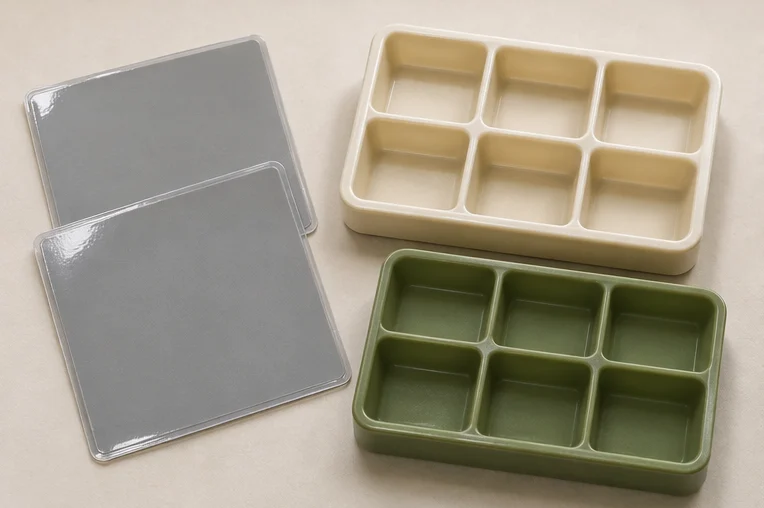
The accompanying art depicts laminated cards and reusable trays as a general scene. It does not represent an actual test or show any of the recorded instructions. The illustration cannot establish that the treatments were visually matched, and the chart cannot establish that staff administered them identically. Each is useful when given a clear job and an honest legend.
The comparison needs an allocation unit and a plan for spillover
It is tempting to hand out cards alternately as people arrive. That can produce equal numbers without producing unpredictability. For example, regular volunteers may arrive in pairs, or the order may track the sequence in which teams move through stations. A brief randomized allocation prepared ahead of time can reduce systematic coupling between arrival and assignment. When there are meaningful session groups, a balanced allocation within those blocks may be useful if it can be implemented without participants sharing answers in ways that undermine the contrast.
If volunteers work together, assigning distinct cards to two people at the same table might not produce two independent treatments. One person can read their directions aloud, the other may follow, and the shared tray might not preserve individual outcomes. In that case it can be better to assign whole tables or sessions, rather than asking participants to ignore the people they are specifically there to help. Evaluating assignment by table changes the unit relevant to uncertainty. A large number of items sorted by one table is not a large number of independently assigned tables.
There is a tradeoff when assignment moves up a level. With few tables, staff experience or location could remain unevenly distributed even after randomization, and estimating an effect with much precision may be difficult. Pairing or blocking tables by a sensible recorded factor could help if enough comparable units are available. A small pilot can still show whether the procedure is feasible. It should not support an impressive interval based on treating every item placed into a bin as an independent trial of the card design. Match analysis to how allocation actually occurred.
Repeated practice raises another threat. Once a volunteer learns a sorting rule from a guide, they cannot easily forget it when given the comparison card. If both variants are tried by each person, the order can become a source of lasting carryover. Counterbalancing may help show order patterns but cannot by itself restore naïve performance. Separate first practice from repeat practice, or use an independent assignment when the question requires it. Do not call a second attempt on the same objects a naïve response to a different card.
A fair supply process also matters. If envelopes containing the revised material run out and are replaced with ordinary cards without keeping a record, the implemented study diverges from the assigned comparison. Log both intended and actual exposure, plus reasons for deviation. A comparison by initial assignment answers how offering a card worked under the procedure actually used. A comparison restricted to people who received or used a specific card may be informative descriptively, but the restriction can introduce selection. People whose packets were changed might not be typical of their original assignment group.
Matching attention does not require hiding essential information
Calling a comparison form a placebo can be misleading if it implies the activity needs the trappings of a clinical trial. In this small educational setting the relevant idea is to make nonessential experience similar enough to interpret a contrast. Both groups should be welcomed, supplied with the required materials, and able to ask for assistance. They should not be asked to believe a fabricated performance claim. A descriptive heading can be truthful without endorsing one condition as superior. If everybody receives useful ordinary instructions, a group receiving no special prompt is not being deprived of the information necessary to complete the task.
Staff can maintain the same duration and tone of welcome without reading like machines. A short standard introduction assures that each participant hears the same task purpose and expectations. A checklist can record when staff needed to add a clarification, pause because a tray was missing, or redirect a group. Some departures are necessary. Documentation helps interpret them and improve the next run rather than inviting a volunteer to proceed without help. A valid protocol treats people well and records what that entails.
Blinding whoever judges outcomes can help distinguish a visible intervention from a judge's expectation. If an assessor receives a tray photo with no header and a neutral identifier, and the scoring rule is common across both groups, they may not know which instructions the volunteers saw. Sometimes the arrangement itself gives hints, or a label enters the photograph. Do not claim blinding worked simply because the assignment key was hidden. State who could see the heading and at what stage, and what evidence was actually retained for independent assessment.
Similarly, a coordinator who knows both conditions may differ in when they provide encouragement or hints. Neutral codes are advantageous only if the distribution and support procedures bring them to life. Training staff on consistent answers to foreseeable questions helps. Keeping the assignment key with a separate person until scoring is finished can help when feasible. The results should explain limitations if it was not feasible. An open comparison is not worthless; it supports a narrower interpretation than an otherwise equivalent comparison that controls those influences.
Consider versions in other formats carefully. A text-only card may adapt easily to an audio description. A purely visual pattern might not. If a translation or accommodation accompanies the intervention, review whether it supplies information that the original did not or loses information that mattered to the design. Report the observation as a delivery variant rather than claiming an identical exposure automatically. For a small practice session, the priority is making the activity usable. Measurement quality then depends on telling the reader which version was delivered.
Count a completion, then count a decision
A record-completion measure can answer whether a group submitted enough material to be scored. A sorting-accuracy measure needs answers that can be compared with a declared reference for the practice items. A task-efficiency measure needs a trustworthy start and stop rule and a plan for people who quit or wait for assistance. Selecting the endpoint after seeing all three gives an unfair advantage to whichever result happened to look attractive. State the primary purpose of the comparison and preserve additional outcomes as explicitly secondary or exploratory.
Define correctness for the actual samples. At a demonstration, the team can choose clean examples with known categories and a common answer key for all conditions. Ambiguous articles might be useful in training discussions, but a test relying on them needs explicit scoring rules and may need an allowed “not enough information” response. Do not require each volunteer to guess if the intended learning outcome is knowing when not to guess. A key that is amended after a staff member sees one group's more convenient answers risks changing the scoring rather than correcting a known error.
Completion can differ by group in ways that distort accuracy among completed forms. Imagine one condition encourages participants to submit partial attempts while the other discourages people who are unsure. Among complete records, the second may appear more accurate because participants with difficulty are absent. A comparison of only complete data describes the observed subset. Record how many assigned opportunities were missing, incomplete, or excluded, then assess the impact on the outcome. Do not recode every missing answer as correct or incorrect without specifying why that convention would answer the practical question.
For a binary scored outcome, a simple sensitivity check can ask what the result would be if the incomplete opportunities had different outcomes. This is not a way to fill in unknown answers. It is a way to show which conclusions depend on them. A report might find that missing cases are too numerous to support a confident claim about overall sorting performance, while still observing the groups' recorded completion differences. Such a result is useful if the next step is to improve the form or the collection process rather than choose a winning instruction.
Even within completed records, the right denominator can vary. An item not included in a participant's packet is not an incorrect answer. A record whose last few decisions were left blank might be complete under an administration rule but lack outcomes for an accuracy comparison on those items. Keep the essential exposure and outcome fields separate enough to reconstruct these cases. Silence in a record is not necessarily the person's judgment, and collapsing the distinction can falsely favor a card that happens to lead to more visible entries.
If a tally uses percentages rather than counts, put the reference beside the numerator. “Accurate among scorable classifications” is not the same as “correct among all assigned sample decisions,” particularly if exclusions differ. Count the number of participants or groups behind those decisions so a reader can assess whether repeated performance by a few people dominates the total. The nicest-looking accuracy plot may be the least informative if it hides where the observations came from. The completion chart is deliberately simple because it does not claim to answer those questions.
Consider a separate label study if the label itself is useful
A coordination team might discover that a clearer heading genuinely helps people get started at a busy table. There is no reason to reject that possible benefit merely because a label could confound a different study. Design a direct comparison of headings while holding the substantive directions and support fixed. Its outcome could be time to identify where to start, partial completion, or accurate interpretation of the general task. Those measures capture what a heading can do without making it wear the identity of a different intervention.
If both the heading and the decision prompt matter and resources allow, a crossed design could assign each heading with each prompt, creating four combinations. That structure can provide evidence about both factors and whether a prompt's effect changes with the heading, provided the sample and analysis support the comparison. It should not be undertaken just to get more columns. Each combination needs to be practically possible and remain understandable to participants. If groups are small, a focused comparison may teach more than a sparse attempt to estimate every combination.
An interaction has a concrete meaning here. The revised prompt might help people interpret categories under a plain header but add little when a descriptive title already sets expectations about the first step. Or the descriptive title might affect willingness to finish irrespective of instruction content. Those are hypothetical patterns, not conclusions suggested by the chart. To distinguish them, define what belongs to the header, what belongs to the prompt, and how outcomes are scored. One two-group comparison where both change cannot separate these possibilities.
Sometimes there is no natural way of separating the two. A heading can be the first meaningful line of the prompt, and a version that removes it could become unintelligible. In that situation it may be wiser to test the original package rather than contrive a detached heading. Then the scope of the claim is clear: this whole guide under these delivery conditions compared with that whole guide. A narrow but accurate result is more useful than an artificially precise figure about an ingredient that never existed independently in the real workflow.
A rehearsal reveals how the kit tells on itself
Picture a table scheduled for a small two-arm practice round. A volunteer gets a packet with a neutral identifier and is asked to sort clean examples. The printed instructions look balanced. But the facilitator, needing to check which reference to use, asks everyone receiving one kind of packet to wait for an extra explanation. That group now gets a different introduction and watches the facilitator handle the first item. Even without a promotional heading, the intended contrast is no longer the only changed experience. The fix is not to cover up the difference in the notes. It is to notice it during rehearsal and decide whether both groups can receive the same demonstration.
On the next rehearsal, both groups see the same opening example. A worker starts filling in a record on behalf of some participants because that group's forms have labels they find confusing. Completion rises in the affected group. This is a real difference in records produced, but it may reflect assistance rather than the guide itself. Capture whether data were self-entered, recorded with support, or produced by the facilitator. Then decide which measure the exercise was meant to use. A record created by a facilitator can preserve an actual sorting decision, but the form's completion rate is not independent of that support.
The materials also need an accountant. A printed identifier can be accidentally reused, copied from an old version, or put on a packet that contains a different page. Before collecting real outcomes, trace a few dummy assignments from distribution through scoring to a mock report. Check that the analyst can recover the correct version once the key is available, and verify that the scorer can do their job without it. Use visibly distinct internal version IDs in the stockroom if needed, while preserving neutral presentation for participants. Administrative safeguards should make the contrast reliable, not introduce another cue.
Keep actual outcomes out of a short experiment designed to diagnose workflow alone. A rehearsal might focus on whether individuals can find the supplies, whether a recorder can identify an ambiguous mark, and how many departures the staff need to handle. It may reveal that a planned distinction cannot be delivered in the allotted time. That is a useful negative result about feasibility. Editing the protocol after rehearsal is normal; changing the main outcome after a broad look at comparative results and then pretending it was always primary is not.
Interpret the results at the scale of the decision
Suppose the final report contains the invented counts in the chart above. A careful summary could say there were eighteen complete records from twenty opportunities with the plain code and seventeen from twenty under the descriptive code. These are observed completion fractions in the hypothetical comparison. They do not justify a recommendation that a real volunteer program use neutral codes to increase completion. With such small groups, one differing record can make the panel appear more decisive than it is. If the exercise was a feasibility pilot, the missing record reasons may be more valuable than the difference in fractions.
A site may be ready to adopt a new guide on other grounds. It might be easier to distribute, more accessible in a reviewed format, or compatible with equipment. Such considerations can inform an operational decision, but they should not be reported as if the chart established sorting efficacy. Separate the choice a coordinator made from the experimental evidence supporting one part of it. That prevents the next team from treating a practical preference as a settled performance result.
Keep generalization narrow. A practice session using clean standardized objects at a supervised table does not show how people will classify real, messy items after the facilitator leaves. It may answer a preliminary training question, not predict behavior across venues. The strengths of standard objects are comparability and a defensible key. The weakness is that they do not sample the full complexity of field choices. Both points can stay in the report without demanding a fresh study for every sentence.
If participants ask what the project learned, return to the same definitions used in the internal report. Summaries can disclose that variants or headings were compared, how completeness and accuracy were defined, and what remains undecided. Do not imply that individual volunteers were judged or ranked if that was not the purpose. A transparent debrief also gives people a chance to report that they interpreted the task differently or inadvertently saw a second card. Those observations can inform planning without being mistaken for the primary outcome.
Save enough information to understand a replicated round
Treat the welcome, the card and the score sheet as three separate artifacts from the same encounter.
A useful handoff includes the exact versions participants saw, the common explanation, the assignment unit, the date and reason for any revision, and the outcome definitions. Preserve how noncompletion and deviations were recorded without retaining unnecessary personal details. An abstract label such as enhanced card might sound adequate to the original designer, but a second coordinator may not know whether it comes with a larger type size, a different tray setup, or an extra facilitator prompt. A picture of the assembled kit can complement the materials list if appropriately labeled.
The key should also survive analysis. An authorized reviewer needs a way to establish that a row labeled plain did not actually belong to descriptive or that a late replacement was handled according to the analysis plan. That does not mean posting the allocation key or personal records publicly. Retain what is necessary for authorized verification and describe the procedure in a reproducible way. If outcomes were scored without the key and merged afterward, preserving the original scored records can help show which steps happened in what order.
For a replicated round, note changes in the reference key, environment and volunteer population separately from changes in the cards. Identical colors and headings do not preserve the substantive contrast if the set of practice objects now emphasizes an entirely different decision. Conversely a modified room layout might have little impact if it preserves comparable viewing and handling. State why modifications are expected to matter, then describe what was checked. Replication requires explaining continuity, not assuming it from identical filenames.
A decision log can record why a title or instruction was retained. Suppose practice readers found one neutral label easy to understand while another could be read as the name of a collection category. Choosing the less ambiguous label is a justified change to the materials. Enter it as a change before the trial, and leave the earlier card accessible for review. If the first field sessions used the older version, retain that fact rather than describing the entire study by the best later form.
Make the common explanation available in the same way even when some people arrive after the group introduction. A brief repeat can be offered to everyone under the same circumstances. Record the use of that repeat, not the identity of anyone who needed it. The delivery history can then show whether lateness made one arm more dependent on staff rather than allowing a claim about the card to absorb what actually happened at the table.
When all those pieces are clear, the conclusion can be simple. One card was different in an intentional way; the rest of the encounter was matched or documented. The report says what participants completed, what could be scored, and what the exploratory differences can and cannot establish. That is sturdier evidence than a demonstration in which paper, labels, staff attention, and instructions all changed together. Make the code carry the assignment, let the instructions carry the task, and let the results carry only the claim the comparison can support.