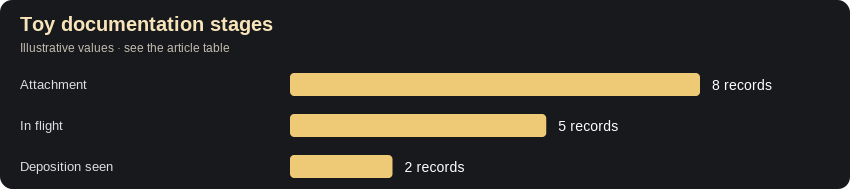
| Category | Value (records) |
|---|---|
| Attachment | 8 |
| In flight | 5 |
| Deposition seen | 2 |
Illustrative values, not sourced observations. Invented example for the stated comparison; not a biological threshold, ecological estimate or observed dataset.
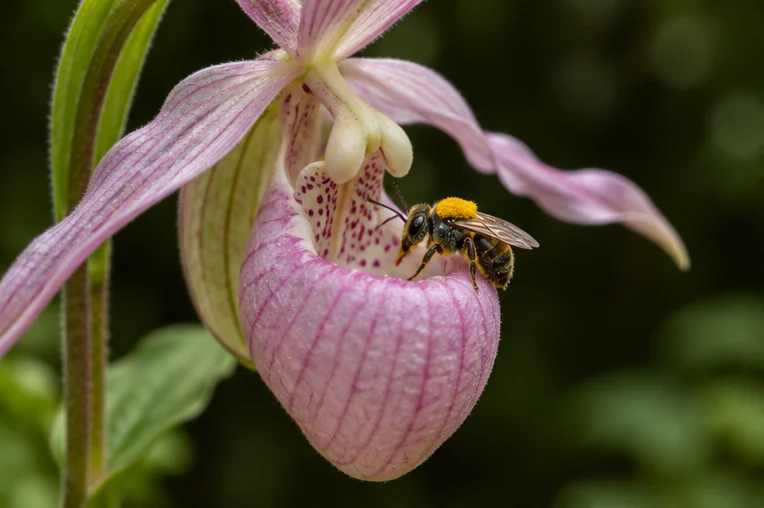
The sharpest picture from a morning beside an orchid might show the moment after a visitor pulls back. A little pale structure stands out against its head. The frame gives the impression of a completed transaction: flower, insect, pollen, all in view. Yet if the object really is a pollen package, the picture has mostly told us something about departure. We still do not know where the visitor will go, how much pollen it will retain, whether it will meet a suitable flower, or whether anything will reach the right part of that flower. A photograph can record an important event without being evidence for the rest of its story.
Follow the same question from the other end. In a second picture, a flower has a little piece of pollen material on its receptive surface. That is evidence at the receiving end if the material and surface can be identified. But it does not necessarily reveal which insect brought it, when it arrived, or whether it came from another plant. One of the difficulties in studying pollination is that the outgoing and incoming evidence can both be excellent while the link between them remains unknown. The gap is especially easy to miss when the outgoing structure is conspicuous enough to be the subject of a dramatic photograph.
We can describe three different things without ranking the people who notice them. Removal and attachment concern a flower and an animal as the package starts a journey. Transport concerns whether and where the animal carried it. Deposition concerns pollen reaching the receiving surface. In a complete sequence these stages would be connected by the same history; in a field notebook the stages may come from different events entirely. They answer different questions even when the notes are from the same flower patch. The trick is to write down what links those notes and not allow an imagined link to stand in for an observed one.
What is the attached object?
In the orchid literature, a pollinium is a coherent mass of pollen; pollinia is the plural. The pollinarium is the transferred unit, comprising one or more pollinia and associated structures where present. The distinction is easy to lose in casual speech because the entire unit can look like one pellet to the eye. The assembly can include a part that adheres to a visitor and a structure connecting that attachment to the pollen mass. In a particular photograph you may be able to see the mass but not distinguish the connecting parts. A safe caption can say which level of identification it supports. Peter and Johnson's original comparison of pollinarium reconfiguration is a useful introduction to the distinction and to several ways the transferred assembly can change.
Attachment is also a stronger statement than resemblance. A yellow thing beside a bee's head could align with the bee in a single projection while belonging to the background. It could be part of the flower the insect is leaning against. A view taken as the two separate can show whether the structure moves with the insect; better views may show the contact point. An attachment visible in one frame does not establish removal from the adjacent flower unless the origin was seen or independently established. The animal could have arrived already carrying it. Likewise, a missing assembly in a flower can support an observation about that flower's condition without supplying the identity of the animal that removed it.
Why distinguish those situations when the pictures look nearly the same? Imagine comparing two flower patches to find out where visitors acquire packets. At the first patch, three insects arrive carrying them and leave with them. At the second patch, two arrive without a visible packet and are recorded pulling one from a flower. An album sorted by how attractive the insects look might make the first patch seem more productive. A question about acquisition needs observations of acquisition, not a tally of already loaded visitors. It also needs to leave room for a package which was present before the visit but invisible from the opening angle.
The names of body parts matter here less for sounding professional than for communicating where the observation is strong. "Attached on the head, above the antenna on the camera side" gives a later reviewer something to look for. "Tagged with pollen" might be read as a human labeling intervention or as a claim about material that was never identified. If the only view is a silhouette, that belongs in the description as well. Later identification may improve the object label; it does not create frames showing how the object got there. A record benefits from separating confidence about anatomy from confidence about the event.
What a deceptive orchid teaches, and what it doesn't
A well known case concerns the early spider orchid, Ophrys sphegodes, and the solitary bee Andrena nigroaenea. In Schiestl and colleagues' original Nature report on orchid sexual deception, the researchers found overlap in the compounds and their relative proportions in signals from orchid flowers and the bee's female sex pheromone. The case makes floral attraction more intelligible than a human verdict that the flower resembles a bee. It connects the flowering plant to biologically relevant signals from the insect, not merely to the appearance of an orchid in a still image. A separate original study by Ayasse and colleagues describes male bees visiting these flowers and the role of cues in their attraction.
That is a specific scientific result about attraction in a particular orchid interaction. It is not a count of how many loads seen leaving will eventually reach recipient flowers. It does not make it safe to conclude that every animal that approaches one of the flowers is carrying a load. The direction the male faces, the parts of its body that contact the flower and the geography of the contact all matter after approach. Once a load is attached, subsequent changes in where the male goes and what it touches still matter. A study can make a persuasive case for a cue without supplying post-departure evidence for a particular insect.
This distinction is useful because enthusiastic explanations sometimes run the whole chain together. The orchid produces a signal, a male responds, and suddenly the next sentence says the insect pollinates another flower. As a description of a mechanism this can be fair if the sequence is known from research on that species. As a report of what was seen in a particular clip, it is often too strong. A careful description might say that the orchid has a documented deceptive attraction mechanism, that this clip shows a visitor contacting the flower and acquiring a candidate packet, and that the next destination is not in the recording. The three statements can coexist without diminishing one another.
Nor is one pair of names a reliable shortcut for every population or every orchid. Breitkopf and colleagues' original population comparison reported different predominant bee associations in two studied O. sphegodes populations. That observation provides good reason not to take a species pair reported at one site and assign it to every still photograph of a similar looking flower. It also warns against treating sexual deception as shorthand for the entire orchid family. The case works precisely because it has a defined plant, insect, interaction, and source. There is no need to broaden it beyond what those details can carry.
A visitor that investigates and leaves without a package can still be relevant to a question about attraction. A visitor that can be shown leaving with a package is relevant to a question about export. Different species, individuals, or moments can account for those records. A photographer can bring back something valuable without trying to identify a pollinator on sight. If a naturalist has only an approach shot, it says something about who approached at that time and place, given the limits of identification. Marking the end of that evidence is not dismissive. It leaves room for someone with a later recording, a confirmed specimen record, or research on the receiving flower to add something different.
Departure has its own timeline
After separation, a package can remain attached yet change its orientation. That is one reason an orchid's departure scene is more than a yes or no event. Peter and Johnson compared reconfiguration and visitor times across documented examples spanning orchids and two plants from another family, and tested the hypothesis that a delay can reduce immediate deposition within the same plant. The broad idea is geometric and temporal: a package taken out in one orientation is not necessarily lined up to touch a receiving surface immediately, and time spent on the donor plant can matter. Their work concerns comparative evidence about a hypothesis, not a clock that readers can apply to any packet.
A before and after image pair can be misleading if the photographer changes angle. The apparent lean of the package might change because the insect turned away, not because the package bent relative to the body. Ask whether the body's position provides a reliable reference and whether the same attachment is visible in both views. A recording of an animal rotating in the air can be remarkably clear to a human viewer and still fail to separate the pose of the visitor from the pose of the load. If direction of bending is the subject rather than a separate fact borrowed from a paper, that distinction matters to the evidence.
Not all studied orchid systems require the same post-removal movement. The original study titled Pollination mechanism in Serapias with no pollinaria reconfiguration documents a case where the studied mechanism did not involve that reconfiguration. This is an important counterweight to teaching with only the more striking delayed-bend examples. The lesson here is not "wait long enough and an orchid packet will be ready." It is that position and relationships at the receiving encounter need their own evidence, and that the way these relationships work depends on the system studied. Seeing a package point up on one insect does not place a different orchid into the same mechanism.
Transport can also be established at different strengths. A bee leaves a flower with pollen visibly attached for several frames: that records at least a brief departure with a load. If the lens follows it to a fence, the record may support carriage as far as the fence but say nothing about the next flower. If the animal leaves frame and a similar one appears on another blossom later, matching the general appearance is rarely enough to bridge the gap. The stronger report describes the continuous portion first, then explains how sure the observer is about identity across the interruption. Continuity is a fact to demonstrate, not an impression a nicely edited scene should create.
One can see why following flight makes a difficult measuring instrument. The flowers are stationary and can be revisited; the event that connects them may happen rapidly and beyond the lens's field. Wind can stop the image from following the visitor while leaving the bee's actual route unaffected. Bright light can make a candidate package merge into the background at exactly the moment the animal departs. A stationary garden camera may therefore deliver many contact views and almost no views in flight. This pattern tells us something about the camera placement before it tells us anything about losses by animals.
Toy documentation stages
The chart counts records in three illustrative documentation categories. All values are invented. They are not a dataset from an orchid study, counts from a field visit, a threshold for good evidence, or an ecological estimate. The unit is records, not pollen packages, recipient flowers, insects, or journeys. In this example the groups are lists of records with a named stage documented. The toy chart does not assign shared journey identifiers, require the groups to be disjoint, or make one group a follow-up sample drawn from another.
| Documentation stage | Records |
|---|---|
| Attachment | 8 |
| In flight | 5 |
| Deposition seen | 2 |
Eight attachment records and five in-flight records do not tell us that three animals lost their packets. Two deposition records do not tell us that two of the five flying animals made deliveries. In order to divide those values and call the result a stage conversion, one would need linked observations from a defined set of tracked journeys, and a way to distinguish outcomes from failures to observe outcomes. Adding the three values gives fifteen stage records in these lists, not necessarily fifteen independent events. An observer might have documented two stages in the same sequence or seen the same recipient flower more than once. The chart deliberately does not resolve those possibilities.
The data arrangement has a decision behind it. If the toy example had assigned every clip to its strongest documented stage, the labels would be exclusive bins. Five in-flight clips might then have clear attachment as well, but not appear in the attachment count, because the classification uses the highest evidence reached. It would be possible to sum the bins to fifteen clips if every clip appeared once and the bins were exhaustive for the selected clips. That would be a different table definition. It still would not tell us the odds of a journey reaching the next stage. A single flight could produce several clips, and observations ending earlier could have unrecorded later outcomes.
Another arrangement would make one row per journey, with separate columns describing stages and whether evidence was available for each. Then a team could investigate how often deposition was found among a carefully defined population of tracked departures. It would need rules for matching individuals and recipients and would have to account for incomplete observations. It would also have to decide whether its primary outcome were first deposition, any deposition within an interval, or amount of pollen deposited. Those are meaningful changes in the study question, not merely alternate display styles. The small figure in this article avoids percentage labels so that those missing decisions cannot hide behind a persuasive bar chart.
The stigma supplies a different perspective
A visitor can touch many surfaces in a flower without placing pollen where it is relevant to reproduction. To record deposition in this sense you need evidence that pollen reached the receiving surface, not simply that a leg brushed something or a yellow object appeared somewhere near the margin. A close view just after contact may distinguish the two, but it can also hide the receiving surface altogether. Differences in visibility between plant species are therefore an important limitation of using footage to compare delivery. A style that seems to work well for one flower might mainly measure how clearly another blossom exposes the structures a viewer needs to recognize.
One practical distinction is between observing contact and detecting material after it. If the pollen mass appears to strike the flower and exits with the visitor, the footage supports a contact event but not necessarily a deposit. If a mass disappears from view while the bee moves, the movement might have delivered pollen or simply hidden the mass behind the insect's head. If the recipient surface has material before the contact, its presence in the after image is not proof of new deposition. The strongest evidence pairs what happened at the contact with a reliable comparison of the receiving surface before and after that visit. Where that is not possible, be explicit about which part the evidence supports.
An inspection can detect a deposit even when no one filmed the airborne journey. That is not lesser evidence in every respect. It may be much stronger evidence for a receiving event than several minutes of beautiful carriage footage. However, identifying the donor, arrival time, and vector are distinct tasks. If a recently monitored flower received just one observed visit during a protected observation interval, assignment to that visit has a different basis than if an already open flower was examined after hours of unknown traffic. A record can state that deposition was detected and the source remains unassigned. It need not choose between overstating what happened and pretending nothing happened.
King, Ballantyne and Willmer's original single-visit deposition study measured pollen deposited after single visits to previously unvisited stigmas across thirteen temperate and tropical plant species. Their comparisons made a distinction between a visitor being recorded and its contribution being detected by the chosen deposition measure. They reported that sixty-three of 105 plant and visitor combinations met their effectiveness criterion. The complement, forty-two combinations or about forty percent, belongs to that aggregation and those methods. It is not forty percent of all individual visits in nature, not the proportion of orchid packets dropped in transit, and not a substitute for a study of the early spider orchid.
Their approach supplies an example of evidence from the receiving end. Responses can differ among visitors to the same plant and among the flowers that a visitor encounters. A relationship inferred from visitation alone therefore represents a different kind of network than one based on delivery evidence. Both can be worth mapping, provided the legend names what the edge means. It is easy to inflate a network by turning every detected visit into a claim about effective pollen delivery. It is also easy to erase genuinely possible relationships by converting a small number of visits with no detected deposit into a claim of impossibility. Those are two separate mistakes in how a chart labels evidence.
Pollen arrival is not the last reproductive event
The headline refers to delivery, not reproduction as a whole. Even a defensibly identified deposit is not proof of completed fertilization, fruit maturation, viable seed production, or recruitment of a new plant. A project interested in reproduction would need a further outcome and a defensible link to the visit or treatment being studied. An early deposit provides a much better starting point for that question than a package on a bee's head, but it cannot remove everything that happens afterward. If a long-term field report measures mature fruit, give that measure its own definition rather than calling its results the amount of pollen transferred.
Donor identity is a similar issue. Different flower labels need not mean different individual plants. On a single plant with several flowers, the observer could document the transfer from one flower to another without demonstrating transfer between plants. The names matter because "crossed to the next flower" can sound like cross-pollination even when the next flower grew on the same individual. When individual plants can be distinguished, record that relationship. When the two flowers were not confidently assigned to individuals, stop the wording at the part that is visible. A gap in the identity record cannot be closed by the fact that the two flowers were an attractive distance apart on screen.
Nor should a later fruit be assigned to the most photogenic visit. Where the receiving flower remained accessible to visitors after the recorded contact, several deliveries might have occurred. The model for assigning causation has to come from study design or another source of evidence, not a sense that one featured insect seemed convincing. A reader can readily understand a report that says a particular visitor delivered visible material and that a later reproductive outcome was not traced to that visitor. These observations can arise in the same project, and it is fine for their identifiers and limits to be different.
The distinction is also an antidote to forcing all flowers into a contest. Suppose one fictional plant shows several clear departures and few accessible views of its stigma, and another yields clear deposits but does not allow the observer to follow approaching visitors in the surrounding cover. Ranking them by documented success would conflate comparisons of plant behavior with comparisons of viewing conditions. A natural history article may appropriately juxtapose these two scenes to show how the evidence differs. It would need comparable effort and a shared endpoint to use them as a ranking of effectiveness.
A field notebook can keep the links out in the open
Consider a volunteer group interested in making a short illustrated feature rather than estimating an ecological rate. Their notebook might have an encounter identifier, a flower identifier or location reference, a time interval, an identification confidence, and separate fields for initial state, contact, attachment, carriage, and receiving evidence. The most valuable entry could be the one that says where tracking stopped. A six second recording might show the bee depart on the flower's left, with the package visible in its first turn, followed by a second of blur and an empty frame. A one line summary that says "departed with attachment; later route not observed" carries almost all the evidentiary meaning without filling in later events.
The association between footage and a written note deserves its own care. A wide shot might establish that a particular flower belongs to the monitored stem. A close shot might show the insect's head but lack any fixed landmark. When these shots were captured consecutively, time and matching features may give some basis for accommodating both. When the close-up actually came from a different plant, use it as an illustration rather than as a documentary continuation. File names can help if they preserve the day and encounter identifier, but the file name cannot prove that the camera did not stop recording in between. Viewers should not have to decode the edit to discover that material was illustrative.
It is useful to distinguish at least three observational states in prose: the event was detected, the event was not detected during a defined and reasonably informative observation, and the record was not informative about the event. For example, a clean view of a previously examined surface immediately after the only observed visit could justify "no deposit detected under this inspection." A still from behind the flower does not justify that sentence. It may show the visitor perfectly while leaving the receiving surface inaccessible. Putting both outcomes in a single absence column erases the difference between a real negative result at stated sensitivity and an unresolved record.
The same distinction has consequences when one observer trains another. Give them a few deliberately ambiguous examples, not just a reel of spectacular ones. Can they correctly say that the identity of an insect across a break is uncertain even when both images look alike? Do they both withhold a deposition label when the contacted structure cannot be identified? Can they detect attachment evidence from motion even if a still frame looks weaker? The aim is less to force agreement about every blurry image than to align what claims need what evidence. Disagreements should be reviewable without asking one observer to reconstruct the conditions from memory.
If recording involves attention from several people, assign that attention to the question before waiting at the flower. Someone concentrating on the receiving surface may miss the departure; someone working a broad camera angle may see the whole movement but miss the small material change. There is no general ranking of those jobs. What matters is that paired records use the same flower and a credible time match. If observers alternate their views and dates, note which kinds of evidence each period could plausibly produce. This helps keep the sampling process out of the biological explanation.
When is a ratio actually meaningful?
A well defined ratio has a numerator that comes from the denominator's eligible opportunities. Consider a different imaginary project from the three-bar chart. It follows twenty individually distinguishable departures with confirmed loads as far as possible within a specified observation area. It documents deposition for four, maintains an informative continuous view through the declared endpoint for six without detecting a deposit, and loses an informative view before that endpoint for ten. Four divided by twenty is the documented fraction among eligible departures, assuming the four are correctly linked. It is not an estimate that sixteen delivered nothing. The lost tracks cannot suddenly be reclassified as observed failures.
Four divided by ten gives the detected fraction among journeys with interpretable outcomes in that small example. The denominator is now four with deposits and six with consistently observable negatives, not all twenty departures. That is a conditional statistic. An assumption would be needed to generalize this fraction to all tracked insects. If loss of observation was more likely among fast fliers or among animals moving into nearby dense flowers, complete tracks could represent a systematically different group. The notebooks can often document the direction of loss without being able to remove the resulting uncertainty.
A narrower statement could report the four, six, and ten together. That reveals the number of confirmed outcomes and preserves the observation problem. Under the toy assumptions that the six negatives are valid for the time interval and the ten missed outcomes could all lie either way, the share that deposited within the study definition could range from four of twenty to fourteen of twenty. Those endpoints express the unresolved outcome status, not a statistical confidence interval and not a prediction for a larger population. Measurement error, false identification, or a question about a later time window would require more qualifications. The point is to use arithmetic to clarify what is missing, not hide it.
A different way to make the evidence usable is to count separate opportunities at the recipient. There, the denominator could be visits to previously unvisited flowers for which post-visit examination was adequate. A result about detection on one visit is not the same as the chance that a pollen-bearing insect eventually deposits material somewhere. Recipient-based and departure-based designs sample different pieces of the journey. Neither has to impersonate the other. The entry requirement for the former is defined by a flower and a visit; the latter begins with an animal and a confirmed load.
A measure can be useful without reaching a causal or population-level claim. A collection of natural history clips may establish that a feature is visible at a realistic scale or that a specific event occurs. A focused sequence can show a previously overlooked part of a known mechanism. A well documented missed event can suggest which viewing angle a later survey needs. Researchers deciding where to spend observation time can use those results, even if the collection does not provide a stable rate. Trouble starts when the claims quietly improve as a feature is compressed into a title or infographic.
What the picture should and should not say
An editorial illustration can use the unusually visible packet to show why orchid departures are interesting. It should not borrow the authority of a documentary photograph. The illustrated object does not need to be huge to communicate its purpose; overemphasizing it can make viewers think recording pollen is easy at ordinary garden distances. The plant and insect need not be claimed as the exact subjects of the Nature paper unless the artist has independent grounds for rendering both species accurately. Instead, a caption can identify the scene as an imagined orchid encounter showing where a pollen package might be visible after attachment. The discussion of species can remain with the scientific record.
If making a panel that contrasts attachment and deposition, an illustrator can put an imagined receiving scene in a second frame, but the caption should make it obvious that this is a proposed sequence or explanatory diagram. Photography offers another option: present the actual animal record and actual stigma record side by side without treating them as one animal's story. A visible label such as "different encounters" removes ambiguity that a reader otherwise has to solve from background details. Pairing pictures by theme is normal editorial work; presenting the pictures as one event requires continuity or some other defensible connection.
A text description can do work visual labels cannot. "The visitor carries a pale mass above an antenna; destination not shown" conveys the specific part of the process captured by footage. If deposit is only visible in a close still after a recorded visit, a caption can say that the material was detected on examination, rather than pretending that the lens captured the instant it moved. If the light is compelling but the attachment itself is indistinct, use an image caption that describes the encounter without claiming the packet is visible. The strongest illustration on a page does not have to support the strongest claim on that page.
The toy bars are vulnerable to the same storytelling conventions as photographs. An arrow between their tops suggests a single stream is being followed, even if a note says otherwise. Icons shaped like individual bees may lead someone to read each count as an animal. Avoid both if the count is of documentation records. On a narrow screen, keep the label "invented records" close enough that someone taking a screenshot of the chart sees it. Readers using a table or text alternative should get the same warning. We want the graphic to teach the difference between stages, not make a tracking study out of numbers written to fit on a page.
There is a judgment call in how many technical terms the article asks a reader to carry. If the caption is for a general audience, "pollen package attached to an insect" may be more useful than words for each tiny connecting part. If two images compare orientation relative to an attachment pad, those terms and the reference position become important. If the target audience is keeping records for comparison among species, give them the terms and show which items they should code as unconfirmed. Precision is not a contest to use more technical words. It comes from giving enough specific information for someone else to understand what would change the conclusion.
Three decisions about where to look next
A field team that keeps returning with good contact pictures but uncertain acquisition should work at the donor end first. Ask whether the initial view shows the same part of the animal as the final view, and whether the known flower surface can be seen as the animal backs off. Success for that next session might consist of one intelligible before and after record, not a bigger gallery of insects. If early identification turns out to be the weak link, keep the uncertainty visible instead of asking the editor to choose a plausible species from the guidebook. A generic but truthful identification is easier to improve later than a specific one that readers have started repeating as fact.
If the team already has credible departure evidence, it might instead choose to improve coverage of receiving flowers. What would make a recipient observation interpretable in this spot? It might be a natural viewing angle that lets people distinguish the receiving surface, or access to simultaneous notes on the one observed visit. Improving visibility need not mean touching a flower or interfering with a visitor. In a protected area or where close access would disturb either, the right outcome may simply be to report that the receiving end was not accessible. The fact that a measurement would improve the article does not make obtaining it from every flower a sensible aim.
If the team has evidence from both ends but not the middle, it should decide whether a linked journey really matters. To show that removal occurs and that flowers receive deposits, separately verified examples can be enough. To document which visitor connected the two, missing continuity is central. The purpose of the eventual claim should decide which missing link deserves the next morning of observation. This is a useful way to leave a project: not with a vague instruction to get better footage, but with a specific question whose answer would make a stated inference possible.
One of the pleasures of watching orchids is that a tiny detail changes the story at ordinary human speed. A visitor pauses, turns, then leaves with something that was not on it at approach. That can be the whole scene, and it is enough to make a reader care about the next scene. We do not have to pretend that one scene already contains both. Report attachment when attachment is supported, carry the story into flight when the record follows it, and reserve delivery for evidence at the receiving flower. The strongest narrative is the one that can survive someone going back to look at the frames.