
| Category | Value (records) |
|---|---|
| Approach only | 11 |
| Near inspection | 7 |
| Contact | 4 |
Illustrative values, not sourced observations. Invented example for the stated comparison; not a biological threshold, ecological estimate or observed dataset.
A solitary bee turns toward a flower and then makes a series of tight movements near the petals. A photograph of the flower might make the whole journey look like a response to its striking outline. The photograph cannot show what made the bee turn in the first place. Conversely, evidence that a flower produces a scent attractive to its pollinator does not establish that the bee never uses vision once it is near enough to see the display. Distance changes which information is available and how much it can help with the next part of the trip.
Two orchid systems make that distinction concrete. Florian Schiestl and colleagues studied chemical resemblance between the early spider orchid Ophrys sphegodes and the female sexual odor of its solitary bee pollinator, Andrena nigroaenea. Johannes Spaethe and colleagues' account of visual detection concerns a different orchid, Ophrys heldreichii, and another bee, reported as Eucera (Tetralonia) berlandi. Its authors explain why the orchid's outer floral display can be informative during a close approach. These are not two halves of a single measured trajectory. They show why the apparently simple question of what attracts a bee can turn into several questions about cues and behavior.
A cue can answer a local question
“Where should I go next?” names different problems depending on the animal's position. At a larger distance the problem might be whether there is a relevant source in the area. Closer in, it can be about separating one object from its background. At contact, it might be about the position of a floral structure or how the animal is oriented relative to it. These are useful roles to distinguish even when successive decisions overlap in time. No rule says the insect must finish processing one kind of information before it can use another.
The word attraction often hides those different outcomes. One author may mean that an insect began orienting toward a source. Another may mean that it entered a defined field of view. A third may count landings or contact behavior as a response. It is useful to say that all those actions can belong to a visit. It is not useful to attach the same inferred cause to all of them on the basis of one visible frame. What the observer saw and what the experiment varied should be plain enough that a reader can tell which claim is in play.
This is one reason to describe cues without personifying the orchid. An evolutionary explanation does not require an orchid to have gradually planned a deception or the bee to have consciously decided it is facing a model. The technical term sexual deception describes a particular relationship where floral features elicit behavior associated with seeking a mate, rather than supplying the corresponding mating opportunity. The orchid can gain a chance of pollen transport when a visitor contacts it in a useful position. That broad description does not imply that every encounter leads to pollen transfer.
An orchid's lip is the conspicuous specialized petal, also called its labellum. The outer display in the visual case is referred to as the perianth in the papers, with the surrounding segments contrasted with the central lip in their discussion of visual appearance. For a general audience, saying that the bee encounters a central lip and an outer display is often clearer than using the terms as if their boundaries or functions were self-evident. The visible parts do not have to resemble an insect to human eyes in order to help a bee detect an object nearby.
Human vision is an unreliable default for these comparisons. A floral patch may look especially colorful to a camera or a visitor while supplying little useful contrast relative to what a bee sees from that angle. A shape that blends into one background can stand out in another. Conversely, a signal useful to a bee need not make the flower look especially conspicuous in a color-corrected photograph. The right question is not how bright the flower looks in the article layout, but what information was available to the animal during the relevant movement.
What the early spider orchid study established
The 1999 Nature report by Schiestl and colleagues examined Ophrys sphegodes and Andrena nigroaenea. It supported the conclusion that the orchid's floral odor mimics biologically relevant features of the female bee's sexual odor. The work paired evidence about related chemicals with evidence of male-bee sensory and behavioral responses. An academic-hosted copy of the original paper allows the comparisons to be checked in the full text. This is direct evidence about a particular interaction, not an assertion that any superficially similar orchid uses the same cue.
Chemical similarity would be interesting by itself, but it would not automatically establish that the similarity matters to the animal. Evidence that males respond to relevant odor information strengthens the biological interpretation. It is still important to distinguish sensory reception from approach behavior and approach behavior from contact. An animal can have a sensory response without leaving a perch or landing on a flower. Studies become more informative when the conclusion tells readers which of those levels was actually measured.
Trying to reconstruct the exact distance over which the odor matters from the fact of mimicry is a category error. The paper addresses a cue and its relation to attraction in the studied system. A scent's detectable reach in a particular setting would depend on the source, flowing air, background and the animal's position and state. A chemical comparison does not draw a circle around every flower within which a bee responds. If a popular article needs a distance claim, it should come from evidence collected with that kind of geometry and precision, and it should remain tied to its own species and conditions.
Likewise, the link to mating-related behavior is about the response, not a proof that the flower resembles a real female in every channel. A biologically useful resemblance in odor can accompany a visual form that differs markedly in color, shape or size. Even within the same channel, what matters to the receiver need not be what catches a human observer's attention. A good account lets the primary evidence support a powerful chemical explanation without trying to make that explanation account for every trait of every orchid.
Several other claims should stay out of a bedside retelling of the result. It does not say that any bee approaching the flower was a male of the named species. It does not imply the bee always contacted the flower after approach. It does not show that one successful visit necessarily led to a deposit on a second flower. The paper is valuable because it narrows the cause of attraction in one system; enlarging its scope beyond the supported comparison makes it less useful, not more.
The outer display helped during a different orchid's close approach
The queued Spaethe, Streinzer and Paulus paper is an authors' follow-up account, not the original experimental report. The original close-range evidence is in Streinzer, Paulus and Spaethe's 2009 field study. The follow-up's full text explains their interpretation. It is worth retaining both links because physical measurements, behavioral results and conceptual explanation can be easier to follow when the corresponding papers are not mistaken for each other.
The study concerned the pink outer display of Ophrys heldreichii and male long-horned bees. The authors compared approach flights in field tests where the visual display differed. They reported that at close range, search time was shorter when contrast in the relevant bee green-receptor channel between the perianth and background was greater. The same close-range search measure did not show corresponding correlations with chromatic contrast or wind speed in that analysis. These descriptions refer to the measured predictor and outcome, not to whether the flower actually looked greener to a person.
The paper used a near-distance division around thirty centimeters in its own setup. At those distances the apparent size of the relevant target was adequate for the proposed visual task in the conditions studied. Farther out in the test, behavior was more consistent with the importance of olfactory search, and the measured visual contrasts did not explain search time as they did closer in. The reported boundary is not a species-independent visual range. The apparent size, orientation, illumination and surrounding scene help give the physical distance meaning. Do not take the paper's division and treat it as the distance at which the Andrena in the other research necessarily switch senses.
The distinction between green-receptor contrast and chromatic contrast matters. A result about contrast in a receptor-associated channel is not automatically evidence that the insects preferred a particular human-named hue. A similarly named flower color can produce a different contrast against another background. A broad reproduction of the visual result should say what the study related to search performance and which alternative did not show the same relation. It should not simplify the story to “pink attracts bees” just because the original flower looks pink in a close-up.
Search time is a performance measure, not a direct reading of sensation. It can change if a bee orients more rapidly, stays in a narrower search area, or more readily separates the target from surrounding vegetation. The study design provides reasons to interpret that result in relation to visual detectability. The association does not let a person look at any individual turn and identify with certainty the stimulus driving it. A natural history record can be specific about the movement while a scientific analysis is specific about what its comparison supports.
At close range several cues could matter at once. Nothing requires a bee to stop receiving odor information as a flower becomes more visible. The short-range result suggests that the visual display can contribute to a task at a useful distance, not that the rest of the sensory environment has become irrelevant. There is also no implication that bees use the same sensory mix in every other activity. Visits to these orchids address a particular evolutionary interaction, not an all-purpose model of an insect's decisions.
Pair the papers at the level of the question
The strongest synthesis is that different cues can contribute to different tasks along an approach, and that claims about their roles need evidence at the appropriate scale. The weaker synthesis is a neat universal sequence in which an odor always guides flight until an exact boundary and then a colored signal takes over. The latter sounds satisfying but joins two organisms and two measurement designs as if somebody had recorded a single shared flight. It also treats a research distance criterion as if the whole environment followed it.
A short comparison ledger can make the differences visible. For the first paper the plant and animal are O. sphegodes and A. nigroaenea, and the principal claim concerns sexual odor mimicry and male response in that system. For the second the plant and animal are O. heldreichii and E. berlandi, and the principal claim concerns short-range detection performance as a function of the visual comparison. Do not fill in a missing column by importing what the other pair did. A blank means that your source did not address that part of the question, not that nature had nothing happening there.
There is a useful common thread even across these differences. Both lines of work focus on the receiver instead of relying exclusively on what a human thought the flower resembled. In one case the relevant evidence includes how the animal responds to an odor comparison. In the other it includes the approach under differences in a visual display described relative to the bee. In each setting the animal's behavior can help discipline assertions that might otherwise be based on an attractive image alone.
An additional primary study of visual displays and reproductive measures asked a separate question about Ophrys heldreichii. Its authors recorded removal of pollen-bearing structures and deposition of pollen material as different endpoints. They reported clear treatment differences in one of their two experimental populations, while relatively few such events in the other did not yield a statistically resolved difference. That distinction is more useful than a generalized assurance that brighter-looking flowers always reproduce better. These are specific measurements at a later step, not evidence that every approach succeeds, or that a flower with pollen removal necessarily yielded offspring.
Later evidence can support a role for the outer display while leaving some mechanisms uncertain. A remaining question might be whether bees find a flower they have already approached more easily, whether they choose one among several objects, or whether an altered cue affects their positioning at contact. Detectability and preference overlap but are not identical. Being able to pick out one object in the scene does not establish that it is preferred over an equally detectable alternative. Good comparison language keeps the outcome sufficiently narrow to see what a further study would have to test.
Toy visible approach stages
This is a fictional chart of records, not counts from the published work, an estimate of visiting insects, or a map of where odor or color dominates. Each record describes one observed encounter classified by the deepest stage that can be supported by the recorded evidence. No record is counted in more than one row. The chart says nothing about the earlier flight of an insect already near the flower at the beginning of a clip.
| Most advanced visible stage | Records |
|---|---|
| Approach only | 11 |
| Near inspection | 7 |
| Contact | 4 |
The eleven, seven and four entries sum to twenty-two records. The taxonomy of the chart matters: a record in the contact category could also include a visible approach and near inspection, while the approach-only row describes records that contain no documented later stage. Thus it is not valid to call eleven the total number of approaches in the set. It is the number of records whose deepest supported stage was approach. The chart also does not tell us how many animals generated the encounters or whether the same individuals returned.
For illustration, suppose one clip begins with a bee still some distance away, shows it move toward the apparent target, and then cuts out. It can enter the approach-only category under this definition even if the animal went on to contact the flower after the camera stopped. In another clip close movement beside the flower is visible, but an intervening stem hides the actual boundary; the deepest supported stage may be near inspection. A third clip clearly shows the insect touching a floral surface. That is contact; it is not necessarily reproduction, nor evidence that the insect detected any particular signal.
A plot with these bars must not be read like a sequence in which twenty-two observed approaches gradually shrink to four observed contacts. Such a funnel would require complete tracking to each stage for a defined group and transparent accounting for losses of visibility. Here each bar is a mutually exclusive summary of the evidence available in a record. If a project counts all observed stages instead, its bars may overlap and their sum cannot be treated as the record count. State the distinction in the caption because a short stage label alone does not convey the denominator.
There is a biological difference between knowing that a bee did not touch a flower and never seeing whether it touched one. The toy chart has deliberately compact categories that do not preserve that difference by themselves. A real archive should retain a separate flag for incomplete or obscured views. To use its records to estimate contact after approach, one would need to address the unknown outcomes rather than classify all of them as refusals. That makes the archive more useful for analysis without changing what the illustration can show.
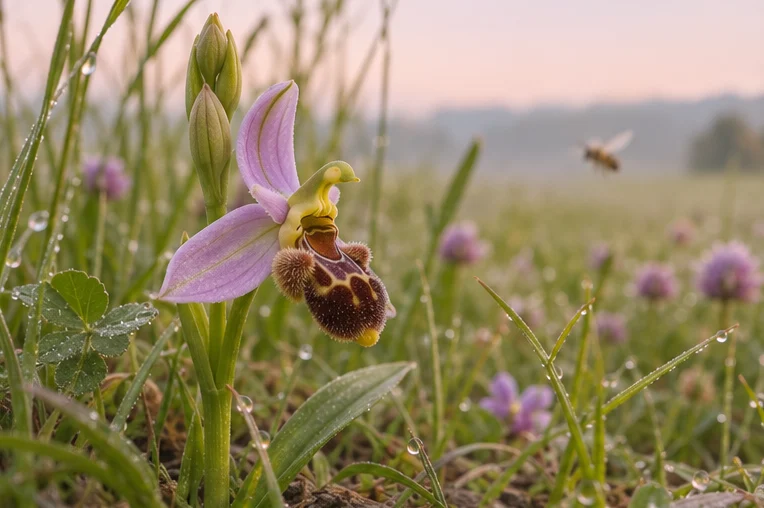
The hero is an editorial illustration, not a visual record of either species pair or evidence of a measured distance. A sharply depicted orchid lip with a bee in soft focus suggests a contrast between near and far for a human reader. The blur says nothing about what any living bee perceived. An eye-level scene should invite curiosity about perspective, not assign a scale of sensory acuity from an art direction choice.
What distance means in a field record
A physical distance is only meaningful if the endpoints are defined. The path from an insect's head to the near edge of a petal is not the same as the path from its body center to the floral center. A nearby flower on the same stalk may obscure that position from camera view. If a clip only supplies a projected image plane, do not assign a convincing-looking metric scale to every insect in it merely because there is a ruler or a known-sized flower at some other depth. The lens does not force the insect into the plane of the reference.
A visual angle describes how large an object appears from a viewpoint. The same flower can occupy a larger angle as an insect approaches. If it faces the insect obliquely, however, a particular feature can look narrower than in a straight-on view at the same distance. These facts are a reason to avoid treating the cutoff in one study as a fixed visual boundary in the wild. They are not a basis for claiming exactly what an insect resolves in another species without evidence about its sensitivity and viewing conditions.
The visual background can change during one flight. The flower might initially be seen against a shaded bank, then against bright open sky as the insect drops. A person standing overhead can miss that change. A drawing or existing sequence taken from more than one angle can help readers understand the range of possible views. It still does not substitute for measurements from a study, and assigning a specific cue to the flight requires more than a convincing illustration of how the cue could have changed.
An air path is not drawn by the same lines as a visual angle. Even without reconstructing a scent plume, one can recognize that airflow and obstructions make it unsafe to claim a tight radial boundary for exposure. A bee can be physically close while approaching from a direction that is not represented by a single “downwind” label from another time. Save direct context if it is available in a record, but distinguish ambient wind observations from actual evidence that the animal encountered and followed a particular cue at that moment.
If someone wants to illustrate the sequence, place the emphasis on the observation rather than invisible mechanisms. A panel can show the animal approaching at a broad scale, then show the relative positions of animal and flower closer in. A figure explaining available kinds of information can be explicitly conceptual. Do not draw a line of scent and imply it was measured at those coordinates, or use an image that appears to show the color as perceived by the bee if it is only a human-visible rendition. The accessibility of a metaphor depends on labeling its limitations.
Code behavior without coding a motive
For a natural history archive, the visible indicators can be more useful than a list of guessed cues. Record whether an insect changed direction relative to the flower, whether it remained in a clearly defined near area, and whether contact was visible. Include the observer's confidence and where certainty is lost through occlusion or focus. An encounter starts and ends under a declared rule. If an animal leaves the view and another enters, do not assume either that it was a new individual or that a returning individual resumed the previous encounter.
For example, a camera could show a bee cross the frame in front of the orchid. From its projection the insect looks near, but a second view places it behind the flower. The initial footage might support a pass-by rather than an approach. If the second view does not exist, transparency about depth is preferable to a strong claim. A catalog is most useful when a different viewer can reproduce the core classification from the saved evidence, rather than needing to accept the storyteller's certainty.
Near inspection is a behavioral shorthand in the toy chart, not a claim about attention. It can describe a short sequence of movements visibly oriented near the flower rather than establish that the bee was comparing colors. Keep the relevant spatial boundary and movement criteria visible in a real project. Holding floral parts or changing the scene to make a particularly clear film produces a different kind of record. A passive account can honestly say it lacked a close view instead of manufacturing one.
Contact needs an equally careful description. A brief visible touch by a leg or the body can be scored as a touch if supported; it does not establish pickup, transport to another flower, or deposition. If a reviewer wants to infer pollen transfer, the record should show the relevant structure and encourage the reader to distinguish removal and delivery. This extension is important precisely because close-range cues can help an encounter advance without determining what happens later. Treating every landing as effective pollination would make display studies answer an unasked reproductive question.
Archiving uncertain identifications is not a setback. A bee-shaped animal in the frame may be a visitor, but the evidence may not settle species or sex. Since the two published systems concern specific male insects, extending their interpretation to an unidentified visitor requires particular caution. A taxonomically ambiguous record is still useful for a coarse description when labeled accordingly. It is not an extra replicate of either cited experiment simply because it occurred near a flower of the same genus.
Keep observation passive and use publicly shared material with appropriate context. There is no need to collect plants, imitate floral odors, or modify displays to learn to distinguish the stages described here. These distinctions can be practiced with published study figures or ordinary reviewed photographs. A responsible account does not direct people to sensitive locations or ask them to interfere with wildlife in order to confirm what a short clip could not establish.
Think about which part of the journey is missing
Consider a clip that begins on a single flower with a bee already in frame. The bee stays near the lip, moves away briefly, then returns and makes contact. That clip could document near inspection and contact better than a wide view taken from far away. It does not document how the bee found the vicinity of the flower at all. A caption claiming that the orchid's appearance drew the bee from across the meadow has invented the most interesting part of its story. In this situation, the close framing is a strength for one question and a weakness for another.
A wide view presents the opposite tradeoff. It can show an animal turning or traversing an unbroken route but leave the landing region too small to establish contact. A different observer might also see a direction change and reasonably decline to call it flower-directed if other objects sit along the same line. Those uncertainties can be recorded directly. The two views can complement each other only when they represent the same event with reliable synchronization or when presented honestly as examples of different events. Editing from one to the other cannot create continuity.
Visibility can also determine the apparent proportions in a collection. Imagine that bright backgrounds make the distant bee easy to track but conceal the detail of the body against a pale petal at contact. Another background can hide distant trajectories while making close motion clear. If someone counts deepest visible stages across those conditions, a change in counts may reflect the record maker's opportunities rather than the bee's performance. A separate column for visibility and time in frame helps reveal which comparison could be affected.
Observe when the label depends on timing rather than place. Near inspection might require the insect to remain within a defined area long enough to capture a directed motion. A bee entering that region very quickly could make contact before such an intermediate stage is recorded. The category does not prove absence of intermediate processing. If interested in speed, record intervals with their uncertainty instead of inferring elapsed time from the mere presence or absence of a category. High time resolution around an event does not prove accurate measurements of depth or direction.
These issues matter even for more detailed observation methods. Sensors and recordings capture different aspects of the same scene. A system that estimates trajectory well may not assess what stimulus was present at the insect's antennae. A description of visible contrast at one angle may not reveal what the insect faced after it turned. The original close-range study specifically analyzed flight behavior with a defined visual comparison; it did not read motives directly. Repeating its conclusion faithfully includes naming its measured proxy and its limits.
Keep a gap between perception and successful reproduction
If the flower is easier to find, more contacts are a plausible consequence, but not a guaranteed one. An insect might find the target quickly and reject it quickly. It could brush a part of the plant rarely involved in pollen transfer. Or it could carry pollen away and never approach a compatible recipient. Each of those possibilities helps explain why later studies have measured more than search time alone. They also warn against describing a measured improvement in search as an observed increase in new offspring.
The reverse inference needs equal care. Suppose a set of flowers has many pollen-bearing structures removed. That could support evidence of contact in a potentially effective position. It would not show that vision contributed to every approach or that the structure left on an animal that went on to deposit it. A later milestone can be reached by more than one sequence of events. Vanishing structures at several flowers cannot replace a measure designed to distinguish the role of distance or particular cues in visitor behavior.
Many useful ecological claims concern a pathway rather than a single final outcome. One study can show an animal's sensory response to an odor that resembles mate-associated information. Another can show how the outer floral display relates to a stage of flight. A third can evaluate reproductive indicators under its own conditions. Together they offer a more layered understanding even though they do not provide a single linked record from the initial turn to the next generation. The value of synthesis comes from respecting these layers, not from taking one number from each article and pretending they belong on a common scale.
When making a literature note for a public garden, put the endpoint near the beginning of the sentence. For example, “the measured search time decreased when a particular type of contrast was greater at close range” identifies the behavioral result. “The experiment showed the importance of orchid pink” leaves both the predictor and the measure unclear. “Pollen removal and deposition indicators varied with treatment in one population” is informative even without proposing a mechanism for every difference. Writing this way helps readers tell a striking result from a broadly suggestive example.
A miniature evidence audit before a story is shared
Read the article's abstract beside its methods, not in isolation. Even a precise result can sound universal if the particular comparison disappears from the retelling.
First check the species pair. Write the plant and visitor names once at the top of a note for each source. In this case, copying the bee from the odor paper into the close-range caption would change the science even if the general point survived. The same caution applies to an unidentified bee in an illustration. Avoid identifying a species from its role in a story alone. A picture may have the right mood and still be useless evidence for taxonomy.
Next check the kind of source. The queued visual link is an authors' summary and discussion of previously reported work. Linking it beside the original report makes it possible to see which paper actually recorded the flights. It also prevents an accidental count of two apparently independent tests when one article interprets the other's findings. In bibliographies, a newer page can be better for an introduction while a less accessible original supplies evidence for exact claims. The useful reader path goes through both if a distinction matters.
Check the words in the result against the actual comparison. In this case the distinction is between contrast in a named receptor channel and a measure of chromatic contrast. That is a good reason to be sparing with color adjectives in a science caption. It is also a reason to preserve how the reported distance was used: to divide conditions in a particular behavioral analysis, not to publish a universal range for seeing orchids. Rounding a physical number to a catchy unit can still preserve this limitation if the text says where it came from.
Finally ask whether a viewer can tell the difference between illustration and observation if the article is read on a phone. Someone may see a chart without the main text, or an image without the separate methods note. Put “Toy” in the title of the fictional chart and label its unit as records. If a drawing stands in for an idea rather than the exact organisms in the study, make that visible in the caption. These small editorial choices preserve the usefulness of pictures without treating them as raw evidence.
The text accompanying a photo archive can also preserve what prompted a revision. A viewer may recognize that two adjacent frames do not show the same flower, or an observer may discover that an apparent near hover belonged to an adjacent stem. Save the original caption, the corrected account, and a reason for the change in the archive rather than letting an updated label silently replace a claim that readers might already have copied. This is especially useful for scenes where the easiest visible conclusion, contact, is also the one a dramatic caption has the strongest incentive to supply.
Save context needed to judge who was observable in the first place. A publication that selects only crisp pictures of contacts on a showy flower need not hide its artistic choice; it simply should not use its gallery to summarize how many bees investigated it overall. An effort log can describe the time covered, changes of view and uncertainty about unattended portions of the scene, while the gallery picks representative examples of the intended visible categories. These are two uses of a collection. Keeping them separate makes both easier to interpret, because an audience can enjoy the clearest picture without mistaking clarity for a biologically typical outcome. Report which windows contributed records if the article makes a comparison rather than displaying examples alone.
The result is not a less interesting orchid. An encounter that begins at a distance and proceeds through a particular scene gives the receiver several distinct problems to solve. The evidence for scent in one system and visual detection in another reveals that richness more effectively than a single description of what a flower looks like. Keep approach, near movement and contact legible as separate observations. Then a story can bring readers close to a flower without claiming to see through a bee's eyes.