| Category | Value (stems) |
|---|---|
| Open | 14 |
| Closed | 11 |
| Uncertain | 5 |
Illustrative values, not sourced observations. One-time state inventory of 30 stems; not flowering onset.
At ten in the morning, the garden map shows a stand of flowering plants at the edge of a path. At the same hour, a volunteer looks down and finds half the marked stems with their petals folded. If the assignment is to map where the plants grow, those stems stay right where they were. If the assignment is to describe what was open to a flower visitor during that watch, the folded stems need a different entry. One garden, one time, two true descriptions. The mistake would be to erase plants from the map because they were closed, or to count every mark on the map as an open flower.
The distinction is especially useful when observations are short. A visitor count takes place during a window, not across the whole life of a plant. In that window some flowers may not yet have opened, others may have closed temporarily, and some may already be finished. Even a familiar flower can be hard to score from a path if its opening faces away. A reliable record keeps location, flowering stage, immediate opening, and confidence separate. It says what the team saw without demanding that a short visit settle the history of every stem.
In this article, availability means an observable state under a written scoring rule. A flower can be counted as open without anybody having shown it contains nectar, presents removable pollen, or admits every potential visitor. If a study asks any of those questions, it needs its own evidence. The modest goal here is to build paired records: a map of what grows where and a time-stamped account of what a particular observer could reasonably score as open.
Make a durable map and a temporary layer
Imagine a group marking two beds with numbered stakes. The map shows the bed outlines and the positions of tagged stems. It also records the flower form or plant identity where known, how it was identified, and which way the observer approached the bed. Take a photograph if it helps distinguish neighboring stems later. The map is a reference, not an assertion that nothing changes. It should indicate when and how the positions were checked. An added stem, a broken marker, or a plant that cannot be located after maintenance deserves an update rather than a silent overwrite.
The temporary layer is more like a weather observation. At a time and place it reports which of the mapped objects could be scored and what state each one was in. The stem identifier remains the bridge. A folded flower still provides a valid state observation even if a photograph would be less attractive with folded petals. A position behind taller growth may remain mapped while the state is unassessed. Keeping the map and snapshot separate means the team can cope with either ordinary closures or unexpectedly lost views without treating them as disappearance.
A plant map may represent a stand, a clump, a tagged plant, or a tagged stem. These are not automatically interchangeable. Counting stems is often easier when bases are close, but several stems can belong to one plant. A running observer might be able to confirm only the patch, not trace every stem to its origin. A drawing showing marked stems gives a defensible map of stems. It does not supply a census of plant individuals. State the unit in the title, on the field sheet, and in any exported chart.
There is a similar difference between stems and blossoms. One stem may carry a single cup, while another bears several blossoms at different stages. If the exercise uses stems as its unit, decide what property earns an open classification. Perhaps at least one target blossom must meet a visible opening criterion. A stem with three open units would then count once, just like a stem with one. That makes sense for tracking the status of mapped stems. It is not a good replacement for an open-blossom tally if the team wants to know the amount of display in view.
A map can be more complete than any one watch. Some stems will be outside the chosen observation target or simply too far away to score. Keep the full mapped set and flag the subset eligible for the watch. On another date an observer may choose a different subset using a documented plan. The change in the assessed set is information, not an inconvenience to remove from the record. It distinguishes an apparent change in flowering from a move to another part of the garden.
Decide what “open” can and cannot mean
Specify a criterion that another person could apply without handling the flower. For a simple cup it might be that the petals are spread enough that a named center is exposed from one of two agreed observation positions. For a tubular flower, the relevant landmark may be the natural opening rather than visibility all the way to the base. The criterion varies with the shape and the question. It should not be a silent assumption that the showiest part of a bloom always gives the best indication of access.
Decide whether the score reflects anatomy or the viewer's evidence about anatomy. If a flower faces away, its observer may not see the landmark despite a real opening. Record uncertain when a known opening criterion cannot be assessed. It is not correct to record closed just because you cannot see inside. At the same time, seeing a clear folded state from the side can support closed even if the entire flower is not visible. Design the category around the information needed for each conclusion, not around a generic rating of photograph quality.
Some stems offer a partial or intermediate appearance that is easy to disagree about. A partially spread set of petals might meet a threshold drawn to include a specific kind of access but not a threshold designed to track full display. Write a rule for intermediates and include a few reference examples. If the biological transition is the main interest, consider a separate ordered stage such as partly open, and keep the chart distinct from an exercise with three categories. For a quick watch, uncertainty can be the correct result when neither binary state can be scored reliably.
Do not confuse uncertain state with unassessed state. An observer may stand at the right spot and remain unsure whether a gap meets the agreed rule. Another stem may never be inspected because a path is closed. Combining these in a small tally can be defensible if the category is explicitly defined to include both. In the raw data keep the distinction, because a better rubric helps the first problem while more complete coverage helps the second. A method that cannot say why records were unresolved has less to offer someone planning the next watch.
Availability to a visitor is not necessarily a property of the plant alone. Small visitors may pass through a gap that another cannot, and some floral resources may be accessible without using the route an observer initially expects. Similarly, a flower with spread petals may offer little of the resource of interest at that time. If a particular visitor takes a route the observer called closed, the right move is to preserve the geometry score and record the behavior separately. That result may reveal a limitation of the opening proxy. Changing the geometry labels after watching the visitor would obscure the very reason the observation is interesting.
The USDA Forest Service brochure on pollination is useful background for considering how floral characteristics can suggest kinds of visits or access routes. Use those patterns to generate questions. A pale flower that opens early in the evening is not proof of a particular visitor identity, nor does a single sighting identify which animals were responsible for effective pollination. Time and opening scores give a study context for looking; they do not answer questions about function by themselves.
Opening is not the same as flowering onset
A seasonal survey might ask when a plant first began flowering this year. A daily watch asks whether a recognized flower met an opening criterion at a particular time. Do not substitute one answer for the other. If a previously observed open flower is closed on a wet morning, its onset date did not move. If a flower appears open for the first time in a weekly survey, the actual onset may have occurred at any time since the last check that could establish that it was not open. The record anchors an observation interval, not a precise opening timestamp.
“Closed” can describe several visually related situations. A recognizable bud may never have opened. A mature blossom may close and later reopen. The same blossom may close at the end of its lifespan. An observer unfamiliar with the plant may reasonably be unable to tell one folded state from another. Keep the immediately observable condition and the interpreted developmental stage separate. It is possible to have a confident measurement of the former and little basis for the latter. A sequence of well-labeled observations can be more informative than an ambitious attempt to infer history from one view.
A stem with no flower has a different status again. It might have no developed buds, or an earlier flower might have fallen. If the base has been damaged, the former position can remain on the map while the past tag is marked as inactive. “No flower present” should not be counted under closed unless the protocol deliberately combines them and says so. In many exercises the distinction defines eligibility. A toy table that sorts eligible flower-bearing stems into three classes should not be taken as a universal status taxonomy for every mapped plant object.
A cut stem can create two different forms of absence. The map can still document where it formerly stood; a current survey can state it was confirmed gone. If maintenance or heavy growth simply makes the tag hard to find, report that it was not located. Confirmed removal and failure to find are different observations. Short watches become much easier to compare when neither is smuggled into the closed category. Someone returning later can see which change was recorded in the site and which uncertainty belongs to the search.
A practical way to keep history clear is to tag the same floral unit across visits whenever possible. Watch the fold open again on the same unit before calling an observed episode temporary closure followed by reopening. If a stem bears multiple similar flowers, one folded and another newly open can create an apparent reopening when viewed at stem level. A fixed mark at the stem may be adequate for mapping, but following an individual blossom calls for an extra landmark or image. The unit that supports a phenomenon should be at least as specific as the claim.
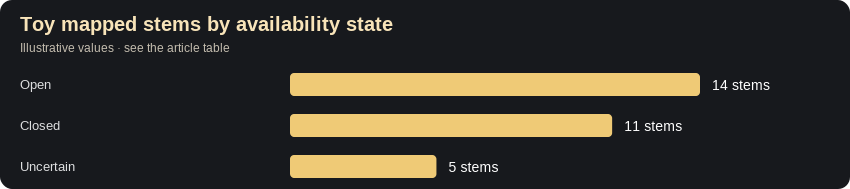
Chart: Toy mapped stems by availability state
These numbers are illustrative only. They are invented counts, not sourced observations, and are not measurements of actual availability to a visitor. The example describes thirty mapped, flowering stems assessed for a single inventory, with one assigned state per stem. It does not measure onset, length of opening, species abundance, or the amount of nectar or pollen.
| Availability state | Count (stems) |
|---|---|
| Open | 14 |
| Closed | 11 |
| Uncertain | 5 |
The total is thirty stems. Fourteen were classified open under the hypothetical rule, eleven closed, and five uncertain. If the question is what proportion of all thirty stems was confirmed open, the answer is fourteen of thirty, or about 46.7 percent. If the question is what proportion of the twenty-five resolved observations was classified open, it is fourteen of twenty-five, or 56 percent. Neither denominator is wrong, but the interpretations differ. The second number is not an estimate for the thirty by default because uncertain stems might not be representative.
If the uncertain stems are otherwise eligible and could each be either open or closed, the arithmetic bounds for the full-set number open are fourteen through nineteen. The bounds are not a confidence interval or prediction. They simply describe the limits implied by leaving five binary classifications unresolved while accepting the recorded results for the remaining twenty-five. The lower bound corresponds to every uncertain stem being closed; the upper bound to all five being open. This exercise makes the cost of uncertainty visible without claiming to know what actually happened.
The eleven closed stems remain on the map. Their presence is useful: if another observer returns later, they know which stems were recorded as closed and may be able to look at the same units again. By contrast, if the report replaces the thirty-stem map with only the fourteen open marks, it destroys the denominator and obscures whether later changes reflect state, relocation, new stems, missed stems, or an entirely different set sampled. A good figure answers a deliberately narrow question without deleting the pieces that support a broader record.
The toy count also cannot establish how many blossoms were open. If fourteen stems each carry one open blossom, the total is fourteen. If some of them carry several open blossoms, a direct blossom count would be higher. The recipe for converting stem status to bloom quantity is not contained in the state flag. Report the open-stem count for a map-level comparison, and design a bloom tally separately when the actual units are important. This prevents the map from looking more quantitative than it is.
What changes through the day
Opening can depend on time and conditions in ways that vary among flowers. In a primary study of five nocturnal evening primroses, investigators observed specific patterns of evening opening and subsequent closure in the flowers they studied, while also examining nectar production and floral visitors. The authors reported that nectar secretion began before the flowers opened in that study. A visual opening score and a measure of nectar production were therefore distinct even in a carefully described system. This is an example of what separate measurements can show, not a universal timetable for evening primroses.
In a second example, experimental work on alpine gentian compared flowers allowed to close naturally with flowers experimentally kept from closing during rain, and measured differences in pollen loss under those conditions. That work is evidence about a particular species, setting, and outcome. An ordinary observer seeing petals close near a rainstorm can record the temporal association without declaring an identical function. The weather transition provides a good reason to revisit a hypothesis. It is not sufficient to demonstrate the mechanism.
Visible changes can coincide with shifts in observer access. A shaded opening might be difficult to inspect just when the sun moves behind a neighboring plant. Wind may turn an otherwise open flower so its center faces away. A thermometer at the path and a flower in a pocket of shade do not necessarily share the same conditions. Log the broad contextual details that matter to interpretation, and distinguish measured values from impressions. “Observed after rain” is different from “closed because of rain,” and “shade prevented classification” is different from “shade caused closure.”
It is tempting to assume that a daytime photograph tells you what was available across the day. A morning snapshot and a late afternoon snapshot can bracket the same set of stems but include very different open sets, even without a change in the mapped stand. An earlier observer might label a patch uninteresting because hardly anything appears open at noon. A later visit can show otherwise. Plan your observations to include the time windows relevant to the question, rather than treating the first convenient window as neutral. If you cannot sample other windows, state that limitation without trying to extrapolate an entire day from one observation.
The same caution applies in the other direction. It is possible to see several flowers start closed and become open on a morning route without proving that they remain open for most of that day. The latest time at which a stem was definitely closed and the earliest subsequent open observation bracket a change. The interval widens if the second check was much later. A pair of snapshots can detect a transition without revealing everything in between. That useful, limited statement is better than assigning an exact change time to the moment the watcher happened to arrive.
How the plant layer and visitor layer work together
A timed watch for flower visitors needs a defined target unit, place, and duration. If the goal is to record visits to open blossoms, document the number visible at the start and any substantial state changes during the watch. A visitor entering just after a flower has opened may have an opportunity that was not available early in the interval. Depending on the question, it can matter that the starting tally was three and the ending tally was seven, rather than simply recording “seven open” for the whole watch.
The UK Pollinator Monitoring Scheme's Flower-Insect Timed Count instructions are a formal example of a timed observation with specified target flowers and a defined patch. Their ten-minute count belongs to that scheme and should be followed as instructed when someone contributes to it. This article's stem-state exercise is separate, with its own coverage, units, and classification questions. The idea to borrow is explicit definition of observation effort and target; do not present an invented stem tally as a scheme submission.
Set the role of closed stems in the visitor data before collecting it. They can remain visible in the reference map while being excluded from an open-flower visitation denominator. If a watch instead asks about observed use of plants across opening states, include closed stems as eligible focal units and retain state as a separate field. A visitor landing on the outside of a folded flower might count as plant contact in the broader project while not counting as a visit into an open blossom in the first project. State is not enough to classify the behavior, and the behavior is not enough to recode the state.
Two useful counts are visits per timed watch and visits per unit of flower exposure. The first can describe what a person saw at a patch over a fixed period. The second is intended to relate activity to the amount present or available. A count of ten visits during ten minutes could occur with two eligible flowers or twenty. Those conditions are not interchangeable if the point is visitation relative to opportunity. Conversely, ten gardens with the same rate per open blossom can differ greatly in how many total visits an observer sees from a path. Write the units into the question so readers can tell why a particular denominator was chosen.
If exposure is expressed in open-flower minutes, it requires either observation of the availability path or an approximation with stated assumptions. In a toy case, two blossoms open for a full ten-minute watch contribute twenty blossom-minutes. Two more that each open five minutes into the watch contribute another ten. Counting all four as present for the entire watch would assign forty minutes rather than thirty. Normalizing the same visitor tally by those denominators gives different results. Such a simple calculation should not tempt a team to invent the missing opening times when only a beginning and end are known.
A watch with no open eligible flowers can be useful to the map and schedule evaluation, but a rate of visits per open-blossom minute is undefined when the denominator is zero. If no visits were observed, report the actual zero in the appropriate count and preserve the zero exposure separately. Do not claim that the flowers had a measured visit rate of zero per available blossom when none was available under the rule. Likewise, if the watch never occurred, both effort and visitor status differ from a completed interval with zero detections. A spreadsheet that visibly separates the conditions prevents later plots from quietly inventing an observation.
Make repeated rounds comparable without pretending they are independent
Choose whether the next round revisits the same stems or observes a new sample. Returning to fixed stems is especially useful when the main interest is change in state. It allows paired comparison, such as tracking how many individually recognized stems went from closed to open. Sampling different stems may be helpful for representing a larger mapped set, but identical totals at two times conceal which ones were observed. If you want both questions, preserve the panel of repeated stems and use a separate labeled sample for broader coverage.
Do not rely on totals alone to identify transitions. Two watches may each report fourteen open stems, yet several stems could have opened while an equal number closed. For a tracked set, compare rows by stem identifier and label the watch pair. A change from open to uncertain is not an observed closure. A missing row because the tag was lost is not proof the stem disappeared. A compact cross-tabulation that includes uncertain records can be more informative than a curve of open totals, especially when the question is what happened to particular individuals.
Time order can be accidentally confused with walking order. If the observer always visits Bed A first and Bed B forty minutes later, a morning change in opening can appear to be a persistent difference between beds. Alternate the order when practical, or collect paired observations at similar times with two observers trained on the same criteria. At a minimum, save the time each bed was actually assessed. A single timestamp for an entire garden route can make a rapid opening period look simultaneous when it was spread across many minutes.
Changing observers has a comparable effect. One person may score a partially open flower as open while another calls it uncertain. Practice on a short shared set that includes ambiguous shapes, not just examples with obvious spread or folded petals. Agree which score the public tally will use and keep notes about disagreements. You do not need a complex reliability model for a garden project, but recording the troublesome cases allows you to improve the definitions and decide whether an apparent change may have been caused by the scoring process.
Variation across space also matters. Temperatures, shade, and viewing angles may differ along the same bed. Many neighboring stems can share influences, and several stems may even belong to one plant. A list with thirty stems is therefore not necessarily a list of thirty independent responses to weather. Descriptive totals are still meaningful when correctly labeled. Generalizing a relationship between weather and closure needs observations across relevant conditions and at the appropriate repeated units. A grasp of which items share a location or history helps prevent an attractive figure from overstating the strength of evidence.
If the field objective includes identifying a stable time window for visitors, select repeat rounds that can check the stability. A pilot may suggest that a stand is most visibly open in the early evening under one day's conditions. Place subsequent rounds at comparable times on multiple days and include some earlier or later intervals. If the pattern appears only once, the original observation remains valid for that day. Do not turn it into a permanent schedule. A realistic result for a garden group might be a range of promising watch times with recorded exceptions, rather than an exact clock time assumed for every visit.
A short field exercise: choose your denominator twice
Mark a modest number of stems you can revisit without handling them. In the first round, note the map unit, whether the stem is present, whether it is eligible, and what you could see. In a separate column record the opening state under your chosen rule. Record the time and rough vantage point. If several stems carry more than one focal blossom, record blossom-level observations in a distinct table or decide explicitly to use the at-least-one-open stem rule. Nothing in the first round requires watching for insects. It is meant to check whether the plant layer stands on its own.
In the second step, select a fixed interval for a visitor watch over a defined subset. Write why it was selected. If it was chosen to include reliably open flowers, say so; the observed visitor activity does not represent the beds where few blossoms were open. If the watch instead uses a predetermined patch regardless of state, preserve what happened there even if it was quiet. Practice recording whether a visitor used an open flower, rested elsewhere on the plant, or could not be localized. Those are all observations, but not all have the same meaning in a watch designed around open flowers.
At the end, compute one map-level summary and one watch-level summary. The map-level value could be the number confirmed open out of all eligible mapped stems in that round. The watch-level value could be the count of observed qualifying visitor events per completed interval. Add a second denominator only if it answers a real question and you have measured it. If you want events per open-flower minute but scored only stem state at a single time, note why the extra measure is unavailable. Correct refusal to compute an appealing ratio is a legitimate and teachable result.
Next ask a second observer or group to reconstruct each denominator from your notes. Can they tell whether uncertain stems were included in the map count? Can they distinguish stems skipped by the watcher from stems with unknown opening state? Can they identify the eligible window for a visitor event? If another person cannot arrive at the same interpretation from the record, add definitions before making a chart. The exercise succeeds when the record makes the scope apparent without relying on the observer to retell the whole afternoon.
Repeat on another day without changing the rubric. If it needs revision because the first method cannot accommodate a type of flower, version it and record what changed. Where practical, rescore archived photos with the new rule rather than comparing results derived from different criteria. If you cannot see enough in the old photographs, do not retrofit a new score. A documented break in methods is better evidence than an invented continuous series. The garden will still be there to support a better round.
Turn uncertainty into a practical improvement
An uncertain record should lead somewhere more specific than “take a closer look.” If uncertainty chiefly reflects flowers facing away, an additional noninvasive viewing position may help. If it reflects doubt about developmental stage, repeated tracking and reference imagery will give more context. If it occurs around the boundary between partially open and open, tighten the criterion or make the intermediate class explicit. If a patch is inaccessible under the site's rules, redesign selection or narrow the inference rather than stepping into the bed. Each problem has a different remedy because the original log preserved its reason.
Be careful when deciding where to improve coverage. A hidden, complex flower may be the very kind most important to the question. Eliminating it to raise the completion percentage can bias the sample toward simple open structures. A report can give a separate completeness summary by flower form or viewing position without pretending that every undisclosed state is random. If the team needs a comparison across kinds of flowers, the harder-to-score group deserves methodological attention. If the question concerns only a clearly defined subset, exclude other groups up front and say why.
Flag effort and opportunity separately from biological observations on your report. A diagram of camera positions can explain why one portion is hard to see. A timeline of watches can reveal a gap near dusk, when you may want another observation rather than a guess. A joint display of mapped stems and state can show closure without redrawing the underlying stand. If the chart looks most impressive after dropping the unresolved cases, test whether the clean version still answers the question in its title. A clear denominator, seen and unseen, is more valuable than polish.
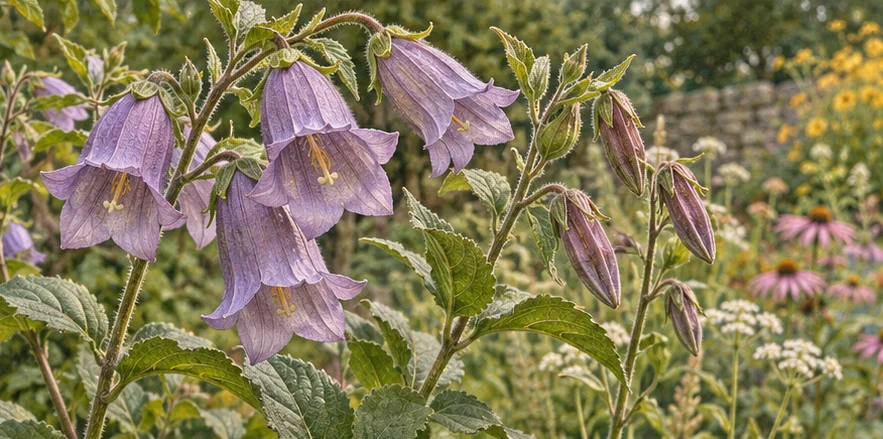
Imagery offers one more opportunity for honesty. An editorial picture of open and folded petals is useful for helping a reader imagine the scene. It does not document a change on a tagged stem. In a real observation panel, a photograph should be labeled with its stem or blossom identifier, date, and perspective, and should not be pushed beyond what it shows. If the second frame is taken from another angle, a visible difference could be geometry rather than a real change in shape. Keep close-ups with the context that makes them interpretable.
A compact field note can preserve the distinctions in plain language: “Stem B07 present, eligible, opening landmark not visible from path, state uncertain at the start of the afternoon watch; no independent nectar measurement.” Another could say: “Stem B08 present; observed closed at start and open at end; no transition time within the interval.” These examples communicate more than a symbol on a map. They preserve whether the observer saw a state, whether it changed within known bounds, and which biological conclusions are still out of reach.
Here is a garden-level report that would build on such notes: “We revisited the mapped stems during a fixed ten-minute afternoon interval. Our open category refers to a visible opening under one shared definition, not measured nectar access. Several already marked stems were folded during the watch and remain on the map. Two tagged positions could not be viewed clearly. We report visitor events for the observed patch window rather than as a whole-day rate.” Change the details to match the real method. The sentence about folded stems is not a disclaimer; it is the observation that keeps the map and the watch from being mistaken for one another.
If you have to communicate a result to someone deciding when to return, distill it to the field consequence. A midday map may be sufficient to find the stand, while a later watch might be preferable for observing open blossoms. Say that the later timing is suggested by the tracked rounds and specify how many days were represented. If someone is planning a comparison among patches, share the range of openness and the unknown portion, not just the highest count. The most useful message helps another person arrive with reasonable expectations without pretending the next day will replicate the first.
In mixed stands, it may help to report the state of each target group alongside the common map rather than aggregating every color and shape into one total. A combined count could remain level as a morning-opening group declines and an evening-opening group rises. For someone choosing a watch location, the replacement is meaningful even if it leaves the total unchanged. Name which groups the observer could reliably distinguish and retain mixed or unidentified classifications rather than allocating them in proportion to more familiar plants. This is a question about the structure of the recorded opportunity: the simple total describes how much showed up under the rule, while the group breakdown can show which kind of opportunity was present.
The original map survives a cloudy noon, an evening opening, and a short wind shift because it answers a different question from the watch. The watch becomes useful because it preserves things a map cannot: present state, conditions, exposure, and limits of view. Put the two together by keeping their shared identifiers and different timescales. Then a closed blossom is not an error to erase. It is part of the evidence that shows why a patch on a map and a resource during a watch are not the same thing.