| Category | Value (openings) |
|---|---|
| Prior use confirmed | 5 |
| No use observed | 9 |
| View obstructed | 7 |
Illustrative values, not sourced observations. Status is evidence about observations, not presence or absence.
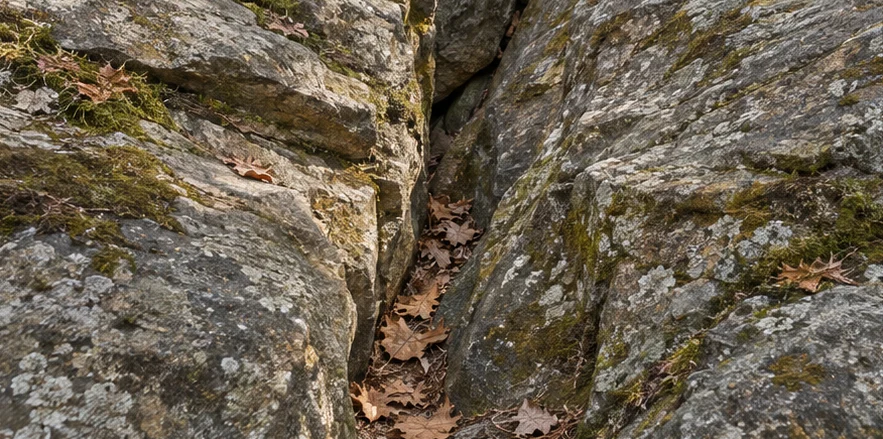
The opening at the bottom of the rock wall looks like a doorway. On a visit in June, someone watched a bumble bee fly directly into it. Today the opening is quiet, half in shade, with a few curled leaves nearby. It is tempting to tell a neat story: the nest is empty now, the leaves have blown in, and there is no reason to leave the spot alone. But the only thing the observer knows from this visit is that no bee moved through the visible opening while someone watched. That fact is worth recording. It is not a verdict about what lies beyond it.
An entrance is not the same thing as a nest. There may be a cavity deeper inside, a bend, a different passage connected to it, or nothing that functions as a nest. Old debris at the mouth cannot tell you whether the interior was used this year or whether it now shelters a different animal. Nor is a day with no traffic equivalent to a season with no use. A sound observation log separates the opening as a physical feature, dated evidence of activity, the opportunity the observer had to see it and the limits of any biological interpretation.
You can do this kind of natural history without testing cavities. Watch from a place you can reach safely, remain clear of the entrance and do not touch, open, light up or obstruct it. Do not lift a rock or remove litter for the sake of a better view. If the mouth is not observable from an appropriate location, the result is an obstructed view or a missed watch. Neither the field method nor the reason for watching justifies disturbing a possible nest. There is plenty to learn from two or three clear external records, provided each says exactly what happened and when.
Separate the doorway from what it has been used for
Start with a neutral physical description. An opening in weathered stone, a gap under a timber and a hole in exposed ground are examples, not diagnoses. One visible hole may connect to multiple spaces, and multiple outside openings may lead to one interior. A sketch of external features helps an observer find the right object again; it should not imply a known map of the cavity. Do not count visible holes as nests. Conversely, a nest can have an entrance that is impossible to see from a path. A survey of openings you can see is intentionally narrower than an inventory of nesting animals.
What you can say about use depends on the record. An identifiable insect disappearing through a particular lip is evidence of entry at that time. It is not, by itself, enough to prove a colony is present. A series of well seen arrivals and departures, especially when there are separate documented occasions and clear links to the same opening, is stronger evidence of repeated use. An insect flying low over a bank, touching the outside rim or vanishing behind a leaf nearby should not become a confirmed entry simply because the observer expected one. Describe behavior before proposing a purpose.
Here are three claims of increasing strength: an exterior hole was visible; a bee was seen using that exact opening on a named visit; a nesting colony was established there. Moving from one claim to the next requires more than changing the wording. For example, consistent bumble bee traffic with apparent provisioning can support a nesting interpretation, but documentation should still state why that interpretation was made and what could not be verified. Most informal watchers do not need to reach the third level at all. A clearly dated external use record is valuable on its own.
The term abandoned needs particular care. It suggests there was a known nest, that its former occupants are no longer using it, and often that the departure is permanent. Those are not conditions you can infer by looking at an unlit mouth. For a monitoring report, replace that shorthand with the observation that motivated it: use documented earlier, no activity seen on a later watch, or current mouth concealed. These phrases are not timid. They are more precise, and they let a later observer add new evidence without being forced to overturn a claim that was never actually tested.
Put season and species in their proper place
The Xerces Society's account of bumble bee nesting and overwintering describes the cycle of founding queens, developing colonies and new queens that overwinter. A characteristic cycle can guide questions about what different visits might reveal. It does not give a timetable that empties every cavity on the same day. Timing varies, different species use different conditions and the evidence available at one entrance can be incomplete. An observation during a quiet part of a life cycle is not comparable to one made under identical weather at a busier stage merely because both were taken at the same hour.
Do not equate seasonal colony decline with a declaration that a particular place is biologically vacant. The same patch of habitat can contain both nesting features and overwintering refuges, and other insects can use what was once an entry route. Those possibilities are reasons to keep the conclusion narrow, not reasons to assert that some particular queen must be nearby. A bumble bee colony is also not interchangeable with a solitary bee's provisioned cells. A sealed opening may have a different significance in a different kind of nest. An observer who cannot identify the occupant should not infer a life history from the shape of the doorway.
Keep weather and animal identity separate from the date. A still half hour late in a season could follow a windy day, a cool morning or changes in nearby resources. An insect at the rim could be an unrelated visitor. Where you have a credible group identification, record it at the highest level visibly supported. Where you do not, use an unknown category and record details such as size impression, direction of movement and which part of the entrance it reached. Avoid changing an older record to a confident species identification on the basis of a guess from an unrelated later visit.
The Xerces nesting and overwintering habitat guide describes how natural features can serve as nest and shelter resources. The most useful implication of that guidance is not that every piece of litter is a nest clue. It is that untidy features have ecological functions that a brief inspection can overlook. For a garden caretaker, leaving a stable patch undisturbed and documenting what can be seen can be a sound choice even when the exact animal use remains unknown. A tidy appearance is not a measurement of that use.
Plan a watch that does not change the doorway
Locate a stable position outside any obvious line of traffic. Use magnification from a safe distance if that helps; it is preferable to leaning over a hole. Keep to a path or other permitted surface. Do not stand over soil around a suspected entrance, move loose material or place equipment across the approach. If a location calls for scrambling, trespass or entering a place that cannot be observed without disruption, make an effort-limited record and skip the watch. People who cannot safely observe from the available location should choose another activity rather than try to get a closer view.
Decide what a clear view means before you start the timer. You might need to see the opening lip against a sufficiently distinct background and have enough light to see whether an insect crosses that boundary. If shadows or stems conceal the precise endpoint, you may still record activity nearby, but not traffic through the opening. Do not assume a wider lens solves the problem: it can show more of the approach and less of the decisive small movement. A clear image of the spot without a clear lip cannot verify an entry.
Write start time and actual observation minutes. A scheduled watch of ten minutes that lost five to a passing obstruction did not produce ten usable minutes. Record conditions relevant to visibility and activity, including a substantial change from light to shade or a stretch of gusts. If safety requires leaving early, go and mark the time rather than trying to finish a watch. A small group can agree on standard windows for comparison without pretending that all scheduled watches delivered the full planned effort.
When watching more than one opening, choose an order independent of what looks promising in the moment. Otherwise a bright moving spot gets plenty of attention and a shady quiet one gets a glance. If two mouths are very close, focus on one field boundary at a time or be honest that you cannot reliably identify which one an insect used. A scheduled repeat during a suitable period gives a different kind of evidence from extending the first visit only after something interesting appeared. Neither is useless, but record the impetus and actual effort so another reader can interpret it.
Nonintrusive means no improvised confirmation test. Putting an object in the entrance to see whether it is moved tests the animal's response to interference, not ordinary use. Pushing a probe or a camera into a space can harm occupants, damage a structure or remove the very condition you wanted to observe. Adding water, smoke, bait or artificial light is not part of this method. Do not lift a rock or clear material away merely to earn a definitive answer. A watch that confirms nothing can still be rigorous; causing behavior to get a record is not an improvement.
Write a rule for traffic and ambiguous arrivals
Start the log with three event types: definite entry or exit, near-entrance behavior, and unclear movement. One simple threshold for a definite entry is a continuous view of an insect passing beyond the visible lip into the external opening. A moment out of sight followed by a bee seen leaving another point is not a verified connection between points. When you can see that an exit originated from the correct mouth, it can stand alone; you do not need to reconstruct when or how the animal entered. If the mouth cannot be distinguished from the foreground, record the movement as unclear.
Do not count the same pass twice because it remained in view for several seconds. When two observers watch one opening together, either have one person keep the definitive log or assign timestamps to observations so duplicates can be reconciled. Separate an event count from an individual count. One animal can make multiple trips. A small set of crossings can be a firm minimum for documented events and a poor estimate of how many insects used the space. Likewise, one opening can yield many events and still be only one physical monitoring unit.
Pair positive observations with honest detail. The note “two apparent bumble bee arrivals through the lip between 10:15 and 10:20, one carrying visible material interpreted as pollen” is better than a claim that there were two colonies. When the object carried on a leg cannot be identified, say that, too. An animal coming out rather than in should be logged as an exit even if an observer assumes it will leave to forage. The record describes a visible act. Later interpretation can consider what that behavior usually suggests without retroactively changing the act itself.
An earlier report can count as historical evidence when provenance is good enough. A dated video from the same opening can be stronger than a memory of bees “somewhere along the wall.” Ask whether the view shows the actual crossing, whether the mouth can be matched unambiguously and whether the date is known. If one gardener's report is credible but only approximate, retain it as a lead, labeled as such. A reliable log allows a well supported prior observation to remain useful even when subsequent watches are quiet.
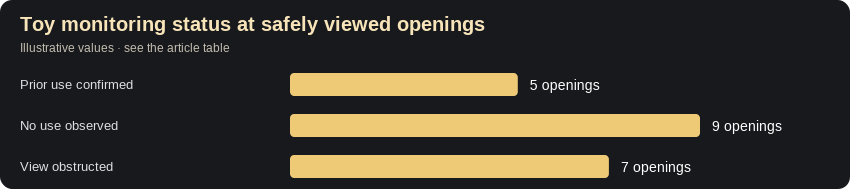
Toy monitoring status at safely viewed openings
This bar chart and table contain fictional records. They count openings in an illustrative monitoring register, not colonies, occupants or measures of occupancy. The title refers to a register made from safe observation positions; some attempted views were inadequate. For this single summary screen the reporting categories are mutually exclusive by rule, not by nature.
| Monitoring status | Openings |
|---|---|
| Prior use confirmed | 5 |
| No use observed | 9 |
| View obstructed | 7 |
The fictional tally classifies an opening as prior use confirmed if an eligible earlier record verifies use. For the remaining openings, no use observed means there was adequate attempted watch effort but no definite movement; view obstructed means a safe view could not supply enough usable effort to make that statement. A real underlying log should retain older and newer observations as separate fields: a history of verified use does not stop being true if the current view becomes obstructed. The summary rule in the toy data is only a way to avoid counting the same opening twice.
The total is twenty-one openings. The nine in the middle bar are not nine vacant sites. The seven on the right are not seven unoccupied holes or seven failed colonies. Five documented prior uses out of twenty-one monitored openings is an arithmetic description of a particular fictional register. It is not a biological occupancy rate; the denominator mixes histories, adequate observation and insufficient visibility. Removing the obstructed examples and dividing five by fourteen would not fix that mismatch. The five positives and nine quiet records could still represent unequal observation histories or different observation windows.
You can make another graph to answer a more specific question if the records support it. One useful plot would show how many previously used openings yielded any new confirmed traffic at a named time of year, with a companion tally of which could be watched. Give the exact effort and keep the current question in its own chart rather than treating a historical classification as a present result. If there are only a few sites, a table of each opening and its dated observations may convey more than a percentage. Do not use a visually polished chart to obscure how little can be known from its categories.
Interpret the quiet visits without making a claim they cannot support
A zero is informative only when the opportunity behind it is understood. On one visit the observer could see the mouth clearly from a safe distance for fifteen uninterrupted minutes. On another, the mouth could be seen for only a few seconds at a time when the stems shifted. The first visit can have a recorded zero confirmed crossings and the second a record of insufficient view. Describing both as inactive gives a false sense of agreement. It also makes it impossible to know where a routine change in vantage point could improve next year's records.
Repeat watches can improve the evidence, but not as fast as a spreadsheet might suggest. Three short watches in succession share the same morning, weather and likely state of the animals. Three watches distributed across different suitable occasions provide a different kind of evidence. Even with repeated observations you may see no traffic when the opening is being used at other times. An absence claim demands knowledge about when use could be seen, not simply a larger number of visits. A clear description of the repeated non-detections is often the appropriate endpoint.
Could we assign a probability to that uncertainty? Only with assumptions and information the typical walk does not provide. The probability of detecting an animal at a used opening could vary by occupancy state, colony activity and observer. If observations share weather and the same inaccessible perspective, treating them as independent trials exaggerates what each check adds. If the biological state changes between visits, a model assuming constant state throughout that interval no longer fits the question. A professional survey might design its effort around these issues. A casual record can be just as honest by not inventing a detection probability at all.
Primary field research by Osborne and colleagues notes the difficulty of finding bumble bee nests and the problem of infrequent traffic. Its research design and survey context should not be turned into a universal waiting time. The relevant lesson is why repeatable effort and detection limits matter. A garden watcher may have better visibility than a research team at one opening and much worse at another. Neither circumstance alone establishes whether activity is rare across the larger area.
If you are watching for current use, pick a period over which the concept makes sense. “Any activity over a whole warm season” is different from “use this week.” An observation in May and a quiet watch in October may be important in a timeline, but combining them into one binary present-time label flattens the difference. Specify whether the summary is “ever documented in this register,” “documented this month” or “seen on this session.” Naming the time span does as much for accuracy as a clear camera angle.
Now imagine you had a very strong positive record at a certain opening early in the year. Later the stone setting changes enough that you cannot tell whether the old mouth is still present. Do not simply give the new gap the old identifier and draw a continuity line in the chart. Retain the former opening with its history and add a new identifier or a note that the match could not be verified. The uncertainty here is not about the movement of an animal. It is about the identity of the physical feature being monitored. A good status system can express that distinction.
Two field stories that look identical on a dashboard
On the dashboard, both site cards say one positive watch and two quiet ones. At the first site, the positive consisted of several clear entries and exits during one session. One later watch had strong light and the other had a distracting background. At the second site, the positive had only one definite entry, and both later watches were conducted from a fixed chair with equal visibility. The same summary count sits above different evidentiary histories. The first is a strong external activity record for one point in time. The second documents a smaller positive observation but better matched later watches. Neither supports a certain diagnosis of abandonment.
A third case illustrates how to document disagreement. One person sees an insect fly toward the wall and loses it at the bottom. A second observer sees a bee emerge from a separate opening several minutes later. These records do not contradict one another, but they do not connect the first and second observations. The first ending is unknown. The second beginning is an observed exit, if the view supports it. A draft map that joins them with a line would describe a route neither observer saw. Keep both records without forcing a unified story just to make the map more satisfying.
You can also encounter disagreement about what the same camera captured. One reviewer thinks they see the insect enter and another thinks it lands on the lip. Put the uncertain observation in a category for ambiguous boundary crossings. If off-axis perspective repeats the problem on most clips, change the next observation plan rather than holding a vote to count every unclear event. A careful review might support an additional entry now and then, but repeated agreement is most useful when it points to a criterion other observers can apply consistently.
If someone's recollection and a recorded observation have different dates, guard against a natural assumption that a later observation is automatically more reliable. A vague recollection from this week may be less reliable for identifying a specific entrance than a clear video taken last month. Conversely, a precise account from this week can establish a newer event without proving that the insect in the old footage belonged to the same group. Keep evidence type and date in separate fields. One does not serve as a proxy for the other.
Keep the record usable when nobody can return
For every watch record, use fields for opening code, date, time, actual observation duration, observer, visibility, definite entries and exits and notes on identification. At the opening level, store the physical description and references to external photographs or sketches. In the field notes, explain any switch in viewpoint or a session stopped for safety. Separate blank values because nobody collected them from zeros because someone looked and saw no events. That difference should survive export to a spreadsheet, where both can otherwise collapse into an empty cell or a displayed zero.
Record which types of movements were explicitly not scored. A fly on a nearby flower is outside a watch defined around one opening; a form without a place to enter it does not establish that there were no flies. If you record near-entrance sightings as a supplemental column, state how you defined near without mapping an arbitrary sight line as a biological boundary. A visible landing past the edge of the planned frame can be an interesting incidental observation while not belonging in the main comparable count. Consistent rules reduce the need for creative cleanup later.
Take an exterior reference photograph only when safe and appropriate, without moving anything. It can help an authorized reviewer determine whether a later view shows the same entrance. Crop only a copy when you need to remove a public landmark or someone's identifying detail, and keep the fact of the crop clear. If an image lacks the context needed to assign it to a physical opening, label it unverified instead of pretending the file name supplies the link. An image ideally supports the record; it should not become the only place observation time or identification confidence was noted.
A public-facing summary does not require precise nest coordinates. Generalize locality where appropriate and follow any responsible reporting program's rules about sensitive observations. Share a named manager enough information privately to avoid inadvertent disturbance where you are authorized to do so. Be clear about uncertainty rather than directing the public to inspect the site themselves. A report that prompts repeated close approaches can undermine the same habitat it was meant to celebrate. An illustration or diagram can teach people how to read evidence without turning one discovered opening into a destination.
Make the caretaker decision separately from the survey result
Imagine a garden volunteer wants to repair a border, remove fallen material or shift foot traffic. The monitoring log is one input into a choice, not approval to intervene. A possible active entrance where people must work deserves a conversation with the site manager or appropriate local specialist. Do not take a brief quiet observation as clearance. If plans can be deferred, keep the area undisturbed while the responsible person decides what is needed. If the situation creates an immediate safety issue, move away, alert the people responsible for the site and do not attempt an informal wildlife check.
Low-impact adjustments often do not require strong claims about the interior. You could pass information along so routine gardening avoids an uncertain patch that is not urgent to alter. If a path can serve users without directing them alongside an observed approach route, leaving adequate space may solve the immediate concern. An observer cannot promise safety merely by putting a marker in the ground; changes and signage should follow the site operator's procedures and avoid causing additional disturbance. The point is that a cautious management choice can be justified by uncertainty without claiming it confirms an active colony.
Think also about stewardship at the scale of the garden. An abundance of flowers does not by itself supply places to nest or overwinter. The Xerces guidance points to habitat features worth recognizing, but that does not mean turning the garden into a scavenger hunt for nests. An exterior survey from allowed points can describe heterogeneity without touching any feature. Retaining quiet corners where appropriate, planning work with the management team and respecting movement from a distance can matter more than getting a definitive label for every cavity in view.
When someone asks whether the opening may safely be filled, a field journal cannot give permission. It can summarize what is known: a confirmed dated entry, several watch windows without a sighting, an obstructed view now and no inspection of the interior. It can also say explicitly that those facts do not establish vacancy. Passing along the limits leaves the decision with the responsible professional or manager, who may have other information and duties. Do not use the article as a protocol for verifying that a location is safe to alter.
Plan a better comparison, not a more intrusive one
If your goal is to compare two garden sections, match the kind of observation you can make in both. A low wall beside a paved path offers more observable lips than a dense bank. A raw count of confirmed events can be valuable for describing each visit, but it does not directly compare biological use between those sections. One area may produce more records because the openings are larger or the background is clearer. Report how openings were selected, how many were observable, and what opportunities were unavailable. The conditions for detection are not an annoyance outside the data; they are part of the result.
Consider a repeatable sampling frame: one route, several named stretches and a fixed amount of effort distributed across safe viewpoints. Keep observations made opportunistically on walks separate from scheduled comparisons. An incidental positive encountered under excellent conditions is real evidence of that event, but combining it uncritically with a systematic tally may bias the comparison. Conversely, an unobstructed place chosen because it has an obvious entrance is a valid teaching site but not representative of all the invisible openings in the garden.
Use the first season of observations to improve the record before adding more categories. If the recurring issue is that observers fail to record what part of the entrance is visible, refine that field and include an example. If most status changes result from a relocated rock or replaced board, prioritize stable identifiers and change logs. If visibility and effort are solid, a repeated seasonal comparison might become worth the effort. This sequence improves what can be said without creating pressure to look more closely than it is safe or appropriate to look.
For a small project, a second observer can independently score practice videos from previously authorized observations or suitable educational material. Compare the coding of clear crossings and uncertain movements rather than simply checking who counted more. Discuss what constitutes an adequate view and which uncertainties the public summary needs. A reliably used small vocabulary is often more valuable than a detailed scheme that cannot be reproduced by anyone other than the person who wrote it.
Treat material at the lip as a separate observation
A patch of plant fragments can become an accidental centerpiece in a report. The observer remembers its look and has a theory for where it came from. Instead, make two entries: the material was visible at a given place on a given date, and its origin was unknown. Terms such as refuse, bedding and nest lining identify a use or source, not just an appearance. If another person could equally call it windblown litter, a neutral description preserves all of the evidence you actually have. Note whether it was near the opening, across part of the visible lip or seen moving. Do not say it came from the nest unless the observation supports that link.
Changes to material can be as ambiguous as the material itself. Suppose a leaf recorded at the mouth on Monday is absent on Thursday. This could reflect wind, rain, an animal or maintenance. The record does not say that an occupant cleared an obstruction. If you actually see an insect remove material, write the action and what was recognizable, while leaving open whether it was preparing a nest, using an established route or doing something else. The distinction is easiest to preserve when people use verb-based notes instead of picking a category from a menu that already assumes colony behavior.
An externally visible plug can be informative physical evidence without indicating failure or abandonment. Do not compare visibly closed and open entrances as though for every kind of animal the same structure had the same meaning. At a closed feature you can describe its external state and when it was observed. You cannot test whether a plug was already present from the perspective of the occupant or remove material to investigate. For the planned watch the practical consequence is that the former observation boundary may not be usable. Keep the old entry record regardless of whether the newer surface can be classified.
An annotated sketch can help distinguish apparent debris movement from a change in viewpoint. Mark two stable exterior reference features and the outlines as you saw them from the path. A new drawing from a different angle may show a gap that the old drawing hid, not a physical change. Label view angle, visibility and the parts obscured by foreground structures. This is an inexpensive alternative to trying to reshape the view. It also alerts a reader that a clean contour drawn on paper should not be read as a complete cross-section of what was underground.
During a team review, ask each person to classify both the event and the strength of the link to the entrance. They might agree that material moved while disagreeing whether it originated inside. That is a meaningful intermediate result. A summary meant for caretakers should not promote it to evidence of a live nest or downgrade it to proof of vacancy. Preserve the raw note, state what cannot be inferred and record any reason not to return. In many gardens no follow-up on the object will be necessary because leaving the spot alone satisfies the practical aim.
How to close the note without closing the case
A good entry might end like this: “Earlier use documented by a dated external observation. No definite movement was seen during today's usable viewing period. The interior and any other access points were not observed. Leave undisturbed.” This is a complete and useful report. Its limitations are clear without suggesting an elaborate future investigation. If a later observer sees renewed traffic, they can append it. If the view remains blocked indefinitely, the last credible evidence stays precisely where it belongs, at the date and feature it describes.
The opening that looked empty on arrival can remain quiet as you leave. There may never be an answer about who used it when nobody was present. You have still done something worthwhile if the record preserves the difference between a known event, a genuine non-detection and an incomplete opportunity to see. Those distinctions keep visitors from overinterpreting debris, help caretakers avoid needless disturbance and give the next observer an accurate place to start. In natural history, the uncertainty you leave intact can be just as valuable as the movement you manage to catch.
Sources and illustration note
- Xerces Society: Bumble Bees, Nesting and Overwintering, bumble bee life cycles and habitat context.
- Xerces Society: Nesting & Overwintering Habitat, conservation guidance on natural nesting and shelter features.
- Osborne et al.: Quantifying and comparing bumblebee nest densities in gardens and countryside habitats, primary research on nest surveys and detection limitations.
The chart is invented. If generated, the hero art is a fictional exterior scene, not an image of a documented nest or proof of what occupies a cavity.