| Category | Value (records) |
|---|---|
| Likely pollen handling | 8 |
| Feeding cue | 6 |
| Unresolved | 10 |
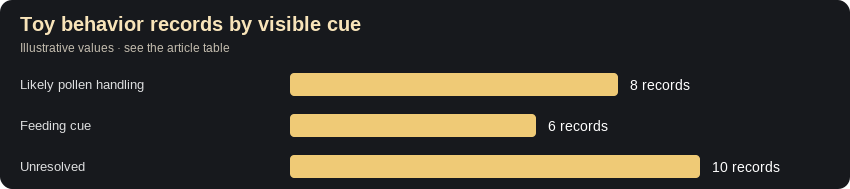
Illustrative values, not sourced observations. Likely classes are not definitive resource use or quantity.
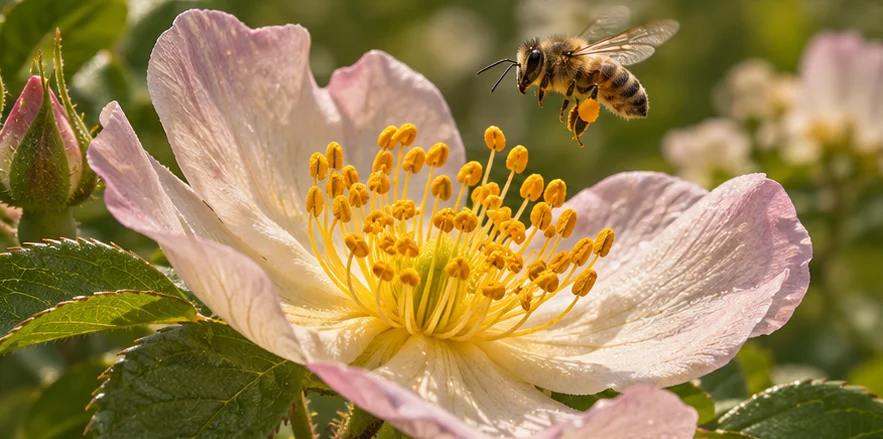
A bee lands on a flower with exposed anthers, walks over the center, and lowers its head. Each bit of the sequence is visible, but the observer cannot see the mouthparts or tell whether the legs made repeated movements against the anthers. If the flower is known for its pollen, it may be tempting to put the visit in the pollen column. If the head went down, it may be equally tempting to call the visit nectar feeding. A better entry says where the bee moved and which details were hidden. A well-described unresolved visit is better evidence than a definitive label supplied by the plant's reputation.
Flowers can present more than one reward, and a bee can do several things during one visit. Pollen may adhere incidentally to a visitor seeking nectar. Material carried on a leg might have been picked up before the visitor reached the watched flower. A visible probe is an attempt or feeding-related cue, not necessarily a measurement of what was available or ingested. To compare rewards in a garden, separate the flower's known or expected resources from the visitor's observed actions and from any claim about what it obtained. The distinctions can fit on a simple field sheet.
Keep the flower part and the behavior distinct
Start by identifying which features of the flower are actually in view. Anthers are pollen-bearing structures. A nectary is a site that secretes nectar, and its position may not be visible from the angle of a watch. Knowing where a nectary typically lies can help frame a likely approach; it cannot prove that a bee obtained nectar or that nectar was present then. Similarly, identifying an anther allows a more precise description than identifying the center of the bloom. It does not distinguish a leg passing over it from deliberate handling unless the motion itself is visible.
The USDA Forest Service brochure on pollination describes patterns connecting floral traits and broad pollinator groups. Shape and access routes are useful starting points for a hypothesis about visits. The brochure is not a lookup table for the resource acquired on a particular visit. A tubular opening may hide the movements that would make its use clear; an open flower may show many parts but leave ambiguous which part the visitor targeted. Use floral form to plan a practicable viewing position and refine the question, not to fill the result column before a bee arrives.
The USGS overview of native bees in the United States describes their importance in crop and wild plant pollination and discusses pollen specialists. An agency overview of bee ecology and plant interactions also distinguishes nectar and pollen as resources. A specialist label concerns use of particular pollen hosts, not what one insect did during one partly hidden visit. An observer cannot infer specialization from a single stop at a flower, and knowing a visitor's likely group does not make every visit an instance of pollen collection.
Plant identity is another field, not the evidence code. Confirm it to an appropriate level where possible. Note whether the target is a single bloom, an identifiable small group of blossoms, or a flower head with multiple smaller florets. The word flower can refer to very different counting units in the garden. If tracking a bee across several visible florets on the same head, decide whether this is one visit to the head with several actions or a series of floret visits. Both units can be defensible. Mixing them can make one plant look substantially busier merely because its blossoms were subdivided.
Define cues as patterns a second person could recognize
A useful cue describes an action, a body part and a target. “Forelegs made repeated strokes at the exposed anthers” is stronger for possible pollen handling than “bee was in the center.” “Mouthparts extended toward the base of the tube” is stronger as a feeding cue than “head was pointed down.” A useful record may still have an uncertain identification of the structure, in which case keep that uncertainty visible. Distinguish “the mouthparts were visible and directed toward the opening” from “the head was below the rim so the mouthparts could not be seen.” Those entries offer different evidence from the same posture.
Pick cue definitions that match the available view. If the primary camera never resolves the leg movement, do not name a leg-based behavior as an outcome that can be obtained from every event. If mouths are visible only near an exposed edge, give mouthpart visibility its own field. A watch can be a good measure of overall visitation even if it cannot distinguish the resources that motivated visits. If the desired distinction is crucial, change the observation design within ordinary nonintrusive bounds or limit the claim. Do not make the label more confident to compensate for hard-to-see behavior.
Write a minimal version of the rule in ordinary words. A colleague should know whether keeping the same legs still on an anther counts, whether the repeated movement must be directed at it, and whether grooming after departure is part of the visit. They should also know when to enter unknown. A cue does not become more valid because it requires elaborate equipment or detailed terminology. It becomes more useful when an independent observer can tell which facts had to be visible for the code to be used.
Toy behavior records by visible cue
The chart and table show identical invented counts of 24 example observation records. The unit is records. Each arises from a defined visit observation, not from a distinct bee and not from a measured amount of either reward. The example bins present one recorded summary label per event. “Likely pollen handling” and “Feeding cue” are tentative behavioral classes, not identities or quantities of collected material. “Unresolved” includes cases in which the view or observed actions could not support a more specific label.
| Recorded cue category | Records |
|---|---|
| Likely pollen handling | 8 |
| Feeding cue | 6 |
| Unresolved | 10 |
The example could use a summary rule requiring an unambiguous single leading cue for the first two bins. If both cues appeared and their sequence could not be separated under the rule, keep both in the raw note and put the combined summary in unresolved. A real project might instead include a separate mixed label or publish two independent cue flags. Either is acceptable if the readership can tell whether categories can overlap. Selecting a single summary label for the chart does not make every visit biologically exclusive to one reward.
The ratio of eight to six is not evidence that bees preferred pollen to nectar. Different cues have different chances of being seen, and the ten unresolved records might not be typical of the other fourteen. The example does not measure reward supply, equal access, comparable opportunity, or the same set of individuals making comparable choices. If you report that eight of 24 records met a likely pollen handling criterion, that is a statement about the records under a particular coding rule. It is not a statement that eight bees collected pollen, much less that each collected a known mass.
A defensible next question might concern why ten were unresolved. If six were obscured by the side of a deep flower and four were too brief for the observer, the data have different needs than if all ten showed several distinct actions. In the first case improve or narrow the viewing question; in the second preserve action-level detail and reconsider the chart categories. Do not combine all those explanations into one putative third type of foraging. The unresolved bin is a statement about evidence, not a reward or activity in nature.
Tell attempts, contact, movement and quantities apart
A nectar-related cue can show a probe, not necessarily uptake. The mouthparts may be directed toward a plausible nectar location, but the camera ordinarily does not show liquid movement or whether the flower had any reward left. A previous visitor could have depleted some, or the flower might offer nectar at a timing the observer did not measure. The most careful short label is often “probe toward the base of the flower” with an interpretation field such as “feeding cue.” Do not call the outcome successful nectar intake unless there is evidence of that outcome.
A pollen-related cue can show repeated handling at anthers, but may not resolve whether grains were collected. If the insect visibly moves a material in a repeated sequence from one body area toward another, describe that sequence and say what could be identified. A patch on the legs at arrival and departure need not have increased on the watched flower. A patch seen only after a rotation of the bee may not be new. To infer an apparent change, check that the same region was visible at both times under comparable conditions. An image cannot weigh the difference in material unless a method has independently linked the image to quantity.
The primary study of bumblebees learning colors for nectar and pollen used controlled artificial flowers and distinguished attempted behaviors from whether they produced a reward. That design made the presence or absence of reward knowable in a way that casual field observation often cannot. The lesson worth borrowing is the separate recording of action and outcome. Do not transplant the study's exact cues into natural flowers without checking whether the field structures and approaches match. The experimental array was a means to identify choices within a task, not a definition of what every hovering visitor is doing.
The same caution applies to a primary experiment on pollen taste and flower choice. The authors used known presentations to address how pollen features affect foraging decisions. A garden study watching several flowers in different locations has less control over the cues and rewards available. The experiment gives a useful reason not to assume that visual floral traits tell the whole story. It does not imply that a field observer can infer a bee's sensory judgment or dietary preference from the sound, speed or direction of one visit.
A visible load and deliberate collecting are different clues
A bee arriving with a conspicuous packet of material on a leg may be a good candidate for detailed observation. It does not follow that the packet came from the first bloom within your frame. It may have been assembled across earlier flowers, and the visitor may only be probing for liquid during the clip. Preserve the arrival view as evidence of existing material. If the bee leaves the frame and returns, do not automatically connect the two observed loads to the same individual unless that identification is independently supported. Similar appearance can be useful at an appropriate level while individual identity remains unknown.
In research on bees that carry pollen, some material can be on body surfaces and some in specialized carrying structures. The primary study comparing pollen in carrying hairs and elsewhere on bee bodies distinguishes collection for provisioning from the transport relevant to plants. The point for an observer is that a visible load and material available for transfer are not interchangeable. A bloom contact does not demonstrate deposition on a receptive surface, and a large load does not measure the effect of a given visit on the flower. Describe the feature where seen and leave its source or function unresolved when evidence is insufficient.
An incidental touch can put a pollen-bearing part and the insect in the same place without looking like purposeful handling. The USDA-hosted COLOSS BEEBOOK pollination methods describe how honey bees can take different approaches to particular flower structures. One reason such distinctions matter is that a nectar-seeking route can go past reproductive parts. This research guidance is about particular methods and honey bee examples. Do not generalize a chosen movement code to all native bees, all visits or every plant with an apparently similar flower shape.
Record several actions if the clip shows them. A bee may first walk through the anthers, then extend mouthparts toward the flower's interior, and later groom while perched. A single label compresses the sequence and may misrepresent what was seen. Write actions in order with approximate times or frame references, and separately mark when the relevant structure was obscured. The raw sequence is especially useful if the project later decides that mixed activities should be summarized as more than one flag. A single caption already declaring the resource cannot be reliably expanded back into those observations.
If a vibration is apparent, do not assume it establishes quantity or deposition. A visible grip or body movement and an audible sound may make a useful behavioral note, but sound picked up near a busy plant could come from another visitor or flight. Document whether the sound and motion are aligned in the recording and whether the part contacted could be seen. Avoid a strong label based solely on a short audio clip with no visible source. A confident identification of a mechanism still answers a narrower question than how much the bee obtained or how much the flower received later.
Keep the watch comparable without changing the animals' options
Decide what the project can see from ordinary, nonintrusive positions. Avoid handling bees or altering flowers to make their parts more visible. Do not shake a plant, remove petals, offer additives, or move insects to create comparable scenes. An appropriate observation from an existing access point may reveal less but preserves the behavior your comparison is supposed to document. If natural visits cannot support the distinction on your target plants, report the limits or choose a simpler outcome rather than make the setup intrusive.
Use comparable effort. In a day of garden watches, give the focal plants defined observation periods and record interruptions, time of day, weather, shade and viewing angle. If one flower is watched from a wider gap while another is viewed only from overhead, the difference can affect which cues are visible. Seek a broad comparison that each watch can support, or report separate quality flags for narrower cues. A beautiful recording after a long opportunistic wait and a complete fixed-duration watch are both worth keeping if they are not silently treated as the same product.
Avoid selecting only still frames that look conclusive. A still can document body position and material, but may not show the movement leading into it or the fact that an insect was already carrying something. Preserve enough continuous footage where available to understand the sequence. If the insect leaves the frame halfway through, say where continuity was lost. The goal is not to collect more footage than the project needs but to maintain the evidence required by each published label.
Describe availability before interpreting differences as choices
A plant visited often for a particular apparent action is not necessarily preferred to another plant. It may simply be more abundant or easier to reach during the watch. At the start of a round, record which focal blooms were open in the defined viewing area, which were available at the relevant time, and which were visible enough for your criteria. These are practical context fields, not measurements of actual nectar volume or pollen. A row that says ten open flowers is not a row that says ten equally rewarding flowers. Keep the limits of the proxy visible.
The temporal order matters too. A pair of plants watched at different times may differ in current conditions, and a morning's observations need not generalize to a later period. If the plant with easily visible anthers is always watched first and the other plant always after the walkway gets busy, part of the pattern may come from the design. Alternate order or use simultaneous observations when they can be made from permitted positions with comparable rules. Record who watched which patch, since observers can differ in what they call visible. Better scheduling does not eliminate all differences in reward availability; it makes some avoidable ones less influential.
Preference is a stronger claim than use. To infer preference, a study ordinarily needs information about alternatives that were available to the visitor plus a definition of choice and an appropriate basis for comparing responses. The group of bees in two plots may not be the same, and the same bee may appear in several visits. An observed association between an action cue and a flower type can be reported directly without naming it a preference. To describe choices more specifically, consider events in which identifiable alternatives were comparably accessible under the observation design and state what about their resources remained unknown.
Consider two hypothetical patches. In one the flower base is easy to see, and there are six feeding cues in twenty visits. In the other the base is mostly concealed, and there are two feeding cues in twenty visits. The arithmetic is valid as counts of documented cues. It does not show visitors were three times as likely to feed in the first patch. The relevant denominator for a more limited comparison would include visits with qualifying views of the appropriate mouthpart action, provided that conditioning makes sense for the question. Report both how many visits were watched and how many allowed that code. Conditioning on visibility can itself select for some behaviors, so it is not a complete correction.
An equal number of visible actions can also come from very different compositions. One bee might make six visits to one flower head, each following the same easy route. Another plant could have six brief visits by different bees, not necessarily distinguishable on camera. Without individual tracking, refer to visits, not independent individuals. If an inference depends on repeated behavior by particular animals, design and scope that separately. A watch can say which cues appeared commonly in sampled events and leave diversity of individual behavior unresolved.
Keep a denominator for poor views and mixed actions
For a practical recording scheme, mark whether the anthers, likely route to the flower base, legs and mouthparts were visible. Then mark actual observations and the level of uncertainty. A visit with an excellent view but no repeated directed movement meets a different condition from one with motion blur that hides the legs. The first can contribute to a qualified nondetection for that motion. The second cannot. If a still clearly shows a laden leg but no moment of action, the record is about the visible load. It should not be merged with a sequence meeting the handling definition unless the report says it combines those clues.
When two cues can both be resolved and timed, store them as two action flags. If you later need a mutually exclusive pie or bar display, create an explicit rule such as likely handling only, feeding cue only, mixed, and unknown. The toy chart uses three categories and holds mixed cases that cannot be assigned under its single-label rule in unresolved. A full project may separate mixed and opaque views precisely because they pose different challenges. A change in the reporting bins need not change the primary observations if they were saved at the action level. Recomputing categories from raw events is safer than overwriting old labels.
Document the denominator for rates such as proportion of records with visible probing. If only thirty out of sixty visits could show mouthpart extension, the share among the thirty is not the share among all sixty. A lower bound on the number of documented probes across all sixty is possible, but no assumption-free classification of every hidden event follows. A report can present counts with the full denominator when describing recording yield and counts with the eligible denominator when describing what was seen among qualifying views. State which argument each figure is meant to support.
If comparing groups, audit whether missingness is uneven. Tiny insects can be harder to resolve than larger ones, and one floral geometry can hide the relevant structure more often than another. That may make a comparison of coded actions partly a comparison of visibility. Rather than fill uncertain records using the observer's knowledge of flower identity, show the unresolved share in each group. If the difference depends on dismissing those records, state the comparison is inconclusive at the desired level. This will help choose a better natural observation angle or a different question without converting uncertainty into apparent preference.
Build a checkable field note and read it back literally
Use a watch identifier for the place, time and observation rule. Link each event to a plant or blossom identifier at a suitable level of detail and note where the visitor entered from. Write down the behavior before interpreting it: position, target structure if visible, movement, and any interruption. Then give the behavior cue plus its confidence and indicate whether any material was present before or after. Keep the media reference if one exists without requiring a photo for every otherwise valid watch. An unfilmed event can be reported at the resolution the observer can support.
For example, a fictional field note might read: “Visitor landed on the upper edge of an open blossom, moved toward exposed anthers, and used both forelegs in several directed motions at the anther area. The head then went below the rim; mouthparts were not visible. Departed to the right. Material on legs not assessable.” The project might code likely pollen handling and explicitly leave feeding unknown. The record would not justify a weight of pollen collected or a conclusion that no nectar was taken. The order and limits of the observation make it useful regardless of the eventual summary rule.
A second fictional note might read: “Bee entered through the flower opening; mouthparts briefly visible extending toward the base. Anthers hidden from this angle. A light patch was visible on one leg at departure, but the same leg was not visible on arrival.” Under a simple cue scheme this might count as feeding cue, with material presence recorded separately and its origin unknown. A reader could reasonably wonder whether pollen was also handled out of view. That possibility is not a contradiction; it is precisely why the categories refer to what was recorded, not to mutually exclusive biological behaviors.
A third might read: “Visitor crossed the head and left within the view. Neither target structure nor mouthpart or foreleg action resolved.” This is an unresolved event, not a failed observer or a no-reward visit. The event still contributes to a visitation count if it meets the visitation rule. If many events look like this in one plot, the watch may be better suited to describing visits than to separating cues. Use that diagnosis to change a future design, not to relabel those events by what flowers usually offer.
If two reviewers disagree, ask which photos or frames justify each part of their code. When one reviewer knows the expected reward and the other does not, that can reveal how much the label rests on prior knowledge rather than on visible action. Blinding plant identity is not always possible, but a first pass that codes behavior before discussing expectations can help. Keep both initial codes and a documented resolution if the difference matters. A genuine disagreement over visibility is useful evidence about how reproducible the project is.
Check whether the cue travels across flower architecture
A useful small pilot is to choose two natural viewing cases that differ in what they expose, not in what you have decided the bee must be doing. One might show the legs clearly while the visitor stands on a broad open flower. The other might show the approach and departure clearly but hide everything below the rim. Try coding the same behavior rules on both without filling the blind spots. If the first view routinely answers the handling question and the second only answers whether the visitor entered, the valid comparison is between records of visible approach, or there may be no common handling comparison at all. Learning that limit before a full study saves work.
Watch for cue definitions that describe morphology rather than action. “A flower had visible stamens” is not an insect behavior. “The bee's legs touched a visible stamen” adds action but may still represent ordinary walking. “The forelegs moved repeatedly at the same exposed anthers while the visitor held position” is a narrower criterion with a better chance of identifying a potentially purposeful action. It sacrifices some coverage because many actual visits do not give a clear view. That is an acceptable trade if the report tells readers how many visits were eligible for the narrower rule.
The same test applies to a phrase like “head in the cup.” Depending on the flower, a visitor can lower its head to pass through, to investigate, to handle a structure, or to extend its mouthparts. Mark which additional detail the observer can see. If the relevant structure cannot be identified, a useful record might name the position without claiming its function. Growth stage or damaged petals can change what is in view. The focal specimen on the observation day deserves a note even if a guide illustrates the species in a clearer state.
A paired example can make the point concrete. In one open bloom a camera resolves repeated directed movements near the anthers followed by a pause; nothing about the position of the head is visible. In another flower the mouthparts are visible at the opening but the anthers are entirely hidden. An analysis comparing the two clips could describe their different visible actions. It would be a mistake to assign the first to pollen exclusively and the second to nectar exclusively and call the difference a two-choice test. Each record could hide precisely the behavior seen in the other. The study needs comparable opportunities to see both cues before it can judge a contrast between them.
Keep visitors, encounters and review frames from becoming new counts
A long visit may produce one clear handling episode, two uninformative frames and another short movement. The project should decide whether the outcome is a per-visit summary or a count of actions. If a chart is per visit, it should not count each frame as a separate record every time a photograph shows the same episode. If the goal is an action sequence, mark when an action began and ended and use the same rule for repeated motions. Both approaches can give reproducible data, but only if the count matches the story the report tells.
The boundary of a visit should be visible and practical. A brief lift from the same flower could be defined as part of the same encounter, while clearly leaving one flower for another could start another observation. A marked time break can help when a camera loses its subject. Do not claim an exact number of individuals from that boundary rule. A bee that returns several times may create multiple valid visit records, and several similar-looking bees may be difficult to distinguish. A legitimate tally of visits can be useful without labeling its entries distinct pollinators.
What a review frame adds depends on its relation to the original event. A clearer frame from the same sequence can resolve whether a visible body part was a leg or a shadow. A still photograph from a few moments later cannot show what happened during an earlier obscured visit just because it contains the same flower and a similar-looking bee. Keep frame references tied to event identifiers so the strongest evidence is not reused across several records. If a submitted image cannot be matched confidently, treat it as a separate sighting or an illustration rather than a missing angle for an earlier event.
A team may discover that most of its cue observations come from a few long events. Reporting one overall count without context can hide that concentration. Compare the number of events with any of the cue to the number of coded occurrences when the latter is appropriate. Show the watch blocks or plants from which the evidence came. If a handful of garden visitors contributed a repeated behavior under the same geometry, it is evidence of that behavior under those circumstances, not proof every bee uses the same resource.
Finally, make at least one pass through the data asking whether a result could be reproduced without the reporter's assumptions about plant type. Recode a small set of ambiguous encounters from their original descriptions. See whether all the evidence needed for the chosen label actually appears in words or footage. If the label depends on the guidebook entry rather than visible action, change the evidential claim and keep the habitat context as its own field. This is especially useful when the report will be read by someone who never saw the site. The other reader can understand a carefully described hidden view; they cannot recover a missed action from a confident noun.
Match the conclusion to the outcome you actually measured
A garden note can motivate a sensible next question. Repeated visible handling near anthers of one plant may suggest looking at whether the action occurs at different stages of bloom. Frequent mouthpart cues in a clear viewing window might warrant comparing same-stage blooms under comparable conditions. If the question becomes which reward amount was taken, recognize that you are asking for a more direct measurement than remote viewing supplied. If the question is pollen transfer, a different design needs evidence about the grains and receiving parts. If the question is reproduction, the endpoint changes again.
It is worth resisting the impression that more descriptive detail is always the answer. Recording the color of one leg patch to several adjectives will not establish its identity if the observation lacks comparison material and resolution. Recording the time the head disappeared to the nearest moment can make a cue checkable, but cannot show an action that was fully behind the petals. Make the next observations targeted: another permitted angle with the structure in view, an event with a better arrival frame, or a smaller subset of flowers where the behavior can be classified consistently. If none is available, unanswered is a satisfactory conclusion.
Write a compact caption that names the cue and uncertainty in the same sentence: “A bee made repeated foreleg movements at visible anthers; collected material and quantity were not established.” For a probing event, “The visitor extended mouthparts toward the flower base; uptake was not measured.” For the toy chart, state that 24 observation records yielded eight likely handling cues, six feeding cues and ten unresolved summaries under a single-label rule. These descriptions give the reader a faithful picture even when the full form is not printed. None is obligated to make the animal choose one reward on camera.
For accessibility, give the figure a short text equivalent that uses the units and the cue labels. A note saying which bar is tallest is not enough, because unresolved is a statement about evidence quality rather than a behavioral majority.
The richest garden records sometimes describe an action contrary to expectation: a plant thought of as a pollen source is probed at its base, or a frequent visitor with a visible load moves through a bloom without the expected handling action. Such records invite questions rather than demand exceptions to be explained away. A flower's two rewards are an ecological context. Feeding cues, handling and unresolved views are observations about events. Keep both kinds of information, attach them to the right unit, and leave collected amount, identity and consequences to evidence that actually measures them.