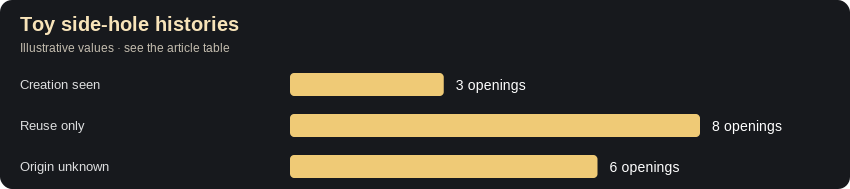
| Category | Value (openings) |
|---|---|
| Creation seen | 3 |
| Reuse only | 8 |
| Origin unknown | 6 |
Illustrative values, not sourced observations. Invented example for the stated comparison; not a biological threshold, ecological estimate or observed dataset.
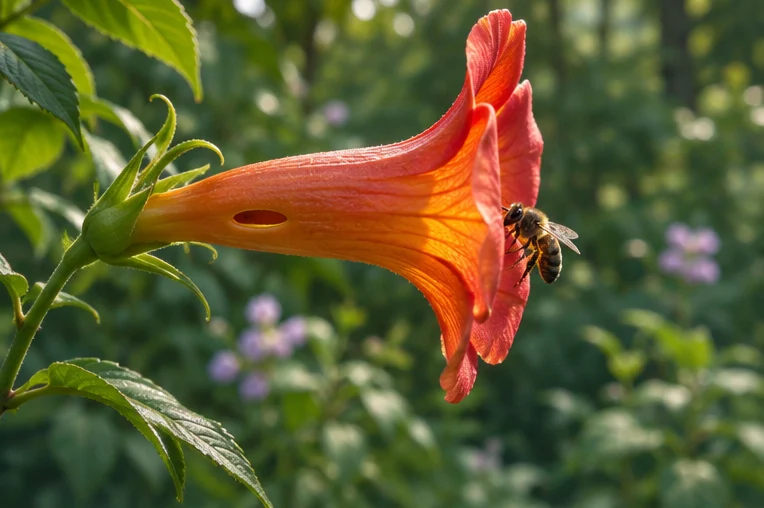
A red tubular flower is photographed from the garden path. In the first image there is a small opening near the side of the tube. In the second, a bee has positioned its head at precisely that spot. The most tempting caption says that the bee made a hole to reach nectar. The photos can establish something narrower and more interesting: the hole existed before the pictured visit, and the insect came to that location. Depending on what the later recording shows, the observer may be able to document use of the existing opening. Neither image assigns its creation to the bee in front of the camera.
An opening has a history; a visit has a route. Those histories can intersect without being the same thing. One visitor can make an opening and another can use it. The same individual could make one opening and later use another it did not make. An apparent opening might instead be a natural gap, tear or indistinct fold whose origin is unresolved. Good natural-history notes connect each claim to the exact evidence for it and leave the rest alone. The goal is not to supply a culprit for every mark on a flower.
The scenarios, numbers and cover illustration in this article are fictional. The exercise uses passive exterior observation from places the observer is allowed to use. Do not make holes, obstruct them, force a flower into a better position, catch a visitor or attempt to test whether nectar remains. The record can be useful even if the animal disappears, the underside stays hidden and nobody ever sees how a particular opening formed.
Separate appearance, behavior and mechanism
An exterior photograph can document shape and location if there is a clear angle. It might show a gap in tissue on the side of a tube distinct from the conventional entrance, or it might show what only appears to be one. Record the descriptive claim before interpreting it: a dark oval on the lower side, a visible discontinuity in the tube wall, or a mark too indistinct for classification. Surface observations do not tell you whether a passage reaches the reward or whether any insect used it. If a photo can't distinguish a tissue opening from a shadow or overlapping petal, leave the opening uncertain.
Behavior requires a different record. An insect landing beside a hole is not automatically using it, and head position does not always make the feeding route clear. A visible mouthpart entering a clearly identified pre-existing opening is stronger evidence that the route was used. It still may not show whether nectar was present or acquired. Use language that matches the evidence: approached, contacted, probed, inserted through an observed opening, or outcome not visible. Keep those words distinct. When documenting natural activity in a garden, a careful description can be more compelling than a confident explanation unsupported by the view.
In ecological literature, primary nectar robbing typically involves making and using an opening that bypasses the ordinary floral entrance; secondary nectar robbing uses an opening made by a previous robber. Richman and colleagues' study of facilitated exploitation explicitly distinguishes these behaviors in its research. For a modest exterior watch, it can be safer to use “creation seen” or “existing opening used” until the relevant origin and behavior are established. Seeing reuse of an available route does not by itself establish that it was originally made by another nectar robber. Even the same insect may have used the route previously, outside the current record.
Do not apply the terms as permanent identities. “Primary” and “secondary” in this context describe roles in forming or using a particular route. The animal's species, behavior elsewhere and whether it can create a hole under other circumstances are separate questions. A casual photograph cannot answer them by appearance alone. It is also unnecessary to read intent into the term robbing. The subject is a route to a floral resource and its ecological consequences, not a moral judgment about the insect. Maintaining that distinction helps keep a useful observation from becoming a call to remove visitors.
Give every flower and opening a distinct identity
Identify the exact flower from a permissible view. A stem bearing several red tubes can look almost identical in different recordings. Use a stable bloom code, date and a sketch or original wide view that lets you distinguish the target from its neighbors. If a flower turns in the wind, the visible side in the second recording might not be the same side you observed in the first. Do not use the position within the camera frame as a permanent identifier. When the match cannot be made without disturbance, retain the photographs as separate records instead of completing a false sequence.
An individual flower can have more than one opening or mark. The notebook can assign subordinate codes to distinct visible locations on that flower, without attaching anything to the plant. A comparison may be valid for one opening and unclear for another. This distinction matters if a later visitor chooses a different route on the same flower. Combining the entire history at flower level may obscure the exact claim the recording supports. Conversely, counting every photograph of one opening as a new opening inflates the inventory. Let the flower ID hold the context and the opening ID carry the physical history where a specific match is defensible.
It may be possible to recognize an opening from a distinctive part of the exterior view, such as its position relative to the lower rim or an adjacent natural feature. That does not mean an observer needs to know the exact internal geometry. Keep the relevant view position and uncertainty in the record. Wide footage can support the flower match while a closer still, taken naturally without approaching beyond a permissible position, supports the opening match. Neither image automatically does both. A picture that fails to identify the subject may still be a useful illustration but cannot extend the underlying evidentiary chain.
The same concern applies to the visitor. A bee visible in one frame and a similar bee in the next are not always the same individual. If tracking broke behind a blossom or during a cut, the later recording may show a different animal. Never use a visually similar coat pattern to bridge lost continuity unless independent evidence genuinely supports that identity. You don't need to name or individually recognize the bee to record an action at a given time. You do need a continuous enough view to connect a given action to a change in the exact opening.
Pair views in a way that answers the right question
An earlier image showing the opening and a later image showing a visitor can be sufficient to establish that the opening predates the documented visit, if the flower and opening match and the timestamps are credible. That is a valid and often achievable comparison. It does not tell how the opening first appeared. For creation, stronger evidence would show sufficiently clear earlier tissue, observable contact and the first visible discontinuity while the relevant region and subject remain in view. Even then describe the observed sequence rather than making claims about any part of the mechanism the camera did not resolve.
A view of apparently intact tissue in the morning and a hole in an afternoon photo is different. It provides a time bracket, conditional on seeing the same region sharply enough in both views. It does not establish which action occurred in between. The last insect recorded near the site is not necessarily responsible. There could be activity outside observation hours, and a fold or rotation could have hidden an earlier defect. A label such as origin unknown should remain available even when you can narrow the time at which the opening first became visible.
Use original sequence timing, not the order in a presentation deck. File creation time can reflect editing or upload. A short clip may have been cut from a longer source, or a pair of observers may have recorded in local notes without synchronized clocks. Keep the capture time and any uncertainties separate from the review time. For a pair of photos, the order may be supported even if elapsed time is not. Do not invent more precision than the timestamps can support. If order itself is uncertain, the two pieces of evidence are not sufficient to establish reuse of a documented earlier route.
Make the actual view limits visible. The first shot could show only the front of the flower, and the second could expose the side. The appearance of a hole in the second view isn't evidence of creation unless the first showed the same piece of tissue clearly. A reasonable paired-review worksheet includes a line for whether the relevant surface was observable before, during and after the action. If one of those intervals was lost, preserve that loss rather than replacing it with the assumption that the movie shows a continuous sequence. Confidence should come from continuous evidence, not from a tidy story.
Toy side-hole histories
The chart and table below count openings in a fictional record set. They are invented numbers, not results from a garden, sourced observations or evidence of ecological thresholds. For this simplified display the categories are mutually exclusive by rule. At a given opening, the underlying detailed record may document more than one type of action over time.
| History category | Openings |
|---|---|
| Creation seen | 3 |
| Reuse only | 8 |
| Origin unknown | 6 |
Three openings had a documented creation sequence under the toy rule, whether or not someone later saw them reused. Eight other openings had documented reuse of an earlier visible opening but no documented creation event. Six had neither a verified creation nor a verified reuse sequence in the classified material. In ordinary prose the origin of the eight can also be unknown: the chart's third label means no verified creation or reuse in that category, not the only circumstance under which origin is uncertain. This reporting rule keeps the totals disjoint.
The three bars sum to seventeen unique fictional openings. Eight divided by seventeen is the share of all toy openings assigned to the reuse-only category, not a fraction of bees that reuse holes. Some openings could have several distinct visits, and one animal could use several openings. The tally is not a count of nectar meals or of flowers pollinated. The combination of units and categories governs which arithmetic is meaningful. If you later need to answer how often visitors use an opening, you would need a separate event ledger and an observation denominator rather than a recaptioned inventory.
A future update might add clear footage of reuse at one of the six openings without changing its physical identity. The total would remain seventeen, with one record moving to a different display category. A brief picture of a flowering branch should not change the count simply because it contains a stronger-looking mark. Another update might document a newly identified opening that really was outside the original register; record that change separately. A category migration and a newly observed physical feature are different events even when the dashboard updates both at once.
Read a natural sequence without filling in the middle
Imagine a short clip in which the side of one flower is plainly visible. A bee arrives, briefly covers the area with its head, and leaves. The next clear image shows an opening where none was confidently visible before. This might be a promising creation candidate, but the contact itself was hidden and the earlier absence was uncertain. Write “newly visible after visit” rather than “creation seen.” Even with an apparently sharp first view, check that the rim or an overlapping fold did not conceal the exact location. The code should reflect uncertainty about the first view and the critical transition rather than asking a single dramatic endpoint to settle both.
In a second clip, an opening is unmistakably visible before the visitor arrives. When the visitor approaches, you can see the relevant behavior in profile and can tie it to that location. The evidence for use of an existing opening is stronger here than in the first clip, even though the hole's creation is completely undocumented. These two histories support different claims, and neither is a failed version of the other. Use the fact that a later visitor inherited a route as an observation worth preserving, rather than treating creation as the only event worthy of attention.
In a third clip, a visitor appears to enlarge a pre-existing opening. If the change is genuinely visible, record that as a modification rather than a first creation. You might be able to see that the edge changed while leaving uncertain whether another tiny opening also appeared. That distinction may seem fussy until someone wants to know how many original openings were made. The same opening can be modified at more than one visit. An inventory of physical features and an event log of actions can both be accurate if they do not use the same row to mean both things.
Sometimes the best evidence comes from reviewing a sequence at normal speed before selecting individual frames. You can track whether the flower swings or the insect changes position. Then examine original frames to judge whether the exact opening remained visible. Do not let a slowed or interpolated playback supply imaginary intermediate evidence. A sharp frame after contact cannot tell you what happened on the other side when the camera was blocked. Preserve the relevant unedited source if it can be stored appropriately. A slideshow of isolated frames is easier to share but can erase the information needed to assess continuity.
Log uncertain routes instead of resolving them with familiarity
A flower's conventional entrance and a hole in its side can look close together at an oblique angle. Some visitors approach from above, others from below, and an insect can pass along a tube without accessing either route. If all you can say is that its head disappeared behind the side, use an unknown route category. A confident species identification does not repair a poor sightline. Especially in repeated observations of a familiar insect, the observer may fill in a route using remembered behavior from a previous occasion. Train your record to preserve the boundary between the familiar pattern and the actual angle of this view.
For direct observations, write a compact chronology from first approach to departure. Include the intervals when the relevant behavior was in view. If you were looking down at a notebook or lost the animal in a shadow, say so. For recorded cases, use the approximate interval in the source, not the time shown by a cropped playback without an established offset. The form can carry two separate confidence decisions: whether an opening could be matched in earlier material, and whether the later action used it. Both need support before reuse can be treated as documented.
An inactive opening can be observed as a part of the flower without ever seeing a visitor. Do not infer that it was unused during the rest of the day. A return with no apparent new visitors might simply be a short watch at a low-activity moment, or a watch conducted when the relevant side was obscured. Record usable effort separately from the number of marks discovered. A photograph that took a second to capture can make a useful inventory record without contributing a minute of behavior monitoring. Those two kinds of evidence should not be mixed in a denominator for how often use occurs.
Differences in view quality can bias a comparison in a predictable direction. Large conspicuous openings are easier to verify than tiny ones, and larger visitors may be easier to follow. A clearer later recording can improve your chance of seeing an existing opening, even if it has not changed. If footage was selected precisely because it showed a striking event, disclose that behavior in the selection of examples instead of comparing a set chosen for clarity to an unselected set of earlier watches. It is possible to learn how a sequence works from selected material without estimating how frequently it happens.
Separate an ecological role from a verdict about harm
Irwin and Brody's study of Ipomopsis aggregata examined how nectar robbing could influence pollinator behavior and reproductive outcomes in a particular system. That is much more than scoring a mark on a flower. The study makes it useful to distinguish direct observation of a side opening from later effects that depend on other visitors and plant outcomes. It does not justify labeling every flower with a hole as poorly pollinated. A garden record which never measured fruit or seed set cannot establish those outcomes by adopting the name of the behavior described in the literature.
The study of secondary nectar robbing and pollen donation treated one component of male reproductive function with an experimental proxy. Its publisher record describes what was actually measured. This is distinct from a count of actual offspring or a tally of all effects on the plant. If two studies discuss benefits or costs using different endpoints, avoid presenting that as an inconsistency unless their methods and questions are genuinely comparable. The possible influence of one route on subsequent visitors is an ecological question, not a diagnosis available from one exterior clip.
Likewise a visitor using an existing hole has not thereby proved that it avoided all floral contact relevant to pollination. Depending on the species and the sequence, it might contact something elsewhere in the visit. A visit through the conventional entrance also does not prove pollen was delivered. Keep the routes separate from transport and reproductive results. One type of observer could document routes during a natural walk, while another study asks about pollen deposition or seed set. Both are credible forms of evidence, provided neither is asked to stand in for the other.
Be clear about what would count as a resource outcome in the observational record. You can say that a movement was consistent with trying to reach nectar without saying nectar was present at that time or measuring the amount remaining. A flower may have been used by previous visitors before the observation began. The amount of nectar, if any, is not recoverable from the size of an opening. A visitor leaving promptly does not tell you whether the route was unprofitable. All of those are interpretations someone could test with an appropriate study; the purpose here is to keep them distinct from a properly documented exterior action.
Record the route even when you cannot name the insect
A garden observer may distinguish a visitor from a bee-like fly in some views and not in others. Do not infer taxonomy from the route it appears to take. If all that is reliable is that an insect contacted the side opening, record that with an unresolved group category. It is better than confidently naming the species most often discussed in a paper about another region. If a later reviewer can identify the pictured subject at a supported rank, retain the determination date and what evidence applies. The action record was already useful before anyone supplied a name.
If comparing a group of apparent bees, make sure cases were eligible by the same identification rule. A collection in which the largest insects were identified and the least visible were declared absent will overstate certainty. Separate the number of observed contacts and the number with an accepted broad identification. A known contextual association can help choose candidate observations for review, but it does not demonstrate all nearby lookalikes used a route. Keep one field for who or what was observed and another for the action supported. Missing information in one need not nullify well-supported information in the other.
An uncertainty about the individual can matter even if the species is clear. If a bee comes back after a break, you might document a second visible use under the study's visit rule. You generally cannot tell whether it is the original individual from the name alone. Similarly two visitors of the same group may perform different actions at one opening. Do not summarize the sequence as the bee “returned to the hole it made” unless that particular continuity and creation are both established. A blooming plant offers many ways for an observer to conflate subjects near it, and a narrow event label is a practical defense.
Design a small observation series that tolerates interruptions
Start with a plant you can see without blocking a path or changing its position. Give the watch a length and define the scope before anything happens. Record when the side of the target surface is stably visible and when it is not. If sight is lost because a person passes or a leaf moves across the opening, mark the lost interval and do not assume the same visitor remained. Identifying a hole afterward should not make the interrupted minutes eligible again. The point of measuring usable effort is to show how much of the sequence could have been observed, not to impose a new burden on the flower.
If checking more than one flower, avoid shifting observation only when you see something interesting. A planned alternation of suitable exterior views can yield better context about which cases were missed. An opportunistic clip can still be recorded separately. Do not combine a collection of interesting opportunistic shots and a timed passive watch as if they provide identical opportunities for observation. If the team watches different parts of the same plant, say whether events could appear in both records and how duplicates were reconciled. Two people seeing an opening from two angles might provide stronger linkage evidence, not two new physical openings.
An observer with a clear view of a surface and an observer with a clear view of incoming flight can contribute complementary records. They may have different confidence about the same moment. If both will be combined, use a common way to align times and label what each actually saw. A separately recorded view cannot prove what happened elsewhere merely because its timestamp was nearby. Their notes can preserve a matched interpretation when justified and an unmatched one when not. This procedure is useful when uncertainty arises from the vantage rather than a lack of interest or skill.
Before declaring the series complete, look at the unresolved cases for patterns. If the same part of the plant is generally hidden, the method may be well suited for identifying visits to the conventional entrance and poorly suited for side-opening behavior. That is a useful finding about measurement coverage. It does not require moving stems or extending the watch into inaccessible space. A narrower future question might make better use of the safe view, or the next group might simply label those cases as outside observation scope. A process that can report its own limits is better evidence than one which labels everything confidently.
Count histories and actions on different time scales
Suppose a flower was checked in the morning and its side opening was visible. During a later scheduled watch, three separate eligible contacts occur at that opening. Under the example's event rule the opening can have three documented use episodes. In the asset-like inventory it appears once, with a documented history of use. If the team's aim is to explain how old openings are reused, the repeated actions matter. If it wants to count how many distinct openings have such evidence, the unique identifier matters. Neither tally establishes a count of distinct visitors, since individual identity might be lost between events.
Choose a sensible opportunity measure for what you plan to compare. A comparison of use per unit of observable time requires some record of the time a relevant surface and its approaching visitors could be watched. A comparison of the number of openings with documented use needs a defined set of openings and a statement about how long they were followed. A comparison of approaches using the side rather than the mouth requires route evidence and inclusion rules for ambiguous approaches. All three can come from a related workbook, but replacing one denominator with another produces a different quantity.
An opening becomes observable to one camera at a specific time and may have existed before then. The first time it is recorded is a lower limit on knowledge, not evidence that it formed at that point. Similarly, a wilted flower falling from view stops contributing usable observation before it tells you what happened to all its openings. Write the start and end of reliable observation for each target. If a team calculates the share ever used across its follow-up, be clear that openings followed for longer had more opportunity to qualify. A chart of ever-used openings need not reflect the underlying intensity of visits.
Watch out for copying groups between dates. If the same flower appears in two surveys, keep a way to identify that dependence. An early watch may establish that a hole existed and a later watch may establish use, together supporting one history. Treating them as two positive histories would duplicate the evidence. On the other hand, a later bloom on the same stem may have a separate opening and deserve a new record. A map code for the plant should not replace the specific flower code. Clear IDs make it possible to summarize the series by plant, flower, opening or visit without confusing the levels.
Give uncertain examples a place in training
A good practice set should include more than one obvious creation and one obvious use. Include a stable view of a pre-existing opening with a clear action, a case where the side is covered during the transition, a rotation that reveals a previously unseen part of the tube and a clip that shows a mark but no use. Only show properly authorized material, with no sensitive details that the activity does not require. Drawings can stand in when you need to teach the distinctions without using real observations. The goal is to give observers a language for confusion, not to make them guess how a diagnostic example was scored.
Ask two observers to judge the same material independently at first. Have them decide whether the opening can be matched across views, whether the prior view actually establishes its condition and whether the current action is visible at that location. These questions diagnose different problems. If they agree about use but disagree about origin, the issue may be a missing temporal bridge rather than different interpretations of the movement. If they cannot agree which flower is in frame, an origin discussion is premature. The best revision to the method might be retaining wider context, not developing tighter criteria for things the existing view cannot show.
When they compare notes, do not require forced agreement for every clip. A documented disagreement can be a final classification of ambiguous, with a reason. If possible, note which extra information would resolve it and whether it is already present somewhere in the permitted recording. Do not solicit a new close encounter because an old record was uncertain. A workbook that contains unresolved cases openly can still produce useful totals for the well documented categories. It also preserves lessons for the next round instead of rewarding a high apparent success rate achieved by dropping hard cases.
For a calibration exercise, keep the reviewed examples separate from the series used to estimate anything about real activity. The practice images were probably chosen to illustrate categories, not sampled for frequency. If the observers become more consistent on those examples, that is evidence about how they applied the rule to the practice set. It is not evidence side holes were made or used more often in subsequent watches. Improved classification and changed biology can both affect a field summary. If the rule changes substantially, state when it changed and reconsider earlier recordings under the same standard where that comparison matters.
Present the sequence without inventing a culprit
For a public article, a pair of generic diagrams or well documented images can communicate the result. Label one “opening visible before the recorded visit” and the next “visitor using the existing opening” only if the actual evidence permits that caption. If an illustration is used instead, label it clearly. Do not select or generate an opening detail in an otherwise authentic image and treat the revised product as part of the documentary record. Keep any uncertainty about route or outcome next to the relevant image so it still accompanies a cropped presentation or text-only copy.
Before releasing a summary to anyone already familiar with the garden, test whether the caption leads them to identify the animal that supposedly made the hole. If the record cannot establish that, the caption should not enable the conclusion. Sometimes the only needed change is a verb: “visited” becomes “appeared beside,” or “punctured” becomes “was filmed after the hole was already visible.” Sometimes the scope must be tightened further because the two images cannot be shown to feature the same opening. Revising the claim to match the evidence is better than making one image act as proof for the missing interval.
Give biological explanations their own supporting text. It is fine to explain that an existing opening can provide an alternate route and that published studies distinguish primary and secondary use in some systems. Then say which of those steps were actually documented in your material. A chart of nineteen episodes or seventeen openings, if used for instruction, should identify its own units. Do not rely on an illustration of an insect at a flower to supply a species determination, a description of crop effects or a timeline of events that the original source did not show.
Finally preserve a useful unresolved question. Maybe in the majority of clips the opening was already visible, and the team cannot say which events originally produced it. They can still report credible later uses and note that previous creation was outside their observation. That is the basis for an honest field comparison, and it may direct attention to longer, safely observable sequences rather than larger numbers of isolated portraits. The point is not to put a perpetrator beside each site in a table. It is to make clear that a later visitor and the origin of a physical opening can have two different evidentiary histories.
Keep the report useful if the bloom is gone when someone checks
The record may outlast the flower. A later review cannot always return to the same plant and verify an old opening, particularly after a bloom closes or falls. Preserve the contemporaneous exterior evidence under the site's sharing rules and keep a brief description alongside it. Include the flower and opening codes, the viewing intervals, whether use was visible and which links remain uncertain. A description that depends entirely on pointing to a living stem is hard for another person to audit. Conversely, be careful not to use a new flower as a substitute for a missing part of the original series just because its shape is similar.
It can help to leave an example of a defensible final note: “The opening was visible before this documented visit. The visitor's action at the opening was visible for part of the sequence. Original formation and reward acquisition were not observed.” This gives the strongest supported result without making the reader infer that the notes were incomplete through oversight. An honest boundary may be the most portable part of the record, because it allows the next group to improve the comparison without pretending the missing moment was already captured.
Sources and illustration note
- Irwin and Brody: Nectar robbing in Ipomopsis aggregata, primary study of visitor behavior and plant outcomes in one system.
- Richman et al.: Consequences of secondary nectar robbing for male components of plant reproduction, original study; publisher DOI.
- Richman et al.: Facilitated exploitation of pollination mutualisms, primary comparison and definitions for patterns of reuse.
All scenarios and counts are fictional. If generated, the tubular flower and insect image is editorial illustration, not documentation of a hole, a visitor determination or a feeding event.