| Category | Value (records) |
|---|---|
| Visible load | 10 |
| Possible load | 6 |
| Obscured | 8 |
Illustrative values, not sourced observations. No color-to-plant assignments in these examples.
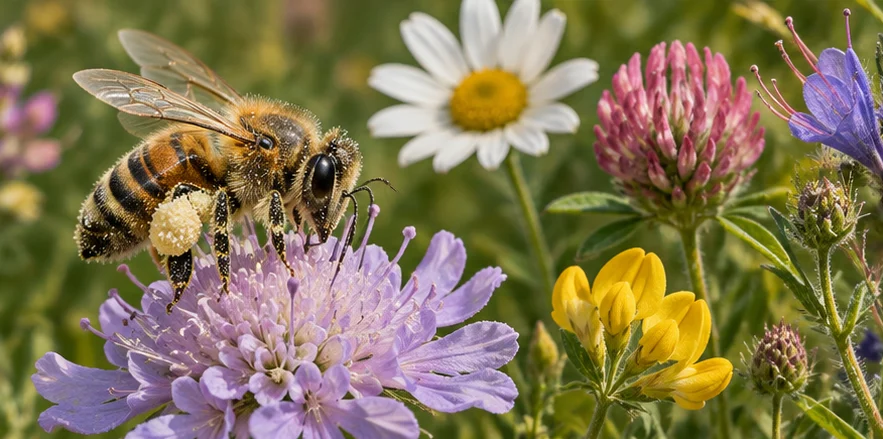
In a photograph of a garden bee, a pale lump stands out against a hind leg. A yellow flower fills the foreground and several more are visible just beyond it. The easiest caption is also the one that requires the most evidence: the bee is carrying pollen from that yellow flower. The photograph may show that a load was present and that the bee was on a particular bloom. It does not show where the load started, what it contains in full, or how many flowers helped make it.
There is a useful observation here even after the guessed source is removed. A visible pollen load records pollen being carried at the moment it is visible, when the identification of the material and structure is adequately supported. An image sequence can sometimes add behavior: the bee worked anthers, groomed material toward a carrying structure, or arrived with material already present. These observations reveal collection and transport without requiring the observer to do a botanical inventory from a tiny patch of color.
The word host requires care. For a discussion of a bee's pollen diet it can refer to plants from which a bee collects pollen, while in other contexts it can have different meanings. One adult on a flower is not enough to establish a diet relationship, much less the bee's nesting location or the origin of this particular load. Use a phrase that describes the question, such as pollen source, observed flower or documented floral contact. They need not point to the same plant.
Start with the evidence in the frame
Look first at where the material appears. Is it distributed loosely among body hairs, held in an obvious packed mass on a hind leg, or situated somewhere else? Some bees carry pollen in specialized collecting hairs often called scopae, which may be on different parts of the body in different groups. Some have pollen baskets, or corbiculae, on the hind legs. It is not sound to expect every bee to have the same visible apparatus. Record the visible position and morphology rather than making identification depend on one conspicuous feature.
An unusual colored region is not necessarily a load. The insect may have a patch of naturally pale hairs, a highlight may make one part brighter, or the image may compress detailed structures into a flat blur. A small load can disappear in an oblique view, and particles may be hard to distinguish from other material. If a view does not support a determination, record its limit. It is better to keep a tentative observation than to convert uncertainty into a botanical name.
A load on a structure used for carrying pollen is a stronger observation about transport than a patch of loose powder on a body. Neither automatically describes how the material was acquired in every instance. Loose pollen can adhere while a bee moves through flowers; active collection is more directly documented when the behavior can be seen. Conversely, compact material with good visual support can make a strong load record even if the observer did not see its accumulation. The phrase “visible load” works because it describes a documented condition rather than claiming a complete history.
Preserve the animal identification separately. The USGS guidance on identifying bee specimens describes tools and expertise used to examine bees and review identifications. A casual photograph may show some relevant features and conceal others. If the record supports only “bee, group unresolved,” that can remain a useful record of transport. Do not turn pollen color into a diagnostic feature of the bee simply because independent animal characters cannot be seen.
The USGS account of the role of native bees in the United States gives broader context on native bees and movement of pollen, including differences in how widely bees use pollen sources. That context makes the source question worth asking. It does not identify the plant in a photograph or allow observers to attribute a visible load to whichever nearby species fits a familiar story. Ecological generalizations are context for interpretation, not missing observations from the scene.
Why color is not provenance
A load may look cream, yellow, orange or another shade. Write down that color if it is an observable feature, together with the conditions that affect it. White balance, exposure, reflection off another object and how tightly material is packed can all affect apparent hue. A warm evening photograph and a shaded morning photograph should not automatically be sorted into plant sources using visual color alone. Even consistent viewing conditions would not make a human color description into a taxonomic diagnosis.
There are two different mapping problems. One asks whether the same plant material would look consistently the same under repeated photography. The other asks whether distinct sources would look consistently different. A method could fail either test. Some potential sources can have visually similar pollen, and a load may contain more than one type. A colored mass is a view of the load as a whole, not a separate image of every grain. Reversing the process from color to a unique source is unsupported without a suitable validated system and reference information.
Do not read petal color as pollen color. Petals and the parts producing pollen are different structures. Two flowers with very different petals may give loads that look rather similar to a person, while a photo of pollen in a flower can look different from a packed mass on an animal. People intuitively match the most prominent colors in a scene. A field notebook can resist that impulse by naming exactly what color belongs to which object.
Even a standardized color chart might be useful for describing appearances without supplying a unique plant assignment. It could help investigators recognize when two photographs disagree in tone, or compare a set of visibly distinct load types for a particular question. It cannot establish that two samples with the same color contained the same pollen taxa. A limitation of taxonomic resolution is not fixed by making the descriptive record more precise. Keep the claimed use of the color scale proportional to what was actually established.
A sensible caption is “pale material visible in the pollen-carrying area; botanical source not determined.” It might add that the bee was photographed at a identified flower when the identification and contact are supported. Those statements can appear next to each other without a connecting “from.” The missing preposition matters. A caption often survives longer than field notes, so it should not smuggle in the provenance claim the photograph did not show.
What proximity can and cannot tell you
Seeing several blooms in one frame provides environmental context. A photograph compresses distance, and the flowers may not all be from plants an animal could have encountered in the time before the picture. Conversely, a plausible source may lie outside the photograph. The camera cannot tell us the animal's complete route. A load present when the bee arrives was acquired at least in part before the first recorded contact, but the moment of pickup and the list of plants remain unknown unless separately observed.
Even the nearest flower can supply multiple resources. A bee on it might collect pollen, drink nectar or do neither during the visible interval. The distinction matters when the research question concerns pollen sources rather than general visits. Do not write “collected its load here” from a single image showing a bee and a flower together. When a video shows it actively working a flower's pollen-bearing structures, say what it did and what the view supported. That is different from assigning the entire visible mass to the current bloom.
Suppose the bee arrives with a nearly empty-looking structure and leaves with it visibly fuller after the observer watches collection. That is stronger evidence that the site contributed to the load. It may still not establish that every grain came from that one blossom, or that an earlier small contribution was absent. The best sentence can be both strong and bounded: its visible load increased during a documented collection bout on this plant. The strength comes from the observed sequence, not a verdict about all of the material.
If several plants of the same kind occur in different gardens, taxonomic source and geographic source are also different questions. Detecting pollen consistent with a particular species would not necessarily distinguish the individual plants that contributed it. Even an exact plant identification in the foreground cannot supply the animal's earlier geographic route. In a report, specify whether source means taxon, individual plant, patch, property or collection event. A claim about one scale should not be reported as proof at another.
Read the toy confidence classes as views
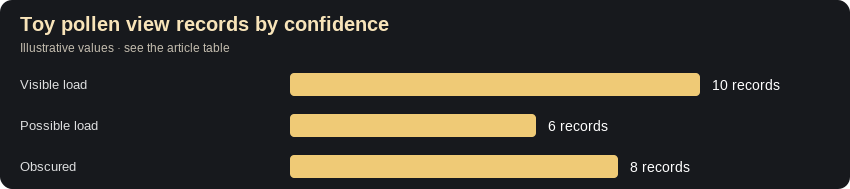
The companion chart, “Toy pollen view records by confidence,” consists of twenty-four fictional view records. In this teaching example, a record is an image or observation view that was scored for visibility and confidence about a load. It is not necessarily a distinct bee, sample of pollen, flowering plant or location. One score is assigned per record under a toy rule. The chart and table contain the same values.
| Toy view classification | Illustrative records |
|---|---|
| Visible load | 10 |
| Possible load | 6 |
| Obscured | 8 |
Ten plus six plus eight gives twenty-four. The visible group consists of records stipulated to support a load determination under the exercise. The possible group contains views where the visible material is not clear enough to classify confidently. The obscured group contains views where the relevant area cannot be adequately inspected. None of these groups assigns a color to a plant family, genus or species. No plants, bees or photographs were used to produce these numbers.
Ten out of twenty-four is a proportion of toy views assigned visible load. It is not a proportion of bees carrying pollen. An insect seen twice could have contributed two observations. Obscured cases might contain or lack loads; the counts do not tell. The chart also includes no explicit load-absent class. That reflects the small set chosen for demonstration, not a declaration that an observer can never document a clear view with no visible load. A real plan would distinguish absent under a stated view rule from inspection not possible.
As an editorial choice, separate confidence in the load call from confidence in proximity or plant identification. A high-confidence load view can coexist with an unknown species of bee and an unidentified flower. A gorgeous bloom photograph may offer strong botanical evidence while the animal's carrying structures remain hidden. Combining confidence into one overall grade can make the report harder to use. Let a reader see which claim the picture supports, rather than rewarding the most impressive image with the strongest classification across the board.
Watch the sequence without forcing a result
Before a visit, decide which part of collection is the question. You may be looking for visible transport, watchable acquisition behavior or repeated use of a species of flower. Each deserves a different record. A still photograph can do the first job well. A short watch may do better for the second. Learning the frequency of an activity across plants and dates requires enough comparable watches to describe that wider setting. Do not extend the claim as though all three tasks were completed.
The first frame of a useful sequence can be a simple context view showing the flower and those parts of the bee that are visible from a respectful distance. Later frames can show behavior without needing to disturb the flower or insect. If the animal disappears behind foliage, mark the break. A nearby similar insect seen shortly afterward need not be the same individual. Maintaining a view of uninterrupted action is valuable because it reduces one specific uncertainty, not because it resolves everything hidden inside the load.
More detail can reveal that a familiar sequence is not as simple as it looks. An animal might contact anthers and later groom but the actual movement of material between those events might be obscured. Do not fill missing frames with the expected behavior. Describe both observed steps and note where the view did not settle the link. An observer who learns to say “subsequent grooming was visible” rather than “pollen went from that flower straight to the basket” makes a record that someone else can reasonably evaluate.
Record time, location context and the portion of the flower visited. A plant list for the same garden is useful background, but only a documented encounter connects the animal to one of those plants. Keep timestamps appropriate to the question. Two images made on the same date can show different opportunities or different individuals. If daylight, shelter, position or weather constrains observation, document it. That helps explain why some records had a better chance of showing material than others.
Do not reposition, capture, scrape or handle an insect merely to find an answer for a casual nature note. Use lawful access and give the organisms room. Seen or not seen from a responsible vantage can be a complete outcome. A plan requiring specimens or specialized methods belongs to properly designed, authorized study. Nothing about the illustrative chart requires acquiring material. Its purpose is to teach what an observer can say from a view and what a different question would require.
Different sources for different certainty
A botanical identification of the visited bloom can be supported by a good record of plant features. A taxonomic identification of the bee can be supported by a different set of features and expertise. A botanical identification of pollen on the bee requires evidence about the pollen. Gathering good evidence for the first two does not automatically supply the third. Separate the fields in the notebook. A reader should not mistake a confirmed flower identity for confirmation of pollen provenance.
Standard sources can help with the limits of plant or bee identification, but the most useful result may still be a category broader than species. An image may show an animal consistent with a group but not the characters needed to distinguish similar members. Some botanical features may not be visible either. Use a status that preserves uncertainty, and record which observer or reference supports a later revision if one occurs. Replacing an old uncertain determination with a named one should have a visible reason.
Laboratory methods can ask more directly what pollen is present. Microscopy can examine grain characteristics against suitable reference material; molecular approaches can detect plant material and compare it with reference sequences under a defined protocol. Both depend on sampling and reference coverage, and both can leave a result at a broader level. A molecular detection does not by itself identify the particular flower, the day, or the geographic spot where contact occurred. Similarly, an apparent microscopic match may not separate similar taxa.
A primary example, Applying pollen DNA metabarcoding to the study of plant–pollinator interactions, examined how molecular data can be used to identify mixed pollen loads in a research context. It is relevant because a load need not correspond to only one source and because the sampling question matters. Its design and findings are not a reason to assign plant names based on the toy chart or authorize casual sample collection. The study illustrates a different level of evidence from visual inspection.
The distinction between presence and amount deserves special care. Detecting a kind of pollen in a mixed sample need not tell how much of the load it represents. Different methods have different response and sampling properties. A tally of detections is not necessarily a tally of grains, and a tally of grains is not automatically their mass. A project estimating relative contributions should use a method suited to that quantity and discuss relevant limits. A field photograph alone cannot provide a defensible measure of either composition or amount.
Even combining botanical evidence with a well-tracked foraging bout may leave uncertainty about what was already carried. A strong composition result may establish that a kind of pollen is in a sample while the observed bout demonstrates use of a plant at that time. If the project can link the material to that specific bout, document how. If it cannot, both individual observations remain valuable without needing to be forced into a single claim.
Collection, transport and pollination are not interchangeable
Pollen packed for transport is evidence of movement of material. It does not automatically prove that compatible pollen was transferred to an appropriate receptive structure of another flower. An insect can carry grains while taking them toward a nest or visiting another resource. Other grains on exposed body surfaces may contact a flower during a visit. The relevant route depends on the plant and the interaction, and neither route can be reconstructed from the load color.
Consider a record in which an animal leaves the photographed bloom with pollen visible on a carrying structure. That supports an observation of transport and, depending on the documented behavior, perhaps collection at that bloom. The record does not establish plant reproduction. An appropriate study would need evidence addressing transfer, pollen compatibility or reproductive outcomes as relevant. The detailed outcome is a distinct measurement problem, not something a photographer can infer by writing pollinator in the caption.
A frequency count can be informative without estimating service. In a well-designed watch, a report could describe how many visible contacts occurred under a particular window. Counts of insects with visible loads can separately describe the observed sample, if the unit is defined. Neither metric automatically ranks groups by their contribution to plant reproduction. More conspicuous carrying structures, differences in viewing angle and observer effort can all change what is counted. The chart in this article is narrower still: it shows made-up classifications of views.
People can also misread pollen in the opposite direction. Not seeing a load does not establish that the animal has not transported grains. Some material may be too small to see or may be carried in places other than a conspicuous packed mass. An observed flower contact with no visible load can still have relevance to a study of visits. Use the category the view can support rather than treating one “no” as an answer to several different biological questions.
When a specialist hypothesis is useful
A person who knows that some native bees use a narrow range of pollen sources may have a helpful starting hypothesis. If an independently identified bee has documented associations with certain taxa, the observer can plan watches where those taxa bloom. The hypothesis uses existing information responsibly when it remains a prediction. It cannot identify a load by itself, especially when the bee identification, local flora or particular collection event remains unresolved.
Some bees use one set of plants for pollen and visit a wider assortment of flowers for nectar. That possibility is enough to dismantle the idea that every photograph of a known pollen specialist on a bloom extends its documented pollen host list. Ask what resource-seeking or collection behavior was actually recorded. A bee on a new-looking flower is worth noting even if it supplies no evidence about pollen. The value of the record need not depend on rewriting a diet description.
Avoid selecting only photographs that appear to support the expected relationship. If all unclear views or unfamiliar flowers are dropped, an apparently clean dataset can reflect filtering rather than ecological specificity. Preserve a record of excluded views and why they were excluded. In a follow-up study, predefine what would count as evidence against the favored hypothesis. Without a chance to be wrong, a hypothesis can function as a naming habit rather than a scientific claim.
The scale of the claim matters. Evidence of use by this individual in this observed bout is local evidence. Repeated, appropriately sampled records can support a broader discussion of use. Claims about specialization or preference need evidence about available choices and contexts, among other design considerations. A flower that dominated today's garden inventory might dominate observations even when it was not preferred under comparable conditions. Presence in an easy-to-watch patch is not a choice experiment.
Design a field sheet with independent questions
Start with the observation unit. If the protocol scores views, give each view an identifier and link it to its session. If it tracks documented individual visits under an appropriate method, distinguish those visit IDs from any individual IDs. Do not use the word count without naming what was counted. One bee per image, one image per view and one visit per bee are assumptions that may be false in a busy flower patch.
A separate set of fields can describe the load. Record whether the relevant parts of the body were adequately visible, apparent material location and color, and the confidence status. Use visible, possible, obscured or other clearly defined classes. Preserve an actual description, not just a code. A later reviewer may need to know whether possible meant ambiguous material in a clear view or half the relevant structure hidden by a petal.
For the plant, record whatever identity is supported, the visible structure contacted and whether the location is documented. Do not derive that field from the pollen label. If plant identification improves after the watch, it can update the plant field without retroactively filling the source field. Where well-supported acquisition evidence exists, record a relationship in its own place rather than changing two independent observations into one sentence with no audit trail.
Finally, allow a provenance field to remain unknown. If a source hypothesis is useful, write it under a hypothesis label and give its basis. For example, “nearby plant blooms were documented; contribution to this load not measured” keeps the field contextual. A project using laboratory or direct collection behavior could later add a different kind of evidence under its own method. An unknown today is not an instruction for someone tomorrow to guess the missing label.
A quick double-entry exercise can make the separation intuitive. Give one person the insect crop without the bloom and ask what they can say about visible material. Give another the flower context without the insect crop and ask what they can say about the plant. Then check the whole frame for actual behavioral evidence. If the inferred source only appears when people are invited to match colors, the evidence is weaker than the original caption implied.
Watch for changes in visibility between sessions
Imagine photographing bees in a low open flower on the first day and in a deep flower on the second. The first set shows hind legs well. The second hides them behind petals. Fewer visible load calls in the second set could simply reflect reduced view quality. Recording obscured views lets readers see that alternative. Excluding them without showing how many occurred would make the two sets seem more directly comparable than they were.
Different groups may also carry materials where the chosen camera position seldom shows them. The toy categories do not claim to correct those differences. In a real study, the direction and size of any resulting bias depend on the organisms and the protocol. Collect evidence suited to the types of observations at issue and report cases that could not be scored. An attractive graph should not silently prefer the animals easiest for a person to photograph.
Watch effort can change as well. A visitor might linger on a flower with obvious loads and take several photos, while passing over less conspicuous scenes quickly. Comparing the resulting fraction of load-positive views can describe that archive, but not necessarily the rate in the garden. A planned sampling procedure would need a different relationship between what is observed and what is retained. State how frames entered the dataset so someone can judge the scope.
Multiple views of the same event can be very useful. A side angle may support a load call while another confirms the animal was at the same blossom. But three views can improve evidence about one event without adding three events. Give the episode an identifier when linkage is supported. If uncertain, do not silently merge or split observations. Future counting choices are much easier when the underlying records preserve those relationships.
Learn from disagreements without looking for a winner
Two observers could independently judge a faint mass differently. One sees a clear margin in the original image and calls visible; the other sees blur and calls possible. This is a practical opportunity to review what each criterion means and which picture supports it. Keeping both classifications before an agreed review is more informative than awarding the case to the most experienced or confident voice. A conclusion can remain unresolved without making the whole dataset unusable.
Before comparing scores over time, try the same classification rules on new examples whose outcomes were not used to create the categories. This is a check on how understandable the rules are, not validation of botanical source. If both people agree that a load is visible, they may reliably recognize a visual pattern. Shared agreement cannot create evidence about what the pattern contains. Treat consistency of classification and accuracy of inference as distinct questions.
Fixing a mistake in one field should not destabilize the rest of the record. If experts later identify the visiting bee, retain the original time, flower and load observations. If the original pollen description was reassessed, record what feature drove the change. The inability to assign an exact plant source can remain unchanged. A revised file should show which facts changed and which simply acquired more precise labels. This helps downstream users tell a new identification from a new event.
An example can be especially valuable when it resists confident classification. Suppose a pale stripe is visible close to a bee's leg, but there is no clear material boundary. Instead of guessing whether it is pollen, record the visible texture and angle, then mark possible. A later image sequence might show material displaced or the same feature on multiple animals in a way that informs interpretation. Keeping a modest record makes room for evidence arriving later rather than declaring the case closed.
Put uncertainty where a reader will see it
For the toy graphic, write “Twenty-four invented view records, not a field survey. Ten visible loads, six possible and eight obscured. No plant sources assigned.” That sentence protects the main point when the graph is copied, read aloud or separated from the article. The chart's categories concern support for a visual call; they do not constitute a biological yield estimate. A caption that just says “pollen sources” would misrepresent the whole exercise.
For a real image, use separate clauses when the evidence is separate. “Bee with visible pale pollen on a hind leg; photographed at a blue flower; pollen source not established.” If the flower or bee is confidently identifiable, include the name without implying the missing connection. If only a possible load can be seen, preserve that qualification from the field entry through the headline and secondary graphics. A story should not become more definitive merely because it became shorter.
The article's illustration can help readers see what counts as a view without claiming an authenticated encounter. It is an editorial depiction of a bee, pollen-like material and blooms, not a field photograph tying a particular animal to a location. Its light and framing teach the visual ambiguity rather than settle it. Reused illustrations should keep that status explicit, especially when accompanied by invented counts whose ordinary visual form can otherwise look documentary.
Plan a next observation that could actually answer more
If the unresolved question is simply what the load looks like, a better permitted viewing angle may be enough. If the question is whether the animal collected at the current flower, a sequence showing the relevant behavior can help. If the question is taxonomic composition, a field image is not an appropriate substitute for methods that analyze pollen in an authorized study. An additional record is valuable when it addresses the actual gap, not merely because it is a second record.
A sampling plan can also separate a one-time claim from a seasonal pattern. Repeat comparable watches during periods when the candidate plants are available, note how views were selected and preserve uncertainty about taxa or load wherever it occurs. A few excellent individual observations do not automatically represent a whole season. Conversely, a season full of vague records may not establish one close behavioral claim. Decide which kind of support is needed before buying the comfort of a large count.
Ask which outcome would change your interpretation. If an independently observed bee already carried the load when it arrived, that weakens the claim that the most recent flower supplied all of it. If direct behavior supports acquisition at that flower, it strengthens the narrower claim that there was a contribution during the watch. Both accounts can coexist for a mixed or growing load. The goal is not to force an exclusive winner when the history may include several events.
A useful editor can test the resulting account with a simple question: if the reader removed the photograph of the bloom, what could they still say about the material? If they removed the insect view, what could they still say about the plant? If a third claim links the two, what evidence actually supplies that link? The exercise does not deliberate away true connections. It shows which ones were documented rather than assumed.
Check the unit before joining records
Suppose an editor receives one table of flowers in bloom, one table of insect visits, and another of loads visible in photographs. All three include a garden name. Joining them on garden alone would put every bloom beside every visit and every load. The result might resemble a network of relationships, yet those relationships were generated by the join rather than the observations. A defensible link needs an appropriate observation, episode or sample identifier and a method that supports what the link means.
Even a timestamp cannot do that work alone. Two observers could record a flower and a bee elsewhere in the garden during the same minute. A camera can also display a time rounded to a precision at which multiple encounters occur. Use the available identifying context and preserve cases that cannot be matched. It is better to publish separate counts than to pair records simply because a spreadsheet permits it. Accuracy in the numbers cannot rescue a mistaken association between rows.
A suitable handoff names each table's unit and carries the limitations next to any derived link. For a site inventory, preserve the fact that the named flowers were in bloom under a documented observation window. For a visit log, name the observed action. For a load photo, state which part of the bee was visible. A map can display all three layers without saying that every photographed aggregate was collected in the mapped flower bed. That restraint makes the map more reusable for a later question that has a stronger design.
Return to the bee and the nearby flowers
The pale load at the beginning is worth noticing. It suggests collection and transport, raises a plausible question about floral use and gives the observer something specific to describe. The nearby blossoms are worth documenting too. They establish context and can support independent records of contact or acquisition behavior where it was visible. Their presence in one frame is not evidence that every grain came from the nearest bloom.
An honest summary may be less dramatic than the first caption, but it is more useful. It gives the next observer an identified gap rather than an invented answer. Pollen was visible if the view supported it. A flower was identified or left unresolved on its own evidence. Exact source remained unknown unless another observation or method established it. Those are not three different ways of withholding information. They are the three pieces of information the field record actually contains.