| Category | Value (images) |
|---|---|
| Moth evidenced | 7 |
| Butterfly evidenced | 12 |
| Unresolved | 5 |
Illustrative values, not sourced observations. No actual species abundances or daily activity profiles.
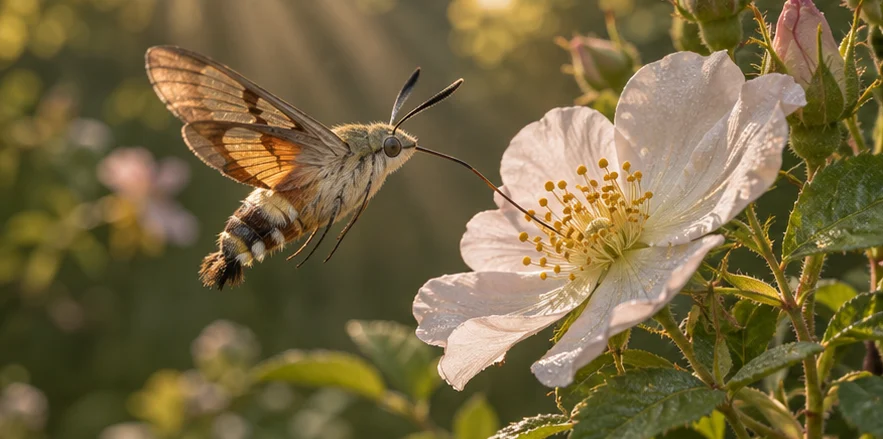
Something hovers at a cluster of garden flowers in full sun. From a distance it looks a little like a bumble bee, then a little like a tiny bird. The wings are a blur, but the upper part of the head comes into focus in one frame. The photograph does not immediately supply a name. It does supply a better question than “What butterflies did we see this afternoon?” If the observer's form made every daytime visit a butterfly record, the first mistake happened before the insect came into view.
A moth may be active at a bright hour, and a moth that is active then may visit a flower. That makes time of day a useful observation but a poor substitute for visible characters. The inverse is also worth keeping in mind. Darkness does not by itself turn a blurred visitor into a moth. A field note should be able to accommodate a time, a behavior, and an identification at three different levels of confidence. When those items are forced into one label, the field log can reproduce the observer's expectation with remarkable consistency and very little evidence.
This is a guide to recording daylight flower visitors without assigning their identities in advance. It explains which features a photograph may support, how to make room for an unresolved insect, and why an image count is not an abundance estimate. The method works for a small garden class or a repeatable observation route. No capture, handling, artificial bait, or intervention is needed to practice it. The chief equipment is a form that lets honest observations stay honest.
The example that breaks the shortcut
The hummingbird hawkmoth, Macroglossum stellatarum, is not a speculative exception based on a fuzzy backyard photograph. Almut Kelber's original study of its flower-feature preferences identifies it as diurnal and discusses its use of many kinds of flowers. A separate original study of pattern discrimination tested how this hawkmoth responds to patterned stimuli and how learning can alter its choices. These are studies of a particular animal and set of questions, not a key to every hovering visitor. Their value here is that daylight flower use by a moth is a documented phenomenon that a survey form must be able to record.
An illustrative garden encounter in North America need not be that European example. Common names can make several unrelated impressions sound more similar than they are: “hummingbird-like” can describe flight, not identity. Do not transfer the research species name to a record because the subject also hovers. Local occurrence, season, and anatomy can narrow plausible options, but if the photograph does not show the distinguishing features, the narrowest honest identification may be a family-level candidate or a broadly moth-like visitor. The goal is to recognize the missing option in the form, not to force every dramatic hover into one species box.
The Smithsonian's moth overview recognizes many day-flying examples and warns against treating color as a defining distinction. Some moths are conspicuous, and a plain-looking insect is not automatically a moth. Moths and butterflies both belong to Lepidoptera. Working with broad field categories within that group can be fine for a survey, provided the boxes represent a practical identification level rather than a claim that every specimen fits a quick visual rule. Once that is clear, exceptions stop looking like errors in nature and start looking like useful tests of the protocol.
The USDA Forest Service pollination brochure presents floral characteristics that can guide expectations about visitors and how they approach flowers. The agency's native-plant pollinator garden guide gives broader context for the range of animal groups that use flowers. For an observer, these references help generate questions about which hours to watch and which flowers to include. They cannot identify a specific visitor from the shade of the bloom or establish that an animal successfully carried pollen. Keep habitat, floral traits, and visitor identification in separate fields.
Write down what is visible before giving it a name
A useful description starts with position and action. A visitor held a position on beating wings in front of the corolla. The body was aligned with the flower entrance. A slender structure extended from the head toward the opening. The antennae were visible for part of the clip but the tips were not clear. This record gives a reviewer several distinct pieces of evidence. “Hummingbird moth at noon” supplies a conclusion and a timestamp but does not say why the name was assigned.
The first useful character to seek is often the shape of the antennae, including the distal ends. Smithsonian Natural History teaching material contrasts the typical clubbed butterfly antenna with commonly tapering or feathery moth antennae. The useful word is “typical.” Antennae are diverse, some moths have thickened tips, and a damaged or blurry image can make an ordinary shaft look enlarged. Do not count a disappearing end as evidence of an absent club. A clear complete feature can be useful in a regional comparison; a dark line that ends at a pale background may tell you very little.
Record which details you actually see. A consistent broadening of both antenna tips in a sharply focused side view offers better information than one apparent dot at the end of a blurred antenna. A pale mark on the flower behind the tip may mimic a knob. A tip pointing at the camera can look round even when the antenna is not round in profile. Use more than one suitable image if available, and mark when the informative structure appears in just one. A feature judged visible and a feature judged present are not identical entries.
Look at wing outline, repeated pattern, and body form together rather than making a color verdict. Wings are moving surfaces, and their relationship to each other in one frame may be an arbitrary point in a wingbeat. What appears to be a transparent patch could be part of the wing, a reflection, or a space between blurred strokes. Body width itself changes in appearance with the angle. A stable outer margin across several frames can justify a provisional comparison with a regional reference; a saturated stripe in one out-of-focus frame cannot carry a fine identification alone.
The proboscis can point to behavior without drawing the taxonomic boundary. The Smithsonian's account describes the feeding tube in moths and their butterfly relatives. An extended structure apparently reaching into the flower can be recorded as apparent probing when the geometry supports it, but not all elongated things near a head are mouthparts. One frame may show an antenna aligned with a petal edge. Follow the structure across the sequence when possible. Even a well-supported probe observation does not itself tell you how much nectar was taken or what happened to pollen.
Resting posture and flight behavior offer context, not universal tests. A visitor beating its wings rapidly in front of a flower can suggest a hawkmoth, yet hovering also occurs in other groups. A settled visitor can hold its wings in different positions depending on moment and taxon. Record if it was hovering, perched, maneuvering, or merely passing through, but avoid rules such as “never landed, therefore moth.” If behavior helps you choose what details to photograph, it has done useful work without a premature identification.
Keep the first frame wide and the useful frame sharp
A broad frame can preserve the flower, the approach route, and the time when the animal leaves. It can also be too wide to resolve antenna tips. A close frame can resolve head details, yet lose both wings and no longer show whether the subject remained at the same flower. For a small survey it is often useful to collect a context view first, then a detail if the visitor remains. Preserve the original view and link any crop to it. The purpose is to retain which evidence was used for which claim, not to make a portfolio of the prettiest images.
A side view tends to show how an animal approaches an opening and how a visible feeding structure is positioned. A front-facing view can show a different part of the head, but one antenna may cross the other and the body can be foreshortened. An upper view may expose a wing pattern while obscuring mouthparts. Neither camera position gives a complete animal by default. If permitted by the setting, reposition unobtrusively from a path, without pursuing the animal through the bed or interfering with access to flowers. Record which part of the body the viewpoint left unresolved.
Motion blur deserves a field reason code of its own. It is not solved by making the image larger afterward. Cropping and sharpening may help a viewer inspect detail already recorded, but generated or interpolated image detail is not an observation. Use original sequences for identification, and distinguish ordinary editing from changes that invent features. A generated illustration of a moth hovering can teach readers what scene to look for. It cannot identify any of the actual visitors in your record, even if it looks more detailed than a real photograph.
Light can introduce a systematic difference in what you document. High sun may light wings well but cast the head into shadow under a flower lip. Overcast conditions can make pattern contrast easier to see while making a fast wingbeat harder to freeze with a given camera setting. If your sample compares bright and cloudy sessions, a difference in resolved images could partly be a difference in documentation. Save a basic record of light, view, and obstruction. Those notes give a specific interpretation to uncertainty rather than making every unclear image sound like an operator error.
Be clear about image selection. An enthusiast may choose one striking frame after watching several brief visitors and saving numerous shots of the most conspicuous one. That is an excellent way to create an identification reference for a memorable visitor, but it is not a survey sample unless the selection process fits the intended question. A repeatable monitoring project can separately log all qualifying encounters during a set watch and attach the best supporting evidence for each. Do not confuse the successful capture of diagnostic images with the occurrence of all the animals that passed through.
Give unresolved an explicit home
A compact form can allow “moth evidenced,” “butterfly evidenced,” and “unresolved” for an image selected as the primary record of a candidate. More detailed projects can use “other insect” and “not an animal” when the initial screening is broad, as well as more specific taxonomic categories when justified. The three-class scheme in the example below presumes an image set selected for a particular identification exercise. It is not a universe in which every insect must be one of two groups. A flier already known to be a fly should not occupy an unresolved Lepidoptera slot simply because it uses flowers.
Reasons for unresolved deserve their own notes. The animal may be identifiable as a lepidopteran but uncertain across the two practical groups. It may be too blurred even for that. The frame may show only a wing and a flower, or two possible subjects. A regional reference may be missing. A second reviewer may disagree about a visible character. Separate the identification outcome from the limitation, so you can find out whether a different angle, a clearer sampling rule, or access to a local reference would improve the records.
Likewise distinguish “no moth detected” from “moth identity not established.” A butterfly identified clearly within a focused image is not a moth in that same primary subject slot. A blurred image supplies no such negative. A set of ten blurred frames does not demonstrate an absence of moths from a site. If the opportunity to observe was complete and nothing qualifying occurred, a zero event count may be appropriate for that watch. Missing evidence of identity for a detected visitor is a different state from no visitor at all. These are different rows in a good log, not three spellings of zero.
An unresolved category is also a guard against circular analysis. If time of day helped quietly assign all uncertain daylight subjects to butterfly, then a later graph showing daylight dominance by butterflies would partly be a picture of the classification rule. To avoid this, make a first pass on characters and behavior without treating the clock as a defining feature. Time and location can subsequently narrow candidates when reliable knowledge supports that use; they should not turn an absent diagnostic character into a present one. Keep what each piece of evidence contributed in the record.
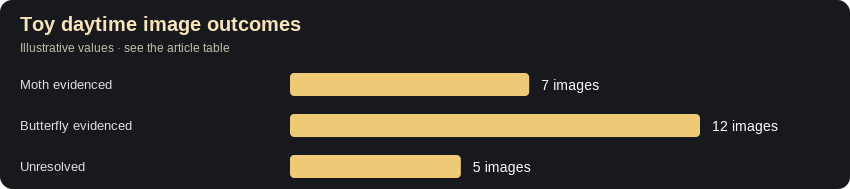
Chart: Toy daytime image outcomes
The bar chart and matching table are illustrative only. These are invented classification counts for twenty-four daytime images. Each image has one designated subject and one recorded outcome in this toy exercise. These values are not sourced observations, not counts of distinct animals, and not estimates of the daily activity of either group.
| Recorded image outcome | Images |
|---|---|
| Moth evidenced | 7 |
| Butterfly evidenced | 12 |
| Unresolved | 5 |
There are nineteen resolved images in the example. Seven of twenty-four images, about 29.2 percent, are classified as moth evidenced with the unresolved still in the denominator. Seven of nineteen, about 36.8 percent, describes the moth share among resolved images. The second number does not estimate the proportion of all images depicting moths without an assumption about the unresolved. Both percentages can be plainly reported as different descriptive calculations. Neither can answer how common moths were in the garden where such pictures might have been taken.
In a narrow hypothetical exercise where each unresolved image must truly depict either a moth or a butterfly, the count of moth images lies between seven and twelve if all resolved classifications are correct. The upper end puts every unresolved image in the moth group. The lower end puts none there. This is arithmetic bookkeeping under stated conditions, not a confidence interval or a claim about what the most likely split is. If some unresolved subjects might not be Lepidoptera, report that possibility and do not turn uncertainty into a binary probability distribution merely because the resolved table has two named classes.
One reason not to guess is that unresolved images may reflect nonrandom viewing problems. A series of fast approaches might leave wing and head details unresolved more often than exposures of a visitor at rest. Images selected for a dramatic posture could make a character especially hard to see. A denominator restricted to resolved photographs may favor both a behavior and whichever visitors performed it in that collection. For a review project, summarize those limitations. If the reason is mainly an unhelpful camera angle, the best response is a change in coverage rather than a statistical correction guessed from the table.
Read the chart title literally. A figure titled “daytime image outcomes” can display how an image review ended. A title such as “daytime moth population” would make the same bars misleading. Even if every image were classified correctly, an individual visiting the same flower five times may have contributed five pictures. Conversely, a visitor that moved through quickly might have contributed none. Recording image outcomes is useful for assessing documentation and training observers. It is not a replacement for an event design or a method for counting individuals.
Use a repeatable watch when the question moves beyond images
Begin with an observation unit. You might designate a small patch with a readable boundary, watch it for a fixed interval, and count visitors that meet a rule such as hovering at or landing on a target blossom. Passing through the background can have its own flag without counting as the same event. State what happens if a visitor leaves the patch briefly and returns. A rule based on observed entry and exit is often more feasible than a promise to recognize each returning individual. Implement the same rule when the visitor is hard to identify as when it is obvious.
A timed watch should preserve records that have no useful image. If the observer saw a clearly bounded visit but the phone camera missed it, the event still belongs in an event log under the stated rules. Identification may be unknown. Conversely, a still photograph of a visitor already resting in view can supply a good identification while not documenting the beginning of a visit. A link between event and image IDs allows each source to do its own job without pretending both pieces automatically have the same scope.
Give the watch a start, an end, and notes on interruptions. Perhaps a person blocked half the patch for two minutes or the observer left briefly to find another angle. Those losses can influence the denominator. A zero event count in a completed watch differs from a zero written for a missing watch. It is also different from recording a completed watch in which there were unidentified events but no diagnostic moth record. For a class, naming these alternatives before the first observation can make the field sheet easier to learn than trying to explain contradictory zeros later.
Flowers change while the day advances. A focal flower may open, close, be heavily shaded, or cease being visible as the route changes. Several blossoms can be available in the morning and fewer in another window. Record the target and enough on-the-ground conditions to judge availability. If a survey wants to compare observed visits per time window, it can report counts per watch while presenting flower coverage beside them. If it wants to normalize by floral opportunity, it needs an appropriate measured denominator. An informal note that there were “some flowers” cannot be turned into a rate per blossom later.
Time itself is better as a continuous record with derived categories than as a forced guess. Log local clock time and, when comparing across seasons or locations, retain enough context to place the session relative to sunrise or sunset if relevant. Noon by the clock and a bright moment in a deeply shaded garden are not the same variable. Weather, cloud, shade, and site orientation can qualify what “daytime” meant for the watch. These details can guide future surveys without getting to vote on whether a blur had clubbed antennae.
Select time windows before looking at the most striking data if the purpose is comparison. A broad daylight question may call for several intervals rather than only the break when a volunteer was available. Replicate on different days, and let a report state which times were not watched. If you did not survey dusk or night, say so rather than comparing daytime event counts to a blank row interpreted as absence. Nothing about finding a moth at noon licenses a statement about its full activity schedule. The observation is still noteworthy without an invented counterpart.
Check what can confound a daylight comparison
Imagine that morning sessions are always in one bed and afternoon sessions in another. A higher afternoon count could reflect the plants, the access, the weather, repeated observations of one visitor, or the hour. Moving the watches so some gardens contribute both windows can help. Similarly, comparing one observer's sharp afternoon images to another observer's morning notes can introduce a difference in classification evidence. When both factors cannot be balanced, describe the comparison as observational and say which changes travel together.
Surveys often separate the distribution of effort from the distribution of results only after data are collected. A dramatic chart then shows that ninety percent of the pictures were taken between eleven and two, with no indication how many eligible observation minutes occurred in each period. Put a small coverage display beside the results. Show actual sessions and their lengths by window, and report how many events were resolved. If most scheduled late watches were canceled because of weather, the absence of late detections cannot be given the same interpretation as quiet but completed watches.
Dividing a tally by the number of observed minutes only addresses effort duration. It does not make every minute equally sensitive. A minute spent looking at a well-lit near bloom differs from one spent watching dense foliage at a distance. A watch may deliberately use a short photographic burst, but a burst measures something different from a continuous search. Time-standardized counts can be useful descriptive outputs when the method stays comparable enough. Give readers the conditions that allow them to judge that comparability.
The stage of the season is another example. Suppose a garden volunteers' program begins in summer and records several clear moth visits while an earlier class, watching in spring, saw none. Neither group must have made a mistake. The animals, plants, weather, and opportunities recorded could differ. A between-season comparison needs defined windows and enough relevant coverage for the intended inference. If each class had a different goal, separate reports may be more honest than forcing all of their observations into a ranking. A data merge is not in itself a common sampling design.
Review proximity to conspicuous flowers carefully. Participants may cluster where flowers are big enough to draw attention, and they may notice a visitor after it starts hovering near the largest cluster. If the target is a fixed flower assemblage, choose the patch by a rule that does not require a visitor to appear before the watch begins. If the project intentionally photographs whatever interesting animal it sees, say that clearly. An atlas of noteworthy examples can teach identification. It does not have to pretend to be a frequency survey to have value.
Turn behaviors into their own observations
A visitor at a flower can hold position, make contact, run across a petal, insert a visible feeding structure, or depart abruptly. Log only the behaviors the evidence supports. Sometimes the animal appears to probe the entrance but passes no part of its body visibly through the opening. “Apparent probe” may be sufficient for a garden note. “Collected nectar” would require evidence that you did not necessarily see. “Pollinated the flower” goes further still and cannot be inferred from a hover alone. Keep the stages separate even if several occur in quick succession.
Record position with respect to structures you can identify, not what you assume an organ must be. In a side view, an animal's head may overlap what looks like a stamen while actually passing several millimeters in front of it. A flower's motion alone might also create the overlap. Note close pass, possible contact, or visible contact separately, and state what was visible. The best footage for classification might not be the best footage for deciding where the animal contacted the bloom. That is a good reason to store evidence for different observations under the same event, not to overinterpret the prettiest shot.
An observer interested in comparative behavior can define an event-level set of questions that all taxa share: did the subject approach, did it settle, did it apparently probe, were any contact locations visible, and how did it leave? Those questions prevent a survey from documenting only the drama expected of moths and only the resting posture expected of butterflies. A shared form lets behaviors be compared without claiming they define the groups. An unfamiliar observation will then reveal the limits of a stereotype rather than disappearing into it.
Learning and context can also complicate broad accounts of why an insect is there. Kelber's studies concern particular moths and how they respond to controlled flower features. A field worker seeing an animal at a brightly colored flower cannot thereby prove that color was the deciding factor in that visit. Flower number, position, history of reward, and which alternatives were available may differ. Use a controlled study to understand what explanations require additional evidence, not to attach a complete cause to every field observation. The simple log of a visible visit remains useful without a theory of motivation.
Be careful about the word “pollinator” in project titles and captions. A study can be a flower-visitor survey even if it contributes background to pollinator research. If all it records is contact with a bloom, do not convert every insect photo into proof of a successful reproductive contribution. Better to say “daytime flower visitors” and then label the observed behaviors. If someone later measures pollen deposition or another outcome, those can be connected explicitly to the visitor record. Distinct observations become stronger when their links are shown, not assumed.
Train reviewers with hard examples rather than prettier ones
Start with known clear examples from authoritative references and use them to agree on language. Then include the problematic cases: an antenna projected head-on, a wing whose edge is partly obscured, two animals in one frame, and a fast blur that nobody can diagnose. Ask reviewers to label visible details first, then choose the broadest confident identification, and only afterward compare decisions. This exercise can reveal that everyone agrees which figure is winged yet disagrees on whether the antenna tips are actually present. A disagreement report that distinguishes those questions is easier to use than a tally of right and wrong answers without explanation.
To check whether clock information anchors the judgment, show reviewers a first set without exact times and collect their character notes. A second pass can add capture context or a regional reference. Do not insist on permanent blindness to geography if geography is genuinely informative for identification. Instead ask whether knowledge of a bright time of day made a blurry character seem more convincing. An identification that changes once timing is shown can still be defensible, but the reason should be documented and not reduced to a stereotype.
Where possible, preserve independent reviewer entries. A team may discuss an uncertain frame and reach agreement, but keep an indication that the positive determination resulted from joint review. If some cases remain unresolved, publish that as an ordinary outcome. It tells the reader how much evidence the method could support. An improvement from half resolved to mostly resolved after switching camera angles could be useful progress even if there is no change in the insects themselves. Reporting the image process openly makes that improvement distinguishable from an ecological trend.
Be especially cautious with tools that suggest names. An automated identifier can propose candidates, and someone can compare those candidates against visible characters and reputable local records. It may also be sensitive to visual context, or simply present a confident-looking answer to a poor image. A proposed name is not an observation. Separate the suggestion from the rationale accepted in review. If a suggestion cannot be checked because the relevant feature is missing, retain the uncertainty even when the tool offers a species-level result that looks convenient.
Prepare a report that another watcher can use
A simple entry might read: “Late morning, Bed C, complete six-minute watch; one visitor hovered at a corolla opening and appeared to probe; antenna tips out of focus; visitor unresolved; event includes original frames twelve through eighteen.” Another might say: “Early afternoon, same patch; one short visitor clip with two clear views of the head and a matched wing pattern; moth supported at broad identification level; species not assigned.” These are fictional examples, but the structure separates time, behavior, and identity. They also give a future reviewer a place to start.
For a public summary, give the scope first. Name the patches, dates or seasons represented, measured observation time, and whether the work was limited to daylight. Say whether the main count concerns images, events, or individuals you could reliably distinguish. Report unresolved cases and their most common reasons. If the map includes taxa or times that were not sampled, label them as such. A caption that reads “we did not schedule night watches” is more useful than a blank field that readers might mistake for evidence of nighttime absence.
Show at least one clear and one inconclusive piece of evidence when appropriate. The point is not to embarrass the person who brought a blurry image. It is to teach what makes a determination possible. A clear paired view may illustrate an anatomical character. An inconclusive example can show why an attractive posture was not enough to decide. Label editorial imagery separately even if it accompanies a scientifically careful text. A reader should never have to guess which picture was an actual record.
Invite the next observer to repeat a specific comparison rather than to accumulate more photographs without a purpose. If the main issue is that head characters were often hidden, try a complementary view while keeping the focal patch and watch rule stable. If the main issue is a narrow schedule, add matched morning and afternoon visits and document coverage. If the question has become species-level diversity, bring in an appropriate regional reference and check whether the available evidence resolves the necessary details. The best use of an unresolved result is to change the next question or capture plan explicitly.
A good report can be surprising without being sweeping: a midday watch documented a moth at a flower, a set of selected photographs supported some determinations and not others, and no nighttime comparison was attempted. Each statement has a defined evidentiary basis. It is less flashy than drawing opposing curves for butterflies and moths over a day the team never watched, and much more useful to someone planning a real follow-up.
A protocol change warrants care when the old and new records are placed on one timeline. If earlier data have a mandatory butterfly box for daylight candidates, look for original descriptions and images rather than relabeling a percentage of the old tally. Correct individual records only when the underlying evidence supports the correction. Some entries may need a wider label such as “daytime visitor, group not established,” and some series may need to be shown separately because the old categories cannot be reconstructed. This is an honest loss of apparent continuity, not a failure to save useful data. The earlier log can still describe where observers watched and which encounters were documented.
When deciding whether to join two periods, explain both the old rule and the new rule in a note a reader can easily find. Keep a field that names the rubric version. If the new version yields more moth determinations, the increase could reflect categories becoming available, attention to diagnostics, or a real change in the encounters. More than one explanation can be true. A limited bridge study, in which independent reviewers apply both rubrics to the same representative set of original images, can help characterize the methodological difference. That comparison still does not recover visitors that went unphotographed under the old method, so distinguish the evidence you gained from the gap you cannot now close.
The sunbeam that opened the story belongs in the notes. It tells us when and under what conditions the scene was seen. It may help explain what the camera captured and what another observer should look for. It is not a feature of the animal's anatomy, and it cannot serve as a substitute for one. When a day-flying moth breaks a simple rule, keep the time, keep the evidence, and revise the rule. Then let the next visitor be what the observations support, even if that is simply unresolved.