| Category | Value (photos) |
|---|---|
| Little visible wear | 8 |
| Some wear | 6 |
| Unscorable | 4 |
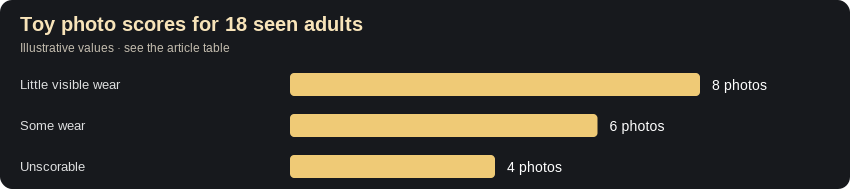
Illustrative values, not sourced observations. Categories total 18; not a migration history.
One of the monarchs in the garden looks freshly painted. Another has an interrupted edge and an orange panel so pale that the sun nearly shines through it. A visitor asks how far the second butterfly flew. The photograph contains no answer in miles. It does contain a wing surface that can be examined and a margin that can be described. Start with those features instead of giving the animal a biography. A weathered appearance might be consistent with long exposure and activity; a missing corner might have happened quickly. Without a record that links the individual to earlier places and times, they remain possibilities, not a route.
Wing condition is useful precisely because the observer does not have to turn it into a distance estimate. A garden record can distinguish a reasonably clear image with little visible wear from one with some visible wear. It can also retain an image in which the necessary features were not visible enough to make that judgment. Across a set of clearly defined photographs, the resulting counts describe what viewers could score. They may motivate a more careful sampling design, help explain a field observation or show how image quality limits retrospective work. They cannot give mileage to a still photograph.
This article builds a short visual rubric and asks where its evidence stops. The approach is intended for existing photographs or noninvasive observations of free butterflies, not for obtaining a closer view by handling an animal. It keeps general monarch migration ecology separate from specific journey claims. It also shows why one unscorable category should remain in the denominator instead of quietly disappearing from an attractive figure.
Introduce the species without giving the photograph a route
The U.S. Fish and Wildlife Service monarch account describes adult feeding and the role of milkweed for larvae. It also provides context for lookalikes. That background is helpful when the only signal someone remembers from the field is an orange insect passing in bright light. The photo needs to show adequate diagnostic features if the project intends to score only monarchs. A record of a definite adult at an aster has a useful location and behavior, but none of that proves arrival from a distant site. A different record of an unresolved orange butterfly is useful evidence at a lower level.
The Service's Monarch Butterfly Species Status Assessment, version 2.3, describes the annual cycle, migration, overwintering, and resources needed through the year. Broad migratory patterns vary geographically and seasonally, and movement over the year involves more than one generation. Even in a place and month where migration is well documented, an individual photograph does not establish whether that particular animal had traveled far, hatched nearby, or taken a particular path. Context can make a hypothesis sensible; it is not evidence of an individual's itinerary.
An editorial caption can make the distinction explicit. “A monarch photographed in the garden in October, with visible wear on one wing” reports a specimen's appearance in context. “A monarch here after a long southern flight” adds direction, distance and a relationship to the season that the image does not show. A local article can mention the larger migratory setting in another sentence, with attribution. That way the photo remains verifiable without implying all of the surrounding biology is embodied in the animal captured in this frame.
Consider a different audience: a survey team interested in the distribution of adults during a poorly understood part of the year. Photo location, date, and details of image collection can be relevant even if condition is unclear. A high-quality photograph might support a more confident condition category and contribute to a larger analysis with explicit assumptions. This is not inconsistent with the warning about mileage. The unit of evidence and the design of the study determine what condition can tell us. One visitor's question about one adult is not the same as a research comparison across images and dates.
Distinguish surface wear, missing tissue and visibility
An apparently faint panel can reflect reduced visible scale coverage, lighting, image compression or the surface of the wing facing the camera. A missing piece is a different visible feature. Broadly ragged margins, discrete tears and absent corners should not all automatically be called old age. Useful descriptions name the feature and position: “one visible break in the outer margin” or “several rough-looking areas along the exposed edge.” The interpretation can be written independently when there is supporting evidence. That separation matters when another image changes what was visible.
For a field distinction, Monarch Joint Venture's measuring guidance treats wing damage such as missing pieces separately from gradual scale wear. This article's simpler teaching rubric below focuses on visible signs consistent with wear and records obvious tears or missing tissue in a separate descriptor. That is a local classification for teaching image review, not a standard laboratory score. A photograph might reliably show a missing corner without reliably showing wear across the rest of the wing. Record both possibilities rather than forcing the stronger visible evidence to stand in for the unassessable one.
An unscorable picture is not one in which a butterfly must have undamaged wings. It could show a well-preserved face and antennae but an edge concealed behind a flower. It could show a silhouette sharp enough to assess shape broadly, without enough surface detail to judge the chosen signs of wear. A flare from sunlight can make portions hard to see. Some images will remain good records of species or site despite not being useful for this score. Evaluate each question using the evidence it needs instead of attaching one global quality grade to the file.
Color especially deserves restraint. A camera processing mode can brighten orange, dim black venation or smooth fine textures across an image. An adult with its wings folded may show a different wing surface and reflect light differently than one displaying flat upper surfaces. Two photos that seem to show saturated and faded examples may differ mostly in exposure or viewing geometry. A project using image colors as data would need more controlled information than a typical casual image set. For an introductory garden exercise, base scoring on defined visible features and put uncertain color interpretation in the notes.
Decide what a single record means
A photographer can make fifteen images of the same butterfly without significantly increasing the number of animals observed. For this example, the unit is a selected photograph for each retained adult-observation record, not a verified unique butterfly. A sensible project chooses the reporting unit and an image-selection rule before sorting by condition. If photographs within one encounter are known to show the same adult, group them under one encounter identifier. Select the image that best meets the viewability rule rather than picking the most dramatic damage. The unused frames can support review without creating more records for the chart.
Looking at separate encounters, the same animal might return to the same patch. Unless there is independent support for individual identity, don't say that one record equals one unique monarch. Familiar looking notches may suggest a possible match, but multiple individuals can have similar marks and a different angle can make the same mark look different. Store a plausible match as a separate hypothesis, not a silent merge. On the other hand, if a camera burst is certainly one continuous sighting, treating the files as unrelated sightings inflates the denominator even without knowing the insect's identity.
Decide which file is the reference before scoring. A phone photograph could be exported as a small crop for a neighborhood post, and the original could still contain enough wing margin to score. Save the identifier and date of the file actually assessed. If an original and a crop are tied to the same record, note which one the analysis used and why. Image selection made after the reviewer sees conditions can distort a teaching set: an impressive tear or unusually intact wing might get chosen because it makes the story look clearer. A documented viewability rule reduces that temptation.
A public chart should name the record even where the technical selection rule lives in a method note. “Scorable photographs” is clearer than “monarch population.” “Eighteen adult observation photographs” may mean a defined group of files, not eighteen individually identified migrating animals. If someone uses a published example in a classroom, they should be able to reconstruct the number of records and see why multiple photographs of one encounter are not multiple votes. A figure is not self-explanatory merely because its bars happen to add up correctly.
A short rubric that starts with a viewability check
Choose the visible region before applying the labels. A simple classroom project might score the visible outer margins and the exposed panels of a stated wing surface. Do not switch to whichever surface happens to show more abrasion on a given image unless the method says to and the interpretation reflects that choice. If an image shows only a fraction of the intended region, mark it unscorable under the rule. A person can still add notes about other visible features. The score should not be more complete than the photo.
Little visible wear should mean that the stated regions were clear enough to assess and showed no more than the rubric's minor signs, if any. It is not a label for a known newly eclosed butterfly. Some wear should mean that one or more defined wear features were clearly visible, such as conspicuously abraded-looking surface regions or fraying not adequately described only as a missing flap. For a rubric this coarse, avoid using an exact percentage of missing scales unless there is a separate method for estimating that proportion. Borderline cases deserve a note, and a clear break of uncertain origin can be recorded as damage outside the wear decision.
Unscorable means inadequate evidence for a rubric judgment. Wing partly hidden, motion blur, overexposure, resolution too low and incompatible pose are useful reason fields. When reviewers disagree over whether an image is assessable, keep that disagreement through initial review instead of pressuring them to choose a visible-wear tier. This helps reveal what would make the protocol more dependable. It also changes the interpretation of a collection where some types of observations are systematically harder to score. Without the reasons, a later reader cannot tell whether the missing assessments were likely to be related to conditions or selection.
Use references that belong to the intended scoring task. Example images can show what counts as visible fraying versus an isolated gap, what a folded wing looks like at several viewing angles, and how a crop can hide the target region. A rubric comparison should not become an identification guide unless it includes separate evidence for that. Label generated imagery and keep it out of the review evidence set. A generated depiction of a Monarch with a worn edge can remind readers what the question is, but it should not train or validate a biological measurement on its own.
Read the illustrative figure and its denominator
The bar chart “Toy photo scores for 18 seen adults” uses eighteen invented photo records. Eight are labeled Little visible wear, six Some wear, and four Unscorable. Each photograph has one classification in this example. The numbers sum to eighteen, but the figure does not establish eighteen unique animals, an encounter rate, or any migrations. It is a demonstration of what happens when uncertainty about visibility is retained in the display instead of converted into a condition.
| Illustrative image classification | Number of photographs |
|---|---|
| Little visible wear | 8 |
| Some wear | 6 |
| Unscorable | 4 |
| Total example photographs | 18 |
Fourteen of the eighteen toy records are scorable. Among those fourteen, six of fourteen, or about 42.9 percent, have some wear. Among all eighteen records, six of eighteen, or one third, are classified as showing some wear. Both arithmetic statements are correct, but they answer different questions. The first is a proportion among images that met the rule. The second is a proportion of the total image set carrying a positive classification, not a population estimate. A report can use either if it names the denominator and retains the four unscorable records.
One way to think about the missing assessments is a bound on classifications in this tiny, fixed toy collection, assuming the fourteen available scores would stay the same and that the other four could all eventually be placed in either wear bin. Depending on how those four resolved, the number with some wear could range from six to ten, or roughly 33.3 to 55.6 percent of all eighteen. This is an arithmetic illustration of incomplete classification, not an uncertainty interval for butterfly populations. It rests on the stated assumptions and makes no claim that any of the alternatives is more likely.
Do not turn the two scorable labels into a numeric average of distance. The categories are ordered descriptions, not equally spaced physical measurements. An image in the Some wear tier is not twice as worn as one in the Little visible wear tier, and the unscorable category has no place along that scale. A separate plot of scoring reasons may be more informative than an arbitrary index. At the very least, put the image counts and labels in readable text or a table so readers do not have to infer the values from color and bar heights.
Why age, dose and cause easily get confused
An old surface can accumulate signs of use. That does not mean that the amount of visible surface change uniquely defines chronological age. Two individuals of the same age can spend their time differently and experience different contacts with vegetation or other surfaces. An isolated injury need not accumulate gradually. A fresh-looking adult may still have moved farther than an animal with an obvious local tear. And a surface that looks faded in one image might appear differently under another light. A wider label such as visible condition is justified by the evidence; an exact date of emergence is not.
Cause has a similar ambiguity. If a margin is torn, an animal interaction, a collision or some other event could be possible, but missing a piece is not a record of which event happened. Look for continuity of observation before claiming a cause. A sequence that visibly documents contact and the new injury is fundamentally different from two images showing a mark before and after an unobserved interval. Even an unusually shaped margin has to be interpreted in context. Describing its outline preserves more usable evidence than calling it proof of predation without witness to the event.
The hypothetical odometer also confuses total movement, displacement and route. Two dates or locations for one identified animal, if independently established, can bound or inform some aspects of movement; straight-line distance between them need not equal the distance traveled along an actual path. One date and location leave even displacement unknown. By contrast, a wing score supplies neither a second verified location nor a track. Adding precise miles to the description is not just uncertain; it represents a different measurement with missing inputs.
It is perfectly possible to study associations between condition and age or movement in a suitable setting. The published study Using community science to map western monarch butterflies in spring applied its own wing-wear scoring scale and filters in a larger research design, treating wear as an age proxy. That is not a contradiction of this article. A proxy can help a team interpret patterns under explicit inclusion rules and limitations. It is not an individual age or migration distance readout. Use the documented study to understand how a rubric enters an analysis, not to assign its assumptions to a one-off photograph.
What stronger migration evidence looks like
In a study of spring recolonization in eastern North America, researchers used wing wear alongside stable-hydrogen isotope information and other observational context. Their data gave the study more than one line of evidence about possible geographic origins and movements. Isotope inference is itself model-based and should not be described as a literal route recorded in a wing. This distinction is quite helpful for casual observers: even an additional line of evidence estimated origin regions within a research design. It did not turn a photograph into an itinerary.
The first improvement to a garden dataset might be less ambitious than tracking movement. Add a date, a correctly identified site, a repeatable photo-selection method and a note on the watched area. If the study is comparing early and late observations, state whether sites, watch effort and photo conditions change jointly with date. Record where geographical coverage came from before drawing a line of progression through observations posted by different contributors. A map of photographs can visualize places where people gathered photographs, not necessarily the route of a tagged animal or the edge of its population.
For a claim about a particular individual, credible re-identification across dates or authenticated records from an authorized tracking program would matter much more than a state label from the wing surface. Do not infer an old marker or attach anything to an animal as part of this casual observation exercise. Follow the guidance of established programs and applicable site and contact rules when contributing data. The purpose of mentioning stronger evidence is to clarify why the claim needs more information, not to suggest every backyard observer should obtain it directly.
A community project can also pose questions that use the data it already has. How often can participants score the necessary wing surface from the permitted view? What poses cause disagreements? Did an outreach session teach people to separate missing tissue from broad surface wear? These are worthwhile questions for an image collection. They can lead to a more reliable rubric and make the next season more consistent without relying on weak claims about migration. The humble question often produces a stronger result.
Train reviewers without asking them to suppress uncertainty
A small pilot can start by having two reviewers classify the same set of files independently. Give them the same rubric and examples, and hide any provisional labels if the goal is to understand agreement. Compare not only the wear choices but the choice to classify at all. Disagreement where one reviewer says Unscorable and the other says Some wear reveals a different weakness than disagreement between the two wear grades on a clear image. Identify what feature or viewing requirement led to the different choices before revising the rubric.
Keep the scale purpose visible throughout training. A volunteer may feel that an answer with little visible wear is equivalent to “this individual is healthy.” That is not the claim. Another may think a middle category means compromise when assessability is poor. That also is not the claim. Use separate exercises to check whether observers can identify the intended region, describe the damage, and choose a category without overinterpreting it. A simple rule can be robust when readers understand why it exists rather than memorizing sample photos as unexamined answers.
When an assessment is reviewed, save both the original and final labels with a reason for any adjustment. If poor exposure was the problem, note that a different file was used rather than pretending the original image revealed more after discussion. A team that applies a new rubric to old images should date the rubric and check which files were reevaluated. Archived charts can remain accurate descriptions of the earlier rule if their legends identify it. Replacing all historical scores without a note makes later differences hard to understand.
Agreement is not the same as biological validation. Two observers applying the same rule may reliably agree on a label with no tested relationship to exact age or origin. That is still useful for scoring what the photos show. A small training sample shows issues to refine but should not be oversold as a field performance statistic. It is better to report the purpose of the check, the kinds of differences noticed and the revision that improved clarity. The harder biological claim remains a separate question requiring separate evidence.
Examine who and what is missing from the gallery
A photo survey depends on an animal stopping or crossing a location in a way that a camera can capture. A high-quality image set may overrepresent easy to approach subjects or individuals perched at open flowers. Flight images with obscure margins may be harder to retain and score. That can matter if the study tries to compare behavior as well as condition. A brilliant archive can still be selective, and a high-resolution camera does not remove biases that govern which insects were photographed in the first place.
Imagine a comparison of two sites. Site A is an open garden with convenient eye-level blooms. Site B is a wooded edge where published records mostly show butterflies in shadow. The two sites might differ in actual condition, but they also differ in the ease of scoring. If Site B has many more unscorable images, a comparison restricted to clear pictures is answering a question about a selected subset. Do not report it as a straightforward site comparison without showing the unscorable rates and collection differences. If an alternative viewing protocol would be possible at both sites, the next study could plan around it.
A temporal comparison can carry the same issue. A spring collection might include wing-folded poses in cooler morning conditions, whereas a midsummer event could give clear views of different regions during a warmer afternoon. If viewing angle changes along with date, a condition line may mix biology and photography. Before aggregating images across seasons, report how they were acquired and check that the criteria apply to both. A narrower comparison between matched image types can be easier to interpret than a graph using every gallery file.
Selection continues after fieldwork. A social feed might feature visually striking butterflies, either exceptionally worn or exceptionally immaculate, rather than a consecutive sample of adult encounters. Removing debris, brightening a panel and smoothing edges can also interfere with the original evidence. Preserve the unaltered record for assessments and document what adjustments were made to the public copy. If the origin and selection history of the images are unknown, say that the figure describes the reviewed collection. It does not represent an unobserved set of all butterflies in the area.
Work through two uncertain photographs
The first fictional photo shows a clear monarch from above against a flowering plant. Most of the region specified in the rubric is visible. Its upper edge looks intact, and a corner has one small clean gap. If the surface and other selected edge portions are clear and show little wear under the local rule, the file may be classed Little visible wear, with damage recorded separately as a small discrete gap. That may seem counterintuitive only if the reader expects the score to summarize all aspects of condition. State plainly how the rubric handles a discrete injury.
In the second hypothetical photograph, the insect is folded against the light. A wide edge looks torn, but the exposure washes out the relevant panel. The scorer chooses Unscorable for wear and notes probable margin damage visible on one side. Another reviewer may hold back the damage note if the glare obscures the edge itself. They can keep both observations until there is a clearer view. Neither score requires imposing a cause, much less a journey. The original frame can still be shared as a butterfly sighting if its ID has adequate support and the publication explains its limits.
Now imagine a series that genuinely follows one butterfly continuously at a flower. A crisp first frame shows one wing face; the next frame shows almost all of the opposite face. The two views can be linked to one observation. A project that requires the first face can choose the first as its primary image and use the second only for additional description. A design that accepts paired views should explain how it decides which are assessable and how it makes one summary classification. Combining useful views does not create a second observation or supply the time history before the first frame.
A final reviewer can read the whole record by asking what would change the category. Would a visible margin with convincing texture resolve a poor crop? Might a separate identification review reveal that the insect is a lookalike? Does a next frame actually belong to the original encounter? With these questions, uncertainty becomes concrete rather than a blanket disclaimer placed in fine print. Some entries will improve under review, and others will remain limited. Both outcomes should leave a trace in the source notes.
Make a chart that does not pretend to be a map
Label the graph by the outcome that was actually scored. Adding a little line drawing of a migratory path behind the bars can suggest the toy scores were sorted by route. The cleanest view is simply three equally readable bars with number of photographs, a clear illustrative label and a table. A separate factual migration diagram can have its own source and caption, and it should not be visually linked to any one photo unless an independent record supports that connection. Keeping visual forms separate prevents a pleasing design from doing argumentative work the text explicitly rejects.
Check the chart by asking someone what the four unscorable images mean. If they think those images show butterflies without any wear, the distinction is not clear enough. If they think the remaining fourteen were identified as different individuals, sharpen the unit label and note. A helpful alt description can state that the three values are eight, six and four photo records, respectively, and that the counts are hypothetical. A long article can make room for a longer explanation, but the point of the short description is that a reader should not need to reach the methods before understanding why these are not distance data.
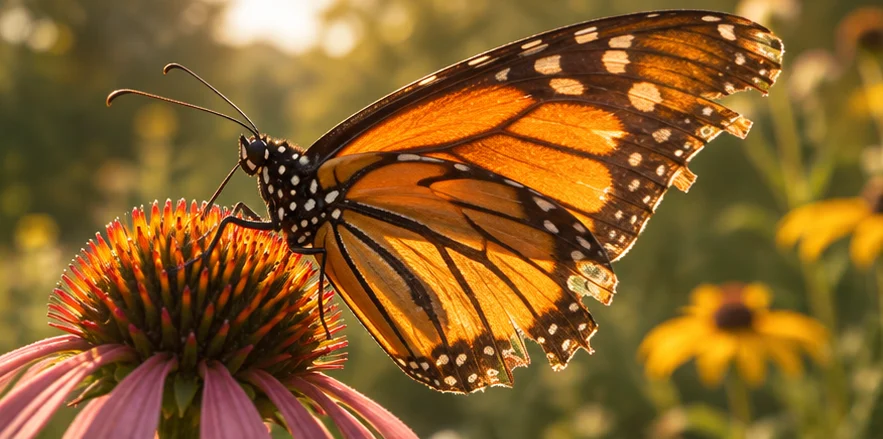
The same check works for captions underneath individual illustrations. A generated backlit wing image shows the general topic and cannot document any animal's appearance, path or injury. Label it as editorial artwork in the caption, not as a file used for scoring. Even a documentary photograph needs a traceable relation to its observation record when it is used as evidence. An appealing photo that was chosen after the plotted figures were compiled can convey atmosphere or perspective without being one of the plotted cases. The article should tell readers which job it performs.
Design an audit that does not reward dramatic damage
Imagine the garden project starts with a folder of seventy-three images taken over four afternoons. The scorer sees a spectacular torn wing in one image and places it at the top of the training set. Several other images have obvious wear. After looking at those, the person considers borderline roughness in the remaining files to be little wear. Another person starts with clear pictures of nearly intact wings and makes different choices on the same borderline examples. Without a common calibration set, the order in which the images appear can effectively change the lesson. Decide on feature examples and review criteria before generating scores for the figure.
An audit can ask a second reviewer to score a balanced set of clear and borderline images in a different order. Log whether each discrepancy came from disputed visibility or a distinction between surface wear and discrete damage. Reconcile the labels under a written rule. If the rule changes, do not simply apply it to whichever category seems problematic. Review all relevant files under the revised rule and state which version the article uses. A good audit can find that the method needs an extra “region only” note or that a whole class of folded views should stay unscorable. The point is to improve consistency, not to make every record fit a chart.
For a more concrete audit, trace a published count back to the actual file identifiers. Confirm that the scorable subtotal excludes the four unscorable toy cases rather than recoding them. Then choose a photo classified as Some wear and inspect the recorded region, original image and reason. If the documented reason is a “missing triangular piece” and the rubric says to record such a break separately, the label needs clarification. If a second image was used to establish wear, the archive should show that the two files depict the same observation. A trustworthy count is not just a plausible total. It is one that can be verified without reenacting the original photographer's memory.
The audit should also examine what was discarded. A camera folder often contains failed bursts, disabled timestamps, duplicates and out-of-focus frames. The method may exclude some for sound reasons, but the exclusions should not depend on the result desired for a particular site. If the study starts from adult-observation records rather than all files, obvious duplicates can be removed at that earlier stage. If a selected observation has no suitable photograph, it might belong to a separate eligibility report instead of disappearing. Showing image scoring and overall observation availability separately prevents the method from looking more complete than it was.
Compare editorial conclusions for the same toy counts
One caption might say, “One third of monarchs in this garden showed mileage wear.” That sentence misstates the evidence in three ways. The chart covers fictional photo records rather than all monarchs, it does not have a field site, and it does not measure mileage. A more useful caption is “Six of the eighteen fictional photo records were scored as showing some visible wear; four could not be scored under the viewing rule.” The corrected wording sounds less dramatic, but it tells the reader which part is method and which part is outcome. The same facts support a sentence about the fourteen assessable records if the change of denominator is explicit.
Another draft might say that the high proportion of scorable files proves the photographers used correct field techniques. The chart alone does not establish this. You could design a hypothetical collection where most files are clear because a reviewer excluded difficult poses before creating the dataset. Or the files might all come from one cooperative animal, contrary to a reader's expectation of a varied gallery. The chart's unit and inclusion method are therefore inseparable from any claim about the skill of observers. In the example the labels were chosen to teach arithmetic, so no success rate of a camera technique should be attached to them at all.
The most helpful next question may be whether future observers can improve assessability without changing which butterflies they record. If the common failure is that wings are folded and the project requires an upper surface, a different permissible viewing routine or a rubric designed for a visible region might help. Those choices can change the question, so do not quietly combine the new results with old scores. If the common failure is that the file available for review was a social media crop, making originals available may improve later assessment without changing the observation method. Diagnose the actual constraint before rewriting the labels or steering how people encounter wildlife.
A worn edge is an ordinary feature worth noticing. It invites questions about what the animal experienced and where it may go next. A useful record leaves those questions open unless the available evidence can answer them. Record the face of the wing and the area you could see, separate gradual-looking change from an obvious break, and retain uncertainty about origin and route. The photographed monarch remains interesting without the invented miles. The careful description gives later readers a place to start when they have better data.
Sources and illustration note
- U.S. Fish and Wildlife Service: Monarch species account.
- U.S. Fish and Wildlife Service: Monarch Butterfly Species Status Assessment, version 2.3.
- Monarch Joint Venture: Vital Statistics and Measuring.
- Using community science to map western monarch butterflies in spring.
- Migratory connectivity and spring recolonization in eastern North America.
- Figure and table values are invented to teach scoring and denominator choice. The header image is generated editorial artwork, not a study subject or field record.