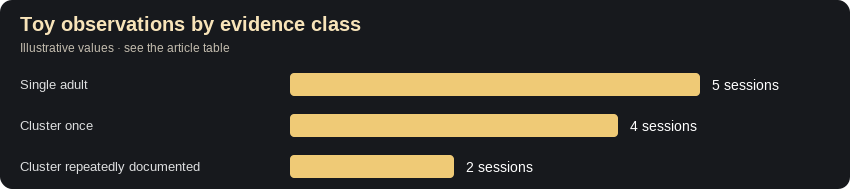
| Category | Value (sessions) |
|---|---|
| Single adult | 5 |
| Cluster once | 4 |
| Cluster repeatedly documented | 2 |
Illustrative values, not sourced observations. Counts are observation sessions, not butterflies.
An orange butterfly crosses an open space at the edge of a grove. A few minutes later a different observer looks through a gap in the foliage and sees what appears to be a group of monarchs hanging together. Both observations matter. They do not describe the same event. The first is a sighting of one adult within view. The second contains evidence of aggregation, provided the insects and the relationship among them can be identified. Neither alone establishes that butterflies occupied the grove throughout the winter.
A photograph can preserve a remarkable moment without proving how long it lasted. A repeat visit can add evidence that the place was used again, without proving the same animals stayed there in the interval. Formal monitoring can provide a more comparable series of observations, depending on the scope and rules of the program. Each step supports a different statement. Writing those statements at the right scale is the point of a good field record, not an obstacle to telling a compelling story.
This article uses a fictional eleven-session ledger to separate a single adult sighting, single-session cluster evidence, and evidence of clusters documented on more than one occasion. It also explains why preserving enough context for a reviewer does not require publishing the exact position of a sensitive aggregation. The quietest useful observation can be made from an authorized, existing viewpoint without drawing attention to a branch or changing anything about the site.
Put the seasonal setting in the background, not into every claim
The U.S. Fish and Wildlife Service overview of monarchs in California describes seasonal movement and the role of overwintering habitat for western monarchs. The Service's December 2024 Monarch Butterfly Species Status Assessment gives more extensive context about the life cycle, populations and seasonal habitats. These are sources for the general ecology, not proof that a particular local group was present for a particular length of time. A site description should not borrow an entire regional life history and attach it to one image.
There are several relevant time scales. A butterfly seen this morning was visible during one brief window. A group documented on different dates can demonstrate repeated use at a defined place. A public report on a particular monitoring period depends on the visits, effort and protocols actually carried out. The relevant questions can coexist: what did a visitor see, did similar activity occur on another documented occasion, and what does a formal monitoring series indicate? There is no need to compress them into a rule that a photograph taken in a certain month automatically establishes occupancy for a season.
Terms such as cluster, aggregation, roost and overwintering site should be used thoughtfully. A cluster can be a description of insects seen in close physical association at an observation time. A roost claim may imply something about what the insects were doing, and an overwintering-site claim implies a stronger temporal or program context than a one-off image. Defined terms can vary with the organization or study. This article uses cluster as an observational description unless otherwise qualified. Use the formal definitions and criteria of a program when intentionally participating in it.
Also distinguish what the observer searched for from what happened to be noticeable. Someone looking for a striking cluster may ignore scattered individuals or record only the largest group. Another person walking the same permitted path may see flying butterflies without seeing insects in the canopy. Both observations can remain meaningful if presented honestly. They should not be combined into a complete accounting of site use simply because they come from one broad area. Show the observation method alongside the seasonal context.
A single adult is already a valid record
A single adult sighting can document presence at a time and place if the identification and location are sufficiently supported. A forest-edge photograph might capture one well-resolved insect, an indistinct orange shape, or a flying animal that never settled. These are not equivalent in identification certainty. Record what features could be seen and which parts remain unclear. A label such as probable monarch can preserve a useful lead, while a confident species determination should rest on the evidence available or on appropriate review. Uniform confidence labels do not make distant observations more reliable.
Some adults will be seen only briefly. Record the actual scene before interpreting it: flight through the visible area, perching on a branch, or an animal pictured after it entered the frame at an unknown time. A sighting that involves one adult does not establish that only one was present nearby. The observer's view may have included only a small sector. Do not infer absence of clusters from a snapshot chosen for one visible adult unless a suitable search for clusters also occurred and is described. Individual presence and cluster absence are different claims with different effort requirements.
Likewise, a moving adult need not be assigned a route. A butterfly flying west across one clearing provides an observed flight direction across that clearing, not its previous origin or destination. An aggregated seasonal movement pattern cannot repair the missing individual evidence. If the public purpose is to explain why particular seasonal habitat is important, cite appropriate background separately. The adult sighting can be an entry point into the topic without being treated as firsthand proof of the entire phenomenon.
Keep incidental sightings distinct from survey sessions. A dated incidental photograph can have considerable value, especially when recognizable details can be reviewed. It does not need to acquire an invented duration or a simulated route around the site before it counts as useful. A formal visit sheet might include timing and scope fields; leave those blank with a documented not-applicable status when they were not part of the sighting. Making a record legible is not the same as upgrading its design.
Describe a cluster without counting what the camera hides
A cluster record should describe the visible grouping, its context and the evidence supporting the identification. If several recognizable monarchs are resting closely together on a visible branch section, say that. If the scene contains a dense-looking form with only a few diagnostic wing areas visible, describe the uncertainty rather than assigning every part of the shape. Leaves, overlapping insects and light can all make the boundary difficult to identify. A camera can preserve genuine evidence and still leave much of the structure unassessed.
A useful context frame can show how the cluster relates to its surroundings without needing to reveal a public location. Pair it with a tighter frame if necessary for identification or for assessing part of the grouping. Make sure both photos depict the same encounter before relating a tight crop to the wider view. An image selected for the strongest focus may include only the most visible edge. It is not a complete cluster count unless the procedure actually supports that interpretation. Store the sequence and make the limitations readable, even if the eventual article uses only one attractive still.
The number of clusters and the number of individuals are also distinct quantities. An observer might recognize one continuous-looking aggregation or two separate groups with space between them. That does not give the number of individual butterflies. Individuals can overlap, and a view can cut off part of the group. A program may use an estimation method under specified conditions, and a casual photograph may support only a minimum visible count or no defensible numerical count at all. Do not make those outcomes look equivalent in the same table. A clear lower bound is often more valuable than a precise-looking guess.
Remember that frame edges are chosen by a camera or observer, not by the butterflies. One cropped image may make two parts of a larger scene look like independent records. Another may include several adjacent branches without showing whether the groups overlap when viewed from a different angle. Describe the visible region before comparing or combining images. If repeated photographs from substantially the same view do not reveal new individuals or portions, they strengthen documentation of the encounter rather than creating several clusters or several visits where only one occurred.
What a repeat visit can confirm
Suppose a cluster was documented on a permitted visit, and a later authorized visit again records a cluster in the same coded observation area. This establishes repeated observation of grouping at that scale, assuming the documentation is sufficiently clear. It does not establish that the same butterfly individuals were present. It does not show whether a cluster was there every day or whether the group moved in and out of view. The saying “they were there again” needs a clear meaning: grouping was seen again, not necessarily that the original membership remained unchanged.
Record the space being compared. The same grove, same tree and same branch sector are different spatial claims. If the precise location may not be shared publicly, retain a suitable internal site or sector key when authorized, and make the public report's level of aggregation explicit. A claim that an exact branch was reused requires consistent matching at branch scale. A claim that aggregation was documented during two visits to the same broad site may need only a stable site identifier. Do not present confidence in a broader match as certainty about a smaller one.
Time is just as important. Two distinct views during one short visit are not two independent revisit occasions. A note saying yesterday and today can support separate times of observation if timestamps and source context match. It cannot fill the night or any other gap. Photograph sharing can create duplicates when different people repost the same file or when the photo appears in several albums with different dates. Check provenance before converting copies into new records. A comparison that requires an actual second visit should be linked to evidence that such a visit occurred.
A repeat visit can also produce a narrower or opposite result. It may find no visible aggregation from an otherwise suitable view, or the observer may not be able to use the usual viewpoint. Both are useful if the status is clear. The first is an observation under the described conditions; the second signals a loss of observation opportunity. Neither establishes that butterflies abandoned the site. If the project tracks evidence through a season, retain both cases rather than filling an interrupted sequence with zeros to make a smoother graph.
Read the illustrated session chart carefully
The figure “Toy observations by evidence class” uses eleven fictitious observation sessions. Five are classified Single adult, four Cluster once, and two Cluster repeatedly documented. The count unit is session, not butterfly, cluster or site. The chart has no observations from USFWS, from the Xerces Society, or from any real location. Its bins illustrate how descriptions of what happened can have different evidentiary scope. It should not be used as a classification guide for a formal monitoring program.
| Illustrative evidence class | Observation sessions |
|---|---|
| Single adult | 5 |
| Cluster once | 4 |
| Cluster repeatedly documented | 2 |
| Total | 11 |
Under this toy display rule, Single adult means that the session's supported visible record was an individual adult without a documented cluster in the session account. It does not mean that the entire grove was searched to rule out aggregation. Cluster once means the session documents aggregation but no other comparable occasion is linked under the display's rule. It does not say that the group never appeared again. Cluster repeatedly documented means the session includes its own supported cluster observation and is linked to separately supported cluster evidence from at least one other qualifying session. The latter two categories concern the documentation relationship, not the number of individuals present.
The two sessions in the last category could be two visits to one site satisfying the rule, not two sites or two independent cases of long-term occupancy. If the question were how many sites had repeated documentation, redesign the display around site as the unit and preserve each contributing session separately. If a new visit changes an earlier record's category under a retrospective rule, date the version of the figure and note what additional evidence was linked. Changing an evidence category after a later visit does not change what happened in the earlier field session. It changes how much related evidence the record can cite.
Five plus four plus two gives eleven, and six of the model's sessions have some supported cluster evidence under the toy scheme. That arithmetic describes the example, not the likelihood of seeing a cluster on a random visit. It cannot support a population proportion, an average group size, or equal survey effort among categories. The example also excludes sessions with no reported sighting and sessions with inadequate evidence. A real comprehensive visit ledger would need those case types or a clear exclusion policy. Its chart should report how the categories were selected instead of implying this illustration already covers every possibility.
Keep a basic field record that survives review
A useful note gives a visit identifier, date, time or interval, permitted viewpoint, basic visibility, and the observed event. Record whether the scope was an ordinary trail view, a planned observation of one named sector or a systematic check under a program. The status of a result should not be assumed from the type of file. A photo can document a single adult from an incidental visit; a worksheet can be a partial account from a planned survey. Match the evidence type to the claim using the actual work description. A form can be short without being ambiguous.
A field sketch or descriptive sector code can help distinguish which part of a tree was viewable. This need not be a public map, and it need not be elaborate. The phrase “north side of the approved viewing area, only the lower edge of the outer crown visible” can tell an authorized reviewer much more than a precise-looking point marking the observer but not the target. If the site rules discourage recording or sharing certain identifying details, follow them and document the permitted scope. Finer positional detail is not always necessary for the intended report.
Preserve the original observation separately from later interpretations. The first note could be “loose grouping of orange insects, identification uncertain.” An expert later might confirm monarchs in the image or note that only part of the group could be identified. Append that provenance rather than rewriting the author's field note as if they had verified it on the day. Reviews that affect a published summary should have a dated trace. This gives the field team credit for collecting evidence without making their original wording carry claims that were resolved only later.
When several people observe the same grouping at the same time, decide how their notes relate. Multiple observers can support the interpretation or give complementary views. They are not automatically multiple independent sessions for a public chart. If people were assigned to separate sectors, the record should say which sectors they covered and how overlap was addressed. A duplicate check is especially helpful when volunteer groups gather photographs in shared albums. It preserves authentic confirmation while preventing the same encounter from inflating the tally.
Formal overwinter monitoring is a separate commitment
The Western Monarch Count program's protocol and datasheet collection and its published survey instructions outline a specific monitoring effort with training and records appropriate to the program. Use that program's current instructions if taking part, including requirements concerning access, scheduling, documentation and authorized reporting. A casual route or photo folder should not borrow the program's name to make its account sound more standardized. The methodological distinction is part of what makes formal programs valuable.
A structured survey can separate scouting from scheduled monitoring, account for different visibility conditions and record results under consistent definitions. That work is not just a larger number of enthusiastic sightings. It involves deciding what site and period each record represents, applying a method across appropriate visits, and reporting limitations that a casual viewer might not notice. Follow program guidance for counts and any estimation rather than creating a method by copying the shape of someone else's published graph. An account of the main program's approach can be educational without instructing an untrained visitor to improvise near a sensitive aggregation.
A formal series can still have uncertainty. A count might be an estimate under a documented method rather than an exact enumeration of every butterfly present. Not all sectors can necessarily be viewed at every time. Inference from reports across a region should respect which sites and periods were surveyed. If a community group relies on an official release, cite and describe the actual scope of that release instead of presenting it as a universal total. Quality documentation should survive the transition from a technical report to a short newsletter caption.
This distinction also gives occasional observers a role. An opportunistic sighting can be offered to an appropriate authorized channel with the date, evidence and limits clearly stated. It need not be vouched as a formal count. Programs may have specific options for reports outside a scheduled visit; take their guidance rather than giving public directions to a sensitive scene. Support for monitoring can include helping readers understand what different observations mean, even when they are not able or authorized to carry out an official survey.
Gaps, quick changes and timing are part of the story
At one visit a cluster might be visible from a path, while at another the view could be obscured by a change in light or vegetation. Butterflies can be difficult to distinguish when they are distant, overlapping or backlit. These factors could coincide with genuine changes in behavior, which makes a comparison more demanding. Keep the observation window and viewability with the result. If a project cannot distinguish a scene's changes from changes in its view, label that limitation rather than assigning the difference to a cause.
One holiday photograph and one image early in a later month do not establish uninterrupted use between them. They can support repeat documentation with dates. A series of observations close together may support a stronger description of patterns during observed periods, but there are still gaps and limited coverage. Recognize this distinction in the verbs. “Documented on both visits” is not “remained throughout the interval.” A more cautious phrase may be shorter and more useful than a confident story based on unsampled days.
A planned visit that did not happen is not a negative biological outcome. A completed watch with no cluster visible is a different status and may matter to a comparison if the view was adequate under the intended procedure. An inadequate view can be saved as a third outcome. Preserve actual arrival, departure and observation time when available. An empty field in the data file should not lead to a graph that implicitly treats an unvisited day as empty habitat. The difference can change how a series appears and which claims it supports.
Compare windows before aggregating them. Suppose one group tends to observe at one time of day, while another has access only in a different period. A discrepancy could reflect how groups use the site, changes in conditions or how readily the observer could see them. A formal design may control several of these factors. A local notebook can instead acknowledge the mismatch and restrict any conclusion to what was actually observed. Sharing a place label is not enough to make two occasions directly comparable.
Protect an observation without turning it into a location announcement
Start from the access and stewardship rules of the actual site. Observe only from permitted places and do not move branches, reach for clusters, or enter restricted habitat for a better photograph. Stop if a viewing spot is unsafe or unsuitable for people or wildlife. More detail is not useful if obtaining it changes the scene or encourages further disturbance. The most defensible report may simply say that a grouping was visible from an authorized position and that part of the view could not be assessed.
A public account need not include exact coordinates, a traceable file tag, or a sequence of photographs that effectively gives directions to a branch. Consider whether identifiable landmarks are needed for the point being made. Public education can often use a broadly described grove and generated or otherwise appropriately approved illustrations. Keep location details for authorized monitoring or stewardship where appropriate, and follow program procedures for routing them. Different audiences need different parts of the evidence. Careful publication choices protect both the local habitat and the utility of a confidential record.
Avoid treating secrecy and accuracy as opposites. A public chart can indicate the area scale, observation method and time window without revealing an exact position. A designated reviewer can see more detailed records if needed under the relevant access rules. State whether labels were generalized in the public edition, especially if the graphics look like individual points. A schematic in an article should not be presented as a map on which precise navigation is possible. A reader can still understand the scope of an observation if the report identifies the kinds of location detail withheld.
An image itself can carry hidden clues. When preparing a public copy, check metadata, file names, backgrounds and accompanying captions before sharing. Keep the original in the authorized record if policy permits, and document any changes made to the public version. A cropped photograph may be suitable for education but no longer show the whole extent of the group or landscape. That is acceptable if the caption describes its purpose. Do not use redaction to quietly imply the crop was a complete field view. Privacy and truthful scope can be managed together.
Work three plausible examples into a repeatable decision rule
Consider a volunteer who has one photograph of an identifiable monarch perched in the lower foliage. The wider scene is entirely excluded, and the volunteer did not carry out a survey. Under a public label this can be a single-adult observation with an incidental effort status. Its one visible subject is not proof that there were no more adults among the branches. It supports the place and time described at the approved reporting scale. If the file does not have a reliable date, the status may need to be narrower still. Strong subject identification cannot replace lost timing any more than a precise timestamp can make an unresolved insect identifiable.
Now suppose another observer has a clearly documented photograph of multiple monarchs hanging close together. The photographer is authorized to submit the site context but has only been there once. The field record can support cluster evidence once. It might allow a reviewer to recognize a group, perhaps describe a visible portion, and mark that there was no estimate of the total. Nothing about its attractiveness or apparently large size improves its temporal support. That class describes a real useful relationship among simultaneously seen animals, not a full interpretation of what the habitat supplied throughout the season.
Finally imagine an authorized repeated observation in which two separately dated records document a grouping at the same broad site. The team can match the site under a consistent code but cannot confidently identify the exact branch in both images. The grounded claim is repeat use at the site scale. The unsupported claims include reuse of one named branch, identical membership, and uninterrupted presence in between. If the category needs the same tree rather than the same site, those two records would not be eligible under that tighter rule. The accepted scale should come from the study question, not from a late desire to promote every good observation into the higher tier.
An editorial check can lay the three cases side by side and ask what new evidence changes each description. A second distinct date changes the repeat evidence only if the association with the study area is established. More precise species evidence can improve identification without revealing a route. A better photograph can strengthen cluster recognition while leaving date or link questions unresolved. Separate these axes on the form. Otherwise a single overall confidence score can mask exactly where a promising report remains weak. Keep the short public description grounded in the strongest supported combination.
Distinguish a photograph, a scientific estimate and a later interpretation
For a workshop, imagine a cropped field image where three wing profiles are plainly resolved. The group can say the visible portion shows at least three identifiable individuals if the profiles truly represent distinct insects. It cannot extrapolate the rest of the tree by assuming that all unseen sectors have the same density. If the study aims to estimate group size from views, the sampling area and overlap need their own procedures. Follow the authorized monitoring program rather than inviting viewers to invent an extrapolation from a representative-looking patch. A literal minimum, a point estimate and a statement that size cannot be assessed are three different outcomes.
Suppose an observer's original account describes two groups and a later review suggests those images partly overlap. Avoid changing the case to one or two without documenting which portions were thought shared. A defensible correction can say that group count was unresolved while preserving supported aggregation. In a display counting sessions with any cluster evidence, that correction may not change the bar. In a chart of clusters per visit it could matter a great deal. This is a useful way to test which parts of a conclusion depend on a disputed detail. It can prevent a small correction from being framed as rejection of every observation a volunteer brought back.
Another distinction concerns what a future researcher can infer from the conditions. Suppose a group was documented at two dates under different weather and was not seen on a third otherwise comparable planned visit. The sequence gives evidence about what was seen and what was not seen under the recorded method. It does not demonstrate where the group went or which conditions caused the difference. Include the negative and describe whether the view was adequate; don't drop it as an inconvenient complication. A series of observations becomes useful for testing ecological questions partly because it retains ordinary dates alongside striking ones.
A short article can state the association in simple but testable language. “An aggregation was visible in two authorized watches at the same study site” is stronger than “someone posted two butterfly photos” and narrower than “an entire overwintering colony inhabited this tree.” The words identify the thing seen, its temporal replication and the spatial level. They don't require public directions. Switch to more specific wording only where the documentation can actually be checked. A technically correct but vague caption can still mislead if readers naturally fill in a more impressive event.
Compare seasons only using commensurate summaries
An organization may have a casual photo archive stretching back several years and later adopt a formal monitoring routine. The more recent season might have many more reports simply because it is better organized. First decide whether any measure in the two archives is comparable. A photo of a group from the earlier year can establish a documented event within its limitations. It does not necessarily supply a per-visit or per-season measure comparable to a structured survey. Instead of forcing the two sources into the same line plot, use separate panels or explicitly identify the change of method and sampling effort.
Even formal seasons can differ in coverage. If some authorized viewing areas could not be assessed in one period, comparisons based on aggregate counts may reflect different search universes. The proper conclusion depends on the program's protocols and on what releases actually report. A cautious article identifies the period and scope rather than interpreting a larger reported value as proof that every location had more butterflies. Avoid turning a one-year observation into a claim about the direction of a regional trend. A larger trend needs a suitable series and an analysis that recognizes important changes in who, when and where was observed.
Public education can still say what the archive teaches without making such claims. A museum exhibit might show a single-adult photo next to a group image to illustrate that aggregation is a different phenomenon. Alongside these it can show a fictional session chart explaining how observations can be classified. The museum should label the two photographs as documentation where appropriate and the numbers as illustrative, and clarify whether the images are from the same place or time. This honest separation can give visitors a sharper understanding of field evidence than a dramatic graphic implying a precise comparison that the archive does not support.
Data preservation helps when scope changes. Store the original records, the observation and release definitions, and the rule used to combine supports across dates. A new standard can lead to a new chart without erasing the earlier one. If an older record is missing crucial details, a team can continue to treat it as an incidental sighting while using more structured observations for the current science. That is not a failure to value volunteer work. It is a way of giving each contribution a role its evidence can bear.
Give an editor a usable final handoff
Before a figure goes to readers, check that it can be reconstructed from the documented sessions and that no photo repost was counted as a revisit. Verify that every session in the repeated class has its own clear cluster evidence and an approved link at the stated scale. Check how a session with no sighting would be handled even if the fabricated example does not include one. A reader should not have to infer whether the eleven bars represent a chosen record set or all attempted monitoring. Give them the unit, the demonstration status and the scope in ordinary words.
Then review everything that might disclose a sensitive location. A seemingly harmless crop with a distinctive background can supply directions when paired with other posts. An authorized data submission and a public story serve different purposes. Keep the data relationship intact for stewardship while omitting unnecessary detail from the public edition. Where a public agency supplies an approved description or access information, prefer that over inventing local directions. If an editor cannot provide a useful location claim safely, describe the general habitat and let the evidence class do the work.
The final sentence can be both vivid and qualified. A lone butterfly said that one adult came into view. A well-supported image of several said that butterflies were grouped at that moment. Repeat documentation said that people observed grouping again, not that they watched its entire history. Formal monitoring adds a deliberate procedure in a defined period. Each is worth keeping in the proper place. The quiet discipline of a dated, limited account lets a striking moment contribute to conservation knowledge without asking the image to be a census, location guide or full winter narrative.
Check that the later record belongs to the earlier question
A final example brings the units together. Suppose an observer records a cluster in one sector during a morning visit, and a different observer records a lone adult in another sector that afternoon. These are two occasions. They do not meet the example's repeat cluster rule because the second occasion has a different observed event. The lone adult does not contradict the first report; it neither confirms nor rules out grouping in the first sector at the later time. A data team can retain both without assigning them to a common condition. A carefully designed linkage rule prevents an exact match on date from doing too much work.
Similarly, if a second cluster is documented in a new sector under an approved view, the broader site may meet a rule for repeated aggregation while the original sector does not. That difference is worth communicating because birds, insects, and observers do not all move at the scale of a display label. An editor can sum sessions across a grove as long as the resulting sentence identifies the grove and the qualifying visits. More specific records can be preserved under access controls without making them navigation advice. Choosing the scale before classifying the observations makes the chart both safer and easier to check.
Sources and illustration note
- U.S. Fish and Wildlife Service: Monarch butterflies in California.
- U.S. Fish and Wildlife Service: Monarch Butterfly Species Status Assessment, version 2.3.
- Western Monarch Count: Datasheets, Protocols, and Flyers and Monarch Count Survey Instructions.
- Chart and table values are fictional counts of sessions by recording class. The header is generated editorial artwork, not evidence or a depiction of an identified site.