| Category | Value (reports) |
|---|---|
| Migration | 18 |
| Breeding | 9 |
| Overwintering | 5 |
Illustrative values, not sourced observations. Made-up counts are not timing thresholds or real region totals.
One monarch calendar opens with a winter grove, where observers look for butterflies gathered in trees. Another starts months later with the first adult a volunteer sees in an inland garden. A third is organized around records of eggs or small caterpillars on milkweed. Put the three calendars side by side and the dates can look like a disagreement about when monarch season begins. Usually the better question is what kind of season each calendar describes. A butterfly arriving at a resting site, an adult appearing in a garden and an egg being found on a host plant mark different events.
Geography and evidence both matter. The habitat that supports a migrating adult passing through is not necessarily where it breeds or where others spend the winter. Records can also differ because of the date volunteers began looking, how often they could go out and how a program classified what they saw. An earliest report is a record of detection, not an instrument finding the instant the first butterfly entered a region. An area can be used in more than one way over a year. Distinguishing these possibilities makes it easier to read local advice without forcing a single schedule onto an entire continent.
This article compares kinds of calendars, not dates for a visit to a sensitive site. It does not give coordinates or a timetable for locating butterflies. The chart and all worked examples are fictional. For regional biology, the U.S. Fish and Wildlife Service's assessment and California account provide context. For observations, use the definitions of the project whose records you are reading. A good local calendar can be both straightforward and explicit about the limits of those records.
Start with the place, phase and record type
The Monarch Butterfly Species Status Assessment describes breeding, migration and overwintering as parts of the annual cycle, with geographically varied patterns. That is a reason to treat a broad map as context rather than a precise local date predictor. At one location the question may be when adults are first seen in spring. At another it may be how long immature stages are detected. At another the calendar highlights when a monitoring program surveys western overwintering habitat. These observations fit one species without having to share the same reference point.
Write a title in three parts: region, event and span. “First documented spring adult observations in an inland district over three years” is more interpretable than “monarch arrival.” “Evidence of immature stages in gardens checked during a summer series” is clearer than “breeding calendar.” “Winter monitoring windows at participating sites” describes a schedule rather than the time all butterflies arrived or departed. Put years in the title when comparing periods. A dated historical record may be reliable for its period and a poor fit to a different question about what is happening now.
Defining the region need not expose a site. A broad ecological area, county grouping or management region can be enough for a public explanation. Keep any finer details needed for approved monitoring within the appropriate program. Avoid generalizing from a single patch to the whole area named in a heading. A garden on one edge of a district can have a different combination of shelter, land use, plants and observation access from another nearby. The geographic scale is part of the result, not simply background for the illustration.
Also specify whether the calendar is a projection, a protocol or a summary of observations. A forecast suggests what may happen; a program schedule says when observers are asked to work; a biological summary records what was documented. These can overlap visually if each is drawn as a shaded strip across the year. Mark them differently. If the period shown is a scheduled survey, do not imply that no animals were present beforehand. If it is a summary of observed dates, do not turn its endpoints into exact recurring deadlines.
Treat first sighting as a defined detection
An adult seen in a garden might be the first noticed by that observer, the first report accepted by a particular project or the earliest known record in a chosen set after review. None of those automatically specifies the first individual to arrive. Nearby adults could have gone unnoticed, observers could start on different dates, and an individual adult's origin is usually not known from a casual sighting. A first-sighting calendar remains valuable when labeled according to its actual unit. It describes the encounter that was documented, not all undetected movement around it.
Imagine two fictional towns with equally early adult activity. One has ten regular volunteers watching accessible gardens, and the other has a single person visiting on a weekend. Earliest verified dates might be much different even if activity began on the same day. The reverse is also possible: two places might report on the same day because both started watching on the same holiday even though the butterflies had been present for different lengths of time. Looking at watch coverage does not resolve every difference, but it prevents a confident migration interpretation of every date gap.
Consult the program's current instructions for a first-adult category rather than assuming every public first date was collected the same way. Journey North's reporting materials illustrate distinct categories such as adult observations and immature-stage reports. Its archived materials describe historical guidance, not a promise that an upload menu is unchanged. If an observation program revises a category or how reports are accepted, note the change before combining records across years. A change in labels or effort can quietly move an apparent beginning without a change in when butterflies appeared.
Time and direction deserve their own notes. An adult seen flying east once does not establish a migration route or whether the animal was headed somewhere beyond the visible patch. A repeated local record can still be valuable as evidence of activity. If the calendar is specifically about migration rather than general adults, describe the basis for classifying reports as migration observations. A program may have a defined reporting category; an editorial summary might make a cautious regional inference from broader evidence. Do not silently promote every adult photographed in a month to proven evidence of a regional route.
Give breeding evidence more than one column
In a breeding-oriented calendar, eggs and caterpillars tell a different story from adults seen taking nectar. The assessment describes the central role of milkweed as a larval host in monarch life history. A milkweed sighting can document an available host-plant resource at some scale but does not document a breeding monarch on its own. An adult observed near a host plant is still an adult record unless the evidence supports a specific action. An immature-stage identification provides different information, and its reliability still depends on the evidence and the observation rule.
A sensible garden sheet can have separate columns for host-plant observation, adult contact, suspected egg-laying behavior, identified egg and identified caterpillar. Those do not need to be steps in a sequential reconstruction of one individual's life. The adult and immature records could be from different days or animals. If someone saw apparent egg-laying but did not inspect further, the behavior can be reported without declaring a verified egg. Do not touch or move immature stages merely to complete the sheet. Let limitations of visibility remain part of the observation.
An earliest egg record is not necessarily the first breeding event across a region. The plant may have been observed for the first time that week. Small stages can be difficult to detect, and a calendar built around records from volunteers may cover favorite gardens better than unvisited places. Say “first egg documented in this series” rather than “breeding began today.” An apparent gap between adult sightings and egg records can be a prompt to check whether host plants were looked at at all. It should not automatically be interpreted as a precise length of a biological delay.
Try a separate example. Two fictional gardens document adults in the same week. The first keeps good records of its host plants and later documents an immature stage. The second reports only adults seen from a path and never claims to check host plants. The first calendar can say something about breeding evidence; the second cannot equate its empty breeding column to no reproduction. On a shared display, use a distinct mark for “not checked” and “checked without a verified record.” The difference is essential for deciding which contrast is supported.
Understand what a winter calendar is counting
The U.S. Fish and Wildlife Service’s California monarch account describes the conservation importance of California habitat for western monarchs, including overwintering. A winter calendar may highlight survey periods at participating sites, dated observations of aggregations, estimated individual counts or a general stage of the annual cycle. Those statements are not synonymous. A program's scheduled period can make comparisons feasible among observations collected under a protocol. It does not establish a biological start and end date for every local site.
Western Monarch Count's protocol resources provide examples of the distinction between a monitored event and the observations or estimates made at it. Protocol dates, coverage and regional scope matter when interpreting a program summary. A visitor's single view from a public lookout is not interchangeable with a structured count. A tree canopy can conceal butterflies, and even a recorded aggregation does not disclose all other habitat use in the surrounding region. Use properly attributed program summaries for regional monitoring rather than treating a casual look as missing or confirming part of an official total.
The assessment describes western and eastern patterns and exceptions within the wider range. In broad terms, coastal California overwintering habitat is important for western monarchs, while central Mexico is central to much of eastern North America's migratory cycle. These are useful broad patterns, not impermeable borders or a description of every butterfly. Do not assume the same winter timeline or monitoring unit can be transferred from one region to another. Calendar dates can also be reported under different methods, and two winter series can be about different phases or kinds of observation even when their latitude or season sounds comparable.
Public use calls for restraint. Do not post exact roost locations, directions to particular trees or private access details as part of a calendar exercise. A regional description can teach the seasonal point without steering readers to secluded habitat. If observing from a designated public area, follow the site's directions and do not disturb a cluster for the sake of evidence. A closed route or obstructed view belongs in the observation record, not in a list of reasons to get closer. A missing sighting is preferable to interfering with shelter.
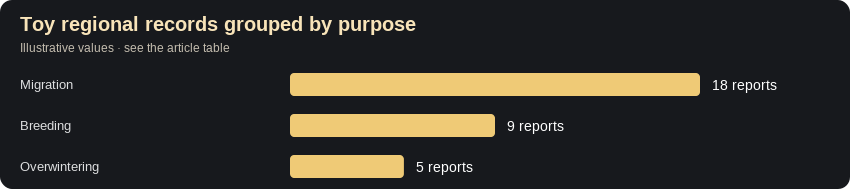
Toy regional records grouped by purpose
The following chart and table contain invented counts of reports in one hypothetical regional notebook. The reports are grouped by their primary purpose. They are not a count of individual monarchs, actual region totals or dates marking biological thresholds. These categories partition the toy notebook for the exercise; they do not assert that the natural phases never overlap.
| Primary reporting purpose | Reports |
|---|---|
| Migration | 18 |
| Breeding | 9 |
| Overwintering | 5 |
The numbers sum to thirty-two reports. Migration has twice as many report rows as breeding in this construction. That tells you how the fictional material was grouped, not that migration lasted twice as long or that twice as many monarchs moved as bred. A single report could describe one adult or repeated observations under another unit. Regional projects can also submit several records for one watch or combine many observations into a single account. The chart counts reports as explicitly labeled, so do not compare its bars as though they shared a known detection rate or biological denominator.
In an actual mixed notebook, one watch might include evidence relevant to more than one question. You could assign one primary purpose under a specified rule and keep secondary tags, or allow multiple tags and disclose that category totals do not sum to the number of unique reports. Choose the method according to what you need to count. If all evidence for one locally important stage is stored as secondary notes, the primary chart may hide it. This is a reason to retain the original record and not use report-category counts as a substitute for examining actual evidence.
Read two apparently conflicting headlines as record descriptions
Imagine a coastal bulletin says that “the season opened with first monitored aggregations in autumn,” while a garden bulletin for an inland district says “the season opens with the first adult records in spring.” Read the nouns before the verbs. The first is about observed aggregations and the second about adults recorded by garden watchers. Their calendars might be describing successive kinds of activity, unrelated subsets of the range or different groups of individuals. The words alone do not establish a direct connection between any named observations. No contradiction follows from the dates being months apart.
Then ask which calendar is meant to guide action. Someone designing a citizen-science chart needs a record type and denominator. A caretaker needs to know when particular maintenance could overlap with documented seasonal use and whom to consult for current site guidance. A teacher may simply wish to show that southward movement, winter residence and later reproductive evidence are phases of a broad cycle rather than a local checklist. For each audience the same source can support useful claims, but it may not support the same practical detail. If you cannot substantiate a precise timing rule from regional material, do not present one.
A more difficult case arises when both bulletins say “first adult,” yet they still disagree about the first date in the same broad area. Check how borders were drawn and how dates were recorded. One bulletin might count a report from a municipality included in the other region only administratively, not ecologically. One could use the date of observation, and the other the date on which it appeared in the feed. One might require reviewed photographic evidence and another accept credible unaided observations. Resolve those definitions before deciding whether a different biological interpretation is needed.
You may also find a genuinely unresolved disagreement. Two records can differ about what was observed within apparently comparable boundaries and times. Do not average their dates to make a reassuring compromise. Preserve both records, describe the evidence and ask which claim each can support. A verified record can coexist with an uncertain earlier candidate. A plausible unverified candidate is not the same as a confirmed early date, but it may suggest where to strengthen observations in the next season. Leave the discrepancy visible until review can actually settle it.
Avoid using the reporting calendar as the life cycle
The date when someone uploaded a photo can differ substantially from the date the photo was taken. A verified spring observation appearing in a summer batch is evidence about spring, provided its observation date is trustworthy. If a project announces results weeks after a monitoring window ended, its announcement date is a publication milestone. It should not be plotted as biological activity on the day the release came out. Keep the date of observation, the span of effort and the date of review separate. An editor can then use the right timestamp even when the latest update contains records from several periods.
Some dates mark what was observable rather than a biological change. A volunteer who begins watching on the first of a month is not collecting evidence for days before it. An event documented on the first day of effort may have occurred earlier than the calendar shows. On the other hand, a series of usable watches with no confirmed sightings supplies more information than no effort at all, though it still does not prove absence. If publishing “earliest observed” and “latest observed” dates, disclose the beginning and end of meaningful coverage next to them.
Ask whether a month with no reports has an explicit status. Did observers undertake suitable watches without seeing an adult, were host plants checked but not found, was public access restricted, or was no one reporting that phase? The word none on a chart cannot do all those jobs. Leave some cells marked not observed and others not in scope. A forecast might have a distinct marker for an expected window without current data. Separating these categories makes clear that a region can have no records on a topic a program was never designed to collect.
The reporting mechanism can change over time. A new phone form may make adult uploads easier, a validation policy may change when records appear on a map, or organized school watches may add effort in a formerly sparse season. Bigger upload counts can come from any of those circumstances. Likewise, a category retired from a program does not imply its corresponding biological stage vanished. When comparing years, note where the protocol or reporting interface changed and make conclusions on appropriately comparable records. No calendar legend should present a blank historical span as definitive when the submission procedure itself accounts for it.
Build a regional summary that retains exceptions
Continental patterns are useful for an introduction because they can explain why coastal and inland calendars emphasize different phases. But a border drawn between two named regions is not a barrier to every butterfly. A source may describe typical movements, localized departures from those movements or distinct forms of seasonal residence. Use qualifiers that match the source's geographic scope. Do not convert “many” into “all” because it makes the drawing easier to label. A small note about variation within a region is better than either an oversimplified rule or a claim that broad patterns have no value.
Seasonal activity in one area can also shift from year to year. Distinguish a typical window inferred from comparable historical records from an observed range for a particular season. A very early or very late record may be accurate, unverified or drawn from a period with unusually high effort. Show where it came from and which event it represents. You can include exceptions without treating each as a new default. If a window is simply a recommendation for keeping a lookout rather than a statistical range, say so and avoid attaching a probability to it without evidence.
If you want to summarize variation in reported dates, start with a table by year and event type. Use the earliest documented observation for each relevant region and year only if the method supports that extraction. Do not mix a typical date calculated across individual submissions with a typical date across first observations by year. They weight the underlying evidence differently. A region with many submitted adult observations can dominate a pooled average, while each year contributes only one value to an annual first-date summary. Define which quantity the calendar needs before aggregating.
Use independent official program totals when the question calls for broad monitoring rather than local storytelling. A short series of garden visits may illustrate how adult activity and immature evidence appear in different windows. It cannot be scaled up to a regional estimate solely by multiplying by the number of similar gardens. The sites were not necessarily sampled with known coverage, and the records may have different detectability or aggregation rules. A layered calendar can contain both an illustrative local story and a properly attributed official regional summary without treating them as equivalent.
Keep habitat descriptions tied to the stage they support
Imagine a public note says “plant for monarch season,” followed only by a list of months drawn from adult observations. Readers might assume those months define every local ecological need. For an educational calendar, separate adult resources, larval host-plant evidence and shelter context. The assessment connects different needs to different stages. Adult activity can draw attention to flowering resources without establishing where eggs occurred. A breeding record can draw attention to host plants without telling you the location of winter habitat. A winter record indicates another aspect of the annual cycle and should not dictate how you interpret every inland garden.
An editor can handle this with one line beneath each calendar layer. Say what is measured, what is inferred and what should not be concluded. For example, a layer may represent the dates when a set of observers documented adults; it can suggest when that observation was feasible under their effort, but it does not prove the species was absent at other times. A separate layer can show when host-plant observations were made, not when every host plant emerged. A third can name a scheduled overwintering monitoring period without implying that observers bracketed the first and last arrivals at every site.
The categories of work follow from the context, not from one fixed calendar date. If managing a site with sensitive habitat, seek regionally appropriate guidance and follow the operator's restrictions rather than applying a timetable borrowed from another region. A date range in an overview is not clearance to disturb a possible refuge outside it. Similarly, a wet or hot year can make an old editorial window less useful for a new watch. Use local observations and current authorized guidance for field decisions and keep the broad article in its explanatory role.
For a simple public activity, ask volunteers to make passive notes from appropriate areas on what they can observe without interference. Separate confirmed adult records and host plant observations. Do not require confirmation of a named phase in order to record a useful watch; no record of immature stages can be an accurate outcome if those stages were not visible or not in scope. The program's stated protocol determines where such records belong. If a record is not useful to an official dataset, it can still teach the observer about the limits of their search and how to describe evidence.
Compare compatible calendars instead of forcing a shared date
For two sources, prepare a small crosswalk with region, year, phase, observation unit, collection window, effort and verification method. Include whether the published date is a field date, an earliest record, a date range or the start of a planned series. Review one example from each source through that crosswalk. If they are different types, report them in adjoining panels instead of calculating the difference between their starts. When the goal is to understand life stages, juxtaposition can be helpful even when a numerical gap is not interpretable.
If the entries really do describe the same measure, check comparability before drawing a trend. One series might include opportunistic first sightings while another only includes visits scheduled at comparable intervals. Adding an opportunistic early record is valuable as occurrence evidence, but treating it as though it came from the protocol series can change the inferred beginning. A record can appear in an overall earliest-known table while being excluded from a specific standardized comparison. Explain the distinction rather than quietly dropping data readers may find elsewhere.
For a comparison of seasonal windows, use resolution the data support. If dates are known only to week, do not attach a specific day at the front of the week and then calculate a day-level gap. A weekly or monthly strip may be sufficient for a regional education piece. Label whether periods overlap because phases coexist in a region or because sources apply different reporting categories. At a boundary between months, avoid implying that the life cycle reset with the page. Calendars are human devices for organizing observations, not clocks insects are required to follow.
Account for the difference between duration and coverage. If monitoring ran from early to late season on a subset of scheduled days, the outer span describes the frame of observation. It does not mean participants performed a continuous scan. A first and last record within the span can bracket activity as detected by the project, but periods between could have varied and the ends may not represent arrival and departure. Use language such as “records occurred from the first listed week through the last listed week” only when it accurately describes the data, and identify missing windows separately.
Try a crosswalk on one imaginary pair of calendars
To see the crosswalk work, take a fictional western winter summary and a fictional inland adult series. The winter summary records the week three monitored locations were surveyed, with an adopted program method and aggregate records. The inland series lists the date the first adult was observed by volunteers in several school gardens, without attempting to describe individual movement. First extract the calendar dates without assigning them a common purpose. Then put the actual observation unit in the same line as each date. One date starts a scheduled survey window; the other marks a confirmed adult sighting under different observer effort. Subtracting one from the other would give elapsed time between two entries but not the travel time of a monarch or the time between biological phases.
Now add a small breeding check in one of the school gardens. Volunteers see an adult early in the season, skip a week and later record a caterpillar on a host plant. Their garden entry can specify two different signs of seasonal use. It cannot supply a precise breeding start date, because the missed window and detection limitations make that inference impossible. Nor does it identify the earlier adult as the individual associated with the later immature observation. A carefully marked pause in the line tells the reader more than connecting the dots with a smooth curve. The missing week is a gap in effort, not a blank in the animal's life.
For comparison across years, imagine the school calendar later begins two weeks earlier. Suppose its new earliest adult sighting is earlier as well. It might be evidence of earlier activity; it might reveal activity that the old calendar was not equipped to detect. Keep the extended series as evidence that an adult was observed, then compare the common period if you want to discuss similarly covered dates. Even a common date range cannot align all other differences, such as the number of observers and their presence in the gardens. It makes one specific limitation explicit instead of allowing a single headline to imply too much.
Finally add a report from outside the declared area. It might be interesting and correct, but ask whether it belongs inside the region or in a linked supplemental note. Do not shift a boundary to include an unusually early confirmed record without marking that change. If two calendars use adjacent regions, the same observation could appear in both published reports, depending on their selection rules. Counting source rows would double that case if you intended unique observations. A calendar can instead show two views linked to one report, or keep separate counts that are expressly not additive. This is another reason the toy bars describe primary reporting categories rather than inferred numbers of butterflies.
Make a useful map without drawing a path between dots
A regional graphic might use wide, non-sensitive areas and distinct markings for life stages. Resist connecting two observation points merely because they fall in chronological order. The fact that one observer documented an adult in one area and a different observer documented another adult later elsewhere does not show the same butterfly traveled between them. Nor does one breeding record prove a direct connection to a particular overwintering location. A map of occurrences and a movement study require different kinds of evidence. Label any arrows in an educational overview as broad schematic patterns, if they are adequately supported, and not tracks inferred from individual diary entries.
Likewise avoid using the popularity of an observation region as if it were a direct measure of habitat importance. Many reports can result from accessible private gardens, an active school network or a public seasonal event. A relatively isolated place can have fewer submissions for reasons unrelated to habitat function. If illustrating effort, use a separate panel or clear markers for where it was documented at the regional scale. Keep sensitive locations out of the public copy. A sparse display need not promise there was little activity; it can say that fewer reports meet the stated description.
For a calendar being updated each season, include a simple revision label beside the evidence legend. Late accepted reports may change earliest documented dates after the first edition appears. Preserve what changed and why instead of rewriting the old calendar without explanation. A dated record added later can improve understanding without moving the biological observation to the date of publication. Readers can then compare versions of a calendar without treating version changes as additional ecological events.
Make a calendar that survives a handoff
A private data form can include region code, protocol, event type, actual observation date, observable effort, evidence quality and any limits on sharing. A public display can retain broad region and definition while withholding protected details. Link each caption to the source's role. The federal assessment gives biology and geography; a program describes how it obtained its records; a local note supplies the conditions actually observed. Do not cite the first as if it furnished every calendar date or the last as if it established a continent-wide pattern. Readers are entitled to know which kind of source supports each claim.
Before sharing a chart, ask someone to explain its widest shaded band in their own words. If they call it a period when all monarchs are migrating, check whether the band actually describes the span of submitted reports, a suggested watch window or dates of a predictable regional phase at a broad level. If they assume toy counts were real, put the word fictional in the caption rather than a small footnote. If they cannot distinguish possible breeding habitat from verified immature observations, reorganize the labels. Clear captions do more than smooth the prose: they preserve the limits of the evidence when context disappears.
Save the version and the date you reviewed each source. A study's report may remain stable while a program FAQ or schedule can change. Keep archived instructions clearly marked, and don't present a link to old field guidance as proof it is still how volunteers should submit new records. If you revise a calendar because new sources clarify the categories, say whether the observation dates changed or only their interpretation changed. That makes the calendar valuable to the next person rather than a seemingly fixed image that hides the decisions behind it.
At the end of the exercise you may have an adult window, a set of immature records and a winter monitoring layer whose bright areas barely touch. That can be the right answer. The task was never to make the colors line up. It was to describe what was seen, where and under which definition, and to leave unobserved time unclaimed. Two calendars can be accurate for their purpose even when their first entries fall in different seasons. That difference is a useful feature of the evidence, not a discrepancy a designer has to erase.
A useful final caption might read: “Examples compare western winter monitoring, first documented adults at inland gardens and immature records. Dates in each strip refer to the event described in its label.” That small wording choice keeps a local detection, a planned effort window and a life-stage observation from becoming one invented arrival date. It gives a reader permission to understand the calendars together without expecting the evidence to match in form.
Sources and illustration note
- U.S. Fish and Wildlife Service: Monarch Butterfly Species Status Assessment, version 2.3, December 2024 agency assessment of the monarch and its annual cycle.
- U.S. Fish and Wildlife Service: Monarch Butterflies in California, agency account of western monarch conservation and seasonal habitat.
- Journey North: Monarch Butterflies, archived primary program material illustrating kinds of reports.
- Western Monarch Count: Datasheets, Protocols, & Flyers, primary resources for structured western overwintering monitoring.
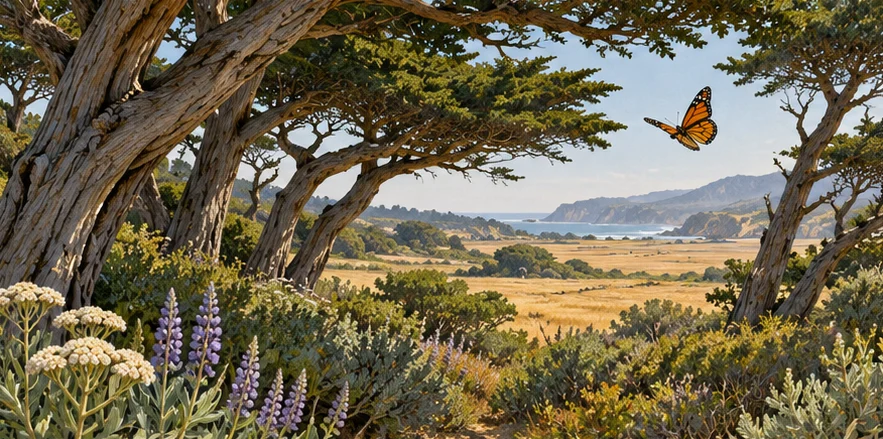
All report numbers and practice scenarios are invented. If generated, the coastal grove and meadow image is editorial illustration, not a documented roost, watch or route.