| Category | Value (leaves) |
|---|---|
| Both surfaces | 13 |
| Upper only | 7 |
| Not visible | 4 |
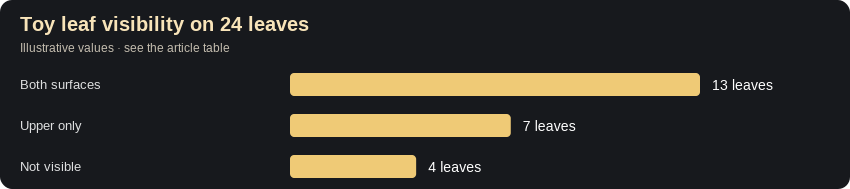
Illustrative values, not sourced observations. Visibility classes partition 24 leaves; not monarch detection probabilities.
From the garden path, a milkweed plant seems to have nothing on it. There are leaves, a few buds, and the shadow of a branch. No one sees an egg or caterpillar. In a notebook this becomes “empty.” Later, a volunteer looks from the other side, where the underside of one leaf is naturally visible, and notices a tiny object that deserves a closer look. The original note did not have to be wrong about what was visible. It was wrong about what its observer could conclude. The plant had not been fully inspected, and the record made that limited view sound complete.
This is a common surveying problem even when the organisms are familiar. A chart showing how many plants had monarch eggs is one kind of result. A record of how many leaves, surfaces and parts of the plant were visible is another. Each is useful, but they cannot stand in for each other. A plant can have visible host tissue without showing any qualifying immature monarch. One leaf can show both surfaces while its neighbor is entirely blocked by foliage. And a site can acquire a good photograph of a single confirmed egg without having run a standardized search at all.
A practical garden watch should leave the plants and their occupants undisturbed. It should also let a later reader tell the difference between a known positive observation, a completed search with no detection, and a part of the plant that was never in view. The following design is for a local, noninvasive educational record. It is not a replacement for the exact procedures of an established survey program. It offers a particular value: even when no monarch sign is seen, the team can say what it actually looked at.
Start with the biology, but do not let it answer the observation
The U.S. Fish and Wildlife Service monarch species account distinguishes adult use of nectar from the dependence of monarch caterpillars on milkweed. The Service's monarch butterfly field guide gives additional context on host plants and the kinds of field evidence relevant to the monarch's life cycle. This biology explains why looking at milkweed can be productive for a project about eggs or larvae. It does not make every visible object on a milkweed leaf a monarch, or every milkweed stem occupied.
A host plant is a necessary kind of resource, not a count of its users. Many plants in an occupied habitat can be unoccupied at an observation time. Some leaves can be difficult to inspect. Some photographed objects may be unresolved because they are too far away, partly concealed or not shown from an informative angle. Even a confirmed adult nearby does not establish immature stages on the particular plant. If a butterfly feeds at milkweed flowers, for example, that observation records an adult action, not a hidden egg on the leaf below. Keep adult sightings, plant records and immature-stage observations in distinct fields.
An underside is especially worth attention because eggs or larvae can occur where an overhead view misses them. It is not the only part that matters. The Monarch Larva Monitoring Project's preparation guidance directs attention to plants as a whole, including stems and reproductive structures where present, rather than relying on a glance at exposed leaf tops. Where your local educational watch is more limited, say so. “Both surfaces of selected leaves” is an observation coverage statement. It is not interchangeable with a complete whole-plant search under a formal program.
The same distinction matters when exactly where an object was seen gives useful context. “On undersurface of leaf” cannot be inferred from a photo that shows the insect but crops away the leaf edge or orientation. Keep the placement as unknown if the image cannot resolve it. A wide photograph can provide context for a still showing a small candidate more clearly, provided the two files are linked to the same observation. If the precise position matters for a comparison, the observer's brief note at the time can be more helpful than a retrospective guess from an excellent but tightly framed picture.
Set the target before walking the path
Begin by writing a narrow question. A class might want to know how many selected leaves are visible enough to inspect from its accessible path. A community garden might want to document independently supported eggs or larvae on plants it can revisit. A conservation monitoring group might need a formal measure of eggs or larvae per host plant under its standard protocol. These three aims are related, but have different boundaries and burdens of evidence. Pick the one the people, time and available view can support. A mistaken claim about plant absence is less likely when the project does not promise a more complete survey than it can carry out.
Name the unit being observed. A person can count an individual leaf, a stem, a mapped plant, or a patch. Milkweeds may have different growth forms, and an apparent cluster of stems may not correspond neatly to an individual plant that can be recognized from above. The Integrated Monarch Monitoring Program FAQs illustrate why explicit plant-versus-stem conventions matter in a field protocol. A local project can use mapped stem units when it is unable to resolve a whole plant, so long as it does not later label those counts whole plants. A leaf census tied to stems needs a different layout than a plot summary that lists plants only.
Agree on what membership in a leaf sample means. Suppose one garden group uses a named lower, middle and upper set of positions on each accessible stem. Another begins with every leaf visible from the route. The second method may be practical, but it makes the group unable to count not-visible leaves as a true category unless the candidate set was known separately. To classify a specific leaf “not visible,” you need a frame that lets you establish that the leaf belongs to the sample even when neither surface can be assessed. If foliage is completely hidden and no reliable frame exists, record unassessed portions instead of inventing the hidden number.
A sensible sampling plan can be very modest. Map several stems at named points where the participants may safely stand. Use diagram labels or descriptive positions rather than tying material around leaves. Identify whether the plan selects stems before looking for an egg, and whether the leaf units can be relocated or are selected anew under a stated rule. Keep the date and version of the plan. When people later find excellent evidence on an unsampled leaf, add it as an incidental record in a distinct column rather than expanding the original denominator after seeing the result.
Use an observation protocol that keeps living things in place
The direction “look under” is a reminder to use an available line of sight, not an instruction to turn over every leaf. Some undersides can be seen from a slightly lower or side vantage along permitted access. Pause to let moving foliage reveal a naturally visible location. If reaching a better view would require stepping into a planting, leaning across unstable ground, breaking a branch, unfolding a leaf, or handling an insect, mark the limitation and stop the attempt. A well-documented partial view is more responsible than an intrusive effort to eliminate all blanks.
Keep equipment unobtrusive. A wider camera angle can show the location of the leaf, and zoom may help if a tiny candidate is visible at a suitable distance. Neither makes an obscured surface visible by itself. Do not position accessories where they contact the plant or interrupt somebody else's access. If repeated visits are part of the design, use a viewing routine that volunteers can repeat without progressively trampling a path or crowding stems. An observation point documented in words is often enough, and not every usable record needs a photograph.
Separate evidence collection from evidence improvement. It may be useful to revisit an obscured plant when a different viewpoint is safely available, but avoid repeated approaches to the same spot just because the score is incomplete. A dataset that records successive independent field visits is not the same as a series of repeated attempts to coax an ideal image from one object. If a new view arises opportunistically during a normal revisit, retain both records and note what became visible. Do not retroactively describe the older view as more complete than it was.
Some monitoring programs have methods, eligibility criteria, and permission guidance specific to their work. The Integrated Monarch Monitoring Program protocol collection separates surveys of plants and blooms from its egg and larva activity. It also provides dedicated field materials and training context. A local teaching log should not be presented as compliant with any program unless it actually follows the relevant directions. If there is uncertainty about participating at a site, ask the responsible land steward or program before approaching the planting. For this article, the intended protocol ends with watching and recording.
Record what was visible before recording the biological result
A sample sheet can have two sections. The first describes visibility and effort: date, route and viewpoint, plant or stem code, leaf code, parts seen, and anything that prevented a planned view. The second describes the evidence: no qualifying item detected in the assessed view, possible egg, confirmed egg under an appropriate review standard, possible larva, confirmed larva, or unresolved object. This separation allows a row to report excellent leaf coverage and no sign, limited coverage and a definite find, or limited coverage and an unresolved candidate. Complete visibility and a positive observation are not prerequisites for each other.
For the toy exercise, use the three visibility categories defined in the chart. Both surfaces means the upper and lower surfaces of that particular candidate leaf were sufficiently visible for the stated check. Upper only means the upper surface met the requirement and the underside did not. Not visible means neither surface met the requirement. A real project may need additional categories, including underside only and partial surface visible. If such cases are possible, add them before doing the survey and document the classification rule. The toy set only demonstrates three mutually exclusive cases; it does not define every real condition.
Visibility is not a guarantee of recognizing the target. A distant observer may know the underside was in view but miss a tiny object against the veins. If the method defines visibility at a minimum useful level, use terms those observers can apply consistently. For example, “clear enough to inspect approximately the full exposed surface using the project's intended visual criteria” is a claim about an observation, not about an instrument detecting every egg. If the leaves are intermittently obscured by motion or light, note whether enough of the target became visible within the planned time window. A moment of clearance does not prove the whole surface was examined.
A clean record can say “leaf present, upper surface assessed, underside not assessable, no object detected on assessed area.” The sentence is longer than “empty,” but each part solves a practical problem. The presence field tells the reader that the leaf existed in the frame. The coverage field names what was seen. The outcome field names what was recorded without expanding surface-level results to the entire leaf. It is also possible to say “an egg was confirmed on the exposed upper surface, other surfaces not assessed.” Good notes do not require either positivity or negativity to win a competition with unknown coverage.
Read the illustrative visibility chart and table
The chart “Toy leaf visibility on 24 leaves” portrays twenty-four invented candidate leaves. Thirteen have both surfaces visible, seven have upper surfaces only, and four are not visible enough to classify either surface as assessed. The three classes form a partition of this hypothetical target set. Add thirteen, seven and four and you get twenty-four. The counts do not refer to plants, butterflies, or eggs. They were not reported by the Fish and Wildlife Service or the Monarch Joint Venture. This is an invented record to show the difference between access to a target and a conclusion about a biological state.
| Illustrative visibility class | Number of candidate leaves |
|---|---|
| Both surfaces | 13 |
| Upper only | 7 |
| Not visible | 4 |
| Total | 24 |
Under this toy definition, the number of leaves with at least one assessable face is twenty, because the upper-only and both-surface categories are the ones with access. The number with an observed underside is thirteen. As shares of all twenty-four, those counts are approximately 83.3 percent and 54.2 percent, respectively. The gap illustrates how a project can look extensively at plants while still missing a substantial fraction of one kind of surface. It does not give an estimate of egg detection. Eggs are not assumed to be spread equally over leaves or surfaces, and the figure contains no evidence about how reliably observers could recognize them.
Another calculation is possible if the project wants to teach a surface count. There are forty-eight possible leaf faces in the twenty-four candidate leaves. Under the simple example, thirteen leaves contribute two visible faces each and seven contribute one each, for thirty-three visible faces. That yields 68.75 percent of the candidate faces, not 68.75 percent of plant habitat area. Large and small faces receive the same count; partly visible faces would need a rule different from this simple binary example. This separate calculation preserves the difference between leaf-level coverage and face coverage rather than blending useful quantities under one percentage.
Avoid rebuilding the figure as a chart of missing monarchs. A tall “both surfaces” bar says something about the observing positions in this imagined exercise. It does not mean those leaves were more likely occupied, or that the observer found fewer monarchs in the unavailable group. The visibility classes can support a comparison of fieldwork logistics when definitions are the same. They cannot reveal the organism's state on a leaf that nobody saw. A good caption explains the unit and keeps the illustrative note close enough to the values to head off these readings.
A confirmed positive and a searched zero are not symmetrical
Imagine a known milkweed stem with ten leaves. A volunteer can check both faces of six leaves and sees a confirmed egg on one of those six. That evidence supports a positive for the stem at the time of the observation, given the identification and the link to the host. The four unknown leaves do not undermine the confirmed presence. They do prevent the observer from drawing a confident conclusion about the total egg count on the stem. “At least one confirmed egg” gives a meaningful result while the rest of the plant remains unassessed.
Now imagine the same six leaves yielded no positive evidence. The remaining four are still unknown. The result is no qualifying detection on the assessed portion, not a confirmed absence on the whole stem. A mark saying “no sign” should therefore be accompanied by its scope. If a formal protocol treats a completed well-defined search as a zero, retain that valid zero. Do not delete zeros merely because they are less exciting than a find. The problem is presenting incompletely observed or unvisited stems as if they supplied the same zero.
A patch-level result depends on how stems were chosen. If the volunteer visited only the easiest plant to view or chose a plant because an adult had just approached it, that record can prove a real positive on that target, if confirmed. It cannot be used unaided to estimate occupancy across unselected plants. A defensible design separates targeted records, standardized selected plants and complete formal surveys when they occur. That prevents the dataset from treating a concentrated search in a likely spot as comparable with a random or full-coverage plant survey elsewhere.
Don't use an uncertainty label to reject useful discoveries. A confirmed find on an incompletely inspected plant still matters. It is worth keeping its supporting evidence whether or not it belongs to a particular quantitative analysis. On the other hand, a bare note “something white” should not become a confirmed monarch egg just because a site is known to support monarchs. The two errors go in different directions: one discards meaningful positive evidence, and the other promotes insufficient evidence. Clear fields allow a reasonable interpretation without forcing each unexpected item into a single tidy outcome column.
Separate plant identification from immature-stage evidence
A plausible host plant is not necessarily a confidently identified host. If the plant can only be identified provisionally, say what features support the description and what evidence is missing. A wide shot of foliage and available plant structures can be reviewed separately from a tight view of an egg-like object. Improvement in plant identification does not automatically identify the object, and a recognizable larva does not repair missing evidence about exactly where it was seen. Maintain links among files so that a second reviewer can judge both parts of the claim without guessing that adjacent photographs come from the same plant.
Likewise, don't assume that a light-colored object with a regular outline is an egg of a particular insect. Surface features or a stronger unobstructed view may help an informed reviewer. The Service's field guide provides context that supports review, but an individual photograph may not have the information needed to apply it. The best record sometimes remains a possible egg on a presumed host. Use that record to document the lesson about visibility or guide a later visit, not as a disguised confirmed record. This matters whether the dataset is published as a formal report or used only as a guide for neighbors.
Record larval features to the level actually seen. Obvious color bands in a good view can provide more context than an out-of-focus suggestion of length. More-specific age or instar assignments need evidence suited to that task. If a garden project has not defined how it distinguishes larval stages, a broad confirmed larva category may be more defensible than fabricated precision. A survey contributing to a formal program should follow that program's criteria, record uncertainties where the protocol permits, and avoid reclassifying unresolved notes simply to fill all expected columns.
Signs on the leaves can help guide attention while staying in a separate category. Leaf damage or a trace of material underneath an apparent feeding area might indicate activity worth looking at more carefully, but neither confirms the identity of what used the plant. A photo caption can acknowledge a clue without treating it as an animal sighting. Keep feeding marks, adult behavior and immature-stage records auditable by their own supporting material. Observations then remain reusable if a later reviewer decides a mark or a species label was mistaken.
Repeat observations without inventing a survival record
Suppose a possible egg is visible at one visit and not visible a week later. The site could still contain it in the same area, it could have changed or disappeared, or the leaf itself could be gone. Visibility can also change independently of all those outcomes. Before interpreting disappearance, verify that the same leaf was relocated and that the relevant area was actually seen. A clean and well-lit picture of a neighboring leaf does not demonstrate that the original object was no longer present. Write which evidence links or fails to link the visits.
Even if the exact leaf is visible and the object is gone, the record does not reveal the reason by itself. Hatching, damage, displacement or an earlier misidentification are not interchangeable explanations, and the end state cannot be assigned just because a caterpillar was later seen somewhere else in the garden. A visitor can enthusiastically describe both records while acknowledging the unknown sequence. If the project needs to assess survival or development, it requires an appropriate design and stronger continuity of evidence. Repeated glimpses of a patch make interesting histories, not automatic life tables.
A visit log should retain changes in route and condition. A previously visible group of leaves may be shaded or blocked after growth. A site may also temporarily close, the path may be wet, or observer responsibilities may change. Keep these limitations as separate notes, not zeros. Otherwise a graph of counts by week might look like a biological decline when the final visits had progressively less viewable habitat. A seasonal display can put coverage beside detections without claiming transmission between them. The goal is to give readers a way to see whether the available observations support the conclusion.
The Monarch Larva Monitoring Project's activity and datasheet collection shows the range of information that established volunteer monitoring can maintain. This article does not propose transporting or rearing any organisms to resolve uncertain records. For a casual project the better next step can be logging another ordinary, authorized watch under similar conditions. If the site is not suitable, stop. Useful fieldwork means advancing the observation within acceptable limits, not making the log complete at any cost.
Compare views and surfaces instead of counting only photographs
In a group exercise, one volunteer may take many photos of a plant with an obvious candidate while others record a small number of images from harder-to-see locations. Counting every file as an independent leaf observation makes the evidence-rich plant appear to have been sampled more widely than it was. Assign identifiers to leaves or view targets and use photographs as supporting material. A series of frames can support one record. If a broad photo shows multiple qualifying leaves, use the stated rule to link it rather than treating the entire image as one leaf or summing the same faces from overlapping views.
Another common mistake is to compare image quality across sites as if it were biological occupancy. A sunny demonstration garden may produce crisp views of many undersides, while a shaded-edge garden yields only fuzzy views of upper leaf surfaces. A larger number of confirmed finds at the first site could reflect access, identification conditions, true occupancy, or several of these together. Show the number of eligible observations and the coverage distribution before discussing plant-level detection patterns. The group can also restrict a comparison to matched recorded conditions when it makes sense, while explaining what records that decision excludes.
The observer's training can affect which tiny objects become documented. Two people can both see a leaf clearly and interpret its features differently. Practice reviewing a few images using the project's categories and compare which records differ in visibility, taxonomic certainty or unit. Hiding earlier interpretations from the second reader when practical can help assess agreement in a pilot. Do not infer a full field detection probability from a classroom review of a small selected image set. That exercise is about improving a workflow, not validating all possible inferences from it.
It is worth checking whether negatives are represented at all in the gallery. Sleek project pages often show only confirmed positives or striking images. A dataset based entirely on those pictures may omit standardized searched zeros, partial inspections and candidate leaves that did not produce any images. The site itself can still make a valuable educational display, but the analysis should not present the gallery as a complete observational record. A small table giving planned and assessed units can provide a more faithful description than an impressive collection of images.
Apply the distinction to a school garden walk
A class plans to inspect four named stems from a single permitted path. Each group gets a worksheet with leaf codes from a prior map that was checked with clear views, and each records whether the target face was visible under today's conditions. On a particular morning, one stem sits partly behind a support stake and another extends over the path at a convenient angle. Students may record unequal surface coverage even though they allocate the same number of minutes to each stem. Equal time is a feature of the design; it does not mean every plant supplied an equal opportunity to record signs.
One pair reports a confirmed candidate after review of a context photo and a detail shot. Another pair reports no sign on the exposed part of a different plant. A third pair writes that the target was blocked and leaves the outcome unknown. The report can include all three without making them equivalent. It might state that one confirmed positive was documented and that the group does not have comparable whole-plant coverage across all stems. If the plant map changed after a branch fell, record that fact before comparing the morning's totals with the previous week's tally.
A future lesson might switch from checking leaves to checking several observed plant structures under an established protocol. That is a defensible change in question, not a simple upgrade in the same outcome. Mark when it happened and use the correct unit beside every figure. The prior visibility chart still supports discussion about obstructions. It should not become a base rate for a complete structured search. Good educational records distinguish the history of how the group learned to look from the ecological history it intended to study.
Parents or volunteers may ask how to increase the number of confirmed detections. The first response should consider whether the goal is observation practice, habitat management, or rigorous monitoring. Improving certainty might mean refining definitions and making a better context photograph from the same route. It need not mean examining more and more of an individual plant, much less disturbing it. If a view is unsafe, skip it and select an appropriate design for another day. If the work is to protect habitat rather than score more records, a cautious description of what is already known may be the most useful result.
Write results without claiming the unseen part
An editor can test the summary by asking what “empty” means at each scale. Does it mean no evidence on visible leaf tops, no cases under a completed whole-plant procedure, or simply a plant not visited? A reader who cannot tell from the caption is likely to infer more certainty than the chart has. Replace the ambiguous term with what was actually assessed and what was not detected. Use a separate phrase for confirmed cases and say how they were reviewed. The most illuminating result might be that underside visibility, not lack of host plants, limited the first survey.
The title's instruction does not require that a person get a perfect view. It means that the lower face is a different part of the evidence from the visible upper face, and a clean view of one cannot always answer questions about the other. In some gardens a position that exposes both sides is ordinary and safe. In others it is not. Make the difference part of the record and stop when the view ends. A documented limitation is a better foundation for later work than a confident statement nobody could verify.
Keep a clear distinction between the survey frame and available views
A folder of photographs can be a useful way to test the distinction after a walk. Imagine that the facilitator receives twenty images of leaf tops, thirteen images that show useful undersides, and no images of four known leaves hidden behind the support. Even if each view belongs to a separate face and the maps are otherwise correct, it would be wrong to declare thirty-three independent candidate leaves. Some images support two views of the same leaf, and the hidden leaves are part of the original frame. A class can reconstruct the toy table only by matching images to candidates and mapping the known unavailable units. The image folder alone does not preserve that information.
A separate design problem arises when a known leaf goes missing between the initial map and the visit. A fallen leaf is different from an existing leaf that cannot be seen. If the target calculation is coverage among leaves known to exist during the watch, the disappeared leaf may be excluded under a stated membership rule. If the question is what happened to the originally marked cohort, keep it in that frame but give it a missing or no-longer-present status separate from visibility. This distinction prevents a new set of leaves from silently replacing an earlier sampling unit. It also makes the procedure readable when the plant's growth changes.
When assessing whole plants, make the denominator relevant to the output. Suppose the class looked at parts of twelve mapped stems, but only three were assessable under its intended whole-stem checklist. Reporting one observed positive per twelve partial and complete visits describes what the mixed visit set produced. Reporting one per three whole-stem inspections may describe a very different set of observations and could be wrong even as arithmetic if the positive belonged to a partial inspection. Before reporting a fraction, check that the positive belongs to the stated denominator. A trigger such as a field row labeled confirmed does not by itself determine which survey result it can enter.
Think about combining results across volunteers. If two people inspected different faces of one leaf during the same planned exercise and the leaflet identity is secure, the team might combine them into one both-surfaces record under a documented shared-view rule. If the two reports come from separate days, that combination cannot support a claim that the two faces were assessed during a single observation. State what time window is being combined and preserve timestamps. Merging partial information can be useful, but it can also create a completeness impression that no single visit had.
Audit the missing values before reusing a chart
Begin with one sample plant and follow the published label back to its notes. If it was recorded as searched, check which portions were assessed and what the label permitted. If no organism was recorded, find out whether the row carries a completed zero or simply lacks an outcome entry. If a positive was confirmed, verify the link among date, photo, observation and host. This is an audit of the evidence chain rather than a fresh biological survey. The reader should be able to do it without knowing which volunteer liked to use blank fields as shorthand.
Try recalculating the figure from a deliberately simplified sheet that contains only each leaf's identifier and visibility class. All twenty-four targets should appear once if the teaching data match the chart. If a subtotal gives more than twenty-four, check whether you counted upper and lower views as leaves. If the subtotal is smaller, check whether hidden leaf rows were dropped automatically before plotting. In any more detailed study, retain the extra fields in the master record so that an area measure, an effort measure and an organism count can be derived separately when the data justify them.
Finally, read the sentence that goes with the graph, not just the action description on the worksheet. A headline like “Almost half the leaves hid monarchs” is not supported by thirteen assessed undersides and eleven unassessed undersides. The unassessed portion is a lack of a qualifying view, not a place where hidden monarchs were established. It is fair to say that many undersides were outside the classroom watch and that this limits claims of absence. Such a result is useful because it points toward improving the scope and clarity of the next observation instead of putting imagined animals in the blanks.
End the field account with the most useful qualified statement you can make. Record what was safely visible, whether what was seen could be identified, and what the study did not assess. A confirmed egg under one naturally visible leaf is worth documenting. So is an honest partial survey that did not find any. Keeping those records in their proper categories is what makes the data a place to begin rather than a story that outruns the view.
Sources and illustration note
- U.S. Fish and Wildlife Service: Monarch Butterfly Field Guide.
- U.S. Fish and Wildlife Service: Monarch species account.
- Monarch Larva Monitoring Project: Know Before You Go and Activities and Datasheets.
- Monarch Joint Venture: Integrated Monarch Monitoring Program FAQs and Protocols and Datasheets.
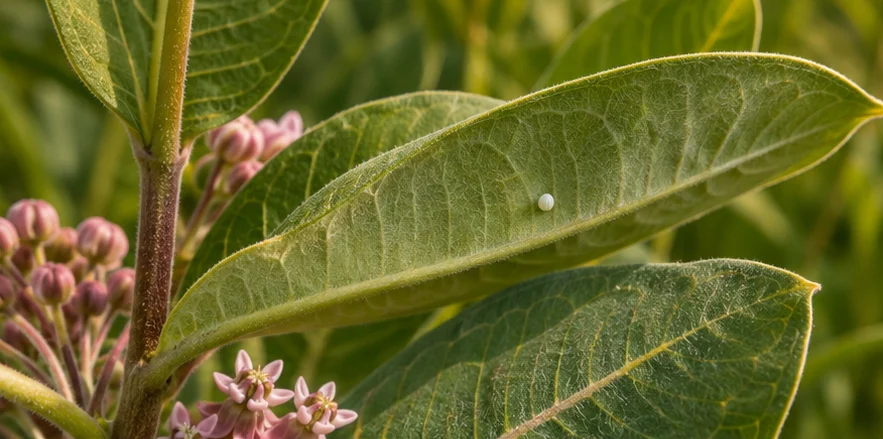
- Chart and table values are illustrative counts of visible leaf surfaces grouped by candidate leaves; they do not report monarch observations. The header is generated editorial artwork, not field evidence.