
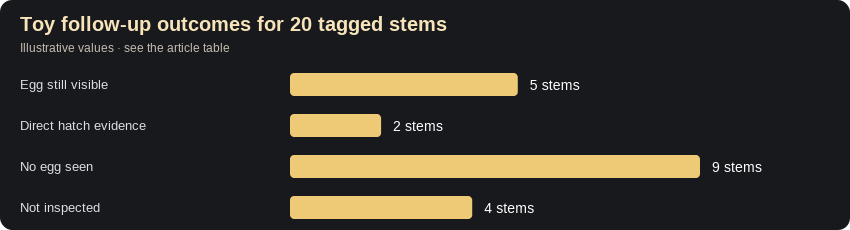
| Category | Value (stems) |
|---|---|
| Egg still visible | 5 |
| Direct hatch evidence | 2 |
| No egg seen | 9 |
| Not inspected | 4 |
Illustrative values, not sourced observations. Counts sum to 20; disappearance alone gives no life-stage transition.
On Monday an observer turns toward a milkweed stem and sees a pale egg under the edge of a leaf. The observer takes a photograph that shows its position beside a vein and makes a note of the stem. On Thursday, the same leaf appears empty. The egg may have hatched. It may also have been eaten, dislodged, or missed by the observer. The leaf itself might not be the one in the Monday photograph. A convincing story about what happened is not another observation. The defensible starting point is that an egg was seen at one time and was not seen on a later search whose scope and quality can be described.
This scene is illustrative, not a record of actual fieldwork. It captures a practical difficulty of checking individually marked plants: staying with the same stem is easier than staying with the same insect. The notebook can preserve the two facts the observer really has without making them stand in for a third. That is worth doing even in an informal garden project. One season of careful notes about what was and was not seen is more interpretable than one season of confident guesses about what happened between visits.
Establish what the first visit actually documented
The U.S. Fish and Wildlife Service monarch field guide describes milkweeds as larval hosts and distinguishes larval requirements from adult nectar use. The agency's December 2024 monarch species status assessment provides broader life-cycle and seasonal context. This makes milkweed a sensible place to look for monarch eggs and caterpillars where monarchs are breeding. It does not make every tiny object on a milkweed leaf a monarch egg. Field identification, location matching and evidence of a later transition are three different claims.
For a single-egg follow-up, begin with a stem that can be relocated without damaging it. Give the stem a durable identifier using an unobtrusive marker where permitted, and document a few landmarks visible without manipulating the leaf. A view of the whole stem or a short sketch can help distinguish it from another stem close by. A closer image can document where the egg appeared relative to the leaf margin, main vein, a bend in a side vein, or a pre-existing hole. The marker identifies a search unit, not the egg; the close view documents the egg location, not the identity of every later object.
Decide what counted as an initial positive before choosing the follow-up cohort. A tiny pale object seen briefly in bad light may be a candidate egg but not securely identified. Keep such a record if it is useful, but label it accordingly. Do not quietly promote it to a confirmed monarch egg after finding a monarch caterpillar nearby days later. That would combine two uncertain links into one apparently secure sequence. Where possible, retain identification confidence and evidence separately from the fate code. An object can be well documented and difficult to identify, or confidently identified but poorly localized. Either weakness affects a different part of the follow-up.
A bounded unit keeps the counts honest. If the unit is one tagged stem with one focal egg, label that choice on the sheet. If two apparent eggs are present on one stem, choose the focal egg by a rule fixed in advance, or give each egg an identifier and keep an egg-level record that links back to the stem. Do not count each egg separately in the numerator and count stems in the denominator unless the outcome has explicitly been defined at the stem level. A report about stems with at least one egg can be entirely useful, but it does not have the same meaning as a report about individual egg fates.
Retain the original time, not merely the day. A note saying Monday through Thursday can hide whether the interval was fewer than three days or nearly four. Time matters when discussing when something might have happened and when comparing irregular visits. It does not reveal the age of the egg on Monday unless laying was actually observed or independently constrained. Finding an egg for the first time is not the same event as its deposition. Record “first seen” and “laid” separately, and leave the latter blank or explicitly unknown if nobody observed laying.
Revisit the location in a known order
Start from the marker and check that the whole stem matches the earlier location record. Look first at the focal leaf under good natural light or other nonintrusive viewing conditions. Note whether the surface that held the egg is still present and viewable. A mild change in an observer's viewing angle can look like a change in the object: the underside of a folded leaf might remain out of view, or a curved edge might shade the exact spot. If inspection is partial, record which surfaces were visible. Do not pretend a quick view from the path was a full search because it yielded an empty tally.
After checking the focal point, look at the rest of the predetermined search unit if the project includes a larva search. The Monarch Larva Monitoring Project's tips for finding stages on a plant are a primary source for the challenge of field detection and describe ways larvae can respond to disturbance. Keep handling to a minimum and follow any local or project rules. A survey should not change the outcome it aims to observe, and a photograph is not worth twisting a leaf or dislodging a small caterpillar. Do not move a larva to the focal leaf to improve a photograph or to see whether it looks like what you expected.
On an unmarked plant, a new watcher might simply inspect what appears to be the right leaf. A marked stem still does not fix every problem. If a top section broke or mowing removed part of the plant, a different leaf may now have the same location in the surviving stem hierarchy. Use more than one landmark; “third leaf from the top” ceases to match if the top is missing. Record changes in the plant itself before entering an egg outcome. If the leaf could not be linked securely, a stem-level visit can be a useful observation even though the focal egg was not inspected.
Use categories that separate detection from a transition
“Egg still visible” should mean the observer could match the original object and location with enough confidence under the project's rules. It means that object was visible at that time. It does not prove that the embryo was alive, had developed at an expected rate, or would eventually emerge. If there is reason to suspect a fresh egg in the same area, record the uncertainty rather than assume the field label identifies the individual. An interval with an observed egg at both ends supports continued visibility of the matched object; persistence of what the observer saw and viability of what was inside it are distinct.
“Direct hatch evidence” should be a narrow category. For the example below it means the observer witnessed a larva emerging from the matched egg or had sufficiently clear documentation of that event with the egg location linked to the focal record. A visual sequence needs continuity: an image of an egg on Tuesday and an image of a small caterpillar near the same edge on Thursday support association but do not show emergence. A different larva could have reached the leaf, another egg could have been present, or the apparent match could be wrong. Keep plausible associations in a separate note. If a different project calls a particular strong indirect sign “probable hatch,” that is a defensible extra category only if its basis is explicit and it is not presented as a witnessed event.
“No egg seen” is a detection outcome after an eligible search, not a biological fate. The exact search might mean the known leaf surface was visible and checked within a stated observation period. It does not certify that the former object was absent everywhere. If no egg was found but the original surface was inaccessible, the record should be partially searched or not inspected under the chosen standard. Conversely, if a search meets that standard and finds nothing, log it as a real negative observation for egg seen, without replacing the fate status with a negative for hatched. Those two questions have different answers and different denominators.
“Not inspected” should be retained rather than silently dropped when a unit was scheduled. Some stems will not be revisited, and some revisited stems will not support an adequate look at the focal area. A label fell off, a dog blocked access, a leaf was gone, or the observer ran out of daylight. Keep reasons distinct under a common display category if the chart is short. It matters whether the observer never reached the stem or reached it and documented the loss of the entire focal leaf. The latter is evidence about the leaf and a possible interruption to egg tracking, but it does not provide the egg's final fate.
Also keep room for evidence that does not fit the four chart categories. A witnessed removal by another animal would be useful evidence of removal. The event is not automatically confirmed predation if the observer did not see consumption or other supporting evidence required by the protocol. A broken stem found on the ground with a visible egg might support persistence after plant damage, while a missing whole stem says something about search coverage but leaves the egg unaccounted for. The illustrative chart omits these edge cases for clarity; a real field form should not force unusual evidence into a familiar but inaccurate label.
Toy follow-up outcomes for 20 tagged stems
These fictional counts illustrate one follow-up for a cohort of 20 tagged stems, each initially documented with one focal egg. The table and the chart show the same categories and counts. The unit is stems. The values are illustrative, not sourced observations.
| Follow-up outcome | Stems |
|---|---|
| Egg still visible | 5 |
| Direct hatch evidence | 2 |
| No egg seen | 9 |
| Not inspected | 4 |
Sixteen stems had an eligible inspection under the toy protocol. Five still had visible focal eggs; two yielded direct evidence of hatch, and nine had no focal egg seen with no direct evidence of hatch. Four did not receive an eligible focal inspection. The two observed hatches are ten percent of the 20 tagged stems, or one eighth of the 16 inspected stems; either fraction can describe the frequency of directly documented cases under its stated denominator. Neither fraction is automatically the actual hatch rate. Some hatches could occur between visits and never be detected as events. Some eggs still visible at the revisit could hatch later, and unknown outcomes do not all end in the same way.
It is particularly misleading to calculate eleven presumed hatches by adding the nine “No egg seen” cases to the two direct cases. The reason that a previously recorded egg was not seen remains unresolved. Combining them would estimate nothing the chart was designed to measure except the number of inspected stems without a continuing visible egg under the stated classification rules. Likewise, subtracting the two direct hatches from twenty and calling the remaining eighteen failures would treat visible, uninspected and unresolved stems as known losses. A report can say how often the project documented different kinds of evidence even when it cannot partition the ultimate fates.
Nearby signs are not interchangeable with emergence
A small caterpillar on the same stem changes what the observer knows. Now there is evidence of a caterpillar on the stem at the second visit. The strength of a link to the previous egg depends on timing, position, stage identification and how much alternative movement or unrecorded laying the search design allows. An early larva near the focal leaf may warrant a stronger association note than an older larva several leaves away. Neither observation by itself reveals which exact egg produced it. An identifier written on the stem does not transfer to the body of the larva.
An eggshell-like remnant at the same location is another distinct observation. Preserve a photograph and describe what it shows: whether the object is attached where the egg was recorded, whether there is an opening, whether the shape changed, and whether condition or image quality makes interpretation uncertain. Do not call every fragment evidence of a hatch or every intact object viable. A remnant with an uncertain opening might be reassessed later by a reviewer, whereas a field sheet containing only “hatched” gives the reviewer no way to distinguish the actual sign. The project could keep a category for hatch-compatible traces without granting them the same status as emergence observed from the matched egg.
Chewed leaf tissue can be tempting evidence because it remains when the insect is gone. A hole, scraped patch or disturbed leaf should be described in its own right. Damage from more than one process can look broadly alike from a distance. Even if an observer has sound reason to identify feeding by a monarch larva, it does not establish that the focal egg yielded that larva or that the larva survived after feeding. Use an image that includes scale or surrounding leaf landmarks, if it can be taken without disturbance. Record the damage without changing the egg outcome unless the evidence addresses the outcome definition.
Likewise, a potential predator in the frame offers an opportunity to investigate, not permission to diagnose. An ant on a stem with a missing egg is evidence that an ant was seen there. Being near a former egg location does not establish removal or ingestion. Time-lapse footage may show an animal contacting the recorded egg and departing, then an empty site on the next frame. It still matters whether the egg was seen leaving with the animal or whether the relevant moment fell between exposures. Where the sequence is incomplete, describe the visible actions and leave the unresolved step open. Separate a plausible explanation worthy of follow-up from a cause counted in a table.
Changes in the plant can set firmer limits on some questions than on others. Suppose a leaf carrying an egg was stitched by a spider, chewed at its base, or knocked down by a storm. If the observer can document plant change, record it, even if no insect outcome is visible. An egg could have been removed before the leaf fell, or could remain with a detached leaf outside the search area. The structural event might explain why there was no eligible inspection. It need not identify whether the egg hatched, died, or was still attached. Knowing the reason for missing evidence is valuable even when it does not provide the evidence itself.
Time between visits tells you what you could have seen
Even visits close together leave gaps. If the first photograph shows an egg intact and a later view shows a larva actively emerging, the observed event anchors the hatch at that second moment. If the later view merely shows the site empty, the time interval bounds when visibility changed under assumptions about matching and detection. It does not provide a hatch time. A record should distinguish known event time, last time the egg was seen, first time the egg was not seen, and time of any later larva sighting. Those timestamps should not collapse into one estimated hatch date without an explicit model and supporting data.
Developmental expectations can help schedule observation but cannot supply a missing event. The species status assessment lays out the life stages and their environmental context; that context is a reminder that a date on the calendar is not a fate detector. The first time the observer notices an egg, its age may be unknown, local conditions may vary across a site, and the only visual record may be a handheld photograph. It is useful to plan follow-up with a reasonable chance of finding relevant stages. It is not useful to reclassify every final empty site as a hatch merely because sufficient time seems to have passed.
A short gap improves opportunity to find an intermediate sign, not certainty that one was available. If checking more often requires rubbing leaves, shadowing stems or blocking access, the gain in detection may come at the cost of altering conditions. Where longer unobtrusive observation is feasible and permitted, describe its coverage, blind spots and interruptions. A camera that stops recording or loses focus during rain cannot certify there was no event. Even continuous operation is not continuous visibility if wind repeatedly turns the leaf away. Log time that was effectively viewable rather than equating it with the entire time an instrument was switched on.
A weekly survey can still be valuable. The Monarch Larva Monitoring Project distinguishes monitoring activities, and its guidance on when to monitor a site recommends regular observation in its setting. Repeated counts can document presence of eggs and larvae at the sampled site and help describe seasonal activity. Weekly counts are not unbroken observations of the same egg. If contributing to an existing project, follow its actual reporting instructions; the local follow-up categories used here illustrate how to communicate evidence about focal records, not a replacement for such a protocol.
Separate an inspected stem from a missed visit
The missingness in the toy chart is not a rounding error. Four of twenty stems lack a qualifying observation. If access was lost at random with respect to the states of their eggs, the inspected group would still not automatically establish hatch because direct emergence may not have been visible. If access was lost differently across stems, there is an additional selection problem: perhaps taller stems with curled top leaves became disproportionately hard to check, or only the tagged stems in a trampled patch were lost. A frequency calculated on inspected stems need not describe the original cohort fairly. Report the reasons and the denominators without promising that they make bias disappear.
A report might present both scheduled stem counts and eligible inspections for every visit. If there were twenty scheduled on Friday, sixteen adequately checked and four not inspected, the reader can distinguish insufficient coverage from absence. Do not add the four to the nine unseen eggs and announce that thirteen disappeared. The nine contributed evidence of a defined negative search; the four did not. If you put all unresolved cases into a single summary bucket, retain a separate breakdown in the record. Collapsing distinctions for a headline is acceptable only when the headline states what that bucket means and what it does not.
Return visits can improve the account without requiring the earlier “No egg seen” record to be erased. Imagine a Wednesday search in windy conditions that passed its inspection standard but failed to find the focal egg. A Friday photograph appears to match it at the original position. The Wednesday observation remains a report of what was seen then; the later photograph makes it less plausible to treat the first nondetection as a biological disappearance. Check location and possible replacement, annotate the sequence, and keep both records. Changing the Wednesday entry to “egg visible” would falsely suggest the observer saw it. Changing it to “hatched” would be worse.
A later return to an uninspected stem is new evidence, not a way to fill the earlier date. Suppose a damaged path prevents a Tuesday visit and the focal egg is seen on Thursday. Thursday can re-establish that the object was visible then, if identity is secure. It does not let the observer claim a Tuesday inspection. If the project needs the status at a fixed interval, a late inspection belongs in a separately dated field. Use rules for permissible timing windows and departures established before comparing outcomes. Otherwise, keen observers may make extra visits where a hatch seems likely and create different evidence opportunities across stems.
A shared site count answers a different question
Suppose a school garden records twelve eggs and no small larvae one week, then four eggs and six small larvae the next week. That is informative as a pair of surveys. It does not show that six of the earlier twelve eggs hatched, or that two disappeared without a known cause. Eggs could be laid after the first visit; some could hatch before the second and their larvae could be visible, hidden, gone or elsewhere. The units might also differ between surveys if a stem was mowed or new shoots emerged. Tracking abundance or observed occupancy at the site requires comparable effort, but it does not require the claim that every first-week individual appears in exactly one second-week category.
When a project wants both datasets, keep them in parallel. The broad survey records which stems or search areas were sampled, what was visible, and what stages were recorded overall. The focal follow-up tracks the specific egg locations established separately. An apparent increase in young larvae in the broad survey cannot resolve individual trajectories in the focal records. Conversely, a string of direct emergence observations from easily visible stems does not represent site-wide hatching if those stems were selected for inspectability. Design identifiers and sampling records to make it difficult to accidentally merge the two analyses.
Plants themselves can occur in groups, with many stems close enough to share weather, mowing, or other disturbances. Ten tagged stems in one corner are ten stem records, but they may not be ten independent opportunities to learn how all the milkweed in the wider region behaves. For a descriptive story about those ten, that is fine. Comparing conditions or extrapolating beyond the garden requires attention to how patches, sites, dates and stems were selected, and which of them share conditions. Closer recording within one patch can answer very local questions well without constituting a broad survey.
The same care applies when contrasting two gardens. If one team checks every morning and one visits only once a week, the first is more likely to witness an emergence even if hatch rates are identical. More direct evidence is real and worth reporting, but it reflects opportunities for observation as well as the underlying process. Record the time and effectiveness of inspection, use comparable schedules if making a comparison, and be explicit if the schedules do not match. Do not turn the better-documented site into the healthier site by definition.
Keep the chain of evidence intact
A small dataset can use a stem sheet and a visit sheet. The stem sheet establishes physical location, focal egg identifier, host identification, baseline evidence and eligibility. The visit sheet records the actual date and time, observer, whether the whole focal surface was inspected, environmental or access conditions, egg observation, larva observation, enclosure or removal if already known, and any media links. A separate evidence label can distinguish witnessed emergence from a compatible sign. This structure allows an egg observation to remain uncertain without weakening a firm observation about the plant, and allows a complete inspection to be recorded even when no insect is detected.
When two observers disagree, preserve the original notes until the discrepancy is understood. One might have seen a fold in the leaf that the other treated as an egg; another might be looking at a nearby leaf rather than the one in the photograph. Ask both to describe where they looked, not just what label they selected. An agreed revision should preserve what was revised and why. If an image cannot resolve the issue, “uncertain match” is a valid result. Reconciliation is intended to make the evidence clearer, not to maximize the number of resolved fates.
Use photographs for different jobs deliberately. A site image establishes the location and the viewing access. A stem image establishes which leaves and nodes were present. A close view can support identification. A motion sequence can show an event, provided the sequence has the right continuity and angle. A beautiful close photograph may be useless for relocating the leaf if its frame excludes every recognizable feature around it. Likewise a sequence that clearly shows leaves moving may not resolve an insect. Save the original evidence and label what role it can play instead of choosing just the frame that makes the strongest story.
A checkable illustration may help volunteers learn the difference. Present one hypothetical pair with the same leaf and no egg visible; call it a negative focal search if the view was complete. Present a second with a larva nearby and no image of emergence; record the larva and the uncertain link. Present a third with the focal egg and a clear view of the larva coming out; report direct hatch evidence. Add a fourth in which the tag is there but the focal leaf is gone; log why a focal inspection was unavailable. The purpose is not to teach people to ignore signs. It is to give signs labels proportionate to what those signs show.
Keep a method note if another person will extend the project. Decide whether a completed revisit must occur within a set time window, what amount of leaf visibility is required, and what handling is prohibited. Write down whether uncertain baseline eggs are part of the main cohort or a separate exploratory list. Define how cases with multiple eggs or newly seen larvae will be reported. If the method changes after a storm, retain a version field so that a later review can tell which rows were collected under which rules. A clean set of four summary bins is not a replacement for the richer decisions that put each case into one of them.
Say what happened only as far as the evidence goes
Survival is not the same as emergence. A larva observed leaving an egg was alive at emergence if the event was witnessed as defined. That does not establish that it lived to a later instar, produced a pupa, or emerged as an adult. Each transition requires its own evidence and an account of inspection coverage. If the monitoring question is survival over several stages, build a design for those stages rather than extend the original label indefinitely. In particular, a larva that was not seen at a later visit belongs in a similarly careful set of observation categories. The missing egg problem moves with the organism; it does not end as soon as a caterpillar is visible.
Even apparently good evidence of a lower limit needs a clear scope. In the toy example, two genuinely documented focal hatches establish at least two for the chosen cohort, by the point that documentation occurred. They do not imply that detection is complete. A branching tree of plausible additional cases is not a measured estimate without a design that supports it. If the comparison requires an estimate of the true rate rather than a minimum documented count, consider whether it is feasible to track qualifying cases with sufficiently complete observation and a transparent analysis of missed evidence. A brief volunteer exercise can legitimately choose not to attempt that estimate.
There is value in letting observations of different quality coexist without combining them. A scientific summary could note that two hatches were witnessed, nine focal eggs were not seen after eligible inspection, and four had no eligible inspection. A story for a garden sign can give the same information in fewer words. A follow-up note can record that a larva was later found nearby without calling it the same individual. A technically careful account can still be readable; the main change is to use active verbs naming what was observed rather than lifecycle labels that imply several steps were known.
Do not let rounding turn a small count into a forceful headline. Two documented events among twenty tagged stems is a simple, reproducible fraction. Presenting an impressive decimal does not create more occasions to see a hatch or more evidence about what happened to hidden eggs. If two observers interpret one documented case differently, that disagreement is large relative to the reported count. Describe the review and preserve the raw number. A short teaching project is especially strong at showing how direct events, signs, nondetection and missing coverage fit together. That is a meaningful result even without a rate estimate.
Habitat questions can benefit from this restraint as well. If one milkweed patch repeatedly loses leaves after maintenance, that pattern may be worth bringing to the site manager regardless of whether egg fates are resolved. Report how often the leaves were damaged and what evidence connects the damage to a recorded action. Do not portray the same record as proof that every associated egg died. If a patch has many eggs on a given day, that observation can guide the timing of a later survey without supporting a claim that it produces more adults than a neighboring patch. The next decision should fit the measured outcome.
One useful final audit is to ask someone who was not present to reconstruct the outcome from the recorded evidence alone. Give them the baseline and visit images, the search notes, and the definitions, without showing the preliminary verdict. If they can verify a matched egg but cannot find evidence of emergence, the record should not count as direct hatch on the strength of the original observer's confidence alone. If that observer really witnessed emergence, their contemporaneous description can itself be evidence; distinguish that from a later interpretation formed after inspecting two snapshots. Independent review is a check on the documentation, not a requirement that every observation be filmed.
Write the inference boundary alongside the table so it does not get lost when the chart is copied. A caption can identify the cohort and say explicitly that the categories represent follow-up outcomes, not a partition into final life stages. Make any labels for uncertain cases visible rather than putting them in a footnote accessible only from the original report. On a public-facing chart, protect site details where appropriate without stripping the internal audit of enough location information to relocate a stem. The exact map may belong with the project records; the sampling method belongs with the result. These choices let a compact display travel without carrying an exaggerated claim.
Check how the chart treats multiple observations from a single stem. If an observer saw a focal egg early in the visit and then documented its emergence, the visit contributes one stem to the direct category, not another stem to “still visible.” Keep both timestamps in the underlying record. If an unrelated egg remains visible after the focal hatch, it belongs to its own separate observation rather than changing the focal result. This priority rule is meaningful only because the chart summarizes one outcome per named focal record in a defined visit. A project summarizing all signs seen over a month might instead let categories overlap and explain why the bars do not add to the number of stems.
The notebook's strongest sentence is often also its simplest: the egg was visible at the first visit and was not seen at the second, after the recorded search. If there was clear emergence evidence, add it. If the site was impossible to inspect, say why. If there was a suggestive photograph or a nearby larva, describe it without erasing the gap between visits. An empty leaf can be a good observation. Keeping it from becoming a guessed hatch makes the whole record more valuable.