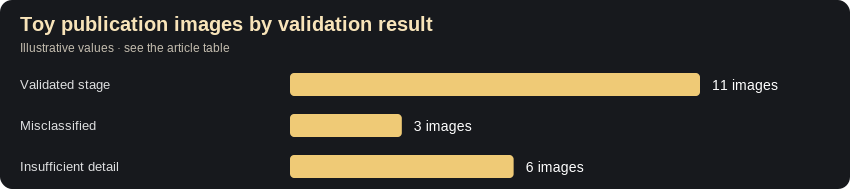
| Category | Value (images) |
|---|---|
| Validated stage | 11 |
| Misclassified | 3 |
| Insufficient detail | 6 |
Illustrative values, not sourced observations. Twenty examples; not a measured model error rate.
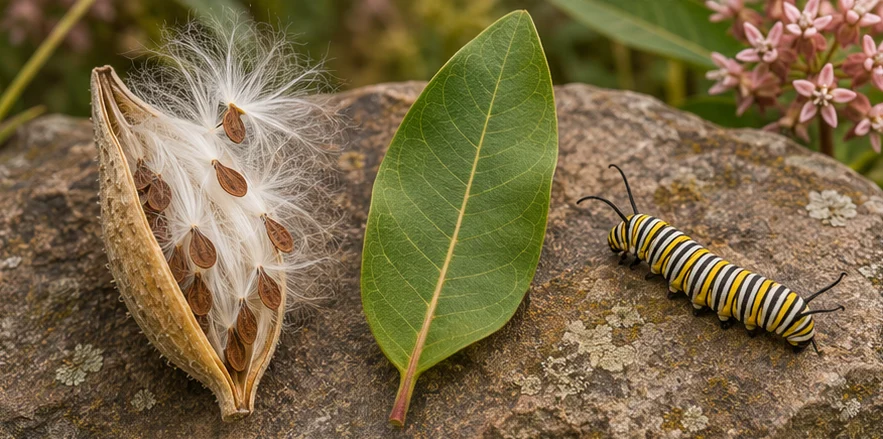
A photo gallery from a school garden begins with a milkweed pod, moves to a close-up of a pale speck beneath a leaf, and ends with a boldly striped caterpillar. Its draft headline says the class found three monarchs. The first image does not show an animal. The second could show an egg, but the photograph may not settle what laid it. The third shows a larva, not an adult or proof of a successful emergence. Put the three images in a thoughtful sequence and they make a useful account of what the class looked for. Count them as interchangeable encounters and the same sequence tells a story its photographs cannot support.
Caption review is not a demand that every image earn a scientific name. A plant-only frame can establish habitat context, a candidate egg can show what deserves another look, and a clearly identified larva can document the life stage at a particular time and place. The work is to keep those contributions visible. An honest gallery has room for pictures that are informative but not countable under a particular claim. Giving those pictures better captions is often more useful than replacing them with impressive but unrelated animals.
This guide is for editing a garden story, a volunteer observation page, or a classroom collection. It teaches how to match captions to evidence and how to build small counts without mixing life stages, pictures, and individuals. It is not a field key that makes every photographed egg identifiable, nor does it replace a monitoring program's protocol. Keep original observations and derived editorial judgments separately, and a beautiful page can remain a credible field record.
The claim should not get ahead of the frame
Start by stating what kind of object is visible. A good review often progresses from plant, structure, or animal to finer biological judgments. A pod and a curled leaf are plant objects. A small raised object might be an egg or something else. A recognizable caterpillar supports larval stage before anyone commits to species. A green suspended object may fit a pupa, but a cropped photograph can omit the features needed to distinguish it. Treat these distinctions as independent decisions rather than one leap from “looks like the monarch gallery” to “confirmed monarch.”
A caption can contain several claims that need different checks. “Monarch egg, below a narrowleaf milkweed leaf, placed here this morning” asserts identity, location on a particular plant, and a time of egg laying. A sharp still might support identity and position. Unless someone observed egg laying or has appropriately bounded prior evidence, it generally does not support the last claim. The photo timestamp dates the documentation, not the beginning of the life stage. A narrow and defensible revision could say “egg candidate photographed beneath a leaf this morning; deposition not observed.”
The U.S. Fish and Wildlife Service monarch field guide describes habitat and the different resources associated with monarch larvae and adults. The agency's monarch species account supplies further species and life-history context. Use the sources to check biological background and plausible identifications, not to declare that every photographed animal using a host is the guide's subject. A description of where monarchs can live is not a substitute for the features missing from a particular frame.
An editor should be especially skeptical when the strongest noun is in a filename. Something called “monarch egg closeup” may have been named by a volunteer on the way home. The original identification is useful provenance, but the name is not an independent observation. The same is true of folder labels, search tags, machine-generated suggestions, and titles that have already been copied into a presentation. Ask who assigned the name, when, and what was visible. If the answer is that all versions descend from one guess, counting their agreement tells you nothing about accuracy.
Do not confuse a pleasing sequence with a tracked sequence. A story gallery can illustrate the transition from egg to larva to pupa to adult with separate examples from different dates, animals, or places. Label the panels accordingly. A heading such as “The life cycle, shown in separate observations” makes this relationship clear. “Our one monarch grew up” implies a tracked individual. That requires records connecting stages, not just the fact that the images appear in biological order. The editor's ability to assemble transitions does not prove those transitions were witnessed.
Read plant evidence as plant evidence
A photograph of identifiable milkweed can show that a potential larval host is present. An adult monarch documented on a flower can show adult presence and perhaps behavior at that flower. These are not the same as an egg or larval record. The USFWS sources distinguish milkweed used by larvae from floral nectar consumed by adults. An adult nectaring near a milkweed planting does not demonstrate oviposition in the planting, and a photograph of healthy milkweed does not establish that it was used. Treat habitat and animal observations as complementary layers.
Keep plant identity within its own evidence limits. A familiar arrangement of leaves or a convincing pod may support a milkweed identification in some contexts, but a cropped photograph of a single green blade may not permit a confident species name. It can still show where an object was attached. If the wider planting was independently identified, link that evidence instead of trying to infer host species by guessing at each extreme close-up. “On a plant independently identified at the site as milkweed” is a different basis from “milkweed probable from this cropped view.”
Clues such as chewing and missing leaf tissue can motivate a search. They do not identify which animal made the mark. Other consumers, breakage, or a damaged leaf can leave ambiguous patterns. Even material consistent with insect droppings does not identify the species without more evidence. A caption can say “chewed leaf photographed during a host-plant inspection; cause not established.” There is no reason to include that image in a larval count merely because feeding signs make the photograph narratively convenient.
Consider a common caption upgrade in the wrong direction: “This milkweed hosted monarch young.” The defensible version might be “Milkweed identified in the garden; no egg or larva documented in this frame.” If associated field records provide additional support, cite them explicitly. A frame without a caterpillar can be part of a validated record if it documents the same marked plant from a different view; that is still a linked evidence package, not invisible animal evidence conjured from the plant texture. Keep the reason for linking the records inspectable.
There is also a positive role for plant-only images beyond decoration. They can show whether the original search concerned all foliage in a plot or just a handful of chosen stems. They can record the plant organ inspected, preserve a tag needed to match later observations, or orient a macro frame whose surroundings are otherwise unrecognizable. Instead of stripping plant-only photographs from the record, give them a status such as site context or host evidence. They become easier to reuse without accidentally inflating the animal count.
An egg claim needs more than a pale dot
The Monarch Larva Monitoring Project's identification reference is particularly useful for editors facing a small candidate object and an imperfect image. It provides examples of eggs and larval stages, and the project's identification training explains how observers approach these distinctions. Refer back to the shape and surface features actually visible. Monarch eggs can have a characteristic ridged structure, but a highlight too small to resolve texture is not evidence that texture was present. Likewise, an apparently pale oval without a reliable outline should remain a candidate.
Note the angle. A side perspective may reveal how a structure projects above the leaf while an overhead view may show its perimeter more clearly. An image from below can keep the plant context but be poorly lit for small surface features. The whitest patch in a photograph might be a reflection beside the feature rather than part of it. Review the original at a practical magnification and compare more than one usable angle where possible. Cropping can bring a detail to the center of a panel, but it cannot make a small blur diagnostic.
The underside of a milkweed leaf is useful context for an egg search; it is not a species diagnosis. Other small objects can occupy the same space, and a visually compatible egg may not be distinguishable to species from the evidence available. Do not grade every candidate on a forced yes-or-no scale. A label such as “egg candidate, insufficient detail for species” carries both the observation and its limit. If the object's egg status itself is not clear, use “unidentified pale object” and let the broader context indicate why it was photographed.
Record a change in the object only when the record can support it. An editor might find a photo of a pale egg-like object and another of a darker object on what seems to be the same leaf. If identification of the subject, continuity of the object, or color rendition is uncertain, “the egg developed” goes beyond what there is. If the investigator followed a marked object using a reliable sequence, a more specific stage description may be possible. Keep the frames and timestamps that support the continuity and avoid inferring an exact event time from changes observed only between visits.
An empty-looking structure can be especially hard to interpret. A caption reading “successfully hatched” might have been supplied because an object disappeared by the next inspection. The disappearance could reflect hatching, removal, an overlooked object, or an inability to relocate the leaf. Even when a shell appears present, a field caption needs the details that justify a particular interpretation. Record “candidate no longer visible at revisit” if that is the direct finding. It is a useful transition in the observation log, not necessarily a transition in the animal's development.
Stage recognition can be easier than precise stage assignment
A photograph of a caterpillar can support “larva” even if it does not support the species. A clear later monarch larva can show a recognizable series of contrasting bands and paired fleshy filaments near the front and rear. For identification, pattern, arrangement, and a good view of the whole body are often more informative than any single patch of color. Other caterpillars can share some conspicuous traits. The photograph may show only one end, the caterpillar may be curled, or a flower might hide another apparent structure. Compare what can actually be inspected with an authoritative guide rather than treating stripes as agreement with the entire description.
A larval instar is the developmental stage between molts. Monarch larvae pass through five instars, as explained by the Minnesota Department of Natural Resources' monarch account and the project identification resources. The existence of five instars does not mean a person can pick one from every crop. A size judgment without a reference can change with image scale, camera distance, or posture. Young larvae need not show the same conspicuous appearance as later ones. An editor can validate “larva” and leave instar unresolved when that finer claim is unsupported.
Nearby lookalikes should be treated as plausible alternatives when they occur in the relevant area. The Western Monarch Milkweed Mapper identification guide presents monarch stages alongside comparable species, including queen and soldier butterflies and the adult viceroy mimic. This does not mean every comparator occurs in every garden. It means a caption check should combine regional plausibility with visible features, not use one in place of the other. A conventional comparison can be very helpful in a clear view and utterly unhelpful when the required part is covered.
Pupae deserve the same careful attention. A compelling hanging shape on a stem may invite a caption specifying a monarch chrysalis. To support it, the image must show characteristics that can be compared with the appropriate references, or the record must link it to a reliably tracked individual. A shadow of a stem or an unrelated object elsewhere on the plant cannot be resolved by knowing there were adult monarchs around. A general caption, such as “unidentified hanging structure; possible chrysalis,” can be more accurate and helps identify what evidence the next view needs.
An adult caption has different requirements again. Recognizable wing markings may support a broad identification or a species-level one depending on which surfaces are in view. An orange-and-dark pattern alone is vulnerable to confusion with other butterflies. If a guide distinguishes an alternative using a hindwing mark, do not assert it was absent in a front-wing crop. Record “hindwing not assessable.” If only a portion of the animal is visible, the adult stage might still be easy to recognize while the species is uncertain. The right confidence is claim-specific.
A photo near a nectar flower does not prove feeding. To say an adult was observed probing, ask whether the relevant body part and floral structure are visible in the same sequence. A still of a butterfly resting on a bloom may accurately record position without establishing nectar uptake. Likewise, a larva shown alongside a leaf edge is not necessarily captured feeding. These behavioral distinctions are not always needed for a simple stage log, but they matter if the caption includes action or claims about habitat function. Keep the biological stage and the activity separate even when both are supported.
Chart: Toy publication images by validation result
The figure and matching table are illustrative only. They classify twenty invented publication images with one designated life-stage caption per example. They are not sourced observations, a measured error rate for a model, or a test of any real editor or monitoring program.
| Validation result | Images |
|---|---|
| Validated stage | 11 |
| Misclassified | 3 |
| Insufficient detail | 6 |
The three rows total twenty. Eleven captions were supported at the stage level used in this imaginary review. Three made claims that the hypothetical evidence contradicted. Six lacked enough detail to decide. In this exercise, a visible seed pod captioned as an egg could be a misclassification. A pale object cropped beyond recognition could be an insufficient-detail record. Do not confuse the two: not enough evidence to validate the claim is not a finding that the caption was false. In a real review, validated stage should also be distinct from validated species if both matter to the analysis.
Eleven of twenty, or 55 percent, is the share of these invented images in the validated-stage category. Eleven of fourteen, or about 78.6 percent, is the share among the examples with a decided classification if those are the eleven supported and three contradicted cases. The six uncertain cases may not be comparable to the others. Very small subjects can be harder to document, for example, or one contributor may have captured only part of an animal. Neither fraction is a population statistic about monarchs. It is not an estimate of identification accuracy outside this constructed collection.
A review of published images cannot recover insects that were never photographed or that were excluded before editorial review. A beautifully sharp sample of later larvae can be much easier to validate than a representative set of images taken during a complete field search. This is why a gallery audit should not claim to measure observer performance in the garden unless it was designed to do so. The chart is about review outcomes for a designated set and no more. Making that part explicit does not weaken a useful quality check; it gives the check a defensible purpose.
Count the right thing after caption review
A gallery count starts with images. A single larva can appear in six views, including three crops of one original file. Those contribute evidence about identification, but not six animals. A biological observation record is a defined detection under a declared protocol. It might consist of a subject believed to be one larva on one marked stem during one inspection, with several images attached. A field project may count additional records if it sees the same plant on another date, but it should not automatically call them distinct larvae without individual evidence.
Think about duplication at several levels. An uploaded thumbnail and a full-size photograph may be variants of the same asset. Adjacent pictures in a burst can record the same episode from one camera. Two volunteers may photograph the same animal on the same tagged stem. Multiple animals on a single well-resolved frame may also produce separate records under a particular count. Neither equal image timestamps nor similar markings alone prove the identity relationship. Use time, location, photo linkage, and subject position together. When in doubt, retain the possibility of duplication.
A count by plant is a useful alternative in some circumstances. If several identifiable eggs are found on one host, an editor can calculate either the number of validated eggs detected or the number of inspected host units with a validated detection. These are different statistics. Do not label the plant-level fraction as a count of individual eggs. A valid denominator requires the number of units actually inspected under a consistent rule, not the number of plant pictures uploaded. That unit might be a tagged stem under one method and an individual plant under another.
Counts by stage also cannot be turned into a life table by listing them side by side. Suppose a gallery has many egg photos, fewer larvae, and one chrysalis. This can reflect differences in search effort, detectability, duration of stages, editorial selection, or actual numbers. Without tracking a defined set and documenting later outcomes, the ratio of photographs in successive stages is not survival. A clear caption can help keep these interpretations separate long before an article tries to attach percentages to the panels.
The monitoring alternative is to work from a field protocol. The Monarch Larva Monitoring Project provides procedures for contributors who want to study milkweed and immature monarchs. A gallery of selected examples can be an illustration of that field work, but it should not be substituted for the field records. Follow the program's own rules when participating. If your local exercise differs, identify its units, effort, and observation periods. Formal program data and editorial metadata serve each other best when each retains its original definition.
Keep nondetections visibly distinct from missing evidence. A protocol can record “inspected, no eggs detected” under its own conditions. An album with no egg images does not establish that anyone inspected for eggs. Likewise, a photograph of a plant's upper side cannot guarantee the underside was checked. If a label says “no larvae” while the notes say the plot was missed, correct the statement. The blank is important: it tells the reader that the question had no opportunity to be answered rather than that the expected value was zero.
Build an editorial check that works on ordinary first drafts
Begin with an inventory of the physical or digital items. Give each original image a stable ID and record relationships to its crops and copies. Retain the submission caption separately from the publication caption. Mark where the date, location, and subject identification came from: camera metadata, field notes, a recollection, or a later review. Metadata are evidence about what someone or something recorded. They are not infallible. A camera's clock may be incorrect, and a copied file may retain the date it was exported instead of the date it was captured.
Break the caption into clauses. A caption reading “second-instar monarch eating milkweed in Plot Two on Tuesday” should be checked for species, instar, action, plant identity, location, and time. Some of those details may be well supported, others not. A reviewer should be able to downgrade one clause without erasing the useful rest. Reporting a monarch larva with instar undetermined is better than rejecting the image wholesale if stage-level identification is solid. Conversely, a confident date does not compensate for a dubious animal identification.
Record the primary evidence in ordinary language. “Both body ends visible; band pattern can be compared” tells a reviewer more than “looks right.” “Only one edge of pale object visible through glare” explains an unresolved egg status. Document why a source was useful: a local identification comparison, species context, or a project definition. This makes the review more reproducible than a yes-or-no approval in a spreadsheet. It also makes it practical to revisit records when a clear expert correction appears later.
Use at least two distinct uncertainty fields if the project has room. One can describe the subject and life stage; another can describe taxonomic resolution. A third might track whether the proposed stage number is supported. An image can be clearly larval, likely monarch, and not classifiable to instar. Calling it “uncertain” with no qualification throws out useful stage information. Calling it “confirmed” because one part is clear overstates the rest. A compact record can carry the nuance without overloading the public caption.
Decide what “misclassified” means before tallying. The word implies more than a reviewer declining to endorse a label. It fits when the record positively conflicts with a claim, as when a seed pod was labeled an egg and its plant origin is clearly visible. If the record cannot settle what the subject is, the correct status is evidence insufficient. Sometimes the right change is simply lower precision: replace “specific instar” with “larva” and log which label was changed. Size, color, position, and species can each fail for different reasons, so keep the corresponding rationale.
Use disagreements to improve the form rather than chasing immediate consensus. A second reviewer may agree one image shows a caterpillar but disagree on whether a hidden feature is needed for species. Another may have access to additional views. Record what information changed and who saw which evidence. If the final caption depends on the additional photograph, attach that image to the record. An independent reviewer looking only at the public crop should be able to understand why the caption can be stronger than the crop, or why it cannot.
Preserve context while making the photo readable
Most photo editing changes the view without producing a new biological observation. Cropping can move a subject into the center. Exposure adjustments can make the relevant outline easier to inspect. But strong sharpening can accentuate false edges, and generated detail can create a surface texture that the sensor never recorded. Review identifying characters in the original or a faithfully processed copy. Do not treat generated fill or interpolation as evidence of ridges, bands, or appendages. It is better to admit an unresolved field record than to create the feature that would resolve it.
Keep a context frame next to an identifying crop where possible. A wide image can show host plant, leaf position, tag, or plot boundary. A closer one can show morphology. The two earn different parts of the caption. If they are not from the same event, do not imply that they are. A visual compositor can make subjects look closer, better aligned, or even simultaneous. If the goal is communication rather than observation, label the composite as an illustration and keep its parts out of a validation tally meant for documentary images.
Scale can be helpful, but avoid making it up. If a photo lacks a known reference, relative length estimates can be misleading because objects have different distances and angles to the camera. A leaf of unknown size does not solve that problem. When a scale was genuinely recorded in the same plane or another trustworthy measurement was taken, say how the number was obtained. Do not disturb an animal or move its support merely to give an image a convenient size bar. For ordinary observation, it is often enough to leave precise measurements out.
Color also needs care. Lighting can alter contrast and perceived hue. A white balance adjustment can improve readability without proving that an animal looked exactly that way in the field. Even accurate color is only one character. If a feature is only discernible after a strong adjustment, check that it corresponds to the already recorded structure rather than an artifact. Save the settings or retain both versions for review if the edit matters. A caption can avoid relying on the disputed color even while still describing the visible form.
An editorial generated image must be identified as such. A hero illustration showing a pod, a leaf, and a caterpillar together is a visual invitation to read, not a record of those objects at one observed site. Avoid captioning it as though it documented a specimen, a site visit, or a specific stage validated by observers. Keep generated images, composites, and field observations in separately labeled collections. Alt text can describe what appears while a label makes provenance explicit. A lifelike result deserves the same clarity about what it is as an obviously stylized drawing.
Match claims to the time and geography actually shown
A single date may fail to support a seasonal claim. The first documented egg at a site is the first in the available record, not necessarily the first egg laid there. A final photographed larva does not establish the seasonal end if visits stopped or search effort declined. State the watch dates, any meaningful gaps, and what “first” or “last” is relative to. Stories about seasonal change become much more credible when the audience can tell the difference between biological timing and the timing of people with cameras.
Likewise, an adult photographed in a garden does not show that the site supports every stage of development. It might be passing through, resting, or apparently foraging. A confirmed larval record on a host supplies another kind of evidence, but it does not identify where the adult came from or whether it will emerge successfully. The USFWS field guide provides broad seasonal and habitat context, not a ledger for that garden. Relate a local observation to the larger story without promoting possibility into fact.
For location records, choose a precision appropriate to the purpose. A local class might use site and plot labels in the public gallery and retain more detailed field locations privately when permitted. A monitoring protocol may ask for a different geographic format. Do not infer a plot from the background of a close crop where no landmarks can be verified. If an image came from another site to show an identification example, credit it as such. A well-captioned comparison image can be used to teach without being added to the local checklist.
Temporal order can also be lost when editors sort by life stage. Rearranging a photo set is often exactly what a story needs. Preserve the capture order and actual date separately so the layout is not mistaken for a timeline. A gallery leading with an adult, returning to an egg, and closing on a chrysalis can still teach the biological sequence if the connection is explicit. Conversely, a correctly ordered life cycle tells an incorrect story if it claims the collection followed one animal when no such record exists.
Walk through four invented edits
Imagine the first caption is “Monarch forming inside a green pod.” The frame shows an intact plant seed pod with a wider view linking it to a stem. A suitable revision is “Milkweed pod photographed in the observation garden,” assuming plant identification was independently established. Put it under habitat context, not animal records. The original claim is contradicted by visible structure. Keep it in the correction log so an editor can find copies of the mistaken caption without confusing the revised plant label with a species observation.
The second says “Fresh monarch egg.” It shows a pale bead under a leaf, with no resolved surface texture and no observation of laying. It may be useful to publish “Pale object beneath a leaf, recorded as an egg candidate; identity and age unconfirmed.” If the stronger identification is editorially essential, obtain a supporting frame or leave the example out of that tally. Moving from “fresh monarch egg” to “candidate” does not mean rejecting the observer's care. It accurately states that the camera did not make the relevant diagnostic claim available.
The third says “Fifth instar eating its way across the plant.” Two clear views support a monarch larva, but there is no usable size reference or sustained view of mouthparts. The visible position can be made public: “Monarch caterpillar on a leaf edge; precise instar and feeding not determined.” Attach both source views to one encounter record if they show the same larva. Count one validated larval observation under the chosen protocol, not one fifth instar and one separate feeding event.
The fourth says “This picture shows our emerging adult from the chrysalis in the previous frame.” An adult wing is clear, and the date of the photo is later, but the frames lack continuity or a shared identifier. A truthful alternative is “Adult monarch photographed at the site on a later visit; not linked to the earlier chrysalis.” If an image did clearly show emergence, it could support that behavior for the pictured animal without relying on sequence arrangement. Separate documented behavior from an inference based merely on being the next picture in a slide show.
These examples are separate from the twenty imaginary images in the chart. They show how caption review can improve a result even when it does not increase the validated-stage count. An editor sometimes needs to replace a single noun, sometimes needs to remove a claim about time, and sometimes needs to split a sequence into unrelated observations. An audit trail that notes different kinds of corrections can reveal where future training should focus. Not every correction has the same cause, and a more useful score records what evidence was missing.
Make the next count easier to trust
A final quality check should read the summary back against the raw evidence. If the headline says eggs, count unique qualifying egg observations, not any image with an egg candidate in the caption. If it says sites, use site identifiers rather than photographs. If it says confirmed stages, describe what level of identity and what review rule that includes. Look at the most impressive photographs and the most ambiguous ones with the same criteria. A story should not be able to borrow validation from its strongest image and use it in all of the other captions.
Keep unsupported candidates as an honest part of the record rather than hiding them to make acceptance rates look better. Such examples tell an observer which frames to improve next time. Maybe several candidates were photographed at a distance that obscured fine structures, or several larvae had one end outside the frame. Improve the noninvasive observation approach to fit the missing feature. If revision is not possible, the gallery can still explain what was visible and why the identification stopped. This is a useful teaching outcome rather than a failure to reach a count.
Where caption corrections affect a released total, make the consequence clear. Correcting one caption among two photographs of the same larva may change a picture count without changing the encounter count. Splitting one collage into its original source frames can change the number of inspectable assets without creating new original events. Replacing a species label with a broader stage may alter the monarch-specific summary but not the count of photographed caterpillars. Saying which quantity changed helps readers understand both the scope of the problem and the value of the correction.
The opening gallery becomes stronger when each panel has its own job. The pod shows context. The pale object shows an unresolved candidate and what a better view might have revealed. The clear caterpillar provides a stage observation at a recorded time and place. Put them together, and they can invite someone to look again without implying three monarchs were counted. Good captions do more than decorate a natural-history story. They preserve the link between an observation and the limited, useful claim someone can make from it.