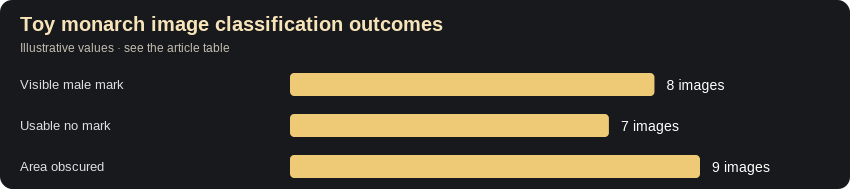
| Category | Value (images) |
|---|---|
| Visible male mark | 8 |
| Usable no mark | 7 |
| Area obscured | 9 |
Illustrative values, not sourced observations. One image-level classification, not a population sex ratio.
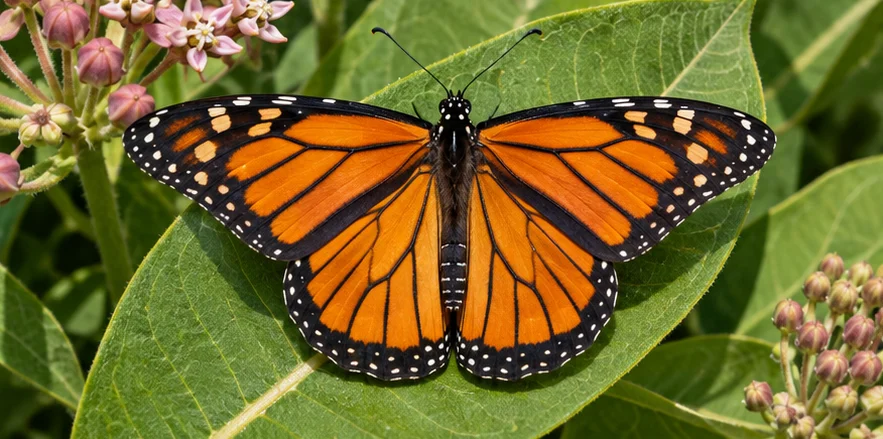
One monarch photo is bright, sharp and close enough to show the white spots in the wing border. Another is dimmer and less striking, but it shows the important part of an open hindwing. For someone trying to classify the sex of a confirmed adult monarch, the second photograph may be the more useful one. A well-focused head or a vivid orange forewing does not help much if the required region is covered. Photographic quality matters, but quality for identification is specific to the anatomical feature and view needed.
This is where a conservative field record earns its keep. In one usable view, a dark mark appears in the location expected on a male monarch's hindwing. In a different usable view the relevant region is clear and the mark is not visible because it is absent. A third image does not show the relevant region clearly at all. That third image is not evidence of a female. It is evidence of an adult monarch, if identity is otherwise supported, and an unresolved image for the sex classification. Treat those two uses separately.
A record that preserves both the finding and the opportunity to see it can support better review later. It also protects a modest photo collection from turning into a population estimate. A gallery can contain many images of the same animal, and the conditions that make sex classifiable can vary across observations. Count images, encounters and individuals only under the respective rules those units require. A clean three-bar figure is useful when it leaves the distinctions intact.
Read the imaginary classification chart correctly
The figure contains eight images with a visible male mark, seven usable images with no mark and nine images in which the necessary area is obscured. All twenty-four images are hypothetical. No field study or collection supplied these data; the example defines one primary image-level outcome per eligible image. The unit is images, not butterflies. No inference follows about the sex ratio of a garden, a migration or the adult population at large.
| Illustrative image outcome | Images |
|---|---|
| Visible male mark | 8 |
| Usable no mark | 7 |
| Area obscured | 9 |
The eight and seven usable cases add to fifteen; the other nine do not resolve the feature. The useful fraction of the imaginary images for this particular classification is fifteen of twenty-four, or 62.5 percent. That is a statement about the toy image collection, not about how frequently photographers in general capture the necessary view. If someone instead calculates eight of fifteen, that measures the proportion of resolved images with the male mark in the example. It still does not measure the fraction of distinct monarchs that are male. Repeated images and selective views could affect that number.
The chart labels a narrow set of eligible examples. The no-mark category means the wing region was actually usable, not merely that no dot was noticed. Area obscured covers images where evidence cannot be evaluated adequately in this illustration; a real protocol may distinguish blocked, cropped, out of focus, glare and indeterminate appearance in a visible region. If the archive includes images whose species is uncertain, those should not be pushed into the monarch categories merely to keep the plot small. Define eligibility separately and report the exclusions.
The U.S. Fish and Wildlife Service monarch species account is background for adult identification and life-stage context. Its Monarch Butterfly Field Guide supplies contextual information about seasonal observations, larval hosts and adult flower use. The National Park Service monarch page explicitly distinguishes males by the small black hindwing spot absent in females. The fictional classification outcomes came from none of those sources. This article uses the anatomical distinction to design a careful image record, not to set a government reporting protocol.
Identify the animal before judging the diagnostic mark
An orange butterfly with dark areas is not automatically a monarch. First ask whether the photograph or its documented companion views support the species identification. The federal species account describes the familiar adult color and vein pattern, alongside wider natural history. Useful views can show elements of the wing markings, margins and arrangement together. Incomplete photographs, nearby lookalikes and unfamiliar local species can complicate the judgment. If species remains uncertain, stop the monarch-specific classification rather than treating a dark patch as sufficient proof of both species and sex.
Probable identity can be preserved without inflating it. One field might note that the butterfly appears consistent with a monarch; a separate field can record whether the documentation meets the project's threshold for species confirmation. A third field tracks whether the diagnostic region for sex is visible. Those fields do not need to agree in certainty. A sharp view of the overall wing pattern may establish species while the hindwing area is unavailable. Another photograph could show a dark patch in a region that looks relevant while lacking the wider evidence needed to identify the animal securely.
Use adult identification rules for the appropriate life stage. A camera may capture a caterpillar on milkweed, a pupa or a butterfly whose identity remains uncertain. The adult wing-mark approach does not apply to those records. The fact that the animal occurs near a known host plant or in a familiar season is context, not a substitute for the anatomical evidence. Record the observed stage and its confidence before trying to use adult characters, particularly if an archive collects many sorts of observations from the same site.
Don't promote an identification merely because the photograph fits a memorable scene. Adult monarch sightings near conspicuous nectar plants can be easier to document than some other encounters, but that does not make the plant a diagnostic character. Likewise, a late-season sighting can be relevant to migration context without proving where that individual came from. Focus on features actually visible in the image. A field record can be rich in ecological context and still remain unresolved for a narrow photographic judgment.
Find the hindwing area before deciding what it shows
In a suitable view of a confirmed adult monarch, the characteristic male mark appears as a distinct small dark spot on a vein of each hindwing. The relevant question is not whether there are dark marks anywhere on the animal, but whether the observer can inspect the particular vein region where that character is expected. Ordinary dark veins, wing borders, shadows and irregular damage should not be converted into the mark just by proximity. A reference illustration or verified comparison can help a reviewer learn where to look without assuming a blurred photograph necessarily agrees with it.
Commonly the upper, or dorsal, wing surface in a clear open-wing image gives a useful view. Some angles may offer a partial look; assess them on their evidence rather than expecting all side views to work or all open views to suffice. A forewing can overlap the region, part of the wing can leave the frame, or a shadow can mask an edge. Reflections and low contrast can also obscure detail. Clarify whether one clearly viewable hindwing is enough for the project's stated rule and whether the mark can be distinguished from lookalike artifacts. When sufficient evidence is not present, retain an unknown outcome.
A conservative positive record requires the visible feature to have the correct location and appearance in a usable view, not a generic dot someplace near the middle. A conservative no-mark record requires an intact enough and clearly viewed region where the spot would be visible if present. Poor visibility does not become negative evidence because another part of the photograph is sharp. Consider preserving the direct image label, usable no mark, before deriving a sex classification under the project's rule. That transparency lets reviewers check how strong the absence evidence actually was.
Wing wear can complicate the assessment. If the critical region is damaged or seems altered, a missing feature could reflect the state of the wing or limits of the photograph. The posture and lighting can hide whether the region is intact. Do not force a female classification when there is an unresolved reason the expected mark might not be visible. A sharply visible mark and a trustworthy verified absence are both valuable observations, but the second classification depends on knowing what could have been seen.
Why brightness is a poor substitute for evidence
A vivid orange photograph is easy to remember. It is not a valid shortcut to sex. Exposure settings, shade, backlighting, camera processing, scale condition and wing angle can all change an image's apparent brightness or saturation. Two photographs of the same butterfly may look strikingly different. Comparing them with a mental example of a “more vivid” male or “duller” female can rapidly confuse photographic conditions with anatomy. Even a difference in an accurate color measurement would not by itself show the diagnostic mark required by the chosen field rule.
The thickness of visible dark lines can supply context for an experienced observer, but images can exaggerate the effect. A narrow vein photographed in sharp focus may appear broader or narrower than a different vein with blur or digital sharpening. Angle and overlap also change the apparent extent of a dark band. If the project has chosen a rule based on the hindwing spot, do not substitute another fuzzy feature after seeing a striking photograph. A more complex character assessment would need documented criteria and an appropriate reference, not informal score adjustments.
The black spot is an anatomical character, not any small dark image artifact. A shadow cast by a stem can fall across a vein. A small insect or debris resting on the wing can create a false dark point. In low-resolution images, compression and sensor noise can also combine several dark lines into something spot-like. Compare the observed feature with its surroundings and prefer an original file or properly documented companion photograph when available. If there is only a suggestive shape, record it as indeterminate rather than raising confidence because the image would otherwise be hard to classify.
Avoid manipulating a photo until it produces the desired outcome. It may be appropriate to zoom into original pixels and make a documented presentation adjustment for visibility, but changing a crop or brightness does not create information lost at the moment of capture. Aggressive sharpening, resampling or generated reconstructions can produce patterns that do not establish what was captured. Keep the original and distinguish a derived viewing copy. An editorial illustration such as the one associated with this article is not a specimen image and should never be used to decide the sex of a butterfly in an observed dataset.
Separate the most common ways an image becomes unusable
A cropped frame can remove the relevant area completely. In that case there is no available image evidence for presence or absence of the mark. A partly covered region is different: some of the relevant anatomy is visible, but the part needed for this judgment is not. A blurred frame can include the entire wing and still lack the sharpness needed to distinguish a small structure. These are different opportunities to improve later records. The same field label may be adequate for a simple plot if a supporting reason survives elsewhere.
Glare can make the issue direction-dependent. One hindwing might be clear and the other hidden under a bright reflection. The reviewer should assess the evidence at the specific wing area, not score the photograph by its best or worst overall region. If using one sufficient wing is legitimate under the stated protocol, document which was used. If only part of the area is clear enough and the interpretation remains uncertain, preserve that. The result should be repeatable from an explicit rule rather than from each person's subjective impression of a polished picture.
Damaged areas need particular care for a no-mark decision. A missing patch of tissue at the expected mark location cannot show that the mark was absent on an intact wing. Similarly, a deeply creased wing can move the feature into shadow without removing it. A worn or misshapen area may support a description of condition rather than sex. An age or health hypothesis derived from damage would be a separate question and may not have enough information. Keep the reason for an unknown classification focused on what prevented visibility.
A record can also be unresolved even though the anatomy is mostly visible. An apparent dark area may be ambiguous or inconsistent with the trusted examples. That is not quite the same as cropped or blocked. A broader archive can represent both without requiring another field visit. Such distinctions give the next reviewer options: request an original file to assess blur, look for another verified view in the same encounter, or leave the case unresolved indefinitely. Not every image needs a terminal sex label to be worth saving.
Use companion photos with an explicit evidence link
An encounter may produce several photos: a profile that supports species, an open view of the hindwing, and a distant frame that documents the animal's departure. They can support different pieces of the same encounter when the identity link is well established. Keep a frame identifier and a shared encounter identifier. Record how continuity was recognized, especially if several butterflies were nearby. A sequence taken in quick succession might strongly support a shared individual, whereas pictures separated by a trip around the garden may not.
A useful archive can retain one sex assessment per photo and a separate derived assessment per encounter. The close view might be useful at the encounter level even if the other frames remain individually unclassifiable. This does not mean those other images suddenly acquired the necessary view. Conversely, don't treat multiple photos showing the same mark as independent confirmations from different butterflies. They verify what several views of one possible individual showed. The analysis must say whether its unit is files, encounters with documented continuity, or independently recognized animals.
An image recorded on another date cannot generally resolve an earlier photograph merely because the butterfly appears similar. Resightings are possible, but secure linkage needs evidence beyond convenience. Avoid personal names for insects unless the study can track individuals appropriately. A neutral encounter code is usually more useful. Where there is a plausible but uncertain match, retain it as such. That makes it possible to see how sensitive an encounter-level summary is to duplicates without falsely joining all similar sightings into one.
Build the decision from an evidence checklist
Begin with eligibility: does the record show an adult monarch to the confidence required by the project? If not, hold it out of a confirmed monarch summary and keep the reason. Next assess whether the diagnostic area is sufficiently visible. If not, record area not usable and why. If usable, inspect whether an expected mark is clear, defensibly absent or still ambiguous. Finally record the image-level result, reviewer information as appropriate and whether an encounter-level decision was based on other verified views. The order matters because a difficult mark should not tempt the reviewer to skip unsettled species identification.
For program documentation, include a few reference examples. Use specimens or images with reliable provenance and appropriate permission or existing published references. Choose examples of clear positive, verified no mark and visibly insufficient evidence. The last category should be illustrated intentionally, rather than mentioned once as a remote possibility. It is where many real-world decisions happen. A reference example should tell reviewers what is visible and why it meets the rule, not merely print a classification beneath a picture without explanation.
A short status code can carry one outcome, while explanation fields carry observations that overlap. For instance, a frame can contain a verified adult monarch but have insufficient hindwing visibility because blur and angle interact. If the report combines those reasons under Area obscured, preserve the original reason fields. If another frame with a clear region is ambiguous for a different reason, do not force it into a confident no-mark group. The exact labels in the teaching chart need not be the only labels possible in a working archive. What matters is knowing which states were included, omitted or combined.
Test the checklist on a photo set that preserves the original order and file identity. Ask two people to classify a short set independently. If they differ, inspect which decision point produced the disagreement. Was it species identification, expected region, quality of exposure, apparent mark or linkage with other images? Agreement about an overall label matters less if people reach it by incompatible logic. Making those decision points explicit can improve consistency without claiming certainty beyond the quality of the source record.
Work through four fictional decisions
In a first example the image clearly shows a monarch's upper wings. One hindwing is well exposed and a distinct small mark appears on the expected vein; the other wing is partly hidden by a leaf. If the protocol accepts one adequately documented wing, the visible mark can support that outcome. Count what is seen rather than claiming to see both spots. Retain which side was usable and where the feature appeared. Nothing in the conclusion requires estimating the other wing's condition.
In a second example the relevant region is clear, the tissue appears intact enough for the judgment, and the expected mark is absent. If species and adult status are supported and the view meets the protocol, this can count in Usable no mark. It is not equivalent to every image where the reviewer did not notice a dot. Describe the positive evidence for the view's adequacy. A usable no-mark case is an example of absence under proper observation, not a default entry for pictures that are hard to interpret.
In a third example the photo is visually striking and the spread of orange across the forewings is crisp. The hindwing region is out of frame. It can show adult morphology or place the butterfly in the site record, but it adds no direct feature evidence for sex. If a companion image later resolves it at an encounter level, the original photo should stay individually unclassifiable. This makes it possible to reuse the frame for another valid purpose without changing its classification quality retroactively.
In a fourth example the region is visible, but a dark irregular patch is unclear and the wing may be damaged. The correct decision may remain uncertain even after reviewing the unedited original. Do not use the shape as a confirmed male character unless it can be distinguished from plausible artifacts under the protocol. Do not classify it as usable absence merely because it lacks an obvious crisp spot. A separate ambiguous-feature status could be appropriate. This practice collection differs from the chart and does not change its invented counts.
Separate marks, images, encounters and population estimates
A valid image classification is a measurement of evidence in a file. At encounter level, the question might be whether any linked usable photograph supports a particular assessment. At individual level, one needs a defensible method for deciding which encounters involved the same animal. Then a population estimate needs a suitable way that distinct individuals entered the sample. These are progressively different questions. Collapsing them can create an impressive-looking proportion for a garden population from nothing more than how many times one butterfly was photographed with its wings open.
Suppose a single clearly visible marked individual generated all eight male-mark images in the teaching-style scenario, while seven usable no-mark images came from seven separately observed individuals. The image counts and encounter counts would give very different ratios. Alternatively, several of the no-mark views might also be duplicates, making any further story unresolved. The chart supplies none of these links. A report can still present the image-level diagnostic workload, as long as it does not imply that a classification count equals a tally of the animals that were present.
Selection can affect the result even after duplicates are addressed. Butterflies photographed on particular plants or perches may differ from those passing high overhead or resting in inaccessible places. Time, place, light and observer preference can all affect which images are taken and which show the necessary region. If photographers preferentially keep crisp open-wing views, the proportion of usable images in the archive may not generalize to all photos or sightings. State how the photo set was assembled. An informative archive does not have to pretend to be a random sample to deserve careful description.
The same caution applies to comparing years. A newer camera can improve shutter speed or reach, producing more usable hindwing views without any biological change. Training can also change what observers photograph or how they resolve difficult cases. If a new procedure changes the proportion of images classified, the new data may be better and still not directly comparable to the old ones. Retain method and coverage information. A comparison of compatible subsets may be appropriate, but a chart spanning an undocumented method transition should not be interpreted as a stable population measure.
Keep photographic observation nonintrusive
A good record does not require steering an animal into a particular pose. Work from legitimate viewing areas, respect closures and let the butterfly choose its own position. If an appropriate view is not available, keep the record unresolved rather than following it off the trail or manipulating its wings. An observer can sometimes wait for an ordinary change in posture from a safe and nondisruptive position. Obtaining a cleaner photo is not a reason to stress an animal or trample a resource. Where local rules limit closer activity, follow those limits and report what the permissible method actually showed.
Avoid sharing unnecessarily precise locations for sensitive observations. A public photo caption can describe the habitat or broad location without creating a trail to a vulnerable concentration of wildlife. Keep original date and location information restricted as appropriate for verification and site context. A map generalized for public use should disclose that it is generalized rather than claiming the displayed point was the exact observation. Image verification and public distribution have different needs; an archive can preserve the former without assuming every detail belongs in the latter.
A cropped educational image can be valuable if its derivation and scope are clear. Keep the original, retain a link to it and do not use a generated figure as a substitute for field evidence. Some illustrations are intended to teach where the wing region lies. Their colors and shape are editorial, and their existence does not verify that a matching mark occurred in a particular image. A viewer can learn to look more carefully from an illustration while the actual evidence still comes from what was recorded in the ordinary observation.
Design a handoff that does not need inside knowledge
A compact image table might contain image ID, date, encounter link and confidence, species and stage eligibility, hindwing side, visibility reason, observed character and classification status. Notes can link to appropriate references or a separate review log. Enter the direct observation before deriving a summary. For example, the reviewer may say right hindwing clear, spot at expected region, then use that basis for the display classification. The recipient can inspect the reason without needing to recognize the photograph from a narrative description.
Keep the original image data and the interpretation version separate. An updated reference or higher quality source image may justify a new classification. Preserve what changed and why. If the new image belongs to the same identified encounter, say which conditional conclusions it resolves. If it is merely a better example of another butterfly, it may improve training but cannot repair earlier visibility. A versioned record allows the archive to become more accurate without rewriting what the previous reviewer could legitimately see.
Prepare simple audit cases before importing a large photo set. Test one confirmed adult with a well-documented mark, one usable absence, one cropped region, one ambiguous artifact, one uncertain species, and two linked views from the same encounter. Check how each flows into image and encounter summaries. Decide whether blanks count as unreviewed, unknown or not applicable and make those distinctions clear. If a project sums only resolved images, retain the number of unresolved eligible ones nearby. They may explain whether an apparent pattern resulted from more complete observation rather than from a different composition.
A secondary table can summarize reasons for unresolved images, such as cropped, blurred, blocked or uncertain apparent feature. Keep the categories reproducible enough to compare and allow multiple reasons in the source data when they apply. If you choose one display reason per image, document its priority. Without a rule, a table may show a rise in blur simply because another reviewer now uses a different term for combined blur and obstruction. The second panel is a check on the observation procedure, not another way to label sex.
Compare progress in documentation instead of inventing a biological trend
A real project may want to improve how often otherwise useful sightings include a reliable diagnostic view. That is an observation quality goal. Count eligible images, usable views and unresolved reasons in clearly defined sets or watch windows. A later increase in usable images might show that the team became more skilled at documenting the wing region without changing animal behavior. Consider whether viewpoints, hours and observer coverage were comparable. A simpler study could compare several practice sessions without treating their outcomes as evidence concerning the garden's sex ratio.
Try distinguishing between two goals. One is making the archive more useful for later review. Another is learning about the distribution of adult monarchs in a larger area. The first can be addressed by better classification records, reliable links and careful training. The second would require an appropriate sampling design beyond the simple photo log. Being able to meet one goal gives no reason to claim the other. It is possible to publish a substantial, useful note on image identification quality even where the dataset is explicitly unfit for population inference.
When publishing results, include the sample frame and unit in the caption. Say whether an image is eligible because species and life stage were confirmed, and show unresolved cases as a visible outcome rather than an unmentioned subtraction. If the figure comes from fictional numbers, say that on the chart and again in nearby text. For the example here a simple caption could state that twenty-four imagined images were classified by whether the diagnostic region revealed a usable mark, usable absence or insufficient view. The text should not imply that the bars measure any observed individuals. Precise wording is an inexpensive guard against misuse when figures are copied out of context.
Decide when to revisit a classification and when to leave it unresolved
A review program can specify what evidence is worth seeking rather than repeatedly reexamining the same compressed file. If the published image is tightly cropped, a preserved original might have more field of view. If the original lacks the region too, another legitimate image of the same documented encounter could help with an encounter-level result. A sharper enlargement cannot fill in a completely absent part of the frame. A review checklist should identify the next source that can actually add evidence, and it should say when there is no such source. Leaving an image unresolved is then a final, defensible outcome rather than a task someone failed to finish.
Consider a photographer who finds an unedited file after the record was previously tagged area obscured. Suppose the original shows enough of the relevant area for the reviewer to document a male mark clearly. Update the image classification based on the stronger source, retaining the original evaluation date, reason and details about which file was used. That update describes a change in evidence, not a change to the animal. If the finding only appears in another image, add the new image classification and link both to their encounter rather than pretending the earlier file is clearer than it was.
The reverse update also deserves an audit trail. A dark mark once accepted as diagnostic might turn out to be on a shadow or on an unrelated wing region after the original is examined. The defensible response is to remove the unsupported classification and explain the reason, not immediately swap it for the opposite sex. The relevant evidence could simply be indeterminate. Log the affected result and whether released counts changed. If the numbers were previously published as proportions, specify their original and revised denominators so the correction doesn't quietly change the scope.
A batch-processing workflow can help prevent accidental upgrades. Preserve the default of unknown until a reviewer records a supporting diagnostic observation, and distinguish eligibility review from morphology review. If the project imports older entries where blanks once meant male marks were not seen, do not automatically treat those blanks as verified no mark. A score of zero in the wrong field can conceal both uncertainty and missing work. Audit several ambiguous imports against their retained images or correctly leave them unclassified when the source cannot be checked.
An especially useful release note can tell readers how often new evidence changed classifications and how that was counted. Consider the image used as before-and-after proof in this exercise: if it was previously obscured and later becomes classifiable after recovering the full original, it contributes to an update in usable evidence, not a new butterfly sighting. Keep a separate count of newly reviewed files and genuinely new encounters. Where readers see only a graph of results, a few words about documentation updates can protect them from interpreting changes in the archive as changes in the garden.
Preserve what the photo actually showed
A conservative classification does not throw away uncertain photographs. A cropped image may still establish a dated adult sighting or supply habitat context. An image with an unresolved mark may still be worth reporting as a species observation if the record independently supports it. Keeping those views under narrower labels teaches future observers which additional evidence would help. It also lets a review honor the things a camera clearly did capture without forcing every file to answer the same question.
Ask three questions before making the call. Is this a confirmed adult monarch for the intended purpose? Is the expected wing region clearly visible and suitable for the interpretation? Does the available evidence show a characteristic mark, a usable absence or an unresolved view? Those questions make the procedure repeatable. Brightness, beauty and timing can all make a photo memorable, but they don't replace a view of the right anatomical region. The missing view is part of the observation, not a reason to turn uncertainty into a sex label.
Before forwarding a screenshot to a reviewer, note whether it preserves the original aspect and frame. A presentation crop may be adequate to discuss a verified feature, but the reviewer should know where to find the source if absence is being judged. Review the observation against what was captured rather than against a deliberately simplified presentation.
Sources
- U.S. Fish and Wildlife Service: Monarch species account. Adult identification, stage and species context, not a source of the illustrated chart.
- U.S. Fish and Wildlife Service: Monarch Butterfly Field Guide. Field context for life history, larval hosts and adult nectar resources.
- National Park Service: Monarch butterfly. Official explanation of the male hindwing spot and absence in females; no source provides the invented image counts.