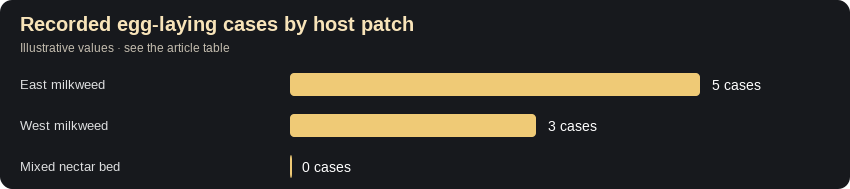
| Category | Value (cases) |
|---|---|
| East milkweed | 5 |
| West milkweed | 3 |
| Mixed nectar bed | 0 |
Illustrative values, not sourced observations. Unrelated adult nectar visits belong in a separate table.
Suppose two neighbors compare notes after a sunny August morning. One saw several monarch butterflies feeding on asters but found no eggs. The other saw no adults during her brief watch but later found two probable monarch eggs on milkweed leaves. Which garden did more for monarchs? The question outruns both sets of observations. The first neighbor documented a resource used by adults on a particular morning. The second found evidence consistent with reproduction, subject to identification and an honest account of where and how she looked. A garden can provide both resources. A single combined tally cannot tell which resource was used, which life stage depends on it, or whether one observation had anything to do with the other.
The best garden notebook for this situation has two related parts. One documents adult behaviors at nectar sources, including uncertainty about what a butterfly was doing. The second records host-plant evidence, distinguishing egg laying observed directly from an egg or larva found later. A third small list of plants establishes what was available and where people looked. The lists can share dates and patch identifiers. Keep their counts separate. Combining an adult feeding event with an egg record produces a number with no clear biological unit.
This article uses monarchs to explain a general field lesson: record the behavior, the plant and the kind of evidence before deciding whether to compare two patches. The examples do not require capturing insects, rearing them, or moving eggs among plants. Many useful notes can be collected from a path with a pencil, a camera if already available, and more restraint about what the field observations mean.
What the life cycle says and does not say
The U.S. Fish and Wildlife Service monarch species account distinguishes the many flowers at which adults obtain nectar from the milkweed resources needed by caterpillars. Its comparison with similar butterflies is another reason not to identify an orange insect solely by the color seen in flight. The Service's monarch field guide supplies a broader account of larval host plants and regional field evidence. These sources support two useful principles for a garden log: adult monarchs can feed away from milkweed, and the plants used by larvae cannot be substituted with any attractive nectar plant.
That does not mean milkweed has only one role. Milkweed in bloom can also be used as a nectar source. An adult on a milkweed flower may be feeding rather than looking for a place to lay an egg, and the same patch can host both behaviors on the same day. Conversely, a butterfly leaving an aster may go to milkweed but can fly out of sight rather than doing so. Record the actions you can see. Do not assign a behavior based only on the observer's knowledge of the plant. A good record can say that an adult perched on a milkweed leaf, or that it fed from flowers of milkweed, or that egg placement was visible. Those statements are not interchangeable.
A caterpillar also documents a different moment than an egg. It shows an observed larval stage, and useful evidence may include identification and behavior on the plant. It does not establish how many eggs were originally present, which butterfly laid one, or how many larvae will become adults. An egg proves no such outcome either. A garden can be used for breeding without your team observing all its stages, and a quiet visit is not strong evidence that a host patch goes unused. Record each stage in its own terms so the notebook does not invent the events that happened between visits.
Timing and place matter. The Service's monarch species status assessment describes the role of breeding, migration, and seasonal resources across a broad geography. That is valuable background for deciding when to watch and how to describe conditions. It does not establish what a single adult in your garden is doing beyond evidence available in the record. A flower visitor on a likely migration date is still best described first as a flower visitor. A local story can discuss migratory context as a possibility without claiming the garden has recorded the insect's route or eventual destination.
Make the watched patch the first thing on the page
Begin with a small map of the area you have permission to watch. A patch could be a raised bed, a marked segment of a hedge, or a group of host plants within a known garden boundary. Assign a stable label that does not depend on a particular plant remaining present forever. East milkweed and west milkweed may be easy names for volunteers to remember, but the map should say where those boundaries are and how a shared edge is treated. If a planting expands into a neighboring bed, either update the footprint with a revision date or create another patch identifier so comparisons do not silently change their area.
Make a resource note for each patch before making an insect tally. It can list the plant identity if known, the observed stage, and whether the resource was accessible from the planned observation point. For a nectar patch, mark which flowering plants had open flowers where you could actually see them. For a host patch, distinguish plants present from those you could inspect without entering a planting or disturbing organisms. A row of twenty milkweed stems offers a different inspection target than one isolated stem, even if both get a ten-minute watch. If plants cannot be reliably identified, retain the uncertainty and mark any plant observations that can be checked later.
Plant identity should be tied to the question. At a community event, a sign reading “pollinator mix” does not identify the plants inside a bed. A photo showing flowers and foliage can support later review, as can information from the gardener who planted it; neither needs to imply that a species identification is already resolved. For a general map, plant groups may suffice. For a documented monarch host record, show that the reported plant is milkweed or label that step unresolved. The purpose of separate plant and insect fields is to prevent strong confidence about one from lending borrowed confidence to the other.
Inventory records also help link changes in management to actual observation opportunities. A patch could lose access when a walkway is repaired. An aster bed could have many stems but few open flowers following storm damage. One week could have a carefully mapped viewing window and another a quick incidental visit. If the background record says what was different, readers can interpret the visit counts as observations made under real conditions rather than imagining that the named bed was a fixed biological machine.
Give the adult watch a clear behavior vocabulary
For a simple adult watch, choose a view, a time window and a consistent definition of arrival. Record clearly visible feeding behavior as its own class. If the butterfly is merely resting on a flower or the viewing angle does not reveal what it did, use another class. Flight through the patch may be worth noting, but it is not a confirmed feeding stop. The same applies when the observer follows one insect outside the patch and loses it against another border: the route ended in the record there, not necessarily in the garden.
A narrow definition of confirmed feeding can reduce the number of usable events. This is not a failure if the note says where uncertainty went. An observer might see a butterfly at petal height for several seconds but have no view of the feeding structures. Recording “flower contact, feeding not discernible” preserves the encounter for education or later study without presenting absence of visible evidence as a negative. Images might help a reviewer later, but a photograph taken moments after the event does not necessarily resolve what happened earlier. Keep any later determination linked rather than overwriting the initial account of what was observed.
Define what simultaneous butterflies mean. If two are feeding on different flowers in the same patch, the notebook can record two feeding observations when both fit the method. If an adult moves among several flower heads, decide whether the outcome is visits to individual flowers, continuous stops in the patch, or number seen at a moment. Those count units are not interchangeable. For a simple outreach project, one continuous feeding stop per adult until it leaves or is lost may be easier to explain than attempting to distinguish every blossom. Avoid claiming that repeated arrivals are known different individuals if the observations do not establish it.
Start timing when observers are actually watching. If the event is a quick pass on the way to another garden task, keep it as incidental rather than inventing duration. If the view was complete but no feeding occurred, write a zero with the observed minutes. If people never conducted the watch, report absence of effort, not zero activity. These distinctions matter whether the project is planning a second planting or assembling a historical account. A count retained without time and context can support a story of what was seen, but it normally cannot support a comparison with another patch watched for much longer.
A host-use record is not a second adult count
For the host side, make the first field the kind of observation: confirmed or possible egg laying, egg present, larva present, or no targeted evidence seen during a stated inspection. Keep behavior observations and later finds separate. For instance, a record that labels a milkweed stem, date and visibly deposited egg reflects a stronger link to an observed adult action than a photograph of an egg found at noon. The second record can still be valuable, but its date is a date of observation, not necessarily the date the egg was laid. Be especially cautious with the way printed labels refer to dates; “egg recorded Tuesday” is not “egg laid Tuesday.”
A volunteer who sees a butterfly touching a leaf should note the action and the limits of visibility rather than guessing from a posture or garden sign. An adult may inspect a plant without depositing an egg. Even if the person could see a characteristic movement, a hidden leaf can prevent direct confirmation of the result. A cautious field table can distinguish “possible laying behavior” from “deposition confirmed,” then make a chart using only categories that fit its title. If the observer can later verify the leaf without disturbing the animal or plant, the record can link the observations while preserving when and how each was made.
A small white shape on an underside does not have to be accepted as a monarch egg in order to be recorded. Note the evidence and keep doubtful records out of the confirmed column. Avoid forcing a resolution from an image that is too soft, too bright, or too far away. If review later clarifies the identity, append the corrected interpretation with its supporting record. The same principle applies when a young larva is hard to identify or the view does not establish the host. Some projects need a review category precisely because a volunteer can collect evidence responsibly without having the expertise to resolve it on the spot.
Decide exactly what inspection means before logging a negative. An easy route might expose the upper portions of several plants but not the undersides of all leaves. Record what proportion or what named subset was viewed when feasible. A restricted site may allow observations only from a single path, limiting the sightline for lower foliage. Do not move living insects, pull stems apart, or pursue uncertain records into unsafe ground to complete a uniform table. A lack of access can be a recorded limitation. No observer owes a conclusive finding from a physical vantage that cannot deliver it.
The figure counts eight example egg-laying cases
The bar chart is labeled “Recorded egg-laying cases by host patch.” It gives five cases in East milkweed, three in West milkweed, and zero in the Mixed nectar bed. These are invented counts for explaining record design. They are not observations from Fish and Wildlife Service surveys, and they do not report an effect of east- or west-facing exposure. In this example a case means one episode in which laying was recorded under the same stated evidence rule. The columns sum to eight cases. They do not count the number of egg-bearing stems, the number of unique mothers, or eventual surviving larvae.
The zero in the final bar is useful only with its background. Imagine that the mixed bed included no suitable observed host plants within the watched patch, and that the observers retained the bed for its role in a parallel adult feeding log. Its zero here portrays that there were no qualifying host-related cases in this invented display, not that the mixed bed did nothing, nor a formal comparison of reproductive rates among identical host resources. Another project could exclude a hostless patch from the egg-laying figure and place the reason in its inventory. Either presentation needs a caption that acknowledges the different resource opportunities.
Adult nectar records from the same garden are intentionally absent. If an additional log recorded twelve adult feeding stops among the mixed flowers and four at each milkweed bed, those hypothetical numbers would belong in a separate figure or a clearly labeled adjacent panel. They would not be added to five, three and zero to rank an overall garden score. A reader can compare resource use qualitatively across the two panels. The bars have different meanings and could be gathered under different protocols. The existence of a shared place label does not create a shared denominator or a common unit.
It might be tempting to divide the five east cases by the three west cases and report a roughly two-thirds advantage for the east bed. The arithmetic yields a ratio for this particular toy numerator, but the conclusion is not supported. The chart has no host-stem exposure, viewing duration, dates, uncertainty measures, or equal likelihood of seeing the event. If a real project wanted to compare laying activity, the team would need a matching design and sufficient observations, not just normalized bars. Inspect eligibility as well as what is tallied before choosing the chart. Attractive side-by-side columns do not settle whether a comparison is warranted.
Record effort differently for the two questions
An adult watch generally needs a time unit. The amount of time viewing the designated zone affects how many behaviors have a chance of being seen. A leaf inspection may instead depend more directly on the number of stems or surfaces examined and the limits of the viewing method. Both can use clocks for scheduling and documentation, but one should not turn thirty minutes spent photographing flowers into thirty equally productive minutes of host inspection. The forms can share a visit identifier if both methods take place on the same day. Give them different effort fields.
Suppose a volunteer watches a nectar patch at a comfortable spot for ten minutes, then sees an egg on the way out. That conclusion belongs as a record of egg presence on the specific plant, not as ten minutes of host search with one detection. A second volunteer who deliberately views the same target subset of stems under the same route rules provides a different kind of evidence. To compare inspection results across dates, hold the effort unit and accessible subset stable if practical, or describe the changes if not. This approach preserves opportunistic finds without confusing them with formal searches.
It is also possible to watch egg-laying behavior on milkweed as a timed activity. In that case time is indeed part of the denominator, and information about which stems were visible helps assess how comparable the behavior watches were. This does not mean a timed behavior watch can be pooled with a detailed count of egg presence. An individual laying event observed in a ten-minute interval can plausibly be detected later as a single egg during an inspection. If both records are retained and linked, the relationship strengthens the evidence. Counting them as two unrelated cases would double count a documented connection.
Effort does not cancel uncertainty about access and backgrounds. A dark hedge behind the nectar plants could make an orange butterfly easier to see. Wind could shift the leaves enough to hide a host sightline. If observation windows were short, one unusual busy period can dominate the result. Watch comparable patches in more than one matched period if feasible. Record the weather and viewability without assuming that any one observation condition caused a difference. Test whether the categories remain useful by showing sample records to another volunteer, rather than waiting for an entire season of inconsistent entries.
Keep resources and neighborhoods in the right spatial frame
A butterfly has no reason to organize its movements around a garden's fence. Adults can enter from adjacent properties and leave the study area in moments. A site with nectar and no known host plants can still be part of a larger neighborhood habitat in which host resources are available beyond the boundary. A site with milkweed and little bloom at a particular moment may still be visited by adults whose feeding occurs elsewhere. These possibilities are reasons to avoid ownership claims about individual butterflies. They are not permission to map or enter neighboring property without consent.
If public information or permitted observations document nearby habitat, retain that as a contextual layer. Say whether it records broad habitat features, potential plant resources, or an independently observed event. A neighborhood map showing likely milkweed locations in public areas provides hypotheses for a survey. It does not demonstrate that a particular butterfly photographed at an aster hatched in a particular patch. Better geographic display can make an unjustified connection more persuasive, so leave unknown paths off the map and show the locations where the observations themselves occurred at a suitable level of precision.
Use repeatable references when sharing results. A local conservation group may need the name of a park sector, not every plant coordinate. A school display may need only one schematic map of the garden, with clear directions to a safe and authorized viewing point. Avoid posting sensitive locations or encouraging a crowd to handle host leaves during a busy event. Precise geographic detail can be useful within a permitted monitoring project and still inappropriate in a public gallery. The observation log and the public report do not have to contain the same location precision.
A useful interpretation can remain modest. “We observed feeding in this bed and found independently supported host-use evidence within the same garden” communicates more than “we had the most monarchs.” It accurately connects two sets of evidence by place without making them continuous in time. If both observations occurred during one day, say so. Do not imply that there was enough tracking to know which adult was linked to which egg. Location co-occurrence can suggest a larger project, not substitute for one.
Plan around seasonal opportunities without forcing a calendar narrative
Nectar availability changes with bloom, and the appearance of a host plant does not by itself establish when eggs or larvae will be detected. If the log focuses on late-season adult feeding, arrange watches when the relevant flowers are actually open and make a record of bloom state beside the visits. For host observations, include stages of plant growth that are actually visible and dates when inspection was possible. This design helps distinguish the disappearance of a planting from the end of a viewing window. It also protects against readings that treat an early season without open asters as a failed aster feeding survey.
A garden account can compare observations before and after a flowering period without claiming that the difference is due exclusively to bloom. Weather, other resources, access and observer effort can change alongside the timing of flowering. Adult monarch abundance in the wider area can vary for reasons a garden watch cannot assess. If two years are compared, look first at whether the selected windows overlapped in dates and field conditions. When they do not, show the dates and explain the limit. A report of first documented use under a stated schedule is still useful and more honest than a reconstructed date of first arrival.
Avoid using a national calendar as a local mandate. Different locations can be used in different ways at different times, and published observations at one site or in one region do not determine the schedule for all sites. Use authoritative regional guidance for resource and conservation planning, and keep precise claims tied to the named region and period. The local notebook should give its actual calendar, access conditions and observation result. Background can frame the garden record, but the garden record should not be described as validating conclusions on continental migration unless that was the design.
Chronology among records can inspire questions without supplying missing events. An observer may see a likely egg early in a week, no longer see it on the next inspection, and then find a small caterpillar on another plant. The records should not be joined into a story of one animal unless the evidence legitimately supports that link. The egg may belong to a different observation history or the initial find may be difficult to relocate. Record what was still visible, what could be rechecked, and what remains unresolved. Honest incomplete histories are preferable to inaccurate complete ones.
Design a first-season project that yields two real answers
Imagine a school science club can visit two plots every Thursday for half an hour. One plot has two marked milkweed groups and an aster border. The other has a small nectar plot and a single milkweed container within the same sightline. The club should identify the adult watch question first: for a fixed time at a marked viewpoint, which confirmed behaviors were seen? It can answer this separately by plot and day without claiming it saw every adult. Then name the host question: during inspection of the designated accessible stems, what evidence of host use was documented? Plot conditions that prevent an inspection are recorded instead of silently equalized.
Set one person to observe and another to note context if this makes the watch more consistent. Keep the roster and method as simple as possible. If several students all see the same adult, combine the group report by event rather than multiplying the encounter by the number of students. If students view different areas, record those view boundaries and combine them only under a stated rule. Sort observations by patch and actual time. A change of roles can be recorded so that differences in classification can be discussed without treating the observers themselves as a source of blame.
Choose one allowed follow-up action for uncertainty that does not disturb the site. A later look from the path, an independent review of a photograph, or a careful recategorization of unclear field language can all be useful. For example, “touching leaves” can remain possible behavior rather than becoming either confirmed laying or no event. Do not retrospectively assign in-person confirmation because a photograph shows an attractive close-up of a different plant. If formal identification is part of the project, distinguish a student field label from a later determination and say which one the public chart counted.
At the close of the season, first report the number of complete visits, partial visits and incidental records. Then provide a compact summary of adult feeding, host evidence and plant availability by period. The summary can show when a resource was used and when lack of access made use difficult to assess. If the report recommends additional nectar plants or a better view of existing milkweed, describe it as a planning choice based on local goals and evidence, not as a measured promise about next year's monarch abundance. Separating the two questions makes the final report more useful because gardeners can recognize where the evidence is strong enough to guide action.
What photographs add, and what they cannot substitute for
A photo can preserve detail that the observer did not have time to name in the field. Both the plant and the insect may be visible in the same frame, which can make a confirmed host association easier to check. A broad contextual frame can show the placement of the leaf or flower a close-up might hide. Preserve the linkage between the context frame, the close-up and the original notes. Dates and patch codes should be consistent across files. If the two photographs are not of the same insect or the same plant, label them as separate records rather than assembling them into an uninterrupted account.
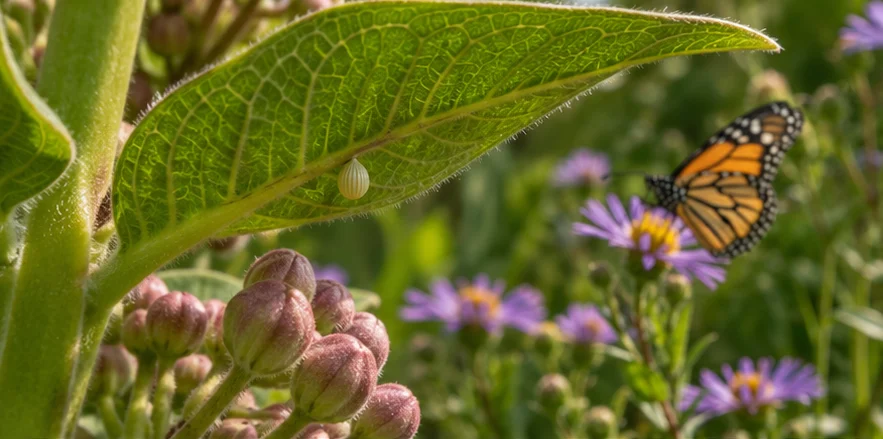
A clear still of a perched butterfly does not establish that it was feeding seconds earlier. The observer can write the observed action separately and explain how the later photo relates to it. If the purpose is to share what an egg or caterpillar looks like, credit and distinguish reference imagery from the actual record. A generated illustration in an article may be useful to show the difference between an adult and an egg in one composition, but it supplies no field evidence. The reader should never have to infer whether a particular illustrated leaf was one the study actually inspected.
Sometimes the right choice is to take no image. A volunteer who moves to frame a butterfly can interrupt the watch or cannot safely get a view. A flower that is too high to photograph can still be logged as an adult observation with uncertainty when needed. Records without photographs are not automatically false, and photographs without notes are not automatically proof of a particular action. Defining the evidence standards before a project begins gives both forms a coherent role. It also prevents the best-edited gallery from silently becoming the most trusted dataset.
Use the two ledgers to tell a better story, not choose a winner
One association might ask two practical questions about improving a public garden: whether visitors can see adults using nectar plants from accessible paths, and whether the same property includes suitably documented host use. The strongest answer may be that the existing aster border contributes a visible feeding scene, while the milkweed area has independent signs clearly worth continued observation. The public interpretation should make each type of evidence legible in its own language. A visitor can appreciate adult feeding without mistaking a flashy bloom for a complete life-cycle habitat.
Before sharing a graphic, check whether the figure communicates a unit acceptable to an outside reader. A title saying “Eight monarch records” is vague if the events were cases of laying. A figure calling all observed butterflies nectar users is inaccurate if some merely flew over. Keep uncertain sightings and incomplete watches visible in notes or tables. If the counts are invented to teach the method, say that directly where readers see them. The same care belongs in accessibility text. Describe what the numbers mean, not only what colors the bars use.
When the next season starts, keep the patch definitions if they remain suitable, document any changes in the observation method, and retain the raw notes beside any corrected summary. Make it possible to re-evaluate a conclusion after a later plant determination or a clearer photograph. You can then ask more focused questions: Did adults use a previously unrecorded nectar bed under matched watches? Was host-use evidence seen in a new patch after the team had enough access to look? Those are useful ecological findings even if the project never compares the number of individual monarchs between gardens.
Ultimately, aster and milkweed observations complement each other because they are different. The adult feeding ledger describes where particular feeding activity was recorded. The host ledger describes events or stages relevant to reproduction and larval ecology. Preserve both, keep their limitations clear, and resist the easy total that discards the part worth knowing.
Test the interpretation with three report readers
Consider a draft report that starts with a map and puts the toy egg-laying chart beside a photograph of asters. One reader looks only at the bar chart and says the nectar bed failed. A second looks at the photograph and thinks the butterflies were counted on the pictured plants. A third asks how observers knew that the zero represented a watched patch rather than an unused field in a spreadsheet. All three reactions are useful tests. The chart title, image caption and patch note should work independently as well as in sequence. A direct statement that the bar counts cases of laying rather than all forms of resource use addresses the first and third reactions without adding a second scale to the graphic.
A report reviewer can read the adult ledger in much the same way. Suppose a headline says that adults preferred asters to milkweed, based on ten recorded feeding events on asters and one on flowering milkweed. How many open flowers were present? Was the milkweed in the same view for the same time? Did the team watch when both plants had flowers? Is movement of the same butterfly within the watch a single event or several? The record might answer none of those questions and still support a simple statement that more feeding events were documented on asters during the visits. “Documented more events” and “preferred” are different claims. A preference design would need to address the availability of alternatives and whether the observations represent meaningful choices.
Try reviewing an ambiguity before a whole season of watches. Give two volunteers the same anonymized example note: “one adult on milkweed twice, then one egg seen.” Ask each to convert it to the table format independently. One may enter two adults and a laying case; the other may enter two contacts of unresolved individual identity and a separate presence record. The disagreement exposes missing fields. Were the two observations part of the same continuous watch? What kind of touch was visible? Was deposition seen? Did the photo establish the egg on the same stem? The project can add these questions to its form without requiring volunteers to find anything new. This is a design exercise, not an accuracy test of the two people.
An editor can also check which “zero” is eligible to show. Imagine four plant rows: an inspected host stem with no egg seen, a host stem impossible to view, an aster with no attempted host inspection, and a host stem whose result was never entered. Treating all four as zero would enlarge the denominator and make the example appear more complete. A well-structured chart uses the first record as a searched zero where appropriate and reports the others as unviewable, inapplicable or missing. An adult-watch chart has a parallel decision when the field event starts late or the volunteer never takes a position. Recording status directly gives future reviewers something to inspect without relying on how each person used white space.
Finally, verify that garden recommendations follow the two kinds of result rather than the intensity of the photographs. If there is strong adult-use evidence only for the existing nectar bed and no meaningful host effort, improving host-view coverage may be more informative than calling the bed inadequate. If the only confirmed laying cases come from one accessible patch, widening the monitored area might answer whether those examples were local and repeatable. Distinguish these next observation steps from habitat work that would require permission or regional advice. An effective release can end with a narrower next question rather than a verdict on the garden.
Sources and illustration note
- U.S. Fish and Wildlife Service: Monarch species account.
- U.S. Fish and Wildlife Service: Monarch Butterfly Field Guide.
- U.S. Fish and Wildlife Service: Monarch Butterfly Species Status Assessment.
- The chart uses fictional East milkweed, West milkweed and mixed nectar-bed counts; the header illustration is generated editorial artwork, not observation evidence.