
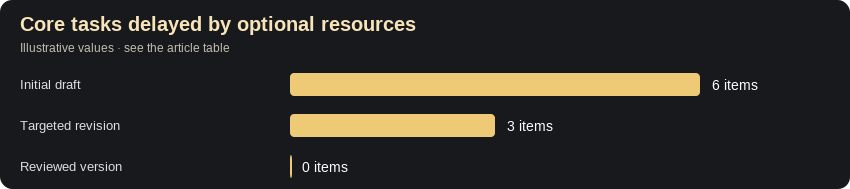
| Category | Value (items) |
|---|---|
| Initial draft | 6 |
| Targeted revision | 3 |
| Reviewed version | 0 |
Constructed audit of 6 fixed, distinct cases. First review resolves 3; second resolves the remaining 3. Not observed performance or a conformance score.
A librarian opens a lesson on a shared computer before a small group arrives. The page title appears right away, a box in the middle says a video is loading, and the browser continues waiting. The question the learners need, the image they need to examine and the instruction for recording their answers are all inside the blank box. The page has loaded enough to advertise the lesson and not enough to teach it. A fast connection at the publisher's office had hidden the difference.
A better packet starts with the learning task. It makes the required directions and source evidence available in a small, controlled first-party version. It offers wider scans, audio, interactive demonstrations or external context as optional extensions, unless one of them truly belongs to the learning objective. Tests should let the reviewer carry out the essential task under a named simulated connection and deliberately unavailable optional resources. A picture of a title visible in a browser is not the test's endpoint.
This guide considers an ordinary library lesson, not an institutional network security policy. Its audit counts are invented. The central design question is not whether every work can become tiny or every library can operate entirely offline. It is how to make the necessary parts of the lesson usable before an optional resource arrives and how to tell the reader truthfully when additional connectivity is needed.
Decide what a learner cannot do without
Make a short list of actions. A class may need to read a prompt, examine two source excerpts, record an observation and follow a citation. Another class may need to listen for a change in tone or inspect fine detail visible only in a large scan. An organizational template cannot decide these needs by file type. A video can be expendable enrichment in one lesson and the subject in another. Define the evidence required rather than declaring that every large resource is optional.
Imagine a lesson comparing two newspaper notices. The essential evidence could be two clearly identified and accurately transcribed excerpts with enough surrounding context to understand them. An original page scan may add visual detail and show the notices in their setting. If the question concerns typography, headline placement or damaged print, a transcription alone is not equivalent. A carefully selected crop or other suitable representation may need to be in the first-party packet. Decide which kind of evidence the lesson actually uses and preserve it explicitly.
The Digital.gov plain-language guide provides audience-centered guidance for making public information understandable and testing whether it communicates. Following that advice here means starting with the required activity and defining a recognizable path to its sources. Readers should not need to guess whether “open resource” means a required page, a downloadable source, or an optional trip to another site. Descriptive link names and short instructions belong to the essential experience as much as fast transmission does.
A useful lightweight assessment is to ask whether a new reader can complete a short representative task without special knowledge of the project. Give them the packet and the setting they are likely to have, not access to the editor's notes. Can they locate the source excerpt, read its date and distinguish what is reproduced from what is commentary? Can they find a meaningful next step when the video is unavailable? If completing the task depends on the reader already knowing what the missing content would have said, the packet has not preserved the task.
Avoid transferring unnecessary labor to library staff. A learner-facing lesson that requires preinstallation of a large app or a librarian who can recreate every missing file is not a low-connectivity lesson by itself. If preparation can solve a real issue, name it clearly for the intended librarian, including what to download and what works afterward. Distinguish material that can be prepared on a better connection from material that will still need a live dependency during use.
Make the first-party packet a recognizable edition
A first-party static module is one served as part of the publisher's intended resource set rather than waiting for a third-party embedded service to assemble the core experience. It could be plain HTML with a small amount of styling and a set of locally hosted source files, or a deliberately scoped printable artifact with a stable page explaining its role. First-party hosting does not guarantee speed, authorization or offline access. It does give the publisher a more direct path to test and maintain what the lesson needs.
Keep a small manifest of the included resources and their relationships. A reader should know which excerpt, image or reference belongs to which version of the exercise. Give the lesson and its source packet a visible version or date where changes matter. Avoid links whose names refer only to an internal build directory. A future teacher opening a local copy should still recognize its subject and which edition a note refers to. This is especially useful when a library needs to prepare a copy ahead of time.
The Library of Congress Recommended Formats summary is a reference for selecting formats in preservation contexts, not a page weight budget or a prescription for browser use. The exact queued link rejected this automated retrieval; use it for the documented preservation context rather than for unverified particulars or performance claims. The purpose of an enduring archive master can differ from the purpose of a lightweight classroom copy. Keep an approved master if policy calls for it, and generate a usable access version without representing it as the unmodified original.
State what the access version does. A reduced image may show the text needed for the task and omit the surrounding page. A transcribed excerpt may include normalized spelling or mark uncertain characters. If substitutions affect interpretation, describe them. A compact packet need not pretend to reproduce the entire heritage object. Clear scope notes make it possible to reduce bytes without erasing evidence. For a fuller comparison, provide the larger permitted source as a separately labeled option.
Rights and access must be considered independently from network speed. If the original excerpt cannot be reproduced, a local page may still give an authorized description and link to the source. If the linked material is essential and not reliably reachable, the lesson needs a different authorized source or a more honest statement of its prerequisites. Do not extract or redistribute a third-party work merely to meet a weight target. A technically reliable offline packet can still be inappropriate if it contains material the project is not allowed to distribute.
Give optional resources an honest boundary
A third-party iframe can load separately and fail independently of the surrounding page. A link to an optional reference can also be unavailable on a restricted library network. An ordinary document should still display the central prompt, essential evidence and instructions if those truly are optional resources. Keep the invitation to load them after the core content has become usable. A placeholder can name what the person will get, its type, and any important size or connection requirement rather than showing an indefinite spinner.
The HTML Standard documents loading behavior for iframes, including lazy loading. Deferring a request can help prioritize a page, but it does not turn critical content hidden in the frame into first-party core content. A lazy frame may still need a connection, and its behavior is not the same as a reader deliberately opting in. Decide whether the alternative should be a normal link, an explicit load action or no inline integration at all. Verify actual request behavior rather than reasoning from the attribute alone.
If an iframe is essential because the task involves a particular interactive model, explain that honestly. Consider whether there is a small authorized export, static worked example, or alternate task appropriate to the same learning goal. A description that cannot reproduce the necessary interaction might be a separate fallback lesson rather than a faithful replacement. Label the difference. “Can be completed without external media” is a claim about outcomes, not a hopeful description of a page with a blank region.
For optional images and clips, show their relationship to the task. “Optional: listen to the full interview” distinguishes the resource from its already present selected passage. “Open original scan” can tell a reader why they might choose a larger file. If the file is large or unfamiliar, give a useful indication before requesting it when the real size or requirement can be established. Do not promise instant access and do not label a destination as offline simply because the link itself appears in a downloaded document.
Set a budget for completing the task, not merely opening the URL
Choose an explicit starting state. A first visit on a shared computer might have no prior copies of the lesson assets. A repeat visit may retrieve some resources from cache. Both experiences can matter, but a warm-cache pass cannot establish cold-start behavior. Record which condition you used in experiments. If testing in a normal profile would expose real user information or alter unrelated settings, use an authorized clean test context rather than borrowing somebody else's session.
A practical budget names required bytes, number and type of requests where useful, and time to an observable learning milestone under the test conditions. “Read the prompt and open the first source excerpt” is more informative than “initial page load fast.” It represents a task. If the headline appears long before the excerpt, a screenshot at first paint is not evidence of readiness. Likewise, a high aggregate score from a performance tool does not prove a specific resource was legible or available.
Separate transferable size from decoded size. The network panel can report transfer information for a compressed response, while decoded data and rendering can impose work on the computer. A small image can have disproportionately large dimensions, and a fixed budget for transferred bytes is not a complete account of performance. Still, a documented request budget helps separate avoidable assets from the core. Choose tolerances with the people who run the lesson instead of treating another site's benchmark as a universal value.
Start by listing what must arrive before the milestone. The HTML might carry the prompt and citations. A stylesheet can support legibility, but the content can remain recognizable if the style is delayed. System fonts can avoid an extra dependency for ordinary text. An image may be necessary and can be resized or cropped with the appropriate context. A script might enhance a data explorer without being the only way to see the worked table. Use this inventory to identify accidental requirements rather than minimizing bytes without attention to the task.
Check what is fetched even if the interface says optional. A video host, font service, analytics script or preload tag might request a resource before a user chooses it. A task can be delayed by network contention or processing despite the optional file never becoming visible. The question is not whether every external request is bad. It is whether a resource described as optional is in the critical route. Inspect the network sequence and compare with the documented design.
Simple arithmetic can inform expectations, but it should not replace testing. Transfer duration depends on throughput along with connection setup, latency, request scheduling and the behavior of the actual device and service. Two designs with equal byte counts can become legible at different times. A lesson that transmits one small text frame first can let a reader start sooner than a similarly sized package that waits to assemble every section. Test the order in which important material becomes usable, not just the total weight.
Use slow, blocked and offline tests for different questions
The Chrome DevTools network reference documents features for recording requests, disabling cache for testing, throttling and simulating offline conditions. Those are useful mechanisms for a controlled check. Do not imply a browser preset is a measured library connection. Record the browser version or relevant environment, selected conditions and whether caching was active. A simulated profile gives a reproducible comparison, not a guarantee about actual deployment.
In a slow cold-start trial, open the intended lesson route and carry out the first core task. Note when the prompt and evidence are available, and which requests remained in flight. If the learner needs a second module, follow the ordinary link rather than relying only on the entry page. Keep an eye on long pauses before useful content appears, not only on resource status codes. Record what the user could actually do. An image that finished downloading after the test user left does not count as evidence available at the earlier milestone.
In the blocked-dependency trial, make the specified optional service unavailable in an authorized fixture and try the same task. Verify that the internal material remains reachable and the fallback text or link explains the unavailable extension. A loading animation that never resolves is not a working fallback. An error message can be concise without blaming the library's network when the cause is unknown. Useful wording identifies the extension that did not load and keeps the main directions visible.
Test offline only when describing offline behavior. A first-party web page still needs a connection on a cold first visit unless an offline package has been prepared or another real mechanism makes it available. A downloaded packet and a cached web view are not the same promise. For a local package, open the actual downloaded artifact with the intended permissions and software, disconnect in an authorized test setting and try the advertised tasks. Check relative links and any assets opened inside the packet rather than presuming everything on the homepage is included.
A repeat-visit trial can reveal different issues. A cached image from an older edition could be displayed with a newer prompt, and locally retained content can obscure an unavailable file that new users would have encountered. Verify that the version markers and referenced evidence agree. Separate a warm cache from deliberate offline availability. It is fine to report a benefit for returning users while acknowledging that the first visit still needs the network. The claim should follow the tested path.
Use real-library feedback where appropriate and authorized. A site may have policies, devices or filtered destinations absent from your synthetic test. A moderate throughput simulation is not evidence that an external host is reachable there. Ask staff about representative use and keep any situational results separate from the repeatable fixture. A design can improve under controlled conditions and still need work before it serves a particular site. Reporting the limitation helps the next team test the right conditions.
Reproduce the six-case audit
The illustrative bar chart is titled “Core tasks delayed by optional resources.” Its unit is items. Initial draft has 6, Targeted revision has 3, and Reviewed version has 0. These values describe a constructed audit of six fixed, distinct cases. The first revision resolves three and the second resolves the remaining three. The numbers are not observed performance, an accessibility conformance score, or results from the official sources. The matching table gives the same values.
| Review stage | Core tasks delayed by optional resources (items) |
|---|---|
| Initial draft | 6 |
| Targeted revision | 3 |
| Reviewed version | 0 |
The fictional first three interruptions are a prompt appearing only within a third-party frame, a large scan fetched before its essential excerpt, and an optional web font delaying visible reading in the tested example. The other three are an audio player initialization gating directions, an optional script competing with the first source request, and an absent first-party fallback when an enrichment panel fails. Give every case a named task and expected result. The unit is the case, not the number of stalled requests or how many readers might have experienced it.
The targeted revision places the prompt in the core document, prioritizes the small relevant source representation, and makes the intended text usable without the optional font. The other three cases remain open. In the fictional reviewed version, the activity directions no longer wait for the audio player, the optional script does not interrupt the tested source route, and the enrichment failure leaves an available local alternative. Zero describes the six named cases under the toy scope only. It does not predict loading time or prove usability in every library.
A useful text counterpart gives the stages, counts and fictional status. If you adapt this audit for actual project work, record the task and the connection condition for every case. Two reviewers can encounter the same interruption without doubling the case count. Conversely, a repair that makes one resource display may not remove another delay. Record which behavior was rechecked before counting it as resolved. Comparison requires a stable definition of what the bars contain.
Package the evidence so a copy remains intelligible
A prepared local copy needs more than a web page that was once cached. Give it the files required for the declared task, keep their internal references navigable, and include a small opening page explaining what works and what requires access later. A packet may use ordinary document formats or a compact locally readable document structure depending on expected software and institutional policy. Test opening it through the real path available to staff. A bundle that an author can open with a developer service may not be usable through a library's normal document application.
Retain source labels beside the necessary materials. A local copy of a chart or excerpt should identify where it came from and any relevant alterations. An optional link to the full source remains useful when the connection returns. Do not require that link to retrieve the bibliographic meaning of the local material. A reader should be able to describe which representation they analyzed whether or not they can immediately obtain the original.
Be careful when shrinking an asset for distribution. A cropped image can omit borders that show the position of the printed notice. A compressed scan can render a crucial word uncertain. A sound recording entitled “complete interview” should not be represented by an unmarked excerpt. Verify that the necessary fidelity survives along the actual reading path and identify the tradeoff. Lightweight is only useful when learners still have the evidence the activity asks them to examine.
Version the packet so more than one local copy can be recognized. A teacher who saves the packet for next year may find that the online assignment has changed. Give a visible version marker and explain when a new packet is required. Do not assume an old package becomes current when the landing page is updated. A later replacement can carry its own description while leaving the older lesson understandable for historical use where appropriate. This is basic editorial stewardship as well as performance practice.
If a packet includes editable work, check whether its save behavior is local or dependent on a service. A static handout can be usable offline and still point to a form that requires connectivity for submission. Do not offer offline completion if the exercise cannot record answers by any intended route. Provide the appropriate alternative if the program supports one, such as an ordinary worksheet or local record, and distinguish doing the learning task from submitting the result. The two milestones need different evidence.
Match scope notes to the person making a decision
A learner needs descriptive instructions about what to open now. A facilitator may need a more detailed account of what to prepare in advance and what could fail during the session. Put the key requirements on each route without burdening everyone with the same inventory. If a lesson takes little bandwidth except for one optional large file, tell people what that file adds. If a source must be acquired in advance because its live version is unreliable, say which lawful route the facilitator can use. Do not transfer uncertainty into a vague “best experienced online.”
Avoid turning a technical test profile into promised service. A sentence such as “in our cold-start test on the named simulated profile, the reader could open both short excerpts without waiting for the video” gives a credible bound. “Works on slow internet” is much broader. Where additional settings or devices were not checked, be specific about the limitations that matter. A qualitative outcome based on real tasks is often more helpful than a decimal load time with no description of what had become usable.
The same principle applies to secondary readers. Someone opening an optional source may be there to inspect the full object rather than complete the lesson. Give a reasonable route for that use, but make it clear that larger originals are separate from the preliminary packet. A current work can serve different levels of depth without embedding each level in the default browser load. The author decides what must be present, and the reader chooses when to ask for additional detail.
Compare two versions of a named task
Imagine a fictional local history module about comparing where two advertisements appeared. In the first version the learner sees a progress indicator while a remote viewer obtains a full issue of the newspaper. The actual question names clues contained on two pages. In the proposed first-party version the prompt, the appropriate authorized clips, the dates and the location cues arrive in one small set. The larger full issue remains linked for optional checking. A reviewer can compare the two by asking whether a person can identify the same differences without waiting for the remote viewer to succeed. Merely asking which page looks better on first load does not test the substitution.
Now change the task: the learner has to locate a notice on an unmarked full page. The two clips no longer supply the equivalent challenge. This is why an essential-resource budget begins with the objective rather than the asset list. The project can preserve the page as a suitable local image or create a related activity that identifies its reduced scope. It should not mark the new version as the same exercise without verifying that the evidence and reasoning are intact. A shorter asset can simplify distribution without necessarily preserving content.
Compare open and ready in both cases. The browser may say it loaded the first page while a required resource is still unreadable. It may also remain busy transferring an optional file after the learner can start. A worksheet with a first question and its evidence visible has a meaningful milestone. If a plan has several phases, name the next one separately, such as reaching a second source or being able to record a response. This helps a small engineering change correspond to an observable improvement for readers.
Check the wording of the enhancement action near the module. A button labeled “Start lesson” implies that what follows is required. If it actually requests an extensive visualization after the core task, give it a more specific purpose. A disabled player can still make people wait if its size and placement imply that they should not continue without it. Reorder the page around the required work and make optional depth recognizable. Language and resource timing serve each other when the expected workflow is clear.
Check dependency choices before adding a fallback
A tightly scoped module should be able to list its essential files without discovering a long chain of transitive calls. A chart might use a script that loads a font that waits on another service, or a page might fetch prompt text from a remote content store. Some dependencies are reasonable, but reviewers need to know which ones can stop the lesson. Draw a simple path from entry to task and mark the requested files involved. A good independent module is one whose observed path matches the intended scope, not one described as static in a source directory.
Fallbacks are more useful when they do not rely on the feature they replace. A fallback message inserted only by a failed script may never appear. A reference image provided by the same blocked origin as an unavailable viewer can disappear at the same time. Place critical explanatory content at a stable local location where appropriate. Keep the required origin and the optional origin distinct in the test. If the two share an outage, be truthful about what is unavailable rather than assuming the fallback succeeded.
Sometimes no alternate path exists for an optional extension. A concise note can tell the reader that it is unavailable and that the main task can continue. Avoid manufacturing a button that appears to retry but uses the same blocked route without any reason to expect a different result. For an essential resource, make the limitation explicit and explain the supported alternative if there is one. The useful thing is the reader's ability to decide what to do now, not a guarantee that every link will always deliver a result.
A development team can test a baseline without an enhancement and then test the enhancement separately. This helps distinguish an independent module from one that is accidentally held back by optional initialization. An improvement can also be confirmed by observing that the required evidence arrives earlier under a named profile, not just by showing fewer entries in a request list. Some requests may be benign if they do not delay the task and have an appropriate reason to exist. Keep that reasoning in the release record so the next team does not remove a necessary feature for the sake of a raw count.
Plan updates for prepared classroom copies
A public website can be updated promptly and still leave earlier prepared packets in library directories. Treat the locally shared version as a distinct release. An explanation of which edition was reviewed, which limitations apply and how to find a current one can accompany the opening page. A date is useful when it clearly marks the packet's own release rather than the source object's date. A teacher should not have to infer that a scan from 1911 was bundled only last month because a timestamp is stripped on download.
A changed prompt can make an earlier excerpt insufficient. If the revised task refers to a different passage or a new annotation, check that the packet provided for it includes the right evidence. Reusing a stable illustration across several versions is fine when the same asset still serves the stated task. Matching names alone are not evidence of compatibility. Record which lesson version expects which packet. If a prepared local copy cannot advance beyond its own edition, say so rather than giving a promise it cannot keep offline.
When recording results, include the definition of success and the scope of a local fallback. For example, a downloaded exercise might allow reading, comparing and writing a response on paper, while submission into the online library program still requires connectivity. A library can decide whether that boundary is acceptable for its session. Reporting “offline compatible” without explaining the available path may lead staff to schedule a class that cannot do what they intended. Clear limitations are not an obstacle to adoption; they make adoption easier to plan.
Give the performance report a short, useful form
A maintainer should be able to reproduce three things: the starting cache state, the named simulated network conditions, and the point at which a representative learning task became possible. A fourth useful detail is which optional resource was deliberately made unavailable. Record the test artifact version and which file supplied the essential evidence. If there was a partial result, state the first activity that succeeded and which one still waited. This account makes it possible to decide whether an improvement helped actual reading rather than moving a progress bar earlier.
For a handout to the facilitator, translate that evidence into an operating instruction that remains honest. “Open the local packet first; it contains the two excerpts needed for the exercise. The full scan is optional and needs an internet connection.” That is more useful than an unqualified promise of optimized access. If the local packet has not been tested with the library's software, identify the prerequisite or report that it remains unverified. An article can describe a repeatable method without borrowing confidence from a library it did not actually visit.
Build an acceptance check that identifies the bottleneck
An appropriate first-party fixture includes one referenced excerpt, one deliberately absent optional destination and a realistic core task. Ask the reviewer to locate the prompt, read the excerpt and give the intended kind of response as far as the test environment permits. Record the last required resource that arrived and whether an optional request was involved. If work stopped, identify what the reader could still see or do. A failing check should produce more insight than a summary of total bytes.
After an improvement, repeat the same task and profile. If the prompt is now available first but the next required source is still unreachable, report the partial improvement. If an unavailable optional element can still be interpreted as essential because of where it appears, change the wording or layout and check again. Resource priority and editorial clarity can fail independently. A real pass requires both paths to agree on what the learner needs before proceeding.
Compare the actual request path with the intended resource diagram. If one local module invokes a third-party script that must complete before it displays any text, it is not independent of that service. If the live page remains usable after the script fails but a locally downloaded copy references unsupported remote fonts or styles, note the separate surface. One check should not receive credit for the other. Record the artifact and version along with the observed result.
Finally choose what to report when an older browser or device differs. A well-designed test can show earlier readiness in the named setup and expose further work on a different one. It does not have to declare that the whole lesson failed under all conditions. Use the findings to decide whether an alternate route needs to be easier to find, whether the essential task should be simplified, or whether the supported platform prerequisites were unclear. The evidence should help a library plan rather than merely describe what software was fashionable.
A release comparison should also record whether the publisher changed source fidelity while reducing the transfer. A smaller transfer may come from a container change without any meaningful loss, or from removing image detail that learners were expected to interpret. Compare the outputs against the lesson's evidence requirements and report any intentional simplification. The task-based review should catch a missing date or illegible marginal note even when the compression makes the performance result look favorable.
Repeat the relevant checks after ordinary edits, not only after changing the delivery architecture. A newly inserted player or remote image can reintroduce a prerequisite without touching the primary lesson template. Name an owner for the essential resource list, and verify new materials against it. A durable small packet stays small because its contents are deliberate, not because a designer once measured a blank demo.
A small source packet succeeds when learners can begin with the evidence and directions they need, even if a richer extension never arrives. Name the optional resources, test the essential task under the conditions claimed, and keep a clear line between a first-party web view and a verified offline copy. This makes it easier to teach on a constrained connection without treating disconnected operation as a benefit the publisher has not actually delivered.