
| Category | Value (grams) |
|---|---|
| Starting material | 500 |
| Transferred | 475 |
| Retained | 18 |
| Unaccounted | 7 |
Illustrative only. Invented values, not taken from a source dataset or an official target. Use a simple nonhazardous gravel tray mass balance to separate gross, tare, transferred and unaccounted material; consider adhering pieces and scale differences.
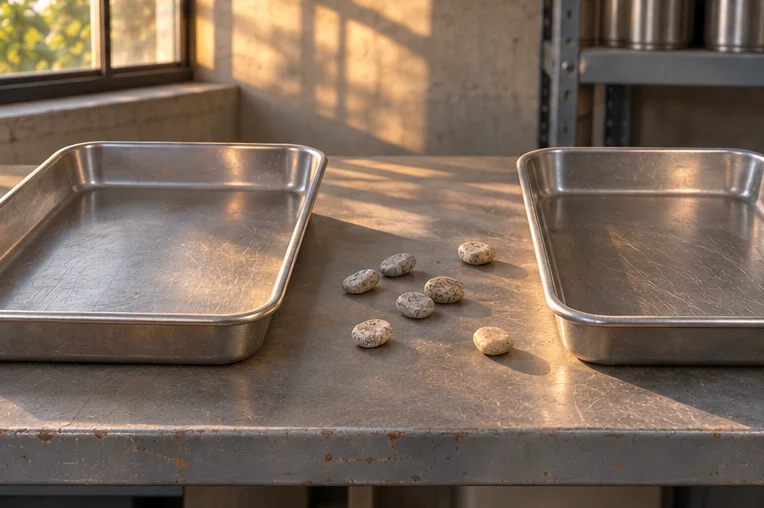
A person moves clean gravel from one steel tray to another. At the end, a few pieces are visibly sitting in a seam in the original tray. The person can weigh those pieces as material retained at the source. The amount delivered can be estimated by weighing what is now in the receiving tray. If the sum is still short of what the person began with, the subtraction gives an unaccounted quantity. It does not tell the person whether a pebble is on the floor, whether a scale shifted, or whether a tare from the wrong tray was entered. The most important field in the report is often the quietest: what the arithmetic does not place.
A mass balance is a way to account for material within a stated boundary. It is not a way to see all the material that crossed it. In this harmless teaching example the lot is ordinary gravel, the bench is a known work area, and the operation is a single transfer. Different equipment, materials or operational requirements call for procedures appropriate to those settings. The point is to preserve observations and relevant identities long enough to separate three questions: what was delivered, what was found elsewhere within the accounting scheme, and what remains unresolved.
Illustrative gravel transfer balance
The chart and table use identical constructed values in grams. They are not sourced observations, recommended losses, or an official tolerance. The weighed starting material is taken as 500 grams in the example. The receiving tray contains an estimated net 475 grams after transfer, and an estimated net 18 grams are retained at the source. The unaccounted seven grams is calculated as the difference; it is not seven grams discovered or independently weighed in another place.
| Balance category | Grams |
|---|---|
| Starting material | 500 |
| Transferred | 475 |
| Retained | 18 |
| Unaccounted | 7 |
Transferred, retained, and unaccounted sum to 500 by the definition of the last category. Starting material is the total, not a fourth destination. The difference between starting and transferred is 25 grams. Of that difference, 18 grams has an assigned location under the example's measurements. Only seven remains unaccounted in that version of the balance. Reporting 25 grams lost would erase the retained material; reporting seven grams spilled would invent its location. Either shortcut obscures the next sensible question.
The example also gives different fractions for different purposes. The amount delivered represents 475 of the initial 500 grams, or 95 percent. The retained share is 18 of 500, or 3.6 percent. The calculated unaccounted share is 7 of 500, or 1.4 percent. These percentages share a defined denominator. If a manager instead asks how much of the not-delivered material has been identified at the source, the fraction is 18 out of 25, or 72 percent. The percentage is not contradictory; it answers a different question. Don't shorten both to “retained percent” without the denominator.
Begin with gross, tare and net readings
Gross is the reading for a loaded container under the specified weighing setup. Tare is the container and other designated components that are intentionally excluded from net material. Net is the estimated material reading after subtracting the corresponding tare, or the net indication from a suitable tare operation on the instrument. A cover, liner or holder belongs in the tare if it is included in the gross and is not part of the gravel. An object included in only one measurement can change the apparent mass even if no gravel moves. Keep the composition of a tare explicit.
For illustration, suppose the source tray alone reads 210 grams, the source tray with starting material reads 710 grams, and it reads 228 grams after transfer. The estimates for starting and retained material are then 500 and 18 grams. Suppose the receiving tray alone reads 190 grams and its loaded reading is 665 grams. Its net gravel is 475 grams. These are additional hypothetical inputs consistent with the figure, not readings from an actual scale. The gross values are useful provenance, but adding them does not produce a material balance because they contain trays and may count one tray more than once.
The NIST weighing and scales FAQ discusses gross, tare and net indications in specific weighing contexts and notes that rounded inputs can matter to a calculated net. The general lesson applies here without importing regulatory tolerances into a workbench exercise. Record what the display reported, what unit and mode it used, and whether a person calculated net from two displayed values or the device produced net itself. Those two paths may not be numerically identical when rounding and internal processing differ.
Put the accounting boundary on the page
The category transferred needs a destination. In this example it means gravel in the receiving tray at the end of the stated operation, before further handling or sorting. Retained means gravel still in the source tray as counted by the original rule, including pieces remaining in its seam if the tray is weighed together with them. If a scoop or intermediate pan touched material during the work, decide how a measured residue there is classified. It can be assigned a separate destination if that serves the purpose. Do not count it as delivered while it is still on the tool.
Then name the time. If the technician weighs the source tray immediately after pouring and the receiver only after moving it to another floor, the observations include different handling stages. A pebble removed from the receiver on the way can look like it never reached the receiver. Decide whether the operation ends at the first transfer, at the second weighing, or at some handoff. All are possible boundaries. They cannot be substituted for one another without changing the question. Record relevant handoffs and the order of readings so another person can map each number to the intended stage.
Keep optional recovery distinct. A person may find three grams of identifiable gravel on an otherwise clean mat after the initial balance. The mat is a possible accounted destination if it belongs to the specified operation and the pieces are convincingly linked to the lot. A revised ledger could put those three grams in a recovered category and record four grams unaccounted under the same initial estimates. Retain the original calculation and its time. Do not subtract three from the residual and also add the same recovered pieces to the receiver's earlier measurement. That would count the recovery twice.
A surface can be part of the system without being part of the measured inventory. The bench edge, floor or hinge may be plausible places for gravel to end up, but a label such as “not searched” or “possible location” does not assign known mass to them. If a location cannot be checked appropriately, do not include it as an observed zero. The boundary tells what the ledger attempts to account for and which places or conditions were outside observation. It does not require proving the state of every possible surface in the room.
Separate known retention from plausible explanations
Retention is strongest when tied to direct evidence. If gravel remains visibly in the source tray and the agreed net reading is sufficient to estimate it, the ledger can assign that amount to the source. Pieces can remain in corners, seams or on an intermediate implement without all being obvious in a photograph. Do not infer their combined amount from number of pieces if their individual masses are not measured or otherwise justifiably estimated. A photographed residue and a measured residue are two different levels of support. The photo may identify the container even where the numerical result is unresolved.
It is tempting to say all remaining mass fell off the bench, especially when a transfer looked messy. The measured deficit could include real loss from the defined interval, readout rounding, changes in tare, different scale behavior, or an accounting error. Before labeling it a spill, ask what evidence locates it. A witness may have seen pieces fall; a clean catch mat may contain linked material; neither necessarily substantiates the full residual. Report the observed trace and the numerical discrepancy separately. If the evidence explains part of the difference, assign only that part and preserve the rest.
The state of the containers can matter. A bit of dust, moisture, a changed liner, or a label added after the tare can change a gross reading without representing movement of the intended gravel. Some conditions would change not just the container but the material being measured. If the question concerns dry gravel and the material picks up water, the measured loaded mass reflects a different state unless the protocol accounts for it. A plain teaching transfer is easier to reason about when material and containers are stable. If the condition changed, write that down rather than quietly equate the readings.
There can also be a negative residual. If the starting estimate says 500 grams but destination and retained estimates sum to 503, arithmetic gives minus three grams unaccounted. That is a measured surplus in the ledger, not a negative amount of physical gravel sitting somewhere. Possible explanations include scale differences, unexpected additions, or an incompatible tare. Preserve the sign because it carries diagnostic information. A reporting rule that truncates all negative residuals to zero makes automatic means and trend plots appear more positively biased than the untruncated results. Interpret negative and positive discrepancies with the same demand for independent evidence.
Ask what can cancel on one scale and what may not cancel on two
The gross and tare for the same tray should refer to compatible measurement conditions. A common additive offset can cancel in a simple subtraction if it is genuinely the same for both readings. If the source tray's loaded and empty readings are both shifted upward by two grams under the same device conditions, their difference is unchanged. An offset that changed during the interval will not cancel in the same way. Scale response can also differ by load, and a multiplicative calibration error is not removed merely by subtracting the tare. Describe the reason for any expected cancellation rather than assume tare solves all instrument problems.
The worked gross records have another useful feature. The same source tare is used to estimate starting and retained mass. When these two estimates are subtracted, that shared tare cancels algebraically: 710 minus 228 is 482. Subtracting the destination net of 475 yields seven. The source tare is still necessary if the report separately needs 500 starting and 18 retained. It simply does not enter that particular residual twice. If the source tray changed state between the first and last readings, using one common tare is an assumption that must be checked. The equation does not inspect the tray.
Using one appropriate scale for both trays can simplify a teaching exercise, but it does not prove the readings agree at every load. Using two scales does not by itself invalidate a comparison either. It introduces a practical need to know which device measured which quantity, whether their responses are compatible at relevant loads, and what checks were made. Comparing an unchanged suitable reference on both devices under documented conditions may reveal relative differences. Agreement on a single reference value does not determine behavior throughout the instruments' operating ranges. A check is not automatically a traceable calibration or a guarantee of accuracy.
The NIST/SEMATECH chapter on measurement process characterization provides context for thinking about stability, bias, repeatability and uncertainty. For an ordinary bench project, repeatability asks how similar repeated readings of an unchanged load are under comparable conditions. Bias concerns a systematic discrepancy relative to an appropriate reference value, and a tightly grouped set of repeats can still be biased. A series of similar indications is not enough to call a seven-gram residual physical loss. Separate what the scale shows consistently from how accurately the combined measurement process estimates the desired quantity.
An instrument change may coincide with a material change and make the discrepancy difficult to interpret. Suppose a receiver was weighed on a portable scale only because the second tray was too large for the bench device. A comparison of large and small lots then combines lot handling with scale choice. Recording both choices allows a targeted review, but it does not separate their effects without appropriate comparisons. If practical, test unchanged representative loads on the instruments used and document what those tests support. If not, say that the scale and setup changed together and avoid assigning differences exclusively to the transfer.
Precision belongs to the balance, not just the largest reading
Displayed resolution is the smallest step a device shows in the relevant mode. It does not establish total uncertainty. A device may show one-gram increments while readings in repeated setups vary by several grams, or while a consistent bias escapes detection. The small residual is computed from multiple measurements and can be difficult to resolve even if the starting load is adequately measured for another purpose. State what the exercise needs to distinguish. A procedure adequate for distinguishing 500 grams from 300 may not distinguish a few grams missing after subtracting most of the load away.
Consider a stripped-down illustrative calculation in which three independent displayed net quantities each round to the nearest gram, and rounding is the only issue under consideration. Each nominal quantity could then differ from its underlying indication by about half a gram, depending on ties and conventions. For the residual, the worst-case rounding contribution from those three separate quantities can reach one and a half grams. This is not a general uncertainty estimate. Gross-minus-tare pairs, shared readings, different resolutions, drift, reference uncertainty and correlated errors introduce other issues. Do not present this scenario as a specification for the scales used in the fictional chart.
A useful distinction is between evaluating a deterministic sensitivity and estimating statistical uncertainty. A sensitivity check might recompute a residual if an alternate verified tare is used, or examine what would change under another documented rounding rule. It gives a transparent conditional result. A statistical uncertainty assessment needs support for how errors vary and combine in the actual measurement process. If the work is exploratory and such evidence is absent, explain the uncertainty qualitatively instead of appending a generic tolerance. A precise looking deficit with a guessed margin is not stronger evidence than an honest unresolved discrepancy.
Structure useful checks before changing the process
Start a review with things that require no additional movement of material. Match the tray IDs, units, device modes and timestamps. Verify that the tare corresponds to the loaded configuration. Look for a row where gross was already a net indication, where a tare was subtracted twice, or where a measurement belongs to another lot. Recalculate the residual from the source readings and compare the result to the export. If the record contains several transfers, check the lot linkage rather than assume all rows adjacent on the sheet represent one operation. A small join error can produce a very convincing but entirely false material deficit.
Next separate instrument checks from tests of the transfer. Repeatedly weighing an unchanged suitable object under documented conditions provides information about the weighing process. It does not measure how much gravel a person leaves in a tray. Repeating material transfers can reveal variability across handling operations, but mixes that with variation in weighing unless the study can separate them. An appropriate test can use both kinds of repeats for different purposes. Label the replicate type and preserve the sequence so a future analyst does not mistake a set of duplicate readings for new transfers.
If the empty tray was weighed a day earlier, think about whether the stored tare still applies. A tray can be cleaned, labeled, fitted with a changed liner, or placed in a different holder. An observed mass discrepancy in the retained calculation may turn out to follow a changed tare rather than a changed transfer. Where a persistent change is found, record it with its effective time rather than assign the corrected value to all historical measurements. A changed workflow may warrant a new configuration identifier. The original record and the corrected analysis both have a role.
Check that weighing a cleaned empty tray after transfer does not erase evidence of what was retained. If residue was removed before weighing, the emptied tray can supply a tare but no longer gives the post-transfer gross. Preserve the sequence and stage of each reading, and do not use the later bare tray as proof that nothing originally remained. Similarly, when a catch mat is emptied into the receiver after the fact, keep its separate recovery record if the study wants to compare first-pass transfer. Accurate weighing at the wrong stage is still the wrong measurement for that question.
Read the diagnostics in the original order
The NIST/SEMATECH graphical techniques index introduces exploratory displays, including ways to examine order and grouped variation. None of its figures supplied the chart data in this article. A simple sequence view of signed mass residuals might show that the discrepancy became larger after a scale switch or after a particular tray was introduced. It is a clue for inspecting those records. The switch could have coincided with another change in the lot or operator, so the plot does not identify a cause by itself.
Put useful variables beside the sequence. A panel can show retained estimates and residuals as separate quantities. Another can indicate which scale weighed the receiver, or which lot category was used, without combining those into a single unexplained color. A steady retained amount with a shifting residual raises a different question from large changes in both. When walking through a discrepancy, look at the original net inputs and not just the residual plot. The same signed difference can arise from an increase in starting estimate, a decrease in receiver estimate or a change in retained estimate.
Look at data from well-defined comparable transfers before comparing methods. If one operator handles larger batches and another smaller batches, larger absolute residuals might follow amount rather than operator, even before considering scale and conditions. Reporting an unaccounted fraction can aid comparison where its denominator is suitable, but a small starting load can make a modest absolute discrepancy look large in percentage terms. Show numerator and denominator and choose a view appropriate to the operating question. No chart is diagnostic if its underlying groups cannot be interpreted.
Repeat the diagnostic after verifying records, not after deleting outcomes solely because they look strange. A large negative residual can expose a mismatched unit or a real extra input and should not be automatically filtered. A modest group of positive residuals might be explained by documented instrument variation, actual material loss, or a combination. Write down which explanations were checked, which were confirmed and which remain plausible. A balance report is most useful when it guides the next test accurately rather than fits every value to a preferred explanation.
Keep independent evidence independent of the arithmetic
It is possible to make every balance close by assigning the residual to a convenient category. If the worksheet says unaccounted equals starting minus every other total, closure is built into the formula. That is a useful bookkeeping fact, not an independent check. The only new information comes from the categories estimated or observed independently. An observed recovered mass can narrow the remaining gap. A guessed recovery set equal to the residual cannot. Keep a note describing how each entry came into being before showing a chart in which all pieces sum to the total.
An independent consistency check can use a compatible second determination of one component, or a traceable inventory of pieces under an appropriately defined setup. Suppose a specific recovered patch of gravel was weighed separately. Record the recovery time and explain how the lot was linked to it. If those pieces could belong to an earlier transfer, the reading is real but the assignment is uncertain. A quantified item in the wrong lot offers no genuine closure for the present one. An honest unresolved assignment is better than an exact equality gained by borrowing from another day's work.
Compare two styles of record. In the first, an observer sees gravel on a catch surface but does not weigh it. The balance may still contain seven grams unaccounted, plus a qualitative note about an observed possible place. In the second, the surface is verified empty at the beginning, all identified recovered material is measured using a compatible setup, and its three grams are recorded as an assigned recovery. The second record changes the numerical balance. The first does not have to be discarded; it simply conveys a different strength of evidence. This distinction gives a technician a reason to document an unresolved clue without feeling obliged to turn it into a number.
Make the result reproducible across people and shifts
A practical record can contain a lot ID, transfer ID, IDs for both trays and any intermediate equipment, the weighing instrument and mode, the time and stage of each reading, and the unit. Store the source readings as recorded. Derived columns can contain the net estimates, the associated retention or recovery category, and the signed residual. Add a field for why a measurement was not available. No numerical blank should become an observed zero by default. The same template can serve a quick demonstration and a more formal study if its required outputs and precision expectations are explicit.
Document the distinction between a repeat reading and a revised entry. If an operator accidentally typed 655 instead of 665, correcting the transcription changes the derived balance without another measurement. A second read of the receiving tray is another measurement of that state, assuming it did not change. A new transfer is another work event, even if it produces the same set of numbers. Preserve each identity so that a worksheet does not count a correction and its original as two loads. Linking them properly also helps resolve apparent disagreements that arise from using different revisions of a table.
A good review exercise sends a small fictional file through the actual reporting process. Include one valid zero retention under the defined criterion, one missing source reading, one same-scale calculation with a shared tare, and one transfer using a qualified alternate device. Check that signs and units survive the export. Then have someone else reconstruct the 500, 475, 18 and seven example from its gross and tare entries. If the two methods produce different totals, investigate whether the worksheet uses a net reading inconsistently or applies a device setting that was not recorded. Resolving that mismatch in a rehearsal is cheaper than diagnosing it after an operational decision.
A comparison report needs the number of separate transfers as well as the number of readings. Six indications on one unchanged loaded tray do not constitute six separate pieces of evidence about the transfer process. Repeated readings can show the behavior of the measurement process under stated conditions; repeat transfers can show variation across operations. If the analysis contains both, preserve the relationship and avoid letting a heavily reweighed operation dominate the results by raw row count. An operator can inspect several states of the same lot without creating several independent lots.
Choose the next question from what the discrepancy can support
A residual resolves neither an operational target nor a cause. If the decision is whether a planned delivery contains at least a certain mass, direct evidence about the destination may be the most important measure. If the concern is reducing material left in seams, the retained-location measurements are more useful. If a discrepancy recurs but no material can be located, the best next step may be to verify the weighing setup or accounting boundary before changing the transfer. Different improvements answer different problems. The chart is not a reason to optimize every component at once.
An especially useful distinction is between returning to an earlier state and repeating a comparable operation. Once a lot has been moved, gathering it together again to weigh it may not recreate the original conditions. A second weighing can provide clarity for the material present now but cannot prove its earlier location, and moving it can introduce another opportunity for loss or addition. A separately identified repeat transfer can show that a process sometimes leaves material behind under the new conditions. It is not a measurement of what happened on the first attempt. Preserve the time order when communicating evidence from follow-up.
A small discrepancy may be operationally unimportant for one use and worth resolving for another. Define that decision criterion separately from device resolution or a numerical result. Do not treat the toy seven grams as a universal threshold. A project may document that it is exploratory and not make a pass or fail claim at all. If a criterion exists, include the measurement support needed to judge it. A conclusion of insufficient evidence is useful when the workbench setup was never intended to resolve such a small difference reliably.
Keep later handling from entering the first-pass result
Imagine a process with a receiving tray and a temporary staging pan. At the original stopping point, the destination holds 475 grams and the staging pan is not yet checked. Later the operator moves the whole receiver contents to storage and the pan is found to contain several pieces. The staged material may be eligible as a new accounted destination, but the storage mass is not automatically another quantity to add to the 475. It may largely describe the same material one step later. Give each reading a location and time, and group together only states that can coexist at the same accounting boundary. When comparing handoffs, follow the identity of transferred material rather than assign every weighing a new share of the starting lot.
A diagram can help avoid the error. Give each relevant container or surface its own row or box at the point when it is weighed. Put events such as transfer, recovery and removal between those states. In a simple first-pass summary, count the destination material where it first satisfies the delivery rule, source residue at the same stopping point, and any measured recovered material not already included. A later summary can explain where the same gravel went next. There is nothing wrong with measuring it twice for separate questions. There is something wrong with adding both results as if they belonged to separate pieces.
If anyone takes a subsample, record what was removed and when. Suppose a measured handful was taken from the destination before its final gross reading and left in a labeled cup. Its absence from the destination can explain part of a difference only if the sampling history connects it correctly and the reported destination value excludes it. If measurement occurred after the handful was returned, adding its recorded amount again would inflate the total. Separate intentionally removed amounts from unexpectedly unaccounted material. The ledger is a history of the defined lot, not a pile of all numbers that happened to refer to gravel.
Let uncertainty guide communication rather than flatten it
An operational note can use three levels of language. “Measured or estimated in a named place” is appropriate for a qualifying net reading, with its method stated. “Observed but unquantified” is appropriate for material seen in a location without a usable reading. “Unaccounted” is appropriate for a calculated remainder with no verified assignment. When a sentence changes from one of these to another, say what new evidence made the change possible. A visually convincing photograph can improve the second status without producing the first. A recalculated residual can change the third without producing new visual evidence.
Separating the terms helps when different teams use the same balance. A receiving team may care about what it can work with now. A process reviewer may care whether the original method routinely leaves material behind. A measurement specialist may be asked whether the seven-gram discrepancy could result from instrumentation or the acquisition process. None needs to inherit an unverified location in the headline. Write the short result in a way that all three can trace it to the same observations, even if their next steps differ.
For a campaign of several measurements, compare the totals and the distribution of individual residuals. Summing signed residuals can be useful for overall accounting, but positive and negative values can cancel. A near-zero total might coexist with several poorly explained transfers. Conversely, adding absolute residuals describes discrepancy size without saying the combined amount is physically lost. Name the summary and preserve the direction for individual operations. If the intended decision concerns the worst unexplained handoff, a sum may not be the right outcome. Match the summary to the question and avoid calling different summaries versions of the same amount.
Reconcile the prose with what a second observer saw
Before publishing a result, ask what a second person could verify. They may be able to tell that the correct source tray was weighed twice, that several pieces were visible in a seam, and that the unit on a scale was grams. They cannot independently certify that the residual spilled unless there is separate evidence. Review the effect of a changed liner or a mistimed reading with the actual source notes. If the review changes the residual, state which inputs changed and keep the earlier arithmetic available if it affected a decision. Not every discrepancy needs a physical explanation to have been handled well.
A figure should not quietly strengthen its label across versions. If the ledger says retained means material still in the original tray at the cutoff, do not use retained to encompass later floor recoveries unless the category definition is revised in both chart and table. Label the total so a reader does not add it to the component bars. Include the unit and note whether the residual was calculated. This allows readers to understand the balance even without the gross inputs printed on the same page.
Say what was assigned and what remained open
A concise result for the illustrative transfer is: 500 grams of starting material, 475 estimated in the receiver, 18 estimated in the source tray, and a calculated residual of seven grams. The record did not locate those seven grams, and the values do not describe a real operation. A comparable real statement should say how the tray configurations were matched, which devices supplied the estimates, and whether significant measurement limitations were found. It should not imply that the bench was the only possible destination simply because the bench was where the observer looked.
Review what happens when an input is missing outright. With a valid measured destination but no usable starting reading, the project can still report what was present at the destination. It cannot calculate a meaningful residual from that record alone. A planned target mass can be listed alongside the reading, but it is not a substitute for actual starting material. Report the unavailability rather than force every transfer to produce a complete balance.
A useful balance does not erase uncertainty by assigning it a physical location. It helps the next person decide what evidence would make a difference: a verified tare, a matched instrument check, a directly measured recovery or a more complete account of the lot's passage. In the gravel example the difference between what was delivered and what was not delivered was clear in the ledger. The location of everything not delivered was not. Keeping those statements apart makes the measurement more useful than a tidy but unsupported claim of seven grams spilled.