| Category | Value (watches) |
|---|---|
| Light-side usable | 9 |
| Dark-side usable | 5 |
| Interrupted | 3 |
Illustrative values, not sourced observations. Invented example for the stated comparison; not a biological threshold, ecological estimate or observed dataset.
At dusk, two observers watch flowers beside a garden path. One can follow an insect from its approach to the moment it disappears behind a blossom; the other can sometimes detect movement but cannot say whether it reached the flower. The first position happens to be closer to an existing path light. By the end of the watch, its tally contains more visits. It would be easy to say the flowers there attracted more visitors. What the records actually show is narrower: more visits were detected and met the recording rule there. The difference might be in the insects, the observer's ability to see, or both.
That is a subtle problem because lighting can affect both sides of the comparison. It can change the physical view the person or camera has of the flower. It can also change the setting experienced by the animals or plants. A field note cannot simply assume that one of those mechanisms cancels the other. Brighter illumination could improve observation while reducing actual visits under some conditions. Equally, broad visual coverage might still fail to identify tiny or fast visitors. The result is not a reason to distrust every dusk watch. It is a reason to describe what the watch measures before giving the light credit for better habitat.
This article concerns passive observations beside existing lighting. It does not recommend adding, removing, redirecting, or changing lights to see what happens. A volunteer does not need to modify a park to learn about how viewing conditions affect their records. The useful first step is to document location, visibility, timing, and what counted as an event, then keep that documentation distinct from research testing ecological effects. A well-described unresolved visit is often more valuable than a confident tally produced from an uneven view.
Name the two pathways before you count
Consider three stages: an animal occurs in the wider setting, it becomes available to observe by entering the chosen area or interacting with a flower, and an observer detects and classifies the action. The watch ordinarily records only the last stage. Some animals may never pass the focal plants during the window. Some may pass but remain behind petals or beyond a clean sightline. Some may be detected as movements but not identifiable as flower visitors. These are different reasons for a missing entry. A viewer's ability to see the center of a blossom bears directly on the final one, not necessarily on the number of insects in the wider setting.
One pathway from existing light to the tally runs through observation. The brighter path may make the camera focus more reliably and the insect's outline easier to follow. This could increase the number of recorded visits even if the number of visits that occurred remained the same. A different type of light might increase glare near the viewer and reduce contrast for some subjects; illumination does not guarantee visibility. Keep records of the actual view rather than treating “lit” as sufficient proof of a better image.
A second pathway runs through ecological behavior. Existing lighting and the conditions associated with it could influence which insects occur nearby, where they move, or whether they approach flowers. The response need not be uniform among species or across situations. And in a passive comparison, path lights may be located at places with different plants, geometry, foot traffic, or maintenance schedules. The lighting labels do not isolate any of these from one another. A tally of encounters at two garden patches is not automatically an experiment on light.
There is a third, easily missed difference: the counting rule can turn changes in visibility into changes in classification even after a visitor has been detected. A movement clearly landing in the center of a flower may be easy to score near a favorable view, while a similar glimpse at the dark edge is recorded as approach only. Both observers noticed something. The difference is the level of evidence each encounter could support. Keep detection and classification separate so the figures do not treat every unresolved event as a lesser number of actual visitors.
A transparent report can put all three observations on the same page without blending them. It can say the local light was on, the target flower was partly visible for a stated fraction of the watch, and a qualifying landing was recorded. It can also say the cause of any rate difference remains unresolved. The information is more useful together than apart: a later team deciding whether to change its viewing protocol can see where the limitation lies without borrowing an ecological conclusion from an equipment note.
Define a modest endpoint and protect it from the light label
Start with one or more clearly named outcomes. An approach could mean an insect comes within a defined area of a focal blossom under a continuous view. A landing could mean the insect is visibly supported by the flower. A handling record could add observed actions such as walking across a surface or probing. Do not declare every bright moving shape a visit. A moth or other insect crossing an illuminated background might never touch the target plant. If the physical boundary of the observation is unclear, draw a simple context sketch or use a stable landmark.
The watch can separately tally “movement unresolved” when the observer cannot determine its relation to a flower. This is not a positive visit under a strict landing rule. It is also not the same kind of evidence as a completed watch in which no movement appeared. A camera frame may show an insect near a bloom without confirming contact because the outlines overlap along the viewing axis. Two observers may agree there was an insect and disagree about whether it landed. Keeping the levels distinct allows a reviewer to improve the criteria instead of classifying every disagreement as a general failure.
Name the flora and units to the extent that the project permits. If one observer watches a composite flower head and another watches a group of discrete blossoms, time alone may not make their opportunities comparable. Count or describe focal floral units consistently, and say when they change during the watch. An insect weaving between parts of one head might be one arrival with several local interactions, depending on the rule. Record that logic early. Brighter conditions can reveal more actions within the same visit without creating additional arrivals.
The watcher should not use the brightness category to decide what counts as evidence. If a dark-side frame is inadequate to establish a landing, do not relax the rule for it simply to improve the tally. Likewise, do not count vague motion at the bright side as unquestionably an insect because you expected more observations there. When comparing notes or footage, apply common behavioral criteria and retain a separate quality or uncertainty label. If different standards must be used for some reason, report distinct endpoints rather than averaging the results into one purported count.
Set rules for repeat activity. A single visible animal can move off screen and reappear, or approach two flowers in a row. Watching continuously may support one tracked sequence; losing the sightline may leave identity unresolved. A repeated arrival can count as an event under a defined entry rule without implying a different individual. It is entirely possible for one site to produce more recorded events and fewer confidently distinct individuals. Do not promise an abundance comparison simply because the event count is easy to obtain.
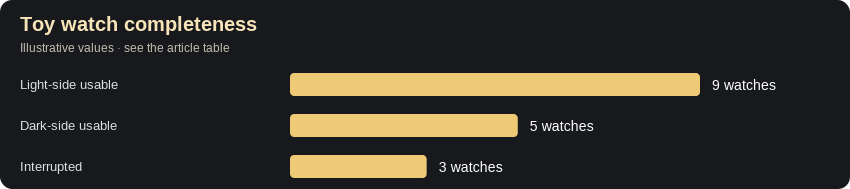
Chart: Toy watch completeness
The chart and matching table are illustrative only. The figures describe seventeen invented watches classified by completion status, not observed visits, ecological measurements, an official performance target, or a real design. A light-side or dark-side usable watch met the fictional observation standard in its designated setting. Interrupted watches form a separate category in this display, regardless of the setting where they started.
| Watch outcome | Watches |
|---|---|
| Light-side usable | 9 |
| Dark-side usable | 5 |
| Interrupted | 3 |
There are fourteen usable watches in the toy example. Nine of those fourteen are light-side, and five are dark-side. Three of all seventeen attempted watches, about 17.6 percent, are interrupted. The table does not supply how many watches were attempted on each side, because it does not split the interrupted category by original assignment. You therefore cannot calculate or compare side-specific completion rates from this display alone. If all interruptions had occurred on one side, that side's completion rate would be different from a scenario spreading the interruptions across both. The table leaves that allocation unknown on purpose.
The graph is a completeness audit, not a pollinator chart. Nine usable watches does not mean nine visits, nine insects, or a higher rate per watch. Without their durations and counts of qualifying events, even a descriptive rate is unavailable. And adding three interrupted watches to a denominator with zero assigned detections could misrepresent what was actually seen. A complete watch with an adequate view and zero observed landings provides evidence about a watch. A watch that could not assess landings does not. Show attempted, usable, and partial efforts at the levels required for the question.
Think about how the toy figure might guide the next collection. The team may want to know whether interruptions were concentrated in one route, whether those watches were short, and whether they failed because of glare, blocked sightlines, weather, or ordinary access. A single separate bar is deliberately too coarse to answer all those questions. A real worksheet should retain the attempted side and reasons independently even if a public chart uses mutually exclusive outcomes. What remains separately stored determines whether the next reviewer can find out why the observations differ.
Define usability without asking which side found more
A usable watch might require the focal boundary to remain adequately visible for the planned time, a defined range of movements to be distinguishable, and the timing record to be intact. Use criteria suited to the endpoint. A dim view might be adequate to record large silhouettes while inadequate for fine distinctions at the flower. That can justify a broader movement record and a missing landing-specific value. A single yes-or-no rating for the entire encounter will not always preserve the most useful information.
One way to judge coverage is to choose passive landmarks. Can a watcher distinguish the petal rim against the visible background at the chosen distance? Can the small area where a landing would be recorded remain in view while the branch moves? Those checks test parts of the observation process without adding light or otherwise changing the setting. They do not measure how detectable every insect was. A clear landmark can coexist with motion blur or a dark background where an insect would be difficult to trace. Document what the check demonstrates and what it leaves unresolved.
Set the criteria before comparing the outcomes, where practical. A bright session with no interesting results should not suddenly be called incomplete while an entertaining flicker near a darker patch gets treated as a fully usable watch. Predefined rules make it easier to distinguish methodological limitations from preferences that developed after the fieldwork. Record genuine changes to the protocol and retain older classifications if possible. An archive of planned rules and deviations tells someone which sessions can be compared rather than relying on the confidence of the final writer.
For partial watches, decide in advance whether a usable subset can contribute to a time-standardized descriptive rate. Suppose the focal area was visible for one defined segment and hidden for the rest. If exact timing and qualifying counts survive for the visible segment, that segment may answer a limited question. It is not equivalent to having a completed watch of the planned duration. Moreover, missing segments may not be random: a gust could both obscure the view and change insect activity. Keeping partial durations is useful, while promising they represent what the whole watch would have shown is not justified automatically.
An alternate label such as “usable for approaches, not for contacts” can be a practical compromise. It protects evidence about larger motions while refusing unsupported detail. A site may appear to have more contacts simply because contact is measurable in more sessions there. To discover that risk, report the fraction of watches eligible for each endpoint. Then compare like with like where coverage supports it and name any loss of scope. A more honest rate may involve fewer watches than expected, and that is useful information for deciding whether to collect more.
What primary light studies can and cannot settle for a path survey
Knop and colleagues' original field experiment, also indexed in a primary article abstract at PubMed, compared experimentally illuminated plant–pollinator communities with dark settings in its study design. The authors reported fewer nocturnal visits under the artificial illumination and also measured a reproductive outcome for a focal plant. The two outcomes should remain distinct. Changes in visit counts and changes in fruit set concern different parts of an ecological chain. The study provides evidence for effects under tested conditions, not a conversion factor for two volunteer watches on another path.
The size and even direction of an effect should not be assumed the same in every context. A lamp near one path, flower species of different shapes, and conditions at a very different time of year depart from the original comparison. A local record could even show more detected events near a brighter path while controlled work elsewhere finds ecological harm under illumination. There is no inherent contradiction. The local observers may have been better able to see, the sites may differ for other reasons, and the biological effects may not transfer unchanged. It is the meaning of each result that needs checking, not choosing which number looks more dramatic.
A second primary example, Learning to feed in the dark, investigated how light level affects the efficacy with which hawkmoths of the species Manduca sexta locate a nectary and considered experience with that task. It is a study of an animal's performance at a flower, not an assessment of human observers' ability to classify a faint landing. A hawkmoth taking longer to find a reward and a photographer taking longer to find the animal in a viewfinder are different phenomena. Both can matter to field records, but evidence for one does not quantify the other.
When reading a study, ask whether light was measured, assigned in a treatment, or inferred from the setting. Ask which other variables were standardized and what behaviors were actually scored. A controlled comparison can provide much better support for one causal question than a casual count, but it still does not apply universally to all lamps, species, and habitats. A detailed study can be an excellent source for a carefully scoped sentence. Do not turn it into an invitation to experiment with public lighting at a site.
Results about lighting can involve competing pathways even inside a well-designed experiment. A lamp might influence which animals move near a flower, the behavior of those that arrive, or the conditions plants experience. An outcome at one stage does not settle the next stage. A garden visitor count that establishes touching a flower still does not demonstrate compatible pollen deposition, and a record of fruit does not identify which specific encounter caused it without further design. Keeping the stages distinct is useful whether the focal question is visibility, behavior, or reproduction.
Compare passive watches in ways that reduce avoidable ambiguity
Pick focal patches and times on criteria written before the insects appear. Match features important to the question as well as practical field conditions: flower form or display, observation distance, time relative to dusk, and obstruction, for example. Record the ones you cannot match. A bright path lined with abundant open flowers and a dark path with one small cluster would not be a clean comparison of two lighting conditions. Describing the mismatch may make the observations useful for each patch while limiting any generalization between them.
If the same person observes both sides, an alternating order can reduce systematic confounding between location and elapsed time. When dusk conditions change quickly, simultaneous watches with separate observers might better address timing. However, that design could confound observer skill with side if the same people always occupy the same positions. A planned exchange across comparable sessions can help reveal that possibility, provided people can move lawfully and safely. Timing control and observer control are different design goals, and practical compromises should be reported.
Record viewing positions rather than assuming distance from a lamp is all that matters. A bright pool might illuminate the foliage but leave a focal opening in shadow. A flower facing away from the path may not be assessable even under a strong overhead light. A camera pointed toward a light source can produce a less useful image than one placed farther away. Retain coarse descriptions or passive observations of actual light and sightline at the flower. A label such as “near the lamp” provides geographic context, not a direct measure of spectral exposure or of how clearly any insect could be seen.
Some comparisons benefit from checking observer agreement without changing lighting. Two people can independently annotate the same original recordings or, if ethically and logistically suitable, make simultaneous watches of the same defined region. Comparing their annotations can reveal whether they recognize the same events and at what evidence level. If neither saw an insect hidden from both positions, agreement does not prove complete detection. Nichols and colleagues' original double-observer study illustrates formal detection reasoning for bird point counts. It is a methodological analogy; merely putting two people on a garden path does not turn their notes into that estimator.
Avoid adapting the view during the comparison only when something exciting happens. A fast switch to a close frame may resolve mouthparts after an insect arrives but may lose the approach phase. Save context footage when available, annotate changes in view, and distinguish incidental footage from records collected under the watch design. A camera's autofocus behavior, exposure, and frame rate can affect which motions are recorded. In review, compare the original files rather than treating a brightened or cropped version as a new event.
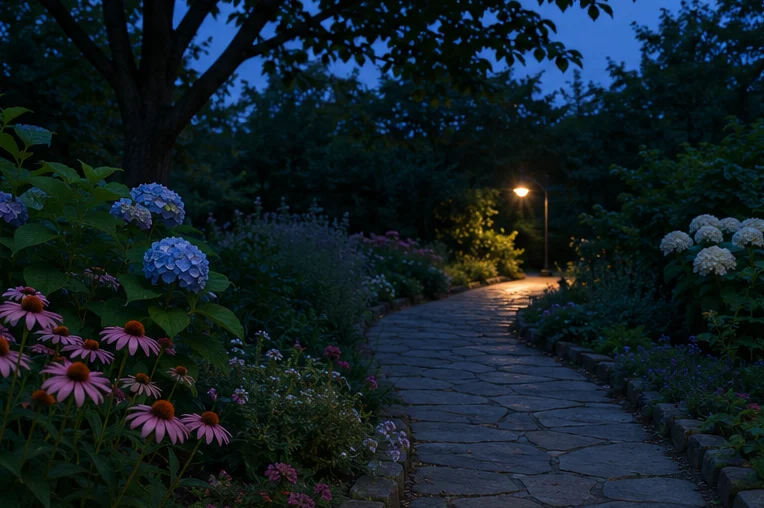
Never assume footage that looks dark can become adequate simply by adjusting a slider. Tonal changes can make recorded outlines easier to see, but they cannot supply events that never resolved at capture. An edited image with synthetic sharpening or interpolated movement should not be used to decide that an insect touched a flower. Similarly, a documentary-looking illustration of a garden after dark helps readers picture the question; it is not a field record. Keep processing notes and editorial captions clear enough that visual polish does not become evidentiary confusion.
Effort, detection, and ecology have different denominators
Start any comparison table with the number of planned and completed watches by recorded setting, the actually usable durations, and the focal units. Give the number of qualifying detected events under the common rule. Include sightings at broader levels if they matter, such as approaches without confirmed contact, while avoiding double counting between categories. If a rate is reported, specify whether the denominator is minutes of usable observation, number of watches, floral exposure, or some other quantity. These denominators can lead to different impressions even on the same notes.
Consider a deliberately invented illustration separate from the chart. Suppose observers see six qualifying landings during thirty usable minutes on one route and four during twenty on another. The observed rates are both 0.2 per usable minute. The counts differ because the recorded effort differs. The rates do not by themselves show that actual visitation is equal, because the observers could still miss different shares of the visits. Dividing by time handles duration; it does not recover unobserved events. This is why a duration correction and a detection model are separate tools.
An observed event rate can be thought of as reflecting both the opportunities that occurred and the process by which they were observed. In a simplified model, if one had a true rate and a constant probability that an event would be detected, their product would give an expected observed rate. The simplification makes the ambiguity visible: a single observed value does not identify both ingredients. Real detection can vary among events, and errors can include false identifications, duplicate counts, and unknown availability. Do not compute an assumed correction merely because the simple model is easy to write down.
An illustrative comparison shows the logical range. If twenty events occurred in each of two fictional windows, detecting twelve in one and six in the other would produce different tallies without ecological differences. If instead detection were the same for two different true counts, it could also produce that kind of gap. And if an actual decline and better detection acted together, the observed counts might even look unchanged. These scenarios are not estimates about the example path. They show why the observed contrast fails to identify an answer by itself.
Pay attention to the denominator for statements about identified taxa. An observer may count twenty apparent visitor movements but identify only ten to the chosen group. Reporting the share of moths among those ten is a statement about resolved observations. It may not estimate the share among all twenty if recognition differs by shape, flight behavior, or visibility. A more interpretable table gives both the broad count and the unresolved portion. Keep the rule for membership at the chosen taxonomic level independent of the viewer's confidence about site quality.
Make missing and uncertain observations useful in review
A compact entry might read: “Path patch B, onset of watch at dusk; flower front visible for first five minutes, then obscured by foot traffic; one definite landing and one movement not classifiable in usable interval; light state unchanged.” This sentence records more than a tally of two. It names which interval can be analyzed, what kind of events support the result, and whether a change in visibility could have happened without a change in lighting. A note for a completed dark-side watch with no detections can be equally informative if its coverage was documented.
Keep reasons for interruption in their own field. A canceled watch before arrival, a blocked view after the start, and an inability to recognize small movements are not interchangeable. The chart groups interruptions only for teaching a simple counting question. A real project can retain all reasons and start settings so that a later comparison of completion rates is possible. If most dark-side watches failed because focal landmarks were unreadable, this finding is meaningful for designing observation even if it leaves the ecological comparison unresolved.
Show when a decision would change if ambiguity were handled differently. If two events were definitely landings and five more were possible but unresolved, a report could show the count of definite landings and retain the possible ones as a separate category. It should not choose all five as either positive or negative to strengthen a narrative. If the project uses alternate inclusion rules to illustrate sensitivity, label them and explain what each rule assumes. This is not an upper bound on all actual visits because unobserved events could still exist. It is a statement about the evidence that made it into the record.
Review differences using the most concrete evidence. Does the dim position obscure the petal edge? Were fine distinctions mainly attempted on one side? Did one observer count visits to any flower while another restricted the watch to a designated stem? A second review can often recover part of the answer without assigning a cause to the entire contrast. Documenting the specific failure makes a follow-up useful. Repeating the same poorly defined watch ten more times may replicate the observation limitation rather than reveal the ecological mechanism.
Write for someone deciding what to do next
A defensible report might say: “More qualifying landings were visible in the sampled light-side watches. Observation completeness and flower context differed, and we did not estimate detection or manipulate lighting. The comparison does not establish an effect of lighting on habitat quality.” If the data only support a completeness report, remove the visit claim entirely. The chart of seventeen invented watches teaches that exact difference. A public figure can help a reader understand the arrangement without turning a difference in usability into the result the project hoped to find.
Give the next fieldworker a reason to choose one change. If the largest ambiguity was interruption, prioritize safe viewing positions whose focal zones remain available. If it was different floral opportunities, define comparable target units and record their availability. If it was observer skill, test common annotation criteria with already collected material. If it was uncertainty about a causal ecological question, read the controlled research and describe how the local conditions differ. There is no methodological need to change lighting at an existing public path just to make a volunteer comparison sound stronger.
Avoid wording that could treat a null result as a conservation verdict. A garden watch with equal recorded counts may still differ in what was available to see or how completely it was documented. It may also have too little coverage for rare activity. An incident recorded clearly near a dark flower is useful as an observation, not proof that darker areas always support more visitors. Both stronger and weaker claims require appropriate evidence. Keeping the record precise is not the same as refusing to say anything about the garden.
At the same time, do not let methodological caution erase actual ecological research. Controlled experiments can identify specific responses that passive observation cannot isolate. Cite them with the appropriate outcome, tested setting, and limitations. Pairing an ordinary note with a careful explanation of the research can help a public audience understand why these questions matter. It is more compelling than forcing two notebooks to either prove or disprove a body of work they were never designed to test.
Work through a paired schedule before using a camera
Imagine the garden group has two permitted positions on an existing path. It has six evenings available and can safely conduct an early window and a later window on each. On the first evening, Observer A watches the lighter side first while Observer B takes the darker side; later they exchange. On another evening they start on opposite sides. This thought experiment is not a required design or evidence from a real garden. Its purpose is to show how balanced assignment can keep all light-side observations from depending on one person or one phase of dusk. The field notes should still show the practical deviations that happen when a route or vantage is unavailable.
Start the accounting with the expected combinations of side, clock window, and observer. After collection, compare that list with the groups that actually returned usable records. An apparently balanced schedule does not guarantee a balanced analysis if one combination accounts for most of the interruptions. If the later darker views are usually unusable, a common-coverage summary limited to the earlier window might be defensible for the visits that can be seen there. It is not a summary of the whole excursion. Show what had to be excluded and how that changes which animals or activities one could plausibly have observed.
A different design question is whether two positions actually expose insects to different light or merely expose observers to different visual backgrounds. The light falling on the observer's notebook is not a direct measure of the light at the blossom where the animal approaches. A person looking toward a bright source and a person looking away can experience different glare while the focal blooms have similar local conditions. If only coarse labels were recorded, say that. Do not turn “light-side” into a numerical exposure contrast after the fact. That label can be useful for a protocol problem even when it is not a variable suitable for ecological modeling.
Use archived observations to pilot the review process before collecting a larger series. Have two readers annotate time ranges rather than exchanging an overall verdict. If one scores a landing and the other finds only an approach, compare exactly which moment and view supports the difference. Sometimes the disagreement is not identification at all: one reader treated the whole flower head as the focal area and the other counted only its visible center. Create a shared example for that rule. A collection method that can reproduce its boundaries is a better next step than trying to estimate detection from a small pile of inconsistently labeled clips.
Separate an equipment check from an ecological outcome
An observer may choose to document camera failures, such as a recording that stopped early or a sustained loss of focus. Those are direct records about the observation system. The camera log does not tell you how many visits occurred during those lost minutes. If only the darker clips had these failures, the observation process is a plausible cause of some difference in observed counts, but its size still needs evidence. Likewise, a camera that recorded continuously might not resolve the key behavior throughout. Availability of a file, availability of a focal view, and availability of the action are separate conditions.
Do not try to create a biological control from the view-quality checklist. A passive record can establish that two flower heads were comparably visible to observers under a written test. It does not establish that the plants, visitor populations, or prior exposure conditions were comparable. Conversely, a useful check of biological comparability cannot prove the watchers saw the same fraction of movements. The fieldwork is stronger when these two checklists are both kept, even if each is quite short. A single summary label such as “good match” hides where comparison was and was not achieved.
If a future analyst wants to combine several seasons of watches, they should be able to tell whether the same viewing and event rules were used over time. Record changes in gear, scene framing, reviewer criteria, or access conditions, even when the path fixtures themselves remain untouched. Where archived files allow it, a common rubric can re-examine selected sessions without assuming that the original views provided identical coverage. The resulting combined table should identify what could be harmonized and what could not. A repeatable description of those limits is an improvement over replacing every old uncertain watch with a zero or assigning it the average of the new sessions.
A useful handoff can preserve a short list of safe positions tried, including positions that gave a poor view. Otherwise a later team may repeat the same unhelpful angle while assuming the original materials represent every available position. Document how the vantage altered the visible section of the flower, not just how bright the frame looked. That tells a successor whether changing viewpoint would solve a recording problem or simply redefine which part of the visit the survey watches.
The path can be brightly lit, the observer can have a better view, and the conditions for insects can still be unknown. The useful learning is to preserve those possibilities until the evidence separates them. Record which watches were usable, which events were detected, and which ecological question another study would have to answer. Then the next person can improve the observation without mistaking visibility for better habitat.