| Category | Value (items) |
|---|---|
| Generic | 6 |
| Named license | 4 |
| Reviewed scope | 1 |
Constructed checklist scenario for this brief, not measurements, ratings, or results from cited sources. Each displayed count represents checked items in the named example.
A reader copies a diagram from an online guide to put it on the back of a workshop handout. She looked for a license before she copied it. The footer said that the guide was open and that all she needed to do was give credit. There was a credit beneath the diagram, so she copied that, too. Only later did she learn that the publisher had commissioned the guide's text but had permission to display the diagram on its own website only. The reader had done a sensible thing based on the information the publisher gave her. The problem started with the footer, not with how thoroughly she read it.
A short reuse note is useful when it helps a reader distinguish the materials they can take from the materials they must investigate. It is not useful when it replaces a decision about rights with reassuring language. The publisher must first identify what it is actually offering, then provide the exact terms under which it is offering that material. The examples can come last. This order matters because a good example shows how to apply a rule to a specific case; a bad example invites readers to infer a rule that was never there.
For a fictional guide in which the text and three discussion worksheets really are offered under Creative Commons Attribution 4.0 International, a practical note might say: “The original guide text and worksheets A through C are licensed under CC BY 4.0. The photographs and the diagram on page 12 are not included. See the credits beside those items for their sources and any separate permission information. This note describes the scope of our license notice; see the linked license for the terms.” In a real guide both the license and the specific works would be linked or otherwise identifiable. In this example, the most useful words are not the name of the license. They are the words that identify the text, the three worksheets, and the excluded diagram.
Here is an editorial workflow for producing a note like that, checking whether it says what the publisher means, and keeping it correct when the material travels beyond the page on which it was published. It does not resolve ownership disputes or determine whether a particular reader has separate permission or an applicable legal exception.
Separate the grant, the map, and the example
The license supplies the terms of the grant. The notice identifies the licensed material and points to the applicable terms. A worked example shows what applying those terms to one scheduled use could look like. They can all appear together, but they are not interchangeable. If a publisher selects a license and simultaneously posts a contradictory rule, a sentence saying that the new rule is only a summary will not make the contradiction useful. Remove the conflicting language and route any real proposal for a separate deal through the people responsible for granting it.
Imagine a collection of instructions for teaching basic map reading. Its publisher wants to make the editable exercise sheets reusable. The cover art appears only in the bound guide. A photographer allowed the publisher to use a landscape image in the introduction. The publisher's own compass diagrams are mixed with borrowed maps. The first question is not what a reader has to write in an attribution. It is which of those works the publisher intends and has the authority to license. The same organization may have broad rights in one diagram, narrow contractual permissions for a second, and no sound record of the source of a third. The PDF wraps these works together without making their rights identical.
Once the scope is known, state it using words a reader can match to visible objects. “Original materials” is a weak label if the catalog gives no clue which ones are original. “The worksheet files listed under Downloads” is stronger, provided the downloads section contains only those files or gives each eligible file its own marker. “Text by the project team” works only if guest sections and quoted extracts are easy to distinguish. If a cover illustration is cropped into a worksheet, that worksheet may no longer be a simple case; the note ought not quietly expand to cover the new asset.
Creative Commons' overview of its licenses distinguishes the licenses by terms such as attribution, noncommercial use, sharing adaptations under the same license, and restrictions on sharing adaptations. Those differences explain why a notice should name the specific license, not just the organization behind the suite. Look up the exact version and license identifier used for the item rather than substituting what the publisher generally uses on its newest work. A migration to a new website is not by itself a reason to change the identifier in an old publication's record.
One useful review is to give the note to a colleague without the context of the editors' discussions. Ask the colleague to circle the eligible materials, put a question mark beside anything uncertain, and follow the steps to reach the license text. If editors know from memory that “supporting materials” means only the editable worksheets, but a new reader circles every appendix, the note failed. Put the names of the worksheets into the notice. An editor defending what the text was meant to say has learned as much as an editor spotting a factual error.
Write for the thing a reader will take away
A person reading the whole guide has more clues than a person arriving at image number four from a search engine, opening an attachment from an email, or downloading a slide for a meeting. Build the notice around the smallest independently reusable object people are actually likely to take. That may be a table, image, video, dataset, code sample, or complete issue. If several objects are bundled in one download, put a notice inside the download as well as on its landing page. The publisher's website cannot answer the question once the files are copied to someone else's shared drive.
Consider a set of print posters. The publisher holds the rights to the diagrams on two posters; a third uses a map inset on different terms. A catalog landing page can list rights by poster, but the individual files also need a small block identifying their respective terms. On the third poster, a broad notice with a footnote naming only the map supplier is not enough to show whether the map is in or out. Use a local cue tied to the actual inset. A credit tells where the map came from; an explicit boundary tells the reader whether the guide's license applies to it. These are different jobs.
For a downloadable collection of worksheets, match notes to filenames and titles. The titles may make sense on paper, while the filenames distinguish editable variants, translations, and exports. If the French worksheet was independently translated and has its own terms, keep the distinction visible even when the two versions share the same illustration. Verify that a new export inherits the right notice, not simply an old footer template. If the export mixes source works or omits the notes, send it back through review instead of assuming the source document has covered it.
Small assets can have usable rights information without covering the art itself in text. On a web page, a credit and scope note directly below the item may be enough for someone browsing. In a ZIP file, a plainly named manifest can tie each file to a specific entry. A full source URL and exact license identifier in the manifest remain useful after the download is disconnected from the originating site. But a manifest is not magic: if people predictably export pages individually, check whether the relevant information is still findable in that exported unit.
For material intended to be printed, think about a device with no network connection. Someone reading a handed-out page needs a term or identifier that can be recognized later. A QR code may help, but it is a poor substitute for the readable name of the license or a short location that survives photocopying. Conversely, a forty-character link in tiny type does not become useful because it is technically present. Find the smallest on-page text that preserves the identity of the work, the license and the path to further details. Then actually print a copy and see whether the credit can be read.
Give the attribution example a bounded job
Creative Commons' recommended attribution practices recommends remembering title, author, source, and license as a practical attribution pattern. Treat that as guidance, not an assertion that the same wording or fields are universally mandatory in every version and context. Verify the actual license conditions and review any relevant information supplied for the work. For example, the CC BY 4.0 legal code addresses recognition of creators and other designated parties, retention of notices when supplied, and indication of modifications, subject to its actual conditions. It allows compliance in a reasonable manner appropriate to the medium and context. A copyable credit is a convenience, not a substitute for that analysis.
Use a case the publisher is equipped to explain. Suppose the team has verified that an original activity called “Draw the Ridge” is covered by the guide's stated CC BY 4.0 license. A reader wants to reproduce the activity with shorter directions. A sample credit can name the activity, identify the credited team, point to the original, give the license name with its link, and say that the directions were shortened. In a site mockup the original link can be marked as a placeholder that must be filled in before publication. If the activity contains a separately credited map, the exercise should either omit the map in the example or explain that the map needs a separate rights check.
The words “example for a shortened copy of worksheet A” tell the reader why the sample includes a change note. They also show someone making an unchanged copy why the exact sample is not theirs. It is worth providing one faithful copy and one changed copy if readers routinely make both. It is not worth publishing a gallery of examples for uses the editor cannot verify. Readers can mistake a confident-looking example for approval of its entire scenario, including details the box was not meant to address.
Do not turn a preferred house style into a license condition. A publisher can supply a usable credit string, explain its rationale, and make the string easy to copy. A site can even offer versions for an academic bibliography and an image caption. But “you must use this badge in red at the bottom of every page” is a very different assertion. Before using obligatory language, confirm which terms create that obligation and whether the statement would correctly apply to all uses targeted by the note. If the design team merely likes a red badge, put the style advice in a clearly separate box for partners using the publisher's layout.
Two things can be true at once: a rights note is not a style guide, and a style guide can make lawful reuse easier by providing real information. For example, a magazine that has many short front-page captions may supply a compact caption plus a full contributor and rights listing. A guide for podcast producers may put an example spoken credit beside sample written episode notes. In either case, verify that an editor can connect the reference to the correct work. A buried contributor page listing thirty names without work titles does not tell a listener who made the closing music.
Build a ledger that distinguishes being allowed to show from being allowed to offer
A useful ledger need not be a large rights-management system. Start with an identifier for each independently reusable asset, the version of the asset in the publication, the person or organization credited, and the source record. Give the asset one of several working states: included in the site's grant, separately licensed, excluded with display permission, or unresolved. Capture the strongest supporting evidence for the state and name the person responsible for reviewing it. A spreadsheet works if it remains connected to the objects that appear in the published output.
The ledger needs to answer two related but distinct questions. Why may we present this work here? What permission, if any, can a reader obtain from this page? The first question prevents publication of assets the publisher cannot use. The second prevents a notice from offering rights the publisher did not receive. A commissioned illustration might satisfy both tests under one agreement or satisfy only the first. An openly licensed contribution may have its own license and required attribution without being subject to a new license chosen by the site. Do not encode these cases as the same generic “cleared” status.
A workable record might read as follows in an internal issue: asset figure 12 in chapter three; seismic cross section by a contributing atlas; used by permission in this edition; not part of guide's CC license; visible credit and exclusion located directly beneath the figure; permission record held by the managing editor. In the public output, the legal correspondence need not be attached. The reader needs accurate identifiers, a visible exclusion, and the applicable separate route if the publisher has verified one. Internal contract details and private contacts can stay internal.
Track where the same asset is reused. A borrowed illustration may appear full size in a guide, as a cropped thumbnail in the catalog, and again in a downloadable pack. Fixing the caption in one location does not fix the other two. Tie each placement to the same underlying record, then track precisely which version appears in which place. A crop can create a new review question about terms or provenance even when the underlying source is unchanged. Make the editor responsible for the asset record and the person responsible for output validation distinct when staff size permits.
Do not leave the public decision to whichever caption gets copied first. A small team can assign an exception review before layout and another review at export. At the first review, the editor examines intended uses, source identity and the likely vocabulary of the public note. At the second, the reviewer takes the actual output as the reader will have it and confirms the intended rule still fits. A photo vendor that agreed to a short image caption on the website did not necessarily agree to include the source photo in an editable handout. Whether the two uses are covered must come from evidence, not from a designer's ability to copy the file.
When the rights in a third-party item are unclear, avoid sweeping conclusions in either direction. “Not covered by our license notice” speaks to the publisher's offer. “Cannot be reused anywhere” purports to decide what every reader could do under separate permissions or applicable law. If a contributor has provided a separate public license, identify it alongside that item rather than forcing readers to search a general credits page. If a source record is uncertain, do not put a confident identifier on it merely to make the page look finished. Depending on the unresolved issue, the publisher may need to seek clarification or remove or replace the item before release.
Test the difference between naming a license and reviewing scope
Imagine a six-item scope review of the same fictional article prepared with each of three editorial approaches. The first is a generic note pasted in from another site. The second names the right license but still relies chiefly on page-level boilerplate. The third traces actual assets and follows them through the release formats. The check counts distinct unresolved errors remaining in each example. An item counts once within a version even if two editors report it. The same checklist is used throughout; these are three snapshots of the example, not a set of observed publications.
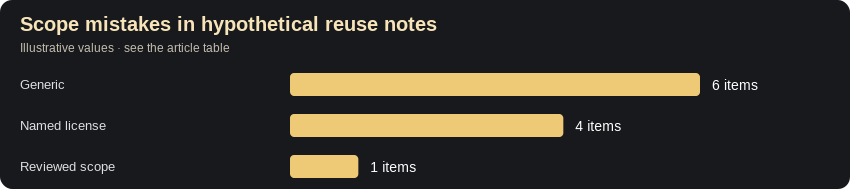
The illustrative bar chart titled “Scope mistakes in hypothetical reuse notes” has three categories. Generic has six items, Named license has four, and Reviewed scope has one. A unit is one checked scope item still wrong or unresolved in this fictional review. No measured reduction, error probability, team rating, or causal claim follows from the chart. The values were constructed to distinguish what naming the right license solves from what only a scope review can find.
| Example | Unresolved scope items |
|---|---|
| Generic | 6 |
| Named license | 4 |
| Reviewed scope | 1 |
The six checks in the Generic version are deliberately concrete: exact license name absent, governing link absent, eligible worksheet files not identified, photograph not expressly excluded, map credited without showing its separate terms, and export not yet checked. Naming the license and linking to its terms clears the first two checks in the Named license version. It does not change whether the photo is included, it does not give a reader information about the map, and it does not make the worksheet boundary visible. Flags three through six therefore remain open.
The Reviewed scope version specifies the worksheets, excludes the photograph and identifies the map's separate terms. The one open item is the export, which has not yet been checked as a standalone file. This is a deliberate example of a remaining issue that still matters. Four becomes one, yet the team cannot assume the downloadable file is ready merely because the page is clearer. A review count is not a release score. If the unresolved issue is part of a promised public deliverable, hold that deliverable or check it rather than congratulating the team on a small bar.
Should an editor use this device internally, divide findings into conditions that block release and polish that can wait. An unidentified rights holder, a false grant and an export that loses its exclusions are not equivalent to a caption that could be easier to copy. When two symptoms come from the same actual defect, identify the shared fix while noting all affected outputs. Otherwise a falling issue count can reflect deduplication rather than work on the rights problem. The best result is a release decision supported by specific answered questions, not the smallest total the editor can report.
The same chart can be made legible without color. Put the category names and units in nearby text, retain the table as an equivalent path to the three values, and do not rely on a hover box to explain that the counts are hypothetical. A reader who only receives the table should still know that each count denotes unresolved checklist items. On paper, the title and provenance note travel with the bars. An unlabeled image reposted on a presentation slide can otherwise make the numbers look like published research.
Choose verbs that describe the offer
Readers pay particular attention to words such as copy, share, translate, remix, sell, attribute, request and credit. In a short note those verbs can help distinguish likely tasks. Use them after identifying the materials, not as an opening slogan for the entire website. If the publisher says “you can adapt the activities below,” the reader still needs to know whether that refers to a printed spread, an editable source file, included artwork, or only the plain text. Match the verb to an object that has passed the rights check.
When an editor cannot make a safe claim with a short verb, do not stack disclaimers on top of it. A front-matter promise reading “use it wherever you want” followed by a general warning about limitations gives readers two incompatible interpretations. A straightforward note about named materials followed by the actual license is more useful. Separate terms can then appear where they apply. In particular, do not ask someone to obtain the publisher's permission for things the publisher has already offered under a public license, or imply that permission is never needed for an item the publisher did not license.
There are also ordinary ambiguities that do not require a legal dictionary. “Reuse is fine in classes” might be read as permission for a class to email a PDF to everyone, print an excerpt, post excerpts online, include the work in a tuition-based course or license a translation to another institution. Those are not variations of a single observable action. If the team has agreed to describe one illustrative way of printing an eligible exercise, describe that way and name the eligible exercise. If a reader sees a clear scope boundary and knows where the license is, the short note does not need to pre-answer every imaginable business or classroom plan.
Distinguish “look elsewhere” situations from “stop” situations in the editorial workflow. A diagram credited to another institution may come with a separately identified license that readers can check. An unmarked contributor's work found in a back catalog may have no usable provenance; that is an internal stop for a new reuse grant. Neither case should be described as “our copyright” by default. The output should preserve the distinction rather than repeat a copywriter's most reassuring line.
A note should also avoid claiming facts it cannot know about the reader or their jurisdiction. Some readers will rely on permission from another source or on a legal exception they have assessed themselves. The publisher can accurately say what its notice covers without adjudicating all of that. For unusual high-stakes uses, the general explanation should leave the reader with an understandable route: identify the exact item, check the terms offered for that item and seek qualified advice or separate permission where appropriate. The note's job is to make those checks easier, not to decide them on the reader's behalf.
Keep the status intact when pages are generated from parts
Editorial teams frequently maintain text, translations, code and images in different systems. A content management system may already expose fields for creator and copyright but no field for the work covered by a rights statement. A template then has to guess whether an empty field means “covered by the page default” or “not reviewed.” Do not let one empty value mean both. Give imported content an explicit review state and show only decisions a responsible editor has actually made. A new kind of contribution should not silently inherit a grant because the template had nowhere else to put it.
A hierarchy can make notices concise, but only if the override behavior is predictable. An archive might put a short collection notice at the start, a chapter credit under an essay, and an object-specific note beside each excluded photograph. The collection notice tells a reader how to interpret those local markings. It cannot repair a contradictory global badge on a downloaded image page. If machine-readable metadata is provided, compare it with the visible notice and ensure it refers to the same object. A correct page footer beside metadata claiming a broader license is still an ambiguous release.
One practical implementation is to store the license identifier once in an approved record and use that record wherever a given eligible work is exported. Keep the editorial summary separate so minor phrasing revisions do not silently replace the identifier. For individual exceptions, point to the specific asset and its separate terms rather than hard-coding an arbitrary caption in each template. The same data can supply a public page, a download manifest and a printable appendix; it still needs a human review of the language and placements in each output.
Migrations deserve particular attention. Suppose an old digital archive handled images as decorative page components. The new platform creates an indexed details page for each image. Yesterday an image's place inside a named section helped explain the collection context. Today it has a detail page and a share button, outside that context. Recheck how a visitor learns the image's status. A system that exports metadata for gallery pages but not for their image detail pages may make unclear exactly the service it aims to make easier.
Keep a dated revision record. When a public note changes, log whether it fixed a typo, corrected a misleading scope description, added a new eligible asset, or reflected new terms for a new release. Those developments are different. A later correction should not purport to erase rights previously granted under an applicable irrevocable license. Preserve the earlier notice text and supporting records where appropriate, and refer any actual grant dispute for qualified review. A reader asking about the archived edition needs information about that edition, not whatever the latest footer happens to say.
Consider translations of the notice itself. Translators need to know whether the source wording is an editorial description, a separate rights notice or part of the actual license text. Provide a terminology sheet for names and visible asset references. Then have someone who reads the target language check whether the translation adds a condition such as prior permission, narrows scope to educational use, or generalizes it to the entire page. A friendly idiom that elides the exception may make the summary less faithful than the literal version it replaced.
Run a release rehearsal
A release rehearsal should test ordinary reuse without pretending to certify every possible future use. Give a reviewer two missions. In the first, take an eligible worksheet and prepare a reasonable sample credit for a handout. In the second, take the excluded image and figure out why the page's main license notice does not resolve its reuse. Start both missions on the most likely arrival page. Repeat them from the exported file. Ask the reviewer to record the exact text or link they relied on, rather than reporting only that everything looked good.
If the reviewer treats the sample attribution as proof that the accompanying image is offered for reuse, move the example closer to the eligible worksheet or remove the image from the scenario. If they use the folder name as the author, improve the source credit. If they read the note correctly but take the wrong file because its exported name is nearly identical, change the download labels. These fixes primarily improve the reader's path. They do not require redrafting the terms.
Take the rehearsal into the actual layout. A narrow screen can put the exclusions underneath a long stack of related content, physically separating them from the notice they qualify. A blank caption slot below the main image can make a visitor assume that only smaller images are third-party assets. A link named “details” can lead to a general policy rather than the specific license. Keyboard navigation or a print view can hide a panel that sighted pointer users see. Follow the links and test that the document's recognizable terms and scope information travel together.
A second colleague should perform a contrary reading. Ask what additional permission a hurried but reasonable person might infer from the note. Ask whether that person could understand which use examples are fictional and which works are actually offered. An editor who wrote “our content” may have meant only the material that the publisher owns. A reader might take it to mean everything visible on the site. Correct the public sentence rather than asking the reader to infer the right private definition.
Finally inspect new projects against legacy ones. If the same publisher offers one handbook under CC BY and a different protected collection with only display rights for much of the material, do not let a menu landing page market both with one promise. Short paired links to distinct notices can do more than a broad institutional pledge. When two rights statements actually govern two different editions, explain which edition a visitor is looking at. A clearer route to the right notice beats a larger banner on the wrong page.
A handoff example for a small publisher
For a quarterly history bulletin, imagine the next issue has four feature articles, a digitized cover on the issue page, a downloadable reading-group sheet, and a publisher-created timeline diagram. The managing editor has verified that the authors authorized the bulletin to offer their feature text under CC BY 4.0. The issue displays a borrowed cover under narrow permission, and the new worksheet reproduces a museum photograph on a separate public license that needs its own notice. A designer is about to turn the timeline into a social image and is unsure whether the art department added third-party icons.
Assign decisions to assets before assigning language to the publisher. The four articles can share a consistent notice if each stays identifiable on its own. The cover needs a distinct exclusion visible to anyone who lands on the issue page. The worksheet can identify scope at the file level and place a local note beside the museum photograph; check what rights apply to the publisher-created portion before saying anything broad about the worksheet. The timeline remains unresolved until someone checks the icons. None of that requires pretending the cover and museum photograph have the same status.
A good reader note for each feature could identify the specific article text and exact license, distinguish excluded art if any, and link to a source page that already carries the correct creator credit. A footer for the entire issue could direct readers to the relevant notices without itself making a separate global promise. One copyable sample credit for an unchanged feature can demonstrate a format, while a note about a translated excerpt can direct readers to the actual conditions and indicate why identifying changes matters. Do not treat the sample as consent to translate the photographs or any other material the author did not control.
At handoff, provide the next editor with three things: the current public wording, a pointer to the evidence for the scope decision, and the output test that was used. Those should be easy to identify even if all staff involved in the issue have left. Estimate time for the recurring workflow by counting assets and distribution formats, not just pages. Four article pages and one ZIP may need many more than five checks if substantial material repeats in the PDF and each file may be redistributed on its own.
This workflow gets better when it records what readers have actually asked. If people frequently want to know whether a worksheet image is reusable with the text, work that question into the next release rehearsal. If they frequently miss the license version number, put the identifier next to the relevant download instead of making the version more prominent in a general FAQ. Ask the help desk to tag ambiguities without copying private questions into a public tracking sheet. There may be a practical problem to solve even when the license terms themselves are perfectly stable.
The best short note does not sound like a miniature contract. It names what a reader is likely to take, points to the real terms, shows how one plausible use could be credited, and gives exceptions a place where they cannot reasonably be overlooked. The language can be short precisely because the editorial work behind it has resolved which materials it can honestly describe.
There is one last checkout worth doing with the exact source packages, not just the production site. Open the worksheet in its ordinary editing application and export the selection a teacher would most likely take: just the instructions and exercise, without the cover page. If that selection cannot carry a notice, the source record should at least make the missing information easy to recover. Conversely, if an excluded illustration comes out in the selection, improve the publisher's template or put a visible credit at the point of separation. Rights information is most valuable at the moment the reader chooses what to keep.