| Category | Value (plants) |
|---|---|
| Cut only | 6 |
| Carrying witnessed | 2 |
| No sign | 4 |
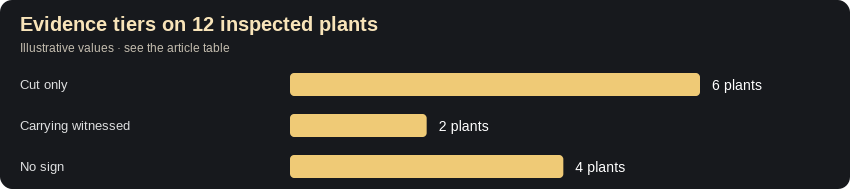
Illustrative values, not sourced observations. One maximum evidence tier per plant; no nest IDs inferred.
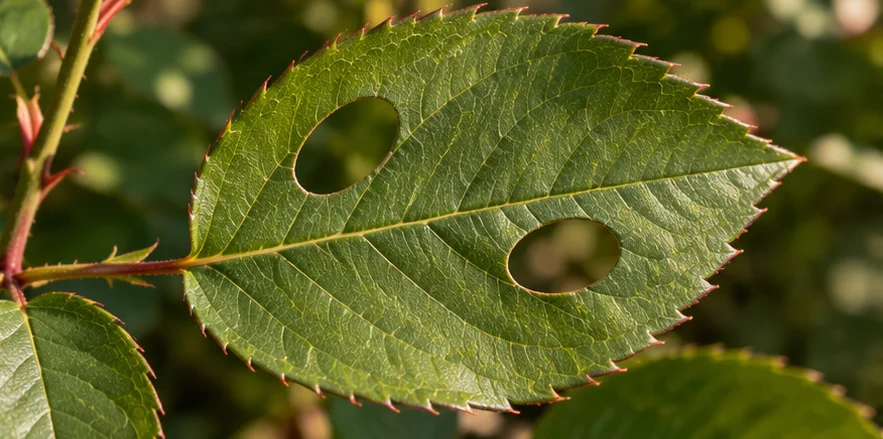
A rose leaf looks as if a small, careful person took a paper punch to the edge. There are two rounded notches, both cleaner than the ragged damage on an older leaf lower in the bush. The gardener who sees them may be looking at the work of a leafcutting bee. The next sentence matters: the marks alone do not reveal which bee made them, when it happened, or where the material went. To learn more, make a record that distinguishes what remains on the plant from what an observer actually saw an insect do.
That distinction turns a pretty garden clue into useful natural history. A picture of a leaf edge records a residual mark. A continuous observation of an insect removing and carrying a piece can link an action to the mark. A separate observation of material carried into an identifiable opening can support a cavity-use report. The two events may be closely related, but one is not automatically a proxy for the other. A garden notebook preserves that relationship best by saving the details of the plant, the insect, the movement, and any gaps in view.
A sound approach requires no removal of leaves and no opening of cavities. The observer can describe the shape, photograph what is already visible and note a movement if it happens from a safe viewpoint. A great deal of interpretive work happens later, when the team decides which evidence categories are actually supported. This article walks through those choices and uses one small invented chart to explain why counting plants with different kinds of evidence does not count bees or nests.
What a leafcutting bee does with the material
The name describes one conspicuous activity associated with many members of the genus Megachile. Female bees of various leafcutting species remove portions of leaves to use as nesting material. The Colorado State University Extension account describes smoothly cut sections along leaf margins and explains that the pieces are used in constructing cells rather than eaten as leaf food. The Utah State University Extension guide to common native bees shows an example of leaf-edge damage, a leaf lining and bees associated with cavities. The combination is valuable because the images show different parts of a biological process. They are not three interchangeable ways to recognize the same event in your garden.
The form of the missing section can make a plausible lead. A rounded scoop from the margin may be more suggestive than an irregular tear through the center, especially when similar smooth arcs recur on several leaves. But curves occur in nature for more than one reason, and the appearance of an older margin can change after injury. Do not turn a visual pattern into a categorical species identification. A photograph of the cut is evidence that the shape was seen, not a field demonstration of the agent's identity. The strongest useful description at this stage can be “a smooth rounded notch consistent with leafcutting.”
A leaf that supplies material is not necessarily the flowering plant from which the same bee obtained pollen or nectar. A bee on a rose leaf may be collecting a construction material; a visitor on a flower may be seeking a floral resource; another recorded insect might merely be resting. Treat plant identity as an observation in its own right. Record whether the material removal and flower contact actually occurred. In many projects neither a food-plant list nor a list of plants with notches can answer both questions at once. Keeping those functions separate allows other people to interpret the results without guessing what the word “use” means.
The Xerces Society's nesting resources describe the habitat roles of cavities, stems, dead wood and other natural materials, and distinguish nesting needs from sources of pollen and nectar. That context is especially relevant when gardening choices are based entirely on showy flowers. A habitat account can include flowering plants, available nesting structures and sources of building materials as separate features. Finding one feature does not demonstrate use of the others. The goal is not to label every bit of dead wood as occupied, but to remember that a bee's local needs do not all show up in a count of flower visits.
Give the shape a description before giving it an explanation
Start with the leaf's position and the type of edge. Is the missing piece along the natural margin, wholly within the leaf surface, near a vein, or too hard to place because the background blends into it? Does the edge look smooth at the available magnification, or is its texture obscured by leaf curl and focus? Is the notch semicircular, broadly oval, nearly straight at one end, or incomplete? None of these descriptions requires a special ranking scale. Pick a few words a second reader could test against a photograph. Draw a quick sketch if a picture won't capture the relevant distinction.
Leaf appearance can pose more than one question at a time. A faded or brown edge may make it hard to decide how recent the notch is. One leaf may carry a smooth semicircular notch and several ragged holes whose origins are not related. Make room to describe each distinctive feature rather than giving the whole leaf one cause. If the project is mapping leaf damage by type, it needs an explicit unit: perhaps each inspected leaf receives one row per type present, or a single leaf row contains separate fields. If the project just wants suitable examples for an outreach walk, it may be enough to save one well-documented mark per plant.
Include a photograph of the uninjured parts if they help with plant identification or showing the original edge form. A rose leaflet's normal boundary can also provide context for distinguishing one missing rounded piece from its usual margin. Using only a tightly cropped edge can hide the purpose of the photo. Keep a context frame with enough of the leaf and plant to identify its position and a detail frame when available. If image pairs come from different leaves, label them accordingly rather than using the clear context frame from one plant to imply a better record of a different cut.
A ruler can be useful only if the situation allows it without handling a busy leaf or changing the observation. If you cannot set an appropriate reference from a safe view, report approximate size or omit it. Measuring the notch in pixels can preserve a record within one image, but turning that number into millimeters requires a usable scale and viewing geometry. A wider image taken at an angle does not necessarily preserve true proportions. For most garden observations the relevant result is a faithful description of a visual clue, not an exact dimension pretending to distinguish species.
Distinguish witnessing a cut from witnessing a carry
The strongest link to a particular mark comes from a sufficiently clear sequence. An insect lands on the known leaf; the observer sees the material being separated from that leaf; and the insect is then visible with the piece. If the event ends with a photograph of the new mark, connect it to that leaf and date without omitting how the sequence was seen. A record of a carry alone is different. It can support a claim that an insect was carrying plant-like material, but the observer may have seen it only after takeoff. Do not assign the source leaf merely because the nearest plant has a matching outline.
Some episodes support an intermediate claim. A bee appears at a leaf margin and moves along it in a way that looks consistent with cutting; a wing or adjacent leaflet hides the instant material comes free. A later still shows a piece near the insect, but the motion linking plant and piece was not observed. Such a note need not be discarded. Keep “possible removal” separate from “removal observed.” If the team cares about how reliably people can identify the action, practice on established examples rather than pressuring volunteers to fill an exact diagnosis into every row.
Observe the full movement when practical. A bee may leave the frame rapidly, and an apparent disappearance can happen behind foliage before its direction is clear. Some strong records can be made without claiming a destination. If another person later catches sight of a leaf-bearing bee at a fence, keep the two timestamps and locations. Unless the observers maintained continuity or have independent evidence, don't stitch the clips together as a single trip. A field notebook can be valuable without becoming a continuous biography of an individual that was never tracked.
Insects and material must also be considered independently. If you see a small black insect carrying green material but cannot identify it from the view, document the insect description and uncertainty without calling it a bee. If an insect looks like a leafcutting bee but its object could be folded foliage, a petal or something else at the available resolution, write the action and its limits. Confirmation of the genus may become possible later with a useful image. That confirmation would not make the material or its source more certain than the underlying view allowed.
A nest association is a different event with different requirements
An observer on a path may see an insect carrying a leaf fragment into a specific existing gap. That supports a description of movement at the gap and the visible load. If the insect disappears behind a larger board without a view of the boundary, destination remains uncertain. An opening capped with leaf-like material is another kind of observation. By itself it does not tell whether something is currently active there or which insect built it. Appearance, presence of material, and repeated entry with cargo can make a stronger record together without asserting a species or internal nest structure that was not observed.
Do not open stems, housings or cavities to convert uncertainty into a confirmed record. A project studying a public garden can follow its own authorized pathway for reporting suspected use of a structure. If a sightline requires lifting wood, pulling apart litter or standing over an opening, that view is not appropriate for the field notebook described here. You may simply write that the presumed destination could not be seen. People sometimes think a visually attractive, measurable exhibit is more useful than a partial field note. The value of leaving the material undisturbed usually outweighs curiosity about one ambiguous observation.
The University of Maryland Extension guide to leafcutter bees on shrubs and flowers describes various protected natural cavities used by solitary leafcutting bees. That diversity is a reason not to infer the location of a nest from damage on rose foliage. A plant could provide leaves while the animal travels to a different place for nesting. There may be many potential cavities in a garden that look similar from outside. A nearby punctuated leaf margin does not assign any of them to the insect that made the cut.
Choose language at the same scale as the evidence. “A material-bearing insect entered a visible opening” is more specific than “the bee nested nearby” in what was directly seen. Repeated entry observations may support reporting possible nest use to an authorized program. No one needs to be told where to find a likely cavity if a public summary only concerns leaf marks and resource diversity. Separating records makes it possible to share the latter without promoting attention to the former.
Read the toy figure as a plant register
The chart “Evidence tiers on 12 inspected plants” divides a set of twelve fictional plants into thresholds of field evidence. Six plants are in Cut only, two are in Carrying witnessed, and four are in No sign. The categories are exclusive for this particular chart because each plant is counted at its strongest recorded tier. If an eligible carrying event was witnessed at a plant that also had a cut mark, that plant is not added again to the six Cut only cases. The sum of six plus two plus four is twelve plants, not the number of leaves, marks, episodes or insects. None of the numbers comes from a published study or agency dataset.
In this example, the Carrying witnessed tier means that the witness saw the carrying linked to the named plant in the observation, rather than simply seeing an insect fly past a plant that had notches. It does not imply a view of every stage of cutting or of an eventual destination. Keep a note on whether removal itself was also seen. A plant that received several confirmed carrying observations would still count once here. For an event-frequency chart, those incidents would become a separate unit and need an explicit observation window. Mixing them into the plant chart because they are interesting would invalidate the denominator.
The No sign category includes four fictional inspected plants with no qualifying evidence recorded. That is not proof no bee ever visited those plants, no leaf material was ever taken, or no nest was in the surrounding garden. It means the categories that govern the chart did not apply to those plants during the example inspection. A real report should distinguish a plant actually inspected from a plant omitted because of access, weather or missing notes. The absence of an observation opportunity cannot be classified as a negative inspection outcome. A tidy table can otherwise create misleading precision around what nobody saw.
Expressed as plant percentages for this toy example, the categories are one half, one sixth, and one third, or about 50, 16.7 and 33.3 percent. Those restatements do not improve the evidence or make the dozen plants representative of all shrubs. They only help a reader interpret how the counted plants were distributed among the three evidence classes. Six plus two gives eight plants, or two thirds, with qualifying evidence in one of those classes. That aggregation is appropriate only if described as evidence across the two tiers, not eight proven active nests. A picture that shows only the three bars and a unit label can remain interpretable if its caption conveys this distinction.
Set the inventory unit before comparing plants
A garden may have one giant shrub beside a raised bed of many small plants. Counting plants rather than area gives each individual the same possible place in the chart, but not the same chance of an observable mark. A large shrub may have far more accessible leaves or much less convenient sightlines than a small plant facing the path. If the goal is to summarize visits to one small garden, the crude count is easy to explain. If the claim is that leafcutting bees choose one plant species over another, a design would need appropriate measures of availability, effort and other possible influences.
For a repeatable household project, choose tracked plants that can be identified without labeling or damaging their parts. Give each a code or recognizable place on a map. Establish how many leaves or which sections will be viewed, and how deeply into the canopy the view reasonably extends. Mark access changes separately from observed leaf changes. A storm that pushes a branch outside the visible section can remove several marked leaves from view without changing the underlying frequency of cutting. A plant that has been pruned is likewise a change in what can be observed. Treat the condition as part of the record, not as noise to hide.
For a park project, make the choice of pooled denominator explicit. A count of six plants out of twelve with cut-only evidence describes the specific plants assessed. The average percentage across several gardens can give each garden equal weight, while a combined count of plants gives larger sampled gardens more influence. Neither solves a choice to sample only plants with previously reported damage. If this project selected sites for showing clear examples, describe it as an example collection rather than reporting all percentages as unbiased estimates. Make a small map of the actual inspected areas and explain which sections were omitted.
Keep identity and counting decisions separate from conversational names. Gardeners might call several stems the same rose because they emerge close together, or assign labels based on where plants were believed to have been planted. You may need an operational unit such as individually marked plants under the bed inventory, without asserting knowledge of all root connections. If the same plant extends across two display areas, agree about how to attribute it once. Otherwise a tally of apparent evidence can partly reflect how many volunteers or zones are involved rather than how many plants were inspected.
Use time carefully when marks persist
The remaining edge is cumulative evidence. It can show a cut after the insect has gone and after the observation window that would have detected it. That is both its strength and a limit. Comparing a snapshot of old markings with a short timed watch is not a direct comparison of rates. A dramatic leaf with five notches may reflect several episodes over multiple days, while a short watch sees one clear event on a different plant. Neither tells which plant is cut more often without a more structured way to detect and date new marks.
One way to bound timing is to photograph the same naturally identifiable leaf or small plant section at two visits. If it clearly had no notch in the relevant place at the first visit and shows a new notch in that place at the second, you have an interval during which it appeared. That still does not show the day, the agent or the destination. If there is no evidence the photographs show the same leaf, the comparison is much weaker. Match architecture and context rather than guessing from color and shape, and mark uncertain links separately. Do not remove the leaf merely to make it easier to photograph again.
The safest version of this project accepts that some precise comparisons will not be possible. If the leaf grows or turns, the bright reference photo may not let someone see the relevant edge at the next visit. If a volunteer records “no new marks” when only one surface appeared in the second frame, revise the label to “no new marks in matched visible portion” or leave the interval unresolved. Some plants will drop leaves, another reason to maintain a stable record of whether the original target was still present. A dated absence of a leaf is not a dated absence of cutting.
An active watch and a mark survey can be scheduled together without merging their data. The watch records when somebody was actually observing and what happened within view. The mark survey records leaf sections inspected and evidence visible at the point of inspection. An observer might spend ten minutes on an activity watch and then notice five strokes of old damage while walking out. It would be incorrect to report five cut events in ten minutes. A pair of related but differently structured records preserves both discoveries and makes later interpretation possible.
Keep identification as narrow as the evidence allows
The U.S. Geological Survey's bee specimen identification resources illustrate the existence of dedicated tools for identifying bees. The right implication for a casual observation is not to assume every image can supply a species name. Some specimens or photographs may show characteristics that a specialist can use. A distant picture of flight through shrubbery usually does not. Attach the image and the provisional identification, and make space for a later determination. Record who reviewed it when a more specific identification enters the dataset. Do not propagate that label to neighboring leaf marks without a supporting link.
A picture of the underside of a bee or a useful side view might document characters ignored by a photograph taken purely for color. The Utah State guide provides examples for a general reader, but it is not a universal key to everything that visits plant margins. Behavior can help a field worker decide what to look for; it should not fill in unseen anatomy. A file may support “bee carrying cut green piece” before it supports a named genus. A photograph taken when an insect visits another flower later may be useful in its own right, not proof that the same insect visited during the earlier observation.
Pollen loads can complicate a casual interpretation of color. A bright area under an abdomen may prompt closer consideration, but a photo of a load does not establish leaf material in the mouthparts or prove where any substance was collected. Describe the part of the body involved and whether the observer saw separate material. States such as visible component, possible component and inadequate view are useful. Add broader taxonomic context only when it helps support observable differences, not as a substitute for evidence of a particular action. A file about garden leaf damage should not accidentally become a species occurrence record merely because the article is about leafcutting bees.
There are good reasons to preserve uncertainty even if an expert later names one insect. Species determinations may be revised, a better image may identify an earlier provisional label as another group, or an apparent sequence may turn out to involve more than one individual. Keep original field text and the revision note in linked fields. In an editorial dataset, this makes it possible to regenerate a graphic under an updated rule. It also makes a correction intelligible to someone who saw only the earlier public version. The evidence and the interpretation are both valuable precisely because they are not the same thing.
Compare two gardens without turning marks into pest rankings
Suppose a community garden asks whether it should remove a shrub because it looks heavily marked. Colorado State's extension account treats typical marks as a minor curiosity in many cases while recognizing circumstances where plantings can be more substantially affected. A field survey of shapes on leaves cannot determine plant health or diagnose all causes of stress. Record the portion of the shrub affected, note other visible symptoms separately, and consult the person responsible for the planting if a real management decision is involved. Do not make recommendations about destroying possible nesting sites or treating insects on the basis of an aesthetic tally.
A fair comparison might inspect the same number of accessible leaves on named plant species in two beds, using the same definition for a candidate mark. It could separately document where confirmed material removal is seen during matched observation windows. Garden conditions still differ: foliage age, watering, duration of growth and observer view all matter. The most defensible early conclusion may be that more suitable candidate marks were recorded in one set of sampled leaves, not that one garden had more bees or that its plants were intrinsically preferred. Report the first as a useful positive result rather than treating it as a weak substitute for the more dramatic claim.
Try a negative scenario, too. Two different plant types have no visible marks during the same inspection, but leaf-bearing insects are observed flying through the area. The correct result is that this inspection did not link those insects to the sampled plants. The flight observation remains useful, and a broader project can consider other material sources. Silence in one evidence column is not a warrant to exclude contradictory observations from another. A plan with several independent observation types can show that a finding is incomplete without making it disappear.
The broader ecological purpose can coexist with a practical decision. A gardener often wants to know whether it is worth keeping leaves with a few clean notches for the sake of observing the season. A conservation volunteer may want to record materials used without disturbing cavities. An educator may need a labeled example to explain the difference between feeding and nest construction. These tasks don't all use the same thresholds for completion. A properly labeled illustrative profile can satisfy outreach without pretending to be a controlled estimate of plant damage.
Check the report with a fictional afternoon sequence
A volunteer photographs a smoothly notched leaflet at noon. At half past noon a second observer sees a bee-like insect carrying a green piece above the bed. At one, a third person gets a video of a carrying insect approaching a distant cavity and losing sight of it behind vegetation. The stories might describe successive parts of one trip, or three unrelated observations. Most importantly, none of them reports a witnessed removal of the photographed notch, and none shows the object crossing the cavity boundary. One should not “complete” the account by arranging it in chronological order. A useful report gives all three observations their own records and explains what relationships are unsupported.
Now change the fictional sequence in one way: the camera continuously shows a bee removing a piece from a traceable leaflet and leaving with it. This supports a new notch and witnessed carrying linked to that plant. It still gives no obvious right to attribute the other notches on that plant to the same individual or identify any nearby nest. If that bee cannot be resolved below a broad category, the report may still be useful. A plot comparing marks-only and witnessed-material cases does not require every insect to reach the same taxonomic certainty unless its stated question specifically does.
An editor reading the resulting notes should verify that image captions, chart labels and prose use the same evidence units. “Eight signs on twelve plants” is ambiguous: it could refer to eight cuts, eight positive plants, or eight records of multiple types. A better caption gives the actual chart categories and the explicit strongest-tier rule. If an illustrative photo shows two cutouts, avoid implying it represents the six plants in the Cut only bar. The simulated data and generated header play different roles, and neither needs to masquerade as a record of a site.
Finally, ask what information would make the next watch more useful. Perhaps there is a safer viewing angle that shows the leaf boundary without blocking the path. Perhaps the updated sheet can note the positions of actual inspected plants or separate leaf material from unverified green specks. A useful conclusion turns uncertainty into a specific next observation rather than suggesting that all missing information be obtained immediately. Some observations, such as the eventual fate of a leaf piece, can remain outside the project altogether. Good boundaries let the record get better without asking the observer to follow an animal into unsafe or unauthorized spaces.
Preserve an evidence ledger that can be audited after the season
A garden group can organize its records around four identifiers: a patch, a plant, a visit and a piece of evidence. The plant record describes what the team meant by a plant in that particular bed. The visit records the bounds of the search, date, and who had access. The evidence record describes the feature or action seen, assigns confidence only to the fields where confidence was assessed, and links relevant files. Not all files must contain every identifier in their filenames if the archive has a dependable way to match them. What matters is that a later reader can determine which mark belongs to which plant without reconstructing the order in which photographs were uploaded.
Imagine someone records three notches on plant R7 but only supplies a photograph of the easiest one to see. Another person marks the same plant as inspected the next day and sees no insect. The table should not conclude that the earlier finding was contradicted. The visits observed different things: one retained evidence of damage and one did not detect active behavior. If the second person also found the original plant hard to identify, that is a matched-target issue worth recording in its own field. When the team later counts unique plants at the strongest tier, entries sharing the same stable plant identifier can be compared without assuming that separate visits always yield separate plants.
A simple audit can start with the chart. Pick one plant counted in the carrying tier. Trace it to the visit and look for the evidence linking the carry to that plant. Decide whether the recorded data meet the rule or whether someone upgraded an unrelated flight observation because the plant also showed damage. Then pick a plant in the no-sign category. Check that it was actually inspected, and that the expected types of evidence were assessed. If the project did not record continuous watch time for the latter, no-sign still can mean no qualifying evidence under a limited inspection. It should not be labeled “no leafcutting activity.”
Retain the logic of combining categories, not only the final output spreadsheet. Members of the team might want a different figure later that displays how many plants have a damage mark regardless of observed carrying. The earlier chart counted only the strongest tier; it cannot by itself answer how many witnessed-carrying plants also had a photographed cut. A chart of overlapping evidence needs two separate binary fields or an appropriate joint classification. That is not contradictory to the first graph; it answers a new question. Raw evidence should support both interpretations if the underlying observations were actually recorded.
Make a sendable account for different readers
A steward may need a concise private note about material entering a gap in a structure scheduled for replacement. That report might give the minimum location context necessary to find the feature, the date, the visibility of the boundary crossing, and who collected the record. An educator may prefer a broad public note about why a rose leaf can hold evidence of nesting-material collection. These communications do not need the same location detail, species determination or narrative emphasis. For a public account of leaf shapes, exact directions to a suspected nesting opening usually add little and can lead readers toward unnecessary disturbance.
When a reader asks whether the guide establishes a fact about their own plant, avoid skipping the examination step. Ask what part of the leaf is missing, what the edge looks like, what the observer actually saw, and whether there is evidence that needs a local specialist. Leaf tissue loss accompanied by other symptoms should not be automatically assigned the same cause merely because one adjacent notch looks characteristic. A subject guide can narrow an observation to a plausible explanation without ruling out all others. Tell the reader which photo or note would meaningfully change the assessment, and do not promise a species name from an ambiguous cut.
If presenting a garden sign, give visitors one activity they can safely try: compare two visible leaf margins without touching or walking into the planting. Invite them to describe differences in shape rather than collect evidence from a cavity. If a bee flies past with a piece, they can record the action as a separate observation. In a longer guided project, one clear example might become part of a shared reference gallery if its provenance is documented. Writing the purpose on the sign helps visitors understand that they are learning to notice evidence, not competing to find the most bee nests.
The record can end with one sentence that is proportionate to the strongest evidence. “Rounded marks were common on the leaves we inspected, and we twice witnessed plant-linked carrying” is already an ecological story. It lets a reader imagine the next question without assuming the answer. If the procedure did not support a nest association, there is no defect in saying so. The most useful field claim is the one that a second person can inspect and understand on its own terms.
Sources and illustration note
- Xerces Society: Nesting Resources.
- U.S. Geological Survey: Identifying Bee Specimens.
- Colorado State University Extension: Leafcutter Bees.
- Utah State University Extension: Beginner's Guide to Common Native Bees.
- University of Maryland Extension: Leafcutter Bees on Shrubs and Flowers.
- The graph uses invented values of six plants with cuts only, two with linked witnessed carrying, and four with no observed sign. The header artwork is a generated illustration, not a field photograph.