| Category | Value (events) |
|---|---|
| Visible contact | 6 |
| Material only | 3 |
| Both | 5 |
| Neither clear | 10 |
Illustrative values, not sourced observations. Neither substance identity nor fertilization inferred.
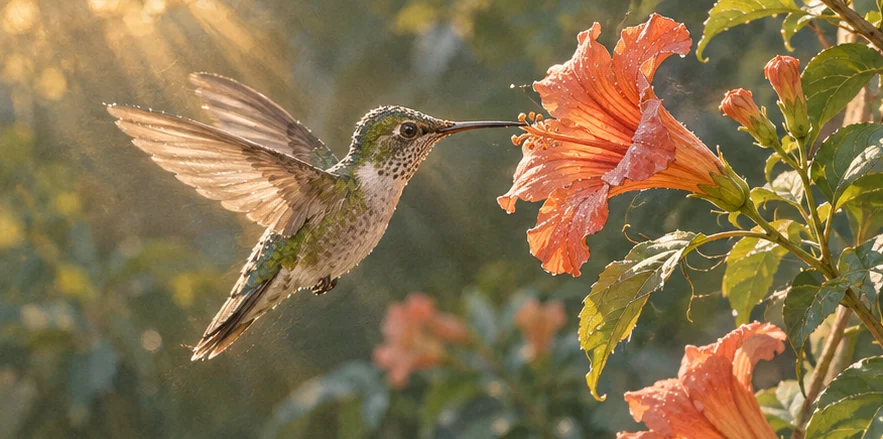
A hummingbird backs out of a flower, turns, and briefly catches the light. In the viewfinder there is a pale patch near the base of its bill. It might be pollen. The flower might be its source. The bird may soon carry it to another flower. All three are plausible and none is shown merely by the bright patch. The photograph can still be valuable. It records the position and appearance of something worth investigating, and a longer sequence may show how the bird fits against the flower.
This illustrative scene has a common trap: several links in a biological process seem to be visible at once because the photograph is vivid. But seeing material on a bird, seeing it touch a flower, identifying the material, and measuring deposition on another flower are separate jobs. A garden record can be excellent at one of them without answering the others. Start with the strongest claim each piece of evidence supports. Then name the next missing link rather than treating a striking photograph as a shortcut through the chain.
Give contact, material and transfer separate records
Contact is an observed physical event. In a well-resolved sequence the bill may touch the rim, the forehead may brush a protruding part, or both may occur. A bird appearing close to a flower in a still image is not necessarily touching it; the two may be at different depths in the frame. A bird taking nectar need not visibly contact a reproductive structure. If the camera shows bill entry but the interior of the tube is hidden, report bill entry. Do not give the event an extra contact type based on knowledge of how a flower usually works.
The material observation is about an apparent deposit or marking, its location and its appearance. Say “pale granular-looking patch near the upper base of the bill,” for example, if that is what the photographs support. The phrase leaves open granulometry, substance identity, source and timing. A mark can be real without being newly deposited, and it can appear new only because the bird turned toward the light. Compare images of the same side when the lighting and focus make comparison meaningful. Lack of a mark in an image where feathers were in shadow is not a confirmed earlier absence.
Pickup is stronger than either feature on its own. It would mean material moved from a source onto the bird. A before-and-after sequence with an unobstructed view and a mark first visible immediately after contact can support that hypothesis, especially when aligned to the precise site of contact. It need not show the moment material moved or identify what moved. Deposition asks the opposite transfer question: did something the bird carried move onto a receiving surface? Even if the answer is yes, it matters what the material was and where it went. A spot on a petal is not equivalent to pollen on a stigma.
Pollination and fertilization are different processes. In this context, pollination concerns pollen reaching the appropriate receiving structure, typically the stigma of a flowering plant. Successful fertilization is downstream; not every deposited grain is the right kind, compatible, viable, or able to give rise to fertilization. A developing fruit or seed can be an important later outcome, but it does not by itself identify the visit that contributed. Use the word “visited” for a visit, “appeared to touch” where visibility leaves uncertainty, and “deposited” only when the evidence addresses movement onto a recipient. This is not a dispute over vocabulary. It is a way to keep the observed comparison reproducible.
Use flower traits to ask a better question
The USDA Forest Service's pollination brochure uses floral characteristics to explain patterns associated with different animal visitors. Such patterns are useful for anticipating how a bird might approach and where contact could occur. A color, tube shape or orientation alone does not identify who visited, what contacted a reproductive part or whether that visit moved pollen. Different flowers offer multiple routes and visitors, and the exact angle of approach can change the points of contact even for the same visitor and plant.
The Forest Service guide to attracting pollinators with native plants describes native garden contexts and a range of flower visitors, including insects as well as hummingbirds. For an observation project, that variety is reason to keep a record of other visits and nearby flowering plants rather than assign the first plausible source to every visible mark. A flower's identity narrows possibilities when reliably identified. It is not a label stamped onto all material in the scene. If the garden has similar cultivars or flowering species close together, record only the level of plant identification that the project can verify.
Before the watch, look at the flowering structures you can see without altering the plant. You may be able to distinguish a petal edge, exposed anthers, or the upper extent of a style in an ordinary photograph of an unvisited flower. Write down which structures would actually be visible from the watching position. A structure tucked beyond a curve in the flower can matter to the biology and remain unobservable from the camera. If the plan cannot distinguish it, define the contact outcome less narrowly rather than claim that a telescope produces an internal view.
Select one prediction at a time. For example, ask whether a bird's forehead approaches the same region of the opening in repeated visits. The outcome could be visible approach or physical contact, but not directly pollen transfer if the method does not observe transfer. A second question could compare whether a material mark tends to become visible after those visits. Keep this exploratory and preserve the unmatched views. Restricted flower shape and consistent body position make an interesting observation even when no claim about pollen identity is defensible.
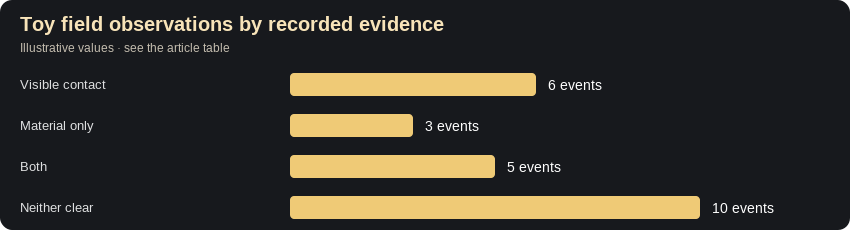
Toy field observations by recorded evidence
The chart and table show the same 24 fictional events. The unit is events. One event is a recorded observation opportunity under the illustration's rules, not a count of distinct birds. The categories are mutually exclusive: “Visible contact” means contact only; “Material only” means a visible mark without independently resolved contact; “Both” means both kinds of evidence were visible in that event; and “Neither clear” means the available view was insufficient to assign either kind of positive evidence. No substance identity, pollen deposition or fertilization is inferred.
| Evidence category | Events |
|---|---|
| Visible contact | 6 |
| Material only | 3 |
| Both | 5 |
| Neither clear | 10 |
Six events showed contact without the material criterion being met, and another five met both criteria. That gives 11 with visible contact. Eight events had visible material, including those five. Fourteen showed at least one type of evidence. Those are counts of what could be documented, not necessarily everything that happened. In a record assigned to contact only, material might genuinely have been absent or hidden by an unfavorable view. The same logic applies to material only when contact was partly out of frame. If a real project can document true absence of a visible feature under a strong inspection rule, it can distinguish that result from an indeterminate view. The small chart simply groups records by positive evidence available.
The five events in the both category are not automatically five pickups. The bird may have had the material before making contact. It may have touched a petal with a part of its body that is far from the mark, and it may have gone on to a different plant outside the frame. The category is useful for finding records worth reviewing, not for counting completed transfers. It would also be misleading to use the five as the denominator for fertilization. Nothing about the way these events are defined, selected or observed measures subsequent reproduction.
Notice what is retained by the neither category. If focus rarely catches a rapid approach, many clips will fail to resolve either feature. Dropping every difficult view would generate a chart about the clearest visits, not all observation opportunities. Keep the reason a clip was inadequate, where possible: focus on background, bird partly out of frame, glare, or interruption. Different reasons may relate to different flowers or viewing positions. Later analysis can report a useful rate among adequately viewed events as long as it states that denominator and does not silently generalize to visits that were hard to see.
Work from an ordinary nonintrusive vantage point
The garden watch should not change what the bird would otherwise do. Stay in an appropriate public or permitted viewing place, give the bird room, and do not pursue it between plants or toward a nest or perch. Do not handle, trap or swab a bird to identify a material patch. Do not put a substance on the bird or on flowers to see how it spreads. Do not bend stems or remove floral parts to create a camera view. If visits are visible only after such changes, the planned observation is not practical as a nonintrusive garden study. An incomplete view is both acceptable and informative.
A stable wide frame can answer some questions better than a fully zoomed one. It can show the approach, which flower was in view and the moment a bird left. A longer focal length from a permitted position can reveal where a visible mark is, but can omit every other flower the bird used. If you already have suitable footage, use each frame for the role it supports. Do not indicate that a crop shows continuity simply because the flower and bird in the crop are both clear. Preserve the source sequence and any neighboring events needed to see whether it was continuous.
Record the viewing conditions. On one side of a flower, shadows may mask the bill base as the bird arrives; on another, bright sunlight can wash out features. A gust can turn the flower and change both where the bird contacts it and whether the camera can see. Log flower motion, light and visible surfaces in the same place as the contact code. Keeping those fields separate makes it possible to ask whether the observer had equal opportunity to see the same thing, instead of assuming one side of the garden received less pollen because its footage was darker.
For a planned watch, define where and when you will observe before looking for attractive clips. Select a regular watch period at a single patch or several defined views. Do not extend a watch only after a particularly bright patch appears and then count another matched watch as though the effort were equal. Accidental sightings can be collected too, with an opportunistic label. The two evidence types can complement each other: one documents a notable sequence and the other helps explain what share of eligible recorded events showed comparable detail.
Describe what the camera could and could not resolve
Feathers, bills and flowers all look different as the angle to the light changes. A pale region could be a reflection, a feature of the plumage, material of unknown identity, or a combination. A series of frames can establish that the apparent patch stays with the same region of the head as the bird moves, which is stronger evidence that it is associated with the bird rather than a background overlap. It cannot necessarily separate an attached deposit from a plumage feature. Keep the same word, such as mark or apparent material, until stronger evidence justifies a different one.
Compression and motion blur are worth checking. A short streak can arise from movement or a video encoder focusing on a changing edge. Overexposure can make feathers and reflected light look white or yellow irrespective of the underlying colors. Heavy sharpening can draw a brighter rim along the bill and make it look textured. Watch the original footage as well as chosen stills, and note any processing that affects interpretation. A crop to make a location visible does not increase the physical resolution available at capture. Avoid quantifying individual grains from an image that does not resolve them.
Place the mark in ordinary anatomical terms. “On the left side at the base of the bill” is better than “on the face” for a contact comparison. If only one side of the bird was visible, do not infer the state of the other side. If the patch spans bill and feathers and the boundary cannot be resolved, say so. Draw an approximate region on a duplicate illustration or use a short description, leaving the original intact. Later reviewers need to know which portion of the image led to the code and whether the contact point could actually be compared with it.
One way to test a criterion is to describe an observation twice, once at the moment it occurs and once from a blinded clip with neighboring frames available. See whether both versions point to the same anatomy and event. A reviewer could code whether flower contact is visible without knowing whether another reviewer saw a mark. This protects against the tendency to find contact in vague frames once the patch has suggested a story. If two reviewers disagree, record the reason. A fast change may genuinely be unresolvable, and agreement reached by assuming the conclusion is not improved visibility.
The same caution applies to contrast between photographs. A frameset can show one side of the bird before entry and the opposite side after departure. The second side may show a clear mark but the first provides no matched baseline for it. In a natural sequence a bird often turns precisely where its head clears the flower. That is a biological event and an imaging change at once. Give a before-and-after claim only where the same relevant area was adequately visible at both times, and say if the one key frame was obscured during actual contact.
Follow the evidence in order instead of stitching together likely visits
If a bird stays in view from a first flower to a second, record that as a continuous observed route and describe which floral surfaces it touched, if any. If it passes behind the shed and another similar bird appears at the second flower, record a gap. An observer can be confident the birds look similar without being able to show they are the same. Do not join separated clips solely because a particular sequence would make a satisfying before-and-after photograph. Continuity of an event, identity of an individual, and certainty about the contact point each require their own evidence.
The potential source may also be ambiguous even with continuous movement. A bird could approach a flower with material accumulated elsewhere. Seeing the mark after the current visit does not identify its origin if you never saw that part of the head beforehand. A prior visible mark is valuable in its own right: it keeps the current flower from being described as the first source without evidence. If the observed patch gets larger at the moment of contact, the difference may warrant a hypothesis about pickup. It remains important to distinguish an apparent change in area from an actual addition of identifiable material.
At a recipient flower, contact at the matching body region is more persuasive than contact at an unrelated part of the bird, but does not by itself demonstrate that grains moved. An example: a forehead patch might align with a protruding stigma in a short sequence. A credible note can record both alignments and say deposition was not measured. If the only visible contact is between the bird's bill and a petal while the mark is on its forehead, the evidence answers an even narrower question. The apparent route and placement help choose a future observation; they do not fill the missing evidence.
Absence of visible material on the bird after a second visit is not direct deposition evidence. An altered pose may hide it, or it might have been lost at another point. Conversely, a patch still present after contact need not mean nothing was transferred: a small change may not be visible or only a portion could move. Describe persistence where you can document it. Avoid treating appearance and disappearance as a balance sheet in which every speck must have a recorded source and destination.
Compare the garden record to the question a study actually tested
An experiment can address a link that a passing observation cannot. In the published Penstemon experiment by Castellanos, Wilson and Thomson, the investigators compared pollen removal and deposition for hummingbird and bumblebee visits in particular flowers, and evaluated how pollen carried over across visits. Their response variables allowed them to distinguish material taken from a flower from material delivered to another. A garden video showing a bird poke at a flower does not reproduce either measurement. Use the research to see why the links matter and which questions need a different design, not to attribute the exact published transfer efficiencies to an unrelated plant or bird.
The experimental columbine study on flower movement and contact asked how the movement of pendulous flowers during visits can affect where contact occurs. This is useful context for why geometry matters, and why a fixed portrait of a flower does not always predict its position during a visit. The experiment's specific intervention and observations should not be generalized to all tubular flowers. A nonintrusive observer can notice similar movement and record it as a hypothesis about where contact occurs. This article does not recommend that the observer restrain or manipulate flowers to recreate the experiment.
Experiments on pollen carryover in hummingbird visits to scarlet gilia followed donor pollen across recipient flowers under a defined arrangement. An important contrast is that “pollen present somewhere on the bird” and “donor pollen reached this particular recipient” are not equivalent findings. Pollen from earlier flowers may persist through later trips, and multiple plants or flowers can contribute to the sequence. It takes evidence about the donor, recipient and actual movement to attribute transfer within a complex garden. The more plausible sources there are, the less appropriate it is to treat a color match as source identification.
Research designs can also ask about effectiveness, not just whether transfer occurred. The share of individual visits that lead to deposition is different from a group's total contribution, since total contribution depends on how often it visits and which plants it visits. A frequent visitor could be important despite low per-visit transfer, or a rarer visitor could move a large amount when it visits. A visually dramatic close-up is not a dataset sufficient for either comparison. Label a good record as evidence of the specific behavior it documents, not as proof that this group is the most effective garden pollinator.
The experimental sources use purposeful conditions that make evidence interpretable. A garden watcher can learn from their distinction between donor, geometry and outcome without trying to duplicate controlled work. Do not handle birds, access nests, add tracers, manipulate flowers, or collect material from animals to fill a gap in a hobby record. If a research question calls for professional evidence, it is a different project with its own expertise, protections and approvals. Observational work has a legitimate role in identifying a repeatable question or describing natural behavior without making the next step compulsory.
Keep absence, uncertainty and out-of-frame separate
Make the recording form show which attributes could be assessed before coding any event. An event where the bill base is in focus throughout and no mark is visible is not the same as one in which the bill leaves the frame. Neither is absolute proof that there was no material, since some material would be beyond the available resolution. But the first qualifies for a statement about visibility under documented conditions; the second does not. At a minimum, distinguish recorded, not detected under a qualifying view, and not assessable. This also makes it possible to describe uncertainty in the toy chart without claiming all ten neither-clear clips contained no contact and no material.
Do the same for floral structures. The observer can have an excellent view of the forehead and a poor view of the stigma. If the study requires both to be seen at contact, the event is unsuitable for that particular code even if the garden visitor itself is exceptionally well photographed. If a clip shows a petal move while the bird hovers, several possibilities remain: direct touch, air movement, or independent motion of the stem. Describe the motion when the source is uncertain. Do not force agreement by defining a moving petal as proof that the bird touched a reproductive structure.
An observation can change categories after review without the event itself changing. A clearer original clip might resolve whether there was visible contact. A reviewer might determine that a pale edge came from an export artifact. Keep the preliminary observation, the reviewed outcome and the reason for the change. Mark each version separately if it feeds a summary. This is especially useful when people submit mixed-quality photographs, because otherwise the most confident initial caption can survive longer than the more dependable later evidence.
If weather or access stops a planned watch, distinguish the unobserved time from an observed period with no visits. Ten minutes during which a frame was obscured by a walking group are not ten minutes of usable nonvisitation evidence. Conversely, a short but complete observation of a specific flower can be useful even if the bird was absent that day. Effort, detectability and outcome are distinct in this case just as they are for each clip. Recording them lets a project explain gaps without spending extra time chasing birds or resorting to staged pictures.
Design a notebook someone else can follow
Start with a watch identifier, time, location at an appropriate granularity, plant identification if known, viewing direction, and context such as natural light and wind. Use an event identifier for each eligible recorded visit or attempt, with precise start and end times when feasible. Mark the flower or floral region the event concerned with a field sketch or landmark. Do not tag nests, alter plants or disturb nearby animals to improve the paperwork. The goal is to link records well enough for an evidence review, not to make every part of the garden identifiable in a public report.
On the event line, keep four fields separate: visible contact, anatomical position of the contact, visible marking, and anatomical position of the marking. Add an uncertainty field and a free-text note for plausible interpretations. If the bird visited more than one flower under continuous observation, add each flower to the sequence rather than assume all contacts were part of the same single event. An event definition could instead be one approach to one marked bloom; if so the later flowers are other events linked by a route identifier. State that choice before comparing event counts. Multiple rapid visits can otherwise make one bird's trip dominate a tally without anyone noticing.
Preserve the selection rules for your summary. A visual archive might contain clips only when a camera detected motion. A human watcher could start recording just when a bird hovered long enough to react. Both processes favor some events over others. A rate such as “a visible patch appeared on a third of reviewed clips” can be fair for a specific selection of usable videos but is not a prevalence estimate for all birds visiting the garden. Describe how many eligible opportunities were missed or unreviewable where possible. If counts are exploratory, say so rather than attach an inference the sampling did not support.
Repeat observations at several visits can strengthen a geometry hypothesis. For example, if a certain flower orientation consistently places the upper edge near the same portion of the bill, even different natural viewing conditions may show the same local pattern. Such repetition is more meaningful when rules and effort were similar across the cases. It still does not identify material. Likewise, several nearly identical clips from one continuous bout may show consistency for that sequence but not establish an independent result for every bird or garden. Keep visit, individual identity if known, and observation block separate.
Try a careful interpretation of a complete example
Imagine an ordinary watch with two flowers open on the same plant. A hummingbird first approaches the left flower with the right side of its bill partly hidden. The clip shows the bill entering and its forehead appearing to touch the upper part of the opening, although a particular structure cannot be resolved. When it backs away, a pale patch becomes visible near the bill base. The observer cannot see that same region clearly in the preceding frames. The bird then moves straight to the adjacent flower, where the view briefly shows the patch and another approach; the stigma is not resolved and no change in the patch can be measured.
One sensible record is that the clip shows a continuous sequence involving the two flowers, apparent forehead contact with the first floral opening, and visible pale material or a mark on the bird after the first approach. The initial state of the marked area is unknown. If the project requires definite contact, this event may instead fall in the material-only category with a note on apparent contact. If its rule counts a clearly resolved touch in a better frame not described here, it could count both. No classification makes the first flower a confirmed source or the second a confirmed recipient of pollen. The clip answers more questions than a single portrait, but not every question about the visit.
A separate observer may later find a fruit on the same plant. It is useful to record it as a later reproductive outcome if plant and location are matched. The presence of that fruit cannot establish which visit mattered, especially when other visitors and flowers were not continuously recorded. A comparison of reproductive outcomes involves its own defined units and conditions. Do not match a likely visit to a fruit simply because both occurred in the same part of the garden. A convincing narrative needs each piece of evidence linked to the preceding one, not merely consistent with it.
A reader may ask what would have altered the interpretation. Clear views of the same head area immediately before and after the first approach could clarify apparent change. Resolving whether the forehead touched an anther rather than a petal would make the likely source question more specific. A method that credibly established identity and deposition on a receiving structure would be a different form of evidence. Spell out limits without asking a garden watcher to obtain the missing evidence invasively. Most projects need only a better description of the first two links. The rest can remain explicitly unknown.
Compare opportunities, not just the easiest images
Suppose the project records two flowers with different orientations. The upright one gives the camera an almost uninterrupted view of the bird's forehead, while the other hangs and conceals it until the bird leaves. You could count more clear contact events at the upright flower despite equally frequent physical contact. Keep a denominator that distinguishes watched visits from visits with views adequate to assess forehead contact. If there are too few qualifying views of the hanging flower, the result is that the study could not compare contact at the two orientations, not evidence that one orientation causes less contact.
Separating the burden of each criterion helps. A view good enough to tell whether a mark was visible need not be good enough to tell whether an anther was touched. Provide separate quality flags and, if giving a combined statistic, name the intersection. A survey comparing apparent material before and after visits may need even stricter matching: both times, same side, similar angle and adequate resolution. A snapshot gallery cannot supply that denominator if its earliest image of each bird was chosen after readers saw a striking patch. Report the images as illustrative encounters rather than infer a before-and-after effect.
If the aim is to compare garden plots, record which plants were flowering and which blooms were actually visible. A small camera field may repeatedly sample just one conspicuous stalk in one plot. Visits elsewhere are neither zeros nor included events. Deciding which part of each plot to watch before collecting helps keep effort comparable. A plant with tall, visible flowers can offer a useful record, but do not extrapolate its imaging advantage to higher contribution from the plant. Seeing more is often a difference in opportunity rather than a difference in behavior.
Plan how review will handle conflicting evidence from angles. One observer may have a sharp view of a bird's head while another clearly sees where a flower part touches it. Synchronize and link the records only where both refer to the same event, using sufficiently specific time and location information. If an angle or timestamp cannot be matched with confidence, keep the observations separate. The result may be two well-documented possible instances rather than one definitive combined event. Counting them separately or combining them should follow the event definition, not the degree of confidence the resulting table would appear to offer.
Finally, distinguish hypotheses by what would falsify them. A proposal that a flower presents pollen to a forehead region predicts a fairly repeatable relationship between contact geometry and that region under comparable approaches. The record could show no contact there or a different floral part repeatedly making contact. A weaker proposal that the bird ever visited some source of pale material is practically unfalsifiable from one flower watch. Prefer the question the available evidence could answer either way. If the observation can only confirm an attractive story, redefine the scope before collecting another round.
Write the caption for the evidence, not the result you hope for
A caption such as “A pale marking was visible near the bill after a visit; material identity and movement were not determined” preserves what the image adds. If contact is visible, name the surface or say which part could not be resolved. If it was not, do not use the adjacency of flower and bird to imply a touch. A useful short caption can present a hypothesis as a hypothesis: the position is consistent with where material might be picked up, but the sequence does not identify the source. Give the same treatment to any illustrative art. A diagram can explain a possibility and must not be offered as evidence of a real visit.
A caption beside a multi-frame plate should give the time order, not just the labels A and B. If the frames are separated by an interval with no view of the bird, identify that break rather than connect them with an arrow that implies continuous movement. Where the image was selected from many qualifying events, say that it is an example rather than representative evidence unless the project documented how it was selected.
This method is not an argument against noticing pollen or describing hummingbirds as potential pollinators. It is a way to keep one image from doing the job of several observations and an experiment. A mark on a face can be an excellent clue. A flower visit can be well documented. A carefully coded sequence can show contact in the same position repeatedly. Preserve each of those results in its own right. The garden record becomes stronger when it makes clear which links are visible and which the observer is still looking for.