| Category | Value (events) |
|---|---|
| Feeder | 16 |
| Flower | 6 |
| Passing | 9 |
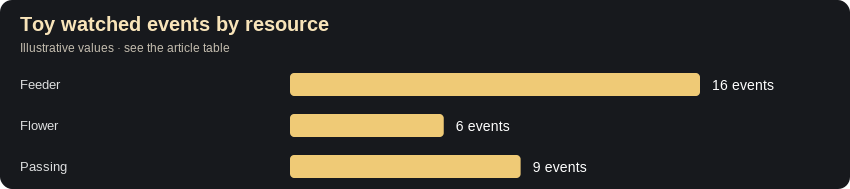
Illustrative values, not sourced observations. Stationary records do not identify individuals or carry pollen verification.
A hummingbird zips past a row of red blooms and settles at a familiar feeder. The photographer catches the moment easily: the next stop is predictable, the bird is close and the garden has a clear background. Later another hummingbird enters a flowering patch, disappears behind its leaves and emerges briefly before heading out of view. The feeder visit provides better identification and timing in this case. That makes it a good feeder record. It does not make it a better record of flower use than the fleeting observation among the leaves, and it does not demonstrate any pollen moved.
This distinction matters when a garden tells a story about its habitat. A stable feeder may be useful as a location for observing birds. Flower use concerns interactions with specific plants. A passing flight supplies yet another observation. Each can help describe a place under a defined watch. Treating all three as interchangeable makes it impossible to tell whether an apparent increase came from feeder activity, a change in flowers or a clearer view of the flight path. Clear event classes preserve the parts of that story that can actually be measured.
Feeder dependence is also a stronger claim than repeated feeder use. A watch can show many visits to a feeder without showing the fraction of a bird's overall diet obtained there, how it would behave if the feeder were absent, or whether a different person would see the same set of visits elsewhere. If the study is about an apparent concentration of activity around a particular resource, say that. If it is about dependence, define what additional evidence would be needed and don't borrow it from a tray of attractive photographs or a raw count of returns.
Read the example chart as thirty-one event records
The figure shows sixteen Feeder, six Flower and nine Passing events. They add to thirty-one. All three values are invented for this article. They are not observations from a real garden or the source documents, and they do not supply population counts or numbers of individual birds. The example assumes one primary event class per eligible record under its display rules. A single continuous encounter might produce several successive events in the underlying log if the protocol records transitions among resources. That does not make the bird several birds.
| Illustrative event class | Events |
|---|---|
| Feeder | 16 |
| Flower | 6 |
| Passing | 9 |
The feeder bar exceeds the flower bar by ten events in the invented record and the passing bar by seven. The gap is a count difference, not a preference estimate. The plot does not supply comparable information about available forage, eligible observation effort by resource, detection rates or how often a bird was already present when the watch began. It contains no recording of pollen on a bird or a receptive flower structure. Even in a real project, a reader would need more information before dividing by the sum and interpreting the result as the fraction of hummingbirds using a feeder.
A garden can use mutually exclusive rows in this chart without treating every relevant fact as exclusive. A bird moving continuously from a flower to a feeder can have a flower event, a feeder event and a verified link between them. If the chart instead uses one row per complete encounter, the designer might give it an explicit mixed-resource category. Decide which unit the figure uses and label it. The toy chart is deliberately simple: it counts events. It has no mixed rows, no uncertain rows shown, and no claim that a real observation program should force ambiguous events into these three categories.
The USDA Forest Service brochure on pollination and floral trait associations gives background on hummingbirds, flowers and pollination as pollen transfer. Its examples of attributes associated with different pollinators provide hypotheses for what an observer might see, not a test of what occurred in a particular interaction. The Forest Service guide to attracting pollinators using native plants provides garden and habitat context. Neither document supplies the fictional counts or authorizes using feeder events as a proxy for pollination.
Decide whether the unit is an event, a bout or a watch
A feeder event might begin when a bird arrives and visibly contacts a feeding port. A more inclusive feeder-use protocol might count landings or approaches that meet a stated rule and separately indicate feeding evidence. A bird hovering nearby is not necessarily feeding, and a bird perched beside a feeder does not automatically qualify as using it. Choose a definition recognizable at the viewing distance and appropriate to the question. If the opening or contact point is hidden, use a mark for limited evidence rather than claiming the bird fed because it looked likely.
A flower visit can similarly mean contact with a designated flower or inflorescence. If the observer sees a bird engage with a flower but cannot see a particular reproductive surface, the visit is still observable under an appropriate rule. It does not become a documented stigma or anther contact. If the study is interested specifically in nectar feeding, define what visible behavior establishes that claim and what falls short. Treat probing, hovering, contact and suspected feeding consistently. The distinction is especially important when looking at a distant bloom that hides much of the animal's head.
A bout can group multiple events within one uninterrupted encounter under a defined rule. A bird might visit three flowers on one stalk, pause on a nearby twig, then return to the same stalk. A whole-patch bout measure can give one continuous tracking record while plant-level event counts include several visits. Those quantities answer different questions. Provide an event identifier and optionally a continuous track identifier, with separate fields for plant unit, feeder and time. Do not compress the two layers into one label whenever the observer happens to take a neat photograph.
A watch is the scheduled or actual observation period, including periods without visible events. Its boundaries define the denominator for many useful summaries. A row per encounter will not reveal how long someone waited when nothing came by unless a watch table supplies that information. A small project can keep one entry per watch with separate notes for its events. Include planned start and end, usable effort, where attention was directed and any gap. If a new observation is made outside the watch, retain it as opportunistic, not as a replacement for revising the denominator.
Define passing without claiming intent
A passing observation can involve a visible flight through a bounded area without qualifying contact during that observed segment. It does not establish that the bird ignored food, was migrating or never landed elsewhere. It may have used a flower just beyond the hedge or returned a few minutes later. Describe the extent of the segment and what was visible. A bird coming from an unknown direction and disappearing before the relevant boundary may belong in an unresolved category, not automatically in Passing merely because it was seen in flight.
Set a few landmarks for the viewed area. You might document a particular gap between shrubs and an eligible height range in relation to visible structures. The aim is a reproducible viewing frame, not a claim that the sector captures the full movement of birds at the site. A participant standing on a different path may see many more passes without any change in actual movement. If the project moves stations or changes the travel boundary, record the start date of the change rather than silently continuing the old time series.
Also distinguish an observed pass from a transition during a known track. A bird visibly leaving a flower and flying to the feeder has passed through space, but a chart might not need a separate pass event for that link. If every transit between two known resource events is counted as Passing as well, the figure will answer a question about trajectory segments rather than nonuse flight episodes. Either definition can be reasonable. Write it down. A simple rule that works at the station is better than a confident report based on assumptions people made differently in the field.
An observer can record actual direction, route and duration when clearly available without assigning motivation. A turn at the feeder might be consistent with approach without demonstrating intent to feed. A loop around a patch may be locally meaningful but is not necessarily a separate identifiable visit every time it crosses an informal line. If multiple tracks look like one recurring movement, record uncertainty. The archive should not have to decide whether the bird intended to feed in order to acknowledge the part everyone saw.
Keep visible contact below the level of unobserved consequences
Pollination involves transfer of pollen to a receptive structure; ordinary observation of a flower visit often does not reveal that step. A bird can approach or feed without touching the structures relevant to pollen transfer under the observation conditions. A visible brush against a flower part is a closer piece of evidence than arrival alone, but it still does not show the source, identity or destination of pollen. Flowers can also be visited differently depending on orientation and access. Record contact where the view warrants it and leave unavailable parts unresolved.
A stronger record states which structure was visible and why the observer believes there was contact. For example, a photograph might support a bill entering a corolla while not showing contact with a visible stigma. A second camera angle may improve one claim without establishing that any compatible pollen reached the plant. Don't turn helpful visual evidence into a complete functional measure. An identified flower species and a documented visiting species are important parts of the record, not the endpoint of the inference. A pollination claim needs evidence for the step asserted.
The Forest Service brochure illustrates associations such as prominent coloration and tubular shapes in the context of hummingbird visits. Traits are a reasonable starting point for deciding what to watch. They do not prove who used a particular bloom, and an observer should never fill a missing species or contact field from a stereotype about flower color. Other visitors can use the same plants. The native garden guide's wider perspective reinforces that a garden may support many other pollinators even where hummingbirds are the observers' favorite group. Local records describe that diverse use better when classification follows evidence rather than expectations.
A feeder observation can be relevant to planning a watch because it identifies an active area or a place with good visibility. It still supplies no contact with a flower. A bird can be carrying pollen while visiting a feeder, but that would not itself show delivery to a plant. Likewise, an animal returning from a flower can have fed without producing any observable transfer. The record can clearly identify resources used and transitions seen. Reserve stronger ecological outcomes for a study with suitable additional measurements and required permissions. Ordinary garden watchers need not capture or follow birds to make legitimate observations.
Protect the denominator when a feeder is easy to watch
A feeder is fixed, often clearly visible and visited at a predictable location. Flowers can be spread over a large area with overlapping foliage. These differences can influence the chance of observing a qualifying event, even if the same person diligently monitors the site. A high feeder count and low flower count may partly reflect unequal opportunities to detect events. Record which targets were visible and whether detection was different for approaches and completed contacts. Do not infer preference solely from the better watched resource.
A watch can deliberately focus on one resource at a time. If the observer chooses the feeder for fifteen minutes and the flower bed for ten, keep both effort totals. A combined twenty-five minutes on the stopwatch is not twenty-five monitored minutes for each. If roles overlap, describe how. A second observer can maintain the broader view while a first records close behaviors, but matching their records requires care. If the study depends on treating observed counts comparably, choose windows and viewpoints where both resources are represented under clear rules. Even then, detection is not guaranteed equal.
The extent of visible resource also matters. One feeder with a few ports and many flowers across a patch do not present the same encounter opportunities. A rate per watched minute is not a rate per flower or per available nectar unit. A count of open floral units can help describe exposure if collected consistently, but it does not directly measure available nectar in a way comparable to feeder supply. Avoid inventing equivalence just to produce a combined rate. A descriptive pair of counts with appropriate context may be more useful than a precise ratio of incomparable opportunities.
Retain quiet observer periods. A watch on an eligible patch with no observed visits contributes a zero. A period when the view was obscured or when no one was watching should be marked unavailable. If an observer is reviewing a close image when a second bird passes, part of the passage watch may have been interrupted. Planned time and usable time need not agree. It is better to report a shorter valid view than to claim a full denominator and then explain missing activity as wildlife behavior.
If the garden's monitoring is partly recreational, opportunistic entries can make the record engaging. Label them separately from planned samples. A striking feeder photograph can support an identification at a known time while telling little about the frequency of returns throughout that day. A short scheduled watch with no photographs can still supply valuable coverage. Both sorts of evidence deserve an archive. Their value is lost when the easiest captures are treated as if they constitute uniform observation of the whole garden.
Describe apparent feeder use without claiming dependence
A bird visiting a feeder repeatedly might use many other resources beyond the field of view. A long watch dominated by the feeder might nonetheless reflect a temporary bloom gap, the observer's attention or one individual making several trips. Dependence ordinarily implies a much stronger inference about alternatives and response to the resource. Showing it would require a clearly defined biological or behavioral quantity and a suitable, ethically appropriate design. For an ordinary garden log, report observed use, timing and context, not percentages of a diet that was never measured.
A feeder's presence may change what people notice. It gives the observer a fixed target, can attract attention away from surrounding plants, and sometimes appears in a camera frame even when flowers are just outside it. Comparing pictures before and after installation can therefore confound visibility, camera placement and resource change. If a project intends to compare flower use under different existing conditions, keep the floral record and observer coverage visible. Do not equate a larger archive of bird pictures with an increase in flower visits. An increase in visible records is a specific and different result.
There are less intrusive ways to study changes. For example, record the naturally occurring flowering conditions and note whether a feeder was present, visible and available during each watch. Document exceptions in access or maintenance. Compare only under a scope the design supports, and note seasonal changes that could coincide. The point is not to manipulate or crowd birds for a cleaner experiment. Stable, nondisruptive observations can reveal how behavior appeared at the resource under real conditions without pretending to isolate every cause.
Don't turn a feeder count into evidence against flower planting. A toy figure of sixteen versus six says which class had more invented rows, not that one resource replaces the functions of the other. Habitat involves more than one food location, and the plot's other visitors may depend on floral resources even if hummingbirds were the only group counted at the feeder. If a garden wants to understand the use of native flowers, record the flowers and their visitors directly. That is a stronger basis for management than an indirect inference from how memorable a feeder scene appeared.
Work through three contrasting watch records
Imagine a ten-minute watch at a feeder. One recognizable bird arrives, contacts a port, retreats to a nearby perch and comes back twice while remaining in view. Under a clearly defined contact-based rule the observer might record three feeder events and one continuous encounter. Under a bout rule that includes short breaks on the perch there may be only one bout. Neither is an error if the rule is stated. Reporting three individuals would exceed the evidence even if each arrival produced a separate row. The difference looks simple in this practice example but can be easy to miss in the final event table.
Imagine a flower watch at a fixed bed with partial visibility. A hummingbird makes contact with one marked bloom, moves to a second and then disappears. One contact is clearly seen; on the second the opening and much of the bill are hidden. The first can be reported at the level actually observed and the second retained under a lower-confidence category. Don't mark both as confirmed contact or reassign the second to Passing just to keep the figure clean. If the bird reappears near the feeder, note whether the transition was continuously witnessed. The field note can record a plausible link without turning it into a confirmed identity.
In a third record a hummingbird travels across a clear sector between two landmarks and leaves the view without touching a watched resource. This can be an eligible pass under the stated boundary. It does not establish that the bird did not feed just before or after the segment. If the observer follows the flight and misses a later flower event, record the shift in attention where it affects coverage. A station that watches transitions can design for narrower scope rather than trying to collect a complete account of everything that happens at all distances.
These examples are separate from the thirty-one invented chart rows. They show how several valid summaries can come from one observation protocol when the record retains count unit, boundary and level of evidence. A daily total of qualifying feeder events can coexist with a smaller number of continuous feeder encounters and an unknown number of unique birds. A report can show those outputs without claiming that one logically proves another. Good data design starts by acknowledging that the world does not provide ready-made rows.
Compare watches under conditions they can actually share
A plan might aim to compare the visible pattern in several time windows. Feeder observations are scheduled during the same broad daylight intervals as flower observations, and paired records carry notes on bloom state and field of view. Comparable timing cannot control every ecological difference, but it addresses an obvious concern. If one resource is only observed at a different time or in a different season, the counts cannot be interpreted as if those conditions were exchangeable. Begin with the overlap the study actually achieved, not the overlap intended on paper.
A garden layout can create a second asymmetry. An observer standing close enough to see the feeder port has a clear view of arrivals there but only an oblique view of the distant bed. Switching places halfway might improve one coverage and worsen the other. Document what each observation point sees, and use separate point codes even when the boundary description seems obvious to people who know the site. Compare compatible segments before combining them. If a planned joint view is not feasible, the study can still present resource-specific descriptions instead of a weak direct comparison.
Weather, sun angle and background light may affect what can be detected. They may also affect actual activity, so it is unwise to assume every condition changes only one thing. A passer can be easier to see against a clear background than against bright reflections or foliage. A nearby flower contact can be hidden behind a leaf. Record the conditions that matter, especially if they differed systematically between watch types. When available, a repeat under a comparable window can be more interpretable than an arbitrary numerical correction for an obstruction.
Sampling decisions affect geographic claims. A garden visited because its feeder is famous provides useful local observations, not an unbiased estimate of feeder use across the surrounding district. A fixed-point watch similarly samples only a limited sector around the observer. To learn about multiple gardens, define which gardens were eligible and how they were chosen, as well as how observation effort was assigned. A series of attractive anecdotes may guide questions, but it does not provide the frame for a wider estimate. Distinguish a record of selected places from an estimate about an entire region.
Preserve uncertainty when tracks overlap
Hummingbirds can move quickly between visible places, and similar individuals cannot always be distinguished. Do not maintain an identity link solely because a bird near a feeder resembles one just seen above the flowers. If continuity was lost, note when and state whether the next record might be the same individual. A reliable track is evidence for a witnessed sequence, not a permanent identifier. A group can store confirmed links, possible links and unlinked events without trying to turn each into a named animal.
Simultaneous movement is another reason to keep the events and watch conditions separate. Two birds can arrive in rapid succession, or one can approach while another is already present. If the observer did not know which continued to a flower, assign the verified parts of the events and leave the transition unresolved. A separate note about overlapping movement may still be useful for planning a narrower or better-staffed view. Do not ask the field recorder to settle an identification the available evidence cannot support.
A simple confidence code can work if it is applied to a named claim. A bird's identification may be secure while the nature of the contact is uncertain. A crossing boundary may be clear while identity remains broad. A single overall confidence score can conceal that distinction. Record uncertainty for identity, behavior, track continuity or timing as necessary. For a particular summary apply its explicit eligibility rules. If an uncertainty code is omitted from the chart, report how many records it excluded rather than implying the missing fragments never happened.
An audit can use two observers independently recording a short shared view, where that activity is appropriate. Compare individual event decisions and not just the day's totals. A disagreement may come from one person counting every approach and the other requiring contact, or one including a brief interruption in the same bout. Refine definitions, update the version and identify which earlier records can still support the new comparison. Team agreement about an illustrative clip is useful practice, not proof that field observation was complete.
Build an archive that reproduces the counts and the caveats
Keep the watch table short enough to maintain. Its fields might include code, date, observer role, start and end, usable time, resource targets, field-of-view status and relevant conditions. Event records can use that code to connect to their observation opportunities. Give each event a time or time bound, event class, resource ID or sector, and a note about contact evidence. Optional linkage identifies segments actually seen as one track. This structure lets a reader reconstruct an event count without inferring session details from the number of rows.
Distinguish a blank, unknown and zero. A blank field for contact may mean it was not recorded, while unknown may mean the observer specifically could not determine it because the flowers hid the relevant structure. Zero applies to a qualifying summary with a usable eligible watch and no matching events. Do not auto-fill unknown observations with no contact; doing so creates an apparent absence from an unobserved position. Preserve timestamp precision and avoid adding invented seconds when only approximate minutes were documented.
A high-quality review checks classifications against evidence before making a figure. Pick one clear feeder event, one documented flower contact, one valid pass, one uncertain transition and one quiet watch. Ask another person to reconstruct the summary from the stated rules. If the two of you disagree about the quiet watch's role, revisit the denominator. If both agree only because they recognize a familiar feeder picture, make sure the rule works with evidence from another place. A reusable method should not require insider knowledge about which events looked good in the original photographer's favorites.
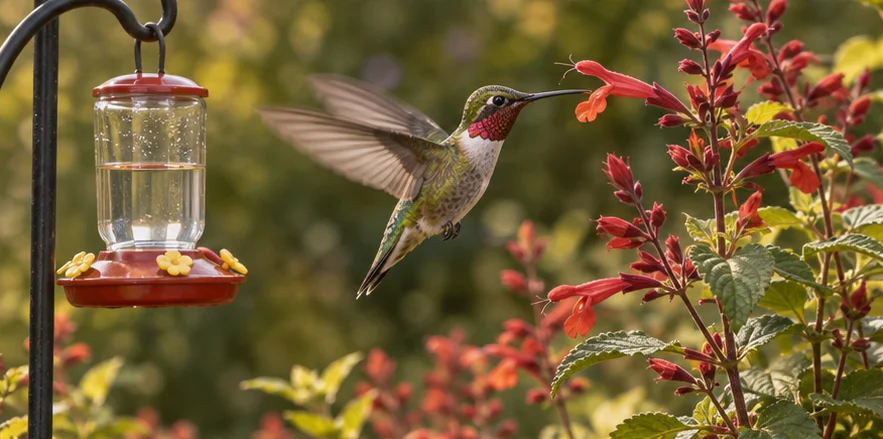
Any released material should distinguish illustrations from observations. The generated image paired with this article is a natural-history illustration; it is not a verified sequence showing a bird's flight or any measure of its resource use. A dated field record and its supporting image should carry the relevant site context at the appropriate level of detail. Do not imply an exact location if the public view generalizes it. Avoid publicizing sensitive coordinates or using unapproved access merely to improve a watch. Legible documentation and nondisruptive observation serve the learning goal together.
Evaluate a midseason change without losing the comparison
Suppose the garden changes the position of the feeder after the first weeks of observation. It is still the same object, but the observation opportunity has changed. The feeder is easier to see from the bench and farther from both flowering patches in view. A later watch records more feeder events and fewer identifiable flower events. Before offering a biological explanation, compare the boundaries and actual attention of the older and newer watches. Show which portion of the site moved outside the observation frame. The difference in appearance from the bench could reflect bird behavior, observer coverage or a combination neither count can separate.
Move and resource availability are distinct events. If the feeder was also temporarily unavailable during the shift, date that interval and avoid scoring it either as normal feeder coverage or as a garden without any food. Which flowers were open and which parts of the site were observed remain separate context. A useful report can retain a simple timeline: original configuration, transition with interrupted comparability, new configuration. It can compare comparable windows within each period or use a brief prospective overlap at two viewing points when feasible. It should not hide that the time series changed method.
A similar problem occurs if a flowering strip is altered. The number of living plants, open units and units visible to an observer may all change in different ways. A well-documented example of a new flower contact on a new plant is a useful finding even if visit rates across the full strip cannot be compared. Keep the strongest limited result rather than either claiming the entire intervention succeeded or throwing out the new records because a stronger assessment was not possible. Good habitat logs can support multiple future questions, provided the records preserve how their scope changed.
Where a garden has several blooming patches, consider whether management would benefit more from tracking one in depth or from spreading effort across all of them. A narrow view can resolve contact at the cost of showing less of the layout. A wider survey can show movement patterns while leaving most fine contact uncertain. Neither automatically provides the other kind of evidence. Label the station type and avoid asking the same graph to answer both questions. The ideal window depends on the decision to make, not how much can be captured in one image.
Check what a weekly summary would hide
Imagine that all sixteen feeder records in the fictional display had come from one unusually busy window. The actual chart gives no such detail; the scenario is an independent exercise. Compare that possibility with sixteen events distributed over many comparable watches. The totals would match, but an estimate of how often the resource is used across watch periods would look different. A clustered glimpse of activity can be important natural history, and a recurring pattern may be important for another reason. Preserve watch identifiers so people can see the difference before averaging all observations.
Similarly, a weekly high count says little about the entire garden if the planned flower watches repeatedly ended when the main path closed. Record what fraction of targeted windows actually occurred, and whether the missed windows affected one resource more than another. A graph of completed events can be truthful while its reader still needs a small coverage table to interpret the apparent imbalance. Document quiet but valid watches as well as interruptions, since they have different implications for the eligible denominator. No amount of accurate event classification can recover effort that was never recorded.
When sharing a summary with gardeners, pair the memorable example with the scope of the regular observations. A short note might explain that a distinct feeding event was easy to document at one location, but the nearby flower strip was only partly visible. A future volunteer can use that information to improve coverage rather than treating the site summary as a verdict about the value of each resource. A chart has done its job when it makes better observation possible without needing to tell a more conclusive story than the records permit.
Ask what evidence would support a stronger outcome claim
If a garden wants to know whether it supports flower use, it can document observed visits to specific plants under a clear method. If it wants to know whether a particular plant interaction transfers pollen, it would need evidence suited to that step. If it wants to assess reproductive outcomes, it would need another suitable design and observations of those outcomes. These progressively stronger questions may justify different expertise or permissions. Do not treat an ordinary visual watch as a failed version of an invasive study. It answers its own question well when its scope is explicit.
An observed trend can also motivate a management decision without settling every mechanism. If more documented flower events appear in a compatible watch after a new bed blooms, the result may support a closer look at the plants involved. It does not by itself quantify the planting's causal effect where season, viewpoint or a feeder also changed. A modest description can be enough for continued monitoring or a well-scoped stewardship choice. The more consequential a public claim becomes, the more critical it is to separate observations, alternative explanations and the actual decision.
The chart's three categories can help guide a final check. Could a colleague explain why sixteen feeder events do not count as sixteen flower visits? Could they find the denominator for a comparable rate, if one exists? Do they know why a pass does not establish what the same bird did beyond the viewing frame? If the answer depends on unrecorded context, put the missing definition in the caption or accompanying table. Clear writing is part of measurement quality because it controls which conclusions readers are likely to draw.
Keep the result anchored to the watch
A concise garden report might describe visits to a feeder, observed contacts at certain flowers and visible passing events over specified eligible windows. It can say clearly which behaviors were uncertain and how often the groups had comparable coverage. It can mention that an ongoing natural-history record may inspire better planting or a better viewing route while not deciding how dependent birds are on a feeder. This is not weaker than an expansive pollination claim. It is stronger evidence about the things that were actually observed.
A feeder and a flower can both be interesting places to watch. They are not interchangeable resources in a record meant to describe interaction with plants. Let arrival, contact, presence and biological outcomes keep their own meanings. A well-defined local event is enough to teach something about a garden. It does not need to stand in for an animal count, a measure of diet or an observation of pollen transfer that nobody actually made.
If a figure is copied onto a sign without its longer explanation, leave the word events in the axis label and keep the illustrative data notice visible. The scope still matters.
Sources
- USDA Forest Service: The Simple Truth, pollination and floral trait associations. Pollination, hummingbird and plant-trait context; not a source for the invented figure.
- USDA Forest Service: Attracting Pollinators to Your Garden Using Native Plants. Broad native-plant garden and pollinator context, not a feeder-versus-flower study.