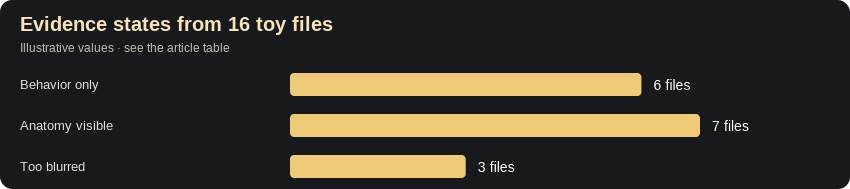
| Category | Value (files) |
|---|---|
| Behavior only | 6 |
| Anatomy visible | 7 |
| Too blurred | 3 |
Illustrative values, not sourced observations. Categories partition 16 image files; not a validation rate.
A striped insect stops in the air above a flower. It stays nearly level while the blossom nods, shifts sideways, and then lands out of sight on the far side of the flower head. The person watching has a reasonable first thought: hoverfly. The mistake is not having that thought. The mistake is letting the thought replace the evidence before anyone has looked at the insect.
You can record the hovering immediately and keep the identification open. If the insect lands, a brief view of a resting wing or how the wings attach can be more useful than thirty seconds of excellent footage in flight. A photograph may show enough to support “fly” but not enough to establish a family. A clean sequence can also fail at identification because the insect is always facing the camera, the flower blocks its wing bases, or a bee-like pattern dominates at the available scale. These are interesting observations of behavior. They do not have to become bad identifications to count as interesting.
This guide is about managing that distinction from first sight to a final dataset. It uses hoverflies, the fly family Syrphidae, as the running example. The observation scenarios are hypothetical, not results from a garden survey. The graph uses invented file counts. Its purpose is to explain an evidence workflow, not to report how often hovering reveals a hoverfly.
That pause in the air belongs in the notebook
Begin with what you can observe without naming the animal. “Held roughly the same place above the leftmost flower head, shifted toward the next head, touched down briefly” conveys something that a family name cannot. Are you looking at one sequence or several individuals? Is the insect approaching the flower, suspended above it, or tracking something out of frame? Is the flower swaying relative to the insect? Unless distinguishing those possibilities is important to the study, there is no need for an elaborate field code. There is a good reason to describe the visible cue separately from your proposed identification.
From a fixed viewpoint, motion is easier to interpret if there are stable references. The same animal framed tightly against a uniform background may appear stationary simply because the camera follows it. If the frame contains both the head of a flower and a more distant stationary object, there is a chance to see which part of the scene moves relative to which. A handheld observer can note the wind or the movement of nearby stems, but a single clip without those references may not justify a claim about exact position. Write “appeared to hold station” rather than giving an unsupported distance or speed.
You do not need to assign a numerical definition of hovering to describe a casual sighting. For a formal count, however, observers should agree on a definition before going out. It could require motion that remains within a specified part of the view for a preselected interval with reference to a stable feature. Define the reference, the tolerated displacement, how the interval is timed, and what happens if the view is briefly obstructed. Pilot that rule through a few clips before using it across a season. A short hover below your cutoff does not become a non-hover biologically; it simply falls outside the operational definition used for that study.
The difference between “hovered” and “was a hoverfly” parallels the difference between “landed on a flower” and “pollinated the plant.” An encounter can support a visible behavior without establishing either the animal's identity or the outcome of the behavior. The USDA Forest Service native-plant guide introduces diverse garden pollinators. That is useful background for expecting more than bees, not a shortcut for turning every flower visitor into an identified or effective pollinator. The visitor may not contact the relevant parts of the flower. Actual pollen placement or another measure of pollination would require other evidence. Report a hover, a landing, or a documented contact at the level you observed.
A candidate belongs in the candidate field
A behavior can direct attention without settling a label. An insect that remains in the air above blossoms makes a hoverfly worth considering; it also makes a landing sequence worth waiting for. Keep “possible hoverfly” as a field hypothesis. Do not put it in an accepted identification column and expect every later export to carry over the word “possible.” In many datasets, an accepted name is what makes the record show up on a range map or in the tally that someone uses for a local account of diversity. The structure of the record, not the sincerity of the observer, determines whether that distinction survives.
A compact record might have separate entries for observed behavior, proposed group, accepted taxonomic label, basis for acceptance, and next review action. Consider one fictional row: “hover, lateral shift, no observed landing” sits in the behavior field. “Hoverfly candidate from motion and shape” sits in the proposal field. “Insect, unresolved” stays as the accepted label. The action line says “review original clip for sharp frames; no separate photos.” A second fictional row can have the same proposal but “fly; family unresolved” as the accepted label because a good photograph provides order-level evidence. The two rows are not duplicates and neither falsely claims family membership.
Avoid burying the distinction in a confidence number. A low score on a hoverfly label might mean a reviewer observed a character but cannot choose between close families. It might mean the animal was too small to see. It might mean only that the application supplied a weak suggestion. Those are different conditions for review. Store which characters are supported or missing. If project software requires a confidence field, define what each value means and pair it with the evidence note. More digits on the score do not increase the amount of anatomy the photo contains.
Because the same encounter can produce several observations, record changes in your interpretation rather than overriding the raw note. “I first thought bee; looked fly-like on review” preserves the independent context in which you made the original observation. If the final identification is unresolved, you can still learn whether bees were being preferentially proposed by a new observer or whether the field was difficult in backlight. The correction history can also reveal something that would be invisible if the most recent identification replaced every earlier guess.
Anatomy helps answer two different questions
One question is whether the object is a true fly. Another is whether the fly belongs to Syrphidae. Evidence for the first is not automatically evidence for the second. True flies have one pair of functional wings; the hind pair is modified into halteres. A well-exposed lateral view can sometimes give a clear view of a flight wing and the small structure behind it. A honey bee or wasp has two pairs of wings, but overlapping wings or an oblique view can hide one pair. When the entire photographic record shows only one beautiful silhouette of a wing, you have not necessarily counted the wings. You may have counted the contours you could see.
The UC Statewide Integrated Pest Management Program's syrphid overview shows why wing detail matters at family level. Many syrphids have a so-called spurious vein, a thickening that looks like a vein. Location relative to other wing markings matters, so a pale line at an arbitrary angle is not the character. A streak left by glare, an edge from a folded wing, or a crack in a compressed image can appear similarly narrow in a small frame. The overview also notes that markings distinguish nearly all species in the family from other flies, which is not the same as saying every individual can be verified from any photo. An absence in an image is not evidence of anatomical absence when the relevant part of the wing is not visible.
Antennal shape, the positioning of the eyes, features of the legs, wing pattern, and overall form can all orient a reviewer or help for particular groups. It is unwise to declare one cue universal from a handful of garden photographs. What looks like a short antenna may be an antenna pointing directly at the lens or partly hidden behind a petal. Eyes can look disproportionately large in a tightly cropped head view. Apparent body proportions change with angle and posture. A field guide designed for the region and suitable for the characters visible may offer a combination worth checking; do not make up a universal one-character test.
The U.S. Geological Survey's bee-specimen identification resource is about bees, not a family key for flies. It is valuable in this workflow as an example of the more formal reference work behind identifications: do not infer that a casual photograph can support every distinction treated by identification resources. If a good photo warrants considering a bee rather than a fly, consult appropriate bee references. If it supports Diptera but not a family, consult references specific to flies or stop at the broader name. Keeping the job of each reference clear is part of avoiding the false certainty that this guide is meant to prevent.
Why the stripes persuade us too easily
Consider a fictional visitor photographed from above, with yellow and dark abdominal marks and a glossy head half hidden under a petal. To a viewer who already expects a bee, the yellow bands reinforce that interpretation. To a viewer who was told that the animal hovered, those same bands may look like proof of a hoverfly. The picture did not change. The frame contains a convincing color pattern, not necessarily a discriminating character. Many hoverflies resemble bees or wasps, and appearance varies within the family. That is why “striped like a bee” and “typical-looking hoverfly colors” can both be impressions rather than identifications.
Hairiness is also a weak shortcut. One angle can emphasize hairs in backlight; another will hide them on the same individual. A clean, modern image can make that property look precise without becoming reliable across groups. Conversely, some very useful photographs of wings have poor color or are unable to show the rest of the body. A reviewer can describe what those images do well rather than letting a familiar appearance override anatomy. Where color has diagnostic value in a key, use it with the other specified features and document which marks were actually seen under the available lighting.
The flower species is rarely a replacement for the insect characters. A bee and a fly can appear in successive frames on a patch with abundant bloom. A patch full of reports of one insect group may be a good place to watch for that group but should not determine decisions about a new blurred object. For survey purposes the flower identity itself can also be uncertain. If neither visitor nor plant is identifiable beyond a broad group, record that rather than inheriting precision from neighboring entries.
Behavior can encourage useful evidence collection for lookalikes. When a visitor repeatedly returns to the same spot, you may get a chance to take a clearer photo. When it makes a single pass, a precise account of what you saw may be all you will get. Neither the repeated hovering nor the missed shot proves or disproves membership in the family. This is a scope decision about what to record, not a contest between more and less observant people.
Capture a sequence without manufacturing the encounter
For a stationary observer who has permission to be in the area, the order of events offers a simple plan. The initial wide view shows how the animal approaches the flower and what else moves in the frame. A subsequent shot after landing can show the insect's outline against the plant. Where possible, a side view can add wing bases or something of the antennae. A view looking onto a wing can show its venation if the angle serves and the wing is still enough. You will often get only one or two of these views. Take them as the animal offers them and note what you missed.
You can improve evidence without handling the animal or pushing equipment into its path. Brace your arms or phone if safe, focus on the flower structure on which it may land, and let the subject enter the frame. If it repeatedly uses the same landing place, set the focus there rather than asking the camera to refocus each time a moving wing crosses the background. Leave room in the frame for turns. Working from an accessible path or the edge of a bed also reduces disturbance to the site and makes repeat visits easier.
A wide shot and a still are only parts of one encounter when you have a sound reason to link them. If two insects are using the same plant and the one you followed disappears behind it, the next animal emerging may not be the same individual. It is fair to flag the identity link as uncertain. Do not attach a sharp photograph of a known hoverfly to the preceding hover simply because you took both around the same time. A reviewer needs to understand which views were continuous and which were assigned by inference.
Take careful notes if recording stops right as you lose the animal. The lack of an observed landing does not establish that it never landed; the observation interval ended. It is easy to overlook this when recoding short clips. “No landing visible” has an honest scope. “Does not land” is an interpretation the footage rarely warrants. The same principle applies when a previously unresolvable clip is followed by a strong still in the same folder. Mark the relationship explicitly rather than assuming that filename order carries enough detail.
Read the toy chart at the level of files
The article's chart, “Evidence states from 16 toy files,” shows six files classified as behavior only, seven classified as anatomy visible, and three classified as too blurred. The categories partition 16 invented files. The numbers add to 16 because each file was assigned once. These are not survey data, validation rates, or estimates of the likelihood of collecting usable photographs. They do not say that seven of sixteen animals were hoverflies. They do not even say that seven of sixteen encounters were identifiable. Multiple files can come from a single animal or event, and visible anatomy need not include a diagnostic character.
Here is the teaching rule behind the categories. Begin by asking whether relevant anatomy can be inspected. If so, put the file into anatomy visible, whether or not behavior was also captured. Where anatomy is not interpretable but the file still supplies usable motion evidence, choose behavior only. For this toy exercise the remaining files are too blurred to support either purpose. A real review might add separate categories for obstruction, an empty frame, a broken media link, or poor lighting; this particular example has none of those. The decision hierarchy explains why a video of a landing with one sharp body frame does not have to be counted twice.
A real project could choose to store anatomy and movement as independent yes, no, or unknown flags instead, which would preserve both properties of a strong file. Those are useful fields as long as a presentation does not imply that their totals must sum to the number of files. If you want a partition for a public figure, derive it transparently from those fields. For example, specify that anatomy visible takes precedence when both can be reviewed. If you want reviewers to find images showing anatomy and behavior together, retain the underlying flags rather than presenting a partition as the entire record.
Be especially careful with percentages. Turning the count seven into a percentage of sixteen invites the reader to ask what fraction of real identification attempts succeeded, and the chart supplies no answer. It depicts a bookkeeping exercise whose denominator is files. A run of six near-identical clips of the same hover could generate six behavior-only entries without adding six encounters. The table next to the chart supplies the same example counts in plain form. It should be read with the same scope and caveats as the plot.
One file, one encounter, and one animal are different units
An observation interface may make it easy to batch twelve images into one record or to treat each as a separate record. Use the study design rather than the interface to choose a counting unit. An image is one media item. An encounter can include clips, still photographs, and a notebook entry from the same observation. An encounter is not invariably one animal: there can be different visitors at once or repeated sightings that a recorder cannot confidently link. If an analysis concerns the number of observed visits, define how visits begin and end, and record where individual identity is unverified.
Imagine a fictional bench observation. At 10:04 an insect hovers in front of one flower head; the photographer takes four images and a short video. While reviewing the footage, she finds a resting wing visible in one of the stills. At 10:07 a striped visitor appears at the same flower. It may be the same insect, but the recorder looked away for two minutes. She takes another pair of photos. A responsible archive can store two encounter IDs and one note about the uncertain link, rather than adding up seven files as seven animals or confidently choosing between one animal and two.
For another project, the observation unit might be a garden watch period. Then both encounters could sit inside the same standardized time block; that denominator allows the team to interpret documented visitation per watch period without equating photos with animals. If no visit was observed in an otherwise completed period, store that differently from a period that was canceled or for which recordings were lost. Unidentified visits should also remain distinct from a completed watch with no visible visitors. Conflating these conditions can turn camera limitations into an apparent ecological pattern.
It helps to store media identifiers under a stable encounter identifier early, while associations are still remembered. If a volunteer labels the subject broadly after fieldwork and a reviewer narrows it later, both people can reference the same encounter. Duplicate files copied from the original may have a different filename but should not become new encounters. Preserve the exact file that was inspected for each diagnostic feature, ideally with a frame time or other locator. A later reviewer should be able to find the basis of the judgment without rewatching every clip in the folder.
Review the original before trusting a clean-looking derivative
A phone previews a photograph at a scale that often sacrifices fine structures. A message app may reduce the image further. Before treating a missing wing marking as evidence, ask to review the largest authorized original rather than drawing a strong conclusion from a compressed copy. Cropping an original can make it easier to direct a reviewer's attention to a real feature, but it does not add optical information. Label a crop as a derivative and retain the original nearby so that the rest of the frame and the original pixel detail are available.
Be conservative about sharpening and automated enhancement. Edge enhancement can make a faint pixel transition stand out while also turning it into what looks like a thin wing feature. Software that synthesizes detail can invent a feature not present in the source. Do not identify a real insect from a feature visible only in such a derivative. If a suspected character is visible across frames with stable placement against neighboring structures, that is more persuasive than a one-frame shape following the compression pattern. You can ask another reviewer to examine the raw images before showing the suggested interpretation.
Keep the original color rendering as well as any contrast-adjusted view. A darker exposure may retain an outline where a brighter view clips highlights on the wings. A brighter frame might instead be the one that resolves the side of the body. Different files can be better for different questions. The point is not to choose the prettiest single photograph any more than a weather observer should choose the prettiest hour as the day’s temperature. Identify which file answers which question, and include a note when a feature cannot be evaluated in any of them.
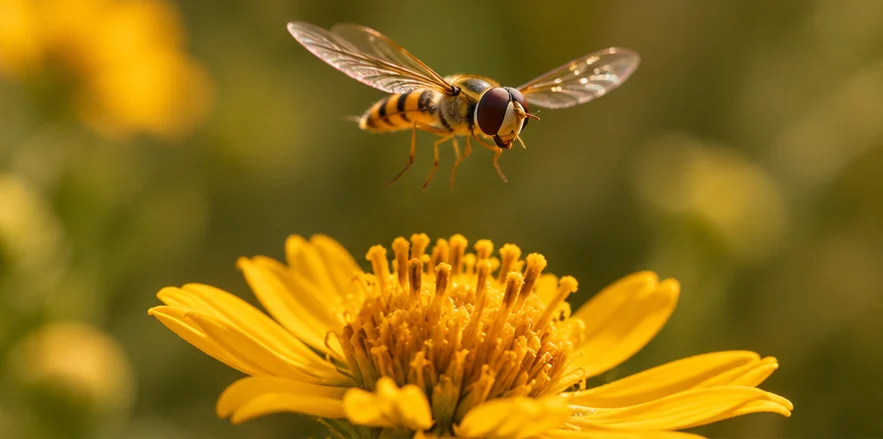
Generated artwork requires a more direct distinction. The illustration accompanying this guide is an editorial image, not a reference specimen. It cannot establish that a character was seen in a field observation, and it is not a substitute for a key or an authenticated identification photograph. If a publication places an illustration above a chart, both pieces should be labeled honestly: one illustrates the subject, while the other explains a count using invented examples. Neither is evidence for the animal in any of the fictional encounters.
An independent review can improve the name or protect its uncertainty
Send reviewers the original evidence and offer your candidate as a separate note. A useful workflow is to have someone look before seeing that note, write the strongest defensible label, and then compare reasoning. One person may correctly notice a haltere; another may point out that the supposed haltere is a petal tip crossing the body only in one frame. That distinction can be tested if the evidence has good focus. Review is about making the inference auditable, not choosing the more confident voice.
Anatomy can be available and still be insufficient. A clear photograph of an abdomen with repeated yellow markings illustrates real anatomy, but the marks may be shared by multiple groups. A person reviewing the example should say which additional feature would discriminate, not simply “need better photo.” In one case that might mean a side view of the wing bases; in another, an unobstructed wing with useful venation. The next requested view follows from the unresolved distinction. Sometimes the observer cannot get it and the record stays at a broader level. That is a successful review.
Maintain specific language for disagreements. “Fly; family not assessable from these files” describes a limit in the evidence. “Candidate families differ between reviewers” describes a substantive interpretation gap. “No reliable view of an insect” is a statement about the evidence itself. Keep the disputed names available in review notes but don't advance them into accepted records unless justified. Adding a confidence modifier to a species name is not always harmless: downstream software may ignore that modifier and use only the species name. Use taxonomic rank and review state that will survive export.
A test of agreement is more helpful when the reviewers explain their decisions and are shown the same inputs. If one reviewer has an original photograph and another has a low-quality crop, different results tell you at least as much about file handling as they do about taxonomic judgment. For a pilot on evidence quality, standardize the media copies and report how many files were viewed rather than calling an agreement result a population estimate. A project can add its own checks without pretending the invented chart supplies verification rates.
Work three hypothetical encounter packets through the workflow
The first packet contains a wide phone clip of a dark, striped object above an orange blossom. The video is fair evidence of motion relative to the flower and nearby stem. The wings are too blurred to examine. The field note identifies the flower bed and states a plausible fly candidate, but does not give additional anatomy. The archived observation can say “insect hovering above flower, no landing visible, family unresolved.” One file goes in behavior only. This is useful evidence for an observation study of approaches, but not for a hoverfly distribution map. It might be worth a revisit if the garden has scheduled survey periods. A later sighting cannot retrospectively identify the first insect.
In the second packet, an insect approaches the flower, lands, and remains poised for a few seconds. A full-body still and a sharp lateral image are well linked by footage. A reviewer can make a convincing order-level case from the attachment region and a visible haltere, but the wing is folded and its markings cannot be read. If a review form distinguishes candidate and accepted labels, this is a “fly, family unresolved” record, with hoverfly as a retained hypothesis. It contributes to a broader tally of fly encounters if the project allows that category. It should neither inflate the family count nor disappear merely because the rank stops at Diptera.
The third packet begins with no observed hovering. The recorder notices a visitor already resting and takes a photograph with fine wing detail. The project consults a suitable identification resource and checks the useful character combination. A qualified reviewer accepts the family, but cannot support a genus from the files. Here a family-level record can be valid even though the behavior that supplied the common name was not recorded. Document the examiner, reference, and character reasoning. Separate the decision about what was seen in the field from the later one about how narrowly to name it.
Now imagine that the three packets are included in a gallery. A careful caption can say that a hovering insect was seen in the first case, a fly was established in the second, and the family was supported in the third. It should not say “three hoverflies, of which one was identified” or use the family name for all three as an umbrella. A gallery that makes the viewer think through these different outcomes teaches rather more than one labeling every striped visitor by appearance. For public counts, list accepted family records and broader unresolved insects separately rather than hiding the unresolved cases or quietly upgrading them.
The detection claim can be smaller than the story we tell about it
A home observer may legitimately want to know whether hoverflies use a particular patch, while not needing the species list that a museum specialist could build from specimens. Start the project with that purpose rather than making every entry chase the most finely resolved label. If documented observations over the season establish family presence in the patch, that is already an answer. If observers want to talk about flower choice, comparisons need a plan that accounts for flower availability, observation effort, and the unresolved cases. It is not enough to compile a gallery of sharp files by plant.
For example, one flower type might stand near the walking path, making it easy to photograph a landing, while another blooms in the middle of a large bed where all the footage is cropped from far away. Confirmed family records could pile up near the path even if the hover activity itself occurred in both areas. A quality-based review gate is needed, but it does not erase bias from unequal visibility. Report examples of how much material stayed unresolved per location or flower category. Keep those quantities separate from measures of visitation when the design does not support direct comparison.
Time and weather can also change the evidence that is practical to collect. A scheduled watch with strong backlight may yield mostly movement silhouettes. If another time produces more sharp lateral views, that change in records may reflect the observation conditions. Include the watch times and note the visibility categories. A project can compare results after standardizing the recording procedure or restricting comparison to compatible watches. None of this makes the toy chart empirical; it explains why a real study needs more information than a few file totals.
If the aim is outreach, explain the visible distinctions without portraying artifacts as mistakes by visitors. Invite them to look for a landing and ask what they can tell at the available angle. Show why a confident “some kind of fly” may be better than an attractive invented species label. Encourage separate questions: what motion did you observe, what anatomy is visible, and what remains an open candidate? These are questions a person can answer honestly even with an ordinary phone and only a few seconds at the garden.
Carry the evidence note into the final dataset
A simple review ledger can be organized around specific transitions. When a media item first arrives, retain the original file and mark the associated encounter if known. At initial review, write a short behavior description and note which features can be evaluated without inference from invisible parts. At taxonomic review, choose the strongest supported rank using appropriate references. At archive, keep the accepted label, the proposal, the reason for any change, and what is missing from the packet. A final export should not silently flatten these into a single string.
Someone inheriting the data should be able to answer why an entry stayed broad. If the answer is “motion file only,” the next field session might benefit from photographing resting individuals. If the answer is “clear order-level image, suitable family characters unavailable,” further anatomy-focused review may help. If evidence is already sufficient for a family but the request calls for species, a more specific key and new evidence may be necessary. A chart of file quality and a table of accepted taxonomic ranks describe different parts of this process. Neither should be substituted for the other.
Close the review by asking what would be defensible to quote in a report without the photographs alongside it. The answer may be “an unidentified insect hovered,” “a fly landed,” or “an adult hoverfly was documented.” If there is documented contact with an identifiable part of a flower, include that separately. It does not automatically prove that pollen was transferred. If there is no image and the original observer had an excellent view, preserve their field identification and its basis, clearly marked as such rather than claiming a photographic verification. This is more informative than assuming all records must fit a single form.
The best use of the hover cue is often what happens next: you notice a landing, change your viewing angle, or add the few words that disambiguate the recording. Sometimes nothing else becomes visible. Keep that observation. A rigorous notebook has room for interesting motion and an unresolved name. The job of the map, tally, or caption is to make sure neither is mistaken for the other.
Check for selection bias in the review queue
A project that receives more media than it can review may be tempted to prioritize files already labeled hoverfly. Those files may be sensible for an initial training session, but selection on that label means the resulting identification collection cannot tell you how often unidentified garden encounters involved the family. Unlabeled files or files initially labeled bee could contain relevant observations too. For a general inventory, sample across original labels and observation conditions, then disclose the selection rule. If you review only particular encounter types to answer a narrow question, make that restriction visible in the outcome.
Set apart an example set for training new observers. Include a sharp non-syrphid fly, a striped animal whose order cannot be resolved, a suitable example with diagnostic family features, and a fly for which the family cannot be assessed. Use documented images from suitable sources or from your own review collection, with the necessary permission. Keep this training set separate from the records on which you will evaluate reliability. When a person has already been taught the answer to an individual image, correctly repeating the answer is not independent verification.
The same care applies when introducing automated suggestions. A tool can prioritize some files for inspection without making the final attribution. Its suggestion is a data field, not proof that a character exists. To evaluate the tool locally, compare its suggestions to independent assessments on appropriately selected records and separately identify files for which the reference reviewers could not establish a rank. An unresolved reference answer is not evidence that the tool is wrong or right. Rather than forcing such records into a simple success total, keep them available for a more specific question about usable evidence.
Sources
- USDA Forest Service: Attracting Pollinators to Your Garden Using Native Plants, for pollinator diversity and garden context.
- U.S. Geological Survey: Identifying Bee Specimens, for formal bee identification resources, not a hoverfly key.
- UC Statewide IPM Program: Syrphids (Flower Flies, or Hover Flies), for the wing comparison, mimics, and the spurious vein.