| Category | Value (records) |
|---|---|
| Adults only | 18 |
| Larva unresolved | 5 |
| Both independently documented | 2 |
Illustrative values, not sourced observations. Record classifications, no assumed parent-offspring links.
An afternoon count goes well. Small striped flies move among the open flower heads, several good photographs survive, and a volunteer enters a row of confidently observed adult visits. At the far end of the same garden, somebody notices a pale larva on a leaf. It is tempting to draw a line between the two records and say the garden has found where its flower flies grow up. What the team has actually found is a set of adults at flowers and an immature insect somewhere else. The line joining them would be a new biological claim. Neither observation supplies that link on its own.
Hoverflies, also called flower flies or syrphid flies, are a good group for learning the difference. Many adults are familiar flower visitors, but immature stages in different species use very different resources. An adult feeding register is legitimate and useful. A larval habitat register is another useful kind of study. Making room for both does not mean forcing the same individual, species, parent or place of origin into the complete story. The field evidence can remain narrower than the questions it inspires.
The example here keeps the two lines of evidence independent. It relies on observations made from places people are allowed to use, without handling insects or opening potential habitat to make a find. Its chart is fictional. It illustrates how an archive can retain adult-only records, unresolved larval leads and records with independently supported evidence of both stages. Those are distinctions in documentation, not a census of nurseries or a verdict on every fly in a garden.
Why the two life stages ask for different evidence
The USDA Forest Service guide to attracting pollinators with native plants provides context for adult flower visitors, including flower flies. It is useful for thinking about floral resources, plant diversity and the kinds of adult contacts visitors may see. It does not reconstruct where a photographed fly developed. A flower can be a resource used by an adult at the observation time without being the developmental habitat of that adult. Writing this distinction explicitly is a simple way to prevent a flower-use note from quietly expanding into a breeding claim.
The University of California IPM account of syrphids illustrates the breadth of immature-stage habitats. Some species have predatory larvae associated with other insects; some have aquatic larvae; others use quite different substrates such as decomposing plant material. The IUCN SSC Hoverfly Specialist Group overview likewise describes differences among larval feeding types. These sources justify multiple habitat hypotheses rather than a single universal nursery. A garden with many documented adult contacts might be surrounded by suitable juvenile habitat, or it might have excellent visible flowers and poor information about the juvenile stage. Both situations can produce a busy adult count.
For example, an aphid-feeding larva on vegetation and an aquatic larva do not lead a field observer to look for the same evidence. Such examples explain why a coarse adult family label does not tell a reader which developmental environment to expect. Even if a particular adult can be identified reliably to a species known for a specific larval association, that natural history directs attention to a possible source. It does not tell where this individual was raised, where its relatives are now, or whether the association was used in this precise garden. Identification narrows a set of plausible questions without answering the local field component.
Adults and larvae also need not appear in the same part of an easy walking route or at the same time. An adult can move into a flower patch from beyond the study boundary. A larva can remain concealed or occupy a part of the site the volunteers are not allowed to reach. A lack of clear larval records beside several flowering stems can indicate a mismatch of methods rather than the absence of juvenile habitat. For a well-scoped survey, that mismatch does not need to be corrected by intensive searching. The record can state what stage the method was intended to detect and what remained outside its scope.
State exactly what the adult count measures
One understandable design is a stationary view of a defined flower area over a planned interval. Name the target flowers to the level they can be supported, define what counts as an adult encounter, and note how interruptions change the eligible time. A watch might count clear contacts rather than every fly hovering nearby. The distinction can be useful even if the project keeps a separate note on flight. A person who saw a striped animal pass above a bed should not be asked to upgrade it to a confirmed fly landing merely because adult records are the subject of the garden display.
The UK Pollinator Monitoring Scheme's FIT Count guidance is a real example of setting a target flower, a defined patch and a timed procedure. Use that scheme's instructions if submitting to it. A broader garden notebook or a local landing tally should state its own criteria rather than adopt the program's name while changing what is counted. The general lesson is that a count depends on the resource, the watched area and the definition of a qualifying contact. No amount of later classification turns a timed flower count into a survey of larvae.
Time is one but not the only effort field. A ten-minute view can cover two clearly visible flower clusters or a much larger bed whose far edge is hidden. Bright insects far away may be easy to notice but hard to identify. If a volunteer pauses to record a photograph after the live watch ends, note the image as support rather than adding those extra minutes to the formal window. If the method permits incidental observations, retain those in a separate class. A count is more interpretable when the reader knows what could reasonably have appeared in it.
Avoid reporting adult contact as abundance of unique individuals unless the design genuinely supports that. The same fly may land more than once or disappear behind a petal and reappear. A protocol can define an observed encounter or a distinct landing and acknowledge repeat appearances. It cannot infer unique adults from a row of images where individual identity was not established. Similarly, a series of visits to flowers can document behavior without establishing pollen transfer or effective pollination. The headline and graph should follow the unit defined in the notebook, not the broader ecological interest.
Make the immature-stage search a separate activity
Start by naming the developmental evidence sought. A casual survey may only aim to document visible larvae with adequate context for review. A more formal project might ask whether a particular eligible habitat unit contains an identified hoverfly larva under a documented protocol. These design choices require different sample frames, skills and permissions. A family-level adult inventory cannot generate the answer by matching colors or proximity. Give the immature-stage work its own locations, observation method and limit. In a public garden, separate activity can mean no more than using a permitted view during an ordinary walk and saving a useful observation if something is naturally visible.
Record the substrate. An insect-like shape on a leaf with aphids, a larva-like object near damp plant debris, and an immobile shape on a stem are observations that belong in different contextual fields. None automatically establishes which animal it is or what it is eating. Keep a note of visible action when possible. If a behavior is inferred only from where the organism was, say that rather than writing a confirmed feeding outcome. A still image could show a larva next to an aphid without showing that it fed. A clear documented sequence can support a more specific conclusion if it truly shows the event.
Do not move foliage, larvae, wood or water to make a specimen easier to see in this educational workflow. The reason is not only concern for the organisms. Interference can also change the situation that the record purports to document. An unassessed cavity does not become empty because it was not inspected. Damp habitat observed from the edge of a path does not need to be altered for a diagram. If more intensive identification work is necessary, use an authorized program or appropriate specialist rather than extending the scope of an ordinary visitor's notebook.
Describe which parts of a target could actually be inspected. A row of leaves may be partly visible, an apparent wet patch might be hidden at the edge, and the lower parts of a stem may not be in view. A clear no-detection statement can apply to the defined assessed view. It does not mean there were no immature stages throughout the target or anywhere on the same plot. Partial observations can have value without making a completed standard search claim. This distinction is especially important when comparing low vegetation with habitats naturally difficult to view from a safe path.
Use different identification resolutions for different claims
The adult record can stop at candidate hoverfly when the body is not visible clearly enough for a family-level identification. A good photo may make a narrower determination possible with authoritative local references or qualified review. Hovering itself is not sufficient, and stripe patterns should not be used to name a species without appropriate features. A reliable adult identification and a reliable behavior observation are independent achievements. A clear enough view of a landing may not show the body from an angle that supports naming the fly. Keep both confidence levels rather than letting a strong claim about one do work for the other.
An immature-stage record can have a different evidentiary ceiling. A still might show “larva-shaped object,” confirmed insect larva, possible syrphid larva or a supported narrower determination, depending on the available views and expertise. The form should not present every one as a species occurrence. Family-level uncertainty belongs in the main evidence record and not only in an image name. If a reviewer later resolves the specimen more narrowly using a legitimate basis, save that determination and keep the original note so the changes can be traced. An uncertain larva is a documented lead, not a placeholder for the most familiar adult species in the same garden.
Some broad associations are informative, but know what they imply. A confirmed aphid-feeding syrphid larva can support a local observation about larval feeding under the circumstances seen. It cannot establish that all adult hoverflies counted at the neighboring flowers belong to aphid-feeding species. In the opposite direction, a confident adult species determination can suggest a life-history reference to consult but provides no observed larvae. These conclusions have different supporting objects and times. The project is stronger when the prose assigns each to its actual evidence source.
Do not fill taxonomic gaps to make the dataset appear uniform. A chart meant to distinguish adult contacts from unresolved immature evidence can accept authorship levels defined in advance. If one record is verified to family and another only to a broad fly group, put them in the right analytic categories. Likewise, an identifiable larva that was not assessed for behavior does not supply a feeding observation. Write which records the chart includes, which it leaves out, and why. The question “What can be known from this file?” is different from “What label would let it join the majority of the file?”
Read the illustrative chart and its companion table
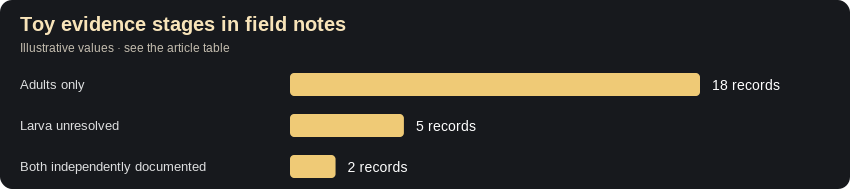
The chart “Toy evidence stages in field notes” shows eighteen records classed Adults only, five classed Larva unresolved and two classed Both independently documented. These counts are invented to explain a documentation scheme. No values come from the Forest Service, the UK Pollinator Monitoring Scheme or a hoverfly field study. A record in this example is a reviewed field account that may hold linked observation notes. It is not an animal, a sampling minute or a nursery. Use one category per example record so a lead in an unresolved class does not get counted again as a second, confirmed larval observation.
| Illustrative evidence class | Number of field records |
|---|---|
| Adults only | 18 |
| Larva unresolved | 5 |
| Both independently documented | 2 |
| Total | 25 |
Eighteen plus five plus two gives twenty-five records. In this invented ledger, eighteen out of twenty-five, or seventy-two percent, are adults-only records; five of twenty-five, or twenty percent, are unresolved larva leads; and two of twenty-five, or eight percent, document both stages independently according to the example's review rule. The shares are not occurrence estimates or probabilities of finding either stage. The chart does not provide a standardized larval search denominator, the number of confirmed larvae, or a measure of how many quadrats were occupied. It is a record classification chart, nothing more.
In the toy rules, Adults only can mean the recorder has adult evidence and no larval evidence attached. It does not imply that an equivalent juvenile search was done and returned zero. Larva unresolved means an immature candidate remains unresolved in the record, without forcing an identification because other notes exist. The last class means the account can point to separate, supported observations of adults and larvae. Neither simultaneous timing nor shared space makes a demonstrated parent-offspring link. Depending on the purpose, a real scheme may need more classes, including a larvae-only confirmed category or a distinct no-attempt code. The example has no need to appear exhaustive.
What if someone combined the five unresolved records and two independently documented ones and announced that seven nurseries had been located? That would transform records into places and uncertainty into certainty. It could also imply that evidence for one larva in a location identified a place of development for adults observed elsewhere. A safer sentence names exactly what the example contains: five unresolved larval leads and two records containing separately supported evidence of adults and larvae. More precise ecology would require a separate dataset and stronger linkage.
Specify what “independently documented” excludes
A clear adult image and a clear immature-stage record can both exist for a site without evidence that they involve the same species. This is especially important if one determination reaches family level and the other remains broader. A reviewer can state that adult flower use and larval presence were documented independently while retaining the respective taxonomic labels. The approach does not imply that the observations are statistically independent in every sense. They may share the same location or date. It means that each identification and life-stage claim is supported by its own observation rather than inferred from the other.
Consider a hypothetical adult perched on an umbel and a larva seen on a nearby stem. The adult photo says nothing about where the larva came from. The larva photo says nothing about the adult's parents or place of development. If the two photographs were taken on the same day at the same site, that co-occurrence is real at the documented scale. It is a limited context claim. A plan for tracing origin would need different evidence, such as appropriately supported life-stage continuity under a professional design. Casual field observation need not pursue that question. It can explain the evidence hierarchy without obtaining invasive samples.
Timestamps and patch codes help document the extent of co-occurrence. A record saying “both in the garden this week” is not equivalent to “both on the same plant at the same minute.” Readers may infer one from the other unless the scale is stated. Keep the addresses or trackable locations of confidential areas controlled according to the project's rules. A public story can give broad descriptions without claiming precise linkage, and an authorized reviewer can consult the private map where necessary. Privacy and evidence quality can be handled together when access is planned instead of outsourced to the chart.
Avoid inferring a parent from a behavior that resembles a related event. Seeing an adult land on a leaf near a later larval find is not documented egg deposition. Even an observed egg would need the confidence and identity appropriate to a more-specific claim. A sequence of separate records can inspire a hypothesis. Do not present it as continuous if sight was lost or the individual could not be traced. A cautious review can say that one photo supplies plant context and another supplies a larval record, without announcing which animal gave rise to which. Concrete uncertainty is more informative than a vague disclaimer attached to a strong headline.
Build a field ledger with two effort columns
Use one roster for the observed adult flower patches and another for intended immature-stage search targets. Each can have a date, place and protocol ID. Share identifiers for places only where the boundaries truly match. Adult watch effort might be recorded in active minutes for a defined visible flower area. Immature-stage effort might be recorded as the number of accessible named plant parts or assessment units under the local procedure. Time can still guide the schedule, but fifteen minutes walking and looking at flowers does not create fifteen minutes of deliberate larval assessment. An incidental larval record should remain incidental unless the prescribed effort actually occurred.
Assign a separate result status to each observation activity. For example, completed adult watch, adult watch interrupted, confirmed adult contact, unresolved fly contact, planned immature-stage check not attempted, assessed view with no qualifying find, and unresolved immature candidate are all meaningful statuses. Not all belong to one mutually exclusive field: a completed watch can yield a confirmed adult contact, and an assessed view can be partial if that is how the method is designed. A well-labeled sheet distinguishes watch status from biological findings and avoids making blank fields carry both meanings.
This structure helps prevent denominator errors. Suppose a survey recorded adult visits on twelve flower units and inspected four different plant parts for larvae. An overall statistic dividing larval positives by the twelve adult survey units would misstate what was searched. Another analysis might divide the number of combined field accounts by the number of all cards submitted. That would describe documentation frequency in the card system, not a natural occupancy rate. State whether the denominator refers to observation sessions, plant parts, mapped units or records before reporting any percentage. The clearer the question, the easier it is to see when two figures should not be combined.
A reviewer can test the workflow by tracing one adult-only record back to its watch. Was an immature assessment attempted, not required, or carried out in a different area? Then trace one unresolved lead. Was the object left unidentified because no confirming features were visible or because the photo did not support a more specific label? Exact outcomes may change after review. The audit does not try to convert every case into certainty. It ensures that a changed conclusion is attached to the correct observation and that a classification never fabricates effort on another life stage.
Think carefully before claiming ecological services
Garden accounts sometimes move directly from “hoverflies were seen” to “we have aphid control.” In some species, predatory larvae do feed on aphids, as described in Cornell's hover fly biological control fact sheet. But that contextual fact does not show local suppression of aphids in the particular garden. Even a directly observed feeding interaction is an event, not an estimate of change in prey population. To assess suppression one would need outcomes and comparisons designed for that claim. The adult flower record is worthwhile without being stretched into a measure of biological control.
A parallel temptation is to infer successful pollination from every adult contact. Adult flower use can be recorded with a direct view and an explicit definition. Transfer of compatible pollen and subsequent plant reproductive outcomes are farther along the chain. A garden display can explain that insects provide important ecological functions without claiming to have measured each one. Clear labels help a horticultural reader act on the right kind of evidence: where flowers were visited, where larvae were actually documented and where the relationship between the two remains untested.
When making recommendations, ask what the current evidence can inform. A well-documented history of adult contacts at a flowering bed may support keeping it on a viewing route or planning another resource comparison. Separate evidence about larvae can prompt a steward to consult appropriate habitat guidance. Neither result instructs someone to modify drainage, expose hidden wood or create potentially unsafe conditions merely to increase the number of recorded larvae. Habitat management requires local context and authorization. A strong garden report may recommend improving observation scope before proposing physical changes at all.
A morning route that gives the two records room to disagree
Picture a school team visiting three sectors in an ordinary public garden. First, a group watches an open flowering patch with clear sightlines. It documents several striped flies landing and saves contextual images of two. A qualified reviewer later confirms both as adult syrphids but stops short of a species name. That is a successful adult observation set under its chosen rules. It tells the students where and when they documented flower contacts. It does not need a larval record to be interesting, and leaving the developmental story unresolved does not make the adult identification less credible.
The second group walks past a partly shaded stretch where leaves show several small organisms. One feature looks like a larva but could not be photographed from a clear angle. The volunteers note the plant part, view limits and proximity to other insects. They record “larva unresolved” rather than using an adult's identity from the first group. Later, a more informative view may add evidence. If it does not, the note remains a candidate. That outcome protects the positive adult reports from being burdened with assumptions about every organism seen in the same garden.
A third permitted observation documents a confirmed syrphid larva in a clearly photographed setting at the opposite end of the corridor. A supported adult contact had also been observed in that sector under a separate watch. The two records can share a place summary while retaining their separate timestamps, methods and taxonomic evidence. If the example project's one-label scheme is applied to a sector report with both observations, it can be placed in Both independently documented. In a real research register, a sector can contain multiple encounters or assessment units. Explain what was grouped into the report before treating category counts as identical to observations.
When the groups meet, they can attempt two different maps. One can show which flower patches the adults were actually seen visiting under the watch. The second can show broad classes of eligible places that were assessed for larvae and the strength of the evidence. Keeping both maps helps the reader see a possible overlap or separation without drawing arrows representing travel by an individual. It also avoids turning an unvisited portion into a zero. Use a schematic or aggregated depiction for public reporting if detailed locations are not appropriate for sharing.
Follow a correction through the adult and larval ledgers
Suppose a reviewer changes one purported adult hoverfly to “fly unresolved” after seeing the image was too soft to confirm the family. That may alter a confirmed adult tally or move a particular field record out of a combined category. It does not invalidate a separately confirmed larval finding with good provenance. Likewise, a larval reviewer could decide that a purported hoverfly larva is actually a different insect. That would change the juvenile evidence and its relevance to hoverfly development, but the adult watch can remain a valid finding. Independent evidence roles allow each record to survive appropriate changes in another part of the dataset.
Keep the original record and a dated interpretation field. A change can affect the way a published chart is derived, and reviewers should know which version of the rule or identification was used. It is not necessary to rewrite every old caption as if the new judgment had always been known. In an archive, show the relationship between the source photo, original label and reviewed label. In a public report, explain when a materially different identification affects the interpretation. If the relevant habitat evidence remains unresolved, do not silently fill the gap by borrowing confidence from another life stage.
Quality review can also reveal that the record unit itself was ambiguous. Maybe the same adult appears in three sequential photos filed by three students. If the images are demonstrably part of one recorded encounter, include them as evidence for that encounter rather than calling them three adults. If there is insufficient continuity to combine two clips, retain that uncertainty. A large folder can be useful for visual training without providing a large sample. What matters in the chart is whether the adopted unit and classification rule can be reapplied consistently. Keep the supporting files separately labeled so a useful image does not have to represent more than it shows.
Before sending a summary, ask a reviewer to find evidence supporting one entry in each category and to say which other activity was not proven in that entry. The test should be possible without interviewing the original observers. The reviewer may flag a candidate moment of feeding or an observation entered under the wrong site label. Such a check improves the archive before graphs travel to new readers. It is not a substitute for a sampling design; it simply protects the difference between recorded material and claims derived from it.
Compare development leads without making an index of habitat suitability
Habitat records may range from broad descriptions of vegetation to one small confirmed spot where an immature stage was observed. The range itself matters. A site list saying “damp edge present” does not document how it was searched or whether the relevant organisms used it. A note saying “larva verified on an accessible leaf in this sector” is stronger about one moment but still does not rate every other part of the sector. If two records come from habitats with different physical visibility, that difference also affects the likelihood that evidence became available. Do not normalize it by guessing a common probability of finding larvae.
A design interested in confirmed larval associations should start by specifying which units are eligible and which evidence is judged sufficient. If a program uses authorized observation rules different from those in this article, follow its definitions and protections. A less formal garden inventory can report where the observation stops instead of adopting methods it cannot carry out. For example, a particular understory region could be mapped and noted as unassessed because the sightline was blocked. That is relevant coverage information even if the group has no intention of returning to disturb it. A target can be important without a confirmed outcome.
Think through the most plausible alternative explanations for any difference. More adult activity in one bed might reflect richer blooms, easier views, time of day or nearby movement corridors. More juvenile evidence in one sector could reflect actual condition, more observer attention, better visibility or more reliable identification information. A claim about which factors explain the patterns would need additional data and design. The useful first report may show both results in separate tables and give the reasons a comparison is limited. Keeping alternatives explicit allows the next project to target a better test rather than defending an attractive first story.
Give readers a conclusion they can check
A report can end with wording like this: “During the defined watches, we documented adult hoverflies at the flower patch. In separate observations we found an unresolved larval candidate elsewhere. The present records do not identify larval habitat for the adults we counted.” The wording gives the reader direct facts, a significant limitation and a clear next question without making those components beat each other into one score. If independently identified larvae were also documented, add that and give their scale. Do not imply that the field observations identified a nursery for specific adults unless the required linkage actually exists.
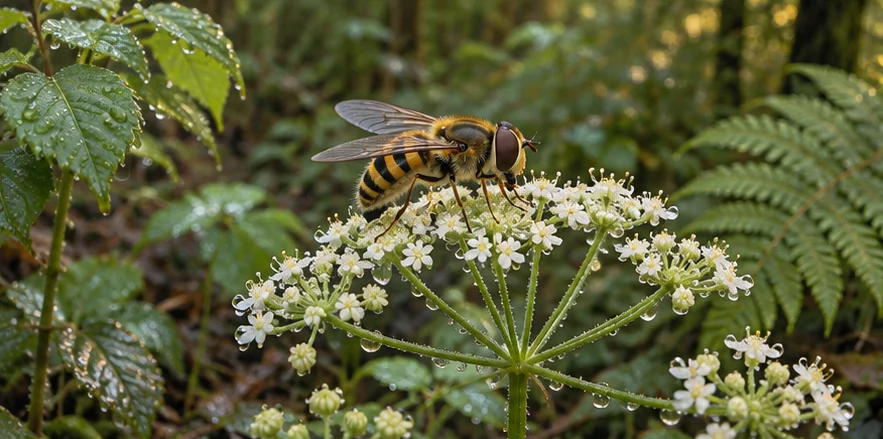
The observation unit should remain visible wherever the chart is included. The fictitious twenty-five field records are not twenty-five breeding sites. A generated picture of an adult near a softly rendered understory should not visually serve as a bridge between the species that a viewer sees and an inferred juvenile environment. It illustrates why a question might arise. A documentary image of a confirmed larva would play a different role and need an explicit link to the field event. Preserving those different kinds of image evidence lets a reader enjoy the illustration without relying on it to make a scientific claim.
Treat season and disturbance as part of the record
A site that has adult visitors in summer may be hard to assess for larvae at that same time. It might be sunny where flowers are open, with immature habitats elsewhere in shade or outside the open route. The sequence of stages varies with species and conditions. A survey concentrated during the flowering peak can be well suited to documenting adult visits while having poor coverage for a different part of the life cycle. Do not call it an all-season species study simply because its observations are repeatable. The survey schedule sets boundaries that should travel with each result.
When two dates are compared, record any temporary changes in access or visible substrate. Construction could close a stretch; vegetation could obscure a previously visible plant part; rain might make the intended view unsuitable. None of those is equivalent to ecological disappearance. If the adult watch happened on both dates but juvenile assessment happened on only one, the comparison of adult activity can be retained while the immature-stage comparison is marked unavailable. A report does not have to discard every part of an incomplete visit. It has to prevent the parts never observed from turning into results.
A person organizing follow-up can ask a question that makes the time scope explicit. For example, “Were independently confirmed immature stages documented in the assessable units during the next three routine visits?” is a workable educational question. “How many juveniles did the adults we counted produce?” is not an answer available from that design. The first question still leaves room to report disruptions, a narrow period and uncertain identifications. It can lead to useful next decisions about record quality without promising an outcome from records that were never collected.
Preserve negative results at the right level
A completed adult watch with no qualifying contacts is evidence about that watch. A completed larval assessment with no qualifying finds is evidence about the assessed units and the method. A row in the adult ledger with a blank larval field might only mean that no juvenile observation was planned. Assign specific status codes rather than relying on a blank row to mean all three. If the chart only displays accounts containing some type of evidence, make that display rule explicit. It is not the appropriate graph from which to infer the frequency of no detections across all planned visits.
In a systematic archive, someone should be able to retrieve negative visits and understand how they were handled without seeing a picture. That is not an argument against photos. It is a reminder that photos disproportionately represent things people noticed. Written effort and result records preserve quieter outcomes that matter for comparing methods. Work up from the separate descriptions of what was watched or searched, and use supported positives where they belong. A combined habitat account is strongest when it keeps both distinctions visible: adult contact is not evidence of an individual's nursery, and failure to record a juvenile is not automatically evidence that there was none.
Sources and illustration note
- USDA Forest Service: Attracting Pollinators to Your Garden Using Native Plants.
- UK Pollinator Monitoring Scheme: FIT Counts.
- University of California IPM: Syrphids.
- IUCN SSC Hoverfly Specialist Group: Hoverflies.
- Cornell University: Hover Fly Biocontrol Fact Sheet.
- The chart and table are fictional evidence categories. The header is generated editorial artwork, not a photograph documenting development at a particular site.