| Category | Value (sequences) |
|---|---|
| Tip visible | 5 |
| Insertion visible | 7 |
| Both visible | 3 |
Illustrative values, not sourced observations. Invented example for the stated comparison; not a biological threshold, ecological estimate or observed dataset.
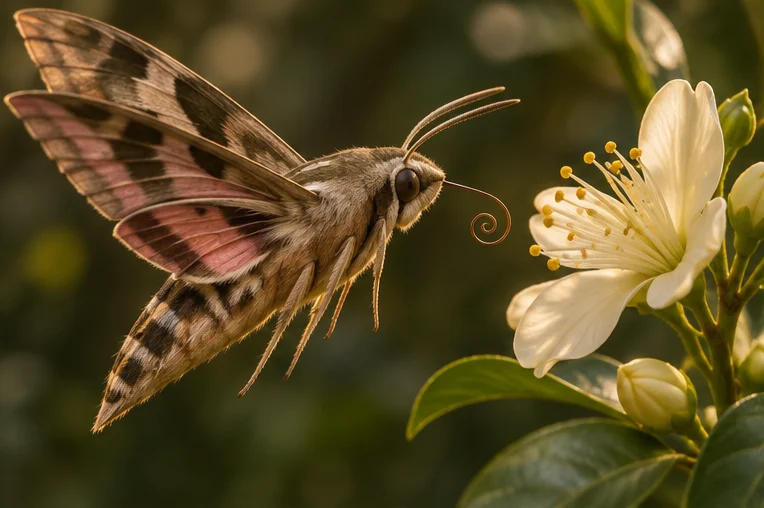
A pale flower faces the edge of a path at dusk. A hawkmoth hovers in front of it and uncoils a thin mouthpart. For a moment the tip is visible against a dark petal. Then the visible strand lines up with the opening and disappears behind its rim. A camera can preserve much of this action, but not necessarily what happened beyond the rim. It may show a probe or an insertion. It may not show that the tip found the nectary, that liquid was available, or that the moth took any. Those are not cautious synonyms for the same event. They are links in a chain of behavior that an observer can investigate one at a time.
The most surprising link may be the one least like feeding. A proboscis is a mouthpart, but in a specific experimental system researchers also found evidence of odor detection at its tip. A structure can help an animal evaluate a flower before or during the process of obtaining a reward. A carefully framed visit record can show how the structure moved without being able to show what was sensed or consumed. The distinction makes an evening observation more useful, not less interesting: the observer has a better question to ask about the next visit.
Name the part and the motion before naming the purpose
An extended proboscis is something that may be visible. A clear tip is a particular part of that structure resolved in the image. A tip passing behind a petal is a change in visibility. A tip crossing into a floral opening is a positional event if the geometry is resolved. An insertion into a known opening does not necessarily put the tip at the nectary or against available liquid. Even if the relevant internal position is known, the duration of that position alone is not a measurement of intake. Begin with the narrowest thing actually observed and build only when independent evidence supports the next step.
A working vocabulary can make these distinctions easy to use. Approach means the subject moved into a defined viewing area toward the focal flower under the criteria of the project. Extension means the visible mouthpart straightened or extended sufficiently to identify it. Contact means a physical touch was resolved. Insertion means a crossing into a named floral opening was resolved. A probe can refer to visible exploratory movement if the observer says what counts as exploration; it should not serve as a hidden label for a meal. Each event can be recorded even if later steps remained unobservable.
Be specific about what was visible in the flower. The mouth of a corolla tube and the position of a nectary in or near it are different structures. A botanical description can provide plausible anatomy, while the actual visit footage may show only the rim. Do not combine an anatomical source and a photo into a claim of a known depth unless the geometry supports it. A photograph of a differently oriented flower can clarify which structures could be hidden, but it cannot turn a hidden tip into a measured point at a particular moment.
Position is especially easy to overread in a still. The strand may cross over the flower opening in the image while passing in front of it at another depth. A still taken at the point of closest approach can make that alignment look nearly conclusive. Neighboring frames may reveal that the tip moved along the outside rather than entered. Record a convincing crossing only when the sequence and angle support it; if all you have is alignment, describe alignment. Leaving some events unresolved makes the remaining insertion records more credible.
Read the odor experiment as a chain of separate tests
Haverkamp and colleagues' original study of hawkmoth scent evaluation studied the hawkmoth Manduca sexta and flowers of the wild tobacco Nicotiana attenuata. The authors combined behavioral experiments with anatomical, molecular, and physiological evidence to investigate odor detection involving the tip of the proboscis. The key distinction is between a flower's chemistry, a sensory pathway, and an observable response. The authors did not infer a receptor simply because photographs showed a long mouthpart near a flower. They assembled evidence suited to the separate links.
This result does not mean the proboscis replaces the antennae or that every flower visit is governed by the same odor pathway. The study tested particular animals and floral cues under specified conditions. It also examined interactions with individual flowers rather than reducing all scent effects to attracting a moth from a distance. Under a particular free-flight comparison the visit counts to scent-emitting and non-emitting flowers did not themselves separate the options, while other outcomes supported differences relevant to the interaction. That is a good illustration of why a result about what happens near a flower can exist without a matching contrast in how many flights reached it.
Use the authors' methods to understand the level of evidence, not as instructions for an observer to repeat their work. Nothing in a natural photo sequence measures neural activity or identifies what molecules were near the tip. The presence of a floral scent a person can smell is not evidence that a particular moth sensed that odor at that location or with that structure. A smell in the photographer's environment is a field note. A claim about a sensory pathway depends on the research that separately tested it.
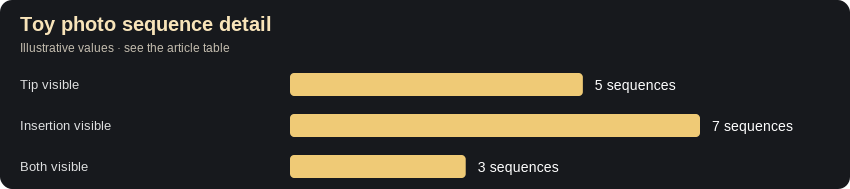
Toy photo sequence detail
The chart and table show the same fifteen fictional records in sequences. In this illustration one sequence is one eligible recording of a visit interval, not one distinct moth or one meal. The categories are exclusive for display. “Tip visible” means the tip was resolved without a qualifying view of crossing into an opening; “Insertion visible” means the crossing met the rule without the free tip separately resolved in its own qualifying view; and “Both visible” means both criteria were met during the same sequence. These invented counts are not sourced observations, biological thresholds, or estimates of feeding success.
| Detail recorded | Sequences |
|---|---|
| Tip visible | 5 |
| Insertion visible | 7 |
| Both visible | 3 |
Under these rules eight sequences offered a qualifying view of the tip and ten offered qualifying insertion evidence, with three in both sets. Adding eight to ten double counts the three sequences that meet both criteria. The correct sequence count remains fifteen. A different chart could count all flags separately, but its totals would not represent unique sequences. In the fictional table there are no eligible sequences with neither detail. In an actual project it may be important to retain those too, as well as files not assessable at all.
The seven insertion-only observations are plausible because the shaft and opening can be tracked during entry while the terminal tip is hidden by the rim or lost to focus as it crosses. Since the criteria distinguish resolved free-tip appearance and resolved crossing, a view can support one more strongly than the other. That explanation does not imply that the picture showed what the tip contacted inside. It identifies why a known geometric event and a still-inadequate anatomy view can occur together in a field archive.
A claim that ten of fifteen sequences contained meals would not follow. The count of sequences with insertion is not a tally of liquid uptake. A claim that only five visits sampled anything would also not follow: five classified sequences with the visible-tip-only label do not count every tip view under the rule, and visibility does not measure sensing. A better title is exactly what the chart names: photo sequence detail. A good teaching graphic can remind a reader how evidence was categorized without pretending to reveal a hidden reward.
Read the light-level experiment through its actual endpoint
The original study of nectary location under different light levels investigated how Manduca sexta found an opening in an artificial floral setting under two specified light conditions. The full paper describes motion sensing and tracking used to assess the moths' performance. In the higher light tested, the moths took longer to locate the opening and hovered farther from the flower during the relevant behavior. The study also examined what happened across repeated visits. These are measured comparisons in that setting, not a rule that every bright garden produces no nectar intake or every moth species navigates best at the same light level.
The paper's way of identifying arrival at the artificial nectary is part of what makes the result informative. A viewer might otherwise count every pause near a flower as successful search, or every loss of the tip from view as the instant of reward. The experiment separated the relevant position and timing more explicitly than an ordinary garden image can. Read its result at that level: efficacy of locating the defined opening and associated movement under the tested conditions. A reader can learn a lot from this without conflating those outcomes with a direct measurement of how much liquid was consumed during a visit.
Reading the light and scent papers together does not make their treatments interchangeable. The scent study addresses an olfactory pathway and behavior with particular floral information. The light-level experiment addresses how vision-associated conditions affected search and movement in a particular artificial setup. Neither infers what sense a garden visitor relied on from a photograph. The two studies illustrate how different evidence can support different links in a sequence that looks like one continuous act from a distance. A field observer can ask a narrower question that fits available images, then cite the experiments to explain why the distinction matters.
A further original study on tactile active sensing used artificial flowers and tracked exploratory mouthpart movements. It supplies a specific experimental example in which repeated probing behavior and changes with experience could be studied. It does not mean every movement along a natural corolla has the same role. Keep the study's measurements attached to its apparatus and task. The project you are considering may be able to record a visible sweep while being unable to identify whether touch, smell or another cue was involved.
Classify the opportunity to see before classifying the action
For a sequence to support a tip judgment, it might need a view in which the relevant part is in focus and separate from a similarly colored edge. An insertion judgment may need visibility of the moth, its mouthpart and the opening in adjacent frames. State how long an occlusion can last before continuity becomes unclear. Be prepared for one judgment to be possible and the other not. A short clipping artifact at the moment of entry can invalidate a crossing code without affecting an earlier tip view. A classification sheet should allow that combination rather than demand one overall quality score.
Three different kinds of negative record can matter. The candidate feature may be absent throughout an adequate view. It may not be visible because the view is inadequate. Or the sequence may not cover the relevant interval at all. If the recording begins after the tip disappeared, it cannot answer how it crossed. If the lens was pointed at another flower, that is a different gap. A good record may simply say that the beginning of the event was outside the frame. Do not assign “no insertion” to all of these cases by default.
Poor visibility is related to the conditions you may want to study. At dusk, a pale flower can remain visible after fine details of the moth no longer resolve. A flower at a particular angle can hide the same portion of the mouthpart on nearly every visit. A bright area can be easier to film even if it has no greater rate of behavior. An apparent difference in observed crossing rates might chiefly be a difference in the chance to code a crossing. Record qualifying views separately from all observation opportunities and consider whether the comparison remains fair after making that distinction.
Choose the viewing unit and sampling rule in advance. An opportunistic clip is valuable evidence of a particular flight, not necessarily representative of all encounters. A fixed observed interval with a defined focal flower can establish its denominator more clearly. If there was no eligible footage, say so instead of showing a zero interpreted as no visits. If a longer video contains several appearances, count by your visit rule and preserve links to the raw footage. A repeated camera angle or crop of the same event is not a second sequence.
Follow the mouthpart without following the animal
Use ordinary, nonintrusive observation from places where it is appropriate to remain. Do not handle moths, restrict their movement, alter flowers, change the available rewards, or manipulate cues for the sake of a field note. This article compares published work and discusses how to interpret naturally available views. If useful recorded detail is unavailable in darkness, accepting an incomplete sequence is the correct result. Introducing a disruptive light source or chasing an animal would change the setting you wanted to describe. A published experiment is not a field instruction for a casual viewer.
A broad frame can document the approach, what flower was in view and whether the moth remained visible. A closer frame may resolve part of the mouthpart but leave no evidence of the arrival path. Use each for its own purpose if already available. Do not portray a close still as uninterrupted coverage of an approach. A natural scene has changing focus, movement and backgrounds; the fact that a frame looks clean when read alone can hide exactly the context needed to interpret it.
Curved motion deserves patience in review. A thin mouthpart can appear to straighten or bend depending on the direction of movement relative to the camera. Backlighting can make a strand along a flower margin look attached to the moth when it is plant material. Neighboring frames may allow the observer to follow the object back to its base. If the frame does not resolve the connection, code uncertainty. No amount of sharpening creates the blocked part of a curve. Cropping can make the evidence easier to inspect but not physically more complete.
Describe what moved relative to what. The flower may swing toward the moth as the moth appears to hold position. In a single perspective both can look like a reach into the flower. A second ordinary viewpoint can sometimes strengthen an interpretation if both views are actually of the same event, but never merge similar unverified observations to create a continuous sequence. A closely matched location and time help establish correspondence. When those are uncertain, keep the records separate and do not manufacture a second angle.
Add enough environmental context to show the conditions under which a view is usable. Note time, weather, relevant shadows, wind, and obvious obstructions where feasible. Those records describe the scene but do not turn an unmeasured light level into a value from the published study. A camera's automatic exposure is not a direct measure of the light experienced by the moth. A film labeled night does not tell which cues were available. Give each condition the strength of statement the observation supports.
Ask which step a pause could document
A moth may hold position at the opening. An observer might think of that pause as drinking because it fits an expected sequence. It could also reflect a search, contact with a structure, a pause between movement, or some combination. If the recording cannot resolve what occurred beyond the rim, record the duration of visible position under a stated rule. “The mouthpart remained aligned with the opening for the visible interval” is more useful than “two seconds of feeding” if uptake was not measured. A long pause is a behavioral observation, not a volumetric instrument.
Distinguish quantity from successful access. There might be an independent way to know that a nectary was reached under a controlled condition. Knowing that point in the movement can help study search efficiency. It still does not necessarily tell the amount ingested, whether any liquid remained, or the outcome for the plant. Those are separate questions with different measurements. Counting a visit as finding a target is not a claim the observer recovered the contents of the moth's diet. In a field story, say which part of the chain was visible and why the rest was not.
The inverse problem is common too. A very short visible insertion need not imply no uptake. If the ordinary view ends early, the apparent short duration may simply reflect loss of coverage. If the amount was especially small it could be below what the method can discern. Do not infer absence of feeding from lack of visible evidence unless the design specifically measures feeding and is adequate to rule it out. The nature footage in this article supports descriptions, not a substitute intake test.
A sequence of visits can contain different outcomes even for one animal. It may explore the first opening, move to another flower, and return to the first after a gap. Record those movements in subject order where continuity is known. Do not infer it is the same individual after it leaves the scene merely because the next visitor resembles it. The occurrence of repeated sequences around one bush does not show how many moths were involved. This also limits a casual claim of learning, which would require evidence about a consistent individual or other identified learning unit across appropriately comparable trials.
Distinguish sensory detection from sensory importance
A detector at the tip may respond to a tested odor in a controlled study, but the argument about its importance in a particular natural visit has more parts. The relevant compound must be present where the moth could encounter it, the pathway must be capable of sensing it at the time, and the observed behavior must plausibly depend on it rather than on another feature. An ordinary photograph seldom addresses those links. The result of a receptor study is still important even if it does not reveal which among competing cues mattered in one flower-filled garden.
Also distinguish testing a response from knowing what an animal experienced. A researcher can define a change in movement or effort under a verified cue contrast. An observer cannot use that result to invent the subjective impression of every moth that explores a flower. Terms such as attraction, probing and feeding describe measurable behavior only when they have an operational definition. A familiar word like taste can imply a different sensory pathway from what a study actually investigated. In the 2016 paper the length of the apparatus or the name of the body part is not the headline; the separately supported olfactory pathway is.
A flower offers several kinds of information. Its geometry may help guide movement, its chemical cues may influence behavior, and ambient conditions can change which features are detectable. Observing several of those at once does not identify a primary cause. The two main sources ask different questions precisely because real behavior includes many connected steps. A credible readout is often narrower than the story across them. It may establish an ability to respond, a difference in search time, or a pattern of visits rather than an overall theory of why moths feed.
A good follow-up question names a comparison that could go either way. “Do qualifying insertion views occur after the same visible contact pattern on this focal flower?” is an observational question. “Would the moth find the opening just as quickly without this odor?” is a causal question that ordinary observation cannot isolate. “How much nectar did the moth take?” is an outcome question requiring a different measurement. They can be worth asking in turn. Do not write the answer to the third one merely because the first gave a clear picture.
Test a field note against alternative readings
Take a fictional clip of a moth just beyond a pale flower. Before the moth arrives, the edge and opening are in focus. The proboscis uncoils in front of the flower, with its tip resolved briefly. As the moth approaches, the edge of a petal obscures most of the view. The observer can later see the strand pull away, but no crossing was visually confirmed. The most defensible record is tip visible and insertion unresolved. There is no reason to code the moth as either feeding or failing to feed. The relevant event could have happened during the hidden interval.
Now consider a clip where continuity through the opening is clear for the mouthpart, but focus does not resolve the distal end independently. The observer could classify insertion only under the toy rule. The status of the nectary and uptake remains unknown. If the flower's shape allows a reasonable estimate of the direction, it can be recorded as geometry, not an assessment of the hidden tip's position. If a broader video frame also establishes the same animal moved later to another bloom, the record can document that observed movement without asserting that either bloom gave it nectar.
A third wished-for view would show both details in the same visit. That qualifies for the strongest image class in the chart and is still only an image class. It does not distinguish which odors or tactile cues the moth evaluated and does not determine reward amount. A good reviewer can agree completely with both positive codes and still reject a caption about a meal. This is a useful quality test: write down the strongest attractive interpretation, then ask which recorded field would actually have had to change to support it.
The reviewers can disagree in instructive ways. One may define insertion by when the mouthpart appears aligned; another may require evidence that it passed behind a named internal edge with a coherent trajectory. They are not measuring the same thing. Review several clips independently and compare which frames or observations justify each code. Revise the definition if needed and keep earlier labels and reasons recoverable. If a clip genuinely cannot resolve the difference, leave it unknown. More consistent disagreement can be a sign that the rule is too subjective or the view too difficult for the intended study.
Let the results describe the available view, not the animal population
If many recordings show clear mouthpart tips, that may indicate good conditions for observing fine detail. It does not necessarily mean moths in the sample extended their proboscises more often than others. If a sequence is selected precisely because it shows the tip, the sample is not suitable for estimating the frequency of tip visibility among all visits. Describe selection and observation coverage before converting the tally into any proportion. The toy table was created to demonstrate categories and has no sampling frame beyond its invented records.
Subject identities introduce a separate limit. A night watch may see the same animal several times, or several similar animals only once. Reporting one sequence per visible episode avoids making claims about distinct individuals. It does not make the episodes statistically independent. If the project needs a biological inference beyond describing recorded visits, design its sampling and analysis accordingly. A behavior figure does not become representative simply because it combines clips from multiple angles or finishes with a large total of frames.
A numerical comparison of timing needs a consistent definition too. Start time could mean arrival in the camera area, first visible extension or first touch. End time could mean the start of a qualifying insertion, loss of visibility, or departure. These are different durations. A clip beginning after one event cannot supply time from that event without an explicit limit or other reliable evidence. After a low light period, the visual record may become more incomplete. Do not interpret shorter observed durations as faster search if the ends of visits were more often cut off. Report incomplete timings separately.
The question of learning has a particularly tempting shortcut. A later visitor might appear more efficient at reaching an opening than an earlier visitor. Without continuity or independent identity, it may be a different animal. Even if it is the same animal, changed flower angle, time or light can affect the apparent contrast. A series of unstandardized clips can document that actions differed. It cannot recreate a controlled repeated-visit comparison by listing events in order. Cite the original work when explaining what an experiment shows, and keep the garden series at the resolution it supports.
Keep the material and the sensory claim separate when reading a source
A paper can use several forms of evidence in one article. The description of how an organ is built does not, by itself, establish that it responds to a chemical. A physiological response to a specified stimulus does not establish the animal's movement around a flower. A behavior difference under a controlled contrast need not reveal every neural step underlying it. The original scent work is valuable partly because it brings several kinds of evidence together. Retell the links separately so readers can see which are supported directly and which are the study's interpretation. An ordinary photograph cannot fill a missing step just because it illustrates the same body part.
A measurement of a flower's reproductive result is yet another endpoint. If pollen transfer or a downstream plant outcome was measured in a particular study, report that with its conditions. It is not a quantity of nectar consumed by the animal. A moth can interact with a flower in ways relevant to the plant without having its intake recorded. Conversely, possession of a feeding-related observation does not establish that appropriate pollen was delivered. A caption that says pollination occurred because the proboscis entered a tube collapses two distinct outcomes even if it accurately identifies the flower and insect.
Some research results seem contradictory only because the endpoints have changed. One study might see no clear difference in visits to a pair of flowers, while finding a difference in behavior after approach. Another might find a difference in time to a defined target without measuring ingestion. These results need not be cast as disagreements about whether the moth used the flower. Clarify the comparison and endpoint first. A null difference in one event does not cancel a positive result for another event. Neither justifies labeling every unrecorded step a success or a failure.
Use the unedited sequence to diagnose apparent certainty
A still selected from a series can give the impression that the tip was clearly in view for the entire approach. Open the source sequence and note when the feature enters and leaves a usable view. Check which position is only inferred from a neighboring frame. If a recorder pauses or automatically jumps over gaps, consult the available timing information before treating frame order as continuous motion. A sequence can be ordered correctly and still omit its decisive moments. Label those gaps without negotiating them away when filling a count.
A rehearsal can show the difference between recording opportunity and finding an attractive picture. Pick a few fictional or ordinary existing clips before looking at their cues and classify the visibility of mouthpart and floral opening independently. Then classify the actions that qualified. If reviewers consistently see tips only after reviewing a dramatic thumbnail, the image selection procedure may affect the apparent balance of results. Collecting more close crops would not necessarily solve that problem. The study may need a fairer selection rule, or it may be appropriate to say it documents examples rather than frequencies.
Finally consider how sound, shape and apparent motion travel between displays. A slowed video can help review visible movements, but it can make a brief pause look long. A crop can isolate the proboscis but remove the landmarks that establish location. A sequence prepared for explanation can retain references to its unmodified footage and disclose speed changes. Do not present an edited sequence as the timing record unless the timing was preserved or independently reconstructed. The more polished the display is, the more important it is to preserve a way to check the source evidence.
Put unresolved evidence to work
Suppose most records show the approach clearly and then lose the tip against the rim. A useful next question might be about approach geometry, because that was consistently visible. If the study instead needs crossing evidence and cannot get it without disruption, the limitation is a real result about feasibility. A cautious project can publish its visible observations and note that it did not establish a feeding outcome. Choosing that scope does not mean the moth probably did not feed. It means the project's evidence cannot classify feeding responsibly.
Build a handoff that another observer can reconstruct
Give each clip or view an event identifier, along with time, plant and visibility notes. Indicate whether approach, extension, tip, contact, crossing and departure were assessable. Then state the positive evidence, any explicit observed absence under an adequate view, and what remained out of view. Use the original time interval for estimated durations rather than a highlight reel trimmed after the finding. If some images were opportunistically selected, mark that and preserve the context as a set of sightings, not a comparison of all visits.
A short caption can be as simple as: “The tip was visible before the moth approached the flower opening. Entry could not be resolved, and nectar uptake was not measured.” A longer caption might identify confirmed insertion into the visible corolla opening without claiming entry into the nectary. If a diagram illustrates the likely internal course, label it as an interpretation or anatomical illustration. Readers often see the graphic apart from the text. State the distinction there too. The evidence categories should not become more definitive as they are shortened.
Do not make timing or exposure records seem more precise than they were. A frame number can anchor a visible event, but the exact instant of a hidden event remains unknown. A description of twilight can contextualize the opportunity, but it does not establish one of the experimental light levels. A date and species identification should be supported independently if the report uses them. Where the visitor is only tentatively identified as a hawkmoth, preserve that confidence level. Better observational detail about the proboscis does not by itself resolve taxonomy.
An archive can also distinguish a clip with an unknown action from a verified absence of that action without displaying two nearly identical empty thumbnails. Add a short reason next to the code. An adequate view that showed no entry might be described as a non-entry during the available interval. An obstructed view should identify the blocked surface. An incomplete recording should say where the gap began. Those descriptions support different follow-up questions and let another reviewer reproduce the denominator. If the source media is later lost, the written reasons preserve what the observer actually claimed, but not the missing visual proof. Do not upgrade a historical note just because it is the only surviving record.
What the observer can report is often quite memorable: a long, flexible mouthpart made a visible sweep, rolled out to a particular extent, or disappeared through an opening in a continuous view. The original papers give reasons why sensing and search are worth distinguishing from drinking. The field record need not claim an odor was sensed or a reward acquired to be good evidence. It can make the next question clear: which movement was observed, which sensory mechanism has separate support, and which outcome is still hidden from the camera?