| Category | Value (events) |
|---|---|
| Hover only | 9 |
| Insertion visible | 6 |
| Outcome hidden | 5 |
Illustrative values, not sourced observations. Invented example for the stated comparison; not a biological threshold, ecological estimate or observed dataset.
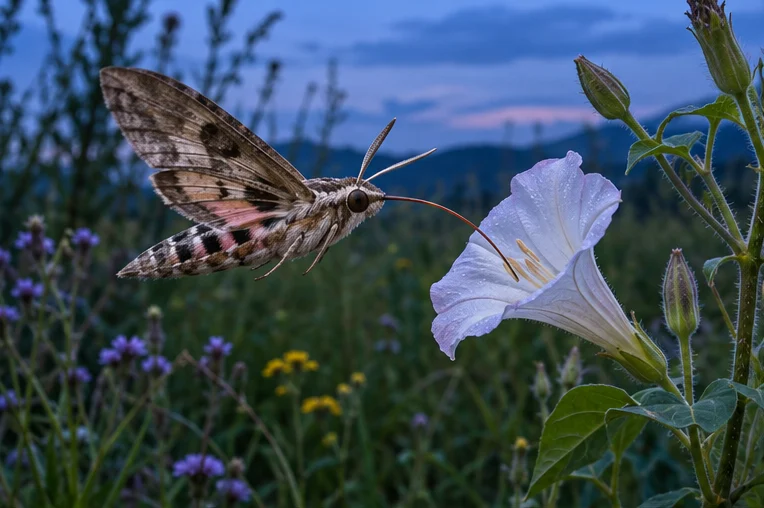
At dusk a moth hangs in front of a pale flower. Its body is clear enough to follow, but only a brief curved line is visible where its mouthparts approach the petals. Then the line disappears against the dark opening. The moth remains there for another moment and flies away. It is tempting to say it drank. The record establishes a hover, and it might establish an insertion from the right angle. The liquid, the tip of the feeding tube, and the exact place inside the flower may all have been hidden.
That distinction is the starting point for studying how a hawkmoth finds a nectary. A moth has to find the flower, bring its mouthparts to it, and locate the nectar-bearing region. A watch can establish some of those steps and not others. A research setup can supply evidence for an event that an ordinary observer cannot see, such as when a probe reaches a defined opening inside an artificial flower. Neither kind of evidence should be made to answer a question the setup was not built to resolve.
Two primary studies make that point in complementary ways. One compared how hawkmoths found a target under two controlled light levels. Another investigated evidence that hawkmoths can receive a scent cue with the tip of their proboscis. A flash of movement at the mouth of a real flower does not reproduce either experiment. What it can offer is an honest record of where the animal was and which parts of the sequence remained visible.
The stages that get lost in the word visit
An approach describes motion toward a particular target. A hawkmoth can cross the near field of a camera without approaching the flower in any useful behavioral sense. Perspective can make a passing insect look as though it is changing its position relative to a petal when the animal is well in front of it. A good note identifies the target and describes what evidence places the path near it. “Crossed image on left” can be a valid record without implying “approached flower on left.”
A hover describes the position or movement of the animal's body relative to a reference. The body can stay within a limited area while the wings move and the proboscis explores, but an apparent hover in a fixed frame can conceal movements toward or away from the camera. State what you could judge. A side view can help characterize changes in the distance from the corolla. A frontal view may be better for seeing the relation between a slender probe and the rim. No one perspective is automatically best for every stage.
Extension is the appearance or lengthening of the proboscis. It can precede contact, and it is plainly not the same thing as fluid uptake. An extended mouthpart may sweep across a petal, point to one side of the opening, or move too quickly to be traced altogether. If the visible section cannot be identified with confidence, write that the probe state was obscured. Neither the insect's stable body position nor a long-looking silhouette should do the work of identifying the tip.
Contact records that the proboscis touched a surface that can be identified in the image or field observation. Entry records something beyond static overlap: the probe crossed a defensible boundary into an opening. A person coding entry should distinguish an apparent tip behind an outer petal from a tip seen crossing the mouth of the tube. A stem or foreground blossom may obscure an approach. Interpreting such a frame as an insertion because it resembles a familiar pose turns previous knowledge about hawkmoths into an observation that was never made.
The next stage is target location. In a controlled assay, a defined region may have a sensor that registers when the proboscis reaches it. In a field image, finding the same kind of target might be much harder to establish because it lies behind tissue. A visible insertion is strong evidence about the entrance of a structure and weak evidence about exactly where the tip went afterward. A transparent teaching model could show this distinction well without implying that an ordinary flower permits the same view.
Finally there is ingestion. The presence of a probe near the nectar-bearing region does not demonstrate intake. The liquid may be absent, the geometry may keep the probe from reaching it, or the insect may have reached the appropriate region but withdrawn before anyone can establish whether it fed. To state that intake occurred requires an observation or measurement appropriate to that outcome. Neither the length of a hover nor the number of frames in which a blur crosses the tube can provide it on their own.
The light experiment built an endpoint into the flower
In the 2021 study by Tanvi Deora, Mahad Ahmed, Bingni Brunton and Thomas Daniel, the researchers studied the crepuscular hawkmoth Manduca sexta. Their experimental setup used artificial flowers fitted with sensors at the nectar target and a machine-vision system to follow hovering moths. They compared a dim condition of 0.1 lux with a brighter condition of 50 lux. The moths in the brighter condition took longer to find the nectary in the setup, including across repeated visits, and hovered farther from the flower during feeding. The numbers describe experimental conditions, not recommended settings or boundaries for every naturally lit flower. The authors' study DOI leads to the original article.
The design combines two different kinds of information. Tracking tells investigators about the visible motion of the animal. A sensor at the target lets them distinguish arrival at the target from a hover that looks like arrival. The tools corroborate different steps, and neither should stand in for the other. An optical record can be excellent at showing where the body hovered without being able to show what is behind the corolla. The ability to compare behavior across illumination conditions is stronger when the endpoint being studied does not depend entirely on the viewer being able to see an exposed white streak in a dark frame.
The study's comparison is narrower than “hawkmoths cannot feed in bright light.” It concerns a species, a pair of controlled light conditions, a defined setup, and the timing and location outcomes measured there. In a garden, different flowers, background brightness, wind, and the experience of visitors may all change together. It would be wrong to take the 50 lux condition and attach it to a specific porch light without measuring the scene. It would also be wrong to take a slow hover captured under that light as confirmation of the experiment's causal result.
The finding is nevertheless useful precisely because it contradicts an observer's easy intuition. Better visibility for a human or a camera does not guarantee more effective handling by the insect. A bright image with an identifiable visitor can carry worse information about the natural conditions that visitor would otherwise have experienced. Conversely, a dim recording with poor visibility is not evidence that the animal had poor access to the information it uses. Keep the visibility of the record separate from the sensory environment of the subject.
A probe can be searching, not just acting after a choice
Alexander Haverkamp and colleagues' 2016 study examined Manduca sexta in relation to flowers of wild tobacco, Nicotiana attenuata. The researchers combined choices involving the proboscis with physiological and anatomical evidence. The results supported a role for scent-sensitive neurons at the tip of the proboscis in the moth's close evaluation of a flower in that system. The published full-text PDF provides the paper and its separate lines of evidence. This is evidence about a particular sensory pathway, not a recipe for diagnosing a moth's use of scent from a single movement in the wild.
One useful implication is that arriving at a flower and evaluating it after arrival need not depend on exactly the same information. A visitor can first approach an object that is promising and still have unresolved work to do at close range. A proboscis moving across the corolla may be taking part in that evaluation rather than simply crossing empty space on the way to an already identified reward. The broad inference is that a probe can have a sensory role. It does not tell us what the moth sensed at every point along a filmed path.
Do not reduce the evidence to a simplistic swap between antennae and mouthparts. Showing that the proboscis tip can take part in chemical sensing does not establish that it replaces the antennae, that both routes have equal roles, or that every detectable scent is interpreted in the same way by both. Sensory capacity in an experimental context is not a complete account of an animal's decisions. Multiple kinds of information can be relevant at once, and their contributions can differ between approaching a flower, finding the opening, and continuing to investigate after contact.
The scent and light papers also concern different questions. The scent experiment does not show that every long hover in a bright place was an odor investigation. The light experiment does not show that improved location under dimmer light was because of a particular scent receptor. Combining papers is useful when their distinct questions make a system richer, not when one is borrowed to fill the other's missing mechanism with certainty. The common ground is that progress from hover to target is an active sequence with evidence at several levels.
A gardener who wants to describe this without jargon can use a familiar analogy with limits: reaching the front of a building does not mean you found its door, and finding the door does not mean you collected what you came for. The analogy captures nested locations and separate outcomes, not the mechanisms of insect sensing. A good caption can explain that distinction and refer to both experiments without pretending the story of an individual moth's movement has already been solved.
Toy observable maneuver categories
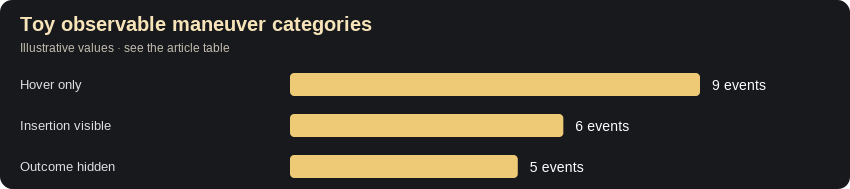
This figure uses invented counts, not data from either cited study or from a real watch. The events are encounters with one defined visitor and flower during one uninterrupted observation segment. Each is assigned one category for this particular display. The chart does not count the individual probe extensions occurring during those encounters, and it reports neither nectar intake nor success at locating a target.
| Category | Events |
|---|---|
| Hover only | 9 |
| Insertion visible | 6 |
| Outcome hidden | 5 |
In this example, hover only means a hover was observed and the view remained sufficient to see that there was no insertion during the event. Insertion visible means the visual record supports entry through a recognizable opening, whether or not later events inside can be seen. Outcome hidden means the available view could not establish whether there was an insertion. It does not label an already established insertion whose tip later vanished from view; that still belongs to the visible category. The category boundaries are what make these toy bars disjoint.
The counts total twenty events. In six, or thirty percent of the entire fictional set, there was documentary evidence of an insertion. Of the fifteen encounters scored with adequate visibility, six, or forty percent, had visible insertion. The figures have different denominators and neither can be called a feeding rate. Substituting forty percent for every unseen event would assume that the visibility problem was unrelated to what actually happened. That assumption might fail, for example, if deep flowers are both hard to see inside and favored for a particular kind of maneuver.
If we focus solely on whether insertion actually occurred, the toy illustration bounds its proportion between thirty percent, if none of the five hidden outcomes involved insertion, and fifty-five percent, if all five did. That interpretation assumes the fifteen classified cases are correct and the hidden category varies only in what is known about entry. The interval is a logical accounting result, not a statistical confidence interval, and it cannot bound ingestion without additional evidence. It illustrates why preserving uncertainty is quantitatively useful rather than a barrier to saying anything at all.
Do not confuse a category count with a sequential chart. A hover and an insertion can occur in the same event, as they would in many of the observations represented by the visible insertion bar. If the question concerns time spent hovering versus time spent probing, the original observations should retain timelines rather than only a final class. If the question concerns whether the proboscis crossed the boundary at least once, this classification is appropriate. The attempt definition and the estimate must match.
The chart and the hero serve different jobs. The hero represents a hawkmoth hovering at a pale corolla in a twilight scene, as an editorial illustration. It depicts neither the sensor experiment nor verified intake. The illustration helps a reader recognize where to watch, while the chart makes boundaries between observations legible. If either is shared separately, retain its label so that the scene does not acquire a false documentary role and the bars do not become a fabricated field result.
A natural-history watch should not alter the visits it records
Choose a position that does not disturb the plants, obstruct the flight path, or require active illumination or handling to make the video look clear. A passive watch may yield fewer classifiable probe events than a staged demonstration. The benefit is that the record describes what happened without introducing another lure or another light condition. A photo of a natural floral opening taken at a quiet moment can help interpret what is visible later, without moving the flower in relation to the insect.
Write a small field legend before beginning. Define a hover using movement relative to a specific flower rather than merely staying near the center of a frame. Define an insertion in terms of a recognizable entry boundary. Decide how you will handle an abrupt cut, overlap between flowers, and an unresolved orientation. When those issues occur, don't pretend they are exceptional nuisances that can be removed without consequences. They are central to the kinds of observations that can be made in low light.
Record a watch's duration and viewpoint changes, especially those that change the probability of seeing mouthparts. If the far half of a patch is silhouetted, movement there may allow only a body-position description. If the opposite half is clear, comparing its insertion count with that of the far half may mainly compare sightlines. You can still keep both observations, but a report about insertion needs to state where the endpoint was observable. A simple map of the patch and relative viewpoints can do more for the interpretation than a more elaborate chart of all visitor counts.
An encounter can begin before the recording. Mark that explicitly. If the first saved frame shows a moth already near an opening, there may be no information about how long it had hovered, how it approached, or whether the tip had entered earlier. Similarly, the clip can end while an encounter is still underway. An interval between the beginning and end of a clip is not necessarily the animal's total time at the flower. If every event begins at a detected movement, a recording system could even favor certain approaches over others. Report the capture rule if it shapes the watched sample.
Keep the event unit modest. If an animal hovers at one flower, leaves, and is later recorded at another, the two entries may be distinct encounters without being evidence from two different individual moths. Within a dense bed, an observer may not be able to keep track of a moth that moves behind leaves or beyond the field of view. Never use event count as a substitute for individual count unless identities can really be tracked. A sequence can describe behavior at a site without serving as a census.
Assess what you can actually identify. The two cited studies concern Manduca sexta. A distant silhouette in twilight may support only a broader identification, or the label possible hawkmoth. A moth on a tube-shaped flower is not automatically that species. Leave taxonomic uncertainty in the record and avoid using resemblance to the hero to decide it. If someone later contributes an identification from clearer material, retain the original uncertainty and record why it changed. The behavior may be interesting even when a precise name is unavailable.
Review motion without asking it to reveal hidden anatomy
Video offers a repeatable record, but not all of its frames are equal. A single bright line can come from a wing edge, a foreground fiber, glare, or an actual proboscis. A convincing annotation should trace the line across successive frames back to its relation to the head and forward to the rim when visible. The strongest record shows how the structure moves into an opening, not only where a still image shows overlap. Describe directly what is supported and stop before the trace disappears.
Ordinary slow motion can help a human inspect recorded frames. It cannot recover events never captured between frames. When a player makes up interpolated frames to smooth a clip, those frames should not supply new anatomical evidence or a tighter event time. Similarly, digital sharpening or denoising can clarify an already recorded edge but can also make a faint line appear more definite than the source supports. Keep an original copy and document any processing used to make a viewing version. Review disputed features on the original.
There is a useful way to record uncertain onset. If a moth is outside the near region at one frame and inside it at the next, its entrance happened somewhere in between, assuming the motion remains identifiable. Save the interval or note the last negative and first positive observations instead of claiming exactness that the video lacks. If the animal moves out of sight for a longer gap, the interval may be too broad for comparing fast events. A record of reduced timing precision helps others understand which comparisons are reasonable.
Do not treat shadows as depth sensors. A probe can cast a visible line on a petal even when it never crosses the opening. Conversely, a clear line may vanish because the background changes tone rather than because the structure went inside. A side view that establishes depth can sometimes discriminate these cases. Where a safe and passive second angle is not available, document the limitation rather than turn to an illustrative reconstruction and call it observed.
If several observers work together, have them independently classify a small shared set and discuss the kinds of disagreements. One may treat a momentary disappearance as entry; another may require the crossing itself. Neither is necessarily inattentive. They may have applied different operational definitions. Revising the codebook to name the decision usually helps more than asking for stricter concentration. Keep examples of both definite and ambiguous events, and document which codebook version generated each series.
For sequences with good visibility, consider storing the actual observations separately from interpretations. A log entry can note the first frame showing an extended probe, the last frame the tip remains visible outside the entry, and the first frame where a crossing is definite. A separate field can assign the encounter class for the article's analysis. This division lets another person disagree about the interpretation without losing the record on which it rested. It also allows a new question, such as time from approach to extension, without expanding the certainty of the previous insertion assessment.
Motion blur carries some information even though it cannot prove intake. It can show that the recording does not resolve the feature of interest under the conditions present. A file in which the wings are blurred but the body position is sharp might support useful hover measures. A file in which the probe itself smears across the rim might constrain the region where it moved but not whether the tip crossed a boundary. The right response is not always to abandon the clip. Match the claims to the features it resolves.
A route through the recording, from first approach to departure
Imagine an unedited twilight clip in which a moth first enters from below. The flower mouth is visible at a slight angle, and there is a second bloom farther back. Early in the clip the insect passes both at similar image coordinates. Do not settle which flower it approached from two-dimensional proximity alone. Only after the moth reorients toward the nearer bloom and slows in relation to it is the target assignment reasonably well supported. A field sketch can explain why the second bloom's position in the image was misleading.
In the next sequence the moth holds roughly the same height while its head shifts left. The timing of its hover is clear enough to annotate, but a pale line in front of the head is missing in every other frame. Assigning either extension or retraction from each gap would manufacture rapid changes that may never have occurred. Instead name the interval over which the line was intermittently visible. If a later continuous segment clearly shows its relation to the head, that segment can support extension without converting the intermittent segment into a precise timing record.
Near the middle of the encounter, a flower tilts. The entrance rotates away from the camera, although the head remains clearly visible. The appearance of the probe against the silhouette now resembles an insertion. The problem is that the entry boundary itself is hidden. In this example the body trajectory would be suitable for a hover analysis, while the insertion outcome would be unknown if clarity never returns. A different clip with a definite crossing just before the tilt would belong to the visible category even though the tip vanishes afterward.
Suppose the flower returns to its previous angle shortly before departure, and a clear sequence shows the probe emerging past the rim. That is evidence that some portion of it had been inside, provided projection and identity are clear. It may not reveal when entry began. This is an example of evidence that can justify a class but not a precise timing claim. Record which direction of the boundary crossing was observed. A single inferred entry instant should not be assigned to every subsequent analysis simply because the class could be settled.
Finally the moth departs out of the right side of the frame. A new moth appears from the same direction shortly afterward. The file alone may not reveal whether it is a return or a different individual. Count separately identifiable encounters if that is the observation unit, but do not attribute declining handling times to learning by the same individual. To make that inference one would need credible identity continuity or a design that keeps identities known. A recording that permits useful within-encounter descriptions may not support a within-individual comparison over a series.
Timing success changes the denominator as well as the clock
The time from hover onset to first visible insertion is not time to the nectary. Time from first contact to a sensor-confirmed arrival is yet another quantity. A well-specified description gives both the beginning and the end of its clock, and says what happens when one or both cannot be found. Starting at the first saved frame and ending at the last moment the moth was in view is easy, but captures clip coverage rather than any particular performance measure unless the event boundaries are actually visible.
Consider a project that reports insertion times only for clips with visible entry. Faster entries may be more likely to happen between frames and end up hidden; alternatively, longer searches may be more likely to continue beyond the recording's end. Either could alter the apparent distribution among retained clips. This is an example of measurement and selection, not a reported pattern from the hawkmoth studies. Keep attempted encounters and reasons for missing timing values available so that a reader can see what subset the timing estimate describes.
If a moth remains visible up to the end of a watch without inserting, a researcher may be able to describe a minimum observed duration to an unobserved future event under an appropriate time-to-event design. An early departure before insertion is different: the focal encounter has ended without the endpoint visibly happening. A hidden opening is different again: the endpoint may have happened before the watch ended but the record cannot decide. These cases should not all be given the same elapsed time, and none requires assigning a zero to an unobserved event.
Keep target-location success separate from an available reward. Suppose a sensor reliably identifies arrival at the correct recess in a research display. That can support a success label for motor location whether or not intake is measured. A second study might instead measure a change in available liquid in a suitable controlled setup, with controls for other ways the liquid might change. These outcomes can be complementary without being interchangeable. In a public report, a term like successful feeding can obscure the difference unless the supporting measure is clearly specified.
The same thinking applies to pollination. A moth's body brushing a visible anther is not evidence that pollen reached another flower. A visit in which the animal probed successfully is not necessarily a demonstrated transfer. If the project concerns plant reproduction, valid evidence might require tracking pollen or later reproductive outcomes at the appropriate scale. This article is about handling and observation, not a substitute measure for those different outcomes. The field footage can suggest how contact might occur while leaving the consequences open.
Separate biology from the camera when comparing evenings
Suppose one garden watch has ten clear visible insertions and another has two. Before telling a story about behavior, compare the number of encounters, recording windows, and angle from which entry could be evaluated. On the first evening the camera may have seen pale open mouths with good definition. On the second the flowers visible to the lens may have tilted inward. Fewer classified insertions might therefore mean less information about visits rather than less entry. Show the share with an unresolved outcome rather than reporting only the outcomes that show best.
Comparability across flowers raises a useful complication. A shallow corolla can sometimes show the tip over much of its path, while a deep corolla may hide it immediately after the mouth. Both records can still be detailed about the crossing itself if observed from suitable angles. The difference becomes more severe for claims about what happened beyond that crossing. A multispecies garden survey that treats “nectar located” as uniformly visible is effectively scoring different outcomes across shapes. A better common measure is the best-defined visible event shared by the settings, with additional shape-specific evidence kept separately.
Even the word twilight can conceal differences relevant to both the subject and record. A clock hour is not a measure of illumination at a particular corolla. A pale flower in open sky and a shaded flower beneath a dense canopy at the same hour need not be lit alike. A camera setting cannot by itself tell you which environment the animal experienced, since the device adjusts to record the scene. A careful observer can record time, weather, surrounding light sources, and position as context while declining to estimate precise light levels without appropriate measurements.
The contrast in the controlled light study did not require interpreting a camera's brightness as the light received by a wild flower. Its two conditions were part of the study setup. If another project changes lighting and loses visibility, it needs a way to separate effects on animal behavior from effects on the recording. When that separation is impractical, the two settings can have their own descriptive notes, but the difference should not be framed as a behavioral experiment. Repeatability in a problematic recording setup can faithfully reproduce the same ambiguity.
A related issue arises when someone publishes only the most dramatic sequences. An edited set of clear approaches can be a useful demonstration, but it is no longer a sample from which to estimate behavior frequency. Longer, more stable hovers may be easier to select because the moth remains in the frame. Very short encounters and departures into dark areas may be overlooked. To estimate proportions, define a sampling window and preserve the complete encounter index, even if only a few of the records are interesting enough to show in a public gallery.
The selection problem can also work against encounters where a moth stayed near a flower for a long time but could not be seen well. If a record keeper rejects all the difficult videos at import, the group loses any ability to report how much footage was unscorable. A brief entry for a rejected file is enough to retain the total: log the session, target if known, and why the evidence was inadequate. A visibly incomplete archive is more useful than an immaculate folder that silently omits the hardest observations.
When sharing raw records, include a clock convention and observation boundaries with the labels. Someone may want to compare the time between body stabilization and the first clear crossing. They need to know whether the logged frame indices refer to the original file or a slower copy, and whether the flower's orientation changed. A short record of those facts gives the footage a life beyond the initial article. It also makes it possible to revisit an uncertainty when a second viewpoint becomes available without quietly editing the original account.
A better caption is often the stronger result
For visitors to a garden, “A hawkmoth hovers before probing at a flower” can be a lively description if the two stages are supported. “A hawkmoth appears to insert its proboscis through the mouth; the tip is hidden inside” is clearer for an image in which entry is likely but not resolvable. A confirmed sequence can say the probe crossed into the tube without claiming the moth took nectar. A sentence about uncertainty does not make an identified event less vivid. It makes clear what the audience should look for in the original field material.
An illustrated guide can put parallel captions on a sequence of drawings: approach, hover, contact, and possible entry. Use the same view for the first three where practical so that the role of perspective is not accidentally disguised. If a later panel shows the inside of the corolla, label that cutaway as a diagram of where the tip could go rather than a depiction of the documented event. Readers will understand both the anatomy and the limitation of a side view.
If a researcher and a filmmaker work together, settle the language before making a highlight reel. A cut from a hover at one flower to a close-up of a different flower can illustrate a general mechanism while being misleading as documentation of one continuous event. Preserve the provenance of footage used for illustration, do not combine unrelated encounters into a single sequence without labeling the edit, and avoid adding an animated probe path to represent a motion that was not observed. Explain what the source film actually shows rather than letting continuity editing supply evidence.
The most revealing question to ask over a short clip is not “Did it do the usual thing?” It is “Where is the last point we can place the tip?” That question usually turns a vague feeding claim into several crisp observations: a body held in the air, a narrow structure turned toward a rim, perhaps a definite crossing, perhaps a hidden continuation. The laboratory work explains why that continuation is worth studying. The natural-history record is valuable when it preserves exactly where the view ended.