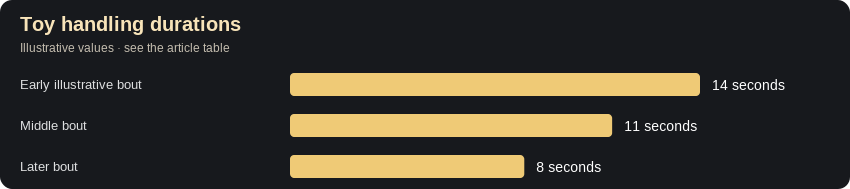
| Category | Value (seconds) |
|---|---|
| Early illustrative bout | 14 |
| Middle bout | 11 |
| Later bout | 8 |
Illustrative values, not sourced observations. Invented example for the stated comparison; not a biological threshold, ecological estimate or observed dataset.
The first time you watch a bee investigate an unfamiliar flower, it can be hard to tell which movement matters. There is a landing, a scramble across the floral parts, perhaps a buzz, and then a departure. On a later visit the sequence may look much more direct. It is tempting to think that a quicker bee must be a better pollinator. But which result improved? The bee might take fewer seconds to get a grip. It might collect more pollen for itself. The plant might receive more pollen at its stigmas, the surfaces on which pollen lands. Each of those questions needs a different observation. A stopwatch answers only the first.
A published experiment makes the distinction unusually tangible. Mayberry and colleagues' 2024 study of flower handling compared experience, pollen collection, and deposition in workers of the common eastern bumble bee, Bombus impatiens, offered four kinds of flowers. It found improved collection with experience, but did not detect an overall experience effect on pollen deposition under its conditions. It also found that differences in handling routines could be associated with deposition even though those differences did not explain collection in the same way. The results make more sense once you stop trying to use the word better for everything at once.
The study is not evidence that learning cannot benefit plants. Nor did it measure every outcome that might matter to a plant in nature. It sampled a specific relationship between experience and a plant-facing endpoint in a designed setting. The payoff is a sharper way to watch what happens at a flower: look for how the visitor moves, follow the reward the visitor retains, and examine what reached the flower's receiving surface. Do not assume that improving a result at one step improves the result at every other step.
Start with three separate observations
Handling time is the duration of a defined contact or activity. To measure it, observers need a rule for when the event begins and ends. One person might start the clock at the first leg contact. Another might start after a secure landing. A third might time only the buzz or the movements around the anthers. Those values can differ without any disagreement about the video. In the Mayberry study the handling measure ran from three legs on the flower until contact ended; the researchers distinguished that interval from the latency to start a pollen-collecting action. The authors' study data and README make the measurement boundaries explicit.
Collected pollen is a different quantity. A visitor can work quickly and keep little, or take longer and leave with more. The researchers estimated pollen in the corbicular load, the pollen gathered in a worker's pollen basket on its hind leg. Treat that measure as an indicator of collected reward in this experiment. It is not the total pollen released by the flower, the amount remaining loose on the bee, or the amount it can subsequently transfer. A fuller basket looks like a success from the perspective of gathering food. It is not a tally of grains delivered to plants.
Deposition is another measurement again. It concerns pollen present on the receiving surface, rather than how much left a donor or how much an animal kept. In this experiment the authors measured pollen on stigmas from the visited flowers, with material pooled by trial. The resulting trial-level record can support a comparison of deposition across trials and be normalized by the number of visits. Such a ratio is not equivalent to directly counting what each visit deposited on each individual stigma. A single unusually large deposit and a collection of small deposits can contribute equally to a trial total. The camera need not show which of those patterns generated the count.
All three observations therefore have different units and boundaries. Duration can be measured as seconds per defined visit. Pollen basket contents are grains collected over an observation interval, or an average relative to the visits made. Stigma contents are grains at a flower endpoint, with the aggregation indicated. When a researcher divides by visits to make a comparison, the numerator does not become the same variable as the denominator. Seconds per visit, collected grains per visit, and deposited grains per visit can move in three different directions at once. An article should name the direction for each measure rather than assigning them a single combined grade.
Toy handling durations
The chart and the exact values below describe three invented bouts used only for explanation. These durations are not extracted from the Mayberry study or any other dataset, and they are not representative observations, recommended timing cutoffs, or estimated averages for any bee species. A bout here is just a named illustrative period. It is not a claim about the formal trial structure of the experiment.
| Illustrative stage | Seconds |
|---|---|
| Early illustrative bout | 14 |
| Middle bout | 11 |
| Later bout | 8 |
The apparent improvement from 14 seconds to 8 seconds is a six-second reduction. Relative to the first duration, it is about a 43 percent decrease. There is no corresponding pollen count in the chart, so we cannot compute how many grains were collected or deposited per bout or per second. We cannot infer increased visit frequency either; time off the flower could have changed. The amount of contact was shorter in the made-up example, and that is the entire content of the numerical picture.
A person might read the equal three-second drops as a linear learning trajectory. The horizontal labels do not give equal intervals of experience, however. Three selected bouts do not show when changes happened, how variable the intervening visits were, or where performance eventually leveled. Any chart that displays a sampled early and late moment has a similar limitation. Its bars may tell us what happened at those moments. They do not fill in the shape of the process between them. In an empirical account the visit history and rules used to estimate a learning trajectory belong beside the visual.
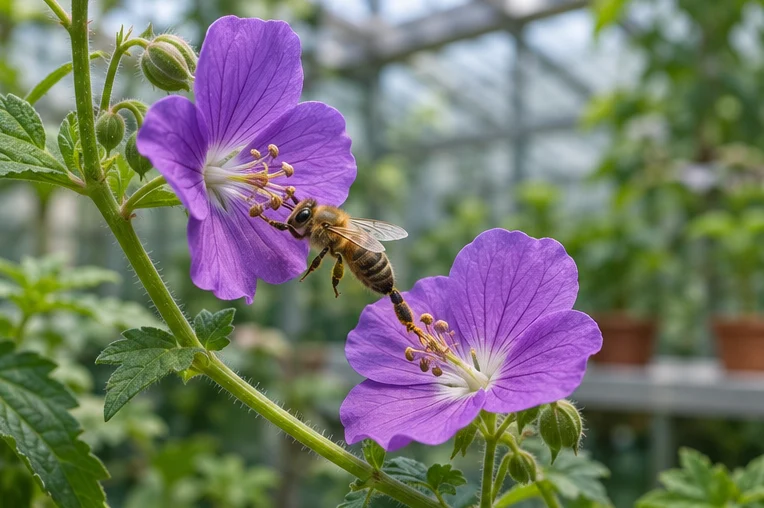
The evidence type ought to remain apparent when the chart is copied. The figure should be labeled fictional durations, not merely "bee handling by experience," and the text alternative should carry that label too. The adjacent illustration of a bee changing its grip is there to invite attention to the movement, not to identify the three bouts as things seen by a photographer. Neither a pleasing image of a flower nor a neat chart turns this invented example into a natural-history record.
A closer look at the published comparison
The 2024 study used initially flower-naïve adults from captive colonies of Bombus impatiens. The four plants in the comparison were Phacelia campanularia, Exacum affine, Solanum elaeagnifolium, and Erythranthe guttata. A given individual was studied on the same flower species in the two trial conditions rather than being changed to a different flower for the experienced trial. The trials were about a day apart, and the visit totals were matched within a bee's pair of trials. That comparison is more informative about changes with experience than guessing whether two unmarked visitors belong to the same category by watching how graceful they look.
The arena was a controlled arrangement of cut flowers of a given species. That setting made the timing, pollen comparisons, and detailed inspection possible. It also defines a limit. The bees were not choosing freely among the four offered species in a natural garden landscape during these trials. The outcomes are not four choices in a real-world preference ranking. The role of paths between flowers, competition, and the availability of other kinds of forage can differ in nature. A good explanation preserves the design long enough to tell the reader both what was made comparable and what the experiment did not attempt to reproduce.
Timing was measured from video, which let the researchers distinguish aspects of the handling process. Finding the relevant structures after arrival and completing the entire contact need not take the same amount of time. Bees also performed distinguishable movements as they collected pollen. In simpler terms, learning can change how long the job takes and how the bee does it. Those are not interchangeable. A shorter duration can emerge with no dramatic motor change; an obvious change in grip can occur without transforming the total duration in the expected direction.
The paper reports that bees generally took longer to become efficient on more complex flower types. Treat that conclusion as a comparison within the study's set of flowers and using its measures of learning. It is not a universal biological rule that any flower a human thinks looks elaborate will be difficult for any bee. Complexity has to do with the task. A structure that presents a challenge to a visitor collecting pollen may not have the same meaning for an animal seeking another resource or approaching with a different body shape. Four flower types help make such a contrast concrete, but do not settle an ordering across all flowering plants.
The differences in handling routines are instructive precisely because their consequences were not all in one column. The authors observed modifications on three of the four flower types, without objectively identifying such a change on the comparatively simple P. campanularia. The other cases included changes in how bees positioned their bodies around the anthers. The point is not to rank the movements by visual sophistication. A shift in body position can change which body region meets a floral structure, even when the forager's basket yield does not change detectably with the shift. Pollen that a bee later delivers may have a different spatial history from pollen it deliberately retains.
According to the paper, overall collection was higher in experienced trials. Slower learners, on the study's measures, also collected less. At the same time, the authors did not find that individual differences in the recorded motor routines explained collection in the stated analysis. Different measures of learning can predict different things: experience level, rate of behavioral improvement, and fraction of time spent on a particular routine are not redundant columns. Finding a relationship for one variable does not guarantee it for another, even in the same set of bees.
Finally, the study found associations involving motor routines and deposition without detecting an overall deposition difference attributable to experience in the tested comparison. There is no logical contradiction in those results. Individual movement differences can matter to deposition while the gain from one trial condition to the next averages out, is small compared with variation, or simply cannot be distinguished with the available data. A headline that says the plant did not necessarily benefit is safer than a universal statement that plants never benefit when a bee learns. The latter would turn a bounded experiment into a rule about every flower and every context.
Why a better grip need not deliver more
Picture two imagined visits. On the first the bee takes its time getting into position, and grains land on both a body surface and a place the bee can groom. On the second the bee moves quickly and puts a greater share of the grains it acquires into its basket. The new movement might be advantageous for the bee without delivering additional pollen to the next flower. Alternatively, the new position could put more loose material on a part of the body that touches a stigma even if the basket count stays much the same. These are examples of ways the measurements could come apart, not mechanisms demonstrated for every bee in the study.
Contact where it matters is a geometric question. Some body surfaces brush reproductive structures; others may not meet them at the angle of a particular approach. Time on the flower says even less about which surfaces touched. A longer visit may include time spent recovering a grip, and a shorter visit may include one decisive contact. Two equal visit durations can therefore conceal large differences in what happened. If the purpose of the observation is plant-facing, where pollen was located before a visit and where contact occurred can be more revealing than how long the animal stayed.
Potential delivery also differs from measured delivery. Loose pollen on a bee may look like a promising load, but it can be dislodged or encountered by the wrong kind of flower next. Pollen in the basket represents a separate destination in the bee's gathering process. Tracking total grains released by the flower, retained by the visitor, and present on recipient surfaces would require multiple measurements. A difference between two measured quantities is not automatically the fraction lost or the score for the plant. The quantities may refer to different flowers, stages, and counts. The original trial need not close a mass balance to tell us that the indicators respond differently.
The other issue is whether shorter time is itself a benefit. A visit is just part of a foraging trip. Faster handling could free up time, but only if the time saved is useful elsewhere. A visitor that has to spend longer searching for the next flower might make fewer visits in the same afternoon despite efficient contact at each bloom. Energy cost and quantity or quality of food collected matter to the animal in different ways. The basket measure gives one concrete indication of reward gained. It does not convert seconds saved into a complete account of the bee's fitness or the colony's food budget.
We can make the units do some work in an invented example. Suppose six comparable visits at fourteen seconds each take eighty-four seconds of flower contact and leave twelve grains under a fictional collection measure. Six comparable visits at eight seconds each take forty-eight seconds of contact and leave eighteen grains. The collection measure rises from two to three grains per visit; per minute of contact it rises from about 8.6 to 22.5. Neither result says how much pollen arrived at a stigma. If separately measured deposition were six grains in each trial, the contact-time metric and collection measures would both improve while the aggregate plant-facing measure stayed the same. These invented counts are independent from the paper and are not typical yields.
That arithmetic scenario excludes flight time, includes identical visit totals, and uses a pooled delivery result. If the first run contained one visit with all six grains on one flower and the second supplied one grain to each of six flowers, the pooled total would not distinguish them. They could have different implications for the plant population, depending on processes that were not measured in the example. That is why the denominator and unit are more than chart housekeeping. They tell you what distributional questions the observations can still answer and which ones the act of pooling has put out of reach.
The kind of deposition record changes the question
A useful comparison comes from King, Ballantyne and Willmer's 2013 primary study of single-visit pollen deposition. Across thirteen selected plant species, the investigators compared flower visitation with pollen detected after a single visit to a previously unvisited stigma. They found that presence as a visitor did not reliably identify the visitor groups that met their effectiveness criterion. One result was that sixty-three of 105 examined plant and visitor combinations were classed as effective under the study's measure. The other forty-two combinations do not imply that forty percent of all individual visits in another population fail to pollinate. The counted unit in that summary is the combination.
The two papers ask different questions from the receiving end. The single-visit study distinguishes visitation from evidence of deposition under its own design. It is not a bumble bee motor learning experiment. The Mayberry study asks how experience and handling relate to collection and a deposition endpoint in paired trial conditions. A per-visit ratio from pooled material and an actual single-visit deposition record are not identical. Both can challenge the use of a convenient proxy, but their names, assumptions, and endpoints should remain intact when compared.
A natural-history observer can take something from both without doing either experiment. Record a visit as a visit, and describe which parts of the interaction you actually saw. If the only view is of the top of the bee, the observer may be able to say it changed position without deciding whether it touched the receiving surface. If the flower was already visited, pollen on its stigma afterward is not necessarily attributable to the last visitor. Calling this an unresolved receiving observation is not the same as saying pollen was not deposited. Each of those statements leaves a different kind of uncertainty.
The same point matters when a visit is scored as zero. Did the observer have a clear view of the relevant surface? Was that surface examined with a method capable of detecting the relevant material? Or did the bee leave the field of view while the camera captured a beautiful image of its legs? A missing measurement is not a measured absence. A defined examination that finds no material is also not a proof that no grain arrived if the measure could miss a small amount. Describing the observation conditions lets a reader interpret the result without assuming a degree of certainty that the figures cannot support.
When transferring the lesson to a garden, avoid treating measurements from one set of insects as transferable grades for all visitors. An insect's role can depend on its direction of approach, which blossoms are available, how its behavior changes with past visits, and which plant response is being measured. A broad visitation tally can still help document activity, even when the best supported plant endpoint is unknown. It is more useful as a clearly named tally than as an implied count of successful reproductive events. One proxy should not quietly become the next stronger claim.
A duration record is easy to collect and easy to overread
Suppose a video appears to show one early visit taking longer than one late visit. If the same bee is known to be on the same type of flower, this is some evidence about the recorded durations. It is not enough to say that the underlying improvement was caused by experience. The visitor may have landed from a different direction, the flowers may be at different stages, or conditions may have changed. A montage that chooses one awkward early moment and one smooth later moment can make the behavioral contrast look stronger than it was. Document what selection rule produced the clips before asking the viewer to infer a pattern from them.
If a count of seconds matters, define how interrupted observations are treated. A bee could land, lift briefly, and settle on the same blossom. Is that one visit with a break or two distinct contacts? A partial recording might begin after the animal has already landed. A flower partly hidden by a leaf may prevent an accurate determination of the start. A duration assembled from one visible fragment cannot be assumed to cover the entire event. The rule used for these cases helps determine whether a shorter later average reflects the animal or a change in visibility and event coding.
Group and individual summaries answer different questions as well. If many bees contribute early records but only the most persistent individuals remain in view late, a faster late group average could reflect which bees were still being observed. Contrasting the same identifiable workers at the two experience conditions reduces that ambiguity in a designed comparison. It does not follow that every worker improved in exactly the same way. The mean summarizes their combined behavior under the stated design. The timing record of one skillful bee can illustrate the movement without being a substitute for the distribution.
A related error is treating every visit by a bee as a new independent test of learning. Repeated visits make it possible to follow an individual's sequence, which is part of what a learning comparison requires. The visits share the same animal, and animals from the same colony share further context. A report should distinguish the many measured visits from the independently sampled bees and colonies rather than offering one big sample size with no unit. Readers can then judge whether the finding repeats among different workers or depends mainly on several long traces from the same individuals.
The period between trials also matters for interpretation. The later test in this comparison was not an entirely separate generation with no relationship to the first group. It revisited the same workers under a defined schedule. Calling the first animals inexperienced and the next animals experienced in an article could make the comparison sound as if those were different bees; that would lose part of the evidence. Conversely, teaching with a shuffled pair of nature photos cannot establish that one marked worker returned. Even a good identification of species is not identification of the individual or its history.
When the pooled plant endpoint stays level
The lack of a detected overall experience effect on deposition could be misread as a demonstration that nothing on the plant side changed. That would be a stronger statement than the evidence permits. A result under a statistical model says what the analysis discerned in the endpoint, sample, and conditions examined. It is not a formal equivalence claim unless a meaningful equivalence margin and analysis support it. A careful summary can say there was no overall effect detected and specify the response. It need not pretend that every possible difference in every flower is ruled out.
Even when deposition is equal by a chosen measure, it does not settle the separate issue of what happened afterward. A stigma count is a useful immediate endpoint, not a direct count of fertilizations or mature seeds. A count does not establish which pollen was compatible or how successful it was in later development. Nor does a recipient count alone provide an independent measure of the donor's eventual success. These are reasons to keep the plant conclusion tied to the tested stages. They are not reasons to discard stigma counts in favor of the available proxy that happens to look most impressive.
Pooling makes comparisons feasible and can smooth some irregularity, but necessarily changes what is retained. Imagine two trial records both showing the same amount of deposition per visit after averaging. One could contain nearly all its deposited pollen on a few flowers while the other spread it more evenly. At the pooled level, the two runs still tell the same story about the mean. At an individual flower level, the records can be very different. If those later differences matter to the question, a follow-up can preserve flower-level outcomes. It is not fair to criticize the original trial for failing to answer a distribution question it did not pose, but it is fair to say where the data stop.
Consider also that the experiment matched the number of visits across the paired conditions. That is useful for comparing outcomes at comparable visit totals. A different field question might ask whether an experienced forager carries out more visits across a period of a day and therefore shifts plant deposition over the entire interval. Per-visit outcomes do not settle that. Even if shorter visits would allow more contacts in a fixed amount of flower time, a foraging interval also includes search, travel, interruptions, changes in the flowers available, and return trips. The study's strength is that it constrains one comparison. An exact answer to a different field question would demand different observations.
Another route to stronger language is to ask which way the comparison is framed. Saying there was a benefit to the bee is fair shorthand for better collection by the study's stated indicator. Saying that the plant did not necessarily benefit describes the mismatch in the measured outcomes. Saying the bee took more at the plant's expense adds a claim about harm. The study as described does not require that claim. Better collection without a detectable shift in deposition is not identical to a decline in deposition. There can be conflicting interests without every individual outcome being a zero sum exchange, and the headline should not invent a winner and loser where only one side's indicator changed detectably.
It is also possible to learn something useful about differences among individuals without explaining a grand mean. A motor routine can be associated with a deposition result within the known setting even when the overall before and after comparison does not show an upward shift. One reason that's interesting is that the handle on the problem changes. Instead of asking whether learning in general is good, one can ask whether a certain position brings a body region into contact with a certain surface, and when that happens. That narrower question has observations a person can name. It does not presume that faster performance is the one relevant feature of a skilled visit.
Tell the story at the speed of the evidence
An effective visual sequence can show an approach, a change in grip, and then a view of a flower's receiving surface. If the images are separately recorded examples, describe them that way. Do not cut from the bee to a stigma close-up and imply that the particular animal delivered the pictured pollen unless the connection was established. A slower replay can help the eye notice contact, but neither slow motion nor digital clarity can add missing evidence about earlier visits. The same applies to an editorial drawing of two flowers. It introduces the action; it does not prove an individual trajectory.
A concise legend can teach more than an ornate title. For a duration figure, state when timing starts and stops, whether it shows an individual visit or a summarized interval, and how identity was established if the points purport to follow one bee. For a collection figure, name the sampled load and whether the units are totals or normalized by visits. For a deposition figure, identify the receiving surface, aggregation, and comparison. These are not merely instructions for presentation. Deciding what goes in the legend forces the editor to work out what an apparently attractive result actually says.
A reader of the original papers will encounter graphs serving different roles. A sequence of times can help explain learning and the number of opportunities available to learn. A plot of recorded behavior against collected grains asks an association question. A group comparison measuring deposition asks a question about the plant endpoint. Combining those roles into one picture may make for a clean slide, but it can also lead the viewer to see a visual causal arrow that the study did not establish. Keep the measure names close to the visuals and specify when multiple graphs use the same workers. Separate outcomes from separate samples should be described differently.
Try reviewing a proposed caption from the ground up. If the first phrase says the bee learned, where is the experience comparison? If the second phrase says it got more efficient, does this mean shorter handling, higher reward per unit of contact, or something else? If the final phrase says pollination was unchanged, what exactly was the measured plant variable and what variation could the comparison resolve? A photograph cannot answer those questions by itself. But a caption that answers them can turn a short image sequence into an accurate account rather than expecting readers to supply all the caveats after seeing the punch line.
Which next measurement would change the conclusion?
For a project mostly interested in visitor behavior, distinguish the time the bee takes to begin collecting from the time it stays overall. An improved first move and a shorter visit are different patterns. The Seattle observer and the field crew in a different location should be able to identify the same event boundaries from the description even if their cameras have different angles. In an opportunistic natural-history clip, it may be impossible to identify each boundary reliably. Keeping a label for an incomplete timing record maintains the integrity of the useful parts. There is no need to abandon the sheet because not every cell can be filled.
For a question about forager reward, decide whether the target is collection per visit, per contact time, or per full foraging trip. A shift in the first quantity can matter even if travel reduces the difference in the third. Define the setting in which the comparison is possible, and report documented constraints rather than silently generalizing around them. The original controlled study was well suited to comparing certain aspects of pollen foraging. Its basket endpoint is valuable precisely because it adds a measure beyond duration. It does not settle unrelated questions about nectar foraging or long-term colony outcomes.
For a question centered on the plant, a result about pollen on a stigma is a good start, but timing and attribution still need a coherent plan. Is the investigator interested in one visit, an accumulated result over the same number of contacts, or total deposition over a time window? Is the next relevant consequence an immediate count or later fruit and seed production? Each version changes the unit and scope. The answer to a narrow question should not be stretched to cover the other versions simply because all can be loosely described as pollination success.
It is worth asking whether the next question can be answered with the existing records before collecting anything else. The publicly documented data include visit-level handling traces and trial summaries with separate variables for stigma and basket counts. A timing question about an identified early sequence can use the former when the footage and records are complete. A question about trial deposition can use the latter. But it would be a mistake to assign the pooled trial count to each individual visit in the tracing file and announce a relationship between the precise duration of that visit and its delivered pollen. A merge on worker and trial identifiers makes the files related; it cannot restore outcomes the design did not keep at that resolution.
This is also a good case for reporting a missing behavioral record by outcome. The authors' repository notes that some initial trials were not video-recorded, making those records unavailable for the behavioral analyses. That kind of gap should not automatically be described as a biological zero, or as proof that every other kind of information from the same trial was missing. A dataset has a measurement boundary for each variable. Set those boundaries before comparing denominators, and make it possible for an outside reader to see which observations entered which analysis. That practice is more useful than attaching one impressive count to every conclusion in a feature.
The intriguing possibility raised by the two studies is not that one quick forager always contributes less. It is that observable behavior and different rewards have to be checked instead of assumed. One can watch an animal do a task skillfully and then examine what that skill did and did not change. The six seconds saved in the fictional chart are only a timing result. The collected pollen in the published experiment is an animal-facing result. The measured deposits are a plant-facing result under specific conditions. Keeping all three in view makes the flower a richer scene, not a more complicated way of telling the same one.