| Category | Value (features) |
|---|---|
| Retained | 14 |
| Newly added | 8 |
| Unavailable | 3 |
Illustrative values, not sourced observations. Status is an asset inventory, not occupancy.
At the end of a garden workday one group takes a picture beside a newly placed log. Another has no obvious before-and-after picture because its main achievement was getting the work plan changed so an old stand of stems stayed where it was. Both decisions can matter for insects. They are not the same kind of achievement. The log is a new candidate feature. The stems carry whatever continuity the site already offered: the same location, material and history of exposure, with possible uses the volunteers may never have seen. A useful field record can give both accomplishments credit without treating one as a replacement for the other.
That distinction changes how you plan a workday, how you label garden features and what you can claim later. “Installed eight features” can be a dependable statement about work. “Retained fourteen” can be a dependable statement about continuity. Neither says how many nests have been produced. A total that collapses both cohorts into one inventory can hide a large loss of the sites the garden had before. In a successful project, the most valuable parts of the report may be the things that were deliberately not moved.
This article uses a fictional community garden, with exterior observation and ordinary records only. It is not a recipe for reclaiming an occupied cavity or a set of universal prescriptions about cutting seasons. The goal is to recognize what is already present, identify justified additions and keep the history of each action visible without handling insects or opening possible nests.
Begin with the resources the site already supplies
The Xerces Society's nesting resources overview distinguishes soil, stems, dead wood and other resources that can matter to different insects. Many native bees nest in ground rather than in above-ground cavities. Different species use different substrates, and a suitable cavity may not resemble the one offered in a marketed bee house. Flower abundance tells you something about forage, but the ability to provision a nest or find shelter depends on other features of a site. When planning a garden, notice the substrate and its continuity before treating an empty corner as a blank slate.
Consider an upright stem left from a prior season. Its history is distinct from that of a seemingly identical stem cut elsewhere and placed in a holder today. The old stem may have a naturally accessible opening or may simply stand amid surroundings that have remained stable. You cannot assume either stem is occupied. Nor can you know that the fresh one will perform the same function. The strongest immediate claim is that a feature from the old setting was retained and a candidate feature with a different history was added. That claim is measurable without making a prediction about the insects.
Natural habitat often supplies several overlapping functions. The Xerces nesting and overwintering habitat guide describes features that can support nesting or shelter, and discusses tradeoffs between natural and artificial options. A leaf layer can differ from an exposed soil patch even when both fall under a broad cover heading. An old log can supply a different kind of structure from a row of dry stems. Record feature type and context, not just an umbrella count. Losing a small example of the only category present is not made invisible by gaining several examples of a common category elsewhere.
It helps to walk the ordinary safe route before work starts and note features without moving them. Where a feature is difficult to separate from its surroundings, describe it as a zone rather than as individual objects. A continuous litter patch might be one zone and a row of standing stems another. Do not turn the walk into a hunt for an insect to prove value. A potentially useful setting can be given deliberate protection even if no occupation was verified. If a feature is in a location that cannot be assessed safely, leave its condition uncertain and refer any work decision to the responsible site lead.
Define the units while the old garden is still visible
A feature is a management unit with a stable definition for the inventory, not necessarily an individual nest or even a discrete object. One upright stem could be a feature in a study devoted to particular stems. A mapped stem border could be a feature in the work plan for a larger garden. A log and the soil around it could be recorded together if that is how the crew will protect the setting. State the unit and stick with it over comparisons. Counting an old border as one unit and counting each piece of newly placed wood as one unit makes the two cohorts look more comparable than they are.
Use neutral IDs based on your management records. A private map can connect labels to zones where authorized caretakers work without disturbing the feature. If you share a public illustration or report, remove details that would point people toward suspected nest locations. Do not leave markers that invite close inspection. Private records can indicate the zone and intent so future crews know why they are avoiding it, while a generic public diagram can describe which kinds of features were retained. These are different audiences and do not need the same detail.
Before assigning a status, decide how to handle modifications. Relocating a log is not retention in place. If it had to be moved by a responsible crew, keep its original identity and record the change in placement as a separate event. Trimming surrounding vegetation might leave a feature physically present while changing its shade or exposure. Keep a condition field so an unchanged status cannot be confused with an unchanged setting. A project that preserves stems but removes the support keeping them upright has a maintenance issue even if the stems still appear on the list.
Define time as part of the inventory. A feature noted before the workday and left intact afterward is in a different cohort from a log first placed that afternoon. If old features are first documented later, do not automatically count them as new. They may be newly recorded rather than newly made available. Retain an unknown origin category for items whose history cannot be resolved. A growing inventory can signify improved documentation, addition or both; you can tell the difference only if the data distinguish their dates.
Plan the evidence for physical status separately from any observations of use. You may document that an upright stem border remained in place from an approved path. That does not require a close view of each opening. You may document new deadwood with its placement record and an exterior check. A bee landing on it is a separate record; entry into an opening is a separate record again. Do not change an asset's cohort just because there is a new behavioral observation. The earlier history remains true.
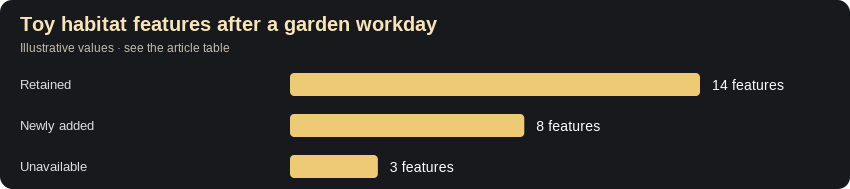
Toy habitat features after a garden workday
This chart and table are a fictional asset inventory, not measured observations, reproductive outcomes or estimates of occupancy. The unit is a management feature as defined by one hypothetical record system. The categories count unique features, not visits to them, and are mutually exclusive in this particular summary.
| Inventory status | Features |
|---|---|
| Retained | 14 |
| Newly added | 8 |
| Unavailable | 3 |
The toy register includes fourteen baseline features left in place and eight additions. The three unavailable features are baseline entries not confirmed as present and suitable for counting in that pass, for example because planned work or access conditions meant status could not be verified. A real record should split known removals, temporary inaccessibility and unresolved condition into separate reason codes instead of treating them as biologically identical. Under the toy definitions there are twenty-two features recorded as retained or added, and twenty-five entries including the three unavailable ones. Neither number is a nest count.
The retained and newly added bars measure different histories. If one of the added features is later found unavailable, it remains in the added cohort while its current condition changes; that is why the underlying system should store origin and availability separately, even when a dashboard displays a simplified partition. Likewise a temporarily hidden baseline item should not be proclaimed removed. A follow-up can clarify whether it was actually affected by work. Until then show the uncertainty instead of silently removing it or carrying it forward as confirmed.
The same twenty-two confirmed features could result from a garden that left nearly all its prior resources in place or one that cleared many and installed several uniform new objects. The totals do not support comparing the ecological outcomes of those two paths. Show the cohorts and types side by side, and do not add them to manufacture a net gain without a comparable baseline and accounting for losses. An addition is known work, not demonstrated compensation.
Give preservation a work order of its own
On an ordinary garden cleanup, the instructions that avoid damage can be just as actionable as the instructions that add features. Tell crews which areas can be worked and which need to stay outside this round. Work boundaries should be clear to people doing maintenance and should preserve safe public access. Values such as keeping soil undisturbed are not conveyed by a sentence about insects on a weekend poster. They become useful when the people who would otherwise rake, till, mulch or remove material know how the work plan applies in a particular part of the garden.
Consider a planned tidy border beside a path. A crew may need to keep the walking surface clear and still leave a separated interior area undisturbed. Other settings may have fire, structural, accessibility or maintenance concerns that a volunteer cannot resolve by interpreting a wildlife guide. Respect the site operator's requirements and refer conflicts to appropriate staff. Do not assume that a safety concern justifies disturbing a possible nest without appropriate assessment, or that a conservation goal overrides safe access. There may be a way to meet both aims by changing where discretionary work happens.
Use a short sign-off after the workday: was the protected area left alone, did incidental activity reach it and were previously uncertain spots checked only from approved positions? Keep notes on near misses such as borrowed staging space or materials temporarily stored next to an area designated for retention. A feature can survive a workday while the next maintenance visit remains a risk. Documenting continuity gives the next team context. It also makes it possible to distinguish a real retention effort from a site simply happening not to be on today's task list.
The most serious gap in many reports is that they say how much was planted or installed but not what happened to what was already there. Ask the crew to carry baseline features forward even when they become uncertain, retaining a reason for every status change. A photo of the finished garden cannot reconstruct a removed feature afterward. A small prework register allows you to say which decisions maintained continuity and which created different conditions. That is more informative than relying on a before-and-after image where the camera did not show the habitat in question.
Identify a missing resource before choosing a visible project
There is nothing inherently wrong with adding habitat. The question is what the addition is intended to offer and why it belongs in the next round of work. If the garden already has carefully retained standing stems but few places where ordinary traffic leaves bare soil undisturbed, another bundle of stems may not address the main gap. Conversely, if staff routinely mow a neighboring verge and the site lacks safe standing material, protecting a suitable zone may provide a different opportunity. These are plausible planning hypotheses, not universal diagnoses from a single look.
Start with a short sentence such as “provide a stable, undisturbed candidate substrate in a zone that presently lacks this feature class.” The sentence forces you to name the context and a measurable deliverable. It does not claim the addition will immediately be used. If no one can explain the target except that a piece of equipment will photograph well, take that as a reason to revisit the plan. An interpretive display might still be worthwhile, but educational visibility and habitat rehabilitation should be reported as separate goals.
A location for a prospective addition needs a maintenance owner and an expected lifespan. A candidate site that is reset every week may not remain available long enough to serve the purpose. If the garden cannot protect the setting when staff rotate, adding material may just supply temporary decoration. Consider committing first to an accessible maintenance plan for what already exists. Retention has maintenance costs too, but it does not require inventing new structures merely to demonstrate action. A small project a crew can carry through the next season can be more coherent than a large one abandoned at the first management conflict.
Think about nearby resources as part of the design. A candidate nesting or shelter feature can coexist with forage but is not a substitute for it. Record major changes to adjacent vegetation, soil treatment or ordinary access if they could affect the interpretation of later observations. Do not let a feature tally become the only measure of habitat quality. The fact that it is simpler to count placed logs than to describe continuity or suitability is a reporting issue, not an argument that counted objects matter most.
Be cautious about apparent matches between old and new
Two features can have comparable dimensions while differing in context, material history or chance of detection. An old patch of standing stems may be close to several seasons' growth and partly screened from observers. A newly installed device may be deliberately easy to photograph. More entries recorded in the latter could result partly from easier detection. Fewer entries might reflect short exposure, a period when users were not present, or failure to see the few openings that were used. Neither direction should be treated as an immediate verdict on the intrinsic value of its cohort.
The primary MacIvor and Packer field study found that a range of bees and wasps used artificial structures in its urban study and cautioned against treating those devices as an established conservation success. Species and outcomes in that study do not predict what your own yard will support. The lesson for the workday is stronger than a rule either to install or to ban an item: a device can have observable users without conclusively helping the conservation outcome a volunteer thought they were measuring. Keep an exterior inventory result and a biological outcome claim in separate parts of the report.
Artificial aggregations can require management that a dispersed natural feature does not. If a device is already managed by a responsible program, use that program's approved maintenance procedure and make it clear who is responsible. Casual observers should not open a chamber, strip material away or clean something to see if it was used. Putting a device on the inventory does not require upgrading its management beyond staff capacity. Where advice conflicts or the feature may be occupied, defer the decision to the site lead and suitable local expertise.
Something that looks like a lower-tech addition also deserves documentation. A newly placed log may not be identical to naturally settled deadwood, and moving existing material changes its setting even when the material is unchanged. A newly protected but previously present patch is neither a fresh physical installation nor a routine continuation of prior management. It can be reported as a baseline feature whose management protection changed. These descriptions make it possible to distinguish a real improvement in stewardship from an artificial increase in the number of objects.
Keep the asset ledger, the action ledger and the observation log separate
Use one row for each feature in an inventory, and a series of dated rows for encounters or actions. The inventory can carry the physical description, origin category, responsible team and current verification state. The action log can record that work respected a boundary, temporarily restricted access, altered surroundings or placed an addition. The observation log can record what was visible at each permissible watch. These need not be three files; they do need separate keys or concepts. A quiet watch should never erase a species-unknown feature, and failure to verify something today should not rewrite its origin.
Give each status a definition that a replacement volunteer can apply. “Retained” might mean that a documented baseline feature remained in place and its assigned zone was not worked this round. “Newly added” means an installation or physical addition that was not present at baseline and was verified. “Unavailable for inspection” means the observer was unable to determine current status under permitted conditions. A known removal deserves its own reason in the action records. What the chart combines for readability should remain more detailed underneath. A handoff loses much of its value if future readers cannot tell no observation from confirmed removal.
Imagine three newly added features are placed on one day. At the first follow-up one is clear, one is partly obscured and one cannot be observed because access is closed. You still added three. You have three different follow-up states, none of which verifies use. If the closed section opens later, add a new observation date without modifying the earlier access record. This allows you to calculate availability under a defined rule after each visit, rather than quietly filling gaps with whatever happened to be learned subsequently.
Limit duplication whenever the scale changes. A corner of upright stems could be one action area and ten measured elements in a detailed monitoring subset. Both views can coexist if records say which stems belong to that area. Combining the ten measurements and the parent zone into eleven “features” would overstate the managed footprint. Do not switch from area to individual material units in order to make the new season appear more productive. For the work plan, a small, consistently defined set of zones can be more informative than a seemingly comprehensive count of all available holes.
Observe later use without turning the inventory into a nest census
If a nonintrusive watch is appropriate, agree beforehand on what can be scored from an approved position. An insect on a nearby flower is not necessarily using the feature. Something seen crossing an exterior entrance is stronger evidence of use at that moment, without identifying what the interior contains. A repeated visible pattern may support a more specific hypothesis in an appropriate project, but avoid structural inspection. A documented visit to the garden is not a substitute for a documented interaction with the named asset, and repeated movements are not necessarily different animals.
Log the effort and conditions with every watch. Existing features in tucked-away areas may not be observable for as long as new installations near a path. A storm can close access or change sightlines. A short watch during quiet conditions may record nothing even where activity occurs at other times. If it cannot be assessed safely, label it unobservable rather than trying to make it comparable through extra proximity. When reporting sighting frequencies between cohorts, condition them on what was actually observable and avoid implying the old and new sites had identical prospects of detection.
For a deliberately modest project, keep observation periods similar within the same feature class and compare comparable moments in the season. Even then, few observations may not support a trend. A count of exterior signs, if the project uses one, is not equivalent to viable brood, successful emergence or local population increase. State the exact endpoint. Clear labels are especially important if a grant or interpretive board wants a simple success number. An asset created or protected is a result the garden can substantiate without saying more than it knows.
A new feature seen in use presents an appealing temptation to infer that the work created new ecological activity on the site. The user may instead have shifted from a neighboring feature, and you may not know how well it fared. That does not make the observation worthless. It supports a narrower conclusion: the identified feature was used in a certain observable way. If the project's main purpose is to provide an opportunity rather than conduct research, this record and a careful maintenance note may be enough. A claim about greater habitat function or net benefit needs a stronger comparison.
Check whether the cohorts can answer the question you are asking
Suppose the retention cohort contains old stem zones spread through the garden and the addition cohort consists mainly of logs in a single corner. A count of signs in each cohort will mix habitat type, location, weather and visibility. Separating the cohorts in the inventory is necessary but not sufficient for a good ecological comparison. It prevents their histories from disappearing; it does not solve differences in where and how they were placed. If comparing use is important, focus first on comparable units or state that this garden intervention did not produce a valid comparison of use.
Consider the effect of age. A freshly placed feature has had fewer opportunities to be observed or used than one that has stood through several seasons. A single calendar date cannot give them the same history. A follow-up schedule might summarize comparable first-year observations for multiple installation cohorts when enough records exist, without trying to infer the first year of an old feature that was never tracked. If you cannot align those timelines, keep origin and exposure visible and make a descriptive report. A chart of counts can still describe what was actually known on that date.
The garden also may not have a credible baseline for all its zones. Perhaps the first note was made after some work was complete, when only obvious newly placed materials attracted attention. Rather than fabricate the missing history from photographs, state when the inventory became reliable. Ask old crews for supplementary records and label recollections as such. From that point forward, track changes in consistent detail. A pilot can be valuable for establishing the method even if there is no defensible retrospective estimate of what the work preserved.
On a large project, a before-and-after record with unchanged comparison zones can help explain which changes happened under wider conditions and which followed management. But the comparison still has to respect access and existing habitat, and an intervention intended for monitoring is not an excuse to disturb a possible nest. Don't take baseline habitats away simply to create controls. A garden may be best served by repeated nonintrusive descriptions rather than a formal intervention experiment it cannot carry out safely or interpret credibly.
Follow one hypothetical feature through a year of decisions
At the first spring walkthrough a low piece of old deadwood is easy to recognize from an approved path. It is already in the baseline, and nobody has looked into it. The crew chooses to route a replacement edging project away from its immediate setting. The after-work record can say that the piece was retained in place and that surrounding work stops at a documented boundary. There is no need to give it the status active. That state would involve different evidence. The action is still meaningful if an observer never sees an animal there because the crew has maintained a potentially useful resource rather than exchanging it for a fresh item.
Later in the season, an observer sees an insect land on an end of the log but cannot tell whether it entered a cavity. Log landing with identity uncertain, along with the watch conditions. Do not turn it into a nesting attempt. At the next permitted check new vegetation partly obscures the scene. Write that the surface can no longer be compared with earlier views, but do not change the maintenance team's earlier action. If the site needs to address something urgent in the area, those notes tell the responsible staff what was and was not established. They are not permission to clear the vegetation for another observation.
Now consider a newly placed log on the other side of the same fictional garden. It is being described as eighty days old when eighty days have really elapsed since placement, regardless of whether the wood was already old elsewhere. Distinguish age of the asset at this location from age of its material. A late watch with a clear entrance might show an insect going inside. The two logs then have distinct historical records and distinct confidence about recent observations. A last-sighting column alone would omit the reason each feature was kept or added and which aspects of the old setting the new one cannot be assumed to share.
If the maintenance team later changes the location of the newly added log, keep the history and distinguish the new period in place. It remains part of the addition cohort for the original workday, yet exposure and surroundings now differ. A season summary can state that one addition had a change of placement rather than recording a second new feature at the same moment the first disappears. This style of record makes a garden intervention auditable even when materials are not permanent and decisions evolve. It also helps prevent the next project from tallying the same item as a new accomplishment every time it is moved.
Consider what maintenance looks like after a smooth launch
At planning time, divide responsibilities into an ordinary path and an exception path. The ordinary path says which areas crews should leave undisturbed during routine operations and who records exterior changes. The exception path says who resolves an access conflict or reviews a potentially dangerous feature. The exception owner should know that a quiet watch is not evidence of vacancy. Volunteers should know whom to ask without having to choose between ignoring a safety concern and disturbing a possible nest. A maintenance procedure with these paths can continue when the people who designed the garden are not on the shift.
Seasonal succession also complicates a crisp definition of success. Some old stems may naturally break down after the workday even when no one disturbed them. That is different from being cut or removed, and the distinction may matter when planning future habitat continuity. A documented area may provide different structure as it changes, even if an asset that was once prominent is no longer present. Record the observed change and its uncertainty before assigning a cause. A target of keeping every item forever can be just as unrealistic as a target of installing more every season regardless of need.
When the deck of site photographs is updated, check whether it rewards the wrong kind of work. A neat image showing only new features makes maintenance continuity invisible. An image of an old stem border might conceal intentional work boundaries or look like accidental neglect. A caption can explain that maintaining an established zone was part of the plan and that the record is about continuity, not verified nests. If the image is a fictional example, make that clear too. A public message succeeds when it explains why a tidy edge and a protected interior can coexist without guiding visitors to an individual refuge.
Finally compare the inventory to what has to happen after the budget is spent. A garden might install several small features with enthusiasm and have nobody assigned to notice when conditions around them change. That risk is not solved by giving the features cautious labels after the fact. Assigning an owner, preserving a usable handoff and leaving a durable record can be the more important form of stewardship. If there is no plan for these things, protect what can responsibly be retained and keep additions small enough to manage.
Let unknowns remain part of the record
A small garden can give an honest report without setting a number for potential nesting capacity. It can say how it defined the units and where sorting by origin was possible. It can admit which status observations were incomplete and count only the things it tracked. Suppose three older features remain inaccessible after a storm. Do not settle their status by assuming that nothing happened or that all were destroyed. The next useful fact may be whether the site becomes observable again, not whether an updated dashboard can be made to sum correctly this week. Preserving the unknown category prevents bookkeeping deadlines from quietly becoming ecological assertions.
Make the result readable six months after the workday
A good report can begin with actions rather than statistics. Say that the crew adjusted its cleanup boundary to protect standing material, left the named class of potential shelter undisturbed where feasible, and placed new candidate features only in areas the management plan can support. Then give the numbers in their own terms. Add a sentence about unavailable baseline records and whether any known removals were confirmed. If a public version includes photographs, label illustrations and avoid pointing readers to the exact locations of suspected nests.
Place the timeline where later readers can find it. The record for a new feature should say when it was added; the record for a retained feature should say which baseline it precedes and what happened during the work interval. If there is a future inspection, preserve that date distinctly. Visitors, maintenance staff and funders may all use the same little table for different purposes. The captions should make clear that the numbers refer to management status on a certain date, while any use records come from separate watch conditions and may be incomplete.
Before committing to the next purchase, list the biggest uncertainties that a new object would not resolve. It will not tell you whether the baseline inventory excluded ground features. It will not fix inconsistent access that makes some watches impossible. It will not create maintenance capacity or guarantee a stable site boundary. Sometimes the best next decision is to preserve the sites you have, clarify maintenance expectations and monitor the interventions already made. That is active stewardship, even though it doesn't increase the additions bar.
Finally, give the next crew permission to report fewer than three neatly populated categories. A year devoted entirely to preservation can have no new additions and still meet the goal. An addition may fail to stay available and need a clearly documented decision rather than protection from the report. An older feature can remain valuable without a confirmed sighting during the watch. The accounting is doing its job when those observations coexist and no one has to pretend that the three numbers make a single interchangeable stock of habitat.
For a final review, give a reader only the inventory caption and ask what they think was demonstrated. If they say eight occupied sites were created, identify the language that led to the mistake and change it. If they cannot tell whether fourteen features were present before the project, put the baseline relationship in the caption. If availability sounds like an ecological assessment rather than an inspection status, spell out the reasons it can be unknown. This small test makes the report more accessible than relying on a distant caveat that people may never see. It also provides a concrete handoff for anyone who later uses an isolated graph in a presentation. Good accounting survives that change of format without turning either preservation or installation into a promise about organisms.
Sources and illustration note
- Xerces Society: Nesting Resources, official overview of ground, cavity and other nesting contexts.
- Xerces Society: Nesting & Overwintering Habitat, guide to natural features and habitat stewardship.
- J. S. MacIvor and L. Packer: ‘Bee Hotels’ as Tools for Native Pollinator Conservation: A Premature Verdict?, primary study of artificial nesting structures.
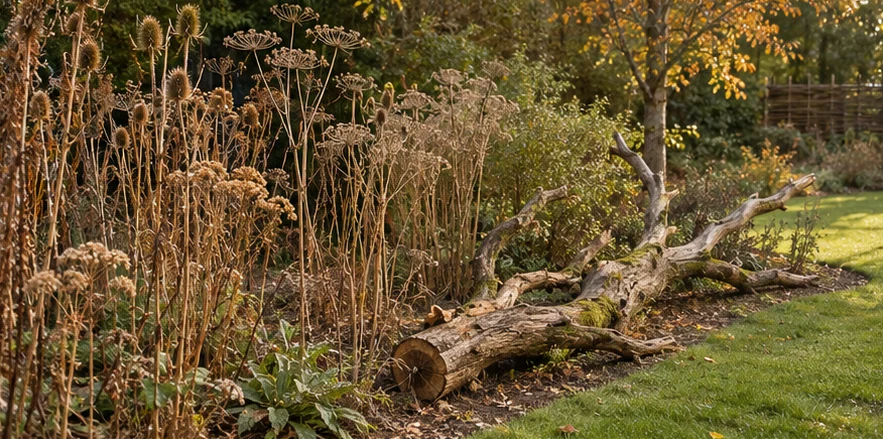
All chart figures and garden examples are fictional. If generated, the standing-stem and deadwood image is editorial art, not documentation of an installation or nest.