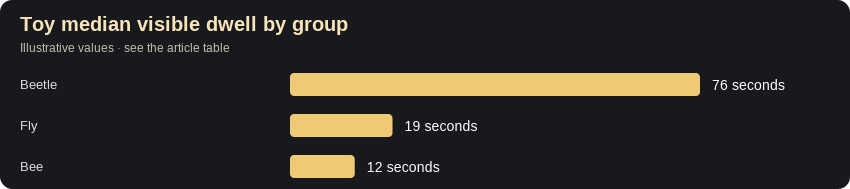
| Category | Value (seconds) |
|---|---|
| Beetle | 76 |
| Fly | 19 |
| Bee | 12 |
Illustrative values, not sourced observations. Invented medians, not a cross-taxon estimate.
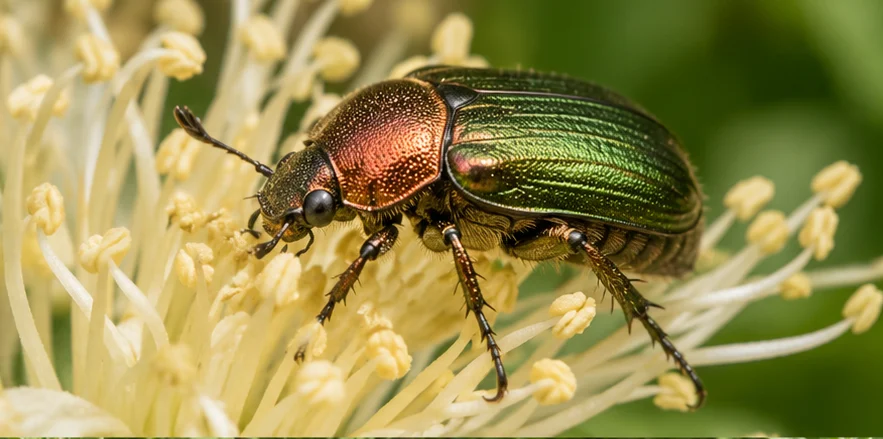
A beetle sits near the middle of a cream-colored bloom. In the time it takes the observer to decide whether the animal has moved at all, several bees have crossed the same garden bed. One stops briefly at a flower, leaves, and touches down a short distance away. Another disappears behind a leaf before the observer can see where it went. The beetle is easy to find on almost every sweep of the bed, but it has not made a new arrival each time the observer looks. Counting the movements of bees and the continued presence of the beetle as if they were the same kind of record would distort both.
That difference makes a small garden a good place to study observation. A person can record how long a visible bout lasts, how many distinct qualifying arrivals occur in an observation window, or how often an organism is visible at scheduled checks. Each is useful for a particular question. None can silently substitute for the others. And none, by itself, establishes how much compatible pollen reached a receptive surface. A long stay is a behavior worth documenting, not a score for pollination effectiveness.
The point of this article is not to prescribe which kind of insect stays longest. The comparison of beetles, flies and bees provides an example of how very different visitor behavior and visibility can enter the same study. Species, plant shape, weather, time of day and viewpoint can all change what is observed. Work from the smallest reliable claim: this recognizable animal was visibly on this marked flower for a bounded period. A practical field method can build several larger questions on top of that record without inventing facts about insects that passed out of view.
What the illustrative graph actually shows
The plotted medians are invented: seventy-six seconds for beetle bouts, nineteen for fly bouts, and twelve for bee bouts. They represent a hypothetical median of visible dwell durations within each entry, not a median for a real species, a feature of those groups in general, or a published estimate. Both linked sources are ecological context, not the origin of the graph values. The chart shows units of seconds. It contains no data about the number of arrivals, total watches, pollen delivered, or seeds subsequently produced. There is no real sample size to infer from those equally prominent bars.
| Illustrative visitor group | Toy median visible dwell, seconds |
|---|---|
| Beetle | 76 |
| Fly | 19 |
| Bee | 12 |
For the made-up numbers, the beetle entry exceeds the fly entry by fifty-seven seconds and the bee entry by sixty-four. The fly entry exceeds the bee entry by seven. Those comparisons are arithmetic only. They do not tell us how widely real bouts vary, whether groups would differ after holding flower and weather conditions comparable, or even whether enough complete encounters are typically visible to calculate a meaningful median in a particular garden. Without observed records and a suitable design there is nothing on which to base a significance claim or uncertainty interval.
A median summarizes the middle of the durations included in a particular calculation. It is not a sum of time spent across all visits. In a real report, define whether the values come from fully observed bouts, visible portions of longer bouts, or a method that accounts for incomplete timing. Label the corresponding denominator and selection. A short complete visit and the visible end of a long visit are not equivalent just because each fits in one spreadsheet row. For the hypothetical display, think of the numbers as possible summaries of sufficiently observed visible bouts; they are not a license to fill in durations that could not be measured.
The USDA Forest Service brochure on pollination and floral traits describes pollination as pollen transfer and presents floral trait associations as a way to form expectations about visitors. That is not a way to identify an individual insect on sight or to establish its contribution by location alone. The Forest Service guide to attracting pollinators with native plants gives garden context for diverse flower visitors. Neither publication supplies the fictional durations or endorses a ranking built from them.
Choose the movement you mean to time
A dwell bout requires a boundary. Decide whether the animal must be on one open flower, anywhere on a composite flower head, or somewhere within a small inflorescence. Those units matter. An insect can walk across many florets without leaving a single head. If the outcome is continuous occupancy of that head, such walking does not begin new bouts. If the outcome concerns encounters with individual florets, it may matter greatly. The point is not to force one universal definition onto diverse flower structures. It is to name a unit another observer can recognize.
Define what starts a bout. A clear example is the first visible contact with the designated flower unit following an approach from outside it. An animal hovering near the bloom is not yet on it under that rule. If an insect walks from another bloom along a stem, it can still enter the observed unit without flying. Record the route separately when it is clear and relevant. If the project chooses to count airborne arrivals only, walking entrances must not be mixed with them under a generic label. The structure of the definition follows the question, not assumptions about how an insect should behave.
Next define what ends a bout. Leaving the unit can be an end. Moving to another petal or around a stamen within the same observed flower generally is not a new arrival for a flower-level study. If an insect goes under the petal and disappears, an exit was not necessarily seen. Treat this as loss of visibility unless later evidence establishes continuity. A timer alone cannot resolve the biological state. In a field record it may be legitimate to say that the insect was visibly present until a particular time and unknown after that.
One convenient rule is to record observable contact continuously and use state labels for ambiguous moments. If the observer intentionally scores a brief within-unit occlusion as continuous under predefined evidence, say how established continuity differs from an assumption made afterward. Very short breaks can be difficult to perceive, especially if video sampling is coarse. Name the recording resolution and the rule for a gap. A procedure that treats any disappearance as an exit may artificially shorten bouts for insects that spend much of their time under parts of the flower.
Keep observed behavior distinct from inferred purpose. A stationary beetle may be resting, feeding or doing something the viewer cannot identify. A brief observation may reveal mouthparts at a structure without establishing what was consumed. Notes can describe walking, remaining still, contact with visible flower structures, and other features that were actually observed. An inferred category such as feeding can be useful if the project defines what evidence supports it. Otherwise retain the observable behavior and let the ecological explanation remain open.
Count arrivals as events rather than sightings
An arrival count tallies transitions into the defined flower unit during a specified watch. If the same beetle is still on its bloom each time the observer glances back, the glances are not new arrivals. If a bee moves from one assigned head to another, there can be two floral-unit arrivals without two unique bees. Report that count as events, not individuals, unless the project has a reliable identification strategy at the individual level. Repeated arrivals by the same animal may be biologically important, but they answer a different question from how many distinct animals used the plot.
Observation effort belongs beside the event number. Twelve observed arrivals over a twenty-minute watch cannot be compared directly with nine over a five-minute watch as though the counts have the same coverage. A rate per watch minute can help, provided the underlying watch conditions and eligibility matter are understood. If the observer stopped for part of the session, the denominator should reflect the intended definition of observed effort. A clock ticking while no one could see the flower does not create more observation time. Keep planned and usable watch time distinct.
Choose whether the watch follows a single flower, a fixed set of targets or a route. Observers following one insect may capture its next few movements but miss simultaneous arrivals by other animals. Observers fixed on one flower may record all clearly visible arrivals there but lose the visitor after it leaves. A route count may offer broader coverage at the expense of continuously monitoring each bloom. Those methods cannot be pooled as though all offer the same opportunities to notice transitions. Record the watch mode and reserve comparisons for compatible records unless differences are deliberately modeled.
Simultaneous insects are a practical complication. If three flowers are watched and two small insects arrive at once, the record needs enough structure to place each event or mark the ambiguity. An overhead image can help with some flower positions, but it may miss side access or obscure brief contacts. If one observer cannot reliably monitor the chosen field of view, narrow the target set rather than relying on memory. The recorded count is then repeatable for a defined task. Add broader coverage as a separate option when staffing, agreement or equipment supports it.
Arrivals can be defined at several scales, and the alternatives should not be conflated. A flight from one flower to another on the same plant is a new flower arrival, but not a new arrival at that plant. A move across the plot may be significant for one study and irrelevant for an experiment restricted to a single head. A data sheet can include both the flower unit and the higher-level plant or patch code. This lets later readers decide which event boundaries were observed and which cannot be reconstructed.
Explain why repeated sightings can favor long stays
A series of snapshots answers a question about presence when inspected. Long visible bouts have more opportunities to fall across a scheduled check than short ones. Suppose one animal occupies a flower for an uninterrupted eighty seconds, and four other visits of five seconds each occur in the same broader window. On duration alone, the one long visit accounts for eighty of a hundred total seconds of occupancy if none overlap. But it represents only one of five visits. A series of evenly spaced snapshots might repeatedly capture the long visitor and miss all four brief ones. This is not a defect in snapshot surveys when presence is the intended measure. It is a defect to label their results as arrival counts.
Continuous watches have their own limits. An insect already present at the start may remain visible throughout the session and still have no recorded arrival. A continuous method that counts only bouts beginning during the watch answers a different question from one that treats each starting occupant as a new visit. The second method can inflate arrival counts and shorten recorded durations by fabricating a start at the watch boundary. Instead mark starting occupancy separately. It can help describe the plot without pretending to reveal when the animal first came.
Imagine moving the group of long visits to a less visible part of the flower. An animal could stay for a long time without being discoverable from the chosen angle. Its chance of inclusion might then be lower despite the long underlying movement history. A correction from a toy example involving watch times cannot recover what was physically hidden. Compare detection conditions, flower structure and observer coverage. A long-bout bias and a concealment effect can point in opposite directions, and without actual evidence their net result is unknown.
Don't treat detection probability as interchangeable among observer tasks. A bright insect resting in view may be easy to find at intervals. A small rapidly moving insect can be easy to notice during landing and hard to follow afterward. A dark insect entering a shaded opening might be discovered only when it leaves. Design the recording method for the relevant event: an arrival watch needs reliable transitions into the boundary; an occupancy survey requires a consistent search for present animals; a duration study requires comparable starts, ends or documented bounds. One method may only partially support all three goals.
Keep incomplete bouts visible in the record
A watch can begin with an animal already on the marked unit. If the observer first sees the animal at second zero and sees it leave at second twenty, twenty seconds is the visible portion from the start of the watch to departure. The true bout could have been longer. Another animal might land at second forty and remain visible until the watch ends at second sixty. Its duration is known to be at least the twenty seconds from landing through the end of observation. It is not automatically a completed twenty-second stay. Preserve which boundary was actually witnessed in each case.
An interrupted view is yet another condition. A moving branch might hide the flower temporarily, or the observer might look away to record another event. In the absence of identifiable continuity, the period hidden cannot establish that a particular animal stayed or left. Record a segment of known visibility and mark what became unknown. If the animal is visible again, the next entry can be linked as possibly continuous rather than accepted as either a definite return or definite continuation. This may look awkward in a spreadsheet, but it protects distinct interpretations the field record cannot settle.
Summarizing only complete bouts can introduce selection. Long bouts, all else equal, are more likely to run out of a fixed window; in other settings rapid or hidden endings may disproportionately remove short visits. Describe the inclusion rule and report how many were incomplete by group. A complete-bout median is useful as a transparent descriptive statistic but need not represent all visits. A larger study may use time-to-event approaches that handle incomplete exposure under stated assumptions. A small field report should not claim that advanced treatment was done unless it actually was.
Preserve intervals for uncertain times rather than assigning false precision. When two observers survey still images at known intervals, the animal may arrive between frames. If the interval is one second and image quality supports identification, an approximate bound may be practical. If checks are minutes apart, the data generally cannot resolve brief dwell times. Store the sampling interval and whether times were exact enough for the intended analysis. A duration rounded from manually operated timing does not gain quality because the device displays an extra decimal digit.
One useful diagnostic is a small table of completion states: observed start and end, already present, still present when the watch ended, temporarily obscured, or unidentified transition. Some rows may qualify for several flags; a documented primary summary category can simplify the plot without deleting the overlapping facts. Compare completion between groups before comparing their medians. A chart showing seventy-six seconds for beetles and twelve for bees would invite quite different questions if nearly all beetle bouts ran past the watch cutoff. In the invented example there is no real completeness information; an actual study needs it.
Compare flowers before comparing taxa
Species in the same garden do not necessarily use the same plants or encounter the same conditions. Suppose most beetle records come from large, open blooms visible in an unobstructed frame, whereas bee records come from short visits through a dense patch with overlapping flowers. A difference in dwell can reflect animal behavior, flower shape and the visibility created by the setup. If the question is whether groups differ on comparable plants, plan watches on flower types used by more than one group. When there is little overlap, acknowledge that the comparison cannot separate the factors cleanly.
Even a single flower species can have meaningful variation. One bloom may be just opened, another may have aged, and another may be wet on the inside after rain. A patch shaded in the morning and sunny in the afternoon may attract a different variety of insects. Record stage, time, conditions and the relevant plant unit if those could shape the results. Avoid combining incomparable windows into one impression of each group. A result limited to a set of accessible blooms can be valuable when it is not generalized to every flower in the garden.
Use trait associations to organize possibilities rather than assign an identification. A bowl-like flower with exposed structures might make it easier to observe a resting visitor, and a flower visitor may respond to attributes that are not obvious from a casual visual inspection. The Forest Service brochure is a starting point for asking how shape, color or scent might relate to visitation. The actual insect and its actions stay separate evidence. A field identification can remain at a broader level than species. An unidentifiable insect can still provide a documented timing observation if the rules permit, without supporting a taxon-level estimate.
Record shifts in the observer's choice of blooms. People may turn attention toward the busiest flower after seeing several events, which makes that part of the record different from a watch on a flower chosen before the action. A prospective selection rule, such as checking predefined flowers in randomized order within each scheduled period, can reduce that issue. Opportunistic notes are still worth keeping. Label them separately rather than pooling the two datasets and implying equivalent coverage. Natural-history discoveries often begin with opportunistic observations and become more testable once the selection is known.
Separate time on the flower from evidence of pollen transfer
A visitor could remain beside the rim of a flower without touching any visible reproductive structure. A second visitor could cross the center briefly and contact more than one structure. Those are two observed movement and contact patterns. Neither identifies where any pollen on the insect came from, whether it was moved to a receiving surface, or whether the grains were compatible. Even visible contact should be described as contact rather than automatically tallied as deposition. If a body part disappears briefly behind an anther, the camera angle may not support a clear contact decision at all.
The chain of evidence has several distinct steps. Arrival and presence establish that a visitor and flower were together. Contact with a named structure provides a more focused observation. Pollen present on an insect is potentially relevant, but it does not by itself establish deposition on another flower. Detecting pollen deposited on a reproductive surface would address a different step. Fruit or seed development can be more consequential for a plant and may depend on additional conditions beyond the visit. A careful study chooses which step can actually be assessed, and it resists treating earlier evidence as proof of later stages.
A visitor moving frequently can show an opportunity for transfer across floral units, while a sustained animal could make repeated contacts inside one unit. That may matter for some biological questions, but it creates no universal comparison of benefit. The relevant movement depends on the plant species, which structures were touched, and whether an animal subsequently visited an appropriate flower. If pollen from another species was already carried, a quick contact still would not tell you what happened. These uncertainties are precisely why it is useful to have a robust account of movement before trying to infer a service from the time observed.
A small garden crew may not be equipped to measure pollen or reproductive outcomes without disrupting plants or insects. That is fine. Keep duration, arrivals and visible contact as valuable behavioral measures. For those that do have a legitimate research question about later outcomes, seek an appropriate study design and any permissions before going beyond nonintrusive observation. An external reader should be able to identify which statements follow from watching or photographing a flower and which would require independent evidence. This is not a demand to carry an elaborate apparatus to every garden. It is a way to report garden observations with a clear boundary.
A worked watch at a single flower head
Consider a fictional five-minute watch at a tagged head. At opening a beetle is already visible. It wanders toward the center, later moves back to the edge and leaves after eighty seconds. Starting occupancy is one, observed departures are one, and no beetle arrival was seen. The visible segment lasted eighty seconds, but its full bout could have been longer. Calling that an eighty-second arrival would lose two distinctions: a duration is not a transition, and the start was not witnessed. The record can still contribute evidence about occupancy and behavior under the stated method.
At about a minute and a half, a bee approaches but does not land. A second bee, or the same individual returning, lands soon afterward for roughly twelve seconds and then leaves. Count one qualifying bee arrival and one visible completed bout, provided the start and end were both established. Do not count two bees merely because one was seen airborne before a landing. If the goal is to document approaches as well, add a separate approach event and retain uncertainty about identity. Both records can be useful without making an unnecessary claim about distinct individuals.
Later a fly enters the center and disappears between florets. A similar fly is visible briefly near the edge and then flies away. If continuity was not established, do not use one confident dwell measurement or two confident arrivals. Record the visible entry and the loss of tracking, and note the final visible departure without declaring that it came from the same individual. A reviewer may be able to resolve continuity from footage if available. If not, the uncertainty survives honestly. Comparing that row with a fully observed bee would require attention to its incomplete status.
This illustration supplies no data to the main graph. It highlights the separate event, continuity and identity decisions a real timing protocol must represent. A summary reporting one starting occupant and two observed landings could be accurate for the records as described. A duration comparison restricted to completed bouts might only have the clearly bounded bee record in this example. Those summaries are not inconsistent. They use different eligibility rules for different outcomes. A good archive lets both be reconstructed from a single watch without inventing data.
Choose a display for arrivals, occupancy and timing
A bar chart of arrival rates can summarize entered flower units per usable observation time. State whether the denominator is time per watched unit or time per plot, especially if multiple flowers were watched simultaneously. An observer watching three flowers for two minutes does not have the same view as an observer sequentially watching each for two minutes. If units vary in selection or accessibility, label rates accordingly. The rate combines observations with time; it does not establish how frequently the same individual returned unless it was tracked.
An occupancy chart can show the fraction of scheduled eligible checks at which each flower or group was visibly occupied. A short caption can explain whether a single check may include more than one visitor. If the unit is the proportion of checks with at least one occupant, add no implication that more than one occupant necessarily changes that statistic. If visibility shifted substantially or several checks were skipped, show counts of eligible and missing checks. Occupancy can be high during one long stay and low during frequent brief visits. That contrast is what makes it a distinct measure rather than an inferior arrival count.
Duration can be presented through a dot plot, a small table of complete and incomplete bouts, or a distribution summary appropriate to the sample. A median alone suppresses important structure. A handful of very short and very long observations can produce the same median as a tightly concentrated set. An incomplete bout can be marked by an arrow or status label without claiming its final length. Apply the same plotting and eligibility policy across groups so the figure does not silently compare completed bee bouts with all visible beetle segments.
Show which animals and flower units were followed when feasible. Many observations from one continuously tracked beetle cannot be treated as independent records from many different beetles just because the data were uploaded in several chunks. Several arrivals at the same flower can also share properties of that bloom and watch. If the study is small, the most useful summary may be deliberately descriptive for the observed patch. If it intends to generalize, define how it samples across dates, flowers, patches and groups and use an analysis that matches that hierarchy.
Caption the metrics in ordinary language. A figure about observed timing should explain seconds on a marked unit and explicitly not label those bars as pollination efficiency. A photo-style illustration, including the generated view paired with this article, is not independent evidence of species, behavior or contact. A monitored watch with timestamps and a documented viewpoint is a different kind of record. Do not use the ease of visualizing one as assurance that the other measured what was intended.
Check how timing decisions change the comparison
A second fictional watch shows how a report can change without any change in insect movement. Imagine a beetle lands before the watch begins and is visible for the full eight-minute session. During those same eight minutes, a bee makes six clearly observed landings and spends ten seconds on each target, with the observations complete. The beetle contributes no known landing inside the watch, eight minutes of observed occupancy of its target, and no completed duration. The six bee events contribute one minute of cumulative occupancy if counted on a comparable single target with no overlapping events. For a standardized arrival comparison, the two groups' counts differ in favor of the bee observations. For occupancy of the marked target, the direction is reversed. Neither summary requires a contradiction or a correction.
If the report instead pools every visible interval as a completed dwell, the beetle receives a misleadingly exact eight-minute value. If it analyzes only complete bouts, that same beetle disappears from the analysis entirely. Record the starting state and ending state so a viewer can see why there is no completed value. A display of time occupied during the watch can legitimately include that full interval even when the duration of the underlying visit remains unknown. This example concerns two outcomes with different observation windows. Clarifying the outcome resolves the apparent mismatch better than choosing one interpretation of the timer for every report.
Now imagine watching the same target through a moving blade of grass. Some short intervals are not clearly visible. Document whether the missing portions interfere with the eligible arrival count, with continuous timing or with both. A person who hears a buzzing sound behind the blade may know something happened without being able to assign an animal or boundary crossing. An uncertain record is preferable to turning the sound into either a confirmed event or silence. Save any timing bounds with the note rather than attributing the entire interval confidently to one species.
The protocol should distinguish a policy sensitivity check from a biological finding. Analyze a small set of eligible records under two stated rules, for example strict verified continuity and a clearly labeled tolerance for momentary same-unit occlusion. If the apparent group ranking changes, that result concerns the procedure and deserves to be reported before strong behavioral claims are made. If the ranking stays the same in that particular comparison, the finding is still limited to those records and rules. A robustness check is not a substitute for comparable sampling or additional evidence about pollen transfer.
Finally, note whether one animal moving through the observation field receives several connected records. A project can keep a shared tracking identifier for arrivals believed to come from the same visible individual without claiming its identity through an unobserved departure. Distinguish confirmed links from possible ones. That extra record lets a future reader ask whether the accumulation of short arrivals reflects several insects, one repetitive route, or an unresolved combination. Even where the distinction cannot be recovered, acknowledging it preserves the difference between what the camera saw and what the report is able to conclude.
Set a small protocol you can repeat
Before choosing an observer position, decide which kind of mark the field project needs most. A group documenting the first arrival of a recognizable visitor has less reason to follow the animal continuously after it leaves. One exploring dwell on a flower will benefit from a narrower field of view and effort to follow the visitor while it remains eligible. Tell participants what to do if multiple insects arrive at once. A repeatable priority rule is better than resolving those conflicts differently for whichever group looks most exciting that day.
Choose target flowers and sessions in advance as far as is practical. A modest panel might follow several examples of one common flower on more than one day, with watches at documented times and suitable conditions. Include fresh and older blooms only if stage is part of the planned comparison, or record stage so an accidental mix can be recognized later. Quiet watches are part of the protocol when they were valid. Dropping every quiet observation creates an attractive dataset of busy moments but removes evidence needed to compare arrival frequency.
A short form can record session code, target unit, planned and usable time, visibility, date and conditions. Under it add one row per event or bout with group, start and end evidence, known visible duration if applicable, identification confidence and noteworthy contacts. If a film or photograph is referenced, link it to the relevant event rather than using file order as the identifier. Keep qualitative notes reserved for behavior the codes cannot capture. For a small project, a clear record with a few difficult cases handled well is more valuable than a long series whose terms are guessed afterward.
Rehearse the rules with two people watching the same flower. Compare their judgments about entry, exit and continuity before interpreting group medians. If one systematically calls every disappearance an exit, the team has found a measurement difference worth addressing. If they disagree mainly about brief landings too fast to resolve, note the time resolution and perhaps narrow the claim. Preserve whichever uncertainty remains after rehearsal. It tells future readers something important about the limits of the recording method.
The garden is interesting precisely because arrivals, stays and later movements are not interchangeable. A motionless beetle can dominate your view while several small visitors pass quickly through it. A timing chart can describe the visible parts of those encounters without claiming to settle ecological effectiveness. Keep the boundary, clock and evidence for each decision in the record. Then you can compare repeated observations as honestly as you noticed the first contrast on the flower.
Before publishing a timed example, check whether clips were selected because they made a particular contrast memorable. A dramatic prolonged stay might be ideal for explaining how a bout is recorded, yet be unrepresentative of the watches as a whole. Disclose that selection and keep examples separate from the sampled data so the illustration does not enter the analysis twice.
Sources
- USDA Forest Service: The Simple Truth, pollination and floral trait associations. Pollination and traits background; no graph values were sourced from this brochure.
- USDA Forest Service: Attracting Pollinators to Your Garden Using Native Plants. General native-garden context for a variety of pollinators and flower visitors, not an empirical dwell-time comparison.