| Category | Value (moves) |
|---|---|
| Within patch | 11 |
| Across plant types | 6 |
| Lost from view | 9 |
Illustrative values, not sourced observations. Counts transitions or censoring events, not individual bees.
Two flower beds meet at a corner. One is full of blue spikes; the other is scattered with flat yellow flower heads. From the bench you see a bee leave the blue flowers, then a bee touch down in the yellow ones. Your first thought is that it crossed from one patch to the other. But if you looked down for a moment or the first bee slipped behind a stem, you may have watched two different bees. Even if it was the same bee, it may have made a stop you missed. This modest distinction changes the map you can draw from a morning of watching flowers.
A visitation survey tells you which insects you saw on which plants. A sequential observation tells you something narrower and richer: where the same visible insect went after a documented visit. It asks you to let go of the route when the evidence breaks. A good log can contain one certain crossing, eleven inconclusive departures and no conclusion about which plant the bee prefers. That is not a failed observation. It is a map with known edges and honestly marked holes. Unlike a route drawn from three separate pictures, it can be repeated, challenged and improved.
You do not need to tag insects, alter flowers, trail bees across a road or find a nest. Use a small area you can see and a consistent definition of a visit. Pick starting opportunities by a rule rather than out of fascination with the biggest bee in sight. Record why each track ends. The result will not be an inventory of all activity in the garden. It will be evidence of what happened next during the small portion of activity you could follow. That is enough to ask useful questions about the arrangement of blooming patches.
First decide what a crossing would mean
Draw the site in the notebook, including the empty spaces. A flowering patch can be a bounded stand, a planting bed or a clump separate enough to recognize from your seat. A plant type is a botanical grouping you can identify at the resolution your project needs. They are not interchangeable. A low mound of the same flower can occur on both sides of the path. A single bed may contain four different plants touching each other. Crossing the path then changes patch without necessarily changing plant type, while changing plant type can happen entirely inside one bed.
If the question is whether bees leave one garden bed for another, define the boundaries of beds and put names on the destinations. If the question is whether bees change flower type while foraging, write both the patch and flower codes. Do not relabel a journey between two same species patches as a stay just because the flower color matches. Nor should a move from a white cultivar to a pink cultivar automatically be treated as a species switch. A flower inventory can say exactly which tags are known species and which are simply distinguishable types. Visible color labels are fine when used transparently as field shorthand.
For a teaching watch, choose two adjacent patches containing different plant types and keep the initial question simple. In that layout a direct move across the boundary also changes plant type, whereas moving between flowers inside either patch does not. An observer can then say whether the next documented floral contact stayed in the origin patch, switched to the other type or was not observable. Later, add a destination code for a third type or a same type patch on the other side. Extending the design in this way preserves the meaning of the original rows rather than forcing all crossings into one vague bucket.
Clarify what measures the next stop. An open exhibition garden may have large flower heads with many small florets, spikes with flowers staggered along the stem, or single blossoms spaced apart. You can define an observation unit as the flower head or other practical target, provided you do so before counting. A bee walking among florets on one head is not counted the same way as a flight to a different head if heads are your unit. This is a choice about observation, not a claim about how the bee experiences the flowers. What matters is that two readers can reconstruct the count with the same rule.
Watch a manageable area without changing it
Choose a location where you can watch both patches from the same accessible position. Scan the gaps, not only the flower surfaces. A shaded background might make a pale insect easy to see; a tangled dark background might make the same bee disappear immediately. Shadows, off-axis views and tall intervening stems affect not only how many insects you notice, but which directions you can follow. The most beautiful spot in the garden is not necessarily the best observation point. Sit somewhere stable that doesn't block a path, shade the plants or require stepping across planting beds.
When a direction is hard to see, note it before the watch starts. For example, a small wall might hide a departure from A toward B at a low angle while the reverse trip appears silhouetted against open pavement. As a result B-to-A moves would be easier to verify even if the true sequences were symmetric. If moving your chair slightly is allowed and will not disturb visitors, a planned second vantage point on another session can reveal how different the record is. Do not switch positions only after improbable or especially attractive departures. If you cannot watch a side safely and consistently, shorten the span you claim to observe.
Record the date, clock time, session duration and observer. Mark a visual reference such as the two ends of a bed and its rough size. A note such as sunny at start, shade over half of A after five minutes is more informative than an all-day weather icon. Wind can change motion and visibility at once. Light changes can send real activity in different directions and can change the observer's chance of tracking it. It is entirely plausible to record fewer verified crossings in wind without knowing how much comes from bee behavior and how much comes from the flowers moving in your line of sight.
Make an inventory of open flowers that fits the time available. You might count visible heads of each type in a small stable area or estimate a named band from a wider patch. Keep the observation unit and counting approach consistent, and record if one type has open heads that are clearly obscured. These counts are context, not a complete measure of food available. Different flower heads can have very different numbers of accessible flowers, and an open corolla does not tell you the current supply of nectar or pollen. The inventory at least keeps a thousand heads on one side from being treated as equal opportunity to three stems on the other.
Recruit a focal bee without cherry-picking a route
A focal follow starts when you select one subject and hold attention on it. One simple rule is to use the first eligible landing after the start signal. When you finish that track, resume the schedule or leave the rest of the short interval unused, whichever rule you chose in advance. Another option is to alternate assigned origin patches in fixed windows and start the first eligible visit in that patch. A window with no eligible landing is still a record of effort. Taking the first bee you happen to see overall is fine for learning, but can make comparisons between types of bees, patches or weather windows harder to interpret.
Decide what eligible means. It could be a visually plausible bee making visible contact with a target head, or a more conservative group such as clearly recognizable bumble bee-like insects. A moving dot that you cannot classify is not an eligible bee under the second rule. If you only take large recognizable bees, disclose that in the result, since small bees were excluded by design. The USGS native bee FAQ discusses the variety of native bees and the existence of specialists. A two-patch watch of readily seen insects cannot stand in for that diversity. Some species are small or easy to miss even at a well attended bed.
What counts as floral contact should also be based on what you can see. A bee passing close to a petal is not yet a visitor. Contact with a visible floral surface can be logged as contact without establishing that the bee touched an anther or stigma. If a bee ducks behind a flower and emerges on the same side, classify the hidden part as uncertain. For a beginner, the safest record often has only a plant code and an event description. Claims about nectar drinking, pollen gathering or contact with reproductive structures deserve their own visible evidence rather than being automatically attached to every landing.
Give a track a neutral identifier, not a supposed bee identity. A session number and track sequence make a good pairing. If a track ends and a very similar bee later reappears, it receives a new track number, unless your method independently establishes identity and continuity. Even then, knowing the individual returned would not tell you which visits happened while it was hidden. The number of track identifiers is therefore not a count of unique bees. In a crowded bed the same individual might supply several tracks, while other individuals never enter the field of view.
Use a conservative rule for linking visits
Start from a confirmed floral contact. Watch the departure and keep the same insect continuously identifiable until its next confirmed contact. Continuous identification does not mean drawing a perfect three-dimensional curve or having a flawless view of every wingbeat. It means having enough visual continuity to distinguish the subject from other insects and to avoid claiming an immediate next stop when an intermediate one could have been hidden. A flight up into the light may be easy to follow for an instant with the naked eye and impossible through a tight camera view. Whichever method you use, say how you decide that continuity has broken.
If two similar bees cross in the air and you cannot tell which one your focal insect became, stop the track. If it goes behind a trellis long enough to visit an unseen flower, stop the track. If you see it fly continuously to a railing, record the nonflower landing instead of claiming a floral switch. You can continue after a documented nonflower stop if the question is explicitly about the next floral contact and the whole path remains observable; retain the nonflower stop as a separate event. If the primary outcome is the next landing of any kind, the railing is itself the destination. Fix the definition before pooling a session.
Record a scheduled observation end separately from a visual loss. If the watch stops while a bee is still on its starting flower, you have not observed a departure. That track is incomplete at the scheduled end rather than a move lost after takeoff. If a departure is observed and the bee is lost in foliage, the next destination is unknown. If a continuously observed bee leaves the observation boundary without a documented floral destination, you may have an observed exit but still lack a destination. These endings are different and matter in different ways. An exit boundary can be mapped; a visual loss near a bed edge cannot automatically be treated as an exit.
Suppose the bee begins at A, lands on B in clear view, then vanishes past C. Record A to B as confirmed and B to unknown as the next ending, rather than erasing the first transition because the final destination is missing. In another track, suppose the bee starts at A and is briefly lost before one appears on B. The correct record is A to unknown. The newly visible insect may start a new track if it meets the eligibility rule; nothing in the unconfirmed interval turns those tracks into a linked path. In particular, a preferred narrative about corridor connectivity does not modify either record.
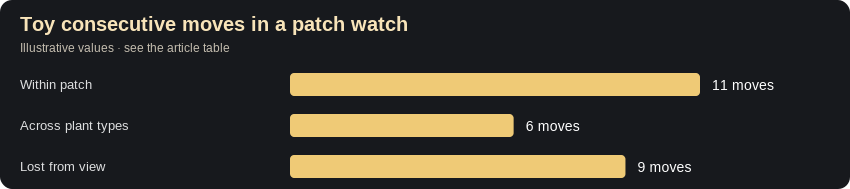
Toy consecutive moves in a patch watch
The chart and table below use invented values. The three mutually exclusive outcomes are defined for a hypothetical two-patch setup where switching patches also changes plant type. The chart unit is moves; the loss category records a censoring event after an observed departure, not a confirmed destination. None of the three bars is a count of individuals or a result drawn from the sources.
| Outcome | Moves or censoring events |
|---|---|
| Within patch | 11 |
| Across plant types | 6 |
| Lost from view | 9 |
Read the first two bars as 17 confirmed consecutive moves. Among confirmed moves, six out of 17 crossed to the other plant type, about 35 percent. If you instead divide by all 26 eligible observed departures in this toy dataset, six out of 26, about 23 percent, had a confirmed cross-type destination. Nine out of 26, about 35 percent, were lost before the destination could be established. The first fraction is conditional on successful tracking. The second is a fraction of departures with a documented crossing. Neither fraction is, without further assumptions, the true share of departures that go across the two types.
Here is another way to see why the missing bar belongs in the figure. Among these departures, six crossings were definitely seen; nine additional outcomes were unknown. If none of the unknowns were eligible crossings, the accounting fraction would stay six out of 26. If all nine were crossings, it would become 15 out of 26, about 58 percent. This wide arithmetic envelope is not a confidence interval, a model or a plausible estimate that they all crossed. It is an illustration of how much the recorded outcomes leave undecided, assuming the tracking labels are correct and the departures are the denominator of interest. You have not bounded the behavior of unseen bees or unrecorded departures.
Would reporting six observed crossings alone be misleading? It depends on the wording. In a notebook the phrase “verified six crossings during the watch” is concrete. On an interpretive sign, “bees often switch plants here” is vaguer; it invokes a frequency and a scope that the counts do not establish. If a summary substitutes percent for count, keep the denominator beside the number instead of on a distant methods page. Show whether repeat observations came from one highly visible track. A four-event track is still one follow, even when it contributes four transitions. A caption that reveals those distinctions is part of the result.
Keep geometry, plant identity and movement apart
Imagine A has ten closely spaced stems and B is a sparse row beyond a walkway. If the observer sees many short A-to-A hops, a larger concentration of A-to-A movements may be consistent with geometry alone. It might also reflect flower rewards, characteristics of the species observed, or the fact that a bee heading away from the visible faces of the bed soon vanishes. Frequencies alone cannot choose among those possibilities. Write how far a bee must travel to reach the nearest heads on either side and which edge a track started near. Two beds described as adjacent can have very different flower-to-flower gaps.
The reciprocal direction matters as well. A-to-B and B-to-A can differ because the origin conditions differ, not because bees treat the path as a one-way gate. If A offers many more starts, a larger absolute count of A-to-B is unsurprising. Give each origin its own results, including the number of lost departures and any difference in eligible effort. If one has few or no recorded starts, resist the urge to call its observed crossing proportion zero when there were no departures. With a few starts, raw counts and a written description are safer than a grand percentage on a display with no denominator.
Now consider a layout with A1 and A2 representing the same plant type across an aisle and B mixed into A1. A1-to-A2 may be important for a connectivity question even though the plant type remains unchanged. The A1-to-B movement answers a different question about floral switching while leaving the bee in the same broader patch. A directed matrix of origin and destination codes keeps both results available. Each cell is a number of confirmed sequences, with a special unknown column. Avoid assigning a hidden destination from which direction the bee initially flew. Knowing the heading and knowing the landing are separate observations.
An attractive line on a diagram can exaggerate your evidence just as surely as a bad percentage. Use arrowheads for direction and agree what line thickness means. A summary arrow from a patch center does not represent the actual flown path; it represents a documented pair of endpoints. Add a legend to say so, especially if someone might think the track followed the straight line shown. Some bees will make a wide visible arc. Others will zigzag in a space too small to draw clearly. A published map of a private garden need not reveal an address or precise neighborhood coordinates to be ecologically informative.
Do not confuse a sequence with pollen transfer
The act of seeing a bee alight on two flowers does not measure pollen deposition. The bee may gather nectar without contacting the receptive part of the second flower. Pollen carried visibly on the body may be packed for transport rather than in a position to rub onto a stigma. Even a movement between two plants of the same species needs compatible and receptive flowers for the question of fertilization. Crossing from one plant type to another is evidence of movement; it is not automatically evidence of effective pollination between those types or of increased seed set.
King, Ballantyne and Willmer compared flower visitation with direct evidence of pollen deposition in their single-visit study. Their work illustrates why the number of contacts cannot simply substitute for an effectiveness measurement. A garden observer who can reliably see a particular body region touch part of a flower can record that as another kind of evidence, but visual contact is not itself a measurement of pollen deposited. Keep the event record and its possible functional significance in different columns. This makes it possible to ask new questions without rewriting past observations as if the outcome had been measured.
The USDA Forest Service pollination brochure describes floral traits and groups of potential visitors. Traits can motivate questions such as whether an insect readily enters a deeper flower or changes its contact position on a flat head. They do not identify an individual insect from the color of the flower it visits. A visitor may exploit a different part of the flower from one you expect, and visitors with different body sizes may interact with the same plant in different ways. Use traits as hypotheses to watch for and verify, not as labels to assign after the observation.
Learn from a morning when the records are messy
Picture three people sharing the watch. One sees bees well against a dark background but loses them in glare. One has learned to recognize familiar bumble bees but tends to narrate an entire track before writing anything down. The third writes everything quickly but sometimes looks down at the wrong moment. Rather than trying to compensate quietly after the session, agree on roles. One person focuses and calls a short code after the events, another keeps the clock and records the call, and the third watches only during a separate calibration exercise. Switch roles in an organized way if you want data usable beyond one observer's strengths.
In a practice session, two observers can try to score the same visible starts independently. Before comparing notes, each should write where they started, where they stopped and whether their decisions depended on uncertainty of identity or uncertainty of contact. If both saw an A-to-B crossing but one person interpreted a hovering pause as a B landing, the fix may be to define contact more clearly. If both saw a bee land on B but cannot agree which flying insect came from A, a stricter continuity rule or a different viewpoint matters more. Compare their missing cases as well as their agreements; agreement on visible hops alone will flatter the method.
Occasionally a camera can help settle whether a movement obvious to the eye actually stayed in frame. A close view of wing markings may identify the visitor but miss the transition; a wider view that keeps both beds visible may capture the path without showing those markings. If recording is appropriate on the site, set the purpose and framing in advance and respect other visitors' privacy. Treat footage that starts just after departure as missing a start, even if the ending looks beautiful. Replaying a gap at slow speed cannot add information that the camera did not record. Use footage that solves a concrete scoring problem rather than filling the archive with clips you cannot interpret.
Review a few tracks immediately after the watch while observations are fresh. In one note you might find “left toward yellow” buried in a destination field. Move that description to a direction or free-text field and keep the destination unknown. In another note, “started A” might mean a bee was already present before the window opened. That can be an eligible start if your rule allowed already occupied flowers; if the rule required watching landings, keep it separate. A corrected transcription should not erase the first record. A later reader ought to understand how the final counts were derived and what was changed.
Make the incomplete tracks count for something
Not all missing outcomes belong in one row in the source notes. A track ending because a bee vanished behind a shrub is unlike one that ended when a visitor walked between the observer and the bed. A session that stopped because of approaching weather is unlike an observed exit across the edge. These distinctions can guide the next visit. When many losses arise from foliage, a fixed alternative view may help. If a walkway blocker interrupts nearly all long crossings on Saturday, a weekday session may permit longer follows. When the animals go out over a private fence, no change of ambition requires following them across it.
Ask which tracks were easiest to retain. A bee hopping between the nearest heads may be visible every second, while an insect flying toward a distant patch may be missing for a large part of the trip. Larger insects may remain perceptible longer. Different plants may differ in whether insects reach their flowers from the visible side. Comparing the confirmed outcomes as though both categories had exactly the same chance of confirmation can then be misleading. The toy illustration does not attempt to adjust for such differences. A real project that needs a more precise claim would have to collect evidence about detectability under the relevant conditions.
Start by comparing the loss fractions by observable context rather than assigning missing destinations. For instance, tabulate confirmed and unconfirmed departures separately for each origin, each observer and any change in sunlight large enough to have been logged. If B accounts for very few starts but most losses, write that plainly and look at its sightlines. If the loss proportion is similar across categories with very small counts, that is not strong evidence that detection is equal. When conditions differ too much, summarize watches separately. Throwing them into one large denominator can hide the exact limitation the watches were meant to reveal.
The sequence length can carry its own selection problem. A focal insect that remains among easy-to-see heads can contribute ten events, whereas one that exits briskly contributes a single ending. If you are answering how many consecutive moves were recorded, counting all ten is appropriate. If you are answering how often the first departure from each eligible start switches flower type, only the first outcome from each start belongs in that calculation. Showing a first-outcome summary next to an all-event summary is one way to make this distinction visible. Do not substitute the version that looks more decisive for the version that answers the question.
Repeat the watch before you change the garden
Choose a comparison that is small enough to interpret. A gardener might ask whether a path discontinuity is associated with fewer directly observable switches than a second border where the flowers touch. Choose two border segments with identifiable boundaries, record the current bloom at each, and spread observations over several paired times. Make an explicit effort to include days when neither location looks particularly dramatic. Keep the origin rules, sensor or viewpoint arrangement, and event definitions aligned. If one border is always shadowed or only one is well visible, that difference should be visible in the notes rather than discovered after the bars are plotted.
Treat dates and places as sources of independent evidence, not every contact as a new replicate. Twenty moves in a tight series can all come from one insect under one moment of weather. Another five on a separate morning provide a kind of replication the first twenty lack. Where several people watch simultaneously in overlapping areas, they may score the same events. That can be useful in a reliability test but not as twenty extra independent movements. Identify overlapping sessions and decide whether to reconcile them as matched observations or keep them as separate records that are not pooled.
If you are testing the effect of an existing planting change, document what else changed at the same time. Fresh flushes of bloom, the end of a neighboring display, a newly placed bench, a changed sightline from pruning, or the gardener's choice of a better field of view all matter. With a before-and-after comparison alone, even a shift in counts might not be attributable to the new arrangement. An unchanged comparison area observed on the same days can make an interpretation stronger, where practical. Even then, one small garden should not become a rule about which widths are barriers to every species of bee.
A quick survey is allowed to stop at a practical question. If you are not trying to change planting, it may be enough to notice that repeated continuous B-to-A observations are possible from one vantage and practically impossible from another. That is a finding about the watch design. It may save a volunteer group weeks of collecting records that are hard to compare. If plant additions are planned for other reasons, a take-home observation can suggest where to tell visitors to sit to see two flower types without leaning into the bed. Neither decision requires claiming that the layout increased pollination.
Two questions that need a different watch
The first is whether a bee will return to a particular bed an hour later. A patch follow that loses an insect on departure cannot establish a return. You can instead report visits to the bed before and after a chosen interval, but those may involve different insects. Do not call an afternoon visitor a returning individual because it shares a color pattern with a morning visitor. For a casual watch, decline the individual return question and ask whether activity in the same bed resumed or changed under similar viewing conditions. That gives you a distinct, answerable measure rather than a weak substitute for evidence of identity.
The second is whether a gap is ever crossed by any of the insects that visit either side. A single verified crossing answers existence for the subject and moment observed, but the converse is not true. Failing to see a crossing after several watches does not demonstrate that the gap is impassable, especially when many tracks leave sight. An appropriately careful claim is that none was documented during a defined period and set of conditions. If a verified crossing would change a placement decision, schedule observation windows while both sides have meaningful bloom and both directions can be seen, before deciding that lack of evidence means lack of use.
It is also possible to document a stretch of flight without seeing either floral endpoint. A bee crossing above an open gap from left to right is a valid observation of aerial movement across the gap. If the question is specifically about consecutive flowers, it is not a verified transition between them. Keep both kinds of records if they are useful but let them retain their separate names. Different evidence requirements often explain why a quick walk-through and a formal watch seem to tell different stories about a busy garden.
Hand the evidence to someone who wasn't there
Use plain field labels in the record: where it started, what happened on departure, what was actually visible next, and whether the session continued. Include a sketch key and a brief note about timing and limits. For public display, summarize what someone can verify from the printed view. An example paragraph might say that observers documented consecutive moves in two adjacent flowering patches during a fixed set of short watches, and that several tracks ended without a visible destination. It can then name the documented crossings without suggesting that the study measured every route or identified every bee.
Keep the evidence behind interesting claims easy to find. If the diagram highlights an especially long crossing, attach the track code and the reason you were able to identify the same bee continuously, not a polished arrow alone. If a display describes bees changing plant type, disclose whether types were identified in the field or assigned from photos later. If the identity of a plant changes after review, keep a crosswalk from the old code to the corrected name. The history makes the numerical record sturdier: a change in what the plant was called does not automatically invalidate the fact that a bee moved between two coded targets.
On a return visit you may find that the blue patch has almost stopped flowering, while the yellow one has expanded over the original boundary. Do not force that altered field into a comparison with the first date as if nothing had changed. You can maintain fixed map boundaries and record how open flowers now occupy them, or define new patches and separately document the rule by which the records link. The choice depends on whether you are following permanent beds or changing flower clusters. In either case, the new observation is worthwhile. It describes a new set of actual opportunities rather than repeating a photograph of what the garden once looked like.
The next time a bee leaves a spike, give it your attention for just long enough to see where the evidence ends. If it arrives on another plant and you never lose the link, record the crossing. If it circles back to the same patch, record the shorter move. If you lose it, don't rescue the route with an appealing guess. A graph of those three endings tells more than a polished map of all the places a bee might have gone. And it tells the next observer exactly where a better angle, steadier watch or more useful question can improve the picture.
Sources and illustration note
- USGS: What is the role of native bees in the United States?; see also the agency's pollinator science strategy for wider context.
- USDA Forest Service: The Simple Truth, an introductory guide to pollinators and floral traits.
- King, Ballantyne and Willmer: Why flower visitation is a poor proxy for pollination, original research on single-visit pollen deposition.
The chart counts are invented. If generated, the hero illustration shows a plausible imagined flight, not documentary evidence of a particular species, place, sequence or plant choice.