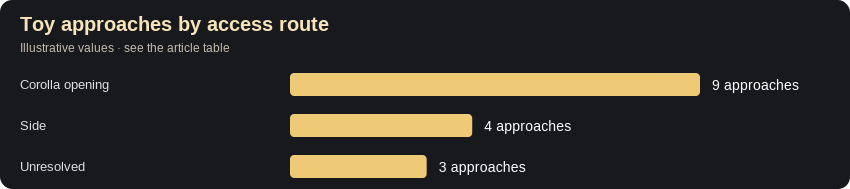
| Category | Value (approaches) |
|---|---|
| Corolla opening | 9 |
| Side | 4 |
| Unresolved | 3 |
Illustrative values, not sourced observations. Counts describe observed position rather than pollen transfer.
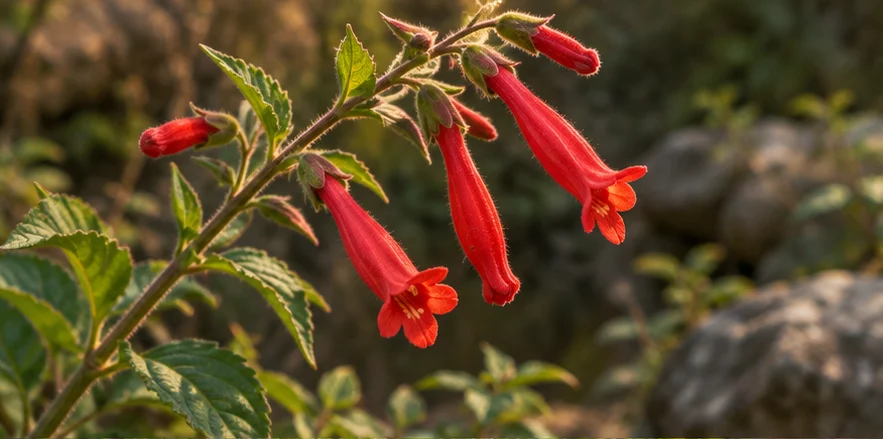
At the edge of a garden path, a long scarlet flower points down into the light. One insect approaches the open end and disappears partway into the tube. A second clings near the base, where the petals narrow toward the green cup that supports them. From a few steps away, both events look like visits to the same kind of flower. From the side, they pose different questions. Did the second insect use an opening in the tissue? Was it simply holding on? Could it reach the same reward as the first without passing the same reproductive structures? Did either event transfer pollen?
A useful account starts by refusing to answer all of those questions with one word. An approach is observable. A route can sometimes be established independently of the visitor's identity. Contact, reward removal, and pollen transfer each call for additional evidence. If a flower wall or the insect's head hides the decisive moment, “unresolved” is a result, not a note to be replaced with whichever route the observer expected. A deep flower may offer more than one way for a visitor to reach the inside, but an honest record keeps track of the ways we actually saw.
This guide describes a noninvasive observation method for gardens and field walks. All examples and counts are hypothetical unless identified as part of a cited study. The purpose is to teach how to distinguish front and side positions, record uncertainty, and choose claims that fit the evidence. It is not a method for making holes in flowers or manipulating the animals. The accompanying illustration depicts a plausible scene; it does not record a particular flower or visitor.
Find the opening before trying to name the route
Start by looking at a flower from a place where you can see its profile. The corolla is the part formed by the petals. In a tubular flower, the petals are joined for part of their length, leaving a natural opening where the tube ends. A flare, projecting lip, or separate lobes can make the mouth easy to recognize. A side view may also show where that tube meets the calyx, the group of sepals around the base. Their boundary is not necessarily an opening into the corolla. A dark spot at the base can be an apparent gap, a real perforation, a shadow, or a section partly obscured by another part of the flower.
“Front” is convenient speech, but “corolla opening” is a more reproducible code. A flower can face down, aim sideways, or turn in the wind. If you define the front by the observer's position, the same interaction can change categories when someone moves around the bed. Define it from the flower instead. The mouth is the usual opening of the corolla even if you are looking at it from behind. A side or base position refers to the wall or base of that corolla distinct from the mouth, not simply the right side of a photograph.
Check that you are watching one flower, not a cluster that appears continuous from a distance. An insect can walk across two overlapping tubes and briefly be hidden by both. If the visitor disappears behind the nearer one, it could still be probing the mouth of the farther one. A rough diagram can help: mark several open flowers and show their axes rather than drawing an elaborate botanical illustration. Use a visible neighboring feature to define them for the duration of the watch. Avoid moving or tagging a plant unless the project has permission and a reason that outweighs the disturbance.
Identify the parts visible to you before recording whether they were touched. The anthers are the pollen-producing portions of stamens. The stigma is the pollen-receptive surface of the female structure. Their placement varies, and a tube's length does not tell you where either is visible, whether they extend beyond the mouth, or whether an interaction brought a particular part of the visitor into contact. Unless you know the plant and can see the relevant parts clearly, describe the contact point in plain spatial terms, such as “head brushed projecting structure just above the lip.” A later botanical review may be able to interpret it.
A flower shape suggests a question, not the answer
The USDA Forest Service pollination syndromes brochure presents combinations of traits, including floral shape, color, odor, and reward placement, that can help predict pollinator groups. Those expectations are useful when choosing when and where to look, but they do not identify an individual visitor. A person who sees a red tube and expects a hummingbird may overlook an insect working the base. A person who expects the long mouthparts of an insect may infer too much from an indistinct dark streak in a single frame. Use a prediction to plan observation, then keep the observation separate.
Consider the contrast between a long tube and a short landing surface. The tube suggests that some visitors might have difficulty reaching a reward by the mouth, if the reward lies far down inside. The landing surface might affect how a visitor faces the mouth. Another visitor might hover with only a bill or mouthparts entering, so the position of its feet says little about its route. All of these are conditional statements. Visible tube depth is not a direct measurement of nectar placement, a visible landing platform is not evidence of where a visitor will land, and two flowers with similar silhouettes can present different reproductive parts to a visitor.
The USDA Forest Service native-plant garden guide provides garden context for watching a range of pollinator groups, including bees, flies, and beetles. That variety is a reason to keep a field sheet open to different visitors, not to assume that every kind of animal is equally likely on every flower. Begin with the observed animal if it is clear enough to name. If it is not, a code such as “small insect, not identified” preserves the record. Route and taxon can remain unresolved independently. A clear sequence can show a side probe while leaving the animal at a broad identification.
Use trait hypotheses in a way that can be proved wrong. Instead of “red tubular flowers were visited by hummingbirds,” start with “during watches of this group of red tubular flowers, record whether birds or insects approach, which part is approached, and whether a probe is visible.” If hummer observations are common, that result will come from the watches, not the color expectation. If insects appear when you did not expect them, you do not need to reinterpret the plant or dismiss an image because its contents disagree with the initial plan.
Keep approach, entry, and feeding as separate events
An approach is the unit used by the chart in this article. For a real watch you need a consistent way of deciding that an approach is directed to a focal flower. A hobby notebook may be satisfied with “moved deliberately close to flower number three.” In a group study the crew can agree beforehand on an observable boundary or sequence for entry into the dataset. Watch a few trial events together and check whether observers count broad fly-bys, repeated hovering motions, and shifts between neighboring flowers in the same way. If you do not want grazing passes in the study, exclude them by a rule everyone knows rather than by the species or route you think the pass represents.
Corolla-opening approaches occupy the end of the flower with the mouth. Some proceed into the tube and others do not. A butterfly perched a little to one side may still uncoil mouthparts toward the mouth, which is stronger route evidence than the position of its feet. A bird may hang in front of the blossom just long enough to aim at it, with no visible insertion. Write what the best angle actually shows. A labeled opening approach does not prove oral contact, and a clear insertion does not prove that nectar was removed. At each stage, keep the broader observation even if a later inference remains unavailable.
A side approach occupies the wall or base in the recording. An insect that lands behind the petals but turns its head to the mouth need not be classified as a side-access event. A visitor visibly probing a hole provides stronger evidence than a body positioned near one. Even then the physical contact is not exactly the same claim as feeding, because the observer may not be able to see what is taken up. If you need successful feeding as an outcome, define independent evidence for that outcome. Do not promote every motion consistent with successful feeding to a confirmed event.
When the relevant position is obscured, use an unresolved code rather than inferring from the point at which the visitor returns to view. A purple tube may hide the head at the moment of contact. A second stalk can block the only angle that would distinguish a relative position at the mouth from a relative position at the base. The unresolved category is not the same as an approach definitely without contact or a complete watch with no observed visitors. Those represent different events or sampling states and need different fields. A simple recording form can capture all of them without requiring a complicated taxonomy.
Some approaches include more than one position. If an individual visits the mouth and then walks back to the base of the same flower, write the sequence in your note. Whether it counts as one encounter or several depends on your counting policy. A rule focused on first approach records the first stable focal position and retains the switch in a separate field. A rule focused on contact episodes can use separately defined units when behavior is interrupted. State the rule in reports; you cannot compare such counts as if they describe the same event. The toy chart uses one route category per approach and does not attempt to tabulate mixed sequences.
A side opening does not tell you who made it
Nectar robbing is a technical name for a route of nectar acquisition through an opening made through flower tissue, rather than through the usual entrance. In Leadbeater and Chittka's experiments on bumble bees, making a hole to access nectar and using an existing hole are treated as different behaviors, commonly called primary and secondary robbing. The terminology describes what happens in an interaction. It is not a permanent label for an individual, a general verdict on a species, or a reason to intervene when an animal uses a given route.
When you walk up to a flower with a small cut, you do not know how the cut appeared. It could have been made by a visitor, damaged by contact with another stem or human activity, or mistaken for a cut because a petal is folded. A before image showing intact tissue, continuous footage of a visitor opening it, and an after image of the visible opening would strengthen the case for that visitor having made it. A photo taken after the event cannot carry the same information. It may accurately document a hole without identifying its maker or even proving that a visitor used it.
When a hole is known to have existed before the animal reached it, an uninterrupted probe into it is evidence of reuse of that opening. If the origin is not known or reward uptake is not established, describe existing-hole use or a possible side probe rather than using more specific terms than the evidence allows. Check any study's published definitions before comparing your notes to its results. Experimental terms can be tied to flower setup, visitation scoring, or direct evidence that a casual garden observer is not collecting. Similar wording does not automatically make the observations equivalent.
The word robbing can also make readers imagine that the plant has necessarily lost reproductive success. The route alone does not establish that outcome. It can bypass structures the visitor might have contacted at the mouth, and nectar removal could change later visitors' opportunities. Effects depend on the plant, the visitor, and the pattern of later visits, among other conditions. For a specific example, a study of pierced flowers of Fuchsia magellanica reported changes in other visitors' behavior without finding a change in seed set under its study conditions. That is a model for separating outcomes, not a result to assume for the next tubular flower in a garden.
Read the chart as positions, not successful trips
“Toy approaches by access route” shows nine approaches classified at the corolla opening, four at the side, and three unresolved. That adds up to 16 invented approaches. Thirteen have an assigned position and three do not. These are illustrative counts, not sourced observations. None of the bars counts nectar meals, pollen grains, plants that set seed, or uniquely identified individuals. An insect can contribute to more than one approach over a watch even when each approach is recorded just once.
The label “Side” is deliberately short. In this chart it means that the relevant approach position was determined to be at the side or base, not that a new opening was made or that nectar was acquired. “Corolla opening” similarly indicates a position rather than a verified contact. “Unresolved” means that the position could not be assigned. Readers cannot infer from the height of the unresolved bar whether ambiguous cases arose mostly near foliage, beneath the corolla, or from animals moving too fast. The toy data do not contain that breakdown.
Dropping the unresolved approaches would make nine out of thirteen the opening share of classifiable positions. Using the whole illustrated set would make nine out of sixteen the share directly classified as opening. Both fractions answer different questions. Neither tells us how common opening approaches were biologically. If the three ambiguous approaches in a real dataset could all belong to either route, a simple range under that assumption would be nine to twelve of sixteen for the opening, and four to seven of sixteen for the side. Those ranges share the same three unknown cases; they are not independent counts to add together. They are also not statistical confidence intervals. If some unresolved events could instead represent another route, say so rather than forcing those events to fit a binary split.
The table beside the chart means the bars need not carry all the information by their shape or color. The examples can be narrated as the three exact named counts and their total. This is a good habit when publishing a real watch summary. Keep the units in the caption, explain what was unknown, and state whether the chart reflects the complete watch data or a selected subset. The apparent clarity of a colored bar does not make its category scientifically clearer than the underlying field definition.
Set up a view that lets you keep the unknowns
For one flower, an oblique view often tells you more about access than a perfectly frontal view. It can show the mouth and part of the side wall at once. It may still hide the far side, and curved tubes can put the mouth and base in different planes of focus. Start with a view of the whole flower and its near neighbors so that later close views can be assigned to the correct structure. Record the direction the flower faces and which side remains hidden. A useful observation does not require a specialized camera if someone in a stable position can see the approach clearly.
Notice how frequently the plant moves before inferring a contact between visitor and tissue. A hovering animal and a swaying tube can briefly align in a single image without ever touching. A head can vanish exactly when the flower tilts forward. Continuous footage sometimes shows that a suspected side contact was only a crossing in the view. If only one frame survives, record the position conservatively and leave contact unresolved. An impressive photograph can establish a visitor's appearance and still fail to establish the behavior that took place.
If a colleague is watching from a different permissible viewpoint, align the timing of the notes without asking anyone to chase an animal. One observer might see a head disappear at the front while the other can see that it emerges along the side without entering. Write their independent notes before combining them. A reconciliation can mark the better supported route, explain the difference in perspective, or retain an unresolved result. If the sequence cannot be matched to the same visitor and flower, do not join it simply because the timestamps are close. Two things occurring in the same bed may be simultaneous and unrelated.
Pay attention to sunlight and shadow as part of the evidence. Backlight may give a crisp outline of a bird's bill while leaving the interior invisible. Diffuse light may reveal a small opening in the tube but lose the strongest outline of transparent insect mouthparts. If the purpose is an experiment comparing views, balance the conditions you can reasonably balance. If the purpose is a casual record, simply name what the view did not allow. This is particularly helpful for distinguishing an unresolved anther-contact field from a confident observation of no contact.
Do not improve a sightline by bending the flower toward a camera, holding the insect, opening floral tissue, or trimming a neighboring stem just to get a shot. Even a slight change to flower orientation can change the very route being observed. If a plant is on private land, near a fragile bed, or beyond a boardwalk, work from a permissible position or stop. Clear observations of a limited sample are useful; a supposedly better view achieved by altering the setup is not the same evidence.
Record contact separately from visible pollen
The natural entry can bring parts of a visitor close to anthers or stigma, but whether it did depends on the geometry of that interaction. A long bill can reach through a mouth with little visible contact. A brief front approach can leave before anything touches. A visitor that approaches at the side could contact an exposed structure while moving along the outside later in the encounter. Those possibilities reinforce why route and contact deserve separate columns.
A simple contact note can specify the part of the visitor, the visible part of the flower, and how certain the observer is. “Head contacted projecting structure; structure not identified” is a meaningful observation. “Possible pollen on head before arrival” is different from confirming pollen removal at this flower. Even a clear yellow dusting afterward does not establish what species the pollen came from, whether it stuck during this visit, or whether any later deposition occurred. An observer can record apparent dust and before-after visibility while declining the larger interpretation.
The cost of collapsing these variables becomes clear when comparing different visitors. Suppose one visitor remains near the mouth long enough for the camera to catch both its head and the floral structures. Another enters from an angle that obscures the head. Treating the latter as definite noncontact penalizes an observation that was simply difficult to score. Compare known contacts against the opportunities you could actually evaluate, retain unknown contact explicitly, and explain differences in visibility between routes. If the easier route to observe produces more confirmed touches, that is not by itself evidence that it produces more touches in nature.
Even a convincing touch is not a direct count of pollination. A meaningful reproductive outcome depends on, among other things, compatible pollen reaching a receptive surface and subsequent processes. A casual observer usually cannot resolve that chain. A formal project may look at pollen deposition, or at reproductive outcomes under a design that connects visits and controls to those outcomes. Keep what your project measured specific. “We saw several front approaches with visible contact at the stigma” and “we established which visitors contributed to seed production” are very different conclusions.
A field record that can survive a second reader
Give each watch a date, time range, focal plant or patch, observer, and a sampling note. Which flowers were open and in scope? Where were you standing in relation to them? Was movement visible on both sides or was there a predictable blind angle? Include the start and end of the watch even if there were no approaches. Notes about interruption, loss of a camera view, or a late arrival at the site should prevent an incomplete watch from looking like a complete zero. If the location itself is sensitive, use a publicly safe location description and keep any restricted records secure.
For each approach, use a stable identifier, an approximate time or clip position, the focal bloom if known, and the method by which it was distinguished from neighboring blooms. Collect separate fields for route, route evidence, visible probe, contact, and visitor identification. One line of natural description helps readers understand unusual sequences. If a record changes because someone inspected original footage, keep the original category available alongside the reviewed category and note the evidence of the change. Accurate revisions improve the record in a way silent recoding cannot.
Tell the next reader what a blank means. In a rushed paper session, no mark in the contact field could mean that no touch occurred, that the view was blocked, or that the data sheet did not yet ask the question. Give those possibilities separate codes. Similarly, if no flower identity is available, a plot code plus a sketch can keep a route record usable without pretending you have a species name. If an animal is identified after the fact, note the basis and any uncertainty; a route-specific summary should not be silently recomputed as if the field observer had recorded that identity.
Keep supporting media useful without sharing more than necessary. Store a durable reference and the frame time showing the decisive movement if one exists. On a public page, suppress private site details or location metadata as appropriate. Avoid asking people to upload pictures of private property or sensitive habitats when a field sketch or a neutral crop would suffice. A crop may make the visible anatomy easier to point out, but retain the original under authorized access if you need to show the wider relation of flowers. A generated or reconstructed image should never substitute for an observational original.
Try the method on five invented approaches
In the first approach, a bird pauses at the opening and puts its bill visibly inside the tube. The mouth faces a clearing, and a side view reveals the furthest position of the bill as well as the visible structures above it. The photograph does not show uptake, and the video is not sharp enough to determine whether a projecting structure touched the bird. Record “corolla opening, insertion observed, contact unresolved, reward not assessed.” It would be an error to label the lack of clear contact as proof this visit was ineffective. It would be equally unwarranted to assume success because the route looked conventional.
In the second approach, an insect lands on the calyx near a perforation already visible in the initial image. A continuous sequence shows investigation near the perforation, but only a brief frame appears to show a mouthpart entering it. The stability of that image is questionable. The best coding is “side position, probe possible, open hole present before arrival.” This is not demonstrated primary robbing. It is not automatically confirmed secondary robbing either, because the record did not establish a nectar-reaching probe. The note can invite further review without implying that additional footage of this one event necessarily exists.
In the third approach, a small insect moves several inches toward a bloom and becomes hidden by another hanging flower. It reappears on the lower side and departs. That later position does not show the position when it reached the focal flower. It could have touched the mouth and moved down, or it could have gone directly to the side out of sight. If the watch rules normally include approaches that reach the focal flower's near zone, count the event as unresolved rather than choosing whichever of those paths looks more plausible. If the observer cannot tell which flower it reached, preserve that uncertainty separately.
In the fourth approach, an insect starts at the opening and then walks along the outside until it pauses at a slit. The opening approach remains its first position when the study counts approaches by first stable route. The switch belongs in a sequence field and could be analyzed separately. An observer who treats each pause as an entire new approach would produce different counts from the same video. Decide what counts before the crew sees an exciting set of switches. Then explain which parts of behavior can be compared across projects and which cannot.
In the fifth approach, an animal lands near the base, sweeps around to the underlying lip, and can be seen reaching the mouth from below. If your rule codes the site of approach only, record where it first approached and keep actual insertion in a distinct field. If your question concerns entry route, do not assume its base landing was side access when the video shows entry at the mouth. This is exactly the scenario in which overly broad use of a word such as “route” can hide a disagreement. An explicit event definition and an independent field for evidence make it clear whether two observers have described different facts or interpreted the same fact differently.
Compare flowers without mistaking visibility for ecology
Imagine two patches a few meters apart. The first has upright flowers for which you can see the mouth clearly; the second has drooping flowers whose entrances point toward a dense cluster of leaves. Side activity may appear more common in the drooping patch simply because the wall is usually visible and the mouth is not. Before interpreting the difference biologically, inspect the number and nature of unresolved cases in each patch. Ask whether observation time, focal bloom count, weather, and the camera's angle are comparable. An identical viewing time is not enough to make equally visible evidence.
A straightforward first comparison splits records by evidence quality as well as route. That could mean reporting how many approaches were assigned from continuous views, how many were assigned from a reliable direct note, and how many remained uncertain. Do not create an evidence hierarchy that dismisses a good observer simply because a photograph is not available. Do explain what kind of evidence a later reviewer can independently check. If substantial differences in visibility persist, a narrow descriptive statement about what was observed is more defensible than claiming a preference.
Likewise repeated approaches to one spectacular bloom can swamp records from several other flowers. If the question is whether route differs by tube shape, observe enough flowers and consider how observations cluster within plants or watches. Visits are not independent simply because they appear on separate lines. The same individual may make numerous approaches or repeatedly return to an opening. In a hobby exercise, reporting the distribution of visible routes per watch or per plant can be more informative than combining all events into a single big total. In a formal study, plan the sampling and analytical unit with someone who can account for that clustering.
Visible damage is a condition as well as a possible consequence. If you watch already perforated flowers disproportionately, you have selected a set with an existing potential side route. Report how flowers entered the watch. A study of naturally available openings might track which focal blooms had an observed opening at the start, at the end, or not assessable from the vantage. That does not prove the source of every opening. It does let the reader see whether routes were compared fairly without altering the garden.
Run an observer calibration that welcomes “unresolved”
Start with a few shared clips or side-by-side observations before making team totals. Ask each observer to independently name the approach position, the evidence for actual entry, and any visible touch. Find out whether they counted the same beginning and ending of the event. The goal is not to eliminate disagreements by instructing everyone to choose more specific labels. The goal is to discover ambiguous definitions and the situations in which the rule should preserve uncertainty.
One good training example shows a perfectly clear front approach followed by a moment out of sight. Observers should agree on the route if the earlier approach position is the relevant unit, while leaving any later contact unresolved. A second example shows a clearly visible rear position but no evidence of probing a side opening. It belongs in the side bar in an approach chart, but not in a tally of verified side feeding. A third provides a close image of a hole and no associated visitor. That documents the flower's condition and does not qualify as a visitor approach at all. Distinguish these classes during training so the data do not shift from one interpretation to another over the season.
If reviewers disagree, ask them to point to the decisive instant instead of comparing only their final code. One person may have counted a broad pass, while the other was evaluating the second approach in a sequence. One may have focused on the visitor's body position, and the other on where the mouthparts were directed. Such disagreement can teach you which variables need to appear on the form. An ambiguous real-world sequence does not always have to be adjudicated to a single supposedly correct answer. The manual can instead document how to preserve the dispute.
Keep difficult examples in the calibration set, but distinguish training files from any later quality check. Showing everyone a clip and teaching a common answer establishes that a convention can be learned; it is not a test of what those people will conclude independently next time. Review a fresh set if a project wants evidence of reproducibility. Keep the outcome at the level tested, such as agreement about approach positions from the clips at hand. It is not evidence that ambiguous behavior never occurred outside the frame.
Write for readers who will not see the raw footage
The text accompanying an observation has to stand on its own. Specify the flower or its field label when known. Describe the sampling setting and whether observers could see both sides of the focal flowers. State whether numbers are all approaches, only interactions with visible insertion, or something else. If a narrative cites a specific study, keep that result separate from the local notebook and the invented graph. A colored editorial illustration should show the kind of question you asked, not be offered as an image of the reported observation.
Avoid species titles that do more work than the actual record. For a set of unidentified dark insects photographed at the base of several flowers, “Unidentified insects approached the sides of tubular flowers” is more defensible than a caption naming a particular bee or declaring that flowers were robbed. If a qualified reviewer later recognizes the visitor in a subset, update that subset and say how it was reviewed. A pattern inferred from the species names of neighboring records should not determine the identification of a blurry one.
Show a persuasive but incomplete example alongside the clear one when teaching this workflow. Readers learn something from seeing why a dark side mark can be a shadow, why the insect's feet did not define the route, or why a momentary overlap did not establish contact. Use plain positional language before specialized terms, and explain the minimum visible evidence needed for the specialized terms. There is no need to make observational uncertainty sound like lack of effort. If the evidence supported a broad label, the observer did enough to keep that fact useful.
Finally, resist interpreting the categories as good and bad. A colorful front visitor can provide no evidence of pollen transfer. A side probe can be interesting for how visitors exploit a flower's shape even when the plant's outcome remains unknown. Unresolved encounters reveal limitations in the view or the coding policy and can even prompt a better next watch. The strongest field account is one where a reader can see which direction the visitor came from, what the observer could and could not determine, and why the final ecological claim stops where it does.
Sources
- USDA Forest Service: Pollination syndromes brochure, for trait combinations as predictors to investigate.
- USDA Forest Service: Attracting Pollinators to Your Garden Using Native Plants, for garden visitor diversity and observation context.
- Leadbeater and Chittka: Social transmission of nectar-robbing behaviour in bumble-bees, for experimental distinctions between making and reusing nectar access holes.
- Nectar robbing and visitor behavior in Fuchsia magellanica, for a study distinguishing visitor behavior from seed-set outcomes.