| Category | Value (blossoms) |
|---|---|
| Damage only | 5 |
| Visitor only | 7 |
| Both | 3 |
| Neither | 9 |
Illustrative values, not sourced observations. Twenty-four toy flowers scored; no causal attribution.
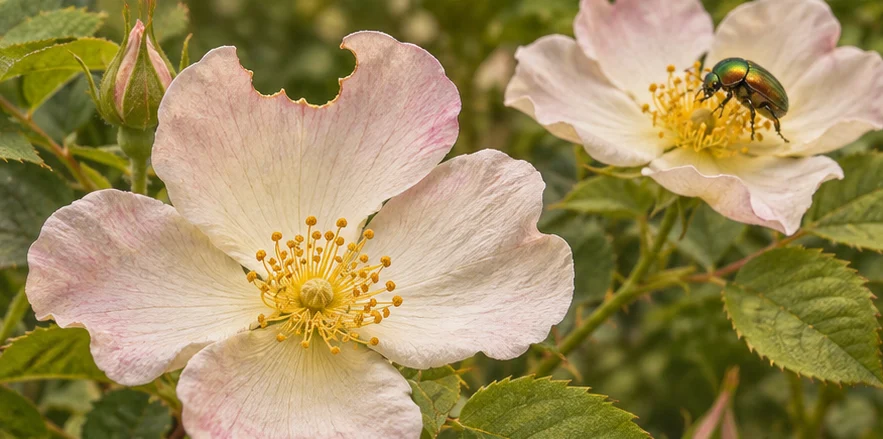
A pale petal has a notch. On the next flower a small beetle works its way between the stamens. A photograph of the pair makes a tidy story almost irresistible: the beetle chewed one blossom, then carried its pollen to another. No such journey is visible. The observer has a damaged petal and an animal on a different flower. Each is worth recording without making one the explanation of the other.
There are several missing links. Was the notch produced by feeding at all? If so, which animal did it? Did the beetle touch a structure bearing pollen, and did any of that pollen travel to a compatible receiving surface? Some of these questions may be answerable with additional observation. None is settled by putting the two things in the same frame. One strength of a field record is that it lets the evidence remain interesting before the full story is known.
This article separates tissue condition, visitor identity and contact with reproductive structures. It also separates that contact from proof of pollen transfer. The companion chart is an invented way to count visible clues from twenty-four blossoms. It is not a report of an actual beetle, a diagnostic guide to bite marks, or a tally of flowers that set seed.
Describe the edge before naming what made it
Start with a short account of which part is affected. A notch in the outer margin is different from a hole completely surrounded by petal tissue. A missing tip differs from a pale patch that has not lost tissue. Folds and overlapping structures can conceal parts of a petal in a photograph. State what was visible, whether material appeared absent, and whether another viewing angle could reasonably change the interpretation.
Words such as ragged, rounded, torn and discolored can describe an edge. They do not all establish cause. A boundary may become less distinct as a flower ages. Tissue may have been affected before the bud opened, then become conspicuous after expansion. An old abrasion and fresh bite can invite similar casual descriptions. When the mechanism is not observed, “notched petal” or “missing tissue at the margin” preserves more truth than assigning an actor by impression.
A timestamp provides the latest moment at which the petal's appearance was recorded. It is not necessarily the time the damage occurred. If yesterday's photograph shows the same edge intact and today's photograph shows it missing, the two photographs can bound the change under a suitable comparison. They do not resolve who was present during the gap. A new association can be recorded without making a new claim about timing that the evidence cannot support.
A series of views can strengthen the observation without disturbing the blossom. The broad view establishes which flower and which side. A closer image can resolve whether the edge is torn or merely in shadow. If permitted, return to the same vantage later and preserve the earlier image. Do not nudge a small animal or peel apart petals to confirm a casual guess. The important question is often what a lawful, undisturbed observation can support, not all that might be possible after changing the scene.
Tissue damage should also be distinguished from a mechanism that sounds plausible because of the animal's name. Calling an animal a flower beetle, whether informally or under a narrower local usage, does not tell what happened to a particular flower. Some visitors may feed on pollen or floral tissues. Others may do something different during the particular visit. The name of a broad group is not the behavior record.
Name the visitor on its own evidence
A small moving shape can be easy to recognize as an insect and hard to classify beyond that. A photograph may suggest beetle from independently visible structures or body form; it may be too blurred, angled or incomplete to resolve a narrower group. A field note can say “beetle-like visitor, identity uncertain” when that is all the available view supports. Do not let a description of nearby damage push the identification farther than the image allows.
An adequately documented beetle identification does not identify the damage maker. Suppose a reviewer confirms the beetle in the image belongs to a group often associated with flowers. That improves the identity record. It does not establish that the pictured animal was present earlier or did the thing that damaged the other blossom. A repeated field mistake is to use a plausible identity to explain an observation and then use that supposed explanation to strengthen the same identity. Keep those inferences independent.
Which flower the visitor occupied is another part of the evidence. An animal walking across two overlapping blossoms can appear in one frame without a clear record of which parts it touched. Name the blossom or record the ambiguity. If the insect could not be tracked between flowers, do not silently join nearby sightings into a route. A familiar-looking animal returning after a break in observation might be a different individual.
The USDA Forest Service native-plant pollinator garden guide discusses beetles alongside other flower visitors and pollinators in a garden context. The broad diversity is a reason to observe behavior carefully, not a shortcut to identifying the actor in an individual photograph. A reference can establish that some members of a group are known to do something. It cannot place a particular animal at an unobserved earlier moment.
Use verbs that match the record. An insect can approach, land, walk, feed, touch and depart. These verbs describe events of different specificity. Seeing a body motion through a petal edge is different from observing a part being removed. A single image may support position with no view of movement. Choose the strongest verb the evidence allows, then stop. Restrained wording in an individual record leaves room for stronger claims when the necessary observation exists.
Four toy categories record two visible things
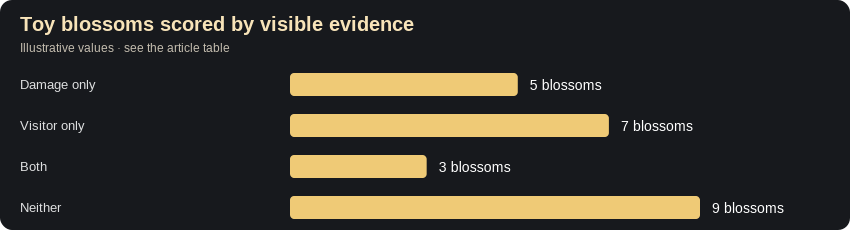
The companion chart, “Toy blossoms scored by visible evidence,” holds twenty-four invented blossom records. Each blossom is scored once using two illustrative yes-or-no fields: visible damage under a defined view and a visible visitor under a defined watch. Classify a blossom by combining those fields. The four classes are not types of insects or causes of damage. None of the counts came from the cited sources or from photographs of an actual garden.
| Visible evidence in toy example | Illustrative blossoms |
|---|---|
| Damage only | 5 |
| Visitor only | 7 |
| Both | 3 |
| Neither | 9 |
The four counts add to twenty-four. Five damage-only records and three both records make eight with damage visible under the toy rule. Seven visitor-only and three both make ten with a visitor seen. If you add eight and ten, you count eighteen positive field entries, not eighteen different blossoms; three share both fields. Fifteen blossoms have at least one of the two recorded clues. Every unit here is a blossom, not a visitation event, an individual beetle, or an identified pollen delivery.
“Neither” is a local description of the evidence categories in the example. It means neither clue recorded under the defined view and watch, not a lifetime without damage or visits. In an actual survey, a flower might have an obscured edge or a watch that never occurred. Then an absent yes is not necessarily a defensible no. Add an unknown or insufficient-observation status where needed rather than forcing every view into the neat four-way table.
Likewise, “both” simply says two kinds of evidence were recorded on the same scored blossom. It does not say the animal caused the damage or carried pollen because of it. A flower may have been damaged in the morning and then visited harmlessly later. A visitor may have moved through without contacting the damaged edge. The two observations might even belong to different watchers. A joint label is an efficient summary of the fields and makes no causal claim.
The chart has no column for contact with anthers or stigma. That omission is deliberate: the counts do not measure reproductive contact. A real record could include a separate third field and a separate graph. Mixing that field into the visitor count would let any photographed insect stand in for an interaction it may never have had. Readers should be able to tell what the bars measure without consulting a hidden rubric.
Damage, attendance and contact run on different clocks
Damage can remain visible long after the event that caused it. A visitor can appear and disappear in seconds. A record of visible contact may represent an even briefer moment within the visit. Those three time scales make them hard to match without a plan. A snapshot count of damage and a five-minute count of visitors will not assign one event to the other. They tell different stories about what was detectable under the chosen methods.
Imagine revisiting four tagged blossoms without touching them. One has a new notch but nobody saw the change. Another attracts several insects during a watch but remains visually intact. A third has old damage already recorded and an insect now moving through its center. The fourth could not be inspected because its face turned away. The records are all useful. None needs to be rewritten as a ranking of insect damage to make the table worth collecting.
Even with continuous watching, define what is meant by new damage. A previously folded edge may become visible as a flower opens. A shadow may have concealed a mark. A good before-and-after description notes what surfaces were visible and whether appearance could have changed without tissue removal. If you actually saw material removed, that observation should be recorded independently of differences between photographs. The action and the results need not share the same uncertainty.
For comparing watches, put effort beside the finding. A blossom seen repeatedly at calm midday and a blossom seen briefly during wind were not given the same opportunity to reveal visitors. An event count is hard to interpret without that context. The problem is not fixed by using more decimal places in a percentage or by counting photo frames as opportunities. A plan with a stated unit and documented observation effort protects modest claims from growing accidentally large.
Contact needs an identified structure
The anther is a pollen-bearing part of a stamen; the stigma is a receiving surface in the pollination process. The USDA Forest Service pollination brochure describes transfer from anther to stigma and treats suites of flower traits as useful predictors of visitor types. Its context helps distinguish a garden visitor from evidence of pollen transfer. It does not say that every visitor on a flower performs that transfer.
In a real image, the reproductive structures may not be easy to distinguish. They can be crowded, hidden by the insect, or partly obscured by petals. If the observer sees an animal in the center, write “contact near center” when the exact anatomy cannot be resolved. If they see a leg touch an identifiable anther, a more specific record is possible. Separating uncertain structure from uncertain insect identity allows a reviewer to improve one determination without pretending to resolve the other.
Contact with an anther could help explain material on a body, but the presence of that contact does not show how much pollen, if any, adhered. Contact with a stigma provides a different kind of potential transfer evidence, but the observer may not know what the animal brought or whether any compatible grains were delivered. A short record can mention each observed step without calling the sequence successful pollination. Evidence of pollen delivery, and evidence of a subsequent reproductive outcome, are further steps.
The direction through a flower is not enough to reconstruct prior visits. A visitor that arrived carrying pollen might have obtained it elsewhere. An animal moving past the stigma might have brushed it or missed it by a distance hard to judge without a suitable view. Shadows from an insect can touch structures its body did not. Use careful observation and admit what the viewpoint limits. A confident label is not a substitute for direct visual support.
It is useful to keep a small vocabulary of evidence categories. For instance, note whether the animal touched a petal, an identifiable reproductive structure, an unresolved flower part, or no part under a view that permitted an answer. Include an obscured status when visibility was inadequate. Multiple contacts during one visit can be recorded separately if that is the intended event unit. The protocol should not imply that a beetle's entrance and its reproductive contact are synonyms.
The same animal can matter in more than one way
Feeding on a flower and moving its pollen need not be mutually exclusive behaviors. The consequences for a plant can depend on the details. Damage to one structure may differ from damage to another; contact can be relevant or irrelevant to reproduction; both effects can occur in an interaction. The label helper or pest is too broad for a record that witnessed only one movement. Establish the behavior first and reserve any wider ecological conclusion for evidence designed to answer it.
One primary example, Anther mimicry in an African orchid pollinated by pollen-feeding beetles, examines a specific orchid and its observed interactions with beetles, including relationships among petal damage, movements of the orchid's pollen structures and fruit outcomes. That case is useful precisely because the researchers studied the anatomical and reproductive evidence in that system, not because a photograph of damaged petals normally proves such a relationship. It should not be transplanted onto a garden flower of another species.
A different primary study, The Functional Dilemma of Nectar Mimic Staminodes in Parnassia wightiana, documents florivorous beetles and reports that the beetles watched in the relevant observations were not seen touching the stigma lobes or carrying conspicuous pollen loads. The observation is not proof they could never do those things. It illustrates why identifying a flower feeder does not settle an animal's transfer role. This article's chart data are unrelated to either study.
The contrast between the cases is more informative than turning them into opposing rules. Some interactions show important connections, while some do not yield the evidence needed to say the same. Flower form, animal behavior and research methods differ. No single tissue-damage category can substitute for that context. If a field guide describes an interaction broadly, cite its scope and test how well the current records fit it.
A report can be explicit about benefits and costs without trying to compute them from one sighting. A tissue loss observation concerns the plant part at that moment. A transfer observation concerns the arrival or movement of pollen under specified conditions. A longer-term outcome may say something about fruit or seed production. A mechanism of repeated contact may affect each differently. Keep the findings distinct long enough for a study to connect them on evidence rather than on a narrative impulse.
Where case evidence ends and attribution begins
Suppose someone obtained unusually clear footage of a beetle removing a piece of a petal. If the scene is clear enough, it can support attribution of that particular act to the observed animal. It does not automatically attribute older marks on the same petal or similar marks on every neighboring flower. Write “beetle observed removing tissue here” and retain the time and blossom identifier. Labels applied at the wrong scale turn a strong specific observation into a weak sweeping claim.
A before-and-after image may support new tissue loss without a clear record of the actor. In a crowded patch, the watcher might see several kinds of visitors between the two images. The list of visitors is valuable context but is not equivalent to continuous observation at the affected edge. Resist assigning the action to the animal most frequently photographed. Frequency of photography depends on visibility and interest as well as on behavior.
A focused watch can improve attribution responsibly. Decide which flower and which visible structures can be observed from a permitted location. Note where the view is interrupted. If any participant in the scene uses the obscured side, record that limitation. Watching longer can increase the chance of seeing a rare action, but cannot see through a barrier. More time is useful only if the observation can address the gap in question.
Do not manufacture evidence by putting an insect on a blossom or altering the tissue to make it easier to see. Besides ethical and access constraints, the change would make the observed behavior unlike the natural encounter the report intended to describe. Review an existing sequence or return as conditions allow. A study involving manipulation belongs to a suitable design with appropriate permissions, not to an improvised proof of a caption.
There can be causal questions beyond attribution to one animal. A researcher might ask whether damaged flowers receive different visits, whether beetle feeding increases future access for another insect, or whether a change in floral shape affects pollen transfer. Each question compares something different. A joint damage-and-visitor chart could help frame them, but it does not answer them just by showing both conditions sometimes occur on the same blossom.
Use separate identifiers for blossoms, visits and contacts
Give each selected blossom a recoverable identifier in the record without altering it for casual observation. A site sketch or permitted orientation photo can be enough. Keep the flower identity distinct from the individual opening or part examined. If the whole blossom could not be seen, note which portions were visible. A “no damage” score should have an operational meaning, such as no visible missing tissue on the inspected edges, not absolute knowledge of the entire flower.
Then decide how to log a visit. A single insect can touch several blossom parts before leaving, so contacts can outnumber visits. The same animal could move to other flowers, so visits can outnumber unique animals. If individual tracking is not supported, do not assign repeat identity on the basis of a similar shape. One flower can generate multiple events and still count only once in a binary blossom-level table.
Write the contact unit in words. A reader might need to know whether multiple taps at one anther were counted separately or whether any touch during one visit was recorded once. A vague count is hard to audit even with reliable photographs. If the objective changes, a sufficiently detailed event log can support reaggregation without having to reinterpret the meaning of an old summary field. Preserve the lower-level observations where they are appropriate to retain.
Include an observation-effort section. Record date, duration, visibility, major interruptions and number of selected flowers. A watch cut short by rain is not the same as a full watch yielding no visitors. If petals obscure the center throughout, the record can still say the blossom was watched while noting that reproductive contact could not be scored reliably. Preserving that distinction prevents a future analyst from treating every unresolved contact as a negative finding.
A robust notebook can have a separate line for changed interpretations. If a reviewer later identifies the insect from an additional image, update that field with its evidence. Do not change the timestamp of the field observation, and do not retroactively assign the visitor responsibility for an old notch merely because its group is now clearer. Correcting one question does not force all other questions to acquire answers.
Look for asymmetry in what can be seen
Old damage can be easier to record than a fleeting visitor. A wide-open blossom can reveal its center more easily than a deep or partly folded one. The number of detected clues reflects the observer's opportunities as well as underlying events. If a table compares shapes or species of flowers, include enough context to distinguish biological differences from differences in visibility. More accurate counting under one view does not necessarily make that view comparable to another.
Time of day can create the same problem. One set of blossoms might be inspected in good light and watched for ten minutes, while another is examined at dusk under inconsistent light. Missing small visitors or subtle edges is more likely in some conditions. If these differences cannot be controlled, present them as part of the method rather than allowing a simple count to appear like a universal ranking. The exact numbers are valuable only alongside what someone could have detected.
A photograph chosen to show a notch is also more likely to represent damage than an independently selected photograph. If volunteers mainly submit striking images, a collection can document noteworthy examples but not estimate the proportion of all blossoms damaged. Distinguish the purpose of a picture archive from the purpose of a planned sample. An eye-catching frame is not dishonest evidence; pretending that it had equal selection probability with unremarkable flowers is.
There is also a classification issue in the intact category. “No visible damage” may mean no clearly observable sign on surfaces that could be examined. It does not mean the flower was examined from every angle and found perfect. The same applies to absent visitors. Make negative claims only within well-defined observation. If another reader could reasonably mistake a qualified negative for a complete absence, bring the phrase “during the watch” or “on the inspected edge” closer to the claim.
Compare hypotheses without assuming one answer
One observer might predict that beetles are associated with newly damaged petals. A second might suspect damage accumulated earlier and the same blooms remained attractive to a variety of visitors. Both are plausible questions to set down in advance. Neither is established by the companion chart, which is fictional and contains no information about timing or visitor identity. A useful investigation identifies observations that could make either explanation less plausible.
For example, a sequence of dated tissue views with consistently observed structure can establish when new damage became visible. Carefully defined watches can provide a list of which visitors appeared and what they did under the chosen view. A separate recording rule for relevant contact gives the report more than a general visit count. The result might still be inconclusive about many individual marks. That is an appropriate outcome when associations are easier to observe than causes.
Do not infer that a conspicuous mark indicates the most consequential event. A small change to a reproductive structure might matter even when many petals remain intact. A dramatic missing petal section might attract attention but reveal little about whether an animal delivered pollen. Which part matters depends on the question. Treat tissue appearance, possible mechanism and plant performance as distinct variables rather than assigning all three the same visual score.
Set competing examples beside each other when explaining evidence. An insect recorded walking on an entirely intact flower can make a contact hypothesis interesting without documenting any damage. A blossom with visible tissue loss and no observed visitor provides damage evidence with unresolved cause. Neither deserves to be called the opposite of the other in a biological sense. They are different combinations of observations under different windows. The categories are useful when they tell us precisely that.
To examine whether prior damage changes visits, do not simply compare the damaged flowers conveniently available with the intact flowers that happen to stand nearby. Differences in flowering stage, location or display could matter. A properly designed investigation can compare like situations or handle multiple variables explicitly, with appropriate permissions. A field report can acknowledge the question without claiming to have answered it. Doing so invites better comparison rather than closing debate on weak evidence.
Pollination questions need outcomes at the right scale
Visible contact is not useless just because it does not prove successful transfer. It can help decide which visits are worth studying as candidates for deposition. A study of deposition can in turn differ from a study of fruit set or seed performance. The pollination pathway contains several stages, and evidence at one stage is a valuable basis for asking about the next. Readers lose that clarity when a label quietly turns any contact into evidence of all outcomes.
In a real research design, an investigator might choose a defined floral stage, document possible visitors and measure a suitable outcome under a method that addresses alternative sources of pollen. The appropriate approach depends on the plant and study. This article does not supply protocols for handling wildlife or plants. Its use is to show why one must name what was actually measured rather than turning conservation interest into authority to disturb a site.
Fruit development can be evidence about a later outcome, but do not assume it explains all the interactions near the flower. Pollen might have come from several agents or times. A missing fruit might reflect conditions that neither damage nor pollination alone would predict. Interpret an outcome in light of the actual design, including the relevant controls where appropriate. A convincing study can test connections; a photo caption rarely includes the evidence to replace it.
In public education, say when a plant group is known to have beetle pollinators and when you are merely documenting a flower encounter. Consulting source guidance helps describe possible roles. Clear direct observations and cautious uncertainty keep examples from becoming unsupported species-level claims. If a group is broad, there is no need to give it the same functional role in every story. Evidence can begin at the group level and remain specific about behavior.
Write a caption a reader can take elsewhere
Start with the two physical subjects. “Notched petal on one blossom; a beetle observed on a separate blossom” establishes the separation at the outset. If the visitor's identification is provisional, say so close to the name. If the photographed view shows contact with a specific structure, add that detail without assigning it a pollen source. If the action responsible for the notch was not observed, the caption can end there. A clear unknown is more useful than leaving a reader to infer an absent connection.
For the toy figure say “twenty-four invented blossom records: five damage only, seven visitor only, three both and nine neither.” Explain counting once per blossom and not attributing causes. That caption will remain honest if the table is exported without its discussion. A chart published under the title “beetle damage” would mislabel every category because actor and mechanism were not counted. None of the USDA guidance or scientific studies provides the numbers.
The hero image is an illustrative depiction of a notch and a beetle on separate flowers. It is neither a specimen record nor a documentation of pollen transfer. Keep that status visible if the image is used independently. An illustration can prompt readers to ask where insects go and which surfaces matter. It cannot supply an observation by making the scene look natural. Precision in labeling visual evidence is part of the argument, not just presentation.
A report can use a simple audit before publication. Remove the visitor photograph and ask what evidence remains about damage. Remove the damage view and ask what remains about the animal's identity and actions. Then assess any remaining sentence that connects them. If the link depends entirely on seeing the observations together, it is probably less secure than the draft implies. The most useful missing observation is often revealed by that small subtraction.
Do not confuse a useful visit with a good sample size
Imagine one beetle walking across three flowers during a continuous watch. The observer records a known route and can describe the actions at each flower. That is excellent behavioral detail. It is not three independent beetles, nor does it show that the same sequence occurs under every condition. If the educational task is to demonstrate a possible route, the sequence could be sufficient. If the task is to estimate a typical pattern, the design must address repetition and variation among individuals, times and plants.
A series of many images from a single encounter can improve confidence about exactly which leg or body part contacted the flower. That may materially improve one observation. Avoid describing dozens of images as dozens of independent interactions. A reliable log groups related images by episode and indicates where continuity was established. It also leaves room for uncertain grouping where the observer lost sight of the animal. A larger archive should not produce greater certainty simply by increasing the number of files.
The same idea helps with damaged flowers examined multiple times. Repeat visits tell what happened to one edge over intervals. A count of damage-positive records cannot be treated as a count of newly damaged blossoms if records include the same persistent mark. Keep identifiers and phase differences so later questions remain answerable. A careful table can describe blossoms, watches and new visible changes independently.
Build a fair summary without pretending the boxes are independent
Suppose a team wants to compare how often damage is visible among blossoms where a visitor was and was not seen. In the toy table, three of ten visitor-positive blossoms have damage, while five of fourteen visitor-negative blossoms have damage. These are descriptive fractions of the invented records. They're not estimates from real data and don't establish a directional relationship. At a small scale they are a reminder that the joint count alone lacks the denominators needed even to describe the table.
In field work, neighboring blooms can share a plant, a branch, weather and exposure to the same animals. The fact that each has a distinct blossom identifier does not establish that each is an independent instance of a broader causal comparison. For some questions it can still be useful to record each flower. For an inferential claim, describe how plant membership and day of observation enter the design. Otherwise a large number of flowers on one plant may create the appearance of broad evidence without providing it.
Classifications should remain checkable even if the rule changes. An early plan might record any damaged petal edge, while a later plan distinguishes petal loss from damage to other structures. Keeping the original location and view allows the analyst to determine which earlier records can be scored under the newer rule. If not all can, mark the limit rather than comparing two similarly labeled totals that came from different definitions. A stable heading is not proof of a stable method.
One useful practice is to state what you would be able to write if every record in a category were unquestionably correct. Even then, “both” would not identify a causal actor. Perfect accuracy at detecting two separate things cannot add an observation of their connection. If someone wanted a claim of transfer, the most helpful new record would concern pollen deposition, not more repetitions of the damage count. Good study questions expose which kind of evidence is missing.
Finally consider a reader who needs to interpret one case, not the total. They may care about whether a specific mark appeared during the watch. Give a way to connect the summary with the recorded observations when appropriate. A table can help organize inquiry without replacing the image sequence, field description or limits that give a particular case its meaning.
Return to the pair of flowers
The notch and beetle are still a worthwhile observation. They remind the gardener that flowers are habitats and resources as well as displays, and that visitors do more than a single prescribed action. The known facts can guide a more focused watch. If an observer later sees tissue removal, that will be a stronger claim tied to a particular moment. If someone documents reproductive contact or deposition, that will be a further kind of evidence. The original photograph does not have to carry it all.
A reader can leave the account knowing exactly what happened in the example: damage was visible on some fictional blossoms, visitors were present on some, and the two sometimes coincided. No cause, individual history or pollen transfer followed from those scores. For the scene at the start, a damaged petal and a beetle on another flower remain two interesting facts. Observing them separately is what keeps open the possibility of learning how they really relate.