
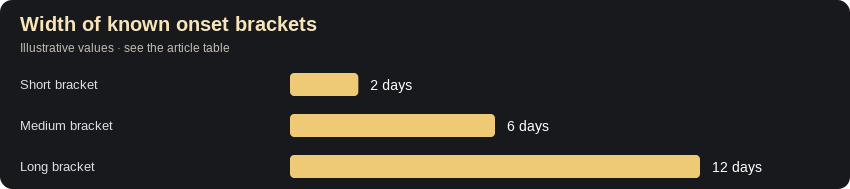
| Category | Value (days) |
|---|---|
| Short bracket | 2 |
| Medium bracket | 6 |
| Long bracket | 12 |
Illustrative only. Invented values, not taken from a source dataset or an official target. Use scheduled walkway inspections to bracket defect onset between last absent and first seen; retain left and right censoring and avoid midpoint dating without assumptions.
The walkway log says the first crack was found on Thursday. A field reviewer checked the same paver on Monday and recorded no visible crack. Those two entries tell us something good: if the same criterion applied, the paver was adequately visible both times, and the condition persisted once it appeared, the onset of the defined visible defect lies after Monday's negative check and at or before Thursday's positive check. The entries do not tell us that it began Thursday. They also do not tell us it began halfway between the two observations. The space between the visits is evidence of uncertainty, not a date waiting to be filled in.
Inspection systems have good reasons to store a first-found date. A crew needs to know when a condition was recognized, how long it has awaited review, and which report initiated the current response. The date is useful for all of that. It becomes misleading when a graph renames it as onset without qualification. Save the last comparable absence, first comparable presence, status of attempts in between, and whether either boundary is unavailable. The data can then describe discovery and bracket onset without confusing the two. This article uses a hypothetical appearance check on a walkway sample, not a diagnosis of structural condition or guidance for managing a potentially hazardous route.
Decide what appeared before dating its appearance
“Crack” can name several events. It might mean the earliest physical discontinuity of any size, the first mark visible under a defined inspection method, or the first observation crossing a grading threshold. Periodic visual checks ordinarily cannot bound the first microscopic change. They may be able to bound when a particular observable criterion was met if the observations are suitable. Write that criterion first. If the data support a bound on first occurrence of a clearly visible line across a specified area, do not advertise the result as the date the material first began to deteriorate.
An event definition also tells the team what counts as a valid negative. A photo from across the walkway might show the panel clearly enough to identify it but not resolve a fine surface feature. An inspector's note saying that they did not notice damage during a walk-through is not necessarily a targeted absence check. Neither is a picture of an adjacent panel. In a properly scoped observation the specific surface and feature in question must be observable to a degree that makes “not present by this rule” defensible. If the evidence cannot support that distinction, mark the negative boundary unavailable rather than using any older image.
Likewise, the first positive record should document the criterion, not merely carry a flag copied from another form. A seam, shadow or mark under glare might resemble the target defect in an image. A reviewer can keep the original ambiguous observation while recording a later first confirmed presence, or document a correction if the earlier evidence actually meets the same criterion after review. Which dates serve operations and which support chronology can differ. The first report of a suspected defect is not always the same as the first adequate observation of it.
The U.S. Census Bureau's Statistical Quality Standards offer a methodological analogy because they distinguish the definition of reference periods, measurement and processing issues, and the coherence of measures over time. They are not inspection rules for walkways. The transferable lesson is that a column's interpretation depends on its definition and collection method. A column called first reported and a column called estimated onset can both contain calendar values without supporting identical conclusions. The distinction should travel with downstream tables and figures.
Write the bracket the observations actually support
For a persistent visible condition, let the last valid negative observation serve as the lower boundary, and let the first valid positive observation serve as the upper boundary. Why use the last negative rather than the first negative after installation? The last supplies the tighter supported window. Why use the first positive rather than the date a reviewer later approved the ticket? The first valid positive already shows the condition had occurred. If the negative check happened at a known instant and ruled out the defined state then, onset falls strictly after that instant. At the upper boundary the condition was observed, so onset is at or before that instant.
For example, say a photograph made on day ten is a valid record of absence and a photograph made on day sixteen is a valid record of presence. A concise notation is “after day ten, by day sixteen,” or “(10, 16]” if the numeric endpoints are treated as observation times. Its width is six days. Keeping both dates is essential: a different interval of the same width might lie in an entirely different season. A report should distinguish timestamps known at the minute from dates recorded only at day resolution. It should not invent times of day simply because it can format them in a database.
The width itself reflects when one looked and successfully scored the condition. It is not how long the crack took to develop, how old it was when discovered, or how long it remained before someone acted. A twelve-day bracket may contain a quickly appearing defect or a slowly crossing threshold. A two-day bracket may occur in a frequently watched area even if its underlying process is identical to that of the slower-checked area. Comparing widths is mostly a description of uncertainty associated with the observation process.
This reasoning assumes that presence of the defined condition does not reverse before the first positive without historical information and that the records plausibly identify the same unit. If a panel is repaired or replaced between visits, or if the visible marker can appear and disappear under changing conditions, the interval may not describe the first occurrence since the starting point. Under reversibility, two endpoint observations show a change between the observed states without ruling out earlier episodes that were missed. Either formulate an event that is persistent over the relevant window or state the weaker conclusion and preserve known interventions.
An alternative question concerns onset of the particular episode ending in the first confirmed positive. A negative check can still help bound its start if there is evidence that the observed condition was absent at the lower boundary and that intervening changes do not undermine the proposed connection. That does not establish an earlier lifetime record. The exact wording matters: “the currently visible episode began sometime since the last valid negative” may be defensible where “this object never had a defect before” is not. The record should not use the term first without a scope.
Keep one-sided evidence rather than forcing every clock to have two bounds
The NIST/SEMATECH reliability handbook's section on censoring describes interval readout and other situations where failure times are not fully observed. The analogy here is that inspections reveal states at particular times. They do not continuously report the exact instant when the state changed. It is therefore possible to have a lower limit, an upper limit, both limits, or insufficient evidence even to use the available dates. Encoding that structure helps preserve what is known.
If the first suitable observation already finds the defect and no earlier valid absence exists, the evidence gives an upper bound, not a measured birthday. This is a left-censored case relative to the defined time axis. The event occurred by the positive observation; it may have occurred before monitoring began. A documented installation date might limit the plausible history if the unit's identity and condition at installation are known, but the date alone is not proof of a negative finding. Distinguish a true known event origin from an administrative start date that happened to be available.
If the asset has no observed positive through its last adequate negative, its event time, if the event later occurs, is beyond that last negative under the stated definition and assumptions. This is right-censoring. It is not evidence that the asset never deteriorates. The last scheduled visit might be later than the last adequate negative if a check was missed or visibility was insufficient. Reports that use the scheduled end automatically can overstate how long absence was actually supported.
An asset with no adequate observations at all deserves a different flag. The file may contain a planned start, a skipped middle check, and an unreadable final photograph. These dates show that monitoring was intended. They do not supply a negative or positive state and therefore should not masquerade as meaningful time bounds. Distinguish “never inspected adequately” from “last inspected and not found.” This difference is easy to lose when both are represented by a single blank in the first-positive column.
Set out the time origin before comparing ages. Calendar dates answer when something happened in a place. Time since documented installation can describe service age when installation and unit identity are known. Time since the first adequate negative describes a monitoring interval, which may begin well into an object's life. Those clocks are not interchangeable. An object installed years before baseline may already present a defect when first assessed. Automatically assigning age zero at the first form date hides the fact that much earlier exposure was unobserved.
Width of known onset brackets
This bar chart and table contain invented values only. They are not a dataset from the Census Bureau or NIST, official inspection intervals, or reports about any actual walkway. They show the elapsed days between the last qualifying negative and first qualifying positive in three different fictional examples. Each example is a bounded interval, so the one-sided cases described above are not part of this particular plot.
| Example bracket | Days |
|---|---|
| Short bracket | 2 |
| Medium bracket | 6 |
| Long bracket | 12 |
To make the subtraction checkable, imagine the short case has qualifying observations at elapsed days three and five, the medium case at ten and sixteen, and the long case at twenty and thirty-two. These are separate toy records. Day five minus day three is two, sixteen minus ten is six, and thirty-two minus twenty is twelve. In each pair the first time is a valid negative and the second a valid positive. None of the bars establishes the onset day; the chart does not show dates, only widths.
The labels short, medium and long are convenient display labels for the examples, not recommended thresholds. If the project needed onset information precise enough to distinguish the week before an event from the week after, the same length could be useful or inadequate depending on its endpoints and timing. A bracket that straddles the event cannot settle which side contained onset. A relatively wide bracket lying entirely afterward could settle the order even though it leaves much more uncertainty about timing. Preserve dates in analysis rather than interpreting width as proof of chronology.
The longer interval could reflect fewer inspections, lost image detail at an intermediate visit, or changed eligibility rules. Those are operationally different explanations for the same bar height. The chart cannot diagnose them without provenance. The editorial image of a paver and faint timeline-like shadows is not a study record and shows no actual elapsed times. Imagine using the table as a lesson in reading intervals, not attaching invented numbers to the marks in a picture.
Why the midpoint is a plausible guess, not a discovery
The midpoint is attractive because it lets a report store a single date and a chart put a dot on an otherwise empty timeline. For the six-day case, the midpoint is day thirteen. The observations give no special prominence to that day. If onset were modeled as uniformly distributed within the interval under appropriate inspection assumptions, its mean would lie at the midpoint. Uniformity is an extra premise, not the information supplied by absence followed by presence. Under another plausible distribution, onset might be more likely near either endpoint.
Inspection scheduling can magnify the cost of that assumption. If multiple assets are checked together once a week, every interval between the same two rounds shares a midpoint. A graph then displays an apparent burst of defects halfway through the week even if the events occurred at quite different times. The same thing happens with first-positive dates on inspection days. In each case the cluster may reveal the schedule rather than the process. A graph of first detections is useful if called that. A graph labeled onset needs a method that does not mistake common visit dates for synchronized changes in the surroundings.
Suppose maintenance researchers want to know whether a cold morning preceded a change. If the last valid absence was Monday and the first valid presence Thursday, a Tuesday cold morning could fall inside the interval. A midpoint calculation may place the implied onset on one side of that cold morning and make the ordering seem settled. It is not. If cold exposure is an investigated factor, show dates and boundaries together so a reader can see which cases establish ordering and which cannot. An observed event preceding discovery is not necessarily an observed event preceding onset.
Sometimes a midpoint is useful as one transparent sensitivity scenario or as a display aid clearly distinct from the original record. In that case preserve both bounds, label the imputation, and see whether the analysis changes when dates are placed closer to the early or late boundary or when an appropriate interval-aware method is used. Do not replace the authoritative observed dates with an imputed value. The midpoint can enter a derived table with provenance while the original history remains intact.
There is generally no finite midpoint for a one-sided interval unless another bound can be justified. Filling first-positive-only cases with their first date and all last-negative-only cases with the study end creates a data file in which the most poorly observed records look as precisely dated as the best ones. It may also move two very different kinds of case toward the same visit date. A report should not reward missing observations with the convenience of a point estimate.
If a colleague insists that a software field accepts only a date, decide what date it can accept truthfully. A discovery date is often a useful answer to that constraint. A spreadsheet can show bounds in two columns or separate tables can carry the detailed chronology even if a service-ticket interface uses only first report. Treat the software limitation as a design detail, not permission to redefine the event. When a derived date is unavoidable for a specific analysis, use another field clearly titled estimated by stated method and never display it as a measured date.
The bracket is only as sound as the visit history
Distinguish the schedule from the visits that actually happened. A Monday, Wednesday and Friday route may look like a tight set of opportunities, but one visit could be canceled or stopped before reaching the relevant panel. A valid negative on Monday, an unavailable Wednesday and a confirmed positive Friday give a Monday-to-Friday interval. Wednesday is informative about the team's opportunity to collect data and uninformative about presence of the defect. Recording both its planned existence and its actual status makes it possible to explain the observed span.
In a different case, Wednesday took place but the paver face was covered by water or a temporary object. Again it cannot narrow the window unless the method supports an adequate reading through the visual obstruction. It is worthwhile to distinguish canceled from obscured when reviewing operational problems. The first might be addressed by scheduling, the second by returning when the view is clear. Both are unlike an observed negative. A blank that stands in for all three makes the later analysis weaker than the original field knowledge.
Unscheduled reports are useful but should retain their source and meaning. A visitor might send an image with a trustworthy time and enough detail to identify the sample and condition. It can improve the upper bound if it qualifies under the observation rule. Another report may state there was a line without an image or clear asset ID, and may serve only as a flag for review. Do not require the field crew to ignore credible evidence just because it came outside the schedule, but do not automatically reinterpret every report as a same-quality measurement either.
Compare the definitions across visits. Suppose the first inspector logs only cracks exceeding a distinct visible threshold and the later inspector logs any thin surface line. A positive under the second does not necessarily contradict a negative under the first. A direct comparison needs the same criterion or an explicit bridge that uses available evidence to translate both observations. If archived evidence exists, a reviewer can sometimes reclassify both visits under one rule. If the relevant detail was never captured, the promising dates may not produce a valid interval for the revised definition.
Track the identity of the object in the record. A paving sample may be replaced with an apparently identical one while retaining a station label. A negative for the first sample and a positive for the replacement do not necessarily bound the occurrence on either object's lifespan. For a question about whether service conditions at the station changed, a station-level record might still be useful if replacement is explained. For a question about first onset in a particular unit, preserve panel or inspection-unit identity separately from location and note events such as replacement, patching, or a reset in the monitoring scope.
Object history, observation history and reporting history
Use three lines of time rather than giving one timestamp several jobs. The first line is about what is known or suspected to have happened to the object: installation, documented replacement, and the bounded occurrence of the visible condition. The second is about attempts to observe it: dates, observations, unusable views, and which method was applied. The third concerns the workflow: when the result was entered, reviewed, corrected, and shown in a report. The same date can appear on more than one line, but the record should not treat that as a guarantee.
Suppose a technician photographed a qualifying mark on Monday while out of network range, filed the ticket Tuesday, and the dashboard exported it Thursday. Monday is a prospective upper bound if the photo is dated and qualifies. Tuesday is useful as the first logged report, Thursday as publication time. This distinction allows a supervisor to estimate entry delay and still analyze observational evidence accurately. If a more recent audit examines the records, they should be able to reconstruct why a dashboard released Wednesday did not yet show the case even if Monday's observation already existed.
Corrections merit their own history as well. An earlier field photo can invalidate or narrow a reported window after review. That is welcome when the source is clear. It does not mean the system knew the revised bracket at the earlier publication date. Save the old and revised versions or a traceable reason for the amendment, and label any tables rebuilt afterward. A service manager may need to know both what the team saw at the time and what later evidence supports. One can be accurate about each without requiring them to match.
If observers only record dates, be explicit about calendar rounding. A check on Monday morning and the next on Thursday evening span more than three days, although the dates differ by three calendar dates. A daily figure can use day indices as a declared resolution. Do not stretch those indices into precise elapsed hours when timestamps were never saved. The same issue arises when a device uses a different clock or time zone. A project does not need unnecessary precision, but it needs to know how much it actually has.
How to display intervals without disguising missingness
The NIST/SEMATECH graphical techniques gallery is useful for exploratory thinking about sequence and variability. It does not prescribe the toy format or furnish any of its numbers. To visualize onset information, an interval line per asset can show the qualifying negative and positive times, and arrows or open ends can mark one-sided evidence. Distinct symbols can show missed or inconclusive attempts. A small figure might display representative examples rather than every unit, as long as the choice is clear.
A separate chart of bracket widths can highlight how monitoring quality varied. It should not include left- or right-censored records as though they had a known finite width. If many cases are one-sided, show their counts alongside the widths rather than leaving them invisible. A line for exact times can be adapted where exact times are actually observed, but those should not be suggested by single dots placed at every first-positive date. Good graphic design is useful partly because it prevents the eye from filling in assumptions the record has not made.
When comparing inspection groups, show how frequently each group could be checked and which planned checks did not yield adequate evidence. Strongly overlapping intervals mean the onset order may remain unknown even when discovery order is definite. Two intervals that do not overlap can sometimes support a robust order for those cases. This information gets lost when uncertainty is collapsed into the nearest date. A timeline that prioritizes endpoints may communicate less drama than a sharp peak and much more about the questions the data can answer.
Tables also benefit from explicit missing reasons. One can store an observation status, a censoring classification, and two optional time bounds in separate fields. A validation rule can require the upper time to follow the lower for a two-sided interval and require the correct one-sided field where applicable. Another can preserve which inspection events supplied those bounds. Do not assume a missing upper end means a valid right-censored record unless the lower end is based on the necessary adequate negative. Similarly, a missing lower bound means something different if no suitable positive exists.
Use the possibility of ordering, not an invented exact order
Imagine two fictional events. Asset West has a bracket extending from after day two to day eleven. Asset East was absent on day six and present by day eight. East was discovered first. Its onset may have been earlier or later than West's because both could have changed at several points in the overlapping window. A precise ranking of discovery times is legitimate. A precise ranking of onset times is not available. Keeping the wider record does not simply make the conclusion weaker; it identifies exactly which ranking can be defended.
Now change West's lower boundary to day nine while keeping its upper boundary on day eleven. Under the declared criterion, East's onset was at or before day eight and West's was after day nine. The relative ordering is now supported even though neither event was dated exactly. This example shows why the two bound fields are useful information rather than placeholders. The comparison can answer a clear question without requiring a model of what happened within either interval.
Similarly, comparing onset with an external event can often produce three classes: definitely before, definitely after, and not resolved from the bracket. Boundary conventions matter at the same instant; a statement that onset occurred no later than a positive check is weaker than saying it happened strictly before a simultaneous event. For calendar dates without exact time, treat claims about the order of two events on the same day carefully. A figure can show the comparison reference as a vertical line with explicit uncertainty where it crosses a bracket.
This can be applied to a summary without inventing exact dates. If a defined cohort has a set of confirmed cases whose brackets lie entirely before a specified inspection cycle and another set whose brackets overlap it, readers can see how many timings are certain and which are unresolved. A lower and upper range for the number before the cycle may be possible if enough status information is known. If uninspected or one-sided cases add further uncertainty, disclose how they enter the counting exercise. A range of logically possible counts is not a sampling confidence interval; name it accordingly.
One of the useful consequences is accountability for the phrase “after the change.” Maybe a dashboard shows a cluster shortly after a new inspection schedule took effect. The timely comparison could still be entirely about recorded positives, with many intervals beginning before the schedule change. Reporting both views allows an audience to see that the policy improved the timing of discovery or changed coverage without asserting it altered the incidence of cracks. A finer observation schedule may itself be a worthwhile improvement even if the actual onset process is unchanged.
Make the observation schedule part of the explanation
Inspection frequency often varies for understandable reasons. A well-used site may receive more checks than a less active site. An item about which somebody has complained may receive an unscheduled visit. In such situations the observation pattern contains information about context and possibly about latent condition. The fact that a method accepts intervals does not make a preferential inspection schedule irrelevant. If precise quantification across sites matters, assess whether checks are planned independently of the event process or whether extra attention follows suspicion of an onset that has not yet been confirmed.
A record of scheduled versus triggered inspections gives an analyst somewhere to start. Separate routine visits from complaint-driven ones in the descriptive display. If adequate records exist, a comparison restricted to the common schedule might answer a narrower question than the combined records and can serve as a sensitivity analysis. It may also discard useful positive evidence, so the report should be clear about why each view exists. Do not assume one view is always best; determine which operational or scientific claim is being considered.
For formal estimation of a distribution, use a method appropriate for the kind of censoring and observation design. The NIST reliability chapter gives examples of interval readout information feeding into likelihood analysis. Conceptually a bounded observation contributes the probability that the event falls within those limits under a specified model, not the probability of an imposed midpoint. One-sided observations can contribute information about occurrence before or after their respective boundary. That does not remove the need to justify model assumptions or account for observation selection and repeated measurements within locations.
When the amount of usable evidence is small, a transparent descriptive analysis can be the better answer. Present categorical timing results and pair plots rather than a model with parameters the inspections cannot support. Fitting a complicated distribution to a mixture of poorly defined records does not give those records a clearer meaning. Improve the unit identification, event definition and follow-up before expecting a model to bridge all of the gaps. The best defense against a misleading statistical result is often a simpler record of what actually happened.
Plan a handoff that preserves the useful uncertainty
The most valuable field in a new template may be the reason an observation did not qualify.
Before the next season, give staff a short definition of the visible condition and what counts as an adequately examined sample. Confirm how identified locations relate to actual units and how a replacement is recorded. Add distinct outcomes for absent, present, inconclusive, and no observation. Record important changes in version, condition or viewing method. These small steps make the last valid negative recoverable without imposing an elaborate technical workflow on every check.
An example handoff might say that the March through May series concerns first appearance under the specified visual criterion, while older pictures were not reviewed to rule out earlier damage. It might also distinguish a prior positive that left no matching asset record from a trustworthy one that could set a boundary. The phrasing helps people use the data product for the manageable task it answers. It avoids implying that everyone must know the whole history of the walkway before they can record one useful observation.
If the schedule creates brackets too broad for the real question, the team can redesign future observation windows. Think about when important comparisons are expected and whether the needed conditions can actually be checked. Increasing the number of scheduled visits without improving the ability to identify the mark might only create more inconclusive records. A pilot can reveal whether inadequate views, gaps, or changes of inspector contribute more to interval widths. Improve the weakest part of the observation process instead of treating every schedule problem as a need for more calendar entries.
There are also cases where a wider interval is entirely adequate. If the sole question is whether a defect emerged between two off-season checks, a short study may not need to place it more precisely. If the question is a work queue, the first confirmed discovery date may be the primary useful number. It is a mistake to insist on a model of onset when the decision concerns timely response to what was recognized. Good measurement does not demand maximal precision. It demands a clear relationship between the precision available and the decision at hand.
Before retiring an inspection sheet, test whether the new one can reconstruct several known scenarios. Give it a negative followed by a positive, a first visit that is already positive, a final adequate negative followed by an unreadable image, and a panel replaced between checks. A successful test preserves the evidence for each rather than forcing all four into the same onset field. Have someone who did not design the sheet explain each record back to the team. If their answer differs from what the observation supports, improve the labels or decide which information belongs in a separate field.
Retention also matters when a report is abbreviated. A summary can contain one row for the date a field team recognized an issue, one for the usable onset bracket, and a note on any missing evidence. The final dashboard need not display every source file or personnel record. It should retain a trace to the qualifying observations for authorized review. If archived photographs are shared more widely, keep the technical details needed to judge comparability while avoiding incidental information about people that adds nothing to the inspection.
A clear replay of one historical case may teach the process better than a formula alone. Start with the source evidence, identify which pictures concern the same object, read the stated definition, and point to the actual time at which each observation was made. Expose the gap where nobody could see the outcome rather than stepping over it in the narration. A reader can then understand why the interval is no wider than the qualifying observations require and no narrower than the evidence justifies. That concrete example can be archived with the monitoring definitions so the procedure remains intelligible after staff turnover.
The first logged crack is therefore not a disappointing imitation of a precise onset observation. It is evidence of discovery, and, with a comparable earlier absence, it supplies the upper end of a useful bracket. Preserve the last negative, the first positive, the observation conditions and the honest unknowns. A reader can then tell when staff found a change and what the record supports about when that change could have occurred. A date on a ticket can do its intended job without pretending to do the other one.