
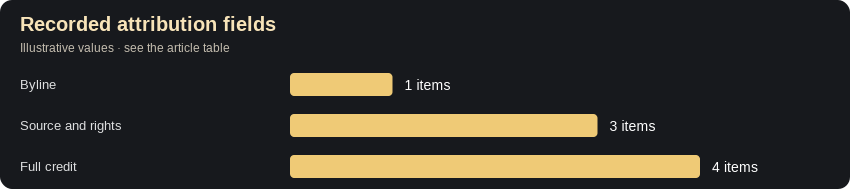
| Category | Value (items) |
|---|---|
| Byline | 1 |
| Source and rights | 3 |
| Full credit | 4 |
Constructed checklist scenario for this brief, not measurements, ratings, or results from cited sources. Each displayed count represents checked items in the named example.
The photograph shows a sparrow tucked under a bent piece of fencing. You can see the photographer's name in the corner, and the museum page that supplied the file has a Creative Commons notice at the bottom. A picture editor writes “Photo: Museum, Creative Commons” and moves on. Nothing about the resulting line tells the reader who made the photograph, which terms apply to it, or whether the museum's notice concerns the page's text rather than the image. A neat little credit has turned several open questions into one confident claim.
There is a similar mistake in the opposite direction. An editor can identify the photographer and the exact license beautifully, then display them beside a substituted photograph. A contributor might supply a better crop with the same subject and a similar filename. A content management system might retain a caption when the actual asset changes. Nobody has deliberately falsified anything, yet the credit has become false. A good workflow treats permission and attribution as properties of a particular work and version, not decorations attached to an empty frame on the page.
The useful way to work is to separate four pieces of information: who made the work or must receive credit, where the specific work came from, what rights or permission apply to this use, and what changed in the version shown. Those are practical categories, not a substitute for actual license terms. A particular license may ask for more than one detail in a category, or for something this simple scheme does not capture. The categories are a way to prevent an editor from treating a person's name as proof of permission, a provider as the creator, a credit as the source, or a crop as an untouched original.
Start with a photographer, a supplier, and one actual file
Imagine an editor assembling a newsletter about a community orchard. The file in the inbox came from an orchard coordinator, but a volunteer made the exposure. An online archive also has a smaller version, and a newsletter from a different group credits the archive. All three organizations could have legitimate roles in distributing the picture. None of those roles establishes that any one of them made it. Ask what the names mean. The volunteer may be the photographer. The coordinator may be the supplier. The archive may have created the catalog record. A signed agreement, direct permission or reliable license statement may identify another party with authority to permit reuse. Record those differences before compressing them into a line.
The result is not always a standalone personal name. A credited maker can be a team; a photographer can use a pseudonym; the licensor might designate an attribution party. Use identity from evidence, including supplied attribution instructions where appropriate, rather than expanding initials from a tempting social profile or substituting a public-facing brand for the name actually requested. If a credit must identify both an individual and a collection, give each a role or a clearly understood separator. A reader should not have to infer from the order of two names whether one person made the photo and the other scanned it, or whether they are joint creators.
The origin of the asset is often more specific than its host. Suppose you find a coral photograph through an image search. The thumbnail links to a lecture slide deck, which points to a paper, and the paper points to an image record in a survey archive. Save the source record for the actual work, including an identifier when available, and preserve enough evidence to explain how you matched your downloaded file to it. The search result is a route to the evidence, not the evidence that a license applies. If the paper shows only a crop of the image, do not quietly change the source in your record to the full original without verifying that your actual file is that original.
Sometimes the same composition appears in files with different dimensions because they are size variants of the same image. Sometimes the resemblance is a trap. A museum might show a historical print, a modern reshoot from the same location, and a digitally restored edition on adjoining thumbnails. An editor who infers identity from striped awnings or a familiar mountain can pick the wrong one. Document distinctive features, item identifier, and the rendition you obtained. For a local workflow, retaining a digest or immutable version identifier of the source file gives the editor a simple handoff check; it does not certify the accuracy of the source's authorship or rights statement.
A descriptive caption answers yet another question. It might identify a bird, a street, or the year represented. A byline tells the reader who contributed the image. A source helps locate the work. A license or permission statement tells the reader something about the terms under which it is being used. A modification note tells the reader what happened before publication. On a small page these can appear together, but their jobs do not merge. A caption with a photographer's name does not communicate whether a file is reusable. A statement that an image was reused with permission does not identify a species. Keeping each fact connected to its proper role prevents a surprising number of editorial errors.
What the four-item checklist is counting
This worked example uses four yes-or-no checks: byline or designated attribution; source identifier or link; specific license or permission basis; and a recorded statement about edits. The examples are constructed to explain a record-keeping choice, not results of an audit. Each named stage includes the checks from the previous one.
| Illustrative chart label | Checks present in this example | Count of recorded items |
|---|---|---|
| Byline | Creator or designated attribution | 1 |
| Source and rights | Attribution, source, specific rights basis | 3 |
| Full credit | Attribution, source, specific rights basis, edits | 4 |
The numbers are not a quality score, a measure of legal compliance, or counts from Creative Commons or another source. One of four boxes can contain a false statement. Four boxes can be checked while the wrong photograph sits on the page. A three-item record can be enough for some cases once the actual requirements and facts are evaluated; a more complicated case can need several records for a single box. The fourth field can contain an affirmative internal note such as “no editorial crop or retouch made” without requiring those words to appear in every public credit. The point of the chart is to make it obvious what an apparently complete byline still leaves unknown.
Another distinction follows from these examples. The record holding the facts and the credit the reader sees are not identical. The underlying record can hold evidence that is not appropriate for publication, such as a permission message or private contact channel. A public line can make sense without displaying every internal field. But information needed by the user of the image, or required to be conveyed under the applicable terms, cannot be left solely in private metadata. The publisher should determine what must travel with the image in each medium and format. The shortness of the printed line is a design constraint, not evidence that the facts were unnecessary.
Permission has a name and a scope
The Creative Commons overview of its licenses distinguishes several standard licenses. The family name “Creative Commons” is not a particular permission. A publisher needs to know the specific terms and version, and whether they go with this image. A license bearing an attribution requirement is not identical to one also including a ShareAlike, NonCommercial or NoDerivatives condition. Where a proposed use turns on the meaning of one of these conditions, inspect the actual legal code and resolve uncertainty instead of extrapolating from an icon or an acronym. The CC BY 4.0 legal code, for example, is specific to that license. It is not the legal code for every CC-tagged item in a folder.
Read the placement and scope of a supplied notice. A webpage may license the editorial text under one set of terms and exclude separately credited photographs. A catalog may make the metadata freely reusable while distinguishing the rights status of each digital image. An article may reproduce a stock image by private agreement even though the article text is under an open license. Start at the most specific evidence you have about the exact item, then read related exceptions or collection notices. When two statements conflict, do not pick the more generous one merely because it makes the layout possible. Save the discrepancy and have an editor verify the basis for using the image.
An organizational credit can also be a contractual requirement rather than a license announcement. “Courtesy of the Orchard Society” might be correct as a credit where the Society supplied a privately authorized image. It does not tell the reader that any person can reuse the photograph. A direct permission message may limit the intended outlet, print run, time, crop, image resolution or kind of promotion; none of that becomes a general CC license by adding a CC badge to the page. The reverse is also possible: a party can make the same work available through multiple arrangements. Record which terms the publisher is relying on for the specific use instead of claiming that every potential user has the same permission.
A link to terms is valuable only if it resolves to the applicable terms. See a common failure in print-to-web conversions: an editor types the correct abbreviation in a caption but links to the publisher's general terms page for convenience. A reader following the link finds conditions for the text and cannot tell what permission governs the photograph. Leave a link associated with the actual rights label, and where a separate source link is feasible, point that to the source item. These are two navigational destinations because they answer two different questions. A link to an archive's home page, or to a broad list of legal documents, is a thinner record than either one when specific pages are available.
If nobody can establish permission, record that fact with the level of certainty it deserves. A blank field, an “unknown” rights assertion, a public domain determination, and an open license are very different states. An inherited spreadsheet of public-facing photos sometimes marks everything in one visible folder “free” so the design team can finish. That converts lack of information into an unauthorized decision. Put uncertain cases in a review queue and use a separately cleared alternative if the project cannot wait. A refusal to publish one unverified image does not require abandoning the entire story or pretending the link has been verified.
Use a flexible template without weakening the facts
Creative Commons' recommended attribution practices organize a useful habit around title, author, source and license. The familiar initials are a memory aid, not the legal code. Record a supplied title where practical, even if it is not required as an attribution element under the version you are using. Some older versions and other arrangements have different requirements. For CC BY 4.0, read the attribution conditions to see what must be retained if supplied, including creator identification and other designated parties, notices and a practicable link or URI to the licensed material. That license also calls for indicating modification and retaining an indication of previous modifications when the material is shared. Requirements and how they can be fulfilled depend on the terms and circumstances, not on whether an in-house example fits in one line.
Imagine a fictional image titled “November Orchard,” credited by its provider to A. Field, on a specific item page with a documented CC BY 4.0 statement. A concise line might read: “November Orchard, photograph by A. Field, via Orchard Collection item 47, CC BY 4.0; cropped.” In a real web credit, the labeled item and the license would link to the actual destinations, and any additional required notices would be retained in a reasonable manner. The name and item description here are invented, not evidence that a reusable image is available. The example is valuable because a reader can point to each element and know what it is doing.
If the file instead came with direct permission for an exhibition leaflet only, keeping that first sentence and replacing the license label with “used with permission for this leaflet” may clarify the public situation, assuming that phrasing meets the actual terms. The archive might internally retain a date, permission source, designated editor, and scope. The institution should not tell visitors they may reuse the photo under a standard open license if it possesses only the right to print it in one leaflet. The difference is not stylistic. It affects what the next person is entitled to infer.
The same logic applies to labels that are more careful than “free to use.” A file can carry a public domain mark, a waiver tool, an institutional rights statement, or a note that the rights holder is undetermined. An editor should transcribe and interpret the actual statement rather than recast every asset into the only familiar license label. The CC overview distinguishes licenses from CC0, for example. A non-copyright statement or permission on the photo does not in itself establish that every person, artwork, logo, or sensitive situation depicted in it raises no other issue. For consequential or unclear uses, ask the person responsible for rights review rather than letting a copyright field pretend to settle all possible rights.
Typography can improve the experience. Place the credit where it can be found, label links by what readers will get, and avoid relying on color alone to signal that tiny credit text is clickable. Credit can be adjacent to the image or in an accessible figure list if the applicable terms and medium allow. A mouse hover does not work for everyone, and a visually neat caption which vanishes in a mobile view is not useful public attribution. Print can use readable supporting references rather than requiring readers to decode a dense string in the margin. Test the format people will actually receive instead of approving only the desktop editor.
The frame on screen is not necessarily the file you obtained
An editorial change worth recording can be as simple as removing the outer edge of a picture. A crop changes which evidence the reader sees. Consider a photograph taken in a wet meadow. A horizontal header crop removes the waterline and makes the bird appear to stand on dry ground. Nobody altered the bird. The crop still changes the impression made by the image. A useful editorial record identifies the derivative and the change, and the publisher can show a full view or add context where it matters. License compliance and editorial integrity overlap here without being the same test.
Many edits are less conspicuous. White balance adjustments can change how a specimen's colors appear. A rotated horizon changes the orientation; a flipped image can make a landmark appear on the other side of a river. An overlay can accidentally look like original text, and stacked photographs can look like a single continuous scene. Make an edit note specific enough to distinguish a size conversion from a change to presentation or content. An internal log can keep additional details such as frame coordinates, transform identity, or a description of a restored region. Do not market a reconstructed part as if the photographer recorded it.
Keep source and derivative distinct before deciding what to say about the change. Size variants automatically exported for responsive layouts can be several binary files and nevertheless be renditions of the same approved crop. An art-directed layout might serve a wide original on desktop and a close crop on mobile. Those variants need accurate records and, where appropriate, modification indications that cover what the visitor actually encounters. A single file-level editor note that says original, applied indiscriminately to all variants, is almost guaranteed to become wrong eventually. The asset system should be capable of associating each meaningful derivative with the source and the underlying edit record.
The legal treatment of a change can depend on the action, applicable license terms, and the underlying law. Do not assume that writing “cropped” grants a permission that did not exist. In particular, a NoDerivatives restriction is not satisfied merely by acknowledging an edit if distributing the resulting material is restricted. Conversely, do not declare every format conversion or technical operation equivalent to distributing an adaptation without checking the actual terms and facts. The practical gate is simple: before publication, identify the proposed alteration, confirm that the rights basis covers it, and record and communicate changes as appropriate. When that cannot be confirmed, use a permitted rendition or get the right review.
Sometimes changes happened upstream. A historical photograph might have been restored before a collection made it available, and the supplied record may indicate modifications. The editor's task is to preserve that information where the terms require it and to avoid contradicting it with a claim such as “shown as captured.” If the archive published a monochrome negative and a third party separately supplied a colorized version, their rights and provenance may need separate analysis. An internally recorded “no changes by us” is not the same claim as “no one changed this image.” That small distinction matters when a published file circulates outside its original context.
A metadata record should not be a prose caption in disguise
The IPTC Photo Metadata User Guide describes distinct fields used in image workflows for such things as creator, source, credit line, copyright and rights information. A helpful in-house record can follow that separation even if the software does not implement every standardized field. One field identifies the exact asset or work. Another identifies the creator and any additional credit parties, with distinct roles. Another identifies the supplier and evidence location. A separate field represents the actual rights status and its scope. The formatted credit line then expresses the facts already recorded rather than functioning as the only place anyone wrote them down.
Consider how a newsroom might handle a correction. A find-and-replace operation on the public credit might solve today's embarrassment. If the original creator and source are embedded as one sentence inside a presentation template, the next syndication job will reproduce the old mistake. Treat the structured record as the place to correct factual identity, then update every presentation that consumes it. A publication-specific credit override may still be needed for space or exact grant wording. Track why it exists, which assets it affects, and when to retire it. Otherwise overrides become a second, unmaintained set of facts that happen to look newer.
There are good reasons to store both embedded metadata and a repository record. Embedded metadata may travel with downloads and files sent to other editors; the repository can hold version history and permission evidence and can generate responsive credit displays. Neither is proof that the other is synchronized. Optimizers can remove embedded fields, some programs change which metadata survives a save, and publishers may intentionally strip sensitive tags. If you expect a downloadable JPEG to carry specific credit information, inspect the actual downloaded copy. If a page credit must remain available even when the file is compressed or resized downstream, verify its public placement separately.
Privacy is a reason to avoid mindless metadata replication. Information given to the archive for contacting a contributor may not be meant for publication. A permission email can include phone numbers or names of uninvolved people. Location tags may expose the location of a threatened species. Have a public-safe set of fields and a restricted evidence record. Do not use a privacy rationale to strip applicable rights information silently. Keep the necessary attribution and license material in a form readers can find, while keeping genuinely sensitive material out of public downloads and public HTML. Check both categories before an export is approved.
Retained URLs need a little maintenance. Save the verified link to the source item and the actual terms, recording when you checked them and where the scope is explained. If an archive moves to a new site, an identifier can help reconnect a broken link. A carefully retained evidence copy may be useful for internal review where policy allows. It does not become publicly distributable just because a link breaks. If the current page contradicts the older recorded statement, do not silently edit the license field to whichever is convenient. Escalate the discrepancy, preserving what is known about which statement covered which version and use.
The record has to be usable by a person who was not present when the photograph arrived. Suppose a small magazine changes editors during a long feature. The first editor knows that a label reading “River Group” stands for the provider, not the photographer, and that the squared thumbnail was already edited by that provider. An incoming editor may assume the exact opposite. Factual role labels and a clear asset identifier are cheaper than an hours-long recovery of informal knowledge. The best structured record does not merely make a publishing system happy; it makes the next conversation intelligible.
Follow the credit through an editorial revision
A photo credit can fail between a draft and the finished page without anyone touching the credit field. Imagine the first draft has a verified landscape photograph. A mobile preview then reveals that the subject is too small to see. During the next design pass an editor inserts a portrait-format frame from the same field trip. The filenames end in consecutive numbers; the photographer is the same; the supplier permission explicitly listed only the first file. The page still looks consistent. An asset revision check catches what spelling and link checks cannot: approval to use one frame was inherited by a different frame without evidence.
Start the handoff at the work identifier or source version, not at the slot on the page. When swapping the image, check the incoming rights record even where no visible caption changes. When replacing a derivative but keeping the same source, check whether the edit description changed or needs to appear in another format. If a preview uses one asset and the publish system uses another, compare what the audience actually receives. It is not enough to see an approved source sitting in the project folder if the production path points elsewhere. These checks are especially important in layouts with duplicated mobile and desktop blocks, where changing one variant can leave the other credit or image stale.
When a composite combines more than one photograph, the single caption becomes an unreliable memory. A field image, background, and inset may each have a different permission basis; some may be photographs and others drawings or scans. A simple placement register can identify each component, the precise source, its author and applicable conditions, and the derivative in which it appears. A reader-facing credit can then follow the order of the placement, such as left, right and inset, with appropriate links or an accessible figure list. A general statement about the publication cannot silently apply one photo's license to the others. Decide how to credit a composite before getting too attached to the design.
Social previews, syndication packages and slide decks can create additional contexts. A story page might contain the full credit while the downloadable image used for social promotion circulates alone. The terms or permission may require credit to travel with that use, and a private license for the story might not cover promotion. Check both what is permitted and what information a reasonable viewer can find in the particular channel. A syndication package can supply source elements and publication instructions alongside the file, but passing them to an intermediary is not evidence that any downstream display is compliant. The workflow's claims should stop where actual verification stops.
The same separation improves error response. Suppose a photographer contacts an editor because the listed name belongs to another contributor. The immediate task is to identify which variant appeared and where, then update the record and the relevant outputs once the facts are verified. If the photographer raises a permission issue, a spelling correction is not enough. Preserve the evidence, consider pausing affected distribution, and send qualified reviewers the actual rights record rather than assuming that the most prominent credit proves authorization. An accurate correction can say what changed without publicizing a private exchange or repeating an unsupported allegation.
None of this is an argument for collecting paperwork for its own sake. The more reusable the record, the less work each legitimate use requires. When a quarterly newsletter is compiled into an annual archive, for instance, an editor can quickly distinguish a CC-licensed still from a portrait cleared for a single issue. Where the annual format is allowed, the structured record supplies consistent attribution and any changes needing mention. Where not, it identifies exactly which asset needs new clearance or replacement rather than forcing an editor to revisit every photograph from scratch.
Work four fictional cases before release
The first case is an archive mirror with a single generous footer. The source page obtained from the mirror displays a moth photograph and a footer saying the website's documentation is reusable. The image has no visible item identifier, and the photographer's name is readable in one corner. The right response is not to remove the name or credit the mirror. Preserve the evidence of the version obtained, look for the original specific item, and do not treat the documentation footer as permission for the photograph. The photographer's visible name may be a strong lead for attribution, but the image remains unverified for the proposed use until an applicable rights basis is established.
The second case is a cleared campus photo with a precise license statement. The item record names a photographer, requests a collection attribution, and states that the photo is under a specific CC version. A copy editor likes an uncropped image on desktop, while the mobile template trims both sides. Record the identified source and terms, confirm that the proposed presentation is permitted, and keep the underlying credit connected to both outputs. Where required or editorially appropriate indicate how the presentation changed, with enough specificity to avoid falsely labeling the other version. If a portion of the credit is moved to an accessible credit list, check that a user can actually reach it from the relevant figure or publication.
The third case is a gift accompanied by limited permission. A contributor sends two uncompressed images of a family collection. The contributor permits both in an internal educational handout and asks to be identified by initials, but does not consent to broad online posting. The files contain full names and exact neighborhood coordinates. Treat the limited grant, requested attribution and private metadata separately. A public display is not cleared merely because the recipient could make polished, smaller versions. For a permitted internal export, verify that the private information does not go beyond what the authorized purpose needs. Keep the material and evidence in the appropriate part of the system rather than distributing the permission correspondence with the images.
The fourth case is an old slide and a recent interpretation. An archive makes a scanned black-and-white image available with a work-specific rights label. A later illustrator adds speculative color and shares a version through a popular gallery. The editor wants to use the latter to explain historical dress. The source of the scan can still be useful evidence, but its rights label cannot simply be copied onto the later rendition or used as proof that distributed color is historical evidence. The editor needs to identify the particular derivative, the origin and permission for relevant contributions, and a clear statement about the coloring. If the question depends on documentary color, an authorized black-and-white source plus a carefully supported explanation may be the more honest choice.
All four cases depend on scope. The most reliable way to spot thin evidence is to ask what concrete thing the record allows a colleague to check. Can a colleague identify the distinct work? Can they tell which statement applies to it? Can they locate the referenced terms or review a permitted internal grant? Can they identify what the copy being distributed actually represents? A placeholder answer might do for a design mockup, but the workflow should prevent placeholder rights fields from looking like release approval. A placeholder note and a release record should be visibly different inside the tools the team actually uses.
Release checks that matter to the next reader
Try starting final review on the public-facing surface rather than in the master spreadsheet. Open the preview the way a reader would and choose a figure at random. Verify the public words and links against the specific item and intended rights record. Change the viewport or test the downloadable format if it has its own rendition. Look at more than the easiest figure. Review at least one updated asset, one cropped or combined image, one privately cleared item if present, and one image with more than one attribution party. Sampling does not excuse neglect of exact required notices, but it can reveal systematic failures in the tools carrying them to the page.
Then make the release routine explicit for the team. Assign who enters creator and source, who has authority to assess permissions, who documents revisions, and who evaluates what the audience can see. Small teams can assign several roles to one person, but the checks remain separate. If a request arrives late, a layout editor can substitute an already authorized image rather than invent a new permission. When an item has to wait for review, identify the concrete unresolved fact: the edit grant, the identity of the work, the link to terms, or a conflict in the supplier's instructions. A targeted hold is more useful than a vague label reading “legal pending.”
A clear credit can invite curiosity about the image. It can take a reader to other pictures by the same maker, a field observation they want to inspect, or a specific license they can understand. A misleading line does the opposite. It breaks the path between work and maker precisely at the moment someone wants to follow it. The best result is not the longest line beneath the sparrow. It is a line whose parts can be traced to an identified version and whose permission claim says exactly what the evidence supports.
Make it possible to export the record
A sensible final test is to send the image record across a boundary within the editorial workflow. Consider a small desk that stores permissions in its content system but gives its print designer a folder of files and a single spreadsheet. Export the asset identifier, filename or rendition identifier, approved public credit, source link, license label and terms link, and any meaningful modification statement. Leave supporting correspondence in the restricted system. Ask the print designer to match three files against the export and independently explain where each credit belongs. Any filename collisions or missing linked inputs will become obvious before the files are laid out.
Handle imports with equal care. An incoming credit column might mix agency names, notices and photographer names in one string. Preserve that supplied line as evidence, then enter confirmed role data separately rather than splitting blindly on the first slash. If the display text cannot be linked back to a source, flag the mismatch. Even a simple export can distinguish an intentionally empty field from an unchecked one by including a status and a short reason. That distinction saves a colleague from guessing whether no changes were documented, the original was not inspected, or the modification field was simply skipped.