| Category | Value (records) |
|---|---|
| Exterior only | 10 |
| Entry seen | 4 |
| Internal evidence cited | 2 |
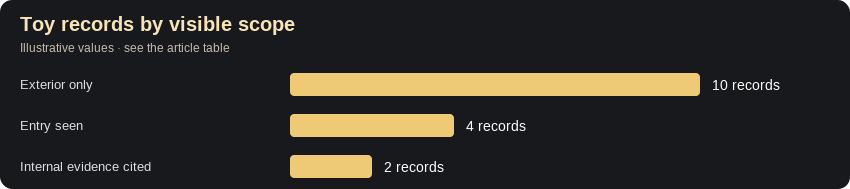
Illustrative values, not sourced observations. Invented example for the stated comparison; not a biological threshold, ecological estimate or observed dataset.
A small insect reaches the end of a fig, moves among the folds near its opening and disappears from the exterior view. It is a remarkable event to catch. It is not a film of pollen reaching a flower. In a fig the flowers face an enclosed interior. The small entrance is important because it connects the outside to that interior, but it also hides the very actions an observer may wish to describe. A view of an insect approaching it, a view of an insect entering it, and evidence about pollen inside belong in different sentences.
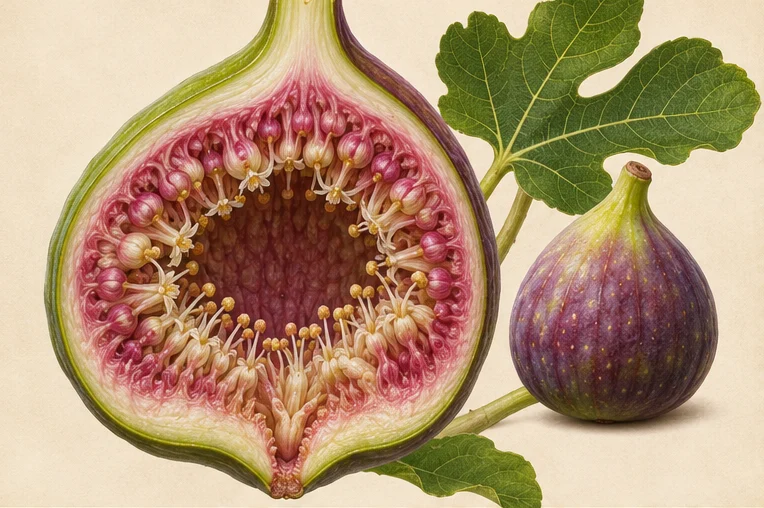
An existing botanical cutaway can show why the distinction matters. It can reveal the relation between the narrow passage and the many small flowers grouped within the enclosing structure. It cannot show that they were reached in the exterior clip. The best use of the cutaway is to map a question: where does the exterior observation stop, and what other evidence would be necessary to say something about an interior event? The cutaway makes a hidden system intelligible without turning anatomy into a guess about what happened on a particular branch.
Read the cutaway as a map, not a live sequence
The fig structure discussed here is a syconium, a specialized inflorescence with flowers facing inward. The bract-lined opening is called the ostiole. In a published section or a careful illustration, the entrance can be drawn in relation to the enclosing wall and the flowers. A generic drawing can convey that overall organization while omitting differences among species, between stages, and among parts of an individual fig. Its proportions should not be used to identify a particular insect or estimate how far an insect traveled during ordinary observation.
Keep several objects distinct when looking between views. The external point at which a passage might begin is not the whole ostiole. The ostiole is not one internal flower. The enclosed space does not itself identify what an insect touched. A flower's receiving structures are another level of detail. In a caption, the word inside can refer to anything from passing out of view among outer bracts to reaching the cavity or making contact with an internal flower. Name the endpoint actually supported by the evidence. A label such as “crossed the visible entrance boundary” is useful precisely because it does not imply every further stage.
The drawing is most informative where it separates things that might otherwise appear continuous. A clean line from edge to cavity could wrongly suggest a fully exposed tunnel when the bracts and angle conceal much of the path. A bold arrow toward the flowers might imply a wasp followed that exact route. Use lines and arrows to identify anatomy, not to stage an unwitnessed action. Differences in scale between an exterior inset and a section should be apparent. If the source describes a particular species and phase, give that context rather than treating it as a universal cross-section of all figs.
In this article the art is illustrative. It is not a dissection of an observed fruit, a specimen record or a view into a private plant. The method for an ordinary reader is to compare a permitted exterior view with already published anatomical material. It does not call for collecting or cutting figs, prying apart an ostiole, opening held fruit, catching insects, or changing the access of visitors to a plant. A study need not provide its own internal view to explain why an external observation has a boundary.
Toy records by visible scope
The chart and table show identical invented values in records. The example uses one assigned scope per record. “Exterior only” means no qualifying entry was established from the exterior view. “Entry seen” means a defined crossing into the ostiole was visible without separate event-linked evidence about the interior. “Internal evidence cited” means a record expressly refers to an existing source that documents some internal feature or finding. The third category is a provenance category, not a way to claim that the observer had an internal view of the photographed fig. The values are not sourced observations, biological thresholds, or an estimate of any ecological event.
| Recorded scope | Records |
|---|---|
| Exterior only | 10 |
| Entry seen | 4 |
| Internal evidence cited | 2 |
The three categories contain sixteen illustrative records. The four entry records do not establish four cases of pollination, and the two records with cited material do not establish that two additional live insects entered. Citation and observation have different functions. In a real project the cited material would often live in a separate reference table and might support many field notes without adding a single observed visit. The combined chart works as a teaching device only because its unit is clear and its label concerns record scope rather than insects, figs, or pollination events.
Exterior-only does not mean no entry occurred. It can mean the opening was not resolved, the insect passed behind a surface, the encounter ended before the relevant moment, or entry was not visible within a qualifying view. Store those details separately if the project will compare frequencies. A tally of what was documented can be honest and useful without pretending every blank in the record describes a biological absence.
Separate the crossing from the disappearance
An observation of entry is strongest when the approach, the opening and the crossing can be followed together. If the camera sees the insect on the exterior and then loses it at the edge of the frame, call that loss of visibility. If it moves behind a projecting part of the fig, the missing part could conceal entry but might conceal another exterior route just as easily. A credible note can include a possible explanation without assigning it as a positive event. Define entry by what has to be seen rather than by what usually happens according to a guide.
The angle helps establish whether an opening lies at the point of disappearance. A small dark area in a photograph may be a shadow or a crease rather than the expected anatomical feature. Use a wider view to identify where on the fig the activity occurred, and keep a close view for the details it actually resolves. Do not attach a close image from a different time or specimen to an event without saying it is only contextual. A consistent match between the images requires more than a similar-looking opening. If the relevant frame is blurred, it stays unresolved even if the rest of the sequence is excellent.
Entry can have several plausible operational definitions. A basic exterior watch might count the animal visibly crossing the outer boundary. A study of route completion would need evidence about reaching a different internal endpoint. Choose a definition appropriate to the available evidence and use words that name that boundary. “Entry at the exterior opening” is a reasonable statement where the crossing was clear. It is not the same as a complete passage through the ostiole. These are different endpoints even though they lie along the same route.
Distinguish the direction of movement too. An insect appearing at the opening may be arriving from elsewhere on the exterior or emerging from a concealed region. A single still near the entrance is not evidence of inward travel. A sequence can establish direction if it resolves where the insect was first visible, the direction it moved and any gaps. Do not reverse an ambiguous event to suit the expected biology. A collection that can identify approaches but not crossings still supports a useful description of where insects appeared and moved.
A particularly strong record does not need to force certainty about every feature. It might say that a small insect moved from the exposed surface into the visible opening and was not seen farther inward. The event time is known, the plant was identified to a reliable level, and the insect was not. That is more useful than “pollinator entered fig” if neither insect identity nor pollination was established. A narrow positive claim and explicitly unresolved fields can coexist on one line.
Do not use the host to name an unresolved insect
Host association is relevant context, not a field identification by itself. Some pollinating fig wasps have close host associations and adaptations for entering figs and carrying pollen. That does not mean a small insect near a fig must be a particular pollinator. The review Speciation in fig wasps, by Cook and Segar discusses variation in host association, pollination behavior and diversity among pollinating and nonpollinating fig wasps. It is an author synthesis of research on the system, not direct evidence identifying the visitor in a new exterior record.
Use original comparative studies when a specific claim needs them. The original work comparing cryptic fig-pollinating wasp species investigated limits of a one-host/one-pollinator assumption in its sampled systems. The existence of exceptions is reason to avoid compressing the relationship into a universal pairing rule. It does not say every fig has several pollinators, and it does not establish which species participates at a particular site. A beginner's photo can support an exterior behavior at a broad identification level without providing the morphological or other evidence a species assignment would require.
Be as careful about the plant. A common name can cover several species, and an image that concentrates on a wasp may omit identifying features of the plant. Keep an identification confidence and source separately from the behavior fields. A local sign may be useful context if it is clearly associated with the plant, but it does not document an internal stage on its own. Scientific names from a cited anatomical plate should not be applied to the watched plant merely because the shape is similar.
Distinguish what the fossil demonstrates from what it suggests
The original fossil evidence for ancient fig wasps is an especially clear example of the distinction between anatomy and action. The authors compared ancient specimens with more recent and living fig wasps and described features associated with passage into figs and pollen transport. The indexed article and its figure descriptions identify images of fossil pollen in a pollen pocket. Features and their placement are observations in the fossils. The behavior they support is an inference established by comparison, not a film of what happened in an ancient fig.
The researchers interpreted the combination of traits as evidence of a long history of this association, on the order of at least 34 million years for the evidence emphasized in that paper. That is not a measurement of the exact date at which the association originated. It is not a statement that every living fig and wasp pair has remained unchanged or co-diverged without host shifts. The fossil can preserve meaningful details while leaving many individual events and historical transitions unobservable. This is an example of strong, properly bounded inference rather than a reason to distrust anatomical studies.
A useful reading exercise is to attach a verb to each piece of evidence. A figure may show a small pollen grain in an examined structure. A comparison may identify a match or resemblance to reference material. The authors may infer a function or association from the combination. Those verbs should not be collapsed into “the fossil shows the insect pollinating a fig,” unless the actual evidence reaches that action. The paper is powerful because it explicitly links specimen anatomy and comparative evidence. Its value is not enhanced by pretending a reproductive event was directly captured.
Modern evolutionary work is also about distinct propositions. A study can find alignment between parts of host and wasp histories while still allowing duplication, shifts or other differences. A primary comparison of histories among fig-associated wasps examined cases involving both pollinating and nonpollinating groups. The result concerns modelled histories and relationships in a defined set, not a general rule for naming an individual at a doorway. Distinguish a coevolution hypothesis from an identification key. An exterior view of one plant cannot settle either the ancestry of its visitor or the full history of the interaction.
Keep floral stage independent of the behavior you want to infer
A fig's stage is biologically significant, but an exterior observer may not be able to assess it in the same way as an anatomical study. A project can describe visible condition or cite a known stage when an authoritative observation established it. If the stage cannot be resolved from the available evidence, record the uncertainty. Do not label the fig as ready for pollination simply because a visitor was seen at the entrance and then use the assumed readiness as evidence that the visit was pollination. That argument uses the same viewing event twice.
To follow the visible development of a fig, keep time, identity and exterior features in separate fields. A new image may show the same branch but a different fig. One plant may have multiple relevant structures at once. If photographs are compared later, identify the actual match or say where it is uncertain. A diagram of an inflorescence at another time or from another species is contextual evidence. It cannot set the stage of the one visible in a camera frame. Use a stage label only when the terms and specimen basis are clear.
A single image also cannot normally show a transition. Seeing an opening and a small insect nearby at one moment does not say whether the insect arrived recently or had been there earlier. Seeing a later fig of a different apparent size does not prove that the observed insect contributed to that development. Other events could have occurred between views, and the two subjects might not have been matched correctly. Track the sequence where the record supports it without converting a decision about ordering into biological proof.
There is room for useful uncertainty in a stage-based comparison. A project might compare approach behavior to structures with a clearly visible exterior feature, and leave interior stage unknown. Another might summarize events from a research archive with independently documented stages. Those projects have different evidential scopes. Do not compare them merely because both use the same label for a generic open or closed view. State what criteria each used and what class of fig was included.
Make an evidence ladder that stops where your record stops
At the first level, the record shows a fig exterior or a candidate opening. At another level an insect approaches a named region. A stronger exterior record can show a qualifying crossing. An internally documented record can show a structure or an insect location if the source actually measured it. A record concerning pollen has to say where it was found or transferred. An outcome concerning fertilization or seeds requires still different evidence. These are not grades for the quality of the photographer. They describe which claim is within reach.
The difference between pollen carried and pollen deposited is particularly important. Research may identify pollen on an insect or in a structure associated with carrying it. That shows transport potential or recorded carriage under the circumstances. It does not by itself prove transfer to a receptive internal surface in the particular fig of interest. Evidence of pollen deposited in a designated place is a stronger result about transfer, but reproductive outcome is a separate question. Use the most specific action already supported rather than jump directly from entering to fertilizing.
Do not interpret visible insect behavior as an obvious reproductive role. Some species associated with figs are not their pollinators, and ecological roles can require study of where development and interactions occur. A visitor at the exterior does not tell a reader whether it used the opening, encountered any flowers, carried pollen from the relevant host, or contributed to reproduction. One reason the fig system is scientifically interesting is that these associations can be close and varied at once. Refusing to force an identity into an ambiguous record preserves the opportunity to ask better questions about it.
A later plant outcome can be interesting and still not close the chain by itself. Suppose one fig is documented in an exterior image and a later photograph shows a developed structure at a matching location. Even if there is a good identity match, the later state is not proof that the insect from a particular earlier visit caused it. Other interactions and unobserved steps can intervene. If the study specifically links a later outcome to an experimental or observational design, explain that. If the only link is temporal order, report temporal order.
Use published sections with the same care as exterior images
Check who made a source image, what it depicts and how its claims were established. Original research figures and their captions may identify a species, a particular phase and whether the image shows an individual specimen or an interpretive drawing. A cutaway in an educational account can clarify the basic plan but may deliberately simplify proportions. Retain the distinction. If several sources show interiors, the easiest-to-read graphic may not be the right one for making a species-specific claim. A useful digest can describe the anatomy based on research and leave detailed artwork clearly illustrative.
If you reproduce a schematic in your notes, identify the observation boundary and the separate anatomical information. One panel might show the intact outline and the place where the camera lost the insect. Another might show a generic section locating inward-facing flowers. Do not draw a continuous tracked path through both panels unless the underlying evidence actually continues. Different visual styles, captions, or labels can make the line between observations and interpretation clear. As with all diagrams, any arrow should be interpreted according to its legend. An arrow labeling an entrance and an arrow showing recorded motion are different claims.
A photograph and a plate can have different units of observation. The photograph might represent one timed encounter. An anatomical plate might represent one part of a different specimen at a different instant, or a general synthesis of several examples. An original fossil figure might document a specimen in deep time. These records can all support one article because they answer different questions. They do not form one sample to use in a frequency calculation. Keep a reference index or note so someone reviewing the observation can see which context came from the literature and which came from the encounter.
The distinction also helps when an external view seems to disagree with an illustration. That difference could reflect species, phase, perspective or simplification rather than an inaccurate observation. Do not redraw the observed opening to match the illustration or use the illustration to “correct” uncertainty about the image. Compare equivalent views where available and describe the mismatch elsewhere. A visible shape may be reliable while anatomical interpretation is limited. The goal is to learn from both records without reducing one to a substitute for the other.
Design a watch that does not need to open anything
Choose an ordinary, permitted viewing position that lets you see the relevant exterior without leaning into a planting or disturbing the animals. Select a defined time or naturally occurring sequence rather than approach a fig solely to make movement easier to see. If the entrance is hidden from that position, record exterior only or an unresolved view. A limited view is a valid outcome. Do not change the plant, remove material, capture visitors or introduce a device into the opening. The interior questions in this article are answered from existing published materials, not by obtaining new internal samples.
An observation form can include place and tree identifiers at an appropriate granularity, time, specimen match, visible feature, insect identification confidence, movement direction, and where the track was lost. Add fields for whether an approach or crossing was assessable, observed, not seen under adequate coverage, or unassessable. Keep elapsed coverage and actual event durations distinct. A short clip beginning before the crossing can say more about movement than a much longer still scene that never resolves the opening. Duration alone is neither a quality rating nor a measure of biological activity.
If observing several figs, decide how to distinguish one encounter from multiple events. An insect that disappears for a moment and is then seen on an adjacent surface may be the same individual or not. Avoid reporting unique visitors if identities cannot be followed. A separate camera crop of the same approach does not create a new encounter. Use event identifiers and compare times and visible trajectories before combining views. If two records cannot be linked, keep them separate and describe what each shows rather than splice an arrival and departure into an invented inside interval.
Observation windows should be described with their limitations. A frame that shows all of the relevant side of the fig can still miss a tiny, fast-moving insect. A close image can resolve a surface yet omit the approach. If a watch is interrupted or conducted around only the most convenient edge, state the scope. Do not fill the other surfaces with zeros. Comparisons between sites or stages are particularly sensitive when one group provides consistently better sightlines. A simple descriptive record can be valid and still unsuitable for estimating entry rates generally.
Ask how the field record and source note are linked
One possible dataset has a table of events and a table of references. An event row can indicate an exterior region and capture time. A source row can identify an anatomical feature, research measurement, or evolutionary inference. A join can show which source informs the interpretation of which event. If one anatomical figure helps a reader interpret twenty notes, the join should not create twenty observations of internal flowers. Preserve the distinction in both arithmetic and language. Citation increases explanatory support; it does not create samples.
Use evidence fields precise enough to identify what the reference contributed. “Anatomy cited” could mean a section documenting the relation of the ostiole to the inner cavity. “Comparative behavior cited” might mean a published demonstration of a pollinating group's role in its studied host. “Event-linked interior evidence” would imply a direct link to the same observation and should not be used for a generic reference. No such event-linked interior data are supplied by the illustrative chart. An article can be clearer by stating that explicitly instead of leaving readers to infer it from a footnote.
Often the data would be more interpretable with independent tags rather than exclusive categories. An exterior event could be recorded while a source cited in its notes explains the anatomy. One flag is observational and one bibliographic, so both can be true. The toy display uses exclusive record summaries for a readable teaching comparison. If a real display uses overlapping flags, say whether totals can exceed the number of records. If a real display uses an exclusive hierarchy, document how a note with several flags receives its main label. Changing the display hierarchy should not rewrite the underlying observations.
Check a few plausible interpretations against the actual view
Imagine a fictional photograph of a fig exterior with a small insect facing a dark crease. No evidence shows the crease is the ostiole or the animal moved toward it rather than merely stopped there. The photo is useful as a location and appearance record. It does not support entry. Next imagine a continuous sequence where a stable, independently recognized opening stays in view while the insect crosses from the exposed surface to the visible boundary and disappears inward. This can support entry under the exterior rule even when not enough detail is visible to identify the species. Neither event has become an internal record.
Now add a published image showing internal flowers around a cavity. It makes the second sequence easier to explain because readers can see where the passage leads in the illustrated structure. It does not change the observed endpoint. Finally add a well-documented original research finding that pollen of a particular form was identified in a fossil carrying structure. That is valuable documentary evidence of a different time and specimen. It clarifies how anatomical evidence can support an inference about the relationship, not how a live insect was shown to complete a particular trip. A strong article can make all three connections without treating the three pieces as interchangeable.
A reviewer can reproduce this reasoning by recording the claims in order: exterior detail resolved, visible crossing resolved, interior anatomy cited, pollination not observed. If one of those notes is removed from a compressed caption, do not make the remaining one stronger. The sentence “Small insect visibly crossed the outer entrance; the cavity was not visible” communicates the finding efficiently. A separate line can point to a published section for the inward-facing flowers. If identity remains unknown, avoid adding a species name in the caption that contradicts the careful record.
Keep the count useful when coverage differs between figs
At least three denominators are possible in a small field report. One is all planned views. A second is completed views of the exterior. A third is completed views in which the entrance was actually resolved for long enough to assess a crossing. The number of recorded crossings can be presented with each denominator for different reasons, but the resulting proportions must be labeled. Crossing per planned view is partly a measure of how much usable evidence the work produced. Crossing per adequately viewed entrance is a narrower record of observed behavior. It does not describe entrance activity under conditions that were too difficult to see.
A volunteer may preferentially begin recording when an insect appears. That creates a valuable clip archive but a poor measure of how frequently insects approach across the entire monitoring period. The loss of uneventful observation opportunities is a property of the selection method, not of the animal's behavior. Mark a series of opportunistic clips as such. If fixed watches are also available, keep them distinguishable and describe what each design can estimate. Never use a count of clips selected for apparent entry as its own evidence that entry was common.
It is worth considering visibility even for qualitative comparisons. One fig may face the observer, while another presents its entrance away from the available view. More recorded approaches at the first can reflect which part was visible. Without planning a comparable view, a summary can say where positive evidence was documented, but should not say the second fig received less attention. The problem becomes more serious if orientation or opacity differs consistently by stage. More attractive imagery will not correct an uneven opportunity to see the event.
A compact comparison can display both counts and limits in one place. Give the number of planned views, the number with verified exterior resolution, and the number with qualifying entry evidence. Note anything unusual in the way repeated records were produced, such as several views of a single tree during one short period. If the data allow several images of the same encounter, define how those are consolidated. When the distinction between one insect and several cannot be made, retain encounters as the unit and avoid converting them into independent visitors. A dataset can represent evidence about a tree and not a population estimate of insects.
Interpret non-entry, loss of view, and delayed sightings separately
Some observation systems provide a suitable view for a long enough interval and show no entry. That is a qualified negative for the interval and location. A second view might lose the insect behind foliage; that is unknown entry status, even if the observer continued looking after the loss. A third recording may not show the opening at all. Labeling all three none would make the handoff shorter but deprive the reader of the main result: the observations had very different opportunities to establish a crossing. Good data distinguish why a positive claim could not be made.
The first later view of an insect outside the opening is not necessarily its first appearance there. If exterior views are intermittent, the exact time of arrival may be unknown. Similarly, a figure showing when the camera lost the insect is not a record of how long the insect remained anywhere afterward. Use times such as first seen and last seen, with records that describe the intervals between. A watch that cannot support a complete entry-to-exit duration can still give a reliable chronology of visible steps. No hidden portion needs to be reconstructed to make that chronology worthwhile.
This distinction matters when a plot seems to show a change. Suppose one round shows four apparent crossings during ten resolved views, and a later round shows none in five completed views with the entrance obscured throughout. The second round did not measure the same opportunity. A count of zero documented crossings is accurate as a record yield, but it is not evidence of zero activity under a comparable watch. Before comparing time periods, separate coverage from behavior. Then preserve the local result in the context where it was actually observed.
Keep the explanatory art honest at publication
A diagram can combine a view from the outside and a section from the literature. Distinguish the panels and mark their roles. The exterior panel may show a schematic feature the observer could identify, while the section explains where the internal flowers would be in a generic example. If a composite visually resembles a single specimen or a continuous camera shot, add a note clarifying that it is not. The same applies when fossil specimens appear beside drawings of living structures: a reader should not think the reference materials were collected from the field scene.
The simplest robust caption often has two sentences. The first names the action and its limit: “An unidentified insect crossed the visible outer opening; movement beyond it was not resolved.” The second names the contextual source: “Published anatomy illustrates the flowers within a fig syconium.” Nothing in that wording diminishes the importance of the partnership. It just ensures the biology is explained without asserting that the camera saw pollen deposited. If the article uses the word pollination, it should point to evidence that actually addresses that outcome or clearly describe an inference anchored to an appropriate study.
A useful check is to show the caption and crop to a person who has not read the related paper. Ask what they think happened and which part of the image convinced them. If they infer a view of flowers in the event when there are none, the source relationship is not clear enough. If they infer that a wasp species was identified, remove a label copied from a separate anatomical drawing or give the actual basis for the name. A short source note beside the image is often more effective than a broad warning at the beginning of the article.
The same review can expose a stronger negative claim than intended. “No entry observed in this clip” refers to evidence, whereas “the insect did not enter” needs continuous adequate observation over the relevant period. Preserve this distinction when shortening labels for a key or use a separate scope field to make the limitation visible.
The useful boundary is not between good and bad observations. It is between different questions. An exterior record can establish appearance or approach. A crossing record can establish an entrance event under its rule. An internal research record can address anatomy, location or pollen when its method supports those claims. A later outcome can address reproduction. Give each its own scope. The entrance makes the inside possible to imagine, and published anatomy makes it possible to understand. Neither makes an unobserved trip inside into a measured event.