
| Category | Value (cards) |
|---|---|
| Visible feature | 8 |
| Comparative inference | 5 |
| Unknown | 4 |
Illustrative values, not sourced observations. Invented example for the stated comparison; not a biological threshold, ecological estimate or observed dataset.
In a museum an amber inclusion can look like an insect that has only just stopped moving. The light catches an antenna and then the outline of a wing. Turn the piece and the apparent depth of the body changes. Nothing the insect did immediately before its capture is shown with the same clarity. A viewer may picture a wasp threading its way into a fig, but the entry, the fig, and the placement of pollen on a flower do not appear simply because the insect is exceptionally well preserved. The exhibit can tell that story as an inference. To tell it fairly, it should first say which insect was examined, in what material, and what features the researchers actually documented.
The distinction is unusually important in this case because the popular image of a fig wasp in amber is not the whole fossil story. Compton and colleagues' original fossil study describes English fossils of about 34 million years ago from the Insect Limestone and also presents a fig wasp preserved in Miocene Dominican amber. In the paper's figures, the fossil showing pollen in a pollen pocket is a specimen from the English limestone, not the Dominican amber wasp. The indexed abstract and original figure descriptions make those assignments explicit. Keep them separate. Put the amber fossil in the amber caption and the limestone evidence in the limestone caption. They belong to the same investigation, but not to the same body or the same moment in geological time.
That is a correction worth making at the beginning, not a footnote for specialists. If a caption moves a feature from one fossil to another, it changes the basis of the claim. It can make readers believe that the piece they are looking at held evidence the authors found elsewhere. More generally it can make it sound as though one spectacular object answered every question. It did not. The study's strength comes from relating several kinds of evidence: the form of fossil bodies, the position and contents of specialized structures where preserved, and comparisons with living wasps and fig pollen. The different pieces of evidence do not have to collapse into one object to work together.
The question is not whether to believe an ancient pollination story or insist that a fossil is only a pretty rock. There is a good position in between. Ask what was preserved, what the preserved features support when compared with living organisms, and what remains unknown about the individual insect. Those are separate layers of a natural history account. The scientific argument gets stronger when each layer can be examined on its own.
Briefly meet the flower that is inside
A fig, in the botanical sense relevant here, is not a flat platform where a bee lands on an exposed stigma. The small flowers in a fig inflorescence face an enclosed space. The structure, called a syconium, has an opening, the ostiole, that connects the inside to the outside. In the living pollinating relationships used for comparison, a winged female wasp can travel to a receptive fig and make her way inside. Where the association permits her offspring to develop, reproduction of the insect and pollination of the host are connected in a life history. An original phylogenetic study of fig-pollinating wasps and its account of the living life cycle provides context for that description.
This is a beginning rather than a single script for every fig inhabitant. A fig may be the setting for more than its pollen-carrying mutualists. An insect associated with a fig need not have entered by the same path or done the same thing inside as a pollinator. Some associated wasps have different roles, discussed in modern fig-wasp research. Nor should assuming that pollen was brought in settle whether or where eggs were laid. A receiving flower is not an observation of the entire reproductive cycle. An evolutionary partnership has several linked interests and stages; a few of those stages can be familiar without every visitor being assigned the same job.
In active pollination, as described for living examples, female wasps deliberately move pollen into specialized pockets and later use pollen from those pockets in pollination. Passive pollination also occurs in living fig-wasp systems. Passive does not mean pollination failed or that the insect is unrelated to the fig. It describes a different mode of moving pollen rather than the active loading and placement associated with specialized anatomy and behavior. Cook and Segar's review, Speciation in fig wasps, discusses the contrast and wider host relationships. It is a synthesis of modern studies, not an original fossil observation. For a separate primary example of modern work, Jandér and Herre's field research on multiple fig and fig-wasp species pairs examined variation among interacting partners and the occurrence of wasps without pollen in actively pollinated systems.
Pollen pockets matter because active movement is otherwise hard to see in ancient material. A well-placed pocket is a candidate piece of functional anatomy. A pocket with recognizable material inside it adds a line of evidence about use. The comparison is between related features and corresponding positions, not simply between an ancient wasp and a modern insect that happens to have a similar outline. It would be much harder to connect a grain stuck to an arbitrary surface with a specialized behavior. Position, morphology, and contents together give the story more weight than a photograph with a general resemblance.
A drawing can help a reader understand the arrangement without imitating a field record. In a modern anatomy diagram, identify the location of the feature under discussion and distinguish it visually from body surfaces that were not assessed. If the illustration moves from external entry to an interior flower, label the interior as a modern comparison or reconstruction unless that particular scene was observed. The modern drawing and the fossil view each serve a purpose. One helps viewers interpret a structure. The other establishes that the structure was observed on a particular body. Neither needs to pretend to be the other.
What the English limestone shows
In the original study, the images of the key English fossil include close views of the relevant pocket area and images of fossil pollen. The authors compare the fossil grains to grains from living Ficus and compare the pocket's position with that of a modern fig wasp. The paper pairs views at very different scales because a full body view answers a different question from a close view of a grain. In the former, a viewer can judge where the feature belongs on the wasp. In the latter, distinguishing details of pollen form can be assessed. A convincing account needs both context and a view close enough to evaluate the material.
The specimen with pollen gives the authors an especially persuasive case that the pocket was not merely an empty depression to which modern readers assigned a function. The position of grains in relation to a specialized feature and their resemblance to living fig pollen support pollen carriage and the authors' interpretation of active fig pollination in that ancient system. A contemporary scene of disposal or delivery is not preserved. The material records that pollen was carried or held at the stage of the history represented by the fossil. It does not show a specific transfer to a recipient stigma.
One way to appreciate the weight of the finding is to imagine withholding parts of it. With only an external body silhouette, the claim concerns identity and comparative morphology. With a pocket but no reported contents, there is a stronger case about a structure associated with carriage, but less direct evidence about what was present in the observed specimen. With grains outside any structure or nowhere reliably associated with the insect, pollen might say more about the surroundings than about the animal's role. The combination documented in the English material matters because each component makes sense in the context of the others.
It is tempting to demand that anything other than a filmed behavior be called speculation. That would misdescribe much of paleontology. A fit between preserved anatomy, position of contents, and documented living counterparts supplies a testable argument for function. Alternatives need to explain all of those observations, not just one visual feature. That is quite different from making up a scenic sequence or giving the fossil a destination it could not reveal. The useful distinction is between an inference supported by material evidence and an invented account of the individual's last trip.
The pollen comparison has limits even when resemblance is strong. A grain being consistent with fig pollen is not automatically a reliable species label for the ancient host. A comparison image made from one modern species does not mean the fossil grain comes from that same modern species. The modern example shows how the researchers recognized and compared the relevant character, not a photograph of the ancient plant. This matters for figure design. If the modern image is labeled with its precise name but the fossil caption repeats the same name without an explanation, a reader could mistake the comparison for a host identification.
The statement "this particular insect pollinated that particular fig" would require a different record. A winged adult that had already collected pollen might never reach a receptive host. A deposit might occur on one of several flowers, and the individual donor and recipient could remain impossible to match. Something as basic as direction of flight is ordinarily not recoverable from a fossil body. None of this undercuts a well-supported inference about what the lineage was capable of and associated with. It keeps a broad conclusion about a living relationship separate from an unobserved claim about the itinerary of one animal.
What the amber comparison contributes
Amber forms from resin preserved over geological time. Here its importance is that the paper shows a specimen in Dominican amber as a separate example in the fossil comparison. The medium can preserve exterior form in striking detail, making it possible to compare structures on a small insect without claiming that everything visible in the limestone specimen is visible here too. An inclusion that looks three dimensional is not a recording of three dimensional motion. Position in the inclusion can make structures look wonderfully clear from one angle and nearly inaccessible from another.
The existence of a good overall view should not be used to infer that all diagnostic features were available for study. A body surface can point away from a useful viewing direction. A dark region, an occlusion, or the orientation of the specimen can affect what readers can confirm from a published photograph. If a feature is not shown in a view, say it was not shown there. Do not claim it was biologically absent unless the record establishes that an adequate view existed and the feature was not present. The difference between hidden and absent becomes especially important when comparing fossils preserved in different ways.
There is a second danger in treating amber as shorthand for any beautifully preserved insect. Two fossils from the same figure can be millions of years apart and come from different regions and materials. A feature's preservation in one cannot correct an interpretive gap in another by association alone. In a public exhibit, the overall figure may still make a strong story when presented as a group. Use two separately labeled panels, reference their actual specimens, and put the comparison after the material has been identified. A label that tells the viewer exactly where to look is more useful than a larger general statement that all the fossils are fig wasps in amber.
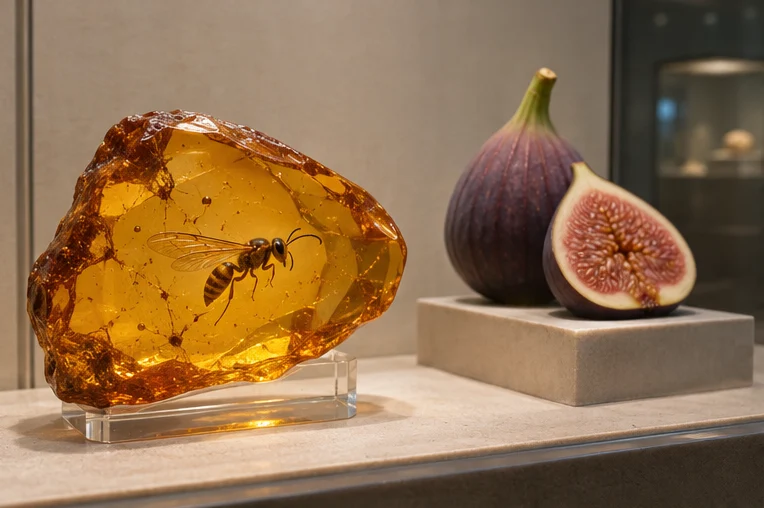
The article's own imagined amber illustration is a third kind of object. It depicts a generic wasp inclusion and uses a modern fig shape for thematic context. It is not a drawing traced from the limestone fossil, a view of the Dominican specimen, or a reconstruction of a particular fossil's host. The conspicuous placement of the fig silhouette should not be read as co-preservation. Captions need to say that when they combine fossils with modern organisms in a way that is visually persuasive. Being clear about the role of illustrated imagery permits it to be useful without silently upgrading it to specimen evidence.
Toy reference cards by claim
The chart and table illustrate how an exhibit writer might sort fictional notes by the kind of claim each one makes. They are not a tally from the fossil study, counts of particular structures or fossils, an ecological estimate, or a threshold for adequate evidence. In this imaginary editing exercise each card gets one classification based on its lead sentence. Cards could refer to the same specimen or to different parts of the same argument. Counting them does not measure the number of independent observations.
| Claim type | Cards |
|---|---|
| Visible feature | 8 |
| Comparative inference | 5 |
| Unknown | 4 |
For a visible feature card, think of a note that specifies the panel, the specimen, and a visible structure, while leaving the broader behavior out of its lead. A comparative inference card might say that a pocket in that position is consistent with a role like the one documented in living active pollinators. An unknown card might ask which recipient flower would have received a particular load. The card is counted because it marks a limit, not because an unknown event happened four times in nature. Three imaginary note lists are enough to teach an editorial distinction; they tell us nothing about frequency in fossil insects.
The numbers sum to seventeen fictional writing cards, not seventeen wasps or acts of pollination. Five inference cards do not make every inference equally strong. They could all draw on the same comparison in different words, or they could draw on independently obtained morphological and contextual evidence. Likewise, eight visible feature cards might describe eight pictures of the same object. Treating note counts as independent evidence would reward repetition. Sorting claims is useful because it reveals how they are supported, not because the winning category gets to determine the article's confidence.
You could organize the cards differently if the goal changed. An illustrator might need rows that distinguish living comparisons from fossils and line drawings, rather than dividing the work by level of inference. A specimen curator might organize views by catalogue number, showing how multiple images connect to one object. A collection manager might start with preservation material because that decides how an item can be handled. Keeping these objectives separate makes it less tempting to treat an editorial sorting system as a standard scientific scoring method. The toy graphic is an example of a writing aid, not a prescription for paleontology.
A chart like this should be able to survive without its surrounding paragraphs. Put the words "fictional claim cards" near the labels, and tell someone reading the accessible description that the counts are not from the fossil research. Avoid icon rows of tiny wasps, which could make the counts look like body counts. Do not put the charts on a scanned-looking specimen label with fabricated collection details. A well-designed article can feel natural and documentary without making every synthetic element look like a record collected by a researcher.
Reading the different meanings of age
The age of the geological material, the age of the oldest evidence in a study, and the age of a biological partnership are not interchangeable. A fossil assigned to a dated deposit gives an age for the material within the precision and assumptions of the geological assignment. If that fossil documents a relevant feature, it establishes that this feature existed by roughly that time. A claim that the partnership originated at that time is much stronger. The organisms and the function could have been present earlier without leaving a fossil we recognize. The specimen is a dated point on a longer and incompletely known history.
This is why the phrase "at least" matters in the title of the original study. It points readers away from confusing an observed minimum with a starting date. The English material supports a statement that a fig-associated pollen-carrying system with remarkable similarities to living ones was present by about 34 million years ago. The amber comparison does not make the English date an age for Dominican amber. It also does not turn that date into the life span of any living species. The original report combines comparison across time with documentation of anatomical continuity. It does not establish continuous observation of the entire intervening history.
Molecular dating asks a related but different question. Cruaud and colleagues' original comparison of fig and fig wasp diversification estimated deeper evolutionary times using sampled lineages and models. The inferred times are not ages read off the 34-million-year-old bodies. Evolutionary trees relate sampled lineages, and estimated dates depend on information used to anchor the analysis and on the models connecting observations to time. A fossil age and an older inferred origin can both be correct because the two answers address different things. The distinction should be explicit if both dates appear in a timeline.
Even "oldest known" has a scope. It refers to the evidence recognized within a defined comparison or available when a report was written, rather than to all events that happened in the past. An exhibit drawing on historical papers can give the landmark date and name the study without claiming to have independently checked every newer collection or taxonomic revision. "The researchers described fossils of about this age" remains useful if a later study discovers an older example. "This was the first fig wasp ever" would not follow from the original fossil study even if its age remained the oldest documented.
Deep time can be described without extra digits. The number 34 million communicates the scale in the original report; inventing greater precision because a timeline graphic takes exact dates would not make the figure better. Geological intervals, dates assigned to individual deposits, and inferred evolutionary branch times should have separate styles if they are shown side by side. It is important that an exact-looking line does not communicate unjustified certainty. If the audience needs only the relative order of the English and Dominican comparisons, a text label may be better than a fine scale timeline with vague qualifications.
What continuity does not mean
The anatomy in the fossil study makes a case for persistence of recognizable functional features across an immense span of time. That is the useful meaning of stasis here. It is not a claim that every anatomical proportion, pollen handling movement, host choice, and seasonal pattern stayed identical. An animal can retain a feature associated with a long-standing task as other features change around it. A form can remain recognizable across related lineages without the organisms being the same species. Readers deserve to know which feature the comparison concerns before being told that the living interaction looks old.
Compare this with recognizing a door latch on an ancient artifact. A latch can provide strong evidence that something closed in a familiar way without telling us who lived behind the door, whether it ever locked successfully, or how the house was furnished. Likewise, a pollen pocket can be an indicator of a recurring biological function without reconstructing the fig community around the wasp. The analogy should not be taken literally: the pocket was not designed according to a written specification. It is useful because it separates recognizing a structure suited to a job from reporting that you witnessed the job being done.
This distinction matters for explaining coevolution. Interaction and reciprocal adaptation do not require perfectly matched branching histories. The primary comparative analysis by Cruaud and colleagues reports long-term correspondence while also discussing host shifts. Those ideas are compatible. There can be a long-lived kind of interaction whose participants have not been paired in precisely the same way throughout history. Learning that one fig attracts a particular living wasp is not grounds for placing that same pair into the ancient forest. A fossil showing the machinery of pollen transport does not fix the identities of all past partners.
The distinction between the family history and the animal's particular history is worth writing into a museum label. A sentence about the fossil's anatomy can lead to one about its resemblance to living pollinators. A third sentence about the evolutionary persistence of the relationship can then be recognizable as a conclusion drawn by the study rather than as a detail preserved in resin. Avoid switching the grammatical subject without notice. "The wasp carried pollen; it has done so for 34 million years" asks one animal to stand in for a lineage and an interaction. The reader can follow a story about both if the language keeps them separate.
Continuity also does not make modern exceptions irrelevant. Study systems with active pollination do not all have identical outcomes at every visit. The field study by Jandér and Herre includes variation in fig-wasp interactions and discusses pollen-free individuals in actively pollinated systems. This provides a concrete reason why a structure associated with pollination is not interchangeable with proof of deployment on each visit. It also cuts in the other direction: an individual found without pollen does not make anatomy or population-level natural history meaningless. Choose the scale of the biological statement to match the scale of observation.
How specimens become evidence instead of scenery
Begin at the object level. Which museum specimen or published view is being described? Is this a full image, a drawing made from an image, or a close view of a particular part? If a second view is enlarged, readers need to know where it belongs on the whole body. Set the figure references up so someone can move from object to detail without having to guess whether the view moved to another specimen. This is especially useful when a paper puts fossil and modern views on the same plate. Proximity on a page is an editorial choice, not a statement that two objects came from the same deposit.
Then ask what is visible and what made its interpretation possible. "A small dark spot" is a description of a view. "A pollen grain" assigns a biological identity. "Pollen carried as part of active pollination" is an inference drawing on the location and modern comparison. The reader should be able to find the transition between those statements. If the original figure caption discusses morphology or scale, paraphrase those details faithfully and credit the caption as the source. Bringing in a second paper on living wasps can improve the interpretation without making the second paper an independent witness to the fossil's condition.
Another useful distinction concerns quality of preservation as opposed to function. A body retaining the shape of a thoracic surface gives information about the presence and position of a feature. Whether the feature carried pollen in a fossil requires suitable contents to be preserved and identified. Whether it does so in a living comparison requires evidence from that system. Those three questions can have different answers even for material from one study. A brief exhibition text might not have room for the entire argument, but it can retain honest verbs: shows a pocket, contains grains, resembles the living feature, supports the interpretation. Each verb performs a different job.
A misleading exhibit often chooses the strongest verb first and then looks for a pleasing object to stand behind it. A better process starts by selecting the image that supports the claim. If the goal is to show grains, the close view from the limestone panel is the evidential choice. If the goal is to invite people to notice an inclusion in amber, the amber example is the right one, without the grain claim unless that exact specimen supplies it. If the goal is to help someone picture a receptive fig, a modern educational image can do the job. The images can run together in one exhibit after their roles have been assigned, not before.
Consider an imagined caption with a species label for a modern comparison and a common name for the fossil. It might look inconsistent to a designer who wants matching lines. In this case the inconsistency could reflect responsible treatment of available identifications. Do not fill the shorter line with a species guess merely for balance. Likewise, do not write geographical details for a generic illustration just because museum labels usually have a locality field. Let blank or absent information remain visible as a limit, or tailor the label to the fact that the picture is not a specimen at all.
Some alternatives can be narrowed, not eliminated
Suppose a tiny grain appears close to a preserved insect. Without more information one might ask whether it came from the animal, the surrounding material, or another event in preservation. The original fig-wasp study goes beyond proximity by relating preserved grains to the pocket and comparing their form with modern fig pollen. That narrows the alternatives. This does not require performing an imagined reconstruction of the exact instant of capture. The location of material relative to a specialized structure is itself powerful, provided the location was established by appropriate views and is not merely a perspective effect.
A similar discipline applies to missing features. Some structures could be too small to resolve, damaged, or oriented poorly in a given specimen. An absence claim is persuasive only when there was a meaningful chance to observe the structure. A body lacking sufficient detail on one side cannot stand as positive evidence that the anatomical feature never existed on that side. In real collections, multiple specimens can sometimes help distinguish a recurrent feature from a preservation accident. They can also raise new questions if one shows a contrast with the others. There is no obligation to sort all fossils into a complete character set before writing honestly about the best-supported feature.
Likewise, several specimens do not automatically form a random ecological sample. Some habitats and organisms might be more likely to contribute to resin inclusions, and preservation in an insect-bearing limestone is a different route into the collection. Collection and study can give another filter: material may be found, prepared, recognized, and published at different rates for reasons other than its original abundance. A collection dominated by one form cannot automatically tell us that its original community was dominated by that form. The original study can provide a striking fossil example without becoming a census of the ancient landscape.
A line of evidence about presence generally carries fewer requirements than a line about frequency. One confidently identified fossil is enough to establish occurrence in the deposit under the relevant interpretation. It is not enough to estimate how commonly an activity happened in the surrounding ecosystem. For estimating frequency one would need a defensible sampling unit, coverage, and a model of how observable remains relate to the original population. The question can be compelling even when the necessary data are not currently available. It is better to leave it open than make a percent out of how many pictures happened to be reproduced in print.
A reconstruction can admit that it is a reconstruction
Imagine a short film that starts at the amber fragment and then dissolves into a living fig. A good narration can tell the audience exactly what changed: "This is a modern comparison that helps us understand what the preserved structures were for." The shot can then depict the enclosed flowers and a pollinating wasp without implying that the animal in the fossil has been identified with that living species. If the next scene shows a pollen pocket in a close view, indicate whether it is modeled on modern anatomy or copied from a fossil figure. This is not an interruption of the story. It invites a viewer to follow the evidence as it switches kind.
One can do something similar with a museum timeline. Place the English limestone record and the Miocene amber record at separately labeled points, use different image backgrounds or descriptive labels where possible, and add a separate track for model-based dates only if those dates matter to the main argument. Do not link an estimated origin and the dated fossil with an unbroken band titled observed. The point is to show what each type of evidence contributes, not to fill every gap in the past with an invented image. Blank intervals can make the dated records easier to understand because the viewer sees how much each carries.
For a younger audience, try asking readers to circle the sentence that could be checked by looking at the picture alone. Then ask which sentence needs access to the original study, and which sentence has no confirmed answer. A careful eye may spot the outline of an insect in an amber picture. Determining where a pocket is or identifying its contents may need views at a scale the picture does not provide. Understanding why scientists connect a feature to a behavior also needs evidence from modern comparisons. The exercise makes clear that there is a real difference between not being able to verify a detail from one image and there being no evidence for the detail anywhere.
A final editing check can be phrased as a practical series of questions. Does the caption distinguish the preservation medium from the location and date of the find? Can a reader tell which visual is a generic illustration? Is the pollen claim attached to the specimen that supplies it? Is the modern host used as an example rather than named as the ancient host? If an estimated evolutionary date appears, is it clearly distinguished from the age of the fossil? Are open questions presented as such rather than as numbers that look like observations? An article can pass these checks and still tell a fascinating story.
An educational sidebar could also ask what would improve the host claim. Finding a recognizably fig-like structure in a related deposit would give valuable context, but that association alone would not place a particular wasp inside that particular inflorescence. A preserved body and confidently identified plant material in direct association might narrow the question further, depending on how they came to be fossilized together. No such hypothetical find should be quietly read into the images already at hand. Saying what evidence would matter next shows that the uncertainty has a shape. It is not a blank where any imaginative story is equally good.
The most durable archive entry would preserve the figure citations, the intended comparison, and the reason the fossil date cannot be used as an origin date. A future revision can then update one element without rewriting the others by accident. A new date for the deposit, a new interpretation of a character, and a new study of modern host relationships have different implications. A narrative built from clearly marked claims can absorb new evidence much more readily than a single headline about the whole partnership being unchanged. Its structure lets curators and readers revise the part that moved while keeping the evidence that still stands.
The value of an amber wasp is not limited by the fact that it stays still. It can preserve a body for comparison. In the English material studied by Compton and colleagues, the position and contents of a pollen pocket give particularly strong evidence for a recognizable connection with figs in the ancient past. Living systems help explain why the feature is significant. The exact journey of a single animal is a different matter. Preserve those distinctions and the reader can see both how unusually much this fossil investigation tells us and why the remaining unknowns are not a weakness to edit away.