| Category | Value (trees) |
|---|---|
| Locked | 5 |
| Obstructed | 3 |
| Unsafe | 4 |
| Deferred | 8 |
Illustrative only. Invented values, not taken from a source dataset or an official target. Distinguish locked, obstructed, unsafe and deliberately skipped street-tree observations; design distinct corrective actions and avoid filling any category with zeros.
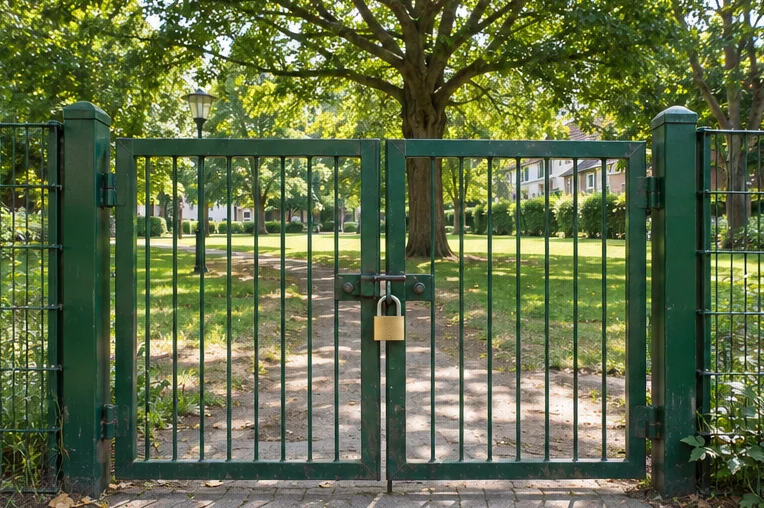
A crew reaches a locked gate and sees the tree on the week's inspection list standing behind it. The tree is visible, but the assessment the crew came to carry out cannot be completed from that side of the gate. Elsewhere, a parked truck blocks the relevant view, a crossing is unsafe under the team's rules, and a fourth tree is removed from the day's list because a supervisor deliberately defers that block. In all four cases the condition field should stay unmeasured. The four reasons should not stay indistinguishable. Each calls for a different response, and each tells a different story about how the assembled observations came to represent the street.
A row of zeros would obscure both problems. A zero is a result where a defined quantity is observed to be zero. It is not a result reached by being unavailable to observe. A blank can preserve uncertainty, but it does not itself tell a coordinator whether to seek permission, change the scheduling window, consult the safety lead, or review a deliberate deferral. The answer is to separate what was supposed to be assessed, what was possible, what was observed, and why the rest was not observed. As soon as those facts are separate, a dataset can be honest about its gaps and still useful for planning.
Why planned trees were not assessed
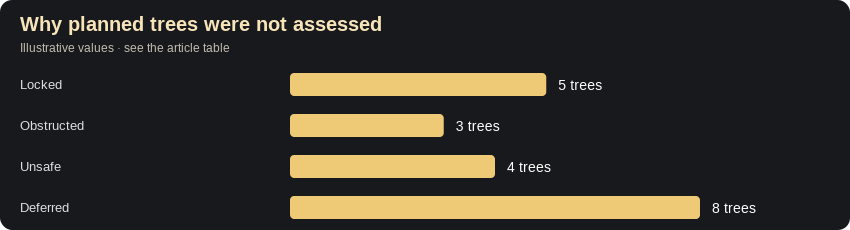
The chart and table show identical fictional values. The unit is trees. There are twenty distinct planned trees whose specified assessment remained uncompleted at the cutoff in this example. Each is counted once by its recorded primary reason at that cutoff. The values are not taken from an official dataset, are not performance goals, and do not measure how many trees were damaged, absent, or hazardous.
| Primary reason | Trees |
|---|---|
| Locked | 5 |
| Obstructed | 3 |
| Unsafe | 4 |
| Deferred | 8 |
Eight of the twenty unfinished trees were deferred in the toy record, but that does not tell us the completion rate. There is no total planned roster in the chart. If the original plan had fifty eligible trees and thirty were validly assessed, that would be a different statement, with a different denominator. If several crews tried to reach one of the twenty trees, those repeated attempts would not increase this chart's tree count. A separate chart of attempts might show more locked observations than there were distinct locked trees. Keep the metric attached to its unit whenever the numbers are reused.
The categories can guide work because the appropriate response differs. For locked sites, a manager can see whether legitimate access can be arranged. For an obstruction, the team can consider a different planned time or a permitted method. For unsafe conditions, stop and follow the governing safety process; the chart is not a list of assignments to try harder. For a deferral, ask who made that decision, whether the unit remains eligible and which round it belongs to. An unexplained zero in a condition column cannot do any of these jobs. It may even suggest a result, such as zero recorded defects, where no inspection was carried out.
Give the unit of assessment a name
A street-tree roster might name one living tree at a fixed location. A different project might name a planting site, which can be empty. Yet another might name a sidewalk segment on which several trees are to be inventoried. An empty site can be a valid result for a planting-site survey. An empty planting site on the roster of individual trees raises a question about whether the named tree was removed, mislocated or never eligible. None of those possibilities should automatically be recorded as a tree with condition equal to zero. Before opening a field form, decide which kind of unit the project follows and how changes to that unit are recorded.
Also name the assessment, not just the entity. A tree visible through a gate may support an observation of presence or a broad description of visible canopy, while a defined assessment still requires an unobstructed view or access not available. One exacting form might require several specified components. A simplified walk-by count might need only location and presence. Completion for one is not completion for the other. When several projects share a device or a roster, link status to the particular outcome and protocol rather than label the tree globally as inspected forever.
The U.S. Census Bureau's Statistical Quality Standards address topics including target populations, the design and coverage of sampling frames, and documentation. These are official standards for the agency's own activities, not instructions for an urban forestry crew. The analogy is helpful: a list of named units is not automatically the target population, and a set of successful measurements is not automatically a complete sample from that population. Keeping the planned roster and its disposition makes later work more reproducible.
An established forestry protocol can also clarify the value of separate fields. The i-Tree Eco field guide and the program's user manual distinguish plot coverage and specific tree measurements in their setting. Their guidance should be applied as written if that is the chosen protocol. The teaching codes here are not its official codes or a substitute for its access and measurement procedures. They illustrate how a local data collection project can describe non-observation without turning the reason into a measured tree attribute.
Define the four reasons by what prevented completion
Locked means access to the required position was restricted by a physical closure under the conditions at the visit. A gate with a visible lock is an understandable case. An occupied building is not automatically locked; a gate that happens to stand open is not automatically authorized. If permission was required but its status was unknown, the project may need a separate permission code. Record the obstacle from the lawful position and route the access question to the responsible person. Do not assign the field crew to defeat barriers or infer there is permission from visibility.
Obstructed means the observer was in an otherwise permitted and appropriate position but could not see or assess the required part of the tree. A parked vehicle can block the stem, a construction screen can hide a low branch, and glare can prevent review of a necessary feature. The reason answers what evidence was missing. It does not imply that everything about the tree was invisible. Record what was visible without transferring a partial look into the condition field reserved for the complete assessment. A later visit in a different legitimate window may help, depending on how persistent the obstruction is.
Unsafe means a governing safety constraint prevented the visit or required it to stop. It can apply before arriving, during an attempt, or when a route changes. Record a short reason suitable for the reporting audience, such as an active traffic restriction, and follow the organization responsible for the work. Do not ask a worker to quantify how close they came or to demonstrate that the location fails a field test. Stopping due to a real safety boundary is a valid operational result. Any decision about a new attempt should be made through the applicable process, not as an automatic retry generated by a chart.
Deferred means the project chose not to carry out the specified assessment in the relevant window even though the immediate reason was a planned exclusion from that round or a deliberate scheduling decision. This can occur in advance because a training block was reassigned or afterward because the project adopted a specified follow-up plan. A deferred unit should have a decision reason and, where appropriate, the next owner or checkpoint. Do not call a unit deferred merely to soften an unsafe outcome or conceal an unrecorded visit. An administratively deferred unit may remain in scope even though it has no assessment for this round.
Other outcomes may be needed. A location that was never on the target roster should not count among planned exceptions. An assigned location that could not be located might need an identity review code. A location genuinely outside eligibility under a stated protocol can be documented as excluded without pretending the crew inspected it and found nothing. An unknown reason may be necessary when old records lack detail. Leave room for that honest label, while monitoring how often it is used. Forcing uncertain notes into the nearest familiar code creates a false precision about the field process.
Preserve the status and the reason in separate fields
On each attempt, put completion status in one field and the cause of noncompletion in another. Status options could distinguish not started, stopped, partially completed, and completed under a named protocol. A reason might be locked, obstructed, unsafe, deferred or another documented category. One tree could be visible but not measured, partially assessed because a view was blocked, then fully assessed on a later visit. Those facts work together when recorded separately and contradict one another when forced into a single permanent label.
For measurement fields, reserve meaningful numeric values for measurements. Use a blank paired with the status, or choose an explicit nonnumeric missing value if the system supports it and preserves it during export. Do not type a minus number into a nonnegative measurement field to mean “gate locked” without a robust data contract; downstream averages or plots can silently interpret it as arithmetic. Separate storage and rendering: a public table can print “Not assessed” while the source keeps a null and a reason code. The design should protect the same distinction even if another application reads the underlying rows.
A real zero can be indispensable. If an observer adequately searched the required area and counted zero qualifying features, that zero belongs in the count column. It should not vanish when cleaners remove empty-looking rows. A method that could record an observed zero and a method not carried out are not variants of the same outcome. Ask the team to give several examples of fields where zero can honestly appear, and examples of how absence can be misread. This is more effective than merely banning zeros in exception records, because the team learns which units and observation criteria make a zero meaningful.
The reason code is also not a score. Four unsafe trees in the chart do not constitute a safety severity rating. The code describes why the assessed value is missing, not whether the missing quantity would have turned out high or low. It may relate to conditions affecting the result, or it may be independent of them. Keep any actual safety incident, closure, or professional assessment in the appropriate operational record under applicable procedures. An observation team can log the reason without inventing a degree of danger or inviting untrained people to evaluate it.
Tell the visit history without counting the same tree twice
Index visits separately from trees. A tree identifier connects measurements across time and should be stable under the project's definition. An attempt identifier names a planned or actual encounter with that tree. The same tree might have an obstructed view on Tuesday, a locked access point on Thursday and a completed assessment the following week. A reason count about why the tree remained unassessed at Thursday's cutoff needs one agreed primary reason. An effort report about the route may reasonably count both failed attempts. The existence of two counts is not an error if their labels, time windows and rules are unambiguous.
If several reasons apply to one attempt, retain them rather than force a worker to discard a fact. A screen might obscure a useful view and the route beyond it might not be authorized. Choose a documented rule to report one primary cause where an exclusive chart is required. One practical approach is to use the first governing condition that prevented the required step, subject to a rule that stopping for safety is never overridden. The use of one primary code is an analysis decision, not a statement that other reasons were absent. If a reporting table instead presents overlapping flags, clearly state why counts can exceed the number of unfinished units.
The primary reason can change from one cutoff to another. A locked gate may be opened under authorized access later, yet a formal safety instruction may make the follow-up impossible that day. Overwrite neither visit. In a daily snapshot, a coordinator can see the reason in effect then and the later update. A retrospective report restricted to the first round should still refer to that round, even if later work fills many gaps. Record the distinction between “not assessed in the initial round” and “still not assessed at the current cutoff.” Those are both meaningful operational outcomes.
A planned deferral may live partly outside the visit system. If a team decides on Monday not to visit a location Tuesday, there may be no field attempt to record. Link the decision to the planned tree and round anyway. Otherwise the roster might show completed and locked locations but completely omit deliberately skipped ones. Leaving these out tends to make progress look better without collecting any more data. If a location was removed from the planned roster before the relevant cutoff under defined eligibility rules, record that different action separately. Moving a unit to another round is not identical to changing its eligibility.
Let each reason point to the right next action
For a locked location, determine which person or team controls access and ask them to resolve it using the approved process. The working record can say access unresolved, requested or authorized for a specified window. Do not put a physical workaround into a general field note. Where access will not be available for the study period, document that limitation and decide whether any authorized observational alternative can meet the protocol. An ordinary photo from a public place may support presence, but it is not necessarily adequate for the assessment that required access.
For an obstruction, note its nature without gathering unnecessary information about other people. A temporary visual block may warrant revisiting under a different scheduled window. A permanent structure may limit the viewing method under the protocol, in which case the project may adopt and validate a different method for that field. Do not move private property, step into the roadway or manipulate the tree to manufacture a view. A method change can affect comparability even where the work stays safe and authorized. Record how any later assessment was conducted.
For an unsafe location, the team stops and uses the applicable safety or incident route. The responsible supervisor may determine that a different qualified team or a formal traffic or access arrangement is needed. Do not assume that another attempt has been approved merely because the location remains on a planning roster. If no further work is appropriate, the record can be closed operationally while the analytical result remains missing. This is not a contradiction. Operational closure records a decision about future work; it does not create an observed tree measurement.
For a deferral, document the trigger and owner. A deferral because a staffing limit shifted a whole block may simply move an eligible group to a later round. A deliberate decision to sample only locations that are easier to reach requires a different disclosure about scope and coverage. If the deferred units are due for a later round, keep the roster entry linked so the project does not lose them entirely. If they were intentionally not selected under the actual design, report that design rather than conflate planned sampling with field noncompletion.
Keep a separate follow-up status even when the first reason points to an obvious action. A reason says why evidence was unavailable; a follow-up status says what has happened since. Obstruction is not necessarily resolved because a new visit was requested. Access is not authorized merely because the contact has been identified. Show which tasks remain open, which were completed later, and which were closed without measurement, without turning any of those operational fields into missing condition values.
Report the denominator that each statement needs
There are at least three useful denominators. Completion is the number validly assessed out of the planned eligible units at the stated cutoff. A reason distribution is the number of unfinished units of a particular reason out of all unfinished units counted under that rule. A measured condition rate is the number of inspected units with the defined finding out of the inspected units with enough evidence for that finding. Mixing denominators makes a chart of operational gaps look like a condition assessment. Print the numerator and denominator together near every percentage.
Imagine a separate fictional roster of fifty trees. Thirty assessments meet the protocol, and twelve of the thirty show a defined condition. The observed assessed-tree proportion is twelve of thirty, or 40 percent. The remaining twenty are not zeros. They are unknown for that outcome. If all twenty are genuinely eligible, each either does or does not have the condition as defined, and the thirty completed classifications are treated as correct, the fraction in the whole roster could range from twelve of fifty to thirty-two of fifty. These are simple possible-case bounds for the illustrative roster, not a confidence interval for broader street trees. They show how much the unresolved units can matter.
Counting unfinished rows as zero would produce twelve out of fifty as a single measured fraction. That number is the lower endpoint under the toy assumptions, not the observed whole-roster result. Dropping them and generalizing 40 percent to the whole roster makes a different unsupported leap. The field reasons help readers see which assumption is least plausible. If access was blocked mostly on streets with a distinct planting program, the completed subset may not represent the rest. If deferrals were scheduled independently of the condition, that might support a different design argument, but it still needs evidence rather than hope.
In some applications an overall fraction is not the most useful output. A site manager may need a map of the unassessed units and how many are waiting on authorization. A forest analyst may need measured coverage by neighborhood and protocol. A field supervisor may want completed assessments per planned route, with legitimate safety stops visible. A single success score may make different reasons look commensurable when they are not. Use the measurements and reasons for their own purposes instead of requiring them to compress into one rank.
Look for patterns in what the crew did not measure
Explore the records by route, date, access type and reason. The NIST/SEMATECH alphabetical index of graphical techniques provides exploratory options such as sequence displays and plots of grouped results. It is a methods source, not the source of the invented chart. A sequence view can help notice that obstructions bunch around a period with work on one street. A grouped count can reveal a high share of deferrals on certain routes. Patterns make good questions for investigation; a pattern by itself does not identify what caused the underlying tree condition.
A plot of observed conditions alone can fail to show that one area was much less accessible. Put assessment coverage next to it, and define the common unit underlying both. Consider reporting assessed and not assessed counts by the same geography, with enough detail to show whether the roster was comparable. If two neighborhoods have different proportions of trees behind controlled gates, a difference in assessed conditions could partly reflect that mix. Do not substitute a visually balanced figure for proof that the measurements represent the same population. The coverage information describes how far the comparison can travel.
Look at the behavior of the workflow too. If most reasons became unknown only after a software upgrade, that may be a lost field or import issue, not a change outdoors. If one crew records every obstruction as deferred while another records the original cause, apparent differences in operations may be code differences. Ask reviewers to trace a small group of records from the raw visit note into the summary. Compare definitions, not only bars. A simple review can find errors a more elaborate sensitivity analysis would otherwise treat as nature.
Assess whether the reason is known at the same level as the missing value. A whole segment might be unsafe to enter, yet the roster might include seven trees along it. Those seven tree outcomes are missing, but seven independent site safety decisions were not necessarily made. Preserve the segment event as one shared record linked to the trees. If the event-level information gets copied into seven rows, later summaries must still distinguish one shared interruption from seven unique attempts. It is useful to be able to count both, not to deduplicate indiscriminately or assume separate causes.
Decide when substitutes alter the population
A crew that cannot enter a locked site may notice an easy replacement around the corner. Measuring it could be useful, but substituting it without a design rule changes which trees represent the plan. Easy replacements can gradually turn a sample into an inventory of accessible trees only. If the protocol permits replacement, state where substitutes come from, what selection mechanism applies, and whether the original unit remains reported as unfinished. If it does not, record the original completion problem and keep any opportunistic observation in a separate stream. Never imply the replacement is a second measurement of the original tree.
A permitted alternative angle can likewise change the measured field. A broad overview from the sidewalk might let a crew describe a visible condition without completing a required close assessment. Do not simply put the alternative observation into the same numerical column as though the measurement mode were unchanged. A distinct status or method field allows analysts to decide which observations can be combined and which answer different questions. If the team later changes the definition to match what can be observed routinely, document the date and re-evaluate comparability across that change.
Changing the reporting roster after the fact can be appropriate if a unit was never eligible. A landmark in an old inventory could be attached to a site outside scope or be an actual duplicate tree ID. Correcting the frame improves clarity. But do not remove an eligible tree just because its measurement is inconvenient. Eligibility is a property of the study's target definition, not a reward for successful inspection. Keep a record of additions, deletions and revisions to the planned list so future readers can distinguish a better roster from a narrower claim.
A location can turn out to support a different tree or event than expected. Imagine that an older tree was removed and a sapling planted at its original site. If the target is one planting location, both may relate to the same location over time. If the target is an individual tree, they should not share its history as though no change occurred. Eligibility and identity fields need to be reconciled before conditions are compared. Both site and tree identifiers can be kept if either will matter later. Do not code the older tree's apparent absence as a numeric zero in its condition field without a defined outcome measuring presence.
Build a small quality check before the field season
Write several practice scenarios and have two people code them independently. Give them a locked location with an excellent outside view, an authorized location with a blocked line of sight, a route suspended under safety instructions, and a scheduled deferral that has not resulted in a visit. Ask them which assessment is missing and which action would follow. If they agree on status but not on the reason, revise the definition of the reason or add an example. If they disagree on whether a view completed the assessment, revisit the protocol's criteria before establishing a dashboard.
Test more complicated cases too. A crew reaches a site where the gate is unlocked but permission has not been granted. A vehicle obstructs a view, but its presence is not the reason the supervisor stops work. A deferred block also has a documented access issue. In each case, the team should know whether to record more than one factor and how the primary code would be chosen for the chart. Good rules leave the original facts visible even when a summary must choose one label.
Check the software with known records. Enter a fully measured zero, a complete positive observation, a partially observed unit, a lock with no measurement, and a deliberate deferral with no visit event. Export the file and calculate the number of completed measurements from scratch. Confirm that no missing value became a zero and no real zero disappeared. Follow a previously obstructed tree through a later assessment and check both the current status and historical snapshot. These checks demonstrate not just that the form can be completed, but that the information survives export and later use.
Protect the audit from incentives that discourage honest codes. A metric that rewards a crew solely for complete assessments may make it tempting to call a glimpse sufficient or to leave a failed attempt off the list. Report adequate coverage and accurate reason reporting as separate measures. Reviewing closed exceptions can be useful, but a correctly recorded safety stop should never be treated as a failed performance task. A well-run project makes it easier to respect limits and still document them. That improves the quality of the dataset without asking anyone to accept more risk.
Distinguish completing a task from resolving a gap
A team can act on a recorded reason without immediately obtaining a measurement. After a contact is found for a locked site, the access problem might be understood but authorization may not be granted. A supervisor may confirm a safety concern and close the request. A deferral might be reassigned to next month's work, making the schedule clearer without changing this month's measurements. Treat these as real changes in the operational record and not as fictional improvements in coverage. A closed issue can coexist with a missing assessment in the original round.
Give the team a clear cutoff policy. For example, the Friday report can describe assessment status as of Friday, with later completions appearing in a subsequent run. If a late record reports an assessment that actually occurred before Friday, a corrected snapshot can distinguish its event time from its arrival time. If the crew performed the measurement on Monday, the earlier snapshot is not mistaken merely because conditions subsequently improved. Record event date, entry date and the published cutoff separately when they matter. A reproducible cutoff saves arguments about whether an old figure should change after every scheduling update.
A shared inspection list often contains fields with different owners. A field worker can describe obstruction, a coordinator can schedule another attempt, and an authorized supervisor can resolve a safety or eligibility decision. The data should say which statement was made by which role when it affects interpretation. Otherwise an analyst may mistake a tentative suggestion for a new field assignment. It is enough to identify the decision role and time where personal details do not belong in the public report. Accountability is not the same as collecting more personal information than the workflow needs.
Before closing a gap, check that the later measurement answers the same question. A blocked crown may be inspected once the view clears, but a severe change to the tree between visits could make the later condition unsuitable for a baseline snapshot. The new measurement may still be valuable for current management. It should carry its actual date, method and outcome rather than silently stand in for the earlier missing one. If a reconstruction or model-based adjustment is used for trend analysis, label it as such and state its assumptions. Do not let a task-management success masquerade as evidence about an earlier date.
In a seasonal handover, separate trees still eligible next round from trees whose status must be reviewed. Lead with the action the reason supports: arrange access where appropriate, reconsider the surveying window for an obstruction, follow the safety route, or reschedule a deferred tree. A reason is most valuable when it is specific enough to guide a lawful and safe decision without being mistaken for permission. Once a case is assigned, preserve the original reason so an analyst can still explain why the first dataset had a gap.
Read a summary aloud before treating it as analysis
One useful review is to speak a draft headline without the supporting table and ask a colleague what they understand. “Twenty trees failed” can imply a poor condition rating or a failed management performance target. “Twenty planned trees had no completed assessment by the cutoff” identifies the operational count directly. If the colleague assumes twenty out of all trees in the city, add the roster or defined area. If they hear that all twenty are unsafe, clarify that the category applies only to four illustrative decisions not to assess. This test often exposes a discrepancy that spreadsheet validation cannot find.
Try the same exercise on a map. A missing-condition color can look like the lowest severity if it appears at one end of a numerical legend. Give unavailable assessments their own symbol or separate layer, with partial observations distinguished where appropriate. Avoid mapping a blank area as though no trees were present simply because there were no records. The symbol should answer whether there is a value to interpret, not suggest what that value would have been. A figure about coverage can coexist with a condition map without merging the two meanings.
Write a result a coordinator and an analyst can share
Begin the result with the scope and date. “By Friday's cutoff, these twenty planned trees lacked a qualifying assessment: five locked, three obstructed, four unsafe to assess under the applicable rules, and eight deferred.” Then state where the values remain missing and what follow-up or scope decisions are recorded. For a field team, include contacts and next steps through the approved operational channels. For a public analysis, present aggregate reasons and scope without exposing unnecessary access details or personal information. The evidence does not change because the report is intended for different readers. Retain the status and measurement definitions with both versions so the figures can be compared later.
A data handoff can provide the planned roster version, the effort count, the date range, primary-reason rule, codes used, and a note on partial observations. Someone receiving a copy should be able to reproduce the chart separately from the condition statistics. If an operational figure concerns twenty unfinished trees, label it accordingly even when the document alongside it describes a measured indicator for the assessed group. A bar titled “unfinished” is not a condition result. A clear note lets the recipient plan access, revisit a scheduling decision, or report a genuine absence of evidence without requiring them to interpret a mysterious zero.
A later assessment can fill a gap, but it does not erase its history. The locked gate may be opened by the responsible staff; the truck may leave; the safety lead may close a case without authorizing a revisit; the next round may take up a deferral. All of those are reportable changes in the process. None is a substitute for a measured tree result. The best field sheet makes those differences easy to read: this unit was planned, this step could not be completed, here is why, and this is what was actually observed.