
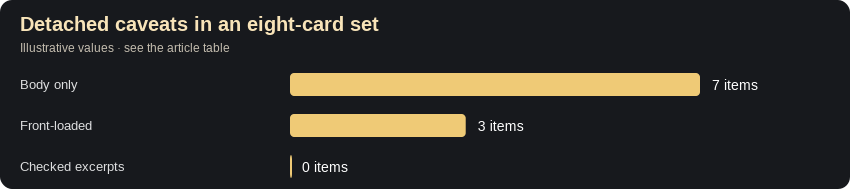
| Category | Value (items) |
|---|---|
| Body only | 7 |
| Front-loaded | 3 |
| Checked excerpts | 0 |
Constructed checklist scenario for this brief, not measurements, ratings, or results from cited sources. Each displayed count represents checked items in the named example.
A neighborhood garden posts a careful report about flower visitors. The report says that an east-border tally was higher during a second set of morning watches, which lasted longer than the first. The social card says, “More insects visited the garden.” The word garden is wider than the sampled area; insects sounds like a count of individuals, though the worksheet records visits; and the change in observation time is gone. An editor might defend the article by pointing to its methods section. The person who encounters only the card has never seen that section.
An excerpt is a small publication in its own right. Readers may see it before deciding whether the underlying article is worth opening, after a friend has forwarded a screenshot, or in a search result that is only loosely connected to the original page. A condition that limits a claim has to survive at that point of use. The solution is not to pack an entire methods section into the first two lines. It is to choose a claim the available space can support, then attach the qualifications that keep it true.
This guide follows eight fictional cards through three versions. The examples are about editorial choices, not observations from a real research site. They show how a qualifier can be present in a manuscript, absent from the visible excerpt, and still missing after a headline has been rewritten. The goal is to prepare a shorter message that remains useful without borrowing the authority of material it no longer carries.
Identify the claim a reader takes away
Start with the sentence a reader would repeat over the phone. If the card opens with “Bee activity is up this year,” what would a listener assume was measured? A garden-wide increase? A larger population? An increased number of observed visits per unit time? The draft might intend only that more events were marked in one notebook. If a plain restatement readily expands the claim, find the word or missing context that lets it expand.
A qualifier is a condition that changes the reasonable scope or meaning of a statement. It may identify a place, time period, sampled group, unit, comparison, reporting method, or uncertainty. It is not automatically optional merely because it follows a comma or belongs to the methods. “At the east border” is essential when findings do not represent the rest of the garden. “Across twelve completed watches” can be necessary if the claim otherwise appears to cover all attempted visits. “Not matched for duration” can prevent readers from interpreting a raw event total as a measured rate. The importance depends on the claim the preview actually makes.
Some details are helpful without being necessary for the card. The field team's training date might belong in a longer report, while the difference between observed visits and distinct insects belongs beside a public count. A worksheet revision number may matter to an archive but not to an introductory line if it did not change the count definition. Conversely, if a revised method is the reason two tallies cannot be combined, the method distinction becomes essential. Evaluate the fact in relation to the particular assertion rather than keeping a permanent list of “important details” that fits no one use.
The federal plain language guide series provides official guidance on writing, design, and testing for the intended audience. The CDC Clear Communication Index is an official framework for developing and assessing public communication. Here the transferable practice is to check what readers can understand in the actual material, not just whether the writer knows what it means. Neither resource supplies the fictional card examples, numeric bars, or evidence for a real garden conclusion. This article's checklist is not a score from either source.
A practical first step is to separate the claim from the context needed to interpret it. Write the claim as a complete sentence. Then list the assumptions a reader must know for that sentence to be supported. Finally decide whether the assumptions must be included, whether the claim can be narrowed so they are no longer necessary, or whether a different type of excerpt would serve better. Do that before placing the first words in a preview field or asking a designer to make a card look less crowded.
Hold the unit and the scope together
Consider a count of 24 recorded landings in 60 minutes at one plot. A description of individual insects would require a separate way to identify which insects were distinct. A reader cannot know from the count whether an insect landed several times. “Twenty-four landings in an hour of observation at Plot A” states the counted event, effort, and place. “Twenty-four bees returned to the garden” adds identification, species or group assumptions, a direction of movement, and a site-wide scope that the starting observation does not establish. That is not a shorter version of the same fact.
Observation effort matters especially for comparisons. Suppose a short watch logged eight visits and a longer watch logged twelve. With no durations, a card suggesting increased activity can be misleading even if it does not say explicitly that the visit rate rose. It can be rewritten as “Observers logged eight visits in the shorter watch and twelve in the longer one.” If this still leaves the time difference too vague for the intended inference, give the durations. If durations are not available, do not replace the comparison with an estimated rate. A more appropriate preview might be “Why two visit totals were not directly comparable.”
Watch how location words jump in editing. “The east border” becomes “the garden,” which becomes “urban gardens” in a roundup title. Each jump adds a claim about representativeness. If the discussion takes place at a broader scale, introduce the local observation as an example and name the site or portion. A naturally portable sentence is “In the garden's east border, observers recorded thirty qualifying landings during eight visits.” It can be useful even to people outside the neighborhood, without pretending that the original observation sampled their setting.
The time of observation can be critical even when geography is clear. “In morning watches at the east border, bee landings were recorded” does not promise activity throughout the day. “Bee activity followed the same pattern this spring” may imply a repeated comparison across periods when one set of observations occurred under completely different conditions. Think about whether dates are necessary for how the excerpt will be reused. “Last week” may work in a short-lived local reminder but mislead in a screenshot shared next month. A date or named interval is usually safer when the card has a long shelf life.
There is no requirement to state every dimension every time. If the article explains what a landings tally is without comparing gardens or dates, the introductory card may simply say, “A landing count records events, not individual insects.” That is a bounded explanation that does not imply site coverage or a before-and-after result. The amount of context needed depends on the content of the claim. A careful editor can often shorten the result by choosing a smaller, better supported assertion rather than compressing a larger claim into fewer words.
Walk through eight fictional cards
The toy review considers eight card subjects: a result for the east border; a comparison of two unequal watches; the proportion of completed sessions in which a landing was recorded; the field team's morning-only species list; a count of landings; a note about excluded rain-interrupted sessions; a display of a result from one spring period; and a general card defining a landing count. Each card has one designated check. Some real cards would face several simultaneous issues. This exercise specifies one controlling qualifier per card so the published bar values can be checked without guessing how items were counted.
The first card needs a geographic qualifier: the east border, not the whole garden. The second needs the effect of unequal effort on direct comparison. The third needs the denominator, completed sessions rather than all attempted sessions. The fourth needs its morning-only observation window. The fifth needs the counted unit, events rather than distinct insects. The sixth needs the exclusion of rain-interrupted sessions. The seventh needs a season and period rather than a claim about the entire year. The eighth teaches the difference between events and individuals in the first place, and that distinction already appears in its opening sentence. It passes from the beginning.
In version one, Body only, the first seven conditions are present only in the longer article body. Each card begins with a wider or less specific sentence and ends before the controlling text. The east-border card says “More visits were observed around the garden.” The eighth card already opens “A landings tally tracks events, not individual insects.” The first seven are therefore counted as detached and the eighth is not. This is true even if there is a clear link to the longer report. The link helps a reader who chooses to investigate, but it does not repair what the visible card already claims.
In version two, Front-loaded, the editor integrates the first four conditions into their respective claims. The east-border card begins “At the east border only,” and the unequal-effort card says that the two watches had different durations before stating the totals. The next card ties its rate or fraction explicitly to completed sessions, while the species list identifies morning watches. Cards five through seven still put their caveats after the two visible lines. The eighth remains unchanged. Four of seven detached qualifiers are repaired; three remain. This version is structurally better without implying that the editor checked all derivations.
In version three, Checked excerpts, the editor fixes the remaining three by writing a narrower sentence for each card and testing its delivered text. The fifth starts “The tally counts landings, not distinct insects.” The sixth begins “Excluding rain-interrupted sessions,” before any claim about the reported set. The seventh puts its named spring period within the scope of the assertion. The editor also retests the first four and the already sound eighth. All eight now preserve their one designated condition in the tested view. This is a pass on the invented review, not a promise about every platform, language, or future edit.
| Version | Detached caveats (items) | What changed in the illustrative review |
|---|---|---|
| Body only | 7 | Seven designated qualifiers appear after the visible excerpt; one card already carries its qualifier |
| Front-loaded | 3 | Four are integrated into the visible claim, leaving three unresolved |
| Checked excerpts | 0 | The remaining three are repaired and all eight tested examples pass |
The chart “Detached caveats in an eight-card set” counts the cards whose designated qualifier is detached, with one check per card. Start with seven; repair four to leave three; repair three more to reach zero. The denominator stays eight and includes the card that always passed. These numbers do not come from an evaluation involving readers. They are not accessibility scores, predicted error rates, or a claim that all cards should have similar length. Use the bars as arithmetic for a worked editing scenario, not as evidence that any particular editing method performed a certain way in the wild.
Choose a sentence structure that protects its own limit
Put a scope phrase before the strongest verb when it can stand there naturally. “In the east-border watches, recorded landings increased” is less likely to leave behind an unqualified result than “Recorded landings increased in the east-border watches.” The second sentence can also be truthful when fully displayed, but an excerpt cut after increased could leave the broad version. Sometimes the strongest repair is to make the scope the subject: “East-border watches logged more landings in the second period.” This avoids an introductory phrase that feels like a proviso and makes the geography part of the named observation.
Do the same for effort. “The longer watches logged more landings” carries the imbalance even when the reader never sees the following sentence, but it still might invite a claim about activity if the publication surrounds it with a triumphant headline. “Visit totals differed across unequal watch lengths” is safer as an isolated teaching card. If comparing data rather than warning about comparability, include the necessary numbers and method or change the subject of the card. You do not have to preserve the original headline's confidence just because the draft began with it.
Beware of a brief opening that turns false when its next word is removed. “The increase was significant only in the group that completed every watch” is risky where a preview could stop before only or where significant has a technical meaning not explained by the example. A revised line might lead with “Among the completed watches,” then state exactly what differed, with a separately checked statistical claim if one is warranted. In an ordinary editorial excerpt, avoid using significant to mean notable when a reader could reasonably understand it as a formal conclusion. The constraint does not require every possible caveat; it does require enough wording to keep the main promise accurate.
Use a negative directly when it prevents a positive assumption. “Not a count of individual bees” can work as an accompanying short sentence, but may be cut when an interface truncates after the first complete sentence. “A count of landings, including possible repeat visits” is less dependent on a later correction. Where the distinction between unobserved and observed zero matters, say which records are included before stating the result. An opening like “No bees visited” is not repairable with a footnote explaining that no visit occurred at all. Choose “No watch was completed,” which states the evidence without assuming the outcome.
Don't front-load so much that the excerpt cannot be read. A dense opening packed with subordinate phrases may technically preserve qualifications but leave no sense of the article before the cut. Choose the one key scope dimension, then revise the claim so fewer assumptions are required. For example, “From the east-border log: a landing count is not a head count” teaches a single useful point. It does not need the observation year or plot boundary unless it also makes a result claim. The discipline is not to attach every hedge; it is to make the text's supported meaning survive in the actual output.
Test the excerpt a person can actually see
A line count is not a stable character budget. Two lines rendered in a wide, small typeface may contain many more words than two lines rendered at narrow width with large text. The letter shapes, the spacing, the padding, and the neighboring image can change where wrapping occurs. A font substitution can shift the cut even when a screenshot of the design looks good. A word count can help editors make an initial pass, but decide what must survive by actually reading the smallest supported presentation in the relevant set of tests.
CSS controls for visible line limits are discussed in the W3C CSS Overflow Module Level 4 working draft. The document is about rendering techniques, not about the editorial integrity of text. A layout can lawfully and consistently cut a sentence at exactly the place that changes its meaning. Different textual representations may also show different amounts of content. Inspect what is visible, what is present in the document, and what a particular assistive technology presents if those paths matter to the publication. Do not infer that every reader gets exactly the visible words or exactly the underlying full sentence.
Test the shortest extraction that a normal workflow produces. A card may show just a title, a title and a short dek, or an opening sentence pulled from the article. An image-only preview may crop a portion of a designed image. An app may turn the same material into a notification that displays only a few words. An aggregator may take the first paragraph and ignore a custom excerpt. Inventory those paths before claiming that the all-important qualifier lives in the place readers see. You can improve controlled paths without guaranteeing the behavior of every third party. Choose robust source titles and opening lines for cases where context is beyond your control.
For each surface, write down the actual visible words. Read them as if you did not know the underlying project. Where did the observation happen? What was counted? How long or how often did we look? What comparison is the text asking us to make? A person should not have to remember the title of the series or infer that two “visits” refer to observation sessions rather than bee events. If the cut leaves an unfinished phrase, assess both readability and meaning. An ellipsis warns of more text; it does not specify which assumption is hidden there.
Make several checks representative of likely variation. Try a narrow box with an adjacent image and a width just before its layout changes. Check enlarged text settings where available. Inspect the export in the format it will actually circulate, not just in the editor's preview. If an image has the text baked into it, a preview may crop a line without the rest of the application knowing. If the language version has longer words, its layout can cut much earlier. There is no single width that proves universal success. Record the environments and copies you verified so the team knows what the result covers.
Assign a different job when a result will not fit
Not every card should present a result. Sometimes the most useful compact notice is a question or promise about what the article explains. “Why two landings totals aren't directly comparable” tells a reader what they can learn without claiming which plot had greater activity. “What we recorded at the east border” invites people into the local record without turning it into a result for the whole garden. A good preview gives a reason to continue while respecting the amount of truth it can carry.
A question should not be a disguised conclusion. “Did our redesign double bee populations?” implies that the report addresses a population effect and that doubling is a live evidentiary possibility. If the report counted only landings in two short watches, a more accurate question is “What can two short landing counts tell us?” Think about whether a reasonable reader would share the question as a claim even without opening the article. Strong hints and a suggestive image can overstate the material just as readily as declarative text.
A card can also be an accurate finding when the right amount of scope survives. “Twenty-four landings across one hour of east-border watches” is compact and bounded. It creates no broader claim about the entire year. If there are several hours on different days, “across one hour of watches” can convey total effort without falsely implying an uninterrupted hour. Test whether an ordinary reader knows what is aggregated. A decimal precision or arithmetic rate that demands extra context may not be worth displaying in the most constrained space.
A third kind of card is an instruction. Here the requirements are controlled by the action, not by the excitement of a finding. If a public notice says to enter an observation but only completed sessions are eligible, keep that gate in the directive: “Log a completed watch,” with a route for interrupted sessions if appropriate. When you cannot include the key protection in the short text, point the reader to the decision instead: “Check which watches to log.” Do not let a general call to action silently authorize cases the full instructions exclude. Not all editorial clips are summaries; some initiate actions with consequences.
Treat link wording as a neighboring cue rather than a place to hide an essential condition. A link called “Methods” can lead readers to more details, but the preceding apparent fact still has to be supportable in its own right. A card that begins “The whole garden had more activity” is not repaired by labeling a button “Read the east-border methods.” Readers may see only the opening. Keep fuller explanations available, but use the link to expand a true statement, not undo a false first impression.
Check combinations, not just individual fields
A title, description, and picture can each be defensible in isolation while jointly making a misleading claim. An example headline reads “The spring tally rose.” The description accurately specifies the east border. The photo shows the whole garden and is captioned “Survey site.” In a composite layout that crops or removes the description, the title and photo invite the broader interpretation. Review combinations the platform actually assembles. Sometimes the designer needs to replace a wide establishing image with a more clearly illustrative one; sometimes a title needs to carry the place.
Pictures can also create timing confusion. A beautiful photo from a summer opening may accompany an excerpt about early spring records. If a reader could reasonably infer the image documents the measured event, label its role or select a photo that does not make that implication. This is particularly important for generated or generic illustrations. A real-looking scene can aid understanding without showing actual evidence. Captions and image alternatives should accurately describe the material; keep the study qualifier in the words that make the claim instead of expecting a description of the image to correct it.
For data cards, verify that the figure and text display the same quantity. A graph might show events per ten minutes, while the teaser says “twenty-four landings” from the raw tally. Those may both be true, but combining the number and the rate visual without labels could lead to a mistaken unit. Put the correct unit and denominator in each presentation that can be shared independently. If the card is designed as a summary of a specific figure, link or name the figure so a reader can tell what it refers to rather than using any attractive plot from the article.
Search and metadata previews are not always under direct editorial control. A publisher can provide a carefully written short description and the platform can still show a different fragment for a particular query or device. State what was tested rather than promising that every preview will use a preferred field. The safest starting point is an honest title and a qualified first sentence in the article itself. These improvements help several possible extraction paths at once without requiring you to know which one a service will use next. When a platform supports a dedicated editorial preview, still inspect the actual output.
Native layout can change the order of fields as well as their length. Some displays show heading, image, then description; others omit the description completely. A percentage in a heading might depend on a denominator described in the second line of the description. If the two cannot be kept together, either bring the denominator into the heading or change the heading to a qualitative statement grounded in what is visible. A card can support interesting claims without putting the most fragile number in the first position.
Make a checklist useful after the next edit
Keep a small excerpt ledger when an article appears in several places. For each surface, record the destination of the main link, the allowed or measured display, the assertion that readers see, and its controlling context. Keep a checked example of the actual cut, especially in a template with fixed framing. The aim is not to archive every screenshot. It is to be able to tell whether a new design unexpectedly removed a place, time, denominator, or condition. A simple list serves if it can describe the formats used and who is responsible for corrections.
Review by asking concrete questions. Give a colleague only the preview for the unequal-effort example and ask whether it shows more visits per minute. Show the geography card without the article and ask whether the study covered the whole garden. Give an editor the social headline and ask them to write one line they would forward. Note any wording that gives rise to a broader interpretation. This does not establish the rate at which the wider audience misreads a card. It is a focused check of whether the publishing artifact invites a preventable misunderstanding.
When repairing card batches, do not confuse removing a difficult card with solving its qualification. A shorter card list can be a good editorial decision, but the denominator has changed. The toy chart deliberately holds its eight cards steady so the count of detached caveats can be traced. If a real team moves from twelve candidates to nine self-contained cards, report what changed rather than implying that all twelve now pass. Tell readers or colleagues which material was removed, revised, or held for better supporting evidence as appropriate to the use of the audit.
Build retesting into corrections. If an article initially reported all attempted watches and later learns some sessions were interrupted, update the relevant count and denominator anywhere they appear. The old wording may remain in a newsletter archive or cached preview even after the page is repaired. Where feasible, correct controlled surfaces and provide a clear correction on the main page. Say what visitors should now understand, not just that a new version is online. If a platform's old copy cannot be updated, state that limitation when it matters to people finding or republishing the result.
A translation should be tested as its own artifact. The correct place and denominator may exist in the translated passage but appear too late for the actual crop. A short label may have a different customary meaning, or the local word for “watch” could suggest a complete survey when the source meant a short observation. Ask someone who reads the language comfortably to state the claim and its limits after seeing only the tested excerpt. Different word order can be appropriate if it preserves the same meaning. A correction made in a master language should prompt a check of translated previews rather than a blind copy of preferred wording.
Work one more case where the caveat changes the action
Imagine a card for a seasonal volunteer survey: “Half the watches found a flower visitor.” That may sound like a statement about all attempts. The records instead cover only completed watches because interrupted ones were not comparable in the review. The repair is not to substitute a vague word like many. Say “Half of completed watches logged a visitor,” if that is what the source says. If the total completed count is small and central to interpretation, include it or restrict the claim further: “What the completed watches can tell us.” A shorter claim should not depend on someone finding the unshown methods line.
Now imagine a person uses the bad preview to plan staffing for another period. They assume that all watch attempts were equally likely to capture a visitor, including sessions that ended early. A small change in a card has become a change in the decision. The improved preview tells the reader to look at reliability and coverage before reusing the headline statistic. It does not forecast how busy the next period will be. The difference is useful even if the person never opens the report.
For an effort comparison, suppose the report uses eight landings in twenty minutes at one location and twelve in forty minutes at another, with both numbers fictional. An unqualified “twelve versus eight” might be read as stronger activity at the second location. If calculating simple rates is appropriate for the teaching example, those are 0.4 and 0.3 events per minute, respectively. This arithmetic demonstrates why the direction can depend on the measure, not that either site has a higher true rate. Where comparability or sampling is at issue, the clearest excerpt may simply say “The watches lasted different lengths, so raw totals alone don't establish a rate difference.”
Finally, know when to leave the headline descriptive. “Watching the east border: what the notebook can tell us” may be less dramatic than “Redesign brings more bees.” It avoids a causal promise the observations do not support and still offers a specific subject. In a later review with better evidence, a narrower outcome or justified causal claim could be published. The short format does not forbid strong findings. It makes their supporting conditions more important when the rest of the account will be out of view.
The discipline is quick enough to repeat: read the material in its smallest expected form, repeat what it seems to say, and ask whether that statement matches the evidence it represents. If not, move the scope into the sentence, shorten the promise, or choose a preview with a different job. A qualifier should travel with the claim it controls, not wait where only the most careful reader will ever reach it.
Run a handoff test for a reusable promotional kit
Imagine another group asks for a monthly slide and two lines of copy. The two organizations agree that the card will refer to the east-border log in one garden, not report on all the gardens in the membership. The original editor can send an approved portable sentence, a longer context note, and a reference to the underlying report. Label the sentence as suitable for reuse without further context and identify the short geographic or effort phrase that must remain. The receiving editor can still adapt the heading, but will know what fact should not be lost in the adaptation.
Try the same handoff with a generic headline and a footnote. An organizer importing the headline into a slide maker may never paste the footnote. Even a conscientious person may shorten “at the east border” because the name feels redundant on a slide titled with the garden's name. The omitted phrase is not redundant if the title denotes the entire property. A guardrail can be as simple as a note showing two acceptable versions and one inaccurate version. This is more useful than telling the partner to preserve the meaning without naming the main risk.
Evaluate what can remain valid when the introductory story evolves. A seasonal count can preserve its date and coverage after the project changes the next year's design. A statement based on what was then the current method should not be distributed indefinitely as guidance for a changed procedure. In a kit with both evidence and instructional material, label the first as a dated example and give the second a clear version. One phrase about the current survey may not be suitable for both roles. Agree which group will update each copy when something important changes.
Even a good handoff cannot control every later summary. A member can copy only the last clause, cut the slide into two images, or write an overbroad caption. The test is not whether every misuse becomes impossible. It is whether the normal route preserves the information needed for a reasonable reading and whether common variants have sensible defaults. Where a chart might circulate alone, keep its definition and scope in the shareable presentation itself. Where the preview accompanies a results post, choose a heading that does not contradict the limits stated in the text.
The same practice applies when citing someone else's data in an article. Do not assume that their full report licenses whatever short conclusion sounds most useful to your audience. Verify what was measured and where. If you adapt a figure caption, preserve its scope and say whether any figures were extracted, recalculated, or only mentioned as explanation. An excerpt that remains accurate in another editor's hands is more valuable than a striking one whose guardrails exist only in the original author's memory.
Sources and further reading
- Federal plain language guidelines, leading to Digital.gov's guide series for audience-centered writing, design, and testing.
- CDC Clear Communication Index, a framework for developing and assessing public communication. Its scores and data were not used in the illustrative chart.
- W3C CSS Overflow Module Level 4 working draft, background on visual clipping and line constraints, not an editorial standard or a source of chart data.