| Category | Value (items) |
|---|---|
| Initial draft | 6 |
| Targeted revision | 2 |
| Reviewed version | 0 |
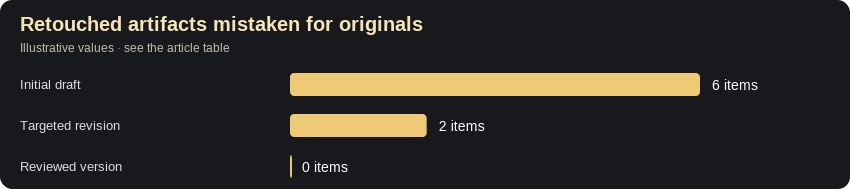
Constructed audit of 6 fixed, distinct cases. First review resolves 4; second resolves the remaining 2. Not observed performance or a conformance score.
A photograph of a clock case looks clearer after an editor crops away a conservator's reference card. That cleaner photograph may be exactly what the exhibit needs. It also no longer shows the card, its relationship to the case, or the part of the mounting board visible at capture. If the exhibit calls that cropped picture the original scan, it has changed an evidentiary claim without changing a single remaining depicted object. The error isn't that somebody made a smaller picture. The error is that the exhibit promises the reader a different kind of picture than it delivers.
Consider an invented exhibition called The North Pier Clock. Its organizers have an object from the pier, a donated print showing the clock in a station room, and photographs from a subsequent repair. They need museum labels, a mobile exhibit, a press packet, and files that a future researcher can inspect. Nobody benefits if all four products must use the same large, awkward file. Nobody benefits either if a retouched publicity image becomes the only account of what was received. The useful arrangement preserves a capture and permits other views as long as a person can distinguish them, understand what changed, and follow a reliable path to the right antecedent.
That approach is stronger than placing a generic disclaimer on the exhibit's About page. A reader arriving from search results or looking at a downloaded press photo does not necessarily encounter that page. It is also stronger than a policy forbidding every edit. Converting a large image for web delivery, making a separate detail, or withholding sensitive material can all have valid purposes. The question is whether the specific copy and its presentation invite the audience to infer more than the recorded process warrants. An intact relationship between item, capture, and publication lets editors choose a helpful display without asking readers to guess what that display represents.
Name the thing that was actually received
Start with the item, not the JPEG. In the fictional exhibit, the clock itself, the donor's photographic print, and a donor's digital photograph of that print would be three different entities. The print might document how the clock appeared in the past. A new scan of the print records the appearance of the print at scanning time. A photograph of the print may preserve features visible under particular conditions or lose them to glare. All three can be useful, but the strongest defensible description of the digital photograph concerns what was captured, not when the clock was installed.
Words such as original and master are slippery because people use them for substantially different things. An original negative is a physical image-bearing object. A camera-original file is a digital file recorded during an exposure. A digitization master is a maintained production file intended to represent source material within a specified capture workflow. A master of a finished exhibition graphic may be the best available copy of that graphic, yet have been made months after capture and contain edited material. Teams can avoid a surprising amount of argument by replacing original in daily conversation with the specific noun they mean.
For this exhibit, assign the clock and the source print separate stable identifiers. When the print is scanned, attach the source capture's identifier to the print record. When a second scan is made under different conditions, link it to the same print but keep its own capture identifier and notes. Each public derivative gets its own identity too, even if software presents only friendly names to readers. The resulting records answer two questions independently: what physical or digital item does this representation concern, and which capture or derivative actually supplied these pixels?
When a collector provides only a previously edited export, preserve that file as the file received. Do not rename it a camera original or imply that the museum possesses its unedited predecessor. The description might say that the submitted file is the earliest available digital copy in the collection and its earlier processing is unknown. This isn't bureaucratic hair splitting. If a second donor brings an earlier copy, you now have a defensible way to explain which contribution contained which information. Better evidence can be added without falsifying the first intake record.
There are awkward cases even when no processing is suspected. A print may itself be a crop of a larger negative. A stamp on the back may describe the place incorrectly. An identical-looking print may be a later reproduction made on different paper. A fresh scan can preserve the appearance of the particular piece of paper without proving these historical propositions. Keep the item's description, observed characteristics, and catalog interpretation separable. If research revises the date, preserve the previous attribution when useful and revise the label as an interpretation, not as an alteration of the capture.
Preserve the source and the conditions of capture
Before adjusting the image for layout, make protected copies of the source material the institution is entitled to retain. For an internally photographed object this may include the capture files, the setup notes needed to make sense of them, and surrounding views. For a delivered digital item it means the complete file as received, not the framed preview a mail app displayed. For a scanning project it can include the structured inventory connecting the scan to the item scanned. An archive's experience and resources should determine the appropriate depth and any collection-specific requirements.
A picture contains only what the imaging situation let it record. A clock case photographed from the front does not establish that its rear panel has no markings. Diffuse illumination may capture surface color more usefully for one question, while oblique light may reveal raised features for another. Record the distinction between such captures before an editor selects the lead image. The photographer can note that the diffuse view was adopted as the primary visual reference and that a separate raking-light view documents joinery. Neither substitutes for the other, and a montage must not imply they were the same exposure.
Color deserves its own limitation. A catalog can describe a surface as appearing blue in a documented view, but the blue seen in a browser is mediated by capture, processing, display settings, and surrounding colors. If a label makes a precise material claim, find corroborating records or an appropriate specialist assessment rather than treating the color of a marketing export as decisive. A caption can say that the published view has been adjusted for legibility. An internal record can give the capture and output color information a subsequent reviewer actually needs.
The FADGI Technical Guidelines for Digitizing Cultural Heritage Materials address creation of digital raster image masters and situate imaging quality in a program of measurement and monitoring. This is a helpful model for a museum considering controlled capture, especially when comparing images across sessions or contractors. It does not follow that naming a format or owning a calibration chart by itself demonstrates adherence to that program. Treat local procedure and formal conformance as separate claims. Use the former to say what was done and claim the latter only when the relevant process is demonstrated.
Library of Congress guidance provides a related but different lens. The Recommended Formats Statement summary and its Still Image Works section help a collecting institution choose among files available in different formats and identify worthwhile technical characteristics and metadata. A well-preserved exhibition poster can be a valuable record of the poster without being a source capture of the object on it. Turning a poster export into a TIFF changes the container, not the history of its pixels. Identify the information content and intended use first, then select the format with a realistic preservation plan.
Classify changes by the question they affect
An editing register works better when it distinguishes operations and their consequences. A delivery operation changes how an established representation arrives, such as providing a compressed copy sized for mobile readers. A framing operation changes what is included or what the eye notices. A tonal adjustment changes how recorded regions are rendered. A content intervention adds, removes, obscures, or reconstructs depicted material. The same processing step can have different significance depending on the purpose: rotating an exhibit portrait upright typically helps readers, but rotating an image used to document how a fragment lay in a tray could alter a relevant spatial relationship.
A single slider movement isn't necessarily a trivial edit. An overall contrast change might make the clock dial more legible and hide faint information in shadows. A crop around the dial might separate the markings from a visible reference scale. In a routine product illustration, similar changes may have little effect on the claim. Here the exhibit specifically discusses what can be read on the dial, so the editor should review the letters and scale against the unedited view. Document the actual consequence, rather than relying solely on the name of the tool.
A narrow dust correction is a particularly instructive boundary. If the team observes a speck that was introduced by the capture process rather than found on the object, an exhibit display copy might reasonably omit it. A speck that appears on the glass or photographic emulsion is a different matter if condition is part of the story. If the editor cannot tell what the mark represents, the conservative choice is to leave the source intact, record the doubt, and avoid placing the cleaned view in a condition comparison. A process note that says only "removed dust" glosses over the most important distinction.
A restored or reconstructed view is valuable in a different way. For a page about a missing section of the clock's face, a designer might illustrate a historian's plausible interpretation of the missing region. That view must stand as an interpretation, not as newly visible evidence. Display it apart from the reference image or pair the views under labels that make their different roles unmistakable. Explain the basis for the inference and do not imply that the reconstructed details were recovered from the source. If the interpretation is too uncertain to depict usefully, say what remains unknown rather than filling the gap visually.
An edit might also be required to protect someone. Suppose the repair photo shows a private address on a work slip. An authorized archive might preserve the received image under restricted access, publish a separate redacted derivative, and state that a private detail was withheld. The public download should be the reviewed derivative, not the underlying capture hidden by a page overlay. Check thumbnails, alternate crops, feeds, and accessible text before release. The audience need not know the private detail to understand the boundary of the public view.
Build a version record someone else can use
A practical record distinguishes the item, each capture or receipt, each editable working representation, and each export that actually reached an audience. It need not be a complicated database to be effective. A small collection may use a structured inventory and consistently maintained folders. A large collection may use a repository with immutable identifiers and linked rights and preservation metadata. In either case, the record should let someone outside the original design team trace an image without relying on a person who remembers what the folders used to mean.
Begin with stable names, then attach dates and roles. The clock face might appear in a full source scan, a dial detail, and a proposed reconstruction. A useful record does not require a future reviewer to infer the role from the words "new," "final," or "final corrected." It names the derivative type and refers to the actual predecessor. It also names the release in which the derivative was used, because the output on an exhibit page can differ from what an editor previewed on release day.
For an edit log, record which action matters, why the action was performed, and how the image may consequently be used. The log may say that a border was removed to fit the exhibit layout and that the resulting view cannot document the full extent of the source print. It may say that the highlight curve was adjusted for a web edition and that the color and exposure values in the download are unsuitable for measuring relative reflectance. This turns an abstract record of changes into a practical note about the downstream limits of the file.
An exact undo recipe isn't necessary for every derivative, but decisions deserve a record independent of editing software. Layered project files can help preserve how an edit was made and support later revisions. They can also depend on external resources or settings that are easy to lose. Keep a usable reference export of important working versions and record the key decisions in a durable format. The ability to replay a complex edit is useful, but it doesn't replace the ability to understand what was done.
A version register should have a deliberate home for uncertainty. For example, a legacy exhibition export may carry a date and match the print generally, but the source scan for that particular export might not be known. The right record can say that the object is recognized, the processing history is incomplete, and the export is unsuitable as a source comparison. Avoid filling unknown entries with defaults. When systems treat every blank as "no editing," they conceal exactly the evidence gap the register was introduced to expose.
Make sure that references continue to point somewhere meaningful after a derivative is replaced. A version that was public and cited should not silently become a different crop under the same immutable identity. A stable exhibit address may point to the corrected current edition, but an edition record can still summarize what changed and identify the earlier version. When the older file exposed something restricted, maintain the history under appropriate access controls without continuing to offer the file publicly.
Inspection is not authentication
A file hash gives administrators a way to test whether a file has the same byte sequence as one represented by an earlier trusted check. It does not prove that the camera witnessed an event, that the photographer identified the right object, or that the pre-ingest history was clean. Record what established the baseline, when the check occurred, which object and file it covered, and what the exception process is. A hash recorded only after a mix-up can preserve a mix-up with perfect fidelity.
Byte identity can also differ from visual identity. Embedding additional metadata into a managed copy may change the bytes without visibly changing the photograph. Recompressing a photograph can change pixel values even if it still looks much the same on screen. The appropriate response to a new byte sequence depends on which change the workflow authorized. Keep the received file unchanged where the policy calls for it, then treat metadata-enriched or converted copies as identified versions with their own records.
Metadata can support tracing, but inspect it in context. A field called Date might refer to the exposure, an estimated date on the depicted postcard, the digitization date, or when the public image was exported. A description carried along from a source file may no longer be true after cropping. A delivery platform can remove metadata or expose fields a publisher intended to keep internal. Do not rely on embedded details as the sole public disclosure. Provide small, visible statements alongside the image and keep the more complete record in a durable inventory.
Visual comparison is an editorial test rather than a license to assign motives. If an edited view shows an unusually clean border, first compare the specific source and derivative under appropriate viewing conditions. The difference might reflect a tighter crop, less glare, or an altered region. Document the visible difference and the confirmed operation separately. If you cannot confirm the cause, phrase the finding accordingly. A review note should make it easier for the next reader to distinguish what was observed from what the reviewer inferred.
Check whether the two images are even comparable before examining particulars. Were they photographed from the same position? Are they two conversions of a single source capture or photographs from different sessions? Was the object dismantled between them? A different shadow or highlight can arise without any document-level change. The working checklist for the North Pier Clock begins with identifiers and dates, then compares the relevant visual regions, then reviews captions. Reversing that order encourages a reviewer to theorize about pictures that should never have been treated as a direct pair.
Put the disclosure where the claim is made
A disclosure should explain the relationship in ordinary terms. "Detail cropped from a scan of the donated print" does useful work. "Digital image courtesy of the archive" primarily expresses credit, not how the image relates to its source. "Enhanced" may conceal more than it reveals. If the brightness was changed to make the dial legible, say so when that change matters. If the missing numeral was reconstructed, do not merely call the picture enhanced. Use a sentence distinguishing drawn material from recorded material.
A compact caption can combine the depicted item, the role of the image, and a link to a relevant record. For example: "Clock in the north station room, from a donated print. Exhibit detail cropped from a scan; view the full print record." This sentence identifies the object of the digital capture as a print, not the station room itself. It does not make the date of the depicted scene the date of digitization. Nor does it require the user to recognize an unexplained accession number before discovering the relationship.
Disclosure must travel beyond the main exhibit. A press editor may receive a picture and a short caption document but never open the exhibit route. If a file has downstream reuse value, package it with a description that includes its role and a stable public link. For feeds and card previews that cannot present meaningful qualifications, select a less ambiguous asset. Treat headline, image, and excerpt as a combined promise. The explicit caption in one surface does not rescue a misleading shortcut on another.
There is not one right amount of markup. In a close comparison of two views, labels need to be visible near each image and not depend entirely on matching a colored outline to a key. In a single decorative hero, an unobtrusive visible descriptor may be enough, provided the context does not present it as historical evidence. On a standalone document detail page, the source link and brief processing note might accompany the title. The aim is not to pack the interface with caveats; it is to give the reader the distinction at the moment it could change their interpretation.
The W3C WAI Images Tutorial distinguishes image text alternatives according to function and context. Apply that principle here. If the photo conveys evidence, the text alternative should communicate the relevant information rather than treating it as decoration. If comparing a reconstruction with a source scan is the exercise, convey the difference in text, using adjacent description for details too long for a concise alternative. Do not repurpose alt text as the sole home for provenance. A person who can see the photograph still needs to know which role it serves.
Sometimes access to the full capture is restricted. Do not promise a public original download if the link only opens a staff login. Identify the destination accurately, perhaps as the catalog entry or access inquiry, and disclose the relevant limitations. If you offer a copy, make the download label distinguish a public reference export from an original file. A defensible implementation values trust more than a false sense of completeness. A reader can still make a sensible decision about the image if the institution is clear about what is and is not available.
Six mistakes in an imagined exhibition review
The following chart is a constructed example, not a reported result. The six cases are fixed and distinct throughout the review. The count is the number of these cases where the presentation still invites a derivative to be mistaken for an original or source capture. A reconciliation record ties each resolution to a change. The chart counts cases, not edit operations; a single derivative could need several fixes and would still contribute only one unresolved case under this setup.
Retouched artifacts mistaken for originals
Illustrative bar chart data. Unit: items. This example is neither observed performance nor a conformance score.
| Review stage | Unresolved items |
|---|---|
| Initial draft | 6 |
| Targeted revision | 2 |
| Reviewed version | 0 |
In the first case, the exhibit's lead picture was a detail but called a complete scan. The reviewer restored the direct link to the print record and made the caption say that the visible view was cropped. They also checked the source item correspondence rather than assuming that a thumbnail containing the right clock was from the right print. That change preserved a useful, readable picture without allowing it to stand in for the whole sheet.
The second case concerned the repair photograph. An edited publicity frame excluded the paper reference card. The exhibit originally used it to argue that the clock case had been examined without a scale. The team corrected the prose after comparing the relevant view and selected the full reference photo where it had the rights to display it. The correction in this case was not just a new caption. The exhibit withdrew a claim that the underlying view didn't support.
The third case was a folder problem disguised as a historical question. A clock face reconstruction shared one filename stem with the dial photograph and had inherited its description. During revision the team moved the reconstructed view into an interpretive section, made its label specific, and fixed the downloadable caption. Because the image still showed the clock, a quick search by object name couldn't distinguish the two uses. Separating the files by role and identifier gave subsequent reviewers something firmer to check.
In the fourth case, a social preview had pulled a high contrast image into a card announcing the release of an original scan. The exhibit page itself contained a more careful description, but the card was a publication in its own right. The team supplied a different image and corrected the card wording. The review did not assert that every copy already distributed changed. It checked the preview under the site's control and recorded that external caches or already downloaded copies might take longer to disappear.
Four resolutions reduce the open count from six to two. The team leaves case five open when a mobile rendition excludes part of a photographed guide line that is material to the text. It also leaves case six open because a download labelled original leads to a derivative whose predecessor has not yet been resolved. In both instances an attractive screenshot of the improved desktop exhibit gives the wrong impression of readiness. The evidence of completion needs to come from the given route or asset.
The next review identifies a mobile asset with the relevant area retained, then checks its on-page description at narrow widths. It replaces the mislabeled download with a correct collection record link and labels the derivative according to what the team can establish. That resolves the remaining two cases, yielding zero for this fixed set. The step from two to zero does not show that all possible problems have disappeared. It shows that reviewers closed the two recorded problems after verifying their stated fixes.
A team might open a seventh case tomorrow when it finds an inaccessible annotation or an older image in a press bundle. That case belongs in an expanded review register, not a quiet rewrite of the chart's denominator. If reporting a real audit, give the inclusion rule, audit date, scope, and exclusions, and distinguish known unresolved cases from defects not assessed. The point of the count is to make work visible without turning a finite checklist into a universal proof.
Audit what the visitor gets, not what the designer exported
Modern sites deliver several representations through the same logical image slot. A browser might choose a size from a list, a server might produce a crop for a device, or a publisher might insert a fallback on a content card. Confirm the relationship of each important rendition to its source. If a responsive display automatically cuts away the frame of the donated print, a text claim visible beside the desktop image can cease to be reviewable on the phone. A user shouldn't have to know that a different file exists in order to discover that a meaningful edge has disappeared.
An art-directed crop is not inherently a defect. What makes it a problem is contradiction between display and claim. A narrow screen might use a focused crop of a hinge for an illustration of hinge design. If the page explains the orientation of the hinge in the complete case, provide the complete frame elsewhere, with the relation made explicit. A small alternate view intended to direct attention to a figure can coexist with a tall reference image that maintains the context. The team decides which information is necessary at each step.
Review the public implementation as a fresh visitor. Start with the page route, open the zoom viewer, download the labelled image, and follow the source record link. Try more than one layout or viewport if assets are selected responsively. If the exhibit has offline or printable uses, inspect those outputs. A button labelled full image should not open the same cropped asset magnified by the browser. Download labels should identify the file that actually arrives, including after any publication cache or image-service routing is involved.
Comparison design deserves more care than a dramatic slider. A side-by-side display with readable captions and individually inspectable images can make a stronger case than a slider that assumes dexterous pointer use and obscures one view at a time. If a comparison relies on a specific mark, name the mark and name the relevant image. If readers need to orient themselves, start with context before detail. The interaction can offer convenience, but the written explanation should not depend on reproducing one exact hand motion.
Print is another test of whether labels are attached to claims. A paper handout can separate a caption from the image because a page break intervened. A cropped detail used as an inset may lose its label when it is reused in a school packet. Where reuse matters, provide paired files and captions with matching identifiers, rather than a packet of ambiguous downloads followed by a single detached paragraph of boilerplate. A confident reader should be able to match the credit and role to the picture even when the page decoration changes.
Finally, test both language and behavior when the image fails to load. The remaining page should make clear what would have appeared and should not assert that the user has already inspected it. Do not use gaps or loading states as evidence of what the collection owns. Good accessible copy and a useful catalog link still help when a heavy image fails on a limited connection. Conversely, when the site shows a successful image but the catalog link goes nowhere, visual polish is not evidence that the underlying record is available.
Design a correction pathway before you need it
Suppose a patron sends the museum a screenshot and says that a crease in the donated print appears in the catalog view but not on the exhibit. The right response begins by noting the exact page, visible image, and date. Ask where the discrepancy was observed if the screenshot doesn't tell you, and check the current and archived release records. The patron may have found an undocumented intervention, but the compare could also involve a different print. Resolve the identity before telling them what happened.
If the touch-up is confirmed, decide what the exhibit had claimed. A cleaned publicity view accurately labelled in its own section may not need withdrawal. A retouched image in a display specifically discussing condition may require replacement, a correction to the text, and a check of related surfaces. A derivative incorrectly offered as an original download may need both a corrected label and a review of outside material supplied with a misleading caption. Scope the changes to the impact of the error rather than treating every correction as a case for deleting everything.
Keep a human-readable correction note for substantive changes. It might say that the digital image appearing in the exhibition was an edited derivative, that the caption previously described it as the complete scan, and that the reference view and display description were corrected. This tells a repeat visitor why their downloaded copy differs. When a note has privacy implications, say enough to correct the public claim without amplifying the private material. Keep any sensitive particulars in the appropriate internal record.
A correction should be timed and tested like a release, not assumed from a successful upload. Verify that an ordinary unauthenticated reader gets the corrected result on a clean request. If a derivative was mirrored in a mobile viewer or a press folder, check that surface too. If a feed might lag, record the pending condition rather than claiming the entire distribution has been updated. A link in a private preview is not proof of delivery to a public route, and clearing a local cache does not alter a copy already saved by a visitor.
When the response requires replacing an archival storage object, be especially careful about preservation and editorial systems operating at different speeds. The offending publication file can be withdrawn without discarding the intact capture. The original public version may remain meaningful historical evidence of what the exhibit once said, even if it should not remain publicly downloadable. Plan how to record the distinction between retained, accessible, and published. These statuses answer different questions and change for different reasons.
What if an authentic-looking hero is not a photo at all?
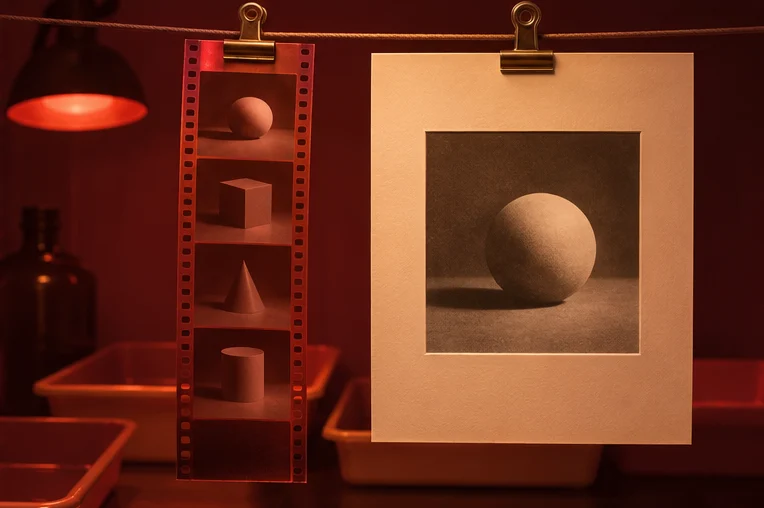
An exhibit front page may use art showing a mounted print beside a film strip. It might be designed in a studio, assembled as a composite, or generated from a written brief. Whatever the medium, if the film strip is not a photographed object from the collection, presenting it as the source is wrong. Organizational branding and professional lighting can lend an impression of documentary authority to something that was never documentary. Make the role clear in a visible descriptor if the picture's position or style might make the distinction uncertain.
Consider the editorial choice in this article itself: a conceptual image of a negative near a reproduction would summarize the difference between source and display, not provide evidence about a real collection or production workflow. A useful description would identify it as an illustration and refer to the things visibly depicted. It should not hint that the film shown is one of the North Pier Clock artifacts. Those objects are fictional. The significance of the artwork lies in what it communicates, not in what it can authenticate.
A photographer commissioned to stage a reconstruction and an illustrator making one from scratch face a related problem. A photograph really can record the staged arrangement, but its authenticity as a record of staging does not make it contemporary evidence of the scene being reconstructed. Separately record when the step took place, who supplied the historical basis, and which features are conjectural. Aesthetic realism should not change a caption from "reenactment" to an archival date.
The reader can also be misled without any caption saying something obviously false. If a page uses the same badge and layout for reference captures and new pictures, it teaches the audience to treat them alike. If a thumbnail of the synthetic illustration is placed among dated collection material without context, readers might give it the authority of its neighbors. Setting aside a separate visual area for interpretation reduces that risk. The difference should also survive a missing stylesheet, high zoom, or a plain text reading mode.
A small team can start without a new system
For a six-person exhibit, assign a named owner for intake, another for the publication version, and a reviewer who didn't make the most consequential edits. Several roles may belong to one person on a small budget; what matters is that decisions have owners and critical checks are not implied. The editor may not know the history of a scan. The registrar may not know what the mobile site serves. Give both an opportunity to check the particular evidence they control.
Choose the scenes where uncertainty matters most. For the clock exhibit this might be the color of the dial, the outer margins of the donor's print, and the timing of a repair. Trace the images supporting those parts of the story before auditing quieter decorative material. This establishes a sensible priority without excusing errors in the rest. When source loss is suspected, the highest-value step is usually to secure what is still available, then determine whether the published claim can be supported with the known material.
A baseline inventory might contain object identity, source file identity, source relationship, creator and applicable dates, access category, version, claim and caption, and the reviewer. The row can point to richer detail if it exists. Avoid designing the inventory exclusively around the app that delivered the exhibit. A useful identifier should survive changing the web domain, moving to another static site system, or distributing a file under a new friendly name.
Check how easy it is for a replacement editor to make a safe choice. The working folder might contain four pictures of the same clock. If the interface offers no distinction between the evidentiary and illustrative ones, assume the wrong file will eventually slip through. Add separate media records, plain role labels, and meaningful default captions. Build the safest valid choice into routine publication rather than expecting each staff member to remember a private conversation.
Not all teams have the budget to make top-quality new captures. State the limitations of the surrogate when you cannot improve it. For an unscanned item, a phone photo may help identify a major feature, but don't let a supersized export pretend to supply reliable detail that wasn't recorded. An exhibit can honestly say that its image is a low-resolution copy received from the lender. Better imaging can be scheduled later without disregarding the usefulness of what is accessible today.
One good handoff exercise is to give an uninvolved staff member the public page and ask them to identify the received object, find its linked catalog entry, and point out which version of the image supports a specified claim. Then give them the managed inventory and ask whether they can reach the correct internal predecessor without a verbal explanation. If they cannot trace a link because it was in someone's message rather than in the record, fix the trail. If they reach a file but misunderstand its role, change the label. These are different defects with different remedies.
Separate what the image can show from what the caption knows
A curator looking at the North Pier Clock can know from the accession material that the dial was removed for a particular repair, while a detail crop may show only an indistinct edge. The image need not depict everything the caption reports, but the caption should let the reader know what comes from other material. "The workshop log records that the dial was removed; this photograph shows the case after the repair" assigns the claims to different sources. A caption that confidently equates a visual detail with the entire log turns two lines of evidence into a stronger claim than either one supports.
Treat measurements in much the same way. A print may show a ruler beside an object, but even a retained ruler may not establish all relevant dimensions if the ruler is in a different plane. A derivative whose crop cuts it away does not preserve that potential context in the first place. For an exhibition that needs a dimension, cite a documented measurement and use the image to show what was measured. If the exhibit is trying to reconstruct a dimension from an old picture, distinguish its assumptions rather than inviting the browser to serve as a virtual measuring instrument.
A comparison of physical condition demands even greater attention to scope. A restored clock may genuinely have fewer visible surface defects than when first received, while the high-contrast earlier shot and diffuse later shot may disagree about which flaws are visible. Pairs of images with different conditions can still make useful comparisons when their limitations are stated, but the institution should not claim that every visible difference was caused by treatment. Where controlled rephotography is unavailable, a carefully documented list of interventions may better support specific claims than an attractive split screen.
Finally, choose durable, searchable language for the status of a file. "Exhibit detail," "source scan," "photo supplied by lender," and "new interpretation" communicate meaningful roles even without the surrounding application. Limit terms such as "before," "enhanced," and "restored" unless you specify what they refer to. A photograph restored digitally is not a photograph of the physically restored object. Neither is a staged picture a record of the depicted historical event. That is the smallest reliable rule for the whole workflow: preserve what you received, identify the view you made, and describe only the claim that view can support.
References
- W3C WAI Images Tutorial: text alternatives according to image purpose and context.
- Library of Congress Recommended Formats Statement summary (alternate domain) and Still Image Works: collection format preferences and technical characteristics, not provenance tests.
- Federal Agencies Digital Guidelines Initiative, Technical Guidelines for Digitizing Cultural Heritage Materials: still-image master creation and imaging-quality program guidance.
The exhibition, incident examples, and numerical chart are illustrative. None of the sources supplies those counts.