
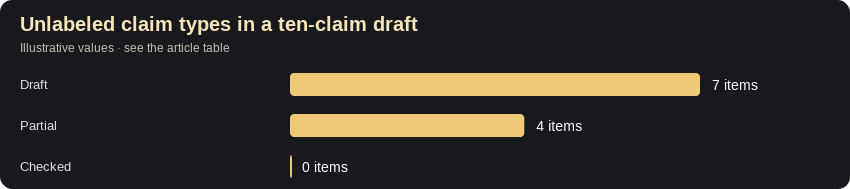
| Category | Value (items) |
|---|---|
| Draft | 7 |
| Partial | 4 |
| Checked | 0 |
Constructed checklist scenario for this brief, not measurements, ratings, or results from cited sources. Each displayed count represents checked items in the named example.
The field notebook says that one person watched a patch for ten minutes. The planning memo says that next month's team should budget twenty minutes at each stop. A draft combines them: “Typical observation effort was twenty minutes.” That sentence sounds like a summary of what happened. It is actually an instruction for what might happen later. The number did not change. Its job did.
The mistake can travel. A chart places twenty beside observations without distinguishing the categories. A preview cuts off the words “we recommend.” A reader estimates how many hours volunteers worked and uses the suggested duration rather than the durations in the notebook. By the time the figure is reused, a reasonable proposal has become imaginary evidence. Correcting that error takes more than putting the original number back into the text. It takes putting the original kind of claim back with it.
This guide follows a fictional observation program through an editorial review. It distinguishes observations, calculations from observations, model-based estimates, suggested practices, and unknowns. The illustrated counts come from a fixed set of ten invented checks, not a study of actual readers. The field examples explain how claims can be reported; they are not recommended protocols for any actual monitoring project.
Name what each sentence is doing
An observation describes something recorded under stated conditions. “The west station was watched from 09:10 to 09:20” points to an event and a source. It can be wrong if the times were entered incorrectly, and it still needs a definition of which activities count toward a watch. But at least its evidence trail is clear: someone could check the relevant record. The recorder's notes may give more information about interruptions, timing precision, or any gap that keeps the elapsed time from being usable as observation effort.
A calculation describes a result derived from inputs with a known rule. “The interval between the two logged times was ten minutes” is arithmetic, not a separately measured elapsed time. It may be a useful way to express the observation if the time record is sufficiently precise and the watch was continuous. If someone stepped away for three minutes, however, elapsed time and active watch time differ. Clear writing can identify both quantities without demoting the calculated one to a guess or promoting it to a new observation.
A model-based estimate uses assumptions or a model to infer something not directly observed. “The route model projects that the team could cover three stops in one morning” is a different claim from a log that records three completed stops. The model can be valuable for planning and can be tested against new records. It needs an explicit input basis and scope. If travel time changes or the site is closed, the model's output may no longer apply. Calling the figure estimated is helpful, but the reader should still know what was estimated and how it differs from what was recorded.
A recommendation describes what the author or responsible group thinks someone should do. It can draw on experience, measurements, models, constraints, and goals. A proposed duration may be sensible because of what a group wants to learn or what its schedule allows. Evidence can support that proposal without turning it into a measurement. “For next month's trial, the team proposes twenty minutes per stop” says what can be verified about the plan. It neither asserts that twenty minutes was previously typical nor claims that the duration is required everywhere.
An unknown is information unavailable under the defined record. “Active watch time not recorded” is not another way of saying zero minutes. It is not a prompt to copy the scheduled duration into the completed record. Some unknowns can be resolved by locating original records or checking a reliable source. Others cannot. Mark the distinction so a person doing later analysis can decide whether to exclude a row, show it separately, or apply an explicit estimation method. Do not let a blank acquire an interpretation merely because a spreadsheet prefers every cell populated.
In the same paragraph, these categories can cooperate: “The log records six complete watches. We calculated a total of sixty active minutes from their individually logged durations. Our planning model estimates that the revised route could fit an additional stop. We recommend testing that route, but travel time on the new segment is unknown.” Each clause has a job. No part needs to pretend to be another for the account to feel authoritative. The evidence becomes stronger because its extent is clear.
Audit the ten claims before counting the bars
Imagine a short report, a chart caption, and a mobile excerpt for a fictional garden route. The editing team fixes a list of ten claims and asks whether each is accurately labeled by evidence type in the selected text or directly associated context. The chart counts unlabeled claim types, not all potential defects. A statement whose label is materially wrong also counts as unlabeled for this exercise. Additional quantitative review might check numerical correctness or adequacy of methods, but that is not what the chart measures.
Three claims already pass in the first draft. The first says “the notebook records six completed watches.” That identifies an observation in a record. The second says “one attempted session was marked incomplete,” another recorded status. The third says “active minutes for the unfinished session were not recorded,” which is an explicit unknown rather than a zero. These three remain labeled through all versions. The remaining seven are deliberately presented without the distinctions readers would need. Counting the three labeled and seven unlabeled claims gives the full ten-item review set.
The fourth claim is a calculated sum of sixty active minutes across the six completed watches. In the starting text, the figure appears without saying it is a calculation from the duration entries. The fifth is a model output estimating thirty possible minutes for a future pair of short stops, published simply as “thirty minutes available.” The sixth is a suggestion to schedule twenty minutes per stop next month, stripped of its recommendation status. These three are the first ones repaired in the Partial version. The sum names its inputs, the estimate identifies the scheduling model, and the recommended duration is explicitly a proposal for the next trial.
Four more unlabeled claims remain in the Partial text. The seventh substitutes an expected count of qualifying stops under a planning assumption for a completed stop count. The eighth describes a preferred reserve for travel time as if it were measured travel. The ninth names a route segment's timing without disclosing that it is unknown. The tenth reports a projected average under a proposed schedule as though it were the observed average. In the Checked version the seventh and tenth are identified as model-based projections, the eighth as a suggested allowance, and the ninth as missing evidence. All ten claims now have their designated labels in the tested excerpts.
| Illustrative review version | Unlabeled claim types (items) | What changes in this constructed review |
|---|---|---|
| Draft | 7 | Three claims already label their status; seven do not |
| Partial | 4 | Adds labels to the sum, scheduling estimate, and recommended duration |
| Checked | 0 | Labels the two remaining projections, suggested travel allowance, and unknown timing |
The companion chart “Unlabeled claim types in a ten-claim draft” shows seven, four, and zero. Three items are repaired between Draft and Partial, then four between Partial and Checked. The same ten items are inspected every time. The chart is illustrative; none of those counts was supplied by NIST or inferred from reader behavior. Zero means the fixed items were labeled in the stipulated example, not that a publication is factually complete, that the model was validated, or that every reader interpreted it correctly. Labels make the distinctions available; evidence and testing have separate jobs.
Keep effort and results on different rulers
Observation effort can include time, distance, number of completed sessions, or another quantity defined by the project. Its exact meaning matters if it appears in a denominator. Ten minutes of active watch is not necessarily ten minutes since the observer arrived. Two scheduled sessions need not be two completed sessions. A count per completed watch and a count per minute answer different questions, even when both are reported as rates. Label the effort with both units and the conditions under which it was recorded.
Suppose a toy example has three complete watches lasting ten, fifteen, and twenty minutes. The arithmetic total of active time is forty-five minutes if the three numbers are accepted as comparable active durations. The schedule might have called for twenty minutes on each of three stops, for sixty planned minutes. The gap between sixty planned and forty-five recorded is not an observation of fifteen minutes of distraction. There could have been a shorter authorized session, a schedule change, or interruptions. The difference describes planned versus recorded effort; explaining why requires other evidence.
Now imagine the same group counts six qualifying events over the forty-five recorded minutes. A simple descriptive rate would use the recorded exposure time under an appropriate consistent definition, not the planned sixty. Replacing the denominator silently changes the result. If one completed watch has no recorded active minutes, an analysis that uses the others should state which results and minutes were included. A useful description is more specific than “normalized by effort.” It tells the reader whether the comparison used minutes or sessions, and whether the numbers were observed, calculated, or estimated.
Even with correct arithmetic, a rate does not erase differences in conditions. A longer watch may sample another part of the day; observers may use different event definitions or have different visibility. A descriptive rate can be useful without proving that every time interval is interchangeable. If a publication recommends more observation time, indicate whether the recommendation is a planning choice, an inference from data with a defined scope, or a formal rule of a particular program. Keep the basis visible without letting a practical decision stand in for the observed distribution.
NIST Special Publication 811 addresses expression of quantities and units. NIST notes that this publication has not been updated for the SI changes that took effect in 2019, and links newer SI material. Here the relevant editing habit is straightforward: state what the number counts and keep its unit with it. Clear units still do not tell readers whether the value is measured or proposed. Both kinds of labels are necessary, and the NIST reference does not supply the garden project, toy rubric, or any monitoring recommendation.
Choose verbs that keep uncertainty honest
A useful edit is to underline the main verb in each sentence. “Recorded” should name a record. “Calculated” should say which inputs and rule were used when they matter. “Projected” should name a future or unobserved case and indicate the model or planning assumptions. “Recommend” should identify a choice and who is making it. “Not known” should distinguish missing information from a negative finding. These verbs are not rigid labels to add everywhere. They help prevent convenient language from assigning a claim a stronger status than the underlying material supports.
Some phrasing can be technically true but practically misleading. “Twenty minutes was the watch duration” sounds retrospective even if the author means the scheduled duration. “Twenty minutes is the watch duration we propose testing” narrows it. “The expected route took forty minutes” joins a prediction to a completed event. “The route model allocates forty minutes” marks the basis without suggesting that anyone walked it. A readable report can still use plain words instead of specialist labels when the provenance is clear.
A bad verb can also weaken a result. If an observer actually logged six completed watches, “The group guessed that six watches were completed” creates uncertainty the source does not warrant. Say that the log records six and identify what the record does not cover. The aim is calibrated confidence, not cautious language in every sentence. Evidence can be trusted as evidence of a bounded claim without exaggerating its reach or casting doubt on ordinary documented facts.
Changes of tense matter when material will be reused. A seasonal statement such as “volunteers watch for twenty minutes” can refer to a rule, a habitual practice, or a description of past observations. If the team just adopted a proposed duration for a pilot, name the pilot and its period. If the period has passed but actual durations have not yet been checked, don't switch from “will be scheduled” to “were observed” merely because the editorial calendar moved forward. Time passing doesn't populate a notebook. The archive needs the actual records.
Pay attention to may, should, and must. A model can say an additional stop may fit under its assumptions. A recommendation can say the team should test whether it fits. A formal approved procedure can require a particular reporting step. Those outcomes differ. A caption that says “must complete three stops” should not be derived from “the model predicts three may fit.” If the author intends a rule rather than guidance, verify its source and scope. Conversely, do not dilute a genuine requirement into something optional simply to sound conversational.
Keep the claim type visible in the shortest copy
A publisher can write a careful paragraph and then reuse only its second sentence as a card. The first says “Our planning model assumes twenty minutes per stop.” The second says “Each stop takes twenty minutes.” The shorter sentence loses the assumption and may even overstate it in context. A safer version is “The plan allows twenty minutes per stop.” Use an attached phrase or meaningful subject so that the evidence type is part of the smallest likely unit. Where shorter space does not allow an accurate claim, use a narrower claim or a question about what the reader will find.
Charts and tables can interrupt the same information. A caption says a bar is a projection, but the bars themselves all have numeric labels and no evidence status. If the image is shared without the caption, the estimate becomes hard to distinguish from observations. Consider labels such as “Recorded minutes” and “Proposed minutes” rather than relying only on a difference in line style. Make sure the table provides the same distinction to readers who cannot use the legend. NIST's gallery of graphical techniques is useful background for choosing a display suited to an analytical task, not a source of this article's editorial counts.
A quote can create a similar mismatch. “We usually need an hour” might be someone's planning intuition. The accompanying article should not translate it into a measured typical trip time without data. If a voice clip is included after the discussion of completed visits, identify the speaker's role and whether the statement is an observation or recommendation. If the clip is meant to show an expectation for the next month, say so beside the clip. A quotation marker proves neither how the figure was produced nor what scope it represents.
For a small-screen preview, ask which words survive if the end disappears. “Twenty minutes at each stop, our proposed target for a future trial” is more fragile than “Proposed trial target: twenty minutes per stop.” The latter is not merely shorter; the label and value travel together. Don't rely on a long explanation farther down the page to undo an unsupported headline. A preview should lead readers toward the fuller account while preserving the status of any assertion it makes. A graphic that cannot reasonably fit both a number and its status can instead link with a descriptive label to the full version.
Work with the cases where labels seem to overlap
Some results fit more than one description at different levels. An instrument reading is an observation in a field record, but its displayed value may already reflect conversions. A worked summary can be a calculation from observations, while another summary computed by software depends on a model that estimates an unobserved quantity. The purpose of labeling is not to pretend only one word can apply. It is to identify the step that matters to the claim the reader will make. A conversion with a fixed rule should not be described as a forecast; a forecast does not become an observation because the software received observations as inputs.
For example, a worksheet that automatically converts seconds to minutes produces a transformed representation of a recorded interval. That output can remain an appropriate description of the same timing record, as long as the units are correct and the precision is not overstated. In contrast, an estimate of active minutes based on how long a session was scheduled, without a record of when observation occurred, has a different basis. Both values can be displayed in a column labeled minutes. Only one directly follows from documented timing. A precise reader needs the source and processing status as well as the quantity label.
Suppose an editorial team recommends twenty minutes because its planning model says a longer observation has a better chance of capturing at least one event under the conditions it assumes. The recommendation now has evidence behind it. It remains a recommendation, because the team chose a goal, weighed feasibility and constraints, and decided on an action. The model does not tell the team how to value effort, access, or uncertainty by itself. The article can describe the modeled result and the value judgment separately. It need not suggest they are unrelated, only that they perform distinct functions.
A factual report that a recommendation exists also needs tight wording. “The committee's notice recommends twenty minutes” is a verifiable statement about the notice, and the referenced number is still a recommendation for observation duration. Do not carry the factual character of the notice over to a claim about the world it discusses. The committee may be able to verify that it issued the guidance even if there is no evidence that participants followed it. If the intended article is about what the group will ask of participants, the notice is the right source. If the intended article is about what participants did, use their records.
An interpretation may use words like suggests that readers understand in several ways. “The notebook suggests that twenty minutes is necessary” can hide whether the author found a pattern, tested a hypothesis, made a decision with incomplete evidence, or simply prefers a longer watch. Use a more explicit statement: “The longest recorded watches included more events, but they took place in a different part of the day. The team proposes testing a twenty-minute watch.” The first sentence reports the pattern with a limitation; the second makes the decision. No causal or universal rule is smuggled into the verb.
Test uncertainty before turning a blank into a number
Imagine a record for an interrupted visit. It has a listed start, a notice that the route closed, and no indication of when observation stopped. A reader may reasonably assume that some observation occurred. That does not identify how many minutes were active. “Active duration unknown” is an informative statement about the archive. It prevents a later tally from treating the visit as deliberately zero effort or as a complete session. Both would be unwarranted.
A separate schedule can give the intended duration. That is useful as context, particularly if the project wants to compare effort commitments with completion. It is not a replacement for the missing observation. If an analyst provides an explicitly modeled estimate of missing time, label it as such, retain the original missing value, and describe the evidence or assumptions behind the estimate. The publication can report an estimated total if the design supports it, but should not claim every component was independently recorded.
Two seemingly similar records can tell different stories. “Completed ten-minute watch; no events observed” contains meaningful information about effort and outcome. “No watch completed; no event total reported” describes a different state. A card that says “No activity” would obscure the distinction. Write what the observer did and what the record actually reports. The same care helps with access failures, a malfunctioning timer, or an unavailable field note. An empty value may be evidence of a documentation gap without being evidence about the underlying event.
A zero in the summary requires a defined quantity. Zero qualifying observations under a reported method need not imply zero true activity. Zero listed records on a filtered dashboard can mean no records meet the selection, not that nobody visited a site. Zero budgeted stops describes a planning decision. These meanings can diverge even though the digit prints the same way. Carry the correct qualifier from the data model through the chart; do not expect a caption buried at the end of an article to make an unlabeled zero safe.
Keep thresholds and defaults distinct from observations
Routine field software may prefill a duration or number of stops. A default can make entry easier for a common case. It can also seed a plausible-looking value in a report without confirmation. An archive should distinguish a default that has not been verified from a duration actually accepted and recorded by a participant. A writer should ask not only which number appears in the form but how it acquired its state. If the system cannot show that distinction, do not claim the entire field was directly observed.
Suggested effort can also be set for more than one reason. A group may deliberately reserve extra time to handle delays, keep route comparisons more comparable, or offer a manageable commitment to volunteers. Name the reason when it affects interpretation. A recommendation to reserve time for travel does not imply an observed average travel time. If a formal protocol established a fixed requirement, cite its actual scope instead of treating a planning slide as the governing document. A design target and a measured average can agree by coincidence; their meanings remain distinct.
A reporting deadline illustrates the same logic. “Records received by Friday” names a class defined by the reporting process, not the dates observations happened. “Records should be received by Friday” is an instruction and does not show that any arrived. If a graph mixes projected attendance and actual completed records, the temporal status needs to be visible. A comparison may explain gaps between plan and result, but it should not suggest the plan was an earlier measurement. Editorial accuracy begins with the right type before the right date.
Run the review in the places people will reuse
Build a compact claim ledger for the material that will be published. For each key number or assertion, note its type, source, scope, date or version, and the sentence carrying the label. If calculated, record the rule and which observations went into it. If modeled, identify what was not directly observed and what assumptions allow the estimate. If recommended, name the decision maker and the context for action. If unknown, say which data are absent rather than describing the result as zero. A team can preserve these facts without burdening the public paragraph with the full internal record.
Check the title, figure, table, downloadable excerpt, and narrated version separately. A careful figure might distinguish modeled and recorded series in its legend but a social excerpt might contain only the larger modeled value. Ask a reviewer to describe the main claim from each surface without opening the full report. If their plausible interpretation is stronger than the record supports, move the distinction next to the value or use a smaller claim. Do not dismiss the mismatch because the full report technically contains the requisite context.
Keep the test consistent when comparing edits. The worked chart uses the same ten designated claims, preserving the distinction between a repair and deleting a difficult item from a review. If an editor intentionally removes three unsupported claims from the release, that may be a wise decision. Document that the scope changed rather than reporting a perfect score on the same ten claims. A missing recommendation is not an accurately labeled recommendation unless the rubric explicitly counts omission as an appropriate resolution. That rule should be defined before reviewing versions rather than set to make the latest version look better.
Check whether the shortest likely extraction contains the source of meaning. A complete sentence can be clipped at a turning point, like “The project logged sixty minutes and estimates an additional thirty next month.” A preview ending after logged sixty preserves one observation-based claim. A standalone card reading “Ninety minutes on the route” is not equivalent, even though ninety is the sum of sixty and thirty. The calculation blends actual coverage with a projection. If a story genuinely needs to discuss a hypothetical combined scenario, label the components and only then report the conditional total.
Try a difficult visual case. A chart shows seven solid bars for observed sessions and one patterned bar for a next-month plan. In a small screenshot the pattern is hard to see. An alternate text says only “eight watch times.” The fix can use direct labels or separate panels and describe the different series in the alternative and the table. If a panel represents a planning scenario, include its assumption near the plot. The core evidence distinction should not depend on what color the reader can distinguish or whether they happen to read a footnote after making an inference.
Correct a label without discarding the source
Suppose an article previously described the twenty-minute recommendation as last season's average. The first repair is to remove the false interpretation in the headline and all summaries. The corrected article can still say that twenty minutes was proposed for the next period. If a measured average is available, report it with the exact source and relevant selection. If it is not, state that no comparable average was established from the available records. Don't silently replace one unsupported estimate with another simply to make a correction retain a number.
When a correction changes a chart, retain the original source values unless they were themselves wrong. Move the proposal to its own category or omit it from the observed series. Recheck any computed totals or rates that used it, because a label correction can have a numerical consequence. Inform readers about the distinction that changed: a value was planned, not measured. A correction that simply says the table was updated may leave the original misunderstanding intact. Good editorial records make it possible to correct both the display and the downstream interpretation.
A changed model can produce a different estimate without making all earlier observations wrong. Store the model version, date, and assumptions separately. When comparing scenarios, avoid describing a revision as an observed change in conditions unless measurements show that change. If the archive includes earlier advice, label it as earlier advice and indicate what superseded it where relevant. A recommendation can have been real and appropriately issued at the time, even when later evidence warrants a different plan. Historical context can remain accurate without inviting current use.
A useful closing check has four questions. What did someone record? What did an analyst calculate or estimate? What does someone propose doing? What is still unknown? Write the answers in the same surviving fragments as the figures they describe. This small discipline prevents the status of a claim from disappearing when the layout changes. It also keeps the value of a good recommendation intact: advice can be well reasoned and worth following without impersonating a measurement.
Read a decision memo with its evidence and values separated
Consider a planning memo that says ten minutes per site is easy for returning volunteers but twenty minutes might produce more usable observations. Treat that sentence as an invitation to ask two separate questions. First, what was the measured demand on volunteers? Second, what does the organization value when setting the schedule? The former might need actual time records or accounts of difficulties. The latter might balance geographic coverage, training, convenience, and data needs. A number cannot supply that balance by itself. A careful memo can report factual evidence about the available options while stating which tradeoff the recommendation prioritizes.
A simple hypothetical comparison uses two route designs. One budgets four pauses of ten minutes each; the other budgets two of twenty minutes each. Both allocate forty nominal observation minutes. They differ in the number of locations, the time available at each, and likely travel context, which the planning numbers do not establish. If the memo says “the plans have the same active observation effort,” add “on paper, assuming the full scheduled duration is used.” If a later pilot records different actual durations, report the difference from the plan. Do not preserve an equal-effort claim in the results simply because the schedule assumed it.
Now imagine that the plan recommends the second route, because the aim is to practice recording relatively long uninterrupted sessions at a few familiar sites. That recommendation does not claim that fewer sites are better for every monitoring purpose. A project studying differences among places might prefer another distribution even if the same model and budget are used. Name the purpose as part of advice that could be copied into another project. Good scope protects not only the measurements but also the recommendation's intended use.
An editor can show the chain explicitly: “The schedule budgets forty minutes across either route. The team recommends two longer stops for this training trial. Actual active time is not yet known.” Each sentence is concrete. The planned sum is a calculation from a schedule rather than observations, the recommendation names its scope, and the unknown remains visible. If someone later copies the middle sentence without the surrounding comparison, the phrase “for this training trial” still prevents a general claim about the best design for everyone.
Test a second extract where the comparison survives but the provenance does not
Suppose a short briefing preserves both numbers: “Twenty minutes at the new stop versus ten at the old stop.” It might look like a helpful comparison because nothing numeric was lost. But maybe twenty is the allowance in a proposed timetable, while ten is one recorded watch on the original route. Placing them side by side without those labels can suggest two equivalent observations. Rephrase the line so the status travels with each number: “Proposed allowance at the new stop: twenty minutes. One logged watch at the old stop: ten.” The paired wording avoids a trend claim and makes the asymmetry immediately visible.
Try reading the labels without the values, and the values without the labels. This can reveal what the surrounding design handles well. A line “proposed allowance” gives provenance but does not tell anyone how much time the plan allocates. A line “twenty minutes” gives a magnitude but not its role. Standardized columns or sentence structure can keep both aspects together in an export. Apply the same test to references: a linked spreadsheet with a descriptive title does not establish that the number came from the sheet unless the report says so and the right row can be found.
If the intended reader needs a direct comparison among observations but only one side has a measurement, say the comparison is not yet available. A recommendation can still be honestly reported as part of planning. The absence of a second measurement does not make it necessary to hide the proposal or weaker to publish a question. It is better to show what the next study needs than to turn a planned result into a measured one by adjusting the caption. The claim's usefulness improves when a reader can tell which decision it can support today.
Sources and further reading
- NIST/SEMATECH Engineering Statistics Handbook: Graphical Techniques. Background on displays for analytical tasks; not the source of the illustrative counts.
- NIST Guide for the Use of the International System of Units, Special Publication 811. Background on expressing quantities and units, with an official note about the later SI update.