| Category | Value (choices) |
|---|---|
| Cue option | 12 |
| Comparison option | 7 |
| No choice | 3 |
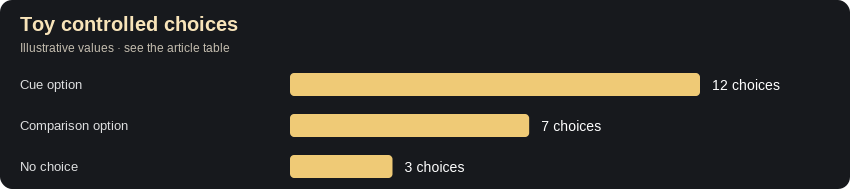
Illustrative values, not sourced observations. Invented example for the stated comparison; not a biological threshold, ecological estimate or observed dataset.
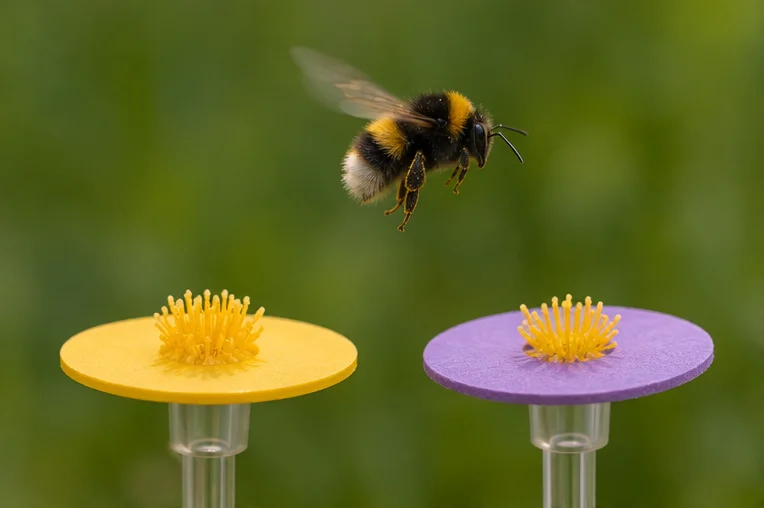
A bumblebee approaches one of two nearly identical disks and settles on it. To a human watching the apparatus, the choice may look mysterious: the two disks appear to offer no obvious difference. To the researchers, that is an opportunity to ask what information the bee can use. If the alternatives differ in a controlled electrical feature, and other explanations have been addressed, a series of choices can support a result about detection or learning. It is not a microphone recording of a flower talking. It also does not show that the same feature decides which flowers the bee visits outdoors.
The distinction makes the experiment more interesting. The apparatus can separate a feature from the floral crowd around it, give different bees comparable opportunities, and distinguish a trained response from an untrained one. A field observation can ask which of several actions changes around a living flower. Evidence at either level can be good without proving that the feature evolved to communicate, that a plant intends anything, or that a particular garden visitor relied on it. An accurate caption should tell the reader which of those questions the study actually put within reach.
Start with the physical difference, not the metaphor
An electric field is not a spoken message, a sound wave, or a visible beam. A study can measure something about electrical conditions near a flower or alter a condition in a test apparatus. A separate question is whether an insect detects the difference. A third is whether that difference changes the insect's action. In a popular account those steps can collapse into a single sentence about a flower sending a signal. In a study, the steps call for different evidence. Neither an electrical reading nor a bee's isolated landing proves the whole chain.
Clarke and colleagues' original study on detection and learning of floral electric fields considered several pieces of the chain. The paper and the authors' institutional publication record describe experiments in which bumblebees discriminated electrical features under defined conditions, and examined learning with electrical and visual information. The results are bounded by the tested species, apparatus, training and stimuli. They support an ability to use the information, not a claim that every bumblebee landing in a natural meadow reveals a choice based on electricity.
One appealing detail in the original work is its treatment of features that come together. The published article compared a color discrimination task with a condition that also offered patterned electrical information. The combined condition improved the measured learning outcome for that task. This is not a demonstration that an electric feature dominates color in all choices. It is evidence that additional information can change performance under this particular pairing. The result makes more sense if described as help with a tested discrimination than if reduced to a contest between two senses.
The physical feature may also change with circumstances. A field associated with a flower is not an immutable badge like a printed label. The original research reports changes in electrical conditions associated with visits in its test setting. To attribute a natural decision to some information left by a previous visit still requires evidence that the feature was present then, detectable under those conditions, and relevant to the later action. A plausible explanation offered by an experimental observation should be labeled as such. A drawing of one visit followed by another is not evidence that the second bee read the first visit's trace.
A later primary experiment on bumblebee mechanosensory hairs investigated possible sensory mechanisms. It reported movement of antennae and body hairs under experimental fields and a corresponding neural response from hair deflection in its test. Neural and mechanical evidence bears on how the animal could detect a stimulus. It still does not count choices outdoors or clarify what happened in a specific flower visit. Neither does mechanical deflection turn the result into one about hearing flowers. Keep a mechanism study attached to its experimental outcome instead of letting it fill every gap between flower and bee.
Define what counts as a choice before looking at the winners
A bee approaching a disk, landing on it, probing it, and later returning are not interchangeable events. An observer might code first landing within a defined window as the outcome. Another study might measure the duration of investigation or count how many trials are needed to meet a learning criterion. Both are valid choices when the design supports them. A demonstration of earlier orientation cannot be restated as a change in consumption unless consumption was measured. Conversely, the absence of a landing difference does not prove no change in earlier approaches occurred.
Specify the alternatives by what the study actually presented. “Cue option” can mean the item with a particular applied feature in an imagined contrast. It should not mean “the only flower with any sensory information” if both options had shape, odor or position. “Comparison option” identifies the paired alternative, not necessarily an empty sensory world. A controlled comparison requires assessing other distinctions that could account for the choice. Calling one target the control does not establish that everything other than the feature of interest was held equivalent.
The observer needs a rule for ambiguous or incomplete responses. A bee that approached both items but landed on neither during the observation period could be “no choice” under a first-landing rule. An event lost when the camera failed is not the same thing. Record technical failure separately. If a bee lands outside the defined alternatives, the protocol must say whether that qualifies as a no choice, an excluded trial, or another outcome. The rule matters because removing these events changes the denominator and can leave a deceptively simple pair of bars.
Toy controlled choices
The chart and table use the same invented values. The unit is choices, including an explicitly recorded “No choice” outcome per presented opportunity. The counts are illustrative, not drawn from either cited study and not an ecological estimate, a sensory threshold, or a biological benchmark. Imagine that the outcome rule was first qualifying landing within a stated test period. The 22 entries describe the outcomes under that rule.
| Outcome | Choices |
|---|---|
| Cue option | 12 |
| Comparison option | 7 |
| No choice | 3 |
Twelve of 22 opportunities ended with a qualifying landing on the cue option, about 54.5 percent. Restricting the denominator to the 19 opportunities with a choice gives 12 of 19, about 63.2 percent. Both summarize the same records and answer different questions. The first combines willingness to make a classifiable choice with where the choice went. The second describes where qualifying choices went among those that occurred. If an animal is more likely to withhold a response under some circumstances, conditioning on having made a choice is not automatically innocuous. It defines a narrower group.
The table does not identify 22 individual bees. An experiment might contain repeated trials on the same animal or animals from a few shared colonies. If so, the observations can share learning history or other conditions, and simple independent-trial arithmetic will not support every inference. The count also tells us nothing about ordering. Twelve cue choices could cluster late in training, be spread evenly, or come from one particularly active bee. Always retain subject and trial identifiers in the underlying record when the design involves repeated choices.
Even if a real tally matched those counts, it would not show discrimination without a defensible comparison. A cue placed almost always near the starting point might receive more landings for a reason unrelated to the cue. The apparatus could have a light gradient or a residual odor. A group of visits could be accidentally counted more than once. The probability of either option under a comparison depends on the design and the question being tested; an appealing percentage alone is not a baseline. In a report of this example, say which option was chosen more often in the toy records and stop there.
Discrimination, learning and preference are separate claims
Discrimination means an observable response differs between alternatives under conditions that support attributing the difference to the feature being tested. It need not imply that the favored alternative always attracts an untrained animal. In a learning task, the experimenter may deliberately associate a feature with a reward. A bee making choices after such a history provides evidence about how the history and feature affected its performance. If no similar result was measured without training, leave that question unanswered. This does not undermine the learned result; it describes its scope.
An untrained comparison would answer a narrower kind of preference question only under a defined context. The subjects could have previous experience outside the experiment, and one setup cannot represent every natural alternative. Use “before experimental training” rather than “innate” unless the design supports the latter. Similarly, do not call a difference in final performance faster learning if the data did not track progress over time. A final choice and a change across a defined sequence are different outcomes. Claims about memory after a delay also require a measurement at a suitable delay, not an inference from choosing correctly immediately after training.
A useful demonstration can separate stages. Imagine observing a baseline at the beginning, then providing training under a defined rule, then testing performance under comparable conditions. The baseline can reveal side preferences or different rates of choosing. Training trials can show how performance changes in that part of the setup. A test can ask whether discrimination continues when a reward is not available to be detected directly. Different studies use different procedures. This outline is a tool for reading the logic of a published paper, not a recipe for capturing wild insects, powering equipment in gardens, or altering flowers.
A changed response after a feature is removed can support stimulus use if the comparison controls other changes that removal might introduce. No change could reflect indifference, an insufficiently detectable alteration, a noisy measure, or reliance on another cue. Avoid reading every null result as proof the feature has no role. A carefully designed study can define what size and kind of effect it could assess. A set of small uncontrolled observations cannot answer an open-ended question such as whether bees ever use electrical information under any circumstances.
Check the ordinary alternatives before naming an unusual sense
The independence of the cue from the option's location is particularly important. A subject could simply approach the right side more often, learn the route to a familiar place, or orient to a direction relative to room light. Showing the same cue on different sides or otherwise accounting for positions lets the study distinguish use of the cue from use of the spot. Report what was held fixed and what was varied. A diagram placing two different disks side by side is not evidence that the experimental conditions differed only as intended.
Reward history can be an alternative too. A bee may remain interested in an item because of direct cues to reward or trace odors rather than because it discriminated the studied feature. Read how the paper established its contrasts, how options were compared, and what happened when information was removed or combined. Do not assume the feature was unobservable in other ways solely because humans could not see it. It is useful to ask what a bee might exploit under the exact setup, not just what a human spectator could detect from a photograph.
Another ambiguity arises when one cue strengthens another. A comparison of visual information alone with visual and electrical information together can show a difference between treatments. It does not determine what an electrical cue alone would achieve unless that condition was also tested. Conversely, a null result with an electrical cue alone would not preclude an effect when another feature makes the alternatives easier to learn. Use the treatment names that describe the entire presentation. A claim that “the bee used only electricity” is particularly strong and usually requires more evidence than a comparison with an extra cue.
If researchers describe information about rewards, identify where that relation came from. In a training experiment the relation may be created by the investigator. In a natural setting a feature may covary with reward because of flower age, previous visits or other processes. Those different origins matter to a claim about what the feature means. Even when a feature is informative on average, a bee may ignore it in individual cases or integrate it with other evidence. A match between cue level and reward in one sample does not identify which animals used it or how they weighed it.
A field study can split outcomes that a headline tends to merge
Koski and Ashman's original field experiments on ultraviolet floral patterns asked how pattern and reflectance affected visitors to a particular plant. They distinguished attracting visitors from how visitors oriented or foraged once there. In their tested system, patterned flowers increased attraction relative to uniform ultraviolet treatments, but the relevant pattern contrasts did not show that visitors were more likely to orient to the center during a visit. This makes the paper particularly useful for learning to read a claim about a “guide.” A feature can help a flower stand out without supplying evidence that it guides every later movement.
The ultraviolet example is not confirmation of an electrical effect. It illustrates the value of dividing a broad story into observable steps, and it comes with its own species, visitor groups and conditions. Approaches, landings and orientation are different endpoints. No source here turns them into fertilization or seed production automatically. In a story about a flower advertisement, ask whether the research measured appearance from a distance, a close-range behavior, or a reproductive consequence. Use the exact measured action where possible rather than a familiar metaphor that covers all three.
Watch the word confirmed in an account of field research. A field treatment effect can be a strong result for the setting tested, yet still not identify what happens in another plant, region or season. The Koski and Ashman work is about ultraviolet properties, not a general test of every mode of attraction. A nearby bee appearing to travel straight toward a bright blossom is a natural observation, not an uncontrolled replication of the field experiment. For a transfer claim, first ask whether the taxa, alternatives, environmental conditions and outcome were comparable to those in the study cited.
The same caution holds in reverse. A field observation can discover a striking choice pattern even when an apparatus has not isolated the sense involved. The result may warrant a controlled study. It does not become less real because its cause remains unknown. A useful report gives the field event its own name and unit: a series of approaches or landings on a defined set of flowers. Then it says that the relevant electrical feature, reward availability or attention to other cues was not measured. A hypothesis is more valuable when readers can see where it starts.
Distinguish present information from an evolved signal
In this context, cue is a good working word for a feature an animal can use as information. The feature need not have evolved because of its effect on the receiver. A claim about the evolution of a signal is stronger: it asks how the feature came to have its role and why it is maintained. Authors may use signal and cue with particular formal meanings. Read the definition in the relevant paper rather than force ordinary language onto it. Saying a bee used a feature is not proof the plant produced it specifically to manipulate or inform the bee.
Intention is not necessary for an evolutionary signal either. A physical or visual feature could have an evolved communicative function without a plant deciding to send a message. “Talking” is appealing because both a source and a receiver are involved. It is misleading when it suggests words, conscious aims or an acoustic channel. More useful wording gives the feature and response names: a patterned electrical treatment altered performance in a learning task, or a pattern in ultraviolet reflectance changed how often an animal approached in a field experiment. Those sentences retain the surprising biology without adding an unmeasured mechanism or purpose.
A stronger evolutionary claim would need evidence about trait differences, receiver responses and fitness or selection relevant to the proposed function, along with serious consideration of alternative explanations. A laboratory discrimination result can motivate such work but is not itself a demonstration of historical selection. A feature may covary with other properties that matter independently to the plant. A repeated behavior may affect visitation without changing successful reproduction. The task is to make the next claim testable, not to award a story of adaptation whenever a bee consistently chooses the item a researcher labeled rewarding.
It is possible to be careful without using dull language. The striking result is that an animal can exploit information unavailable to a human watching the scene unaided. It is even more striking that the effect can be separated from visual patterns and examined together with them. One does not have to call it speech to make it memorable. Write first that the choices were observed. Then tell how the experiment makes use of the tested feature plausible or demonstrable under particular conditions. Leave the issue of why the feature exists as a separate hypothesis if nobody measured it.
Keep trial design visible in the denominator
A first landing can be easy to read and a hard outcome to compare if the opportunity structure differs. A bee given no adequate viewing time is not equivalent to a bee that spent the full allotted time and made no choice. A recording ending early is a missing observation under most ordinary definitions. A bee that stayed stationary throughout a complete trial may be a true no-choice record. Keep those states separate even if both contribute no landing. Otherwise the rate among observed choices answers an unclear mixture of behavior and technical availability.
The fraction in the toy example would change if the study excluded the no-choice trials, and the strength of the inference would still depend on the unit sampled. When several bees contribute unequal numbers of opportunities, a pooled count can be dominated by heavily trained individuals. An equal-bee summary would answer a different question and may need eligibility rules for animals with few usable trials. Colony membership can add another grouping level. Retain the original identifiers and describe whether the statistic concerns a randomly selected trial, a typical tested subject, or a group performance criterion. An isolated table of counts does not say which one it was designed to estimate.
Sequence can matter even with a balanced total. Separate baseline, training and test phases. If an animal loses interest over time, later trials may more often be no choice; excluding them could make apparent performance improve. If the feature is paired with a reward for the first half of the observations and with a different outcome later, summing over the phases hides the premise of the task. Keep the rule in force for each opportunity. A report can show a trajectory if learning is the question, then report the number of animals and trials contributing to each portion. The figure's density is not a substitute for subject-level replication.
Check how the observer could know which option was chosen. If scoring involves judging contact on a video, record whether labels or equipment made the treatment obvious to the scorer. A protocol that can be scored without knowing the intended outcome reduces opportunities to infer a choice from a near miss. Where that is not possible, define examples of boundary cases and document independent review where appropriate. A measurement error in the choice rule can masquerade as discrimination if one option is easier to see or define. The behavioral endpoint deserves as much attention as the unusual stimulus.
Treat the combination of cues as a real result in its own right
Multiple cues are not merely contaminants of an ideal single-feature study. They can carry complementary information in an animal's ordinary environment. A study may test whether two cues together improve performance compared with either one alone, or whether one helps when another becomes unreliable. These are different claims even if all involve the same two features. A report should name which comparison was available and whether the result concerned accuracy, learning speed, or another outcome. A faster average path to a criterion is not the same statement as improved accuracy at a single fixed trial.
Consider an imagined case where the electrical and visual treatments point to opposite options. An animal's choice might help reveal which feature prevails under that conflict. It would not necessarily reveal which it uses when the features reinforce each other or when one is much less detectable. A difference in task performance can arise from redundant guidance, different learned associations, or other factors appropriate to the study. Do not label a combination as a hierarchy of senses without measuring the relevant contrasts. A summary can celebrate an observed improvement while leaving its broader explanation open.
The design also has to speak to the contrast between adding a cue and changing the apparatus. Adding something can inadvertently add a physical feature or a regular sequence in presentation. Read whether the study compared conditions with otherwise similar equipment and how it ruled out alternate indicators. It is not a criticism of an experiment to be specific about its controls. Those controls are what allow the interesting result to be attributed to the tested feature rather than to an accidental difference between options. When the source has not established a detail, do not embellish its protocol in the retelling.
A visible or audible change to a human observer is neither necessary nor sufficient for a bee's experience. Describing a pair as visually alike can be useful only if likeness was evaluated for the relevant question rather than by a casual human glance. The ultraviolet study is a reminder that surfaces identical-looking to humans can differ in parts of the spectrum sampled by some insects. The fact that another sensory channel is possible does not establish its use in a particular trial. A well-identified effect requires a comparison suited to the relevant sensory alternatives.
Read “in the wild” as a design description, not a result by itself
A field experiment and a field observation both happen outdoors, but they are not interchangeable. A field experiment varies or assigns conditions under a defined design and records outcomes; a simple watch can document behavior without controlling its cause. Koski and Ashman's work manipulated ultraviolet pattern and examined multiple visitor responses in a particular system. A garden observer watching ordinary flowers can describe approaches or contacts without claiming comparable manipulations. The setting matters, but it does not remove the need to ask how the evidence was produced.
The natural alternatives also may differ moment to moment. One plant may have more open blooms, be in a wind-sheltered corner, or already be occupied by another insect. A bee approaching one and leaving the other untouched could be responding to several differences or encounter histories. A watch can record the alternatives in view and the sequence of visible behavior. It should not assign a response to an unseen electrical feature that was never measured. A more complex environment does not make the ability shown in the apparatus go away; it makes the contribution of each candidate feature harder to isolate.
An ecological outcome can be narrow and still worth publishing. For example, a series might show that visits clustered around a particular place in the patch during certain part-day watches. It may inform where to sample next or suggest a comparison between open flowers. It does not prove information transmission, reward uptake or pollen deposition. If the endpoint is orientation to a location, say whether the animal approached, landed or moved within the flower. That small vocabulary prevents both observational and experimental work from inheriting goals chosen later.
Keep the observation nonintrusive and use ordinary permitted vantage points. Do not collect bees, change natural flowers or add experimental electrical equipment to public or shared spaces to recreate these papers. A behavior notebook is adequate for recording visible events, including uncertainty. If the question moves to experimental sensory manipulation, that is different work with appropriate expertise, facilities and procedures. The useful household conclusion is not to try to make a flower converse. It is to notice how much can be gained by describing the context and stopping at the level the evidence supports.
Build a source check around the claim you intend to repeat
First find which paper supplies the result. The electrical research, the sensory mechanism research and the ultraviolet field work are separate sources with different response variables. A single passage might use all three to illustrate an evidence hierarchy, but it should not treat one paper's details as proof of the other's inference. Place a source beside the specific statement it supports. When explaining results in a short note, keep the tested group and outcome attached: bumblebees in a defined discrimination task, for example, rather than “pollinators in general.”
Next look for the comparison that gives the result meaning. If a chart shows two choices, inspect the eligibility rules, the number of subjects and trials, the handling of no-choice records, and whether performance was pooled across phases. If the result concerns improvement with a feature added, identify the features both conditions shared. If it concerns orientation after arrival, make sure the source did not only report visits. The comparison need not be restated in all its procedural detail, but its boundaries should be apparent. Readers cannot judge whether an effect is relevant to another question if the original contrast is invisible.
Finally distinguish measured findings from the authors' proposed interpretations and from your own analogy. A study may argue that electrical information could matter in natural ecology, but a controlled test may establish a narrower ability. A field paper may discuss possible evolutionary functions beyond its immediate outcomes. Those implications are appropriate to share as possibilities, provided they are not promoted to measurements. Use terms such as may, suggests, or not tested when they refer to a concrete limit, not as generic caution sprinkled over a headline that still overclaims.
Ask what a repeat would have to preserve
A useful repackaging of the story is to imagine a repeat that could challenge the conclusion. If the claim concerns discrimination after training, a repeat would preserve the intended cue contrast and training relationship, describe subjects and choices, and deliberately watch for consistent alternative explanations. If the claim concerns generalization, a repeat would change one well-defined feature of the setting while preserving enough of the original comparison to make the results interpretable. Repeating a colorful screenshot of similar-looking disks will not test either claim. Repeating the logic of the comparison is more important than duplicating every stylistic feature.
Consider a report that combines several flower visitor groups. A combined attraction effect can reflect the group with the most observations, while another group might respond differently or be too seldom observed to evaluate. Identify which groups contributed to the outcome rather than generalize across visitors by default. The ultrasonic, ultraviolet and electrical words that sometimes appear together in a popular feature do not define one class of evidence. Each sensory hypothesis needs its own tested stimulus and behavioral outcome. If two studies used different visitor groups, say so explicitly. Similar reactions can motivate a comparison without proving a shared mechanism.
The same principle applies to outcomes that disappear when observation is more stringent. A brief approach may be easy to detect for a large bee but hard to separate from a pass-by for a smaller visitor. If a study can reliably count landings but not distant approaches across groups, use the landing comparison and say why the approach data are less complete. If the missing events are mainly in one treatment or phase, their absence could influence the conclusion. A robust result identifies the evidence opportunity for each class, rather than use unfamiliar sensory biology to distract from the ordinary challenges of counting behavior.
A short educational activity can use fictional trial descriptions rather than live manipulation. Give readers a set of records with the same cue-choice total but different subject histories. In one, a previously trained individual contributes almost all choices. In another, several individuals contribute one each. In a third, all no-choice outcomes occur late in the test after a treatment change. Ask which observations support a claim about one subject, those tested, or learning over time. The exercise keeps the central issue visible: an aggregate count presents outcomes, not the design that produced them. A striking cue effect becomes more intelligible when the reader can see what a replicate means.
Keep a clear line between measuring sensitivity and measuring importance
A feature detectable in a carefully arranged test can be one of many weak or strong contributors outside it. Ecological importance depends on opportunities, variation, alternatives and consequences under the conditions of interest. A study that demonstrates sensitivity to an applied contrast does not, by itself, show how often natural contrasts reach comparable values or whether other cues reduce their influence. Conversely, the absence of a field estimate does not argue against sensitivity. Do not demand that each experiment settle the whole ecological question before valuing its contribution.
A careful follow-up might first ask whether a relevant field feature varies in an informative way, rather than start by claiming that it drives preference. Then a behavioral study could ask whether a measured contrast changes an explicitly defined response under appropriate comparisons. A later analysis could examine whether that response matters to a plant outcome. These are research questions, not tasks for a reader to stage with garden wildlife. Listing the successive questions makes the original achievement clearer: an initially surprising sensory possibility became a testable result under named conditions, with meaningful scope still to explore.
Say what the flower experiment did show
The fictional table can be summarized without dressing it up: 12 qualifying choices were assigned to the cue option, seven to the comparison, and three opportunities ended without a choice. Beyond that, a real report would need to name the cue, tested conditions, subjects, choice rule and study design. It would need an evidence based reason for claiming discrimination or learning. It would need still other data to show an untrained field preference or a plant reproductive consequence. The point of the table is not to decide among those possibilities. It is to make the evidence from which such decisions start explicit.
Check the image caption as well as the text. Experimental disks can illustrate alternatives without showing the field itself. If a diagram depicts invisible fields with lines or color, label it as a representation, not a photograph of a bee's perception. The graphic should explain the tested difference rather than suggest direct access to the animal's experience.
A defensible conclusion about the real work is similarly specific. Bumblebees used tested electrical differences in particular controlled tasks, and later work investigated a plausible sensory mechanism. In the separate ultraviolet field study, attracting a visitor and directing its subsequent movement were not the same outcome. Neither study records flowers speaking or supplies the reason an unrelated bee landed. There is no loss of wonder in saying that plainly. An animal can make choices using information a human cannot see, and a well-designed study can test part of that process without claiming to have decoded the whole conversation.